

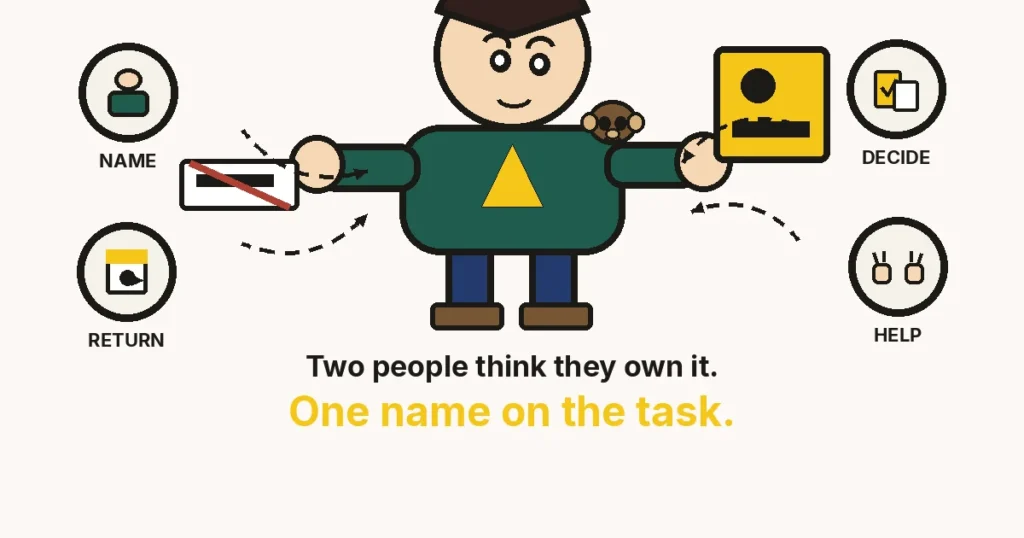
Two people think they own the same task when the next move sits on both backs. Name one owner, the decision they can make, and the checkup they bring back. Blanchard states Oncken’s rule as one monkey on one back, and the talk does not end until that next move is named.
Key takeaways
- Two people think they own the same task when the next move has a leg on both backs, or when you promise to get back to them and they still hover.
- Ken Blanchard, on 20 September 2010, writing about the 1989 book he wrote with William Oncken, Jr., and Hal Burrows, defines a monkey as the next move after two people meet.
- In that 2010 post he states Oncken’s assign rule: all monkeys shall be owned and handled at the lowest organizational level possible.
- The same post states the decision they can make as one of two policies, recommend then act, or act then advise, and it states a checkup appointment for what they bring back.
- This week’s line names one owner, one of those two decisions, and one checkup. A second name on the next move is the split you already have.
What it means when two people think they own the same task
Two people think they own the same task when either of them can still change the work, and neither can say who has the next move. You are a new manager, so two people on the team both answer the client, both edit the deck, or both wait for the other to send it. You are a solo founder with one other person, a cofounder, a contractor, or a first hire, and the same file has both of your names on it. The work is not stuck because nobody cares. It is stuck because the next move has two owners. Care from two people is not the same as one name.
The cut for this week is one sentence, not a new org chart. One name owns the next move. That person can make one kind of decision, and only that kind. They bring one thing back, at a time you name. The other person can help. The other person does not own the next move. If you cannot say the name, you have not made the cut. You have renamed the share.
Why both names land on one task
Both names land on the task in the middle of the conversation, before anyone assigns the next move. Ken Blanchard, on 20 September 2010, defines the thing that moves. A monkey, he writes, is the next move after two individuals meet. His scene is a hallway. The staff member says they have a problem. You listen. You know you will have to be involved, and you do not know enough to decide. You say, “This is very important, but I don’t have time to discuss it now. Let me think about it and I’ll get back to you.”
He splits that minute into three owners, and only one of them is a single name. Before the talk, the monkey was on the staff member’s back. While you were talking, the matter was under joint consideration, so the monkey had one leg on each of your backs. When you promised to think about it and get back to them, the monkey moved squarely onto your back. You accepted the responsibility for the problem, and you promised a progress report. The staff member, he writes, will then stop in to ask how it is coming. The job was theirs. The next move is now yours, and they are supervising you on it.
That is the split a solo founder and a new manager both walk into. The joint minute feels polite. Both of you are “on it.” The promise to get back to them feels helpful. It is the moment the next move changes backs without a decision attached. Blanchard says managers who pick up other people’s monkeys broadcast that those people lack the skills to care for the work themselves, and that everyone is then left waiting for the boss to make the next move. The 1989 book’s introduction, which we read in the publisher sample, calls the same habit rescuing: doing things for people they can do for themselves. The sample’s opening of the story calls the overload self-inflicted. We did not turn that story into a measured result.
The owner line: name, decision, bring back
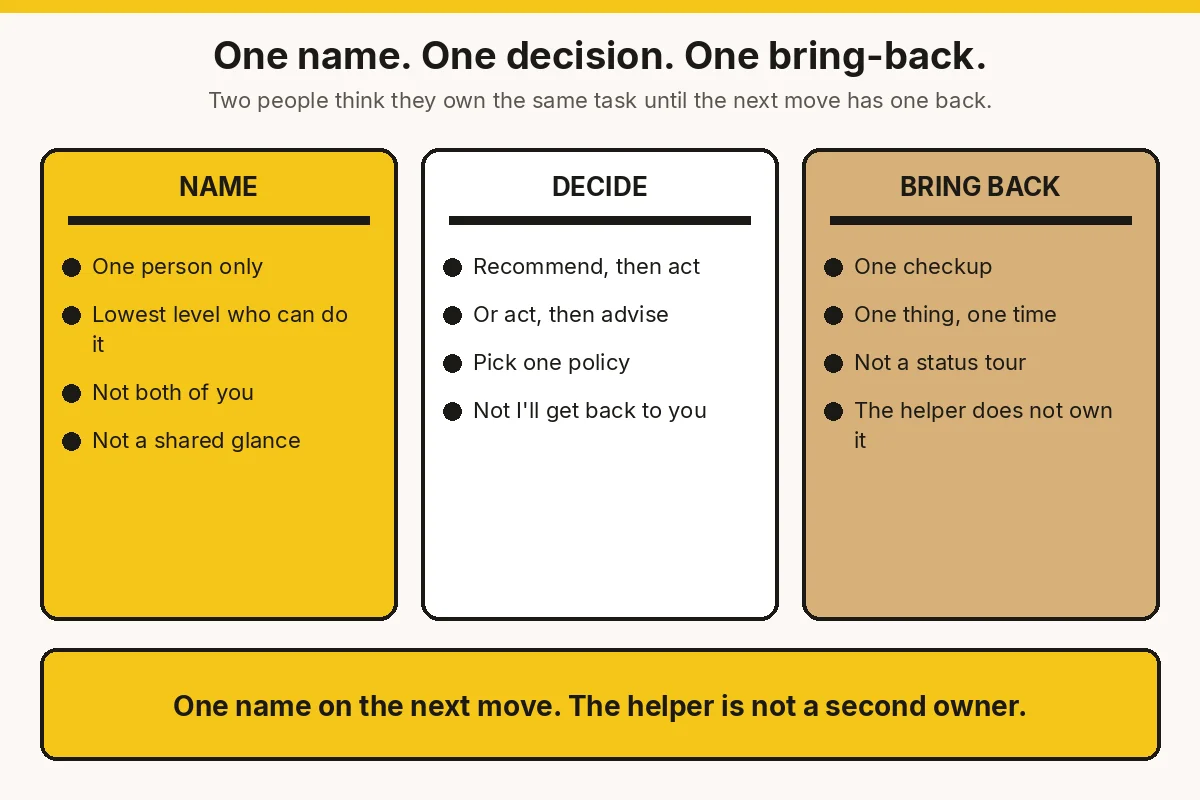
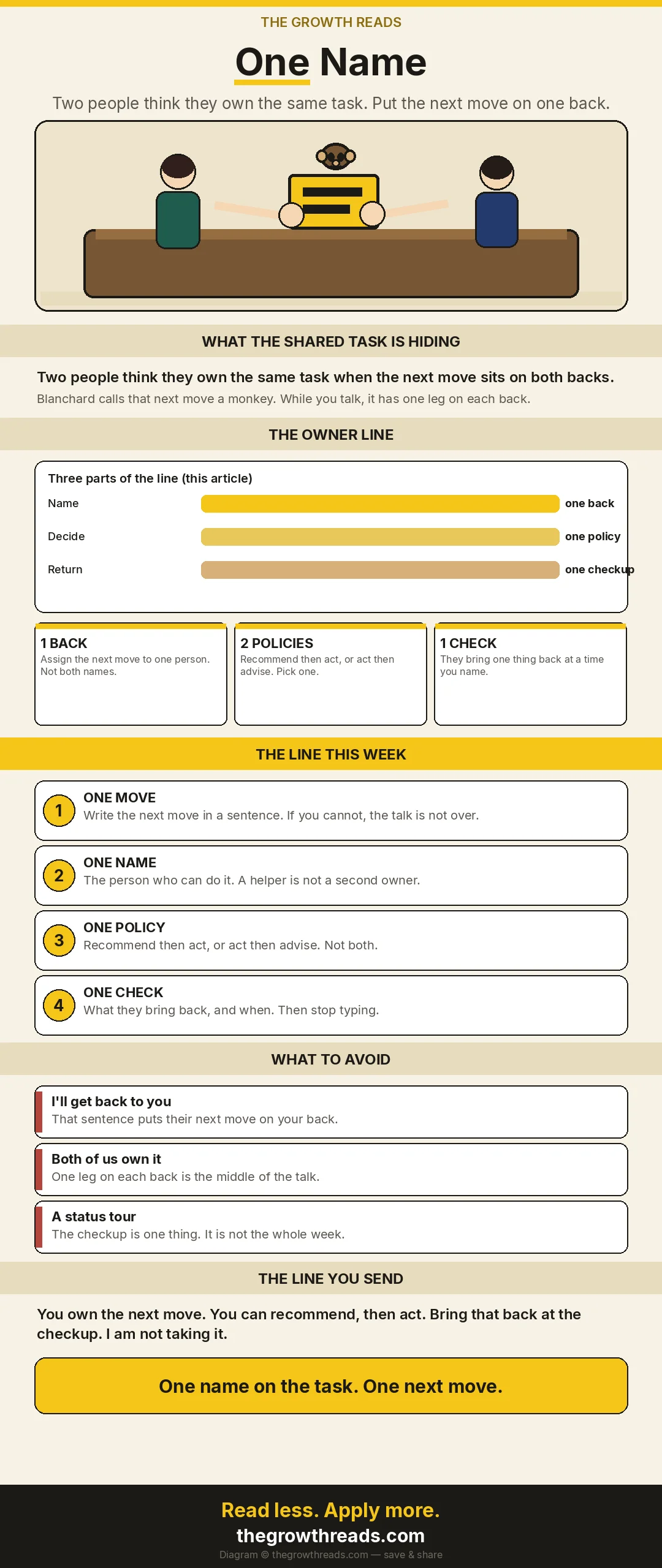
The owner line is one name, the decision that name can make, and the one thing they bring back. Blanchard’s 2010 post gives Oncken’s four rules for handing the monkey back without being accused of buck-passing or abdication. Describe the monkey: the dialogue must not end until the next moves are identified and clearly specified. Assign the monkey: all monkeys shall be owned and handled at the lowest organizational level possible. Insure the monkey: every monkey that leaves on someone else’s back is covered by one of two policies, recommend then act, or act then advise. Check on the monkey: every monkey should have a checkup appointment.
Those four rules are the owner line, in order. The name is the assign rule. The decision they can make is the insurance policy, and there are only two in the post. Recommend, then act: they bring you the recommendation, you say yes or no, then they do it. Act, then advise: they do it, then they tell you what they did. The thing they bring back is the checkup, not a tour of the whole job. A helper can be in the room for either policy. A helper is not a second name on the next move. If both policies feel too small and too large at once, you have not described the monkey yet. The first rule says the talk is not over.
| Where you are | The one name | The decision they can make | What they bring back |
|---|---|---|---|
| Two reports both touching the same task | The person closest to the work who can actually do the next move | Recommend, then act, if you still need a yes. Act, then advise, if they can proceed and tell you after. | The checkup you named: one note, at one time. Not a status of every other task. |
| You and one other person, and you were about to say you would get back to them | Them, if the next move is work they can do. You, only if the next move is a decision they cannot make. | The same two policies. “I’ll think about it” is not a policy. It is you taking the monkey. | Their recommendation, or their note of what they already did. You do not owe them a progress report on their job. |
| You are the only person in the work | You. There is no second back. | None of this. The hallway scene needs a second person. | Nothing to a colleague who is not there. A different cut applies, the one about your own hours. |
| Both of you will “keep an eye on it” | Nobody. That sentence is the joint minute, left in place. | Either of you, which means neither of you. | Whoever remembers. That is not a checkup. |
The contents page in the publisher sample lists the same four ideas as chapter headings: descriptions, owners, insurance policies, and feeding and checkups. We read the headings. We did not read those chapters, and this article does not invent what a page inside them says. The wording of the four rules above is the 2010 post. The sample’s introduction does add one limit we did use: rescuing is doing for someone what they can do themselves. Assigning the move to a person who cannot do it is not the lowest level. It is a dump. Oncken’s rule, as Blanchard states it, is the lowest level possible, and the insurance policies exist so the handoff is not abdication.
The sentence you send
Say the owner line once, in writing, with one name and one policy. The post and the sample do not print this note. The wording is this article’s. Leave the shape. Do not add a second task, and do not add “I’ll stay across it.”
When they can do the next move
[Name] owns the next move on [the task]. The next move is [one sentence]. You can [recommend, then act / act, then advise]. Bring back [the one thing] at [the checkup]. [Other name] can help. [Other name] does not own the next move. I am not taking this back to my desk.
When you were about to take it
I am not going to think about this and get back to you. The next move stays with [name]. Send me [the recommendation] by [time], or do it and tell me at [the checkup]. I will answer that one thing. I will not take the task.
Then stop typing. A second paragraph that says you will both keep an eye on it puts a leg back on each back. That is the joint minute, written down. The checkup is one thing at one time. It is not the 1:1 that turns into a tour of every project, which is a different meeting, the one in the 1:1 that becomes a status recital. If the next move is a call only you can make, this sentence is the wrong cut. That call is the one in the work that waits on you.
How to write the line this week
Do this before you tell anyone you will look at it later, including if the conversation already happened. Six moves. None of them is a new tool.
- Name the task both of you are touching. One task. If the list has five, you do not have a monkey yet. You have a pile, and the first rule says the next move has to be specific.
- Write the next move in one sentence. What happens next, not who cares. If you cannot write it, the talk is not over. Blanchard’s statement of the first rule is that the dialogue must not end until the next moves are specified.
- Put that move on one back. The person is the lowest level that can actually do it. If the only person who can do it is you, say so, and do not pretend the other name owns it. His statement of the second rule is one owner, at the lowest level possible.
- Pick one policy. Recommend, then act, or act, then advise. Do not leave both open. Two policies on one move is two names again. The third rule, as he states it, is one of those two coverings.
- Name the checkup. What they bring back, and when. One note. The fourth rule is a checkup appointment, not an open door.
- Send the sentence. Take your name off the next move unless step 3 said the move is yours. Do not add a second task in the same note.
If you are a new manager, both people may already be on the team. You are not hiring a third person to break the tie. You are picking the one who can do the next move. The first hire’s week one is a different problem, about what you give someone new. This line is about a task two people already think is theirs.
When there is no second person
If nobody else is in the work, you cannot assign a monkey to a back that is not there. The 2010 scene needs two people in the hall. The sample’s story is a manager and the people who bring him problems. A founder alone at the desk does not have a joint minute. Taking the task off your own week, and naming who would absorb it, is the other cut, in the week that still depends on your hours. Do not use this sentence to announce that a person you have not hired owns the work.
A cofounder, a contractor, or the one employee you do have is a second person. Use the line with them. Do not wait for a department. A meeting that exists only to tell both of you what you already know is a different test, in the meeting that should have been a note. Send the owner line instead of booking that meeting. If every item on the list is marked urgent, the priority cut is a different one, in a week where everything is marked urgent. Pick the one task both of you are touching before you sort the rest.
Common mistakes
- You say you will get back to them. Blanchard’s scene says that sentence moves the monkey onto your back and promises them a progress report. The job was theirs. You just took the next move.
- You leave it under joint consideration. One leg on each back is the middle of the talk, not the end of it. His first rule says the dialogue is not finished until the next move is specified.
- You name two people. “Both of you own it” is the problem, written as a decision. The assign rule is one owner.
- You skip the policy. A name with no decision right will either wait for you or change the work without cover. The post gives two policies. Pick one.
- The checkup is a status tour. They bring back the one thing you named. A recital of the week is a different meeting, in the 1:1 that is only status.
- You assign it below the level that can do it. The introduction we read calls that a failure of a different kind only when you do their work for them. Dumping a move they cannot make is abdication, which the post says the rules are meant to avoid.
- You are alone and you write the sentence anyway. There is no second back. Use the capacity cut in the company that still depends on your hours, not a note to an empty chair.
What the sources do and do not say
The 2010 post states the hallway, the three positions of the monkey, and the four rules. The publisher sample states the edition, the introduction, and the chapter headings. Neither source prints this article’s email. We read the post in full. We read the sample’s copyright page, introduction, contents, and the opening of “The Problem.” We did not read the rules chapters the contents point to.
| Source | What it is | What we took | What it does not show |
|---|---|---|---|
| Ken Blanchard, “The Art of Managing Monkeys,” howwelead.org, 20 September 2010. The page also shows 18 September 2010. Read in full on 14 November 2026. | Blanchard’s own account of the rules in the book he says he wrote with Oncken and Burrows. | A monkey is the next move after two people meet. The hallway. Joint consideration puts one leg on each back. “I’ll get back to you” puts the monkey on the manager and promises a progress report. The four rules: describe, assign at the lowest level possible, one of two insurance policies, and a checkup. The rules are for handing the monkey back without buck-passing or abdication. | A study. The reader comments under the post. Any page number. This article’s email. A claim that two permanent co-owners is the phrase he uses. He describes the joint minute and the leap onto the manager. |
| Publisher sample PDF, kenblanchardbooks.com, file dated in the path August 2017. Read 14 November 2026. Copyright page, introduction, contents, and pages 13–14, the opening of “The Problem.” | The opening of the 1989 Morrow first edition, as the publisher posted it. | Copyright 1989, Blanchard Family Partnership and The William Oncken Corporation. First edition. ISBN 0-688-06767-0. William Morrow and Company, New York. Blanchard’s introduction names the November 1974 Harvard Business Review article by Oncken and Donald Wass, titled there “Managing Management Time: Who’s Got the Monkey?” He calls the habit rescuing: doing for people what they can do themselves. The contents list Rule 1 Descriptions, Rule 2 Owners, Rule 3 Insurance Policies, and Rule 4 Feeding and Checkups. The story’s opening calls the overload self-inflicted. | The text of those four chapters. The HBR article itself, which we did not open. A page quote from the rules. The introduction’s line that the department’s performance drastically improved. That is the story. We did not use it as a result. |
| Ken Blanchard Books, “The One Minute Manager Meets the Monkey,” kenblanchardbooks.com. Read 14 November 2026. | The publisher’s page for the book. | Authors Kenneth Blanchard, William Oncken, Jr., and Hal Burrows. Publisher William Morrow. Publication date 1989. ISBN-13 978-0-688-06767-0. The page lists 144 pages. Oncken is described there as the person who originated the monkey-on-the-back analogy. | Agreement with the sample, whose contents run through page 137. We did not pick one page count and call it the real one. The marketing line about becoming hopeless bottlenecks. The reader quote on the page. Any rule the page does not actually state. |
Limit: the four rules you can use this week are the ones Blanchard wrote out in 2010. The book chapters those rules live in were not in front of us, so a page number would be a guess, and this article does not guess. The sample and the publisher page disagree on whether the book is 137 pages of contents or 144 pages on the product page. Use the edition they agree on: Morrow, 1989, first edition, ISBN 0-688-06767-0. The owner line will not tell you which of the two policies fits. You still have to look at whether they can do the next move before you send it. A solo founder with no second person cannot borrow a back from the hallway scene.
Frequently asked questions
What do you do when two people think they own the same task?
Two people think they own the same task when the next move sits on both backs and either person can still change the work. Name one owner, the person at the lowest level who can actually do the next move. Name which decision they can make: recommend, then act, or act, then advise. Name the one thing they bring back, and when. Ken Blanchard states those as Oncken’s rules in his 20 September 2010 post about the 1989 book. The other person can help. A second name on the next move is the split you already have. Send one note, and stop.
What is the monkey on a task?
A monkey is the next move after two people meet, which is Blanchard’s definition in the 20 September 2010 post. In his hallway scene the staff member brings a problem, and the next move starts on that person’s back. While you talk, he says, the matter is under joint consideration, one leg on each back. If you promise to think about it and get back to them, the next move jumps to you. The 1989 introduction we read calls picking up that work rescuing, when you do for someone what they can do themselves. Describe the next move in one sentence before you assign it.
Who should own the next move?
One person, at the lowest level that can actually do that move. Blanchard’s statement of the assign rule is that all monkeys shall be owned and handled at the lowest organizational level possible. Lowest possible is not the most junior name in the room. If they cannot do the move, the level is wrong, and handing it down is the abdication the post says the rules are meant to avoid. If you are the only one who can make the move, the name is yours, and you should say so. Two names, or “both of us,” leaves the leg on each back. That is the joint minute, not an owner.
What decision can the owner make?
One of two policies, and you pick before the talk ends. Blanchard’s 2010 post calls them insurance policies. Recommend, then act: they bring the recommendation, you answer, then they do it. Act, then advise: they do the move, then they tell you. He does not describe a third policy in that post. Leaving both open means they still do not know what they can change without you. “I’ll think about it” is not a policy. In his scene that sentence takes the next move onto your back and promises them a progress report on their job. Write the one policy into the note.
What should they bring back?
One checkup, which is the fourth rule as Blanchard states it: every monkey should have a checkup appointment. Name the thing and the time in the same sentence as the owner. A recommendation, if the policy is recommend then act. A short note of what they did, if the policy is act then advise. They do not bring back a tour of every other task, and you do not owe them a progress report on a move you refused to take. The appointment is the checkup the 2010 post names, plus the one thing you write in the note. We did not read that chapter.
What should you say instead of getting back to them?
Say that you are not taking the next move, who owns it, which of the two policies applies, and when they bring the one thing back. Blanchard’s scene shows the opposite sentence, “Let me think about it and I’ll get back to you,” moving the monkey onto the manager. Use one task and one name. The other person can help and does not own the move. Then stop. A second line that says you will stay close to it puts your name back on the move. If the move is a decision only you can make, say that your name is the owner, and say what they should bring you.
What if you are a solo founder with no team?
Do not write the owner line to an empty room. The hallway in the 2010 post has two people, and the sample’s story is a manager whose people bring him problems. With no second person, the next move is already on your back, and assigning it to a hire you do not have is a fiction. Take one recurring task off the week, or name the person you would need, using the capacity cut for a company that still runs on your hours. A cofounder, a contractor, or the one person you do have is enough for this line.
Is one owner the same as handing off the whole job?
No. The owner line is the next move on one task, one policy, and one checkup. It is not the whole role, and it is not every decision that person will ever face. Blanchard defines the monkey as the next move after two people meet, not as the job title. The assign rule puts that move on one back. The insurance policy says what they can decide this time. A later move can have a different policy. Handing someone their whole week with no next move and no checkup is how two people end up “owning” everything again. Describe one move. Assign it. Cover it. Check it once.
Sources
- Blanchard, K. (20 September 2010). “The Art of Managing Monkeys.” Conversations on Leadership, howwelead.org. The page also shows 18 September 2010. Read in full on 14 November 2026. Used for the definition of a monkey, the hallway, the joint-consideration image, the “I’ll get back to you” leap, and the four rules as he states them. Not a study. Reader comments were not used. Blanchard, The Art of Managing Monkeys.
- Blanchard, K., Oncken, W., Jr., and Burrows, H. (1989). The One Minute Manager Meets the Monkey (1st ed.). William Morrow and Company, New York. ISBN 0-688-06767-0. Read from the publisher sample PDF: copyright page, Blanchard’s introduction, the contents, and the opening of “The Problem” (pages 13–14 in that sample). Used for the edition, the November 1974 HBR title as the introduction states it, the rescuing line, and the chapter headings. The rules chapters were not read. The introduction’s “drastically improved” line was not used as a result. Publisher sample PDF.
- The Ken Blanchard Companies. “The One Minute Manager Meets the Monkey.” kenblanchardbooks.com. Read 14 November 2026. Used for the publisher’s listing: William Morrow, 1989, ISBN-13 978-0-688-06767-0, 144 pages, and the note that Oncken originated the monkey-on-the-back analogy. The sample contents run through page 137. Both figures are reported. The page’s marketing lines were not used as findings. Publisher book page.
Related reading on The Growth Reads
The decision next to this one
- You are the bottleneck — the move only you can make, which this line should not pretend to assign
- The 1:1 is a status recital — a checkup that turned into a tour of every task
- The company still depends on your hours — the cut when there is no second person
- The first hire’s week one — what you give a new person, not a task two people already share
- The meeting that should have been a note — send the owner line instead of booking the update
Where this sits
How this article was researched
The hallway, the definition of a monkey, and the four rules are Ken Blanchard’s post of 20 September 2010, read in full on 14 November 2026. He says those rules come from the book he wrote with William Oncken, Jr., and Hal Burrows. The edition is the 1989 Morrow first edition in the publisher sample we read: copyright page, introduction, contents, and the opening of “The Problem.” The publisher’s book page lists the same ISBN and lists 144 pages, while the sample contents run through page 137. We did not read the rules chapters, and we did not open the 1974 Harvard Business Review article the introduction names. The owner-line note is our application for a solo founder or a new manager.
Limit: a page number for the four rules would be a guess, so there is no page number. The two page counts are both reported and not reconciled. The line will not choose the policy for you. A founder with no second person cannot use the hallway.
How we work: every article on The Growth Reads is built from sources we can check, and it is date-stamped when those sources change. Read our methodology.