

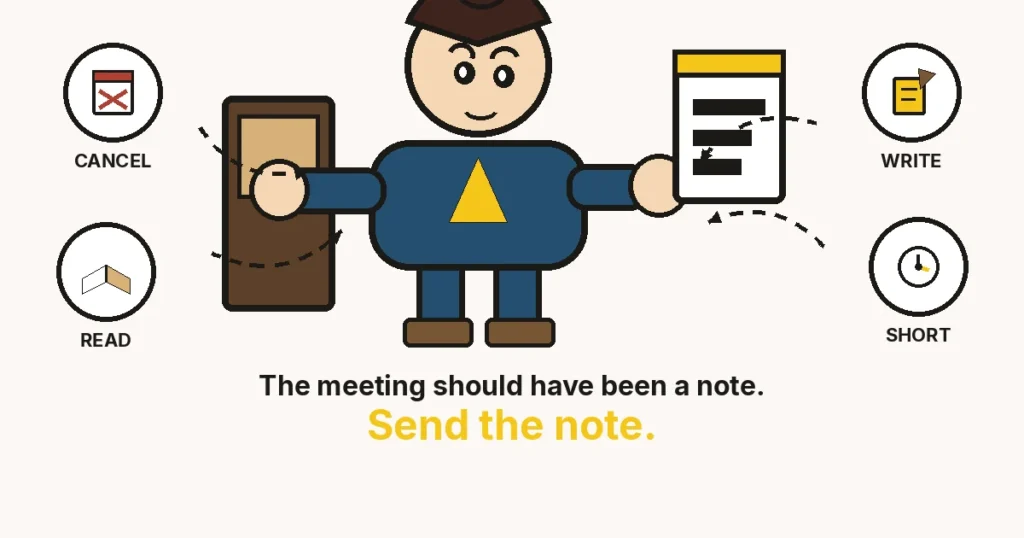
The meeting should have been a note when you called people together so they would hear an update. Cancel that meeting and write a clear memo, and ask them to read it. Keep a meeting only when a decision still needs the people who own it, and make that meeting shorter than the hour the calendar offers.
Key takeaways
- The meeting should have been a note when the room exists so people will hear an update they could have read.
- Al Pittampalli, in a 2011 interview about Read This Before Our Next Meeting, says to cancel informational meetings, write clear memos, and commit to reading them.
- Steven G. Rogelberg writes in the preface of The Surprising Science of Meetings (Oxford University Press, 2019) that meetings are essential, and that the target is bad meetings, wasted time, and unnecessary meetings.
- On the Bregman Leadership Podcast (22 July 2019), Rogelberg says he does not literally mean meet for 48 minutes, and that an hour on the calendar takes an hour.
- In MIT Sloan Management Review (21 May 2020), Rogelberg says to schedule 15, 20, or 25 minutes, to write the agenda as questions, and to end when those questions are answered.
What the meeting that should have been a note actually is
The meeting should have been a note when the room’s only job is to deliver information people could have read. You are a solo founder, so the invite is you, a contractor, and a client who wanted to “hear where things stand.” You are a new manager, so the invite is the team, and the hour is a tour of work that already happened. Nobody has a question that requires the group. The page was the work. The page was never sent.
Al Pittampalli names the loop in a 2011 interview about Read This Before Our Next Meeting (Domino Project, 2011). “We call a meeting instead of writing because we know our people don’t read. We don’t read, because we’re certain that if the information is that important, someone will probably call a meeting.” The result, in his words, is people “herded into a room just to be force fed information.” His cure is one sentence: “Everyone agrees to cancel all the informational meetings and instead write clear, cogent memos. And in turn everyone commits to reading the memos without fail.”
That interview is the Pittampalli text this article uses. Google Books lists the 2011 Domino Project edition at 66 pages, ISBN 9781936719167. We did not read a numbered page. The Google Books description says an office worker spends eleven hours a week in meetings, and that the Modern Meeting Standard has eight principles. That block is the publisher’s description. It is not a page we opened, and neither number is used here.
Steven G. Rogelberg’s The Surprising Science of Meetings (Oxford University Press, 2019) draws the other line, and we read it in the publisher preview. The preface says meetings “are not in and of themselves problematic” and “are essential” to coordination, communication, decision-making, and inclusion. “What we need to rid ourselves of are bad meetings, wasted time in meetings, and unnecessary meetings.” Chapter 1 defines a work meeting as “a gathering of two or more employees for a purpose related to the functioning of an organization or a group.” A memo is not that gathering. A decision the owners still have to make together still is.
Why the update keeps becoming a room
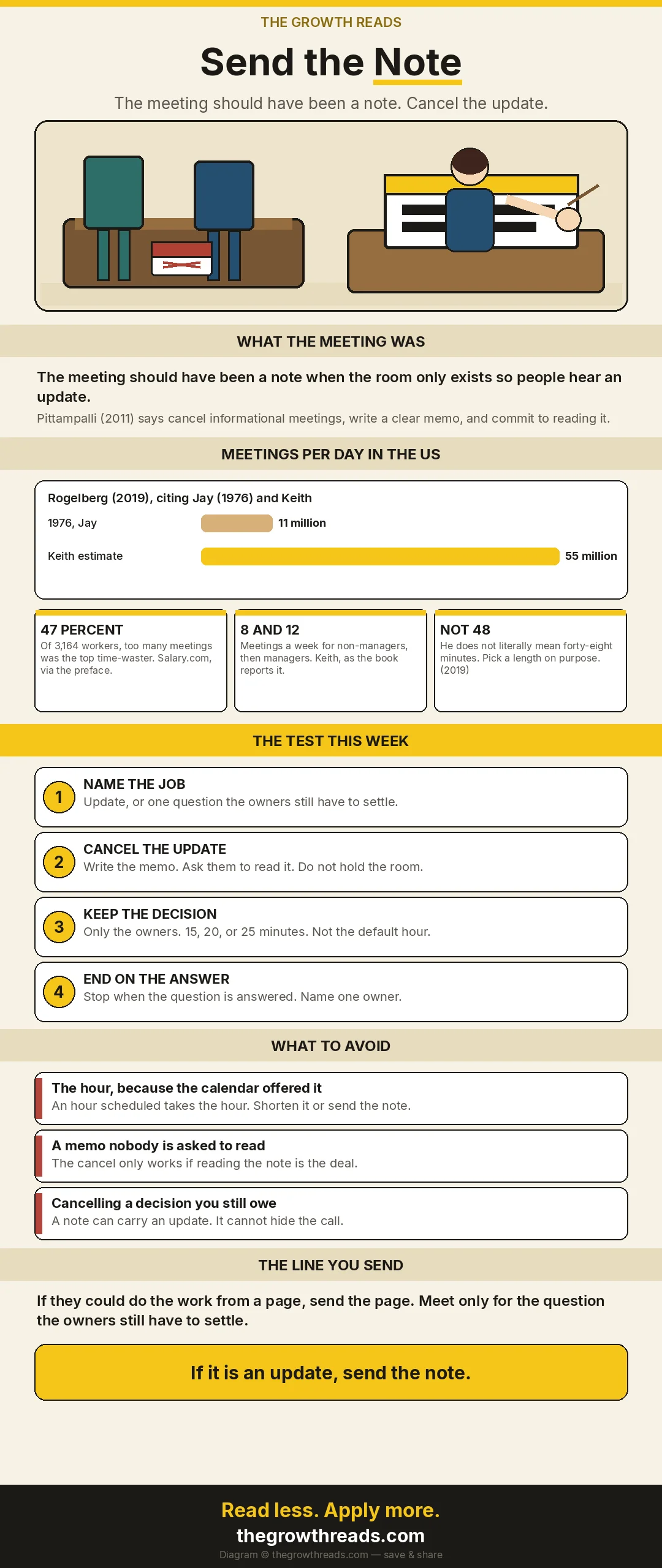
The update becomes a room because the calendar offers an hour, because people do not trust one another to read, and because saying no to an invite feels ruder than sitting through it. Pittampalli’s loop is the reading half. Rogelberg’s preface is the volume. He writes that a recent estimate puts fifty-five million meetings a day in the United States, and that the annual cost “is estimated” at $1.4 trillion, or 8.2 percent of 2014 US GDP. “Too many meetings” was the top time-waster at the office, cited by 47 percent of 3,164 workers in a Salary.com study he reports. He calls “over $250 billion a year” one reasonable estimate of the waste, and he says those figures leave out frustration and strain. The salary math is not shown on the pages we read. We did not re-read the Salary.com study. The numbers stay his report of them.
Chapter 1 attributes the fifty-five million to Elise Keith, who extrapolated from databases associated with Verizon, Microsoft, Fuze, and others. Rogelberg writes that her analysis, “consistent with my research,” has non-managers at eight meetings a week on average and managers at twelve. He also cites Antony Jay’s 1976 Harvard Business Review report of about eleven million meetings a day in the United States. We did not read Jay, and we did not read Keith’s own write-up. The jump from eleven million to fifty-five million is Rogelberg’s comparison, not a count we repeated.
The same chapter shows what a heavy day looks like when someone is asked for one. These are three people Rogelberg asked, not a survey of founders. A state-university chancellor’s typical day had seven meetings totaling four hours and forty-five minutes. The chief executive of a national advocacy nonprofit had eight meetings totaling six hours and thirty minutes. A senior human-resources leader at a global food company had six meetings totaling six hours and thirty minutes, and several of them existed to prepare for a later succession-planning meeting. A meeting whose job is to get ready for another meeting is the first candidate for a note.
He also names a plainer cause, in the opening of the section on why there are so many meetings: some leaders overuse the room because they will not make a decision, or because they want to appear active. That is the failure a note can hide if you are not careful. Cancelling the room is not the same as making the call. If the decision is still yours, write the decision in the note, or keep a short meeting and make it. Do not send a recap that ducks the choice. That is the same line as the decision you do not hand off.
A new manager at twelve meetings a week is the book’s average for managers, not a quota. A solo founder may have fewer rooms and still lose a morning to one client update that should have been a page. The Executive Time Use Project, as Rogelberg describes it, looked at 94 chief executives of top Italian firms and 357 corporate leaders in India and found 60 percent and 56 percent of working hours in meetings, not counting conference calls. We did not read that paper. It describes large-firm calendars. It is not your Tuesday. Your Tuesday is the invite in front of you.
The keep-or-cancel test
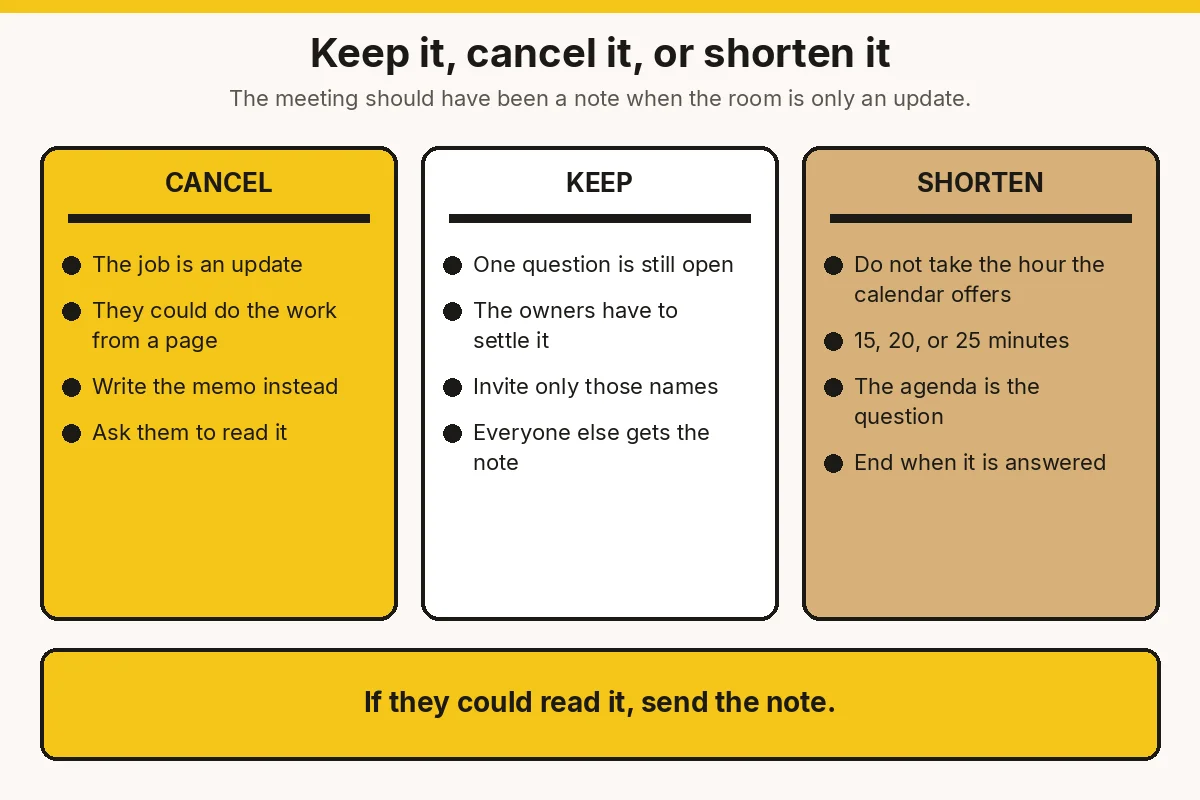
Ask one question: could a person who misses the room do their work from a page? If yes, cancel the meeting and send the note. If a decision is still open, keep a shorter meeting for the people who own it. The test is ours. It uses Pittampalli’s cancel rule for informational meetings, and Rogelberg’s line that unnecessary meetings are the ones to drop while necessary ones stay. It does not pretend either source printed this checklist.
| What the invite is for | What you do | What you do not do |
|---|---|---|
| An update, a status tour, a walkthrough of something already written. | Cancel it. Write the memo. Name who must read it, and by when. | Hold the room “so people hear it.” Pittampalli’s cure is the memo plus the promise to read. |
| One question the owners still have to settle together. | Keep the meeting. Invite only those owners. Put 15, 20, or 25 minutes on it. | Take sixty minutes because the calendar button offered it. Add spectators so nobody feels left out. |
| A meeting that exists to prepare another meeting. | Send the prep as the note. Meet only if the later decision is actually open. | Book a prep hour, then a decision hour, to say the same facts twice. |
| You were invited, and you are not an owner of the question. | Ask for the note, or for the answer after. Offer to read. | Attend so your absence is not read as disinterest. Rogelberg’s 2020 advice is to let nonessential people off the hook and give them the option to come later. |
Pittampalli says a meeting system has to address “delayed decision making, culture of compromise, and false urgency.” We did not read the chapters where he writes those up. The usable test from the interview is narrower. If the urgency is “everyone should hear this now,” and the hearing is the whole point, it is a note. If the urgency is a real clock — a client who is down, a payroll deadline, a legal date — do not cancel the room to protect a rule. Sort that clock the way you sort a week where everything is marked urgent. A hot feeling is not a deadline. A deadline is not a status recital.
Two meetings this test does not cancel. A 1:1 that still has to end on one decision and one owner is not an update, even when the first ten minutes want to become a status recital. Keep that half hour and run it as a 1:1 with one owner, not as a group note. A client who wants more than the price covers needs a scope answer, not a cancelled “quick sync.” That reply is the note that says what is in and what is a change. Do not hide either decision inside a meeting you were too polite to cancel, and do not hide them inside a cancellation either.
The note you send instead
Say what changed, what you need, and the time you need a reply. Then stop. These lines are our application. They are not quotations. Pittampalli’s own starter, for a meeting that still has to happen, is “Hey, can you read this before our next meeting, please?” Use that when the room survives the test. Use the templates below when the room does not.
When the meeting was an update
Subject: [the update] — no meeting. Read by [time].
What changed: [two sentences a person can act on without you]. What I need from you: [one action, or “nothing; this is the record”]. If this is wrong, reply by [time]. If I don’t hear from you, I’ll take this as the record.
When a decision is still open and you were about to book an hour
Subject: [the decision] — [15, 20, or 25] minutes, only if you own it.
The question: [one question]. What I would do if we do not meet: [the call]. Who must be there: [names]. Who gets this note instead: [names]. We end when the question is answered. [Name] owns the next step.
When you were invited and you are not needed in the room
I can do my part from the note. If the question is [the question], send me the answer after. I’ll read it. I don’t need the seat.
Then stop typing. A second paragraph that apologises for not meeting, or that re-opens every side topic, puts the hour back in writing. A joke about “this meeting could have been an email” is not the note. The note is the update. If you are a new manager, you send it. A report can draft the facts. They do not cancel your meeting, and they do not announce a decision you have not made. If the “update” is really a judgment of someone — “Alex isn’t on top of it” — that sentence does not belong in the memo. Name the behavior, as in feedback that turns into a personality comment, or leave it out.
How to run the test this week
Run the test on the next invite you were about to send, and on one invite already on the calendar. Eight lines. Then send four of them. Pittampalli’s practice suggestion, for someone who does not yet trust their own writing, is to go “an entire week (or at least a couple of days)” without calling a meeting, and to write instead. A solo founder can try the two days on internal updates. Do not spend them cancelling a client decision or a 1:1 that still has an owner.
- Write the job in one line. “Update on the launch,” or “Do we move the deadline to Thursday?” If the line needs a paragraph, you do not yet know whether it is a note.
- Ask who can work from a page. If the answer is everyone in the invite, it is a note. Cancel it.
- Write the memo before you defend the meeting. If the memo is the whole meeting, send the memo. Pittampalli’s deal is that you cancel the informational room and people read. One without the other restores the loop.
- Name the readers and the time. “Read by 3.” Silence after that is the record, and you said so. Do not book a follow-up to check whether they read.
- If one question is still open, list the owners. Everyone else gets the note. In the 21 May 2020 MIT Sloan article, Rogelberg tells leaders to let nonessential people off the hook, share what they missed, and give them the option to attend a later meeting on the topic. He writes that they usually will not take the option, and that they will be glad they were asked.
- Put 15, 20, or 25 minutes on the invite you still send. Those are the lengths in that MIT Sloan piece. Not sixty. The agenda is the question, not a list of topics. When the question is answered, end, and name the person responsible for the next action. That closing move is also his.
- If you cannot change the company’s meetings, change one. Pittampalli’s starting move, for someone who cannot set the policy, is to convince one person — a boss, a colleague, a manager — and to ask them to read before the next meeting. One note is the start. A company-wide ban is not required, and Rogelberg’s preface says a ban on meetings themselves would be the wrong ban.
- Look at the prep meeting. If this hour exists so the next hour can happen, send the prep as the note. Meet for the decision, once, shorter.
The contents of Rogelberg’s book list a “Guide to Taking Good Meeting Minutes and Notes” at page 163. We did not read page 163. The template above is not that guide. It is the note you send so the meeting does not happen, or the short agenda you send when it still must.
When you still meet, shorten it
If the test says keep the meeting, do not keep the hour. Choose a length on purpose, and end when the question is answered. The contents of the 2019 book place a chapter called “Meet for Forty-Eight Minutes” at page 41. We did not read page 41. On the Bregman Leadership Podcast of 22 July 2019, Rogelberg says he had a chapter saying to meet for 48 minutes, “but I don’t literally mean meet for 48 minutes.” The unedited transcript garbles the chapter title as “me for 48 minutes.” The next clause is clear: he wants the length chosen on purpose. “There’s nothing magical about 60 minutes.” “If you schedule a meeting for an hour, it magically takes an hour.” “If you schedule a meeting for 45 minutes, it’s going to take 45 minutes.” He also says the shorter block leaves an interval so people can change rooms and check a phone outside the meeting. He calls this Parkinson’s law, work expanding to fill the time allotted. He does not name a study for that sentence in the transcript. We use the scheduling advice as his advice. We do not attach an effect size to it.
The MIT Sloan article of 21 May 2020 is more specific about the numbers he will actually put on an invite. “Don’t hesitate to schedule just 15, 20, or 25 minutes for a meeting.” He writes that reducing the length “creates positive pressure,” and that “research shows” groups under some time pressure perform more optimally. The article does not cite that research on the page. We do not repeat it as a finding. We do use the three lengths, because he names them as what to schedule instead of the default hour. Frame the agenda as questions. “Once the questions have been answered, you know when to end the meeting.” End on time. He calls running over “a tremendous source of stress.”
In the same 2019 interview he says people do not hate meetings as such. “What they hate are bad meetings.” A world without meetings, he says, is more problematic, because cooperation, coordination, communication, and consensus still need a room. He also says what he generally finds is that around 50 percent of meeting time is not well spent. The MIT Sloan piece says his research suggests only around 50 percent of meeting time is effective. Neither page shows a sample. We do not treat 50 percent as a measured result. The practical split is the one in the test: the wasted half is often the update. Cut that half by sending it. Keep the half that is the decision.
He describes the better meeting leader as “a steward of others’ time.” You already act that way with a customer or with someone who can fire you. You stop acting that way with peers and with your own team. The note is that stewardship. So is a 20-minute invite with one question and four names instead of twelve.
When you were invited and you do not need to be there
You can decline an informational meeting without disappearing. Ask for the note, and say you will read it. Rogelberg’s 2020 article is written for the person who calls the meeting. Pittampalli’s interview is the move for everyone else. If you are not the one who can cancel it, you can still refuse to be the audience for a readout. “I can do my part from the note” is our sentence. His sentence, when a meeting remains, is to ask them to read before it.
A new manager gets invited up, and sideways, to prove they are across the work. Sitting there feels like the job. It is the job only when you own the question or you are needed to carry the decision out. If you are in the room so a director can see your face, you are the spectator Rogelberg tells the leader to release. You will not always be allowed to leave. When you are, leave, and read. When you are not, do not fill the hour with a second status report. One sentence on what changed is enough. The rest was a note.
A solo founder gets the same pressure from a client. “Can we hop on a quick call for an update?” is often the informational meeting with a nicer name. Send the update. Offer a short call only if they have a decision to make. If what they actually want is more than the price covers, do not spend the call discovering that out loud. Send the scope line. If the first hire is about to accept that call and give the update themselves, the call is still yours to cancel or keep. Week one is the easy week to let them become the meeting. The shape of that week is the first hire’s week one, and the client update is not homework you hand off so you can avoid writing.
Pittampalli is explicit that you may not be able to set the company rule. Convince one person. A founder with no staff is that person. The two-day stretch without an internal update meeting is the whole policy. A manager with a team can start with one recurring hour. Cancel it once, send the note, and see who actually needed the room. If the answer is nobody, do not put it back.
Common mistakes
- Cancelling the meeting and not writing the memo. Pittampalli’s cure is both. A blank cancellation puts the information back into the next meeting, because nobody read what was never sent.
- Writing a memo nobody is asked to read. The interview’s deal is a commitment “without fail.” “I’ll send notes” with no time and no reader is how the loop survives.
- Keeping sixty minutes because the button said sixty. Rogelberg, on 22 July 2019, says an hour scheduled takes an hour, and that there is nothing magical about sixty minutes. He does not literally mean forty-eight either.
- Inviting spectators so they feel included. The 2020 article says quality drops as the remote meeting gets larger, and that nonessential people can get the recording or, here, the note, plus the option to come next time. Inclusion is the option. It is not a chair.
- Using the note to avoid a decision. Rogelberg writes that some leaders meet because they will not decide. A vague recap does the same job without the room. If you would do it if you did not meet, say so in the note. If you cannot, keep the short meeting and decide.
- Cancelling the 1:1. A status recital inside a 1:1 is a problem. The fix is one decision and one owner, not a group memo that replaces the person. Run the half hour.
- Putting a verdict in the memo. “The team is behind” is a personality comment aimed at a group. Name what changed, and what you need. Leave the label out.
- Treating a publisher’s blurb as the book. Eleven hours a week, and eight principles, sit on the Google Books description of Pittampalli’s book. We did not read them on a page of the book. They are not the test.
What the sources do and do not say
Pittampalli gives the cancel-and-read deal, in an interview, not on a page we opened. Rogelberg gives the reason not to ban meetings, the volume, and the instruction to shorten what you keep. Neither of them is your email.
| Source | What it is | What we took | What it does not show |
|---|---|---|---|
| Al Pittampalli, interview with Mark Shead, productivity501.com, 2011. Pittampalli replied on the page on 10 August 2011. Read in full. The book is Read This Before Our Next Meeting, Domino Project, 2011, 66 pages, ISBN 9781936719167, as listed on Google Books. No book page was read. | The author’s account of the Modern Meeting Standard. Not a survey. | The reading-and-meeting loop. Cancel informational meetings. Write clear memos. Commit to reading them. Practice for a week or a couple of days by writing instead of calling. Start with one person if you cannot set policy. “Hey, can you read this before our next meeting, please?” He says a meeting system has to address delayed decisions, compromise, and false urgency. Those chapters were not read. | A page number. A sample. The eight principles in the publisher description. This article’s note template. A rule for a client outage, payroll, or a legal clock. |
| Steven G. Rogelberg, The Surprising Science of Meetings, Oxford University Press, 2019. ISBN 9780190689216. Publisher preview: copyright page, contents, preface, chapter 1 through the three days and the opening on why meetings multiply. | A research book. The preface says the advice is a reasonable extrapolation from evidence, including his own work and what some firms do. Not a trial of this note. | Meetings are essential. Drop bad, wasted, and unnecessary ones. The definition of a meeting. Keith’s fifty-five million a day, eight and twelve a week, “consistent with my research.” Jay’s 1976 figure of about eleven million a day, as cited. Salary.com: 47 percent of 3,164 workers. The $1.4 trillion and $250 billion estimates, as estimates. Three executives’ days, including meetings held to prepare for a meeting. Some leaders meet because they will not decide. Chapter title only: “Meet for Forty-Eight Minutes,” page 41, not read. A notes guide is listed at page 163, not read. Chapter 2’s title, “Get Rid of Meetings? No, Solve Meetings through Science,” page 15, not read. | Proof that this template saves a founder’s week. The text of chapter 4. Keith’s databases, Jay’s article, Salary.com, and the Executive Time Use papers, which we did not re-read. A solo-founder sample. The 50 percent figure, which is not in these pages. |
| Rogelberg, “The Surprising Science Behind Successful Remote Meetings,” MIT Sloan Management Review, 21 May 2020. Read in full. | A six-minute article by the same author, for remote meetings, which he says also fits in-person meetings. Not the book chapter. | Stewardship of other people’s time. Do not over-invite. Let nonessential people off the hook and give them a later option. Schedule 15, 20, or 25 minutes. Agenda as questions. End when the questions are answered. Name the person responsible for each action. Start and end on time. | A citation, on that page, for the time-pressure claim and for “around 50 percent” of meeting time being effective. We do not use either sentence as a finding. |
| Bregman Leadership Podcast, episode 158, Steven Rogelberg, posted 22 July 2019. Unedited transcript, read for the meeting-length exchange and the lines on bad meetings versus no meetings. | An interview. The transcript is unedited and misspells the chapter line. | He does not literally mean meet for 48 minutes. Nothing magical about 60 minutes. An hour scheduled takes an hour. Forty-five scheduled takes forty-five. Shorter meetings leave a gap between them. People hate bad meetings, not meetings. Be a steward of others’ time. Around 50 percent of meeting time is “not well spent,” as what he “generally” finds. No sample in the transcript. | A cleaned quotation of the garbled Parkinson sentence. A study name. Permission to treat 48, or 45, as a magic length. Permission to cancel a decision. |
Limit: the big counts describe the United States, large firms, and databases Rogelberg is citing. They are not your calendar. The three executive days are three people who answered him. Pittampalli’s cure is a pact, and a pact fails if the memo is muddy or if nobody reads. This article does not show that sending the note raises revenue. It shows the decision in front of a solo founder or a new manager: update, or open question. Write the first. Shorten the second. Do not ban the room.
Frequently asked questions
What do you do when the meeting should have been a note?
The meeting should have been a note when you gathered people so they would hear an update. Cancel it. Write what changed, what you need, and when you need a reply, and ask them to read it. Al Pittampalli, in a 2011 interview about Read This Before Our Next Meeting, calls that the cure: clear memos, and a commitment to read them. Keep a meeting only when one question is still open and the owners have to settle it together, and make it shorter than the hour. The note here is our application. We did not read a numbered page of his book.
How do you decide whether to keep or cancel the meeting?
Ask whether someone who misses the room can do the work from a page. If yes, cancel and send the note. A status tour, a readout, or a meeting that only prepares another meeting fails that test. If one question is still open and the owners must settle it together, keep the meeting and invite only them. Rogelberg’s 2019 preface says to drop unnecessary meetings, not meetings. His 21 May 2020 MIT Sloan article says to let nonessential people off the hook. A real deadline, a 1:1 that needs one owner, and a client scope change are not this cancellation.
What do you write in the note that replaces the meeting?
Write what changed, in two sentences someone can use without you. Write the one thing you need, or write that the note is the record and you need nothing. Name the time you need a correction, and say that silence after that means you will proceed. If a decision is still open, add the question, the call you would make if you do not meet, who must attend, and who only gets the note. Then stop. Pittampalli’s line, when a meeting remains, is to ask them to read before it. These templates are not quotations.
Should the meeting be forty-eight minutes?
No. The 2019 contents list “Meet for Forty-Eight Minutes” at page 41, and this article does not quote that chapter. On 22 July 2019 Rogelberg said he does not literally mean meet for 48 minutes. An hour scheduled takes an hour, he said, and forty-five scheduled takes forty-five. Nothing about sixty minutes is magical. The lengths he names in MIT Sloan on 21 May 2020 are 15, 20, and 25 minutes. Use one of those when the test says the meeting stays. End when the question is answered, not when a number expires.
What if people will not read the note?
Pittampalli says that is why the meeting exists: people do not read, so you meet, so they never have to read. His cure is a pact. Cancel the informational meetings, write clear memos, and commit to reading them. Name the readers and a time. Do not book a second meeting to see if they read. If you do not trust your writing yet, he suggests a week, or a couple of days, of messages instead of calls. Try that on internal updates. Do not use it to dodge a decision, a client who is down, or a 1:1 that still needs one owner.
What if you were invited and you do not need the seat?
Ask for the note, and say you will read it. If the meeting is only a readout, you can do your part from the page. Rogelberg’s 2020 article tells the sender to release nonessential people and to leave them the option of a later meeting. You can say the same thing from the other chair: send the answer, I will read it, I do not need the seat. You will not always be allowed to leave. When you must stay, do not add a second status report. If you own the question, stay. Declining is for the spectator.
What if you are a new manager and the team expects the weekly hour?
Cancel the update once, and send the note that morning with a time for corrections. Keep a short meeting only for the one question that is open, with the people who own it. Pittampalli says that if you cannot change the company, convince one person to read before the next meeting. Rogelberg says not to abolish meetings. Do not replace a 1:1 with this note. A half hour that still needs one decision and one owner stays. A tour of last week’s tasks does not. If the hour was five urgent items, name the one commitment instead of briefing all five.
What do the books actually show about meetings?
Pittampalli’s 2011 interview states the rule: cancel informational meetings, write memos, and read them. We did not read a page of the book. Rogelberg’s 2019 preface, which we read, says meetings are essential and that bad and unnecessary ones are what to drop. Chapter 1 reports Keith’s fifty-five million US meetings a day, eight a week for non-managers and twelve for managers, plus Jay’s 1976 figure of about eleven million a day. It does not test this note. The 15, 20, and 25 minute lengths are the 2020 MIT Sloan article. The refusal of a literal 48 minutes is the 22 July 2019 interview.
Sources
- Pittampalli, A. (2011). Interview with Mark Shead. productivity501.com. Read in full. Pittampalli replied on the page on 10 August 2011. Used for the reading-and-meeting loop, the instruction to cancel informational meetings and write memos people commit to read, the one-or-two-day writing practice, the one-person start, and the line “Hey, can you read this before our next meeting, please?” The book named in that interview is Read This Before Our Next Meeting: The Modern Meeting Standard for Successful Organizations (Domino Project, 2011, 66 pages, ISBN 9781936719167), as listed on Google Books. No numbered page of the book was read. The publisher description’s “eleven hours” and “eight principles” are not used. productivity501.com interview.
- Rogelberg, S. G. (2019). The Surprising Science of Meetings: How You Can Lead Your Team to Peak Performance. Oxford University Press, New York. Copyright 2019. ISBN 9780190689216. LCCN 2018006496. Read from the publisher preview: copyright page, contents, preface, and chapter 1 through the three executive-day tables and the opening of “Why Are There So Many Meetings?” Used for the definition of a meeting, the preface’s “essential” line, the fifty-five million, the Salary.com report (47 percent of 3,164), the $1.4 trillion and $250 billion estimates as estimates, Keith’s weekly averages as Rogelberg reports them, Jay 1976 as cited, and the three days. Chapter 4 (p. 41) and the notes guide (p. 163) were not read. Publisher preview PDF.
- Rogelberg, S. G. (21 May 2020). “The Surprising Science Behind Successful Remote Meetings.” MIT Sloan Management Review. Read in full. Used for stewardship, not over-inviting, 15/20/25 minutes, agendas as questions, ending when the questions are answered, and naming one person per action. The page’s unsourced “around 50 percent” and time-pressure sentences are not used as findings. MIT Sloan, 21 May 2020.
- Bregman, P. (host). (22 July 2019). Episode 158, Steven Rogelberg, The Surprising Science of Meetings. Bregman Leadership Podcast. Unedited transcript, read for the length exchange and the lines distinguishing bad meetings from no meetings. Used for “I don’t literally mean meet for 48 minutes,” the hour-takes-an-hour line, the forty-five-minute line, and stewardship. The transcript’s garbled Parkinson sentence is not cleaned into a fake quotation. No sample is given for the “around 50 percent” remark. Bregman Partners, 22 July 2019.
Related reading on The Growth Reads
The decision next to this one
- The 1:1 is a status recital — keep the half hour, and end on one owner
- Everything is marked urgent — a hot note is not a deadline
- You are the bottleneck — the decision stays with you, including the one in the note
- Feedback turns into a personality comment — do not put a verdict in the memo
- More than the price — a client who wants more is a scope note, not a sync
- The first hire, week one — they do not accept the update call for you
Where this sits
How this article was researched
The cancel rule is Al Pittampalli’s, from his 2011 interview on productivity501.com, read in full, including his reply of 10 August 2011. The book’s edition and ISBN were checked on Google Books. No page of Read This Before Our Next Meeting was opened, so this article does not invent one. The meeting definition, the preface’s warning not to ban meetings, and the counts in chapter 1 are from the publisher preview of Steven G. Rogelberg’s The Surprising Science of Meetings (Oxford University Press, 2019). The 15, 20, and 25 minute lengths and the question-shaped agenda are his MIT Sloan article of 21 May 2020, read in full. The refusal of a literal 48 minutes is the Bregman Leadership Podcast of 22 July 2019. The keep-or-cancel test and the three note templates are our application for a solo founder or a new manager.
Limit: the large meeting counts are Rogelberg’s report of other sources we did not re-read. They are not a study of solo founders. The 50 percent lines in the 2019 interview and the 2020 article have no sample on those pages, and they are not used as findings. Sending the note is a decision. It is not proof of a revenue change. If the hour is a real deadline, a 1:1, or a client decision, do not cancel it to satisfy the rule.
How we work: every article on The Growth Reads is built from sources we can check, and it is date-stamped when those sources change. Read our methodology.