

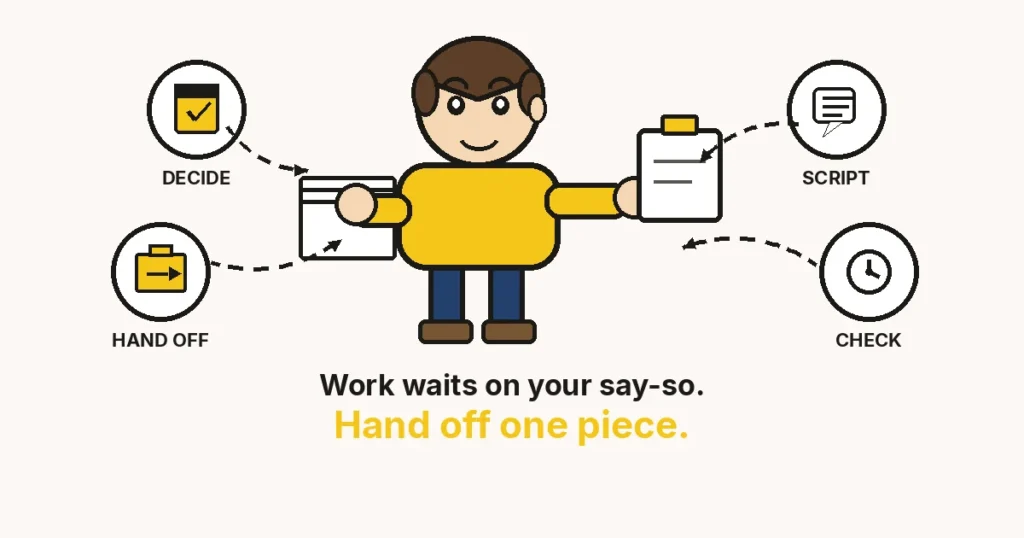
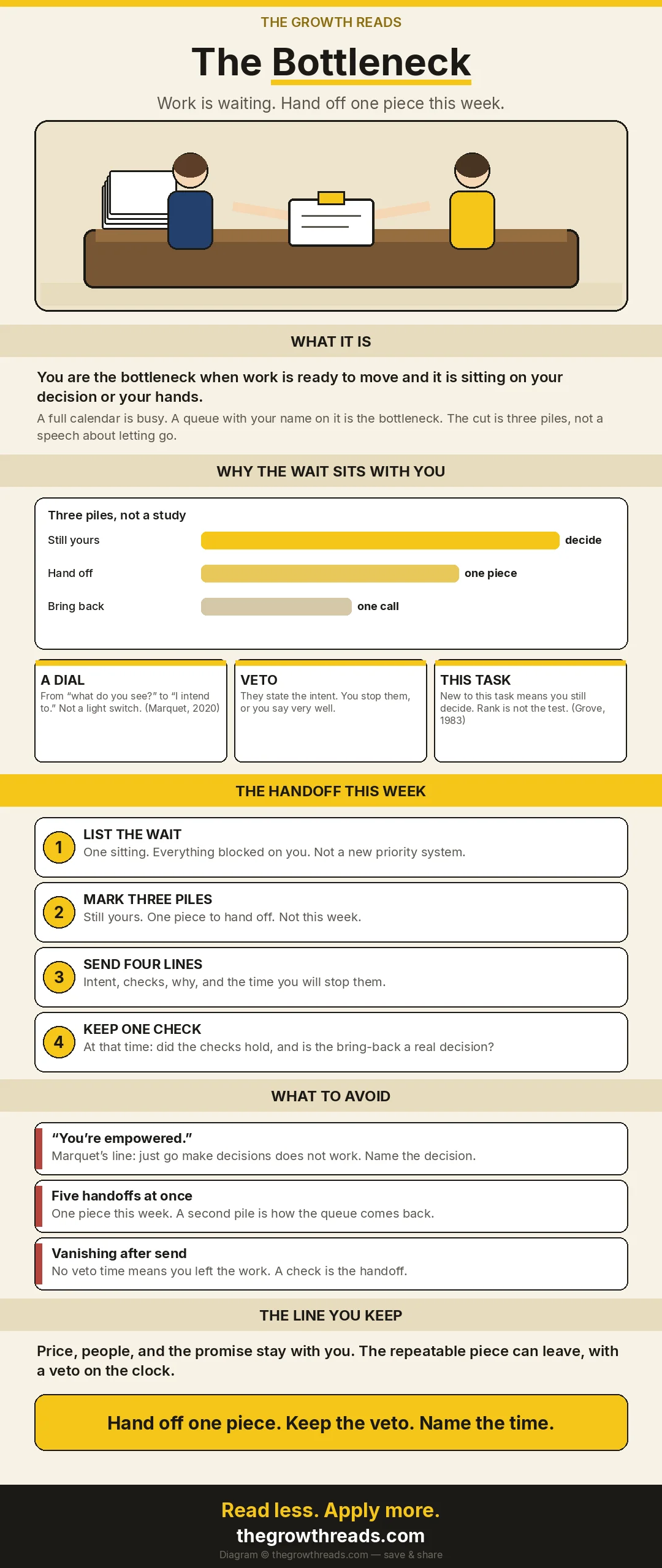
You are the bottleneck when work is waiting on your decision or your hands. Sort that queue into what you still decide, the one piece you hand off, and the one call that comes back. Send intent, the checks, the reason, and the time you will stop it, then let the work proceed unless you do.
Key takeaways
- You are the bottleneck when a piece of work is ready to move and it is sitting on your say-so or your hands, which is a queue, not a full calendar.
- L. David Marquet, on The Leadership List on 3 July 2020, called the overnight handoff a light switch — “Yesterday I used to make this decision. Tomorrow you make the decision” — and said that move fails.
- In that same interview, the handoff is the sentence “I intend to,” with what will be done, why it is technically correct, and why it serves the work, after which the leader says “very well” or stops it.
- Marquet said that “just go make decisions,” with no decision named, does not work; the shift needs a defined decision, clear ownership, and language people actually say.
- Andrew Grove’s High Output Management (1983) treats a manager’s output as the team’s output, and task-relevant maturity as specific to the task: new to this task means closer direction, familiar with this task means a lighter check.
What being the bottleneck actually is
You are the bottleneck when work is ready to move and it is not moving because it needs you. The draft is finished enough to send, and it is in your folder. The new hire has a free morning, and they are waiting to hear which three outcomes are theirs. The client asked a narrow question on Tuesday, and the answer is still a tab you have not closed. None of that is a motivation problem. It is a queue with one name on it.
A solo founder sees it as client work that leaves only through their keyboard. A new manager sees it as a team that asks “what should I do?” and waits. Someone has become the permission step. Until that step moves, the rest of the work sits.
What is the difference between a bottleneck and a busy week?
Busy means your hours are full. A bottleneck means other work is idle because of you. You can be busy on the right piece and still not be the bottleneck. You are the bottleneck when a second piece, one a colleague, a contractor, or your own next hour could advance, is parked until you touch it. The test is a Friday disappearance. If you were unreachable until Friday, which items would still go out, and which would sit in the state you left them? The ones that sit are the queue.
Sorting that queue is a different job from ranking a to-do list. A priority tool such as the time-management matrix tells you what is urgent and what is important. It does not name who is allowed to move the item. An owner line does. This article is the owner line.
Why the work waits on you
The work waits because moving without your yes has been how people get it wrong. You have corrected the price, rewritten the email, or taken the task back often enough that asking is safer than proceeding. The queue is the rational response.
Captain L. David Marquet met a sharper version of this on the submarine Santa Fe, and he described the mechanism in a 3 July 2020 interview on The Leadership List, the American Forces Radio program. In the old pattern, the officer of the deck said “Request permission to submerge the ship.” Marquet then gave the order. If the captain said nothing, the ship did not submerge. The officer was asking. The captain was deciding. Marquet’s change was the sentence “I intend to submerge the ship,” followed by why it was technically correct and why it served the mission. His line after that was “very well.” They were going to do it unless he stopped them.
He called the difference easy to miss and large in practice. In a permission system, nothing happens if the person in charge says nothing. With intent, the work proceeds unless they veto it. In the same interview he gave the office version: an email that says you intend to offer a discount, or you intend to launch a product.
Why “you’re empowered” does not move the queue
A speech about empowerment leaves the old language in place, so the queue stays. Marquet called the overnight version a light switch: “Yesterday I used to make this decision. Tomorrow you make the decision.” He wanted a thermostat instead. The questions, in his order, were: what do you see, what do you think is going on, what would you recommend, what do you intend to do, and only in a fast operation, do it and report afterward. Each step hands over a little more of the thinking. Skipping to the end is how a founder “delegates” on Monday and takes the work back on Tuesday.
He also named the failure mode we see in small companies. People are told they are empowered, and when they ask empowered to do what, the answer is “just go make decisions.” He said that does not work. The conditions he listed were trust, a defined process, a defined owner, and language the team actually uses. Without those, pushing decisions down “would have been a mess.” Our Turn the Ship Around review walks the same mechanism as control, competence, and clarity. The point for this week is narrower: name one decision, in words, before you announce that someone else owns it.
Why a bottleneck costs more than the hour you spend
The expensive part is not your hour. It is the thinking other people stop doing while they wait. When every draft comes back to you for the real version, people send placeholders. You rewrite them at night, which confirms the lesson, which produces the next placeholder.
Andrew Grove’s High Output Management, published in 1983, states the manager’s side of that arithmetic directly. A manager’s output is the output of the organization under their supervision, plus the output of the organizations under their influence, not the list of tasks they personally finish. Grove’s book treats high-leverage work as the work that moves many people’s output: a clear decision, a training pass, a one-on-one that unblocks someone. Rewriting a repeatable email is low leverage once someone else can do that email and you can still see whether it is right.
Grove was writing about managers who already had people. A solo founder does not create output by narrating a handoff to an empty room. If there is no recipient, the cost is delay. The fix is a real person for one piece, or one sitting in which you decide the queue and stop reopening it.
The three piles, and the fix for each kind of waiting
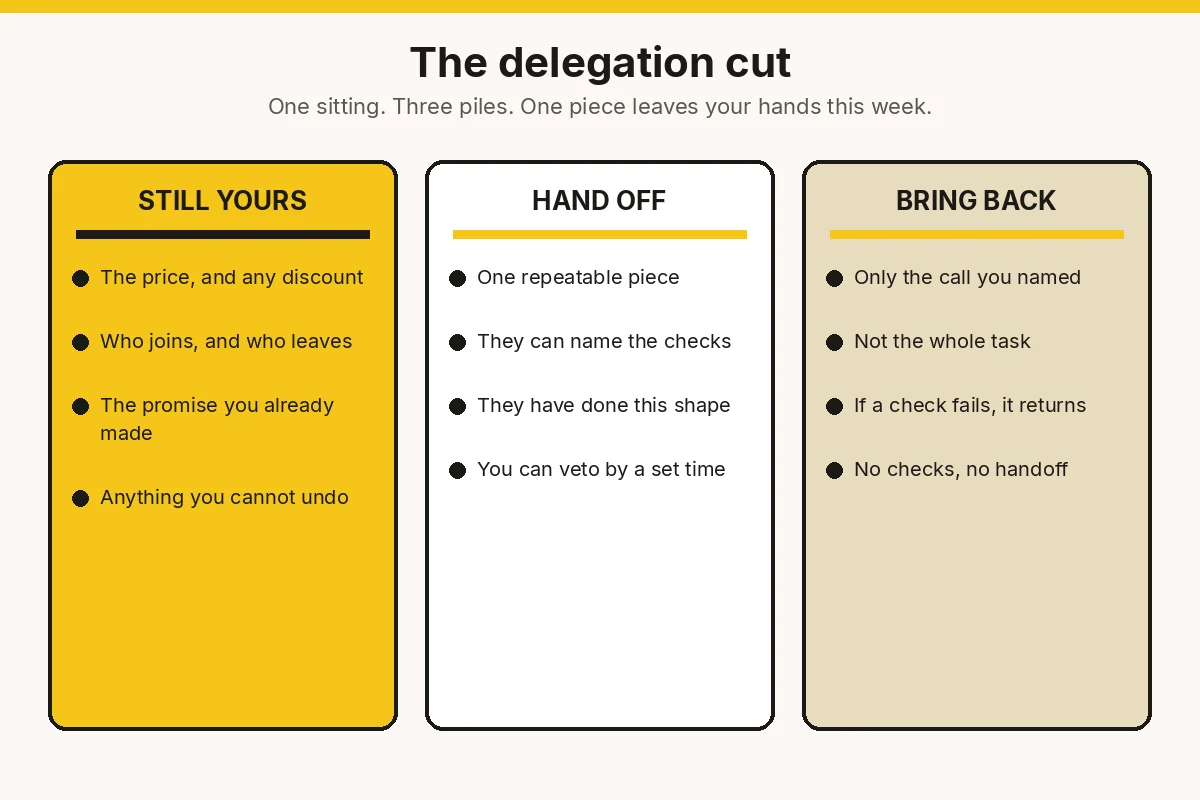
Every item waiting on you goes in one of three piles: still yours, hand off this week, or bring back only a named call. If an item does not fit, it is not a handoff. It stays with you, or it waits until next week on purpose. The point of the piles is to stop a fuzzy “can you own this?” from spreading across the whole queue.
| What is waiting | Pile | Who decides | What “done” looks like |
|---|---|---|---|
| The price, a discount, or a change to what the client signed | Still yours | You | You write the number or the change. Nobody else sends it. |
| A hire, a firing, or what you will promise a person | Still yours | You | You say the decision in a sentence another person could repeat. |
| A repeatable piece someone has done in this shape before: a revision inside the signed scope, a status note, a first-pass outline | Hand off | They do. You may veto before the time you named. | They send you the four-line note, then they proceed unless you stop them. |
| The same piece, but they have never done this shape | Still yours for the decision. They do the looking. | You decide. They report what they see. | They answer “what do you see?” You keep the call. |
| A check fails, or the scope in the latest email does not match the signed note | Bring back | You, and only for the conflict | They bring the two lines that disagree. They do not bring the whole task home. |
| You cannot name a check they could fail | Not a handoff | You | You either write the check, or you keep the work. |
The bring-back column is where handoffs go to die, so it has a hard edge. “Let me know how it goes” brings the whole task back, because anything could be how it goes. A bring-back is one sentence you wrote in advance: “If their last email asks for a page we did not sign, stop and send me the sentence that asks.” If that sentence never triggers, you do not need a meeting. The work went out.
How to hand off one piece this week
Pick one piece, send a four-line note, and put the veto on a clock. One piece. A second piece brings the queue back.
Step 1 — List what is waiting, in one sitting
Write every item blocked on you, on one page, in one sitting. Include the client draft, the unanswered question, the hire who does not know their week, and the decision you have reopened. Do not turn the sitting into a new ranking system. The ABCDE method ranks work you will do yourself. This page names an owner. “Operations” is not an item. “Send the revised Northwind proposal” is.
Step 2 — Mark the three piles
Mark each line Still mine, Hand off, or Not this week. Still mine is a short list: the price, people decisions, the promise already signed, and anything you cannot undo before next Monday. Not this week is allowed. A bottleneck gets worse when you pretend twelve items will move. Hand off should have one line by the time you stand up. If two lines both qualify, choose the one that has been waiting the longest, not the one you are most tired of.
If every line feels irreversible, you are refusing to choose. That stall is analysis paralysis, not a missing owner. Mark the page, then come back to the handoff.
Step 3 — Confirm the piece can be checked
The piece you hand off must have checks a specific person can name without you in the room. For the Northwind proposal, the checks are ordinary: the scope matches the note they signed, the price is the price you already gave, and the sender has read the draft once out loud. If the only check is “use good judgment,” you are still the bottleneck. You have just moved the moment of judgment to a later panic.
Match the person to the task, not the title. Someone who has never sent this kind of revision does not get “I intend to send it.” They tell you what they see. You keep the send. The next section is the ladder.
Step 4 — Send the four-line note
The person doing the work writes the note. Draft the first one side by side if you need to. After that, they write it, because the thinking is the part you are moving. Marquet’s three parts, in the 2020 interview, were what they intend, why it is technically correct, and why it serves the work. Add a clock. Without a time, “unless I stop you” means “wait, because I might.”
The note they send you
I intend to send the revised Northwind proposal on Thursday at 3pm.
Checks: the scope matches the note they signed, the price is unchanged, and I have read the draft once out loud.
Why: they asked for it before Friday’s call, and it has been sitting since Tuesday.
I will send it unless you tell me to stop before Thursday at noon.
Bring back only this: if their latest email asks for a page we did not sign, I will not send. I will send you the two sentences that conflict.
Change the nouns. Keep intent, checks, reason, and a veto time. This is an application of the shape Marquet described, not a line from the book. If you are writing to a contractor, you are the person who receives the note. If you are a new manager, your report sends it to you. A note that says “please handle Northwind” is still permission language.
Step 5 — Put the veto on the clock, then stop touching the piece
The check is one look, at the time you named, at the checks and the bring-back. It is not a second draft. Put Thursday noon on the calendar as a 15-minute hold. A time block is useful here only as a fence around that look. It is not the method. At noon you read the note they already sent. If the checks hold and the bring-back did not trigger, you say very well, or you say nothing, which is the same instruction. If a check failed, you decide the one conflict. You do not reopen the adjectives.
Then leave it. Opening the doc after you have said very well puts your name back on the queue. Write one line on the same page: sent, or brought back, and why. That line is how you choose next week’s piece, and how you notice you took the work back.
When the other person is new to the task
If they have not done this shape of work, they do not start at “I intend to.” They start at “what do you see?” Marquet’s dial exists for this. Grove’s task-relevant maturity says the same thing in management language: someone new to a task needs the work structured, including what, when, and how. Someone with a track record on that task needs the objective and a check. Hands-off with a novice ships a confident, wrong email. Close direction with someone who has done the work teaches them to wait.
Use a short ladder, and do not skip a rung in the same week.
- What do you see? They compare the latest ask with the signed note and report the difference. You decide.
- What do you recommend? They name one action. You still decide, and you say why you agreed or why you did not.
- What do you intend to do? They send the four-line note. You veto or you let it go.
- Do it, then tell me. Only for a piece this person has already shipped cleanly, and only with the bring-back sentence still written down.
A first hire in week one is on rung one for client-facing work, even with a senior title from the last job. Grove’s point, as our High Output Management review records it, is that the same person can be excellent at one task and new at another. Name the rung out loud. You do not need a new meeting to do that.
If there is no other person, the ladder has nowhere to stand. Hire or contract the one piece, and give them rung one with the checks written by you. Or, if you will not spend the money, hold the half-hour sitting, decide the Still-mine items yourself, and ship them before you add a tool. A template does not receive a handoff.
Common mistakes
- Announcing empowerment and keeping the old sentences. “You’ve got this” plus “can you just take a look and I’ll send it” is the light switch. The queue does not care about the speech. Change the sentence to “I intend to,” as Marquet describes in Turn the Ship Around, or do not claim the handoff happened.
- Handing off the price. A discount is still yours. If the note says “I intend to offer 15 percent,” the right use of the veto is to stop it. Do not discover the discount in the sent folder.
- Handing off five things because the list was embarrassing. One piece this week is the whole method. A second piece starts after the first one has gone out without you rewriting it.
- Writing their intent for them, every time. The first note can be drafted together. If you are still the author on the fourth note, the thinking never moved, and you are still the bottleneck with extra paperwork.
- Checking by redoing. A veto that becomes a rewrite teaches the other person to send you a rough draft. Read the checks. Touch the sentences only when a check failed.
- Using a priority sort as a substitute for an owner. Re-ranking the list with ABCDE or the matrix can be the right move on Monday morning. It does not name who may send the work.
- Vanishing. No time on the clock means they either wait forever or send something you then disown. The veto time is the part that makes the handoff different from walking away.
When you should not hand it off
Do not hand off a decision you cannot afford to see for the first time after it has gone out. That set is short, and it should stay short. The price. A person joining or leaving. The promise a client has already signed, or a change to that promise. Anything that cannot be undone this week: a public launch, a legal commitment, a number you would not want to explain on Friday. If the piece is one of those, it stays in Still mine. You can still ask someone to gather the comparison. You cannot ask them to be the person who chose.
Do not hand it off when they have told you they do not want the decision. Marquet said in the same interview that you cannot force someone to think. Offer the rung once. If they want to be told, tell them on a smaller piece, and do not call that a handoff.
And do not hand it off to fix a conversation you are avoiding. If the real issue is that the work is bad, or the client is the wrong client, a script will ship the wrong work more smoothly. Say the thing. Then decide whether any piece of it can move without you.
The evidence behind this cut
This cut rests on a primary interview and on two management books, not on a trial of founder productivity. We are not going to dress a submarine story up as a percentage you should expect. The table says what each source actually is, what we used, and what it does not show.
| Source | What it is | What we took from it | What it does not show |
|---|---|---|---|
| Marquet, interviewed by George Maurer, The Leadership List, 3 July 2020 (DVIDS story 373385) | A primary interview. Marquet describes the language he used on Santa Fe. Not an experiment. | The permission-versus-intent difference; the three-part statement; “very well”; the dial from “what do you see?” to “I intend to”; the warning that “just go make decisions” does not work; the office examples of a discount and a launch. | A measured effect on revenue, speed, or error rates in a company. We did not import fleet scores from secondary retellings. |
| L. David Marquet, Turn the Ship Around! (Portfolio/Penguin, 2013), checked against our full-text review | A narrative management book. The review is the text we re-read for this article. | The same mechanism, stated as a practice: replace “request permission” with “I intend to,” and do not push control down without competence and clarity. | A script for a two-person studio. The book’s setting is a nuclear submarine with drilled procedures. We use the language, not the setting. |
| Andrew S. Grove, High Output Management (Random House, 1983), checked against our full-text review | A management book drawn from Grove’s Intel practice. Not a field experiment in delegation. | A manager’s output is the organization’s output. Task-relevant maturity is about this task, not rank. New to the task: structure it. High maturity on the task: less direction, still a way to see the work. | The sentence-level handoff. Grove tells you how close to stand. Marquet gives you the words. We did not merge them into a fake Grove quotation. |
If there is no second person, the mechanism has no listener. If the task is new to the only person who could take it, stand closer, not further off. The cut is a decision for this week, not a finding about all teams.
Frequently asked questions
What does it mean that you are the bottleneck?
You are the bottleneck when a piece of work is ready to move and it stays put because it needs your decision or your hands. The usual shapes are a client draft only you will send, a new hire waiting to hear what their week is, and a question you have reopened without answering. A full calendar is a different problem. The test is what would still go out if you were unreachable until Friday. The items that would sit are the queue this article is about, and the fix is an owner for one of them, not a longer day.
What should a founder or a new manager still decide themselves?
Keep three kinds of call. The price, including any discount. People decisions: who joins, who leaves, and what you will promise them. And the promise already made to a client, including a change to the scope you signed. Add anything you cannot undo before next Monday, such as a public commitment. Everything else on the waiting list is a candidate for the one handoff, or for “not this week.” Keeping the whole list because one item is sensitive is how the sensitive item hides the ordinary work.
What do you say instead of “can you just take this”?
Ask them to send you four lines: what they intend to do, the checks that would make it wrong, why it matters this week, and the time after which they will proceed unless you stop them. Add one bring-back sentence so a failed check returns a decision, not the whole task. L. David Marquet described that shape on The Leadership List on 3 July 2020. The officer stated the intent, why it was technically correct, and why it served the work. The captain said “very well,” or he stopped it. “Can you take this?” leaves the thinking where it already is, which is with you.
How is “I intend to” different from asking permission?
Permission waits. If you never reply, the work never moves, because the other person has not been given an order. Intent moves unless you stop it. Marquet put it in those terms in the 2020 interview: under the old pattern the ship did not submerge if the captain said nothing, because the officer had asked and the captain had not ordered. Under intent, the officer had already decided, and silence meant proceed. He gave the civilian version in the same conversation: an email that says you intend to offer a discount, or to launch a product.
What if the person is new and might get it wrong?
Do not start them at “I intend to.” Marquet described a dial: what do you see, what do you think is going on, what do you recommend, what do you intend, and only then do it and report. Andrew Grove’s High Output Management, from 1983, makes the same distinction with task-relevant maturity. Someone new to this task needs the work structured. Someone who has done this shape of work can bring you the decision. A senior title is not the test. If they cannot name a check, you still decide, and they still do the looking.
How often should you check a handoff?
Once, at the time you wrote into the note. The look has two questions: did the checks hold, and did the bring-back sentence trigger. It is not a second draft and it is not a status meeting. A task this person has done before gets that single veto. A task they are new to is not on this cadence yet, because you still own the decision and you are reading what they see, not waving a piece through. If you reopen the document every afternoon, the note was decorative and you still own the send. Write down whether you took it back.
What if you have nobody to hand the work to?
Then there is no handoff, and a script addressed to nobody will not ship the proposal. Choose one piece a contractor or a first helper could do, and give them the first rung with the checks written down. If you will not spend that money this week, you are the bottleneck to yourself. List the decisions that are waiting, decide them in one sitting, and do not reopen them between sittings. Send the proposal yourself before Thursday noon. A queue of your own unfinished calls is still a queue. A new app, a new template, or a speech about systems will not receive the work.
When is handing the work off the wrong move?
When they cannot name a check. When the item is the price, a person, or the promise you signed. When you could not undo the decision this week. And when the handoff is a way to avoid a conversation about quality or about a client who does not fit. Marquet was clear in the 2020 interview that telling people to just go make decisions, with no decision defined, does not work, and that the change needed an owner and language, not a speech. If those are missing, keep the decision and write the missing line before you delegate anything.
Sources
- Maurer, G. (host). (2020, July 3). Transcript: The Leadership List — L. David Marquet, Turn the Ship Around!, episode two. American Forces Radio Network, via DVIDS, story 373385. dvidshub.net/news/373385
- Marquet, L. D. (2013). Turn the Ship Around! A True Story of Turning Followers Into Leaders. Portfolio/Penguin. Checked for this article against our full-text review.
- Grove, A. S. (1983). High Output Management. Random House. Checked for this article against our full-text review.
Related reading on The Growth Reads
The books this cut uses
- Turn the Ship Around summary and review — the “I intend to” mechanism, and why a speech about empowerment leaves the queue where it is
- High Output Management summary and review — managerial output as the team’s output, and task-relevant maturity as a task, not a rank
Related articles
- The time-management matrix — urgent versus important, which still does not name an owner
- Analysis paralysis — when the wait is that you will not choose
- The ABCDE method — a ranking for your own list, not a handoff
- Time blocking — a fence around the veto, not the delegation itself
Where this sits
- Leadership books — the shelf these two books are on
- The best productivity books
- All productivity articles and summaries
How this article was researched
The handoff language is Marquet’s account in the 3 July 2020 Leadership List transcript, read in full. How close to stand is Grove’s High Output Management, via the full-text review on this site. We did not add fleet scores, page numbers, or a delegation study. The four-line note is our application of his three parts plus a clock.
Limit: a nuclear-submarine crew with drilled checks is not a two-person company. If you have no second person, the script has no recipient. If the task is new, closer direction is the correct Grove move, and “I intend to” is premature. Treat the cut as a decision for this week.
How we work: every article on The Growth Reads is built from books we have read and from primary accounts we can check, and it is date-stamped when those sources change. Read our methodology.