

★★★★½ 4.6/5 — A strategy is a response to a challenge, not a list of hopes.
Best for: Operators who already have goals and still cannot say what is in the way.
Reading time: ~7 hrs (Crown Business, 2011) · this guide ~14 min
Difficulty to apply: Easy to spot fluff. Hard to cut a goal that does not face the crux.
Good Strategy Bad Strategy in one minute
A pile of goals is not a strategy. Richard Rumelt’s Good Strategy Bad Strategy separates the costume of ambition from a real choice. Bad strategy wears vision words, a long list of priorities, and no mention of the obstacle. Good strategy starts with a diagnosis — a plain account of the crux — then chooses a guiding policy and a handful of actions that reinforce each other. The power is focus. Like a leader who refuses to fight on the whole front, you put the effort where a coherent push can move the system. The rest of the book shows where that power comes from: proximate objectives, chain-link systems, designed advantage, and the honesty to name what you will not do.
Key takeaways
- The kernel is the whole strategy. Diagnosis, guiding policy, coherent actions. If one is missing, you have a wish with headings.
- Bad strategy avoids the hard choice. Fluff, a skipped challenge, goals dressed as strategy, and a dog’s dinner of objectives.
- A goal is not a path. “Grow 20 percent” does not say what is blocking growth or what you will stop doing.
- Diagnose the crux. Name the obstacle that, if it moved, would change the outcome. Keep it to one or two facts.
- Set a guiding policy. An overall approach that rules out most of the clever ideas already on the list.
- Coordinate the actions. Each step should make the others stronger, not open a second campaign with its own logic.
- Use a proximate objective. Pick a near hill the team can actually take. The next hill shows up after that one falls.
- Respect the chain-link. A system moves at the weakest link. Polishing a strong link does not raise the output.
- Design the advantage. Do not chant “be better.” Build a coherent advantage, or ride a wave a rival is too inert to catch.
What is Good Strategy Bad Strategy about?
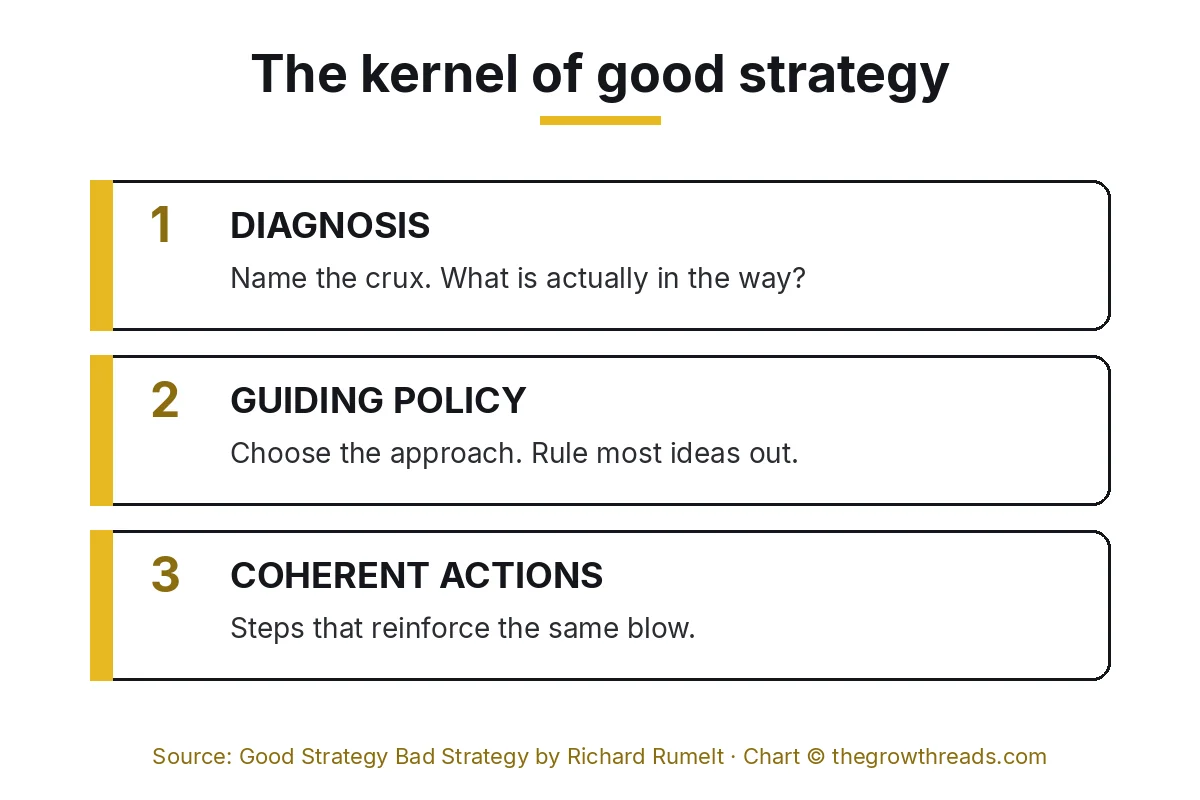
Good Strategy Bad Strategy argues that real strategy is a designed response to a specific challenge. Rumelt calls the core the kernel: a diagnosis of the crux, a guiding policy, and coherent actions. Most plans fail because they skip the diagnosis and stack goals instead of choosing.
About the author
Richard Rumelt is a strategist and emeritus professor at the UCLA Anderson School of Management. He trained at Harvard Business School and spent decades in the room where executives presented their strategies, first on the faculty and later as an advisor to companies tied in competitive knots. Good Strategy Bad Strategy, published in 2011 by Crown Business, names what those decks kept missing: a plain statement of the obstacle. He cares less about vision language than about the logic that connects a hard fact to a focused set of moves. Readers who want a fill-in template will not find one. The value is a standard you can use on Monday: say what is going on, say what you will do about it, and make the actions agree. Explore all Richard Rumelt book summaries →
Key concepts at a glance
| Concept | What it means | Use it when |
|---|---|---|
| Kernel | Diagnosis, guiding policy, and coherent actions that agree with each other. | A plan has headings and still does not say what you will stop. |
| Diagnosis | A judgment that names the crux, not a restatement of the goal. | The team argues about projects before it agrees on the obstacle. |
| Guiding policy | The overall approach, including the paths you refuse. | Every idea can still survive the meeting. |
| Coherent actions | Steps that reinforce one policy instead of starting side campaigns. | Work is busy and the results do not compound. |
| Proximate objective | A near hill people can finish, which reveals the next hill. | The ambition is real and nobody can tell if this month worked. |
| Chain-link system | Output is capped by the weakest dependent step. | Improvements land on strong teams and the result stays flat. |
| Bad strategy | Fluff, a skipped challenge, goals as strategy, or a long list of objectives. | The deck could be signed by a rival without changing a word. |
Part 1 — Four hallmarks of bad strategy
Most strategic plans fail a test you can run in five minutes. Read the document and circle the sentence that names the obstacle. If you cannot find it, you are holding bad strategy. Rumelt is specific about the costume it wears. Fluff is the first hallmark: abstract words stacked until they sound like direction. They restate a hope. They do not choose. The second hallmark is a refusal to face the challenge. The deck talks about ambition and stays silent on what is hard, who is already winning, or which constraint is binding. The third is mistaking goals for strategy. A revenue target, a share number, or a culture slogan is a destination. It is not an approach. You can write “grow” in a sentence and still have no idea which customers to ignore.
The fourth hallmark is a dog’s dinner of objectives: a list so long that every team keeps a pet project. Bad strategy feels busy because busyness avoids a disappointment. Good strategy disappoints most ideas on purpose. A coherent push on the crux beats a fair share of attention for every goal. The common move is subtraction: concentrate force, cut the catalog, or keep a promise with a system rather than a slogan.
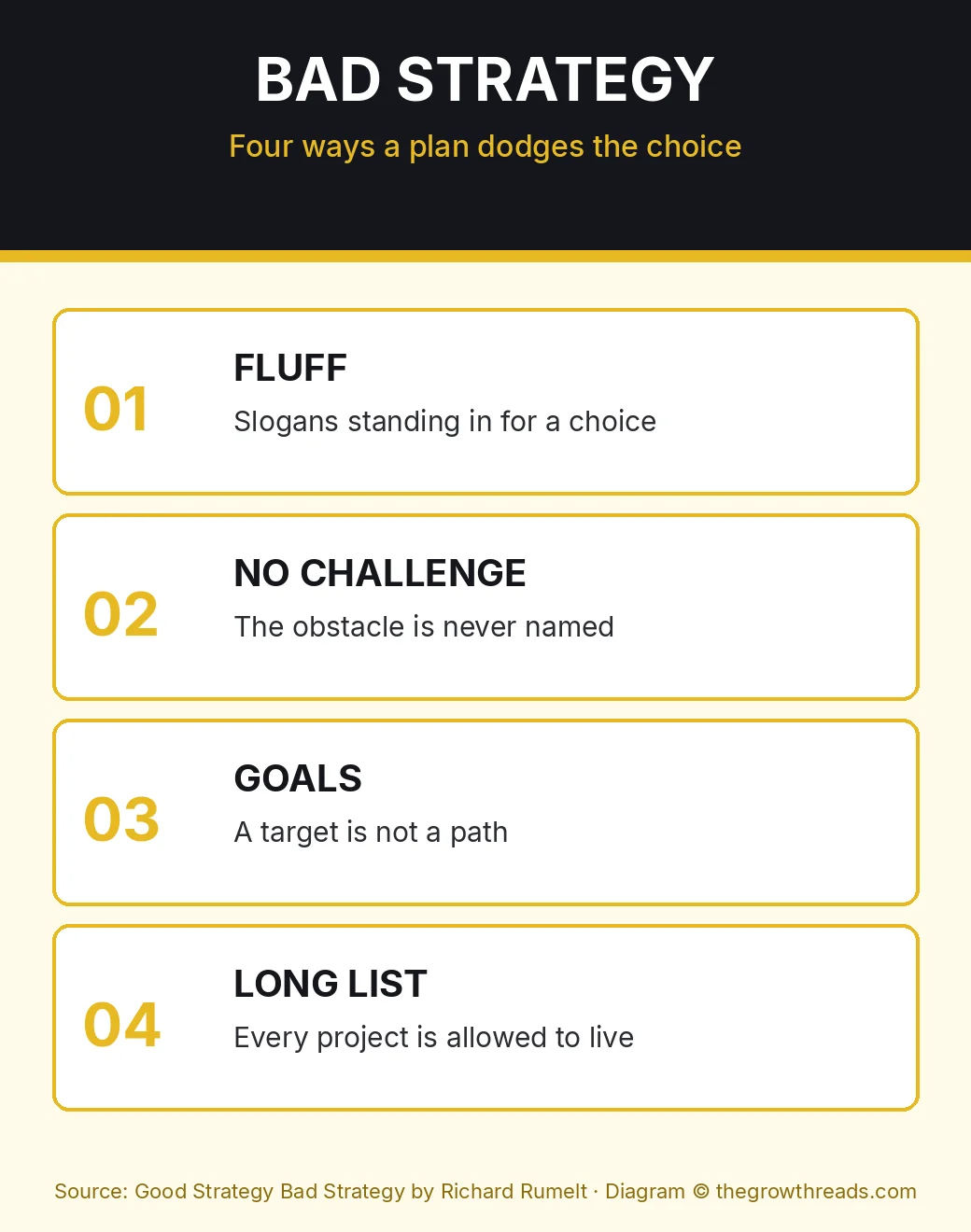
Mark each bullet: fluff, a missing challenge, a bare goal, or one more dish in the dog’s dinner. A bullet that misses the obstacle is a wish with a budget. Rumelt’s line is that good strategy creates strength through the coherence of its design, and coherence starts when the list gets shorter.
TGR Note: If the long list is the problem, pair this chapter with The One Thing and Essentialism. Those books train the personal version of the same cut: one priority, and a disciplined no. Rumelt is writing to the organization. The muscle is the same. A goal you will not postpone is not yet a priority.
Part 2 — The kernel: diagnosis, policy, action
The remedy is not a thicker template. Rumelt calls the core of a good strategy the kernel, and it has three pieces that have to agree. The diagnosis is a judgment about what is going on. It simplifies a messy situation by naming the crux — the one or two facts that actually govern the outcome. A team with slow delivery might be tempted to “raise the bar on quality.” A diagnosis says the bottleneck is the handoff after build, because work sits unsigned and the queue never clears. That sentence is narrower, and it is useful. It can be wrong, which is a virtue. A wrong diagnosis can be corrected. A slogan cannot.
The guiding policy is the overall approach, and it rules things out. In the handoff example, the policy might be “nothing starts until yesterday’s queue is signed,” so other projects wait. Coherent actions make that policy real: a daily unsigned list, one owner for stuck items, and a rule that new work cannot jump the queue. Each action is ordinary. Together they are a strategy because they share a crux. Leaders often skip the diagnosis and jump to actions that do not agree. Write the kernel in four sentences. If a skeptical peer cannot tell what you will stop, the policy is not finished.
TGR Note: Crossing the Chasm is a diagnosis you can steal when the crux is a buyer. Moore names a specific obstacle — pragmatists will not buy what visionaries bought — and then a guiding policy: win one beachhead and finish the whole product. That is a kernel. If early fans love you and the next fifty buyers stall, write the beachhead as your guiding policy before you add another feature.
Part 3 — Proximate objectives and chain-link systems
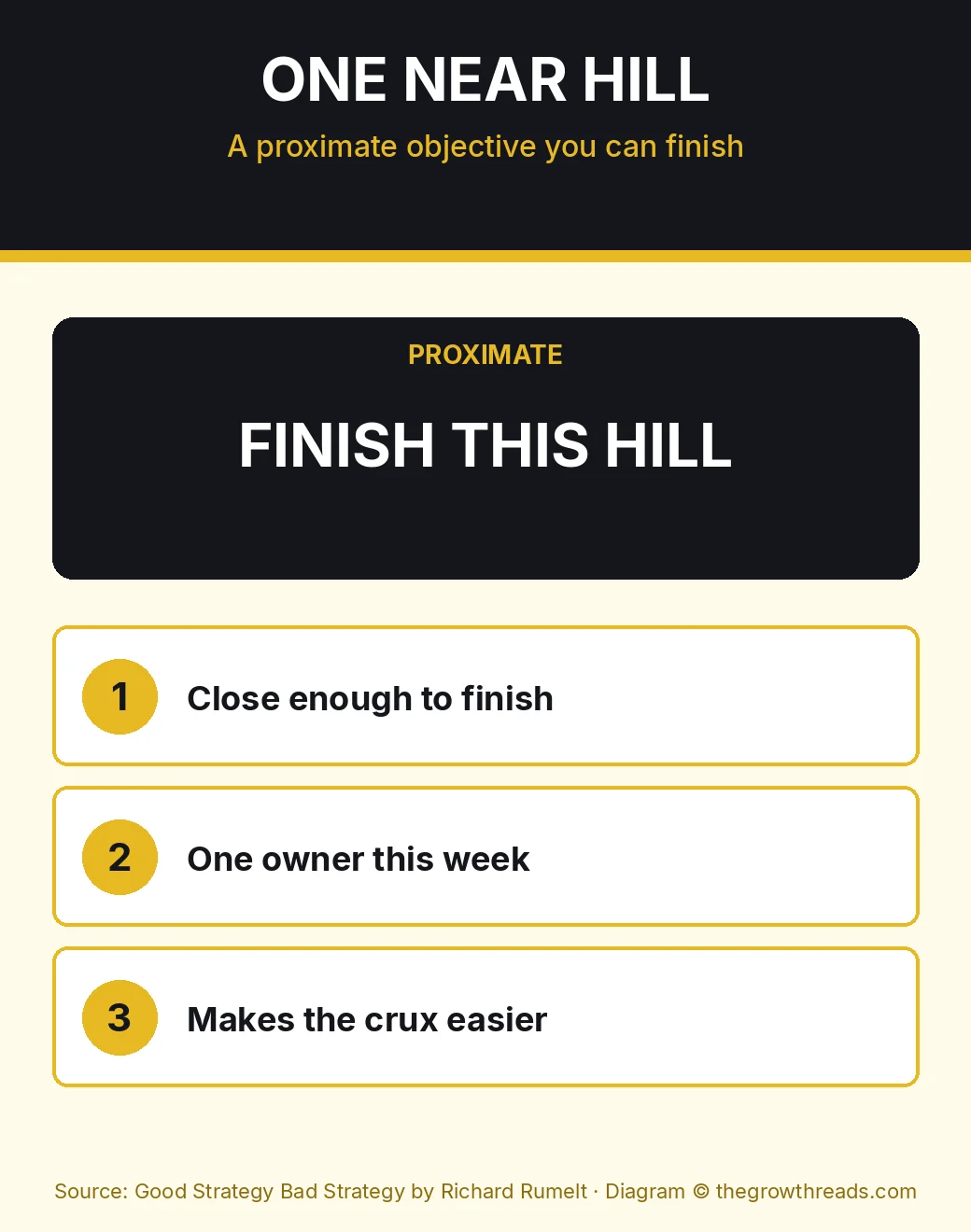
Two sources of power matter as soon as you leave the slide. A proximate objective is close enough to reach. “Become the category leader” is not proximate. “Close the next twenty deals in one use-case and collect five references” can be. A near hill focuses people who cannot march on fog, and it leaves you somewhere the next hill is visible. The test is binary. If Friday can only say “we made progress,” the objective is still a mood.
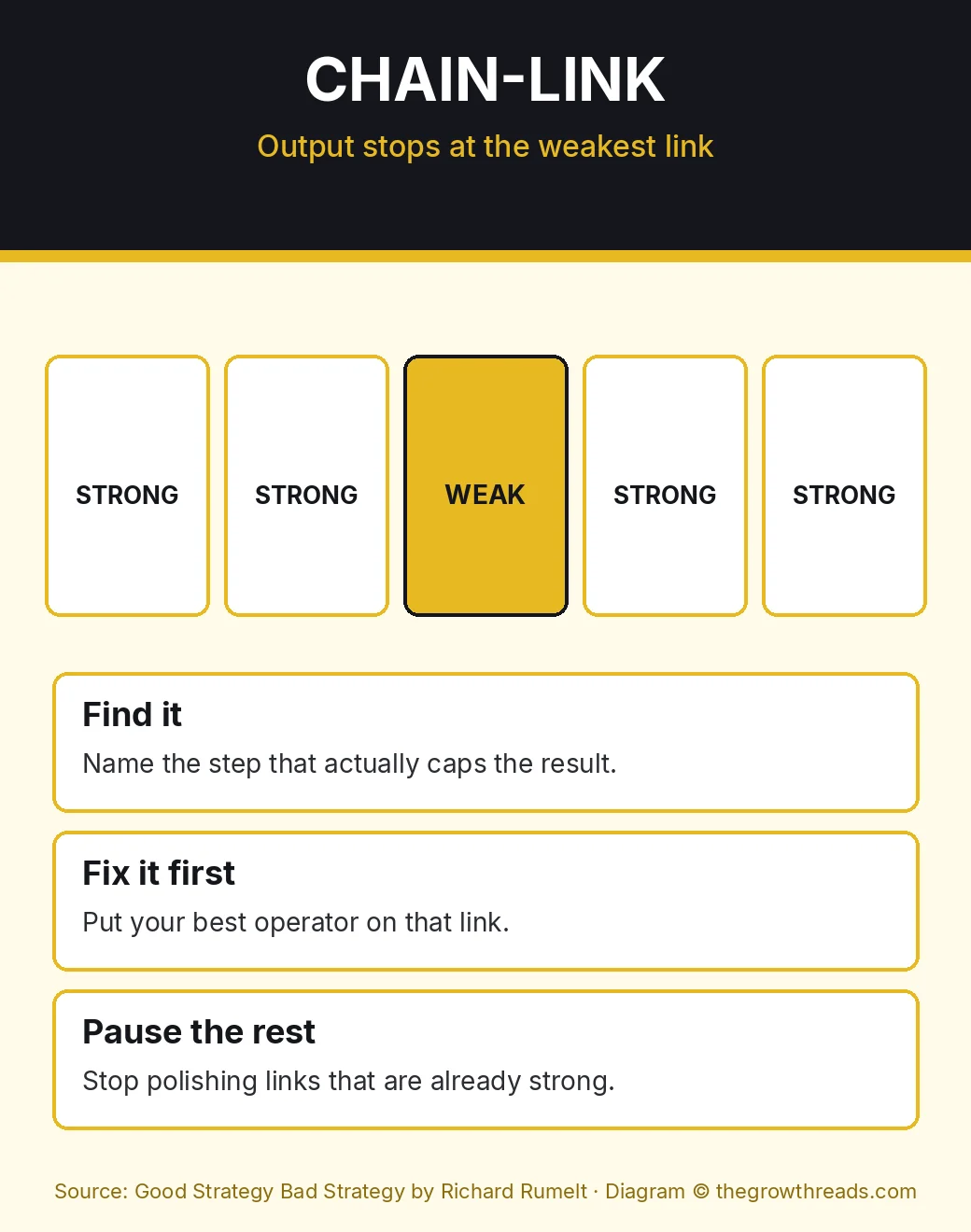
The second source is the chain-link system. When activities depend on each other, output is capped by the weakest link. Training a strong team, or buying a tool for a step that is not stuck, will not move the result. Find the link that fails and fix that one. Stop polishing the strong links until the weak one holds. Put your best operator on the ugly step and measure it weekly. Leaders resist this because it looks like neglect. It is concentration. Fair improvement programs change nothing if the chain still breaks in the same place.
TGR Note: The Goal is the chain-link idea told as an operations story. Goldratt’s constraint and Rumelt’s weakest link are cousins. If your team argues about which improvement should come first, point at the link that actually caps this month. The argument gets shorter when the constraint is visible. Use The 4 Disciplines of Execution when you need a weekly scoreboard for that one proximate objective.
Part 4 — Advantage, waves, and the strategist’s habit
Advantage and change are the last sources of power. A good strategy does not ask you to be “better” in the abstract. It designs a place where your strengths matter and a rival’s do not: a shorter catalog that lets design pour into a few bets, or a logistics system that makes a price promise true. Copy one piece and you do not copy the strategy. Waves of change in cost, technology, or taste let a focused entrant do what an inert incumbent will not. Inertia keeps last decade’s policy. Entropy is the decay of systems nobody maintains.
Look for a wave worth riding and a rival too stuck to answer. Then the habit turns inward. Sit with the situation until you can say what is going on, what you will do, and what you will stop. Rumelt has little patience for sessions that produce a poster and no choice. If the kernel cannot be said in a minute, you do not have one yet. Name the advantage without the words “best” or “leading.” Use the mechanism instead: the link you fixed, the buyer you chose, or the offer you made coherent.
Who is Good Strategy Bad Strategy best for — and who should read something else first?
Read this if you own an outcome and the current plan is a list. Founders, general managers, product leads, and chiefs of staff get the most.
Start somewhere else if you do not yet have a real challenge to face. If the work is personal habits and you are avoiding the first rep, Atomic Habits will move you faster. If you are still guessing whether anyone wants the product, The Mom Test will save you from a beautiful kernel aimed at a fiction. If you already know the mainstream buyer and you need the sequence across the gap, Crossing the Chasm is the closer cousin. Come back to Rumelt when you can say, in one sentence, what is in the way.
Questions to reflect on
- What is the crux in your work this quarter — the obstacle, not the goal?
- Which current initiative would an honest diagnosis cancel?
- What proximate objective could you finish in two weeks that would make the crux easier?
- Where is the weakest link, and who is still polishing a strong one?
- If you had to say the kernel in four sentences on Friday, what would you cut?
🔥 Ready to name the crux?
Put the kernel next to a live plan and cross out every goal that does not face it.
How to apply Good Strategy Bad Strategy (7-day plan)
- Day 1 — Circle the obstacle. Read your current plan and mark the sentence that names what is in the way. If you only find targets, write a one-sentence diagnosis before you add any task.
- Day 2 — Tag the hallmarks. Label each bullet as fluff, a skipped challenge, a bare goal, or one more item on a long list. Count how many survive.
- Day 3 — Draft the kernel. Four sentences: the crux, the guiding policy, three coherent actions, and the project you will stop. Read it to someone who will disagree.
- Day 4 — Pick one near hill. Choose a proximate objective a named owner can finish in two weeks. Write the Friday test that says done or not done.
- Day 5 — Find the weak link. Map the chain that produces the result. Circle the step that caps it. Move your best available person onto that step.
- Day 6 — Name the advantage. Replace “be better” with the mechanism you are deepening, or the wave you are riding. Cut one initiative that does not serve it.
- Day 7 — Say it in a minute. Deliver the kernel out loud. Change one line based on the question that punctures it. Put the near hill on next week’s scoreboard.
Frequently asked questions
What is Good Strategy Bad Strategy about?
Good Strategy Bad Strategy is Richard Rumelt’s 2011 book on why so many plans never touch the real problem. Strategy, in his account, is not a vision or a stack of targets. It is a designed response to a challenge. He calls that design the kernel: a diagnosis that names the crux, a guiding policy that picks the approach, and coherent actions that carry it out together. Early chapters show bad strategy dodging the work with fluff and long lists. Later chapters show where the power comes from: focus, and advantage built on purpose. The test is simple. Does the plan face the obstacle, or only announce a hope?
What is the kernel of good strategy?
The kernel is Rumelt’s name for the smallest complete strategy. It has three parts, and they have to agree. The diagnosis says what is going on and which obstacle governs the outcome. The guiding policy is the overall approach, which also says what you will not do. Coherent actions are the steps that make the policy real, each one reinforcing the others. A revenue target is not a kernel. A culture slogan is not a kernel. If you cannot say the diagnosis, the policy, and three actions that serve it, you have a wish with headings. The kernel is short on purpose, so a colleague can disagree with it.
What does Rumelt mean by “bad strategy”?
Bad strategy is not a missing document. It is a way of avoiding the hard choice, and Rumelt names four hallmarks. Fluff stacks abstract words until they sound like direction. Failure to face the challenge talks about ambition and stays silent on the obstacle. Mistaking goals for strategy treats a target, such as a growth number, as if the number were a path. A dog’s dinner of objectives lists so many priorities that every team keeps its pet project. The document looks busy, and that busyness is the tell. Good strategy cancels most ideas so one coherent push can land on the crux.
What is a proximate objective?
A proximate objective is a target close enough that people can organize to hit it. “Become the category leader” is a horizon, not a proximate objective. A near hill names one segment, one broken step, or one offer a named owner can finish in weeks. Rumelt’s point is that ambitious results come from chaining these hills, not from repeating a distant slogan. A good near hill focuses people who cannot march on fog, and it leaves you somewhere new, where the next hill is visible. If Friday cannot say done or not done, tighten the objective until it can.
How do chain-link systems change what you improve first?
When activities depend on each other, the result is capped by the weakest link. Strengthening a link that is already strong does not raise output. Rumelt uses that fact against improvement programs that feel fair and change nothing. Find the step that actually breaks, whether it is a handoff, an approval, or a missing reference, and put your best effort there. Pause the polish on the strong links until the weak one holds. Name the link, name the owner, and decline the upgrade that does not touch it. The chain keeps failing in the same place until you fix that place.
Is Good Strategy Bad Strategy worth reading in 2026?
Yes, if you own a plan and the plan is mostly targets. The cases come from business and public life, and the kernel has not aged, because organizations still hide from choices. You do not need a 2011 market to write a diagnosis. It earns the time when the calendar is full and results are flat, which is often design rather than effort. It is a poor first book on habits, and it refuses a fill-in template. Pair it with Crossing the Chasm for a mainstream buyer, or with The Goal for one constraint.
Who should read Good Strategy Bad Strategy, and how long does it take?
Read it if you own an outcome and your current strategy is a list. Founders, general managers, product leads, and chiefs of staff get the most, because they can stop a project. Budget about seven hours for the Crown Business edition, or use this guide and then read the kernel chapters beside a live plan. Skip ahead of it if you do not yet have a real challenge. Habit design belongs with a habits book first. An untested product belongs with customer interviews first. Come back when you can name, in one sentence, what is in the way. The hard part is canceling a popular goal that misses the crux.
Related summaries
- Crossing the Chasm — a full kernel for the mainstream buyer who will not follow your early fans.
- The Goal — the constraint, told as a story, when the chain-link is an operation.
- The One Thing — the personal cut when the dog’s dinner is your own calendar.
- Essentialism — a disciplined no, which is what a guiding policy feels like up close.
More books in this silo are on the best productivity books list.
How we analyze books: we paraphrase arguments, add original application notes, and skip chapter-by-chapter reproduction. Read our full methodology.