

★★★★☆ 4.4/5 — A short, sharp practice for people who went agreeable and lost the mission their love was supposed to stand next to.
Best for: Readers who recognize a masculine essence in themselves and want purpose, presence, and intimacy in that order
Reading time: ~4 hrs for the 224-page 20th-anniversary paperback · ~16 min for this guide
Difficulty to apply: The chapters are short. Staying on your purpose when someone you love is upset is the actual work.
The Way of the Superior Man in one minute
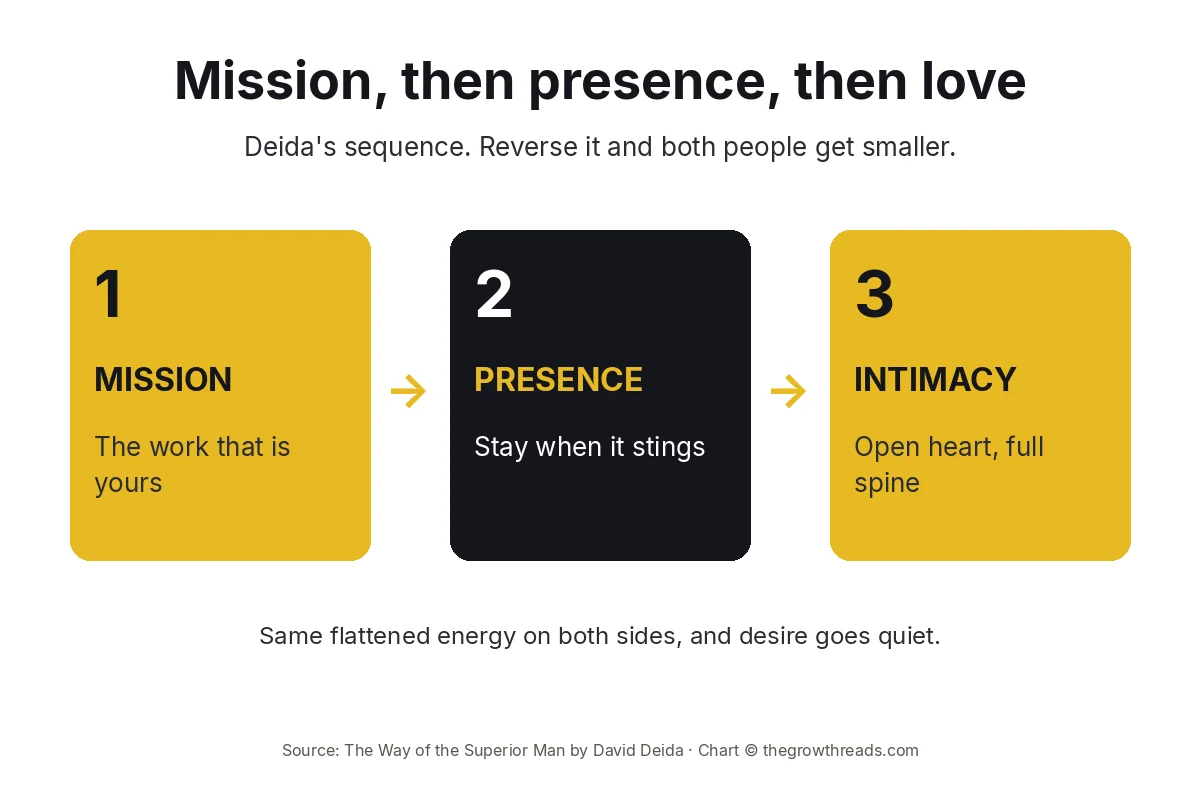
Put the mission first, keep your heart open, and stop making your partner the center you will later resent. David Deida published The Way of the Superior Man in 1997. The Sounds True 20th-anniversary edition is the one still on the table: short chapters on work, intimacy, and a presence that does not collapse when the mood changes. He writes to the reader whose gift in love is direction. That reader can be any gender. The gift is a life aimed at something you would still do if the relationship ended on a Thursday.
It is a field manual. Live just past your edge. When the room is stormy, stay, and do not treat a clear no as a test. Desire fades when both people sand themselves flat. It returns when direction and radiance are both allowed.
Key takeaways
- Purpose before the relationship: if she is the whole point, you will resent her for the life you did not live.
- The edge is the practice: lean just past the place you slightly fear, most days.
- An open heart is not agreement: feel the sting and keep your direction.
- Stop waiting for a finished life: start the real work inside the mess.
- Own your decisions: stop outsourcing your spine to a parent, a boss, or her mood.
- A mood is not always a problem: presence often lands better than a diagnosis.
- A clear no is not a test: do not use his frame to ignore a boundary.
- Polarity is a difference: direction and radiance can live in any body. Sameness goes quiet.
- Own the dark stuff: desire, anger, and ambition stay yours. Do not leak them as sarcasm.
- Depth beats a performance: she is asking whether you are actually here.

What is The Way of the Superior Man about?
The Way of the Superior Man is David Deida’s 1997 guide to purpose, presence, and intimate polarity. He tells the reader to put the mission first, to love with an open heart without dropping direction, and to let masculine and feminine energies stay different so desire has something to move between.
About the author
David Deida was born David Greenberg on 18 March 1958 in Cleveland, Ohio, and later took the name Deida. He studied theoretical psychobiology at the University of Florida, then earned a master’s in biology from the University of California, San Diego in 1989, working with neuroscientist Francisco Varela and teaching for a time at San Jose State. A founding associate of the Integral Institute, he left a doctoral track before the thesis was finished and turned to workshops and books. Explore all David Deida book summaries →
The Way of the Superior Man appeared in 1997, after Intimate Communion (1995). Blue Truth, Dear Lover, and Finding God Through Sex followed, and the books have been translated widely. He is not a couples clinician. What he offers is a practice: purpose, an open chest, and the refusal to go numb so you will be easy to live with.
Key concepts at a glance
| Concept | What it means | Use it when |
|---|---|---|
| Purpose first | The mission organizes the days. The relationship stands next to it. | Her mood has become the calendar. |
| The edge | The slightly frightening next step in your actual work. | You are busy and strangely flat. |
| Open heart | Feel the hurt without closing or winning. | You go cold the second there is tension. |
| Father-dead | Stop waiting for an older voice to bless the move. | You poll friends before you decide. |
| The test | A mood that asks whether you will abandon yourself. | You are about to explain your life away to buy peace. |
| Direction | Masculine essence: mission, stillness, a spine. | The week is only logistics. |
| Radiance | Feminine essence: energy, emotion, love as a force. | Feeling has been shamed in the pair. |
| Polarity | Charge that shows up when those gifts stay distinct. | You have become polite roommates. |
Part 1: A man’s way
Life does not complete. There is no Tuesday when the inbox is empty and the real work can start. Men who wait for that Tuesday manage tasks and call it love. His “superior man” is someone who stopped postponing the gift. One hour on the thing you are avoiding beats another evening of being pleasant and absent.
“Live as if your father were dead” is a decision rule. A lot of men still run choices past an older voice: a dad, a first boss, an old picture of success. Bless your own move. If it is wrong, own it. Do not borrow her certainty to cover a choice you were afraid to make.
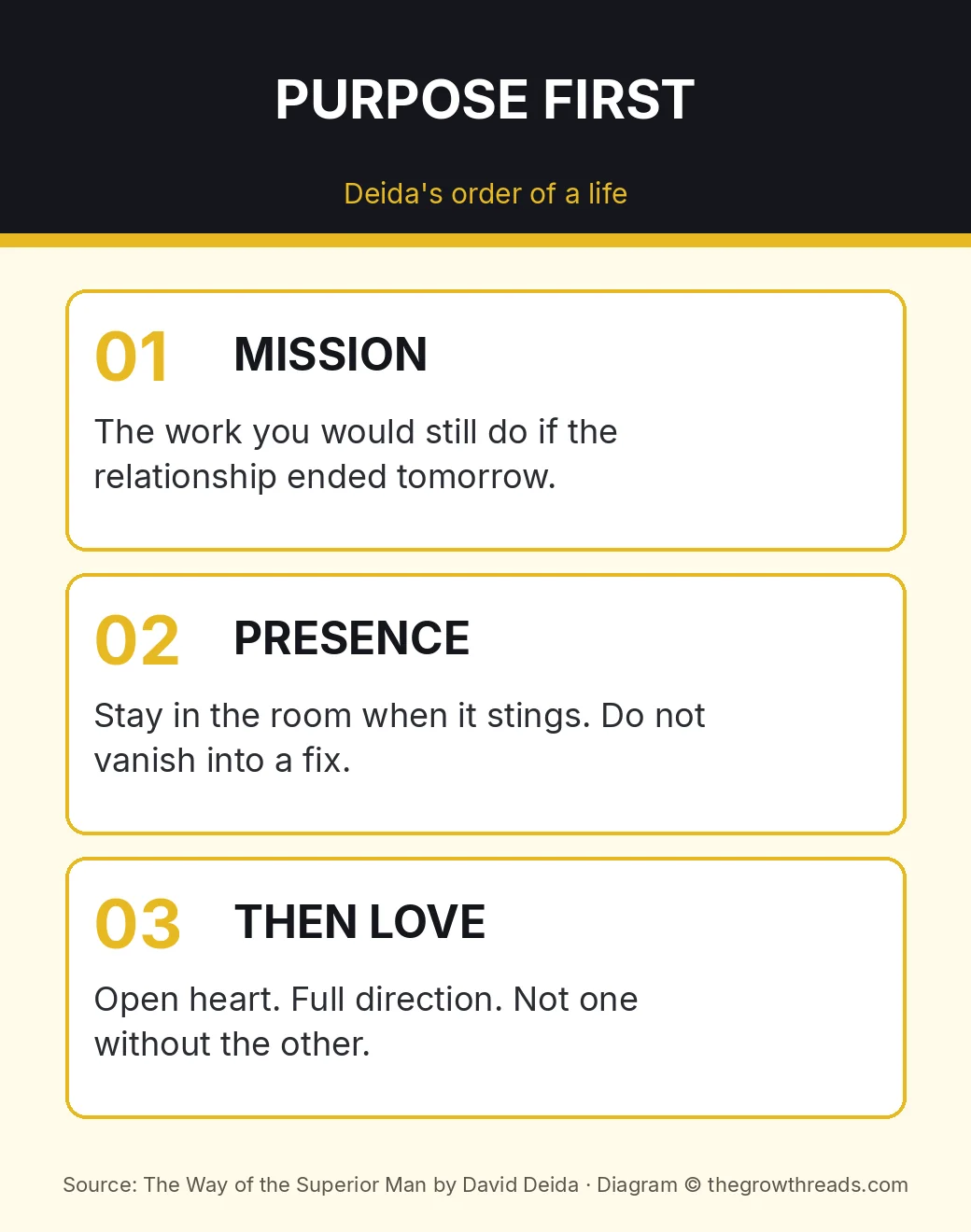
An open heart is not agreement. Feel the sting and still keep the mission. The famous line is next. Your purpose comes before the relationship, as sequence, not as cruelty. If she is the only altar, you resent ordinary needs and she feels the collapse. Stop using “we” as a hiding place. The edge is the next honest hour, just past the place you slightly fear. What did you postpone today, and what is the smallest piece you can do before bed?
TGR Note: If the collapse is people-pleasing — yes, then cold — read No More Mr. Nice Guy beside this. Glover names the childhood bargain. Deida names the posture that replaces it.
Part 2: Dealing with women
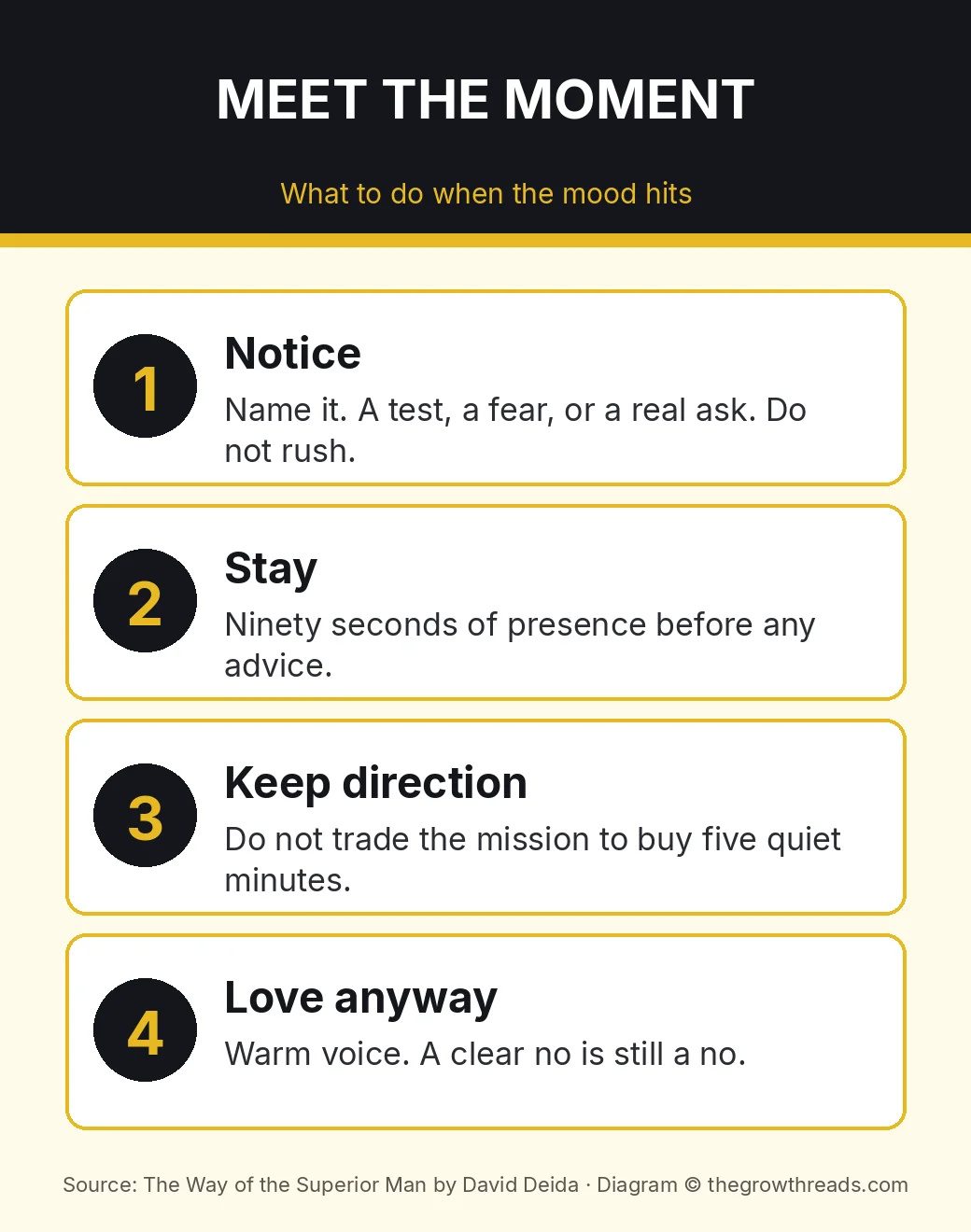
Deida says a woman will test you. The test often looks ordinary: a changed mind, a complaint, a mood that arrives when you sit down to the mission. Will you abandon what you know so the room can be pleasant? Do not collapse. Do not lecture. Stay loving and stay directed. Do not turn her feeling into a problem you solve to get your evening back.
Do not treat every upset as a fire to put out with an explanation. Ninety seconds of presence teaches more than a theory of her childhood. The dangerous half is filing every boundary under “test.” A clear no is a no. Consent, a request to stop a tone, and “the baby needs you at six” are not riddles you pass by overriding her. His frame is about not abandoning your purpose to manage a mood. It is not permission to ignore fear. If fear is the climate of the house, this is the wrong first book.
Stop making her choose your life. Three career options and then blame for the one she picked is not partnership. Offer a direction. Invite how it lands. Choose a partner who is choosing you. If you are auditioning with longer texts and smaller opinions, more performance will not create the choosing.
TGR Note: If “she is testing you” is making you dismiss a real need for reassurance, switch books. Attached maps anxious and avoidant patterns without the polarity costume. If the fight is a pursue-and-withdraw loop, Hold Me Tight is the repair manual. Use Deida for direction. Use Johnson when the bond itself is scared.
Part 3: Working with polarity and energy
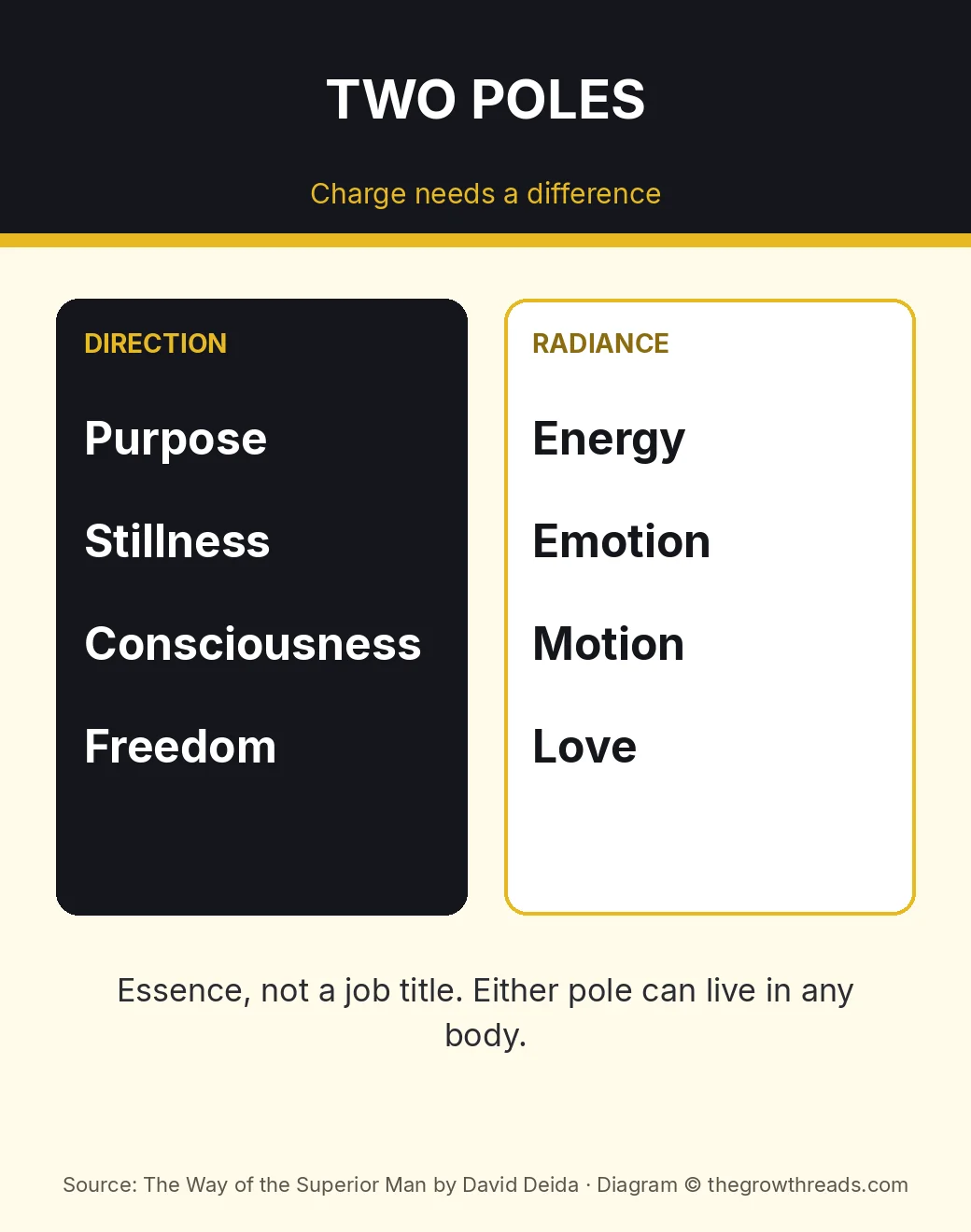
Deida says desire runs on polarity. Direction is mission, stillness, a clean aim. Radiance is energy, emotion, and love as a force. Everyone carries both. Most people lean one way. The book is for the reader who comes alive in their direction while a partner lives in radiance. These are essences, not a dress code, and not a rule that only men may carry direction.
The claim is easy to test at home. Desire goes quiet when both people spend the week as project managers of a household. Two calendars, no depth, no one allowed to be vivid. You can love someone and still feel the erotic life leave. His prescription is not a costume kit. Stop neutralizing yourself into a safe roommate. If your gift is direction, stop apologizing for a spine. If it is radiance, stop sanding the feeling down so the house stays manageable. The charge is the difference.
Own desire, anger, and ambition instead of leaking them as sarcasm or a secret habit. Owned, they become direction. Disowned, they become her second job. Say “I want” without making the want her duty. Then check your body. Are you more loving when you stop neutralizing, or only louder? If you are only louder, take the costume off.
TGR Note: Esther Perel makes a cousin of this argument without the gendered costume. In Mating in Captivity, desire needs otherness inside commitment. If Deida’s language fights you and the roommate problem is still real, Perel is the cleaner next summary. If the fight is who does the dishes, Fair Play will do more this month than another chapter on essence.
Part 4: What women really want
Deida’s answer is not a gift list. He says she wants your consciousness and your love more than your analysis, and more than the favors you use as payment for being half-gone. In his chapters that means a person who is actually in the room. Watch yourself in a hard conversation: half your mind is drafting the defense, the other half is already in tomorrow’s meeting. She can feel the empty chair. The practice is small. Phone in another room. Eyes up. One breath before the sentence. Say the true thing in a voice that is not a closing argument.
Later chapters treat attractiveness as openness, not a beauty checklist, aimed at whoever carries that pole. The body pages ask for breath, gaze, and presence instead of a rush toward a finish. This guide will not turn them into a technique list. Stay in love and in sensation. Read the exercises with a partner who is choosing them.
Give the gift you have, direction or radiance, without demanding the other person become you. Two whole gifts is the intimacy he means. A merged pile of logistics is a household. Do not get grandiose. Sometimes she wants the dentist booked and you home for bedtime. Depth does not refund a broken agreement. Forgetting the school run while you meditate on your edge is just unavailability in better clothes.
TGR Note: If you need a research-backed map of repair and friendship inside a marriage, read The Seven Principles for Making Marriage Work before another week of polarity language. Gottman asks whether you turn toward her when she reaches. Do that, and Deida’s presence practice has somewhere to land.
Who is The Way of the Superior Man best for — and who should read something else first?
Read this if you have gone flat inside a relationship you still want. You are agreeable, busy, and slightly resented, and you keep trading a mission for a quiet evening. It is especially useful for men trained to be nice instead of directed, and for any reader who abandons a masculine pole when they fear being too much. You will not get a questionnaire. You will get a posture.
Read something else first if safety is the issue. If you are afraid of your partner, start with It’s Not You. If the pattern is anxious pursuit and avoidant distance, start with Attached. If the marriage needs repair more than a philosophy of desire, start with Hold Me Tight or The Seven Principles for Making Marriage Work. If you want love as a discipline without the gender poetry, start with The Art of Loving. Come back when you are safe and tired of being pleasant and gone.
Questions to reflect on
- What work would you still do if the relationship ended on Thursday, and how many hours did it get this week?
- Which decision did you outsource so you would not have to wear the result?
- At what sentence in the last hard talk did your heart close?
- Which request was a real boundary, and which was a moment you abandoned yourself to buy peace?
- Are you more loving when you tell the truth about your direction, or only more impressed with yourself?
🔥 Ready to put the mission back in front of the mood?
Read Deida in the 20th-anniversary edition, then run the seven days before you adopt the vocabulary.
How to apply The Way of the Superior Man (7-day plan)
- Day 1 — Name the mission in one sentence. Write the work you have been postponing, in a sentence a friend could check. Spend twenty minutes on the ugly first piece. Say the sentence at dinner and do not ask her to improve it.
- Day 2 — Take one decision back. Find a choice you have been polling other people to avoid. Make it before noon. Tell the person affected. Wear an imperfect result.
- Day 3 — Reopen one closed moment. Say one true sentence about the last time you went cold: “I left when you said you were lonely.” Stay two minutes without fixing the feeling.
- Day 4 — Ninety seconds before advice. Eyes up. No analysis and no joke. Then ask whether she wants listening or a decision, and do only that.
- Day 5 — Praise one true thing. Specific, short, and free of a lesson. If you cannot find one, you are not looking.
- Day 6 — Touch the edge for twenty-five minutes. The page, the call, the boundary, or the workout you skip. When the urge to check a mood or an inbox hits, finish the block anyway.
- Day 7 — A direction conversation. Share the mission, one way you will be more present, and one agreement you have dropped. Ask what she wants more of. Repeat what you heard. Put one promise on a day.
Frequently asked questions
What is The Way of the Superior Man about?
The Way of the Superior Man is David Deida’s 1997 field manual for purpose, presence, and intimate polarity, still sold in the Sounds True 20th-anniversary edition. He writes to the reader whose gift is direction: a mission you will not trade for a quiet evening, and a heart that stays open when the room gets tense. Put the mission first. Love without collapsing into a pleaser or hardening into a statue. Desire fades when both people live in the same flattened energy. It has a chance when direction and radiance are both allowed.
Who is David Deida?
David Deida was born David Greenberg in Cleveland, Ohio, in 1958, and later took the name Deida. He studied theoretical psychobiology at the University of Florida and earned a master’s in biology from the University of California, San Diego in 1989, working with neuroscientist Francisco Varela. He taught for a time at San Jose State and was a founding associate of the Integral Institute. He left a doctoral track before the thesis and turned to workshops and books. Intimate Communion came in 1995. This book followed in 1997. He is a practice teacher, not a couples clinician.
Is The Way of the Superior Man only for men?
Deida wrote in the voice of a man speaking to men, and many examples assume a woman partner. He also says masculine and feminine are essences, not a dress code, and that either essence can live in any body. A reader who leads with direction can use the posture: mission first, heart open, do not neutralize yourself into a roommate. If the pronoun makes the book unreadable, the practice still transfers. If the whole frame feels like a costume, Mating in Captivity and The Art of Loving carry the neighboring lessons in other language.
What does Deida mean when he says a woman will test you?
In his telling, a test is a mood, a changed mind, or a complaint that arrives when you sit down to your mission. He reads it as a probe: will you abandon what you know so the room can be pleasant? Do not collapse, do not lecture, stay loving, and stay directed. Give the feeling ninety seconds of attention before you offer a fix. A clear no is not this kind of test. Consent, a request to stop a tone, and a concrete family duty are boundaries. Do not override them.
Should your purpose really come before your relationship?
Read the line as sequence, not as permission to neglect a partner or a child. Deida’s claim is that a relationship cannot be the only altar. If it is, you resent ordinary needs, and your partner feels the collapse of a person with no direction. Purpose first means the work with your name on it gets real hours, and the relationship gets a present person. It does not mean skipping bedtime or calling selfishness a mission. The school run still counts. So does the hour you have been postponing.
How is this different from No More Mr. Nice Guy?
Robert Glover’s No More Mr. Nice Guy is about the covert contract: I will be good, and then you will love me, and when you do not I will go cold. Deida assumes you can already see that collapse and offers a stance: an open heart with a spine, and a mission that is not her job to provide. Read Glover to name the childhood bargain. Read Deida for the daily posture. They point at the same failure, the man who abandons himself and calls it love.
Is Deida’s masculine and feminine language outdated?
Some readers find the gender language dated, and critics have called parts of the work one-sided. Deida’s frame is that masculine and feminine are essences any gender can carry, direction on one side and radiance on the other. You can test the practical core without adopting the poetry. Did you trade a mission for a quiet evening? Did you close your heart to stay easy? Did desire go quiet because both of you became project managers? If those questions help, use them. If they excuse ignoring a boundary, close the book.
Related summaries
- No More Mr. Nice Guy — the people-pleasing collapse this book stands you up from.
- Attached — when “she is testing you” is a sloppy read of anxiety.
- Mating in Captivity — desire and distance without the gendered costume.
- The Art of Loving — love as a practice, not a mood you catch.
More in the silo: the best relationship books.
How we analyze books: our summaries are built from a full read of the source text, cross-referenced against the author’s published interviews and research where relevant, and structured around practical application rather than critique. Read our full methodology.