

TGR Verdict: ★★★★☆ 4.4/5
A groundbreaking, still-relevant case that male depression hides in plain sight — disguised as workaholism, addiction, anger, or withdrawal — and passed down silently from father to son.
I Don’t Want to Talk About It in one minute
Family therapist Terrence Real’s breakout 1997 book argues that depression in men is often invisible, not because men don’t experience it, but because masculine cultural conditioning pushes it into disguise. Instead of visible sadness, male depression frequently shows up as workaholism, addiction, rage, affairs, or emotional withdrawal — behaviors culture reads as “just how men are” rather than as depression in another form. Drawing on his own family history as the son of a violent, depressed father alongside decades of clinical case studies, Real traces how this pattern passes silently from one generation of men to the next, and argues that grandiosity and depression are two expressions of the same underlying shame rather than opposites.
Key takeaways
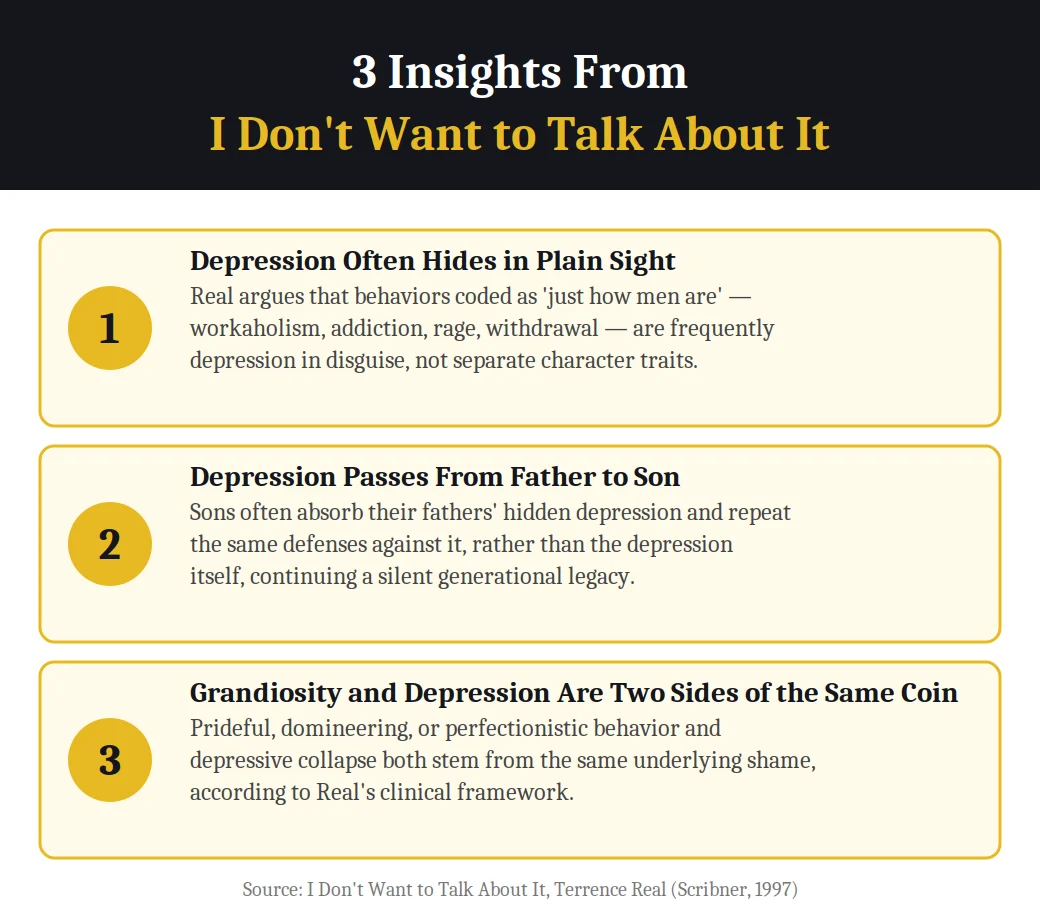
- Male depression is often “covert” — expressed through masculine-coded behavior like workaholism, addiction, rage, or withdrawal rather than visible sadness.
- “Overt depression” — the recognizable, visible presentation of sadness and hopelessness — is culturally coded as feminine, pushing men’s depression into hiding instead.
- Depression is frequently passed down from father to son, with sons absorbing not the depression itself but the same defenses against it.
- Grandiosity and depression are two sides of the same coin — prideful, domineering, or perfectionistic behavior shields the same underlying shame as depressive collapse.
- Masculine socialization actively trains boys away from emotional fluency and connection, rewarding stoicism and toughness instead.
- Behind covert depression’s outward behaviors — addiction, affairs, workaholism — is frequently unprocessed childhood trauma and shame.
- Recovery requires naming the inherited pattern directly rather than treating destructive adult behavior as unrelated to a father’s own hidden depression.
- Breaking the cycle means processing the underlying shame rather than continuing to defend against it through achievement, anger, or distance.
- Real writes as both clinician and son of a depressed, violent father, grounding the book’s clinical framework in his own family history.

What is I Don’t Want to Talk About It about?
I Don’t Want to Talk About It is Terrence Real’s foundational book on hidden male depression, mixing clinical case studies from his therapy practice with his own family history as the son of a violent, depressed father. Real’s central argument is that depression in men frequently goes unrecognized because it doesn’t look like depression at all — it looks like workaholism, addiction, anger, affairs, or emotional distance, all of which culture reads as separate character issues rather than as depression in disguise. The book traces how this covert depression gets passed from father to son across generations, and lays out a recovery path built on naming the inherited pattern, processing the shame underneath it, and restoring damaged relationships.
About the author
Terrence Real is a family therapist who founded the Relational Life Institute in 2002 to train other therapists in his Relational Life Therapy model. I Don’t Want to Talk About It (1997) was his breakout book, a bestseller credited with helping popularize public discussion of male depression; he followed it with How Can I Get Through to You? (2002), The New Rules of Marriage (2007), and Us (2022), a New York Times bestseller. His work has been featured on Today, Good Morning America, and Oprah, and covered in The New York Times, Psychology Today, and Esquire. Explore all Terrence Real book summaries →
Key concepts at a glance
| Concept | What it means |
|---|---|
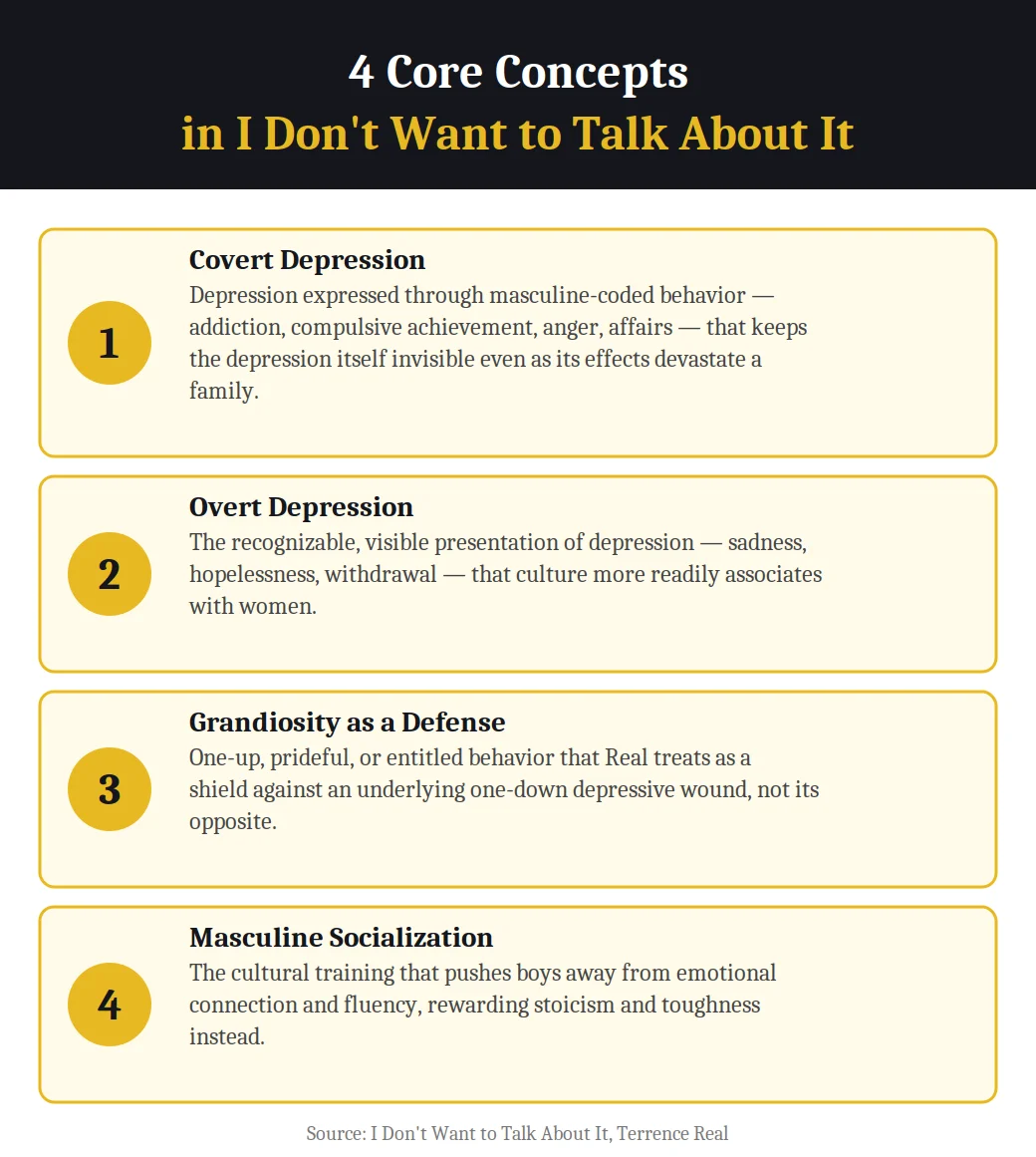
| Covert Depression | Depression expressed through masculine-coded behavior — addiction, compulsive achievement, anger, affairs — that keeps the depression itself invisible. |
| Overt Depression | The recognizable, visible presentation of depression — sadness, hopelessness, withdrawal — culturally coded as feminine. |
| Grandiosity as a Defense | One-up, prideful, or entitled behavior that shields an underlying one-down depressive wound, rather than being its opposite. |
| Generational Transmission | The pattern of sons absorbing their fathers’ hidden depression and repeating the same defenses against it. |
| Masculine Socialization | The cultural training that pushes boys away from emotional connection and fluency, rewarding stoicism and toughness instead. |
Part 1: The hidden face of male depression
Real opens by naming the central problem: male depression is a “silent epidemic,” hidden not because men don’t suffer it but because visible sadness is stigmatized as unmasculine. Instead, depression gets expressed through behaviors that read as separate character traits rather than depression itself — workaholism framed as ambition, addiction framed as a private vice, rage framed as a short temper, and emotional withdrawal framed as simply being a quiet or private person. Real’s clinical argument is that these are frequently not separate from depression but are depression’s disguise, each one protecting against the shame of visible vulnerability at the cost of real connection and health.
TGR Note: This idea that destructive behavior is often a defense against an underlying wound connects directly to Real’s later concept of “losing strategies” in The New Rules of Marriage, where retaliation and withdrawal are reframed as reactive habits rather than fixed character traits.
Part 2: Grandiosity, shame, and the covert/overt divide
A central clinical framework in the book is Real’s distinction between covert and overt depression, and his argument that grandiosity and depression are two expressions of the same underlying shame rather than opposites. A man who appears domineering, prideful, or perfectionistic isn’t necessarily the opposite of a depressed man — he may be defending against the exact same depressive wound through a different, more socially rewarded behavior. Real argues that culture’s discomfort with visible male sadness (overt depression) actively pushes men toward these covert expressions instead, since workaholism and even anger are more socially acceptable than tears.
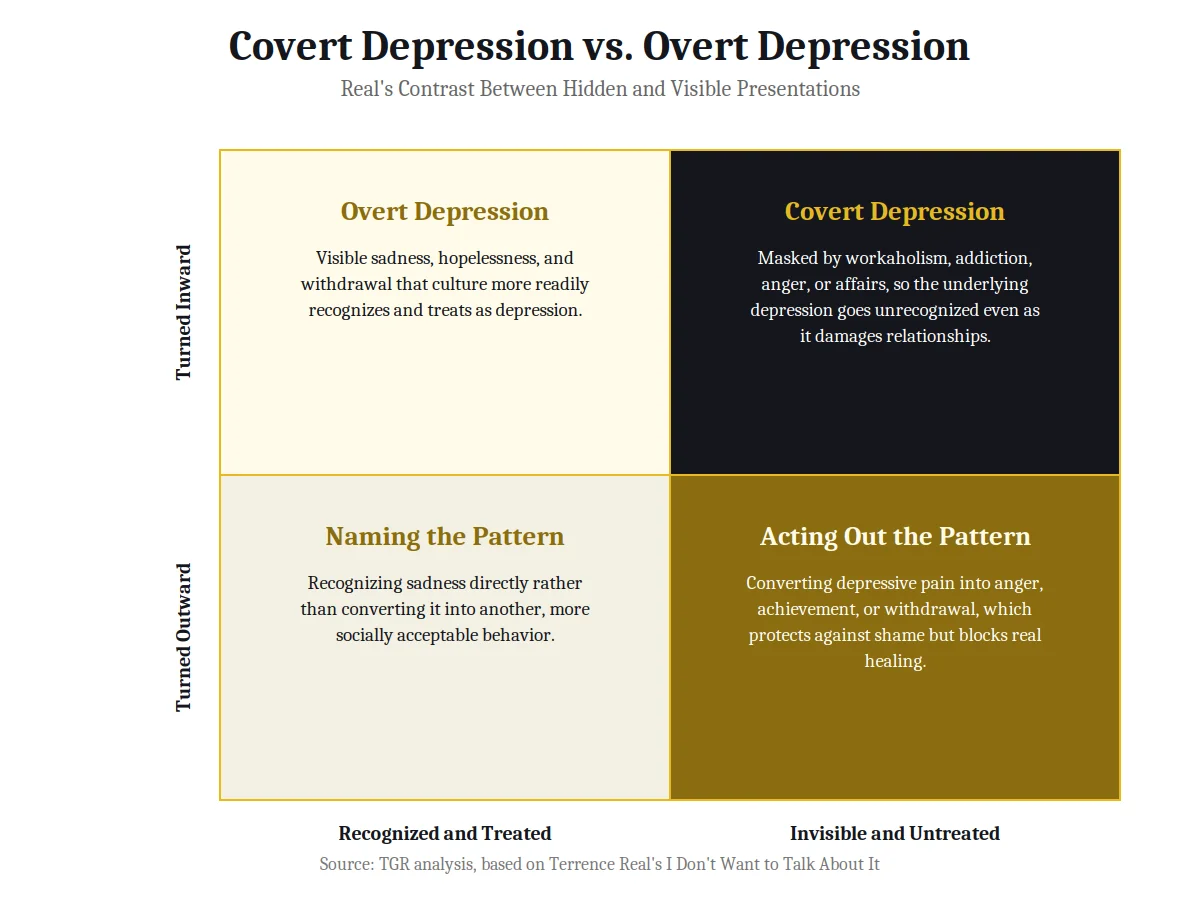
TGR Note: This one-up/one-down framework is the same lens Real later applies to marriage directly in The New Rules of Marriage, where he argues partners should relate from a position of “same-as” rather than dominance or submission.
Part 3: Breaking the generational legacy
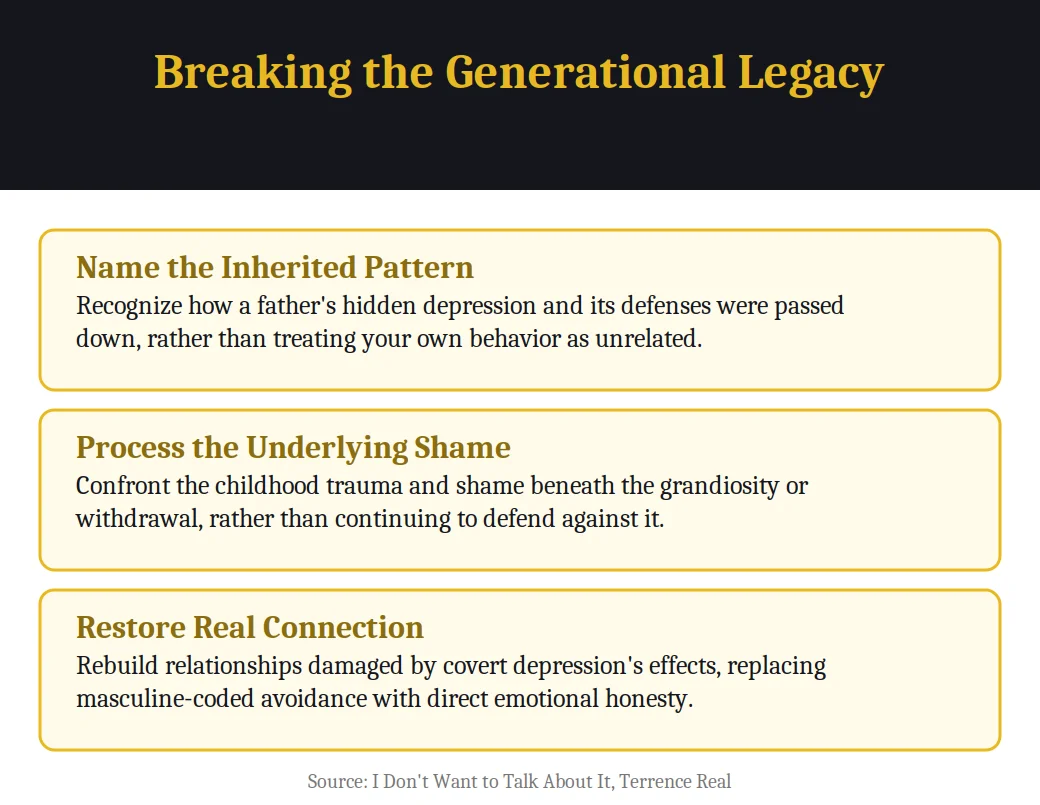
Drawing on his own family history as the son of a violent, depressed father, Real argues that covert depression is frequently passed down across generations — not the depression itself, necessarily, but the same defenses against it. A son who grows up around a father’s hidden depression often absorbs the same patterns of avoidance, achievement-seeking, or anger as protection against an unnamed family shame. Real’s proposed recovery path asks men to name this inherited pattern directly, process the childhood trauma and shame underneath it rather than continuing to defend against it, and rebuild the relationships damaged by years of covert depression’s effects.
Who is I Don’t Want to Talk About It best for?
This book is best for men who suspect their anger, workaholism, addiction, or emotional distance might be masking something deeper, as well as partners and family members trying to understand a man in their life whose depression has never looked like depression. It’s especially valuable for anyone examining generational patterns passed from father to son, whether or not those patterns have ever been named directly.
It pairs well with our The New Rules of Marriage summary, Terrence Real’s later book applying many of these same concepts directly to marital conflict and communication.
Questions to reflect on
- Have you or a man in your life expressed depression through workaholism, addiction, anger, or withdrawal rather than visible sadness?
- Can you trace a pattern of hidden depression or its defenses back a generation, from a father to yourself or a partner?
- Do you notice grandiosity or perfectionism in yourself functioning as a shield against an underlying sense of shame?
- How did the culture you grew up in teach you, or the men around you, to handle sadness or vulnerability?
- What would it look like to name an inherited pattern directly instead of continuing to defend against it?
How to apply I Don’t Want to Talk About It (7-day plan)
- Day 1: Reflect on whether a behavior in your life — overwork, a habit, anger, distance — might be functioning as a disguise for something deeper.
- Day 2: Trace whether that pattern echoes something you saw in a father or father figure growing up.
- Day 3: Notice a moment of grandiosity or perfectionism and consider what shame it might be shielding.
- Day 4: Reflect on how you were taught, explicitly or implicitly, to handle sadness or vulnerability as a child.
- Day 5: Practice naming a difficult feeling directly to yourself, rather than converting it into action.
- Day 6: If safe and appropriate, share one honest feeling with someone close to you instead of deflecting it.
- Day 7: Reflect on what breaking an inherited pattern, rather than just managing its symptoms, might require.
Frequently asked questions
What is “covert depression” in I Don’t Want to Talk About It?
Covert depression is Terrence Real’s term for depression expressed through masculine-coded behavior — addiction, compulsive achievement, anger, affairs — that keeps the depression itself invisible even as its effects devastate a family.
How does depression pass from father to son according to this book?
Real argues sons often absorb not the depression itself but the same defenses their fathers used against it, repeating patterns of avoidance, achievement-seeking, or anger across generations.
What does Real mean by grandiosity and depression being “two sides of the same coin”?
He argues that prideful, domineering, or perfectionistic behavior and depressive collapse both stem from the same underlying shame, functioning as two different defenses rather than opposite personality types.
Is this book only for men?
While it’s centered on male depression specifically, it’s also valuable for partners, family members, and anyone trying to understand a man in their life whose depression has never looked like textbook depression.
Who is Terrence Real?
Terrence Real is a family therapist who founded the Relational Life Institute in 2002; I Don’t Want to Talk About It (1997) was his breakout book, followed by The New Rules of Marriage (2007) and Us (2022), a New York Times bestseller.
How does I Don’t Want to Talk About It relate to The New Rules of Marriage?
The New Rules of Marriage extends many of the same concepts from this earlier book — like the one-up/one-down dynamic and the cost of unprocessed emotional defenses — directly into marital conflict and communication.
Does the book offer a specific recovery framework?
Real’s stated recovery path involves naming the inherited pattern, processing the childhood trauma and shame beneath it, and restoring relationships damaged by years of hidden depression’s effects.
Related summaries
If you found I Don’t Want to Talk About It valuable, read our The New Rules of Marriage summary for more from Terrence Real, or explore our full list of best relationship books.
Our methodology: TGR book summaries are researched using the original text, publisher materials, author interviews, and critical reception, then structured to give you the core arguments, practical applications, and an honest verdict on who the book is best for.
Related Relationships Summaries
How to Win Friends and Influence People Summary & Review: Carnegie’s Timeless Playbook
I Hear You Summary & Review: The Validation Skill That Transforms Every Relationship
Never Split the Difference Summary & Review: FBI Negotiation Tactics for Everyday Life
Nonviolent Communication Summary & Review: Replace Blame With Connection
The New Rules of Marriage Summary and Review