

★★★★½ 4.5/5 — a field manual for leaving the official line and inventing a way in.
Best for: People who already work hard and still wait to be picked — jobs, mentors, clients, rooms they can see but cannot enter
Reading time: ~8 hours (320 pages) if you binge · this guide ~12 min
Difficulty to apply: Easy to see — three doors. Hard to keep — you have to send the ask while it still feels too soon
The Third Door in one minute
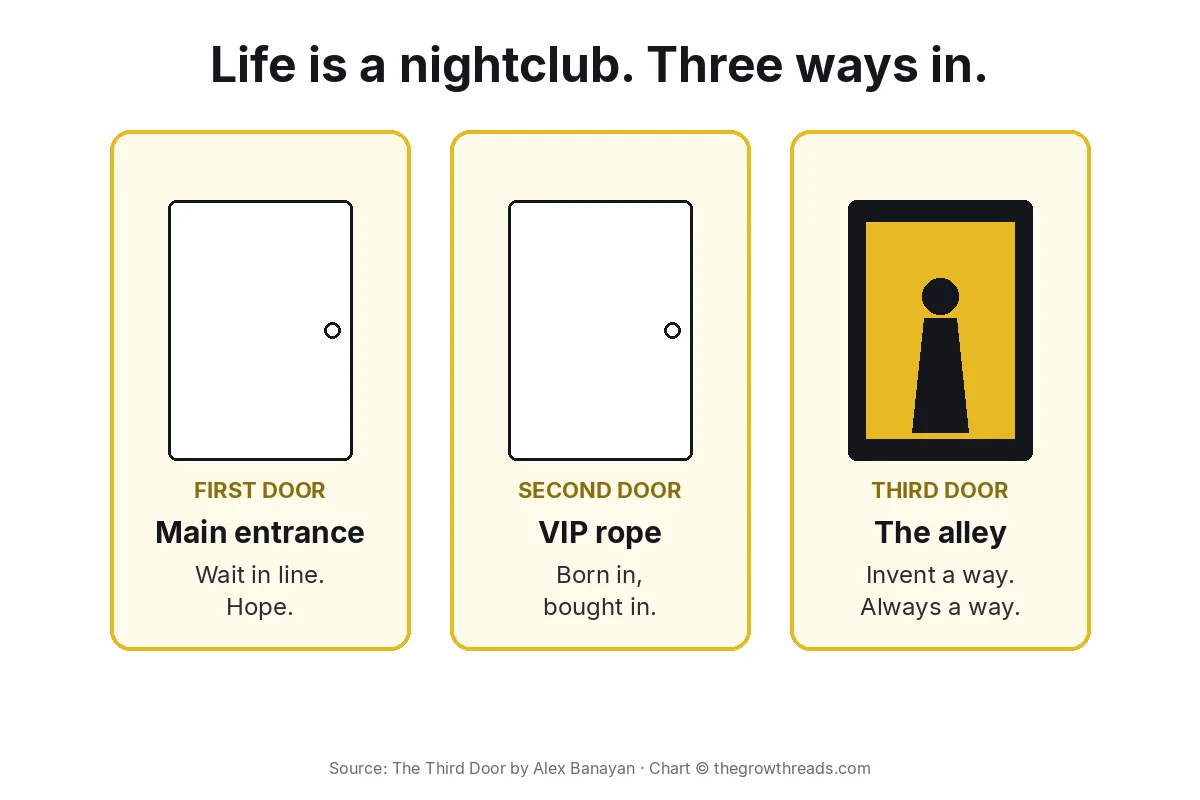
Stop waiting at the main entrance. There is always a third door. Alex Banayan’s The Third Door (Currency, 2018) is an 18-year-old’s quest memoir with a usable rule: life and access behave like a nightclub. Most people queue at the first door. A few glide through VIP. The people whose careers we study invent a side entrance — an alley, a specific ask, someone already inside. Banayan funded the hunt on The Price Is Right, then spent years collecting conversations with Bill Gates, Maya Angelou, Steve Wozniak, Jane Goodall, Larry King, Tim Ferriss, and others. This summary is the application layer: one line you will leave, one inside person, one sentence they can forward, and a 7-day plan.
Key takeaways
- Three doors, not two: Official line, VIP rope, and the alley you invent. High performers use the third.
- Ditch the line first: The posted path (pre-med, job board, “wait until I’m ready”) is a tour bus. You can step off.
- The Spielberg Game: Leave the itinerary, find one inside person, ask them to bring you in. Skip a step and you are still sightseeing.
- A specific ask beats a dream: Busy people can forward a sentence. They cannot forward a vibe.
- Linear vs exponential: College → internship → permission is one model. Successful people opt into a path that jumps when the window is open.
- The Avoidance List: Write 25 wants, keep 5, treat the other 20 as forbidden busywork. Focus is subtraction.
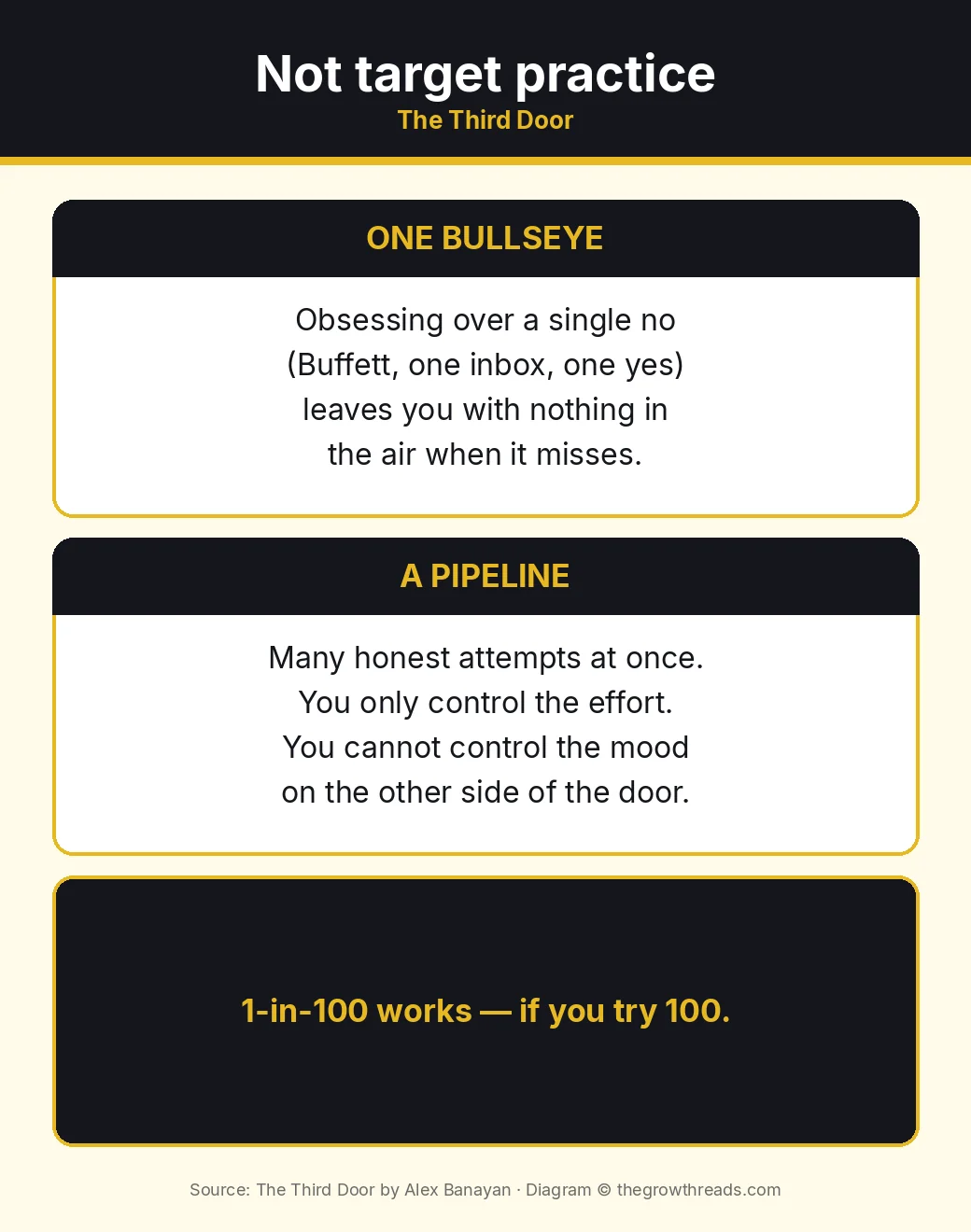
- Business is not target practice: One Buffett-sized bullseye leaves you empty when it misses. Keep a pipeline of attempts.
- 1-in-100 is a volume problem: Dean Kamen’s math: if you will not try a hundred times, you never bought the odds.
- Define success before you pick a door: Wozniak’s version is not Jobs’s. The wrong VIP rope is still a trap.
- Possibility is the real payload: Tools without a changed “what is allowed” still leave you in line.
What is The Third Door about?
The Third Door is Alex Banayan’s 2018 account of how high performers actually get in — not through the main line or the VIP rope, but through a side door they invent. The usable move is one specific ask, one inside person, and a pipeline of attempts instead of a single bullseye.
About the author
Alex Banayan was an 18-year-old USC freshman on a pre-med track when he decided the book he wanted to read did not exist — so he would write it. He funded the quest by winning a run on The Price Is Right, promised his family he would finish school, then spent years hunting interviews with Bill Gates, Maya Angelou, Steve Wozniak, Jane Goodall, Larry King, Jessica Alba, Pitbull, Tim Ferriss, Quincy Jones and others. The Third Door (Currency, 2018) is that report. He is a speaker who turned the same access thesis into a career, not a lab researcher. The through-line is practical: stop waiting for the posted opening, find someone already inside, and ask in a sentence a busy person can answer. Explore all Alex Banayan book summaries →
Key concepts at a glance
| Concept | What it means | Use it when |
|---|---|---|
| First door | The official line. Wait and hope. | You are refreshing a portal |
| Second door | VIP. Born in or bought in. | You are copying a last name |
| Third door | An entrance you invent | The posted path is stalled |
| Spielberg Game | Leave the tour, find an insider, ask | You are still sightseeing |
| Inside person | Someone whose reputation opens a latch | Cold volume is going nowhere |
| Exponential life | Jump when the window is open | You are waiting for permission |
| Avoidance List | Keep 5 wants, forbid the other 20 | You are busy and unmoved |
| Pipeline | Many attempts, not one bullseye | One no ended the week |
Part 1: Ditch the line
Banayan opens in a dorm, already good at surviving other people’s checklists. Pre-med. Grades. A degree that no longer arrives with a guarantee. The itch is not “hustle harder.” It is that no book on the shelf is written for the launch stage he is in. If the book does not exist, write it. That decision is the first third door: leave the official story of a serious freshman year. He still promises family he will finish school. He still needs money. The next day he plays The Price Is Right and wins a budget that looks, from the outside, like a joke.
The first-door habit is waiting to be picked: the job board, the posted internship, the “I’ll reach out when I have a real project.” Banayan’s claim is not that rules are fake. It is that the people whose careers we screenshot did not treat the posted entrance as the only legal one. Qi Lu’s later reminder is about the same 24 hours everyone gets — luck as a bus you can miss, but only if you are not standing where it stops. The TGR translation is smaller than a game-show plot. Name the line you are in this week. Then name the tour bus you will step off. If you cannot name it, you are still decorating the queue.
TGR Note: If the “line” is a default 40-year career, start with our 4-Hour Workweek summary — that is the book that cracked Banayan open. If the stall is becoming the person who gets asked, Linchpin is the craft layer. This book is the access layer.
Part 2: The Spielberg Game
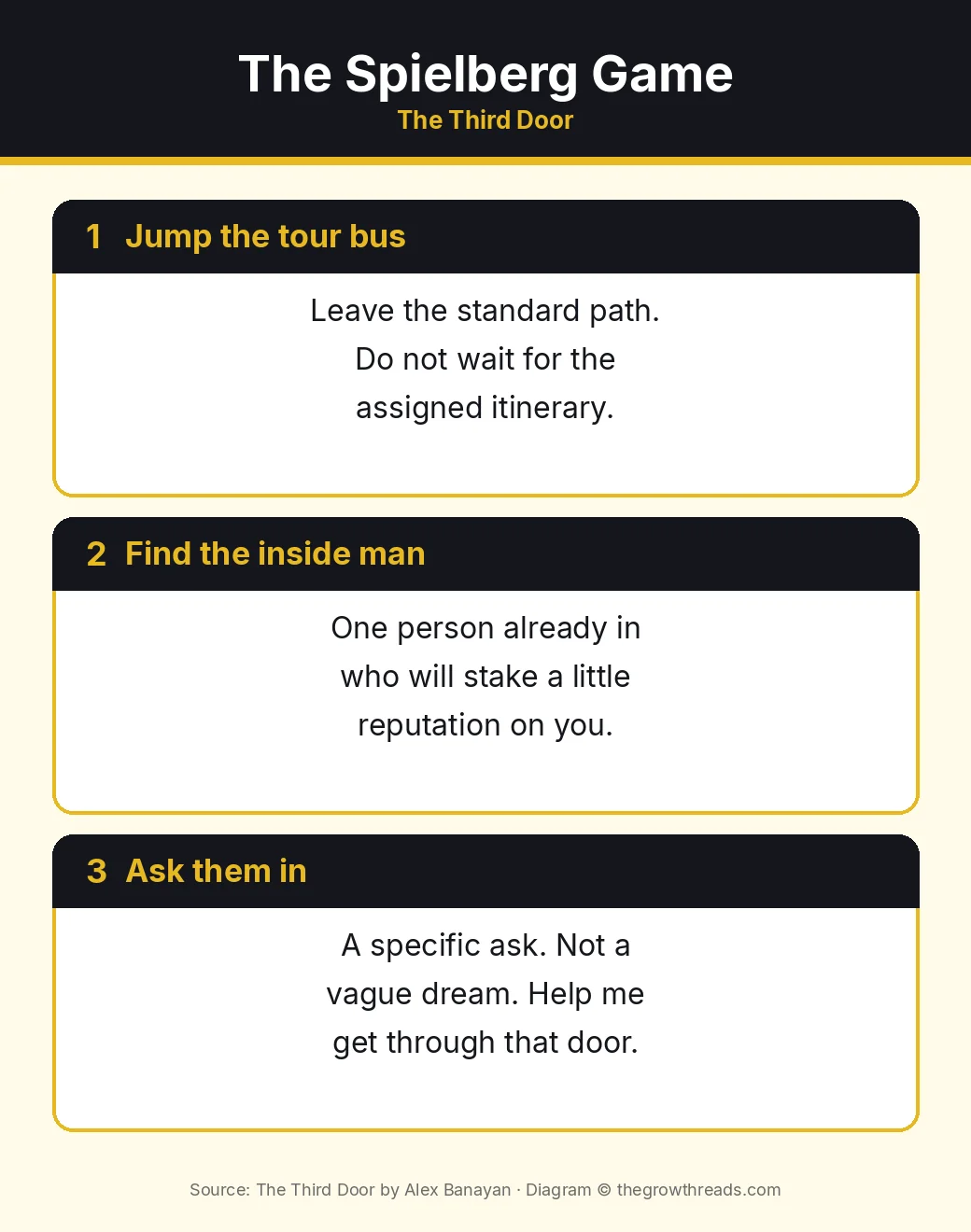
The second movement is tactics. Banayan names a three-step drill after the Spielberg folklore: a kid who leaves the studio tour, finds someone already on the lot, and asks to be walked in. Step one is jumping the bus — abandoning the assigned itinerary. Step two is the inside person, willing to put a little reputation on the line. Cold volume without that person is just a louder queue. Step three is the ask. Not “can I pick your brain.” A request a busy human can forward in two lines. Tim Ferriss’s email advice in the book is the opposite of the template everyone sends: lower the burden, borrow credibility honestly, and back off if you become a hassle.
“Nobody achieves a dream from the comfort of certainty,” Banayan writes. The flinch before you knock is the tell that you are still on the tour. Linear life says you must complete x, y, and z before you are allowed to want the thing. Exponential life says when the window is in front of you, you move. Tony Hsieh’s throwaway line is the whole chapter: he would let people shadow him, but “no one ever asks.” The chart in this part is the game as three cards. If you cannot point at all three, you are still hoping the bouncer notices.
TGR Note: Need a stack of mentor answers without the quest plot? Tribe of Mentors and Tools of Titans are the sibling shelves. If the flinch is quitting in the middle, The Dip asks whether this is a third door or a hole.
Part 3: Trudge through the mud
The third movement is what happens after the cute origin story. Gates’s office says come back when you have momentum. Buffett’s world says no, then no again. Banayan flies to Omaha anyway and learns that obsession with one bullseye is not strategy. A mentor’s correction is the operational rule: business is not target practice. Put many balls in the air. You cannot control the mood on the other side of a door. You can control whether you have a pipeline. Dean Kamen’s version is statistical: a one-in-a-hundred shot becomes a plan only if you will actually take a hundred shots. Giving up at attempt twelve is refusing to buy the odds you claimed to believe.
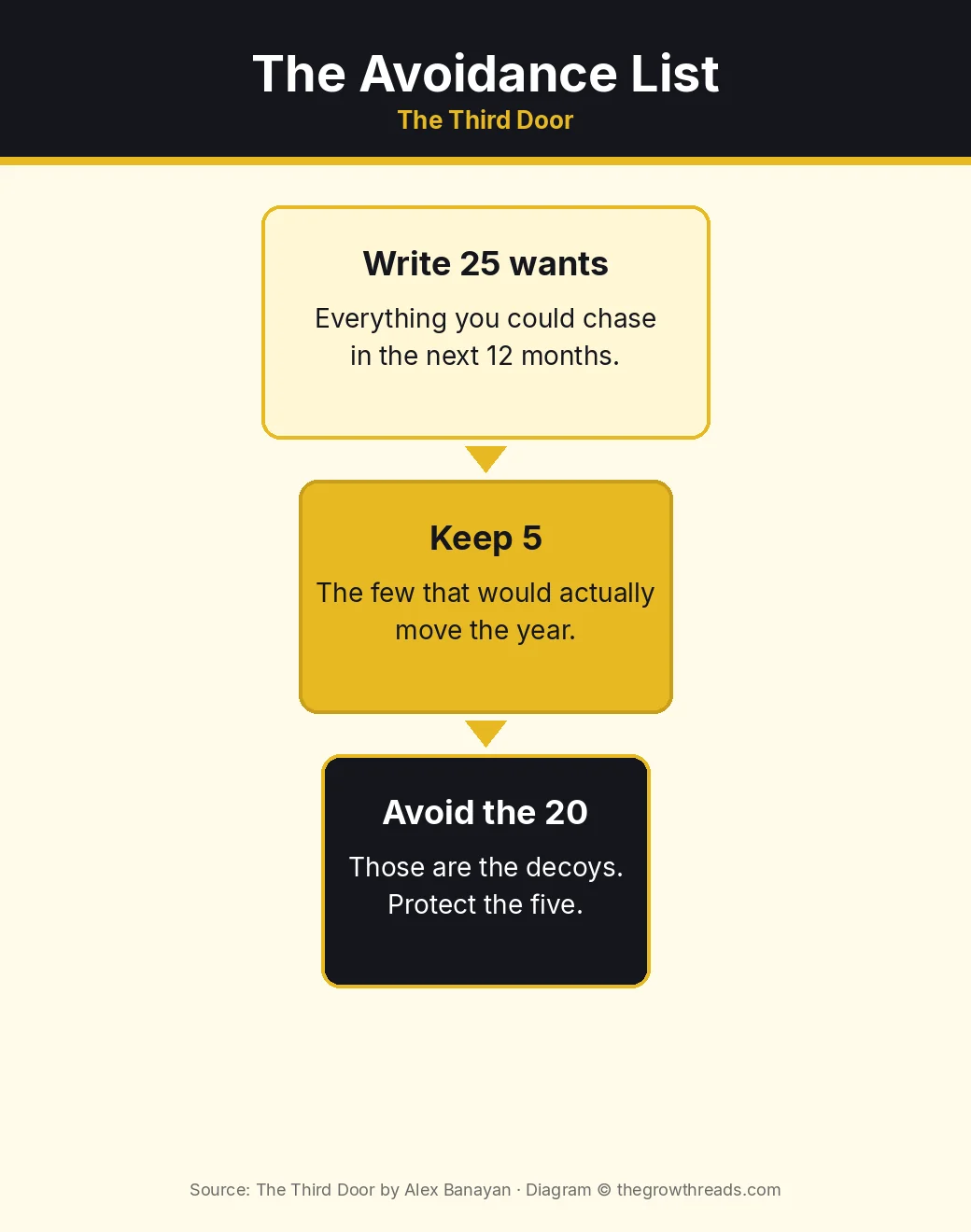
The Avoidance List is the other half of the mud. Write twenty-five things you want in twelve months, keep the five that matter, cross out the rest. Extraordinary results come from being world-class at a few things. The key to the five is avoiding the twenty — the extra brand, the extra meeting — that feel like third doors and are actually more line-standing. Banayan also has to stop copy-pasting other people’s playbooks. Agent emails written like a how-to blog go nowhere; the version that sounds like him lands. Study the greats, then bet on what is actually true of you. The funnel infographic is the list. The pipeline infographic is the other half: many attempts, one forbidden bullseye addiction.
TGR Note: A pipeline of attempts without a written blacklist becomes twenty hobby doors. Pair the Avoidance List with Essentialism if the problem is too many yeses, or with Who Not How if the missing piece is a person, not more hours. Banayan wants both: fewer goals, more honest shots.
Part 4: Take the third door
The last movement is what the access was for. Banayan does get the Gates conversation. He still does not get Buffett, and the no hardens. The lesson is not “try harder on the same latch.” It is: am I the kind of person people want to help? A tipping point, he argues, is a story you tell later. In the week it is little steps, a pipeline, and an offer people cannot refuse because it is actually useful. Wozniak quietly detonates the scoreboard: build something that changes the world, live on your own terms, and treat happiness as doing what you want every day. Society’s VIP rope is not a success definition. It is a second door with better lighting.
The later interviews — Maya Angelou, Jane Goodall, Pitbull, Quincy Jones — are less “how did you hack the lot” and more “what is the work for.” Pitbull’s intern-for-life line is craft: if you remember the floor, no one can bluff you later. Lady Gaga appears because he did the homework, then became useful in the room. The closing claim is the one to steal: when you change what you believe is possible, you change what becomes possible. Tools without that shift still leave you refreshing the same portal. The 7-day plan is one ask and one Avoidance List, not a celebrity itinerary.
TGR Note: If the third door you want is actually an identity war, Can’t Hurt Me is the callousing layer. If you need the belief that ability can grow before you knock, Mindset is the pairing. Banayan is the ask. Those books are the floor.
Who is The Third Door best for — and who should read something else first?
Best for people who already produce and still wait to be invited — a job, a mentor, a client, a room they can see from the pavement. Run the 7-day plan on one real line, not on other people’s nightclubs.
Read something else first if no small daily act sticks: Atomic Habits. If the problem is quitting in the hard middle: The Dip or Grit. If you need to become useful before you ask: Linchpin or So Good They Can’t Ignore You. If you want a stack of mentor answers without the quest memoir: Tribe of Mentors and Tools of Titans. If the cage is the default 40-year career: The 4-Hour Workweek. If the stall is suffering-as-identity: Can’t Hurt Me.
Questions to reflect on
- What official line are you standing in this week, and who benefits if you stay there?
- Who is the inside person you have not named because naming them would make the ask real?
- What would a two-line request look like if they could forward it without a meeting?
- Which twenty “goals” are decoys protecting you from the five that would move the year?
- If this door opened, whose definition of success would you be walking into?
🔥 Ready to leave the main-entrance line?
Get The Third Door, then run the 7-day plan on one real ask — not on a highlight reel of other people’s nightclubs.
How to apply The Third Door (7-day plan)
- Day 1 — Name the line. Write one sentence: the official queue you are standing in (job board, inbox, waiting to be picked). If you cannot point at it, you are still in a story.
- Day 2 — Jump one tour bus. Pick one default path you will leave this week (the ‘wait until I’m ready’ rule). Replace it with a two-hour action, not a rebrand.
- Day 3 — Name the inside person. One human already in the room. Full name. How you know them, or how you will reach the person who knows them. No ‘someone in marketing.’
- Day 4 — Write the ask. One sentence they can forward. What you want, why them, why now, how little time it takes. Send it. If you flinch, send it anyway and log the flinch.
- Day 5 — Build a pipeline of three. Add two more parallel attempts — different doors, same goal. Banayan’s rule: business is not one bullseye. Put three balls in the air.
- Day 6 — Run the Avoidance List. Write 25 wants for the next 12 months. Circle five. Cross out twenty. The twenty are now forbidden busywork for 30 days.
- Day 7 — Review the doors, not the mood. What moved: a reply, a no, a better sentence? Schedule a 20-minute weekly third-door review. The book only works if next Tuesday still has an ask.
Frequently asked questions
What is The Third Door about in one paragraph?
The Third Door is Alex Banayan’s 2018 field report on how high performers actually get in. He treats success like a nightclub: most people wait at the main door, a few walk through VIP, and the people we study invent a third door. The book is a quest memoir, not a lab paper. The usable layer is small: one inside person, one concrete request, a pipeline of attempts instead of one bullseye, and an Avoidance List so twenty decoy goals do not steal the week. You do not need a TV prize. You need one side door you will knock on.
What is the third-door metaphor?
Banayan’s picture is a club with three ways in. The first door is the official line: applications, waiting, hoping. The second is VIP — money, last names, invitations you did not earn this week. The third is the entrance nobody prints on the flyer. You leave the line and invent a way: a warm intro, a useful offer, showing up, asking after a polite no. Gates selling early software and Spielberg leaving the studio tour are told as third-door stories, not magic. Name the line you are standing in. Then name one honest move that is still allowed. That is the door.
What is the Spielberg Game?
The Spielberg Game is Banayan’s three-step access drill, named after the folklore of a young Spielberg leaving the studio tour and finding someone already inside. Step one: jump the tour bus — leave the itinerary you were handed. Step two: find an inside person whose reputation can open a latch you cannot open from the pavement. Step three: ask them to bring you in, with a specific request, not a vibe. Persistence without an inside person is noise. An inside person without an ask is coffee. The 7-day plan is a miniature: one bus, one name, one sentence they can forward.
How is The Third Door different from The 4-Hour Workweek or Can’t Hurt Me?
The 4-Hour Workweek is the lifestyle-design manual that cracked Banayan’s default path — asking for the opposite of the posted route. Can’t Hurt Me is the callousing manual: stay in the arena when your brain wants out. The Third Door is the access manual those books still need. Ferriss redesigns the game. Goggins stays. Banayan gets a meeting without waiting for a title. Read Ferriss if your calendar is a cage. Read Goggins or Grit if you quit when it stings. Read this if you already work and still cannot get in the room. The plan is one ask, not a new identity.
Did Banayan really interview Bill Gates and the others?
Yes on the core list the book is built on: Gates, Maya Angelou, Steve Wozniak, Jane Goodall, Larry King, Jessica Alba, Pitbull, Tim Ferriss, Quincy Jones, and others appear as reported conversations. Some attempts fail in public — Buffett stays mostly closed; a Zuckerberg brush does not land. That is part of the lesson. Banayan is a journalist-adventurer with a book deal, not a random intern with a template. Steal the method — inside person, specific ask, pipeline — rather than the itinerary of TV prizes and nightclubs. The interviews are color. The pipeline is the Tuesday tool.
I hate ‘hustle.’ Is this still for me?
If hustle means spam or treating people like vending machines, skip that cartoon. Banayan’s useful version is narrower: stop waiting for a posted opening, make a request a busy person can answer in two lines, and keep more than one attempt alive so one no does not become a personality. The Avoidance List exists so you do not hustle twenty things. Pick five. Ignore the rest. If even one honest ask feels unbearable, start with Tribe of Mentors or Linchpin — become useful before you talk about access. Then come back for Day 3: one named inside person, one sentence.
Is The Third Door still useful in 2026?
The nightclub picture aged better than the specific hacks. Inboxes got worse. Cold email got cheaper and noisier. AI can draft a hundred pitches that all sound the same. That makes Banayan’s opposite-advice more relevant: borrowed credibility, one specific ask, in-person when the thread dies, and a pipeline so you are not begging one gatekeeper. Ignore the quote-graphic that turns “third door” into a poster. Keep the Spielberg Game, the Avoidance List, and a weekly review of which balls are actually in the air. Day 1 should still be a real line you are standing in this week.
Related summaries
- The 4-Hour Workweek Summary & Review
- Tools of Titans Summary & Review
- Tribe of Mentors Summary & Review
- Linchpin Summary & Review
- Best Productivity Books
How we analyze books: every book on The Growth Reads is read cover to cover, summarized in thousands of words of original analysis, and rated against our five-criteria rubric (lasting impact, evidence quality, practical application, writing & originality, external consensus). Read our full methodology.