

★★★★½ 4.5/5 — a daily practice, not a bookshelf trophy.
Best for: Readers who stall in Greene’s long books, plus anyone who wants one usable law before the inbox opens
Reading time: ~9 hours (464 pages) if you binge · this guide ~14 min
Difficulty to apply: Easy to start — one page. Medium to keep — you have to use the line that stung
The Daily Laws in one minute
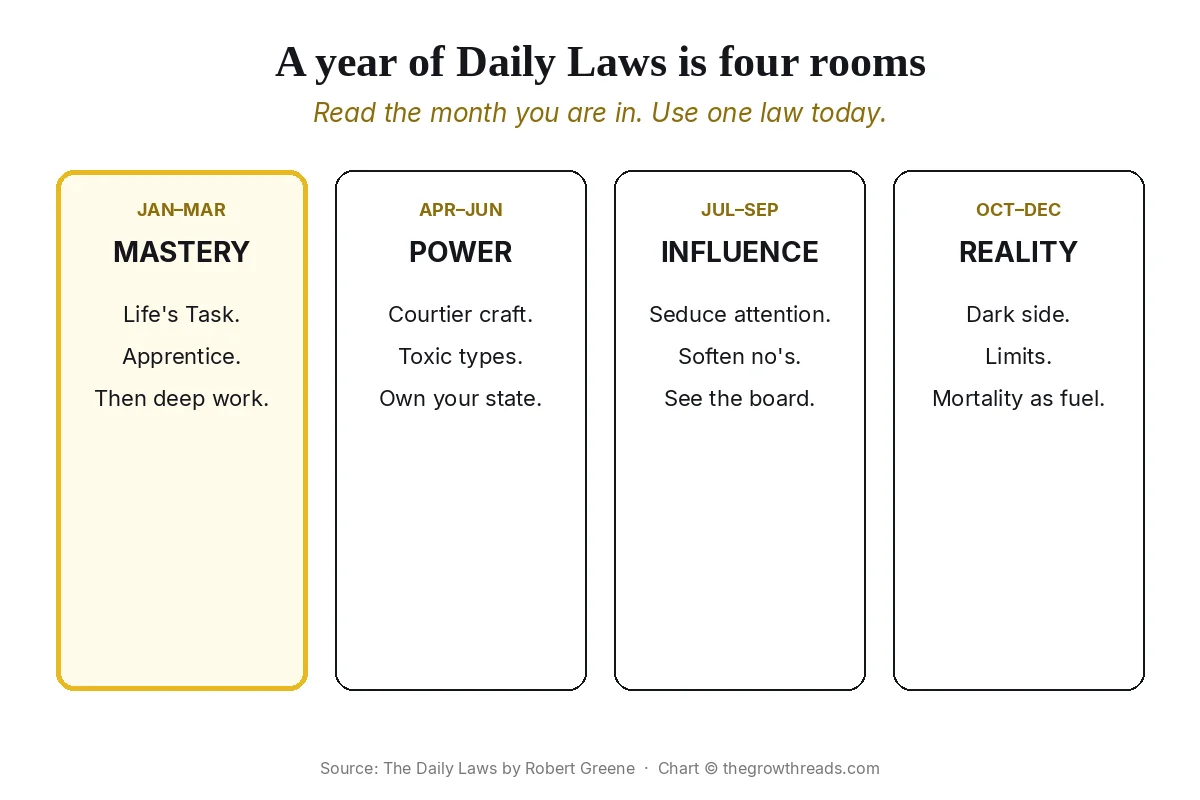
You do not need another 700-page theory of power. You need one sentence you can spend by dinner. Robert Greene’s The Daily Laws (Viking, 2021) is 366 short meditations drawn from Mastery, The 48 Laws of Power, The Art of Seduction, The 33 Strategies of War, and The Laws of Human Nature. Each month is a room: Life’s Task, apprenticeship, courtier craft, toxic types, influence, strategy, the dark side, then mortality. The thesis is blunt. Modern life pulls you into illusion and “tactical hell” — reacting to every ping as if it were a war. The counter is a daily reconnection with what is actually happening in your work, in other people, and in you. This summary is the application layer: the year’s four rooms, the Life’s Task test, the elevated-view move, and a 7-day plan around a job.
Key takeaways
- One page is the unit: Binge-reading this book is missing the point. Spend the line that stung.
- Life’s Task is not a job title: It is the activity you are built to deepen — proven by hours, not a mood board.
- Apprenticeship is the unfashionable chapter: Stay a student longer than your ego wants. Do not skip to “master” on a Tuesday.
- Power is already being played: Ignoring the game does not exempt you. It only makes you easier to move.
- Toxic types are a calendar problem: Name the drain. Limit the access. Do not write a novel about their childhood.
- Influence beats the hard push: Attention, patience, and a softened no last longer than a force play.
- Tactical hell is the default: If every email is a battle, you have no altitude and no week.
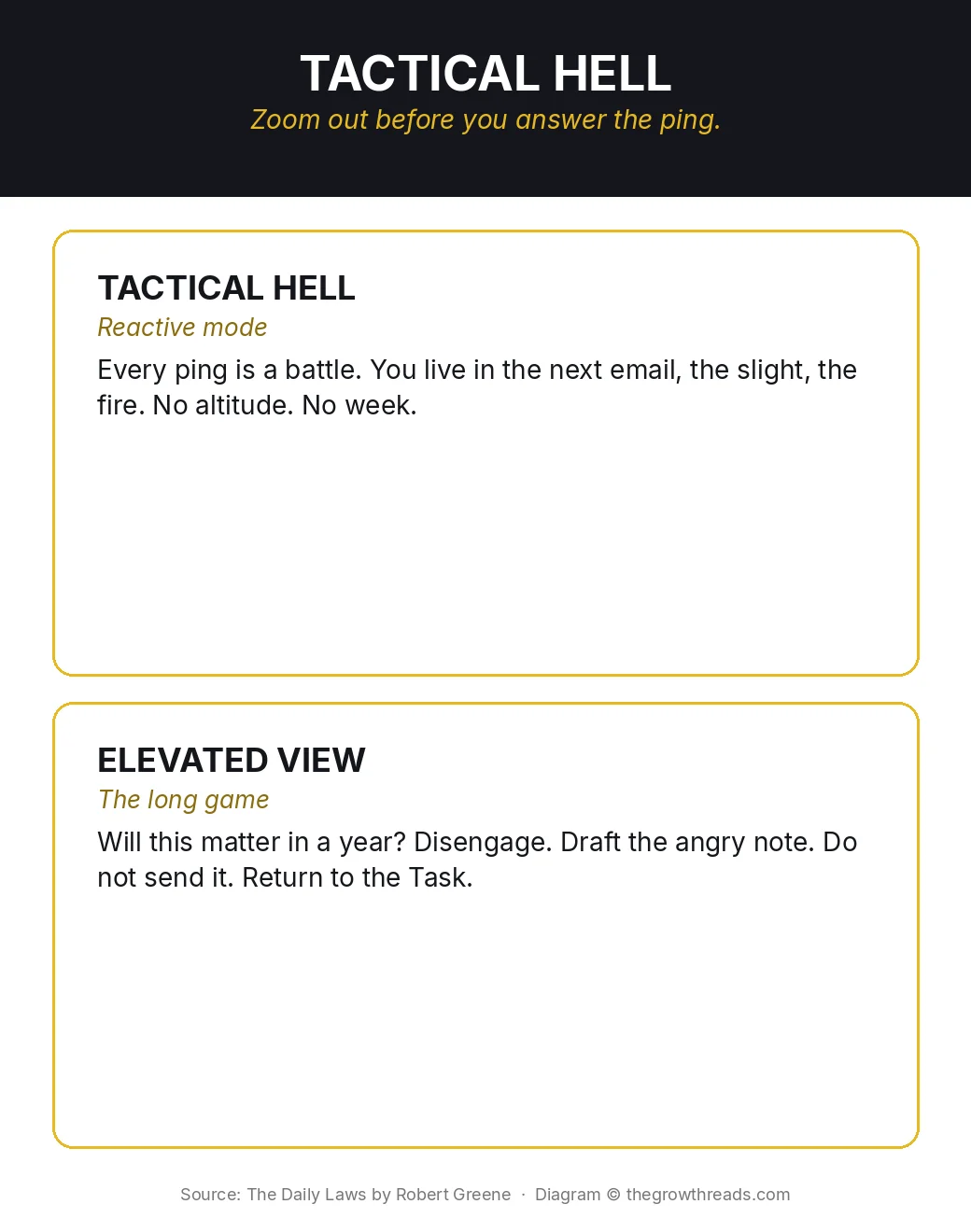
- Elevated view is a move: Will this matter in a year? Draft the angry note. Do not send it. Return to the Task.
- Human nature includes your dark side: Envy, grandiosity, and conformity are data. Pretending you skipped them is the tell.
- Death is a scheduling tool: Mortality is not a vibe. It is the argument for dropping the fake urgency.
What is The Daily Laws about?
The Daily Laws is Robert Greene’s 2021 page-a-day reader: 366 short meditations on mastery, power, seduction, strategy, and human nature. Each month has a theme. The point is not to finish the book. The point is one law, used that day, so you stop living in illusion and tactical hell.
About the author
Robert Greene was born in Los Angeles in 1959, studied at the University of California, Berkeley and the University of Wisconsin–Madison, and spent years in odd jobs — including Hollywood research — before The 48 Laws of Power (1998) made him the unsentimental cartographer of influence. He followed it with The Art of Seduction, The 33 Strategies of War, Mastery, and The Laws of Human Nature, each built from historical case studies rather than pep. A 2018 stroke sharpened the mortality thread that closes this book. The Daily Laws is not a new system. It is the field manual: one usable page from two decades of that research, dated to the calendar so you cannot hide in the unread stack. Explore all Robert Greene book summaries →
Key concepts at a glance
| Concept | What it means | Use it when |
|---|---|---|
| Life’s Task | The work you are uniquely inclined to deepen, proven by hours | Your calendar is full of impressive work that is not yours |
| Ideal apprenticeship | Observe, practice, delay the master pose | You want the title before the reps |
| Tactical hell | Reactive mode: every ping is a war | You cannot remember last week’s actual priority |
| Elevated perspective | Zoom out to the year, then choose | You are about to send the angry note |
| Courtier craft | Power is a social game with rules you can learn | You keep “just being honest” and losing the room |
| Toxic types | Some people drain strategy; limit access | One person owns your mood after every meeting |
| Seductive influence | Pull with attention and mystery, not force | Your pitch is louder and still ignored |
| Reconnect with reality | Drop the story; look at what is happening | You are living in a future that has not arrived |
Part 1: Your Life’s Task — stop renting someone else’s ambition
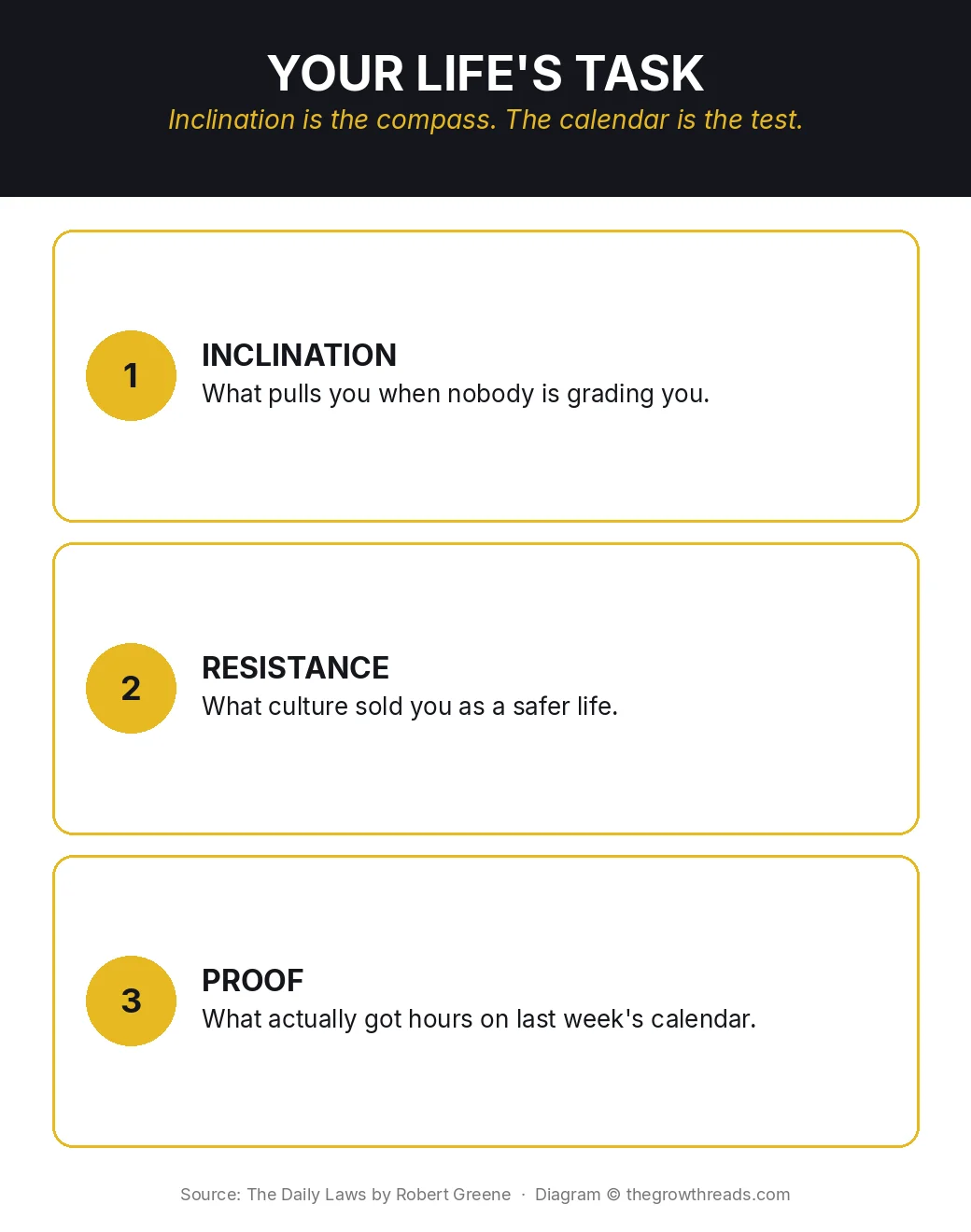
January through March is the Mastery wing. Greene’s opening claim is that most discontent is a vocational error. You rented a life that looks serious — the credential, the title, the path a parent could explain at dinner — and then you wonder why the hours feel rented too. Life’s Task is not a branding exercise. It is the activity you return to when nobody is grading you, the thing that still has voltage after the status is stripped. The test is last week’s calendar, not a personality quiz. If the work you call “you” never got an hour, you do not have a Task yet. You have a wish.
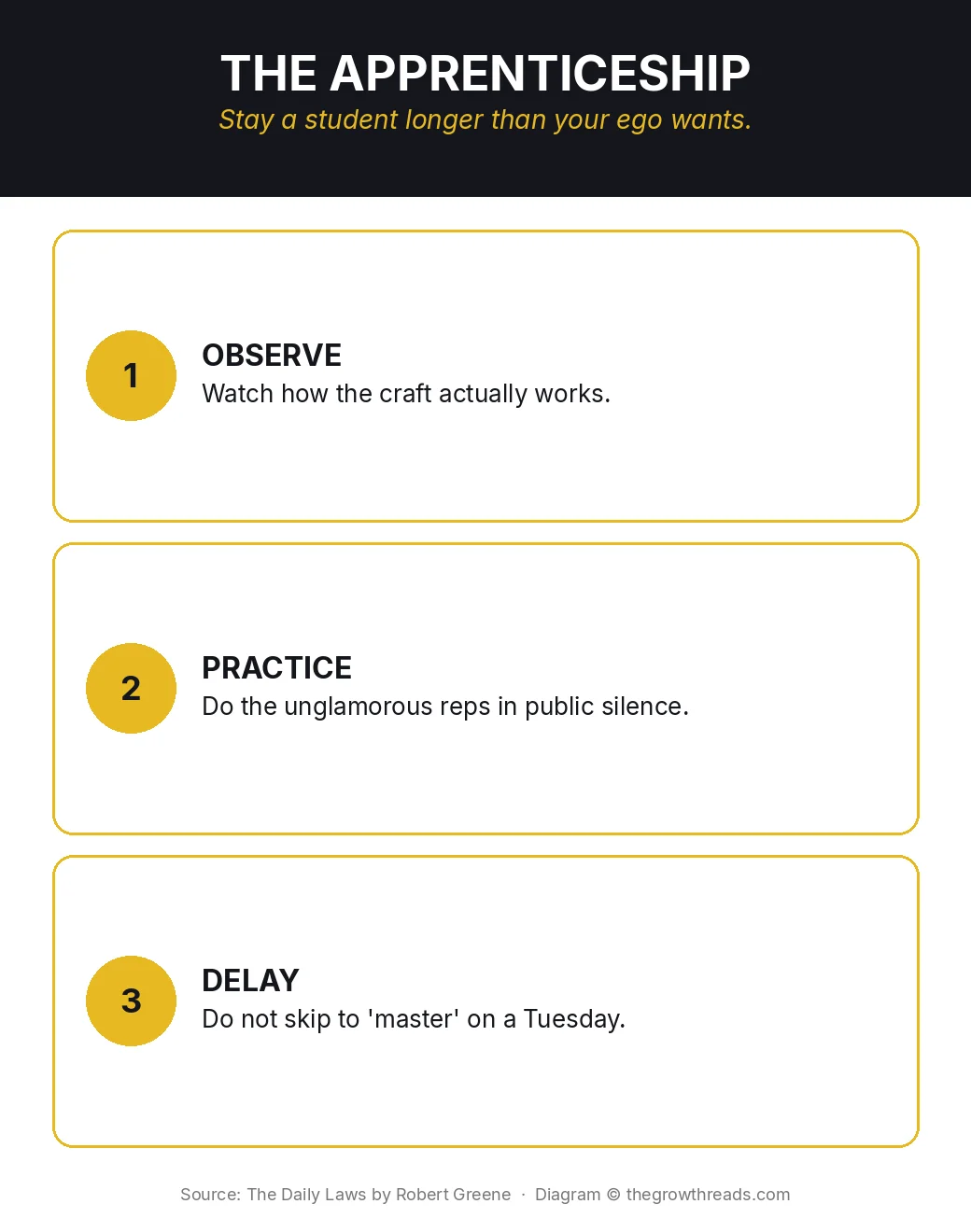
The apprenticeship chapter is the one ambitious readers skip. Greene’s masters stay students longer than is fashionable: they watch how the craft actually works, they do unglamorous reps in public silence, and they delay the performance of being already great. Grandiosity protects an identity instead of improving a skill. Today’s page is not “reinvent your career.” Name the inclination, name the safer story you were sold, and put one proof-hour on the next calendar. If that hour keeps losing to other people’s urgency, you already know which life you are living.
TGR Note: For the full apprenticeship argument, our Mastery summary is the long book this month is sampling. If you need the practice design under the romance of “calling,” Talent Is Overrated and Peak are the drill manuals. So Good They Can’t Ignore You is the warning not to wait for passion as a weather report.
Part 2: Power is already being played
April through June moves into the court. Greene’s least popular sentence, and the one that earns the book its keep at work, is that power is not an optional seminar. It is already running in the meeting you just left. People who announce they “don’t play politics” still play — they just play badly, then call the loss a moral victory. The courtier chapters are not a license to become a villain. They are a field guide: say less than the insecure explanation, watch coalitions, and stop mistaking bluntness for courage when it is only a lack of timing. The supposed non-players — the ones who perform above-it-all — are often the most strategic people in the room. Treat the performance as data.
Toxic types get their own month because one person can own a week. Identify the pattern: the drama, the envy, the person who is always almost helpful. Then limit access. A calendar with no boundary is not kindness. It is an unpaid job as their regulator. If a slight can hijack three hours, you are not in the power game. You are in theirs. Take the wheel back before you write the novel about their motives.
TGR Note: The full playbook is The 48 Laws of Power — use this monthly room as the digest, not a substitute if you need the case studies. If the block is inner discipline rather than the room, Discipline Is Destiny is the Holiday pairing. If the drain is attention, not office politics, Deep Work is the installer.
Part 3: Influence without the hard push
July through September is influence and strategy: seduction as attention, persuasion as softening, war as seeing the whole board. Greene’s seduction chapters are easy to misread as manipulation tips. The usable claim is narrower. People do not move because you increased the volume. They move when they feel they chose. That means patience, mystery, and actually looking at the other person instead of reciting your deck. In a job this is the difference between a demand and an invitation that still has a point. Softening resistance is not people-pleasing. It is refusing to create a new enemy because you needed to win the minute.
The strategist month is where “tactical hell” gets its name. You are so inside the next email that you cannot see the week. Elevated perspective is a zoom: will this slight matter in twelve months? Most will not. Disengage. Write the angry note if you must. Do not send it. Return to the Task. That extra beat is a productivity skill. It protects mastery hours from the fake wars the inbox will gladly supply.
TGR Note: For the longer treatment of pull versus push, see The Art of Seduction. If your “strategy” is actually fear of starting, The War of Art names Resistance; Greene names altitude. The daily sister format in a different tradition is The Daily Stoic — same unit (one page), different ethics.
Part 4: Reality, the dark side, and death as advisor
October through December is the Human Nature wing and the cosmic close. Greene’s late-career move is inward: envy, narcissism, conformity, aggression — not as other people’s diseases, as yours. The emotional self is the part you keep off the LinkedIn summary. It still runs the afternoon. Coming to terms with it is not a weekend retreat. It is catching the tell: the comparison, the grand story, the sudden contempt. The rational human month is the correction. You have a unique mind, and it has limits. Knowing the limit is how you stop promising a week the brain cannot deliver. Reality, throughout, is the opposite of the daydream that says wealth or applause will finally make the restlessness stop.
December’s mortality pages are the scheduling argument the year was building toward. Greene is not asking you to become a monk. He is asking what you would drop if fake urgency had to defend itself against a finite life. You do not need a personality transplant. Spend today’s line on a real hour — Task, not theater. Later is the same person with a thicker inbox.
TGR Note: The deep cut is The Laws of Human Nature. If the restlessness is a cap you yank after a good week, The Big Leap is the thermostat cousin. If you need a smaller daily habit than Greene’s tone, start with Atomic Habits and come back when the page has somewhere to land.
Who is The Daily Laws best for — and who should read something else first?
Best for people who own Greene and never finish him, people who like a dated page (the Daily Stoic habit) but want strategy instead of Stoic ethics, and anyone whose week disappears into other people’s urgency. Run the 7-day plan on one law plus one proof-hour — not as a personality rebrand.
Read something else first if you need the full Mastery argument, not a digest: Mastery. If you need the full power casebook: The 48 Laws of Power. If you cannot get a page habit to stick at all: Atomic Habits or Mini Habits. If you want Stoic daily rather than Greene daily: The Daily Stoic. If the stall is designed practice, not philosophy: Talent Is Overrated. This one waits until you will actually spend a page.
Questions to reflect on
- What activity still has voltage when status is stripped — and did it get an hour last week?
- Where are you performing “master” before the apprenticeship is done?
- Who is a toxic type in your calendar, and what access have you not yet limited?
- What ping yesterday pulled you into tactical hell, and would it matter in a year?
- If death were the scheduler, which fake urgency would lose its slot this week?
🔥 Ready to spend one law before the inbox opens?
Get The Daily Laws, then run the 7-day plan on today’s page — not on a binge.
How to apply The Daily Laws (7-day plan)
- Day 1 — Read today’s date, not page one. Write the one sentence that stung. If nothing stung, you skimmed. Read it again and circle a verb you can spend.
- Day 2 — Name the Task hypothesis. One line: the activity you would deepen if money were not the first question. Then check last week’s calendar. If the hypothesis got zero hours, the calendar is the true answer.
- Day 3 — Apprenticeship audit. List one skill you are performing as if you already mastered it. Schedule a beginner rep: observe someone better, or practice the unglamorous part in silence.
- Day 4 — Limit one toxic access. Name the person or channel that owns your mood. Cut one slot this week — a meeting, a thread, a “quick” call. Kindness with no boundary is still a job.
- Day 5 — Soften one no. Pick a live resistance (a colleague, a customer, yourself). Do not increase volume. Ask one better question and wait. Influence is a beat, not a speech.
- Day 6 — Elevated view once. When a ping feels like war, write: will this matter in twelve months? Draft the angry note. Do not send it. Return to the Task hour.
- Day 7 — Mortality as scheduler. Drop one fake urgency from next week. Keep the Daily Laws date habit. The book only works if tomorrow’s page still has a job to do.
Frequently asked questions
What is The Daily Laws about in one paragraph?
The Daily Laws is Robert Greene’s 2021 page-a-day reader: 366 short meditations drawn from his books on mastery, power, seduction, strategy, and human nature. Each month is a theme, from Life’s Task through courtier craft to mortality. The argument is that modern life pulls you into illusion and tactical hell — reacting to every ping as a war — and that one spent page a day reconnects you with what is actually happening. This summary is the application layer: the year’s four rooms, a Life’s Task test against the calendar, and a 7-day plan you run around a job, not a binge.
How is The Daily Laws different from The 48 Laws of Power?
The 48 Laws is a dense casebook on how power is gained and lost. The Daily Laws is a calendar. It samples 48 Laws, Mastery, Seduction, War, and Human Nature into dated pages so you can use one idea before the inbox opens. If you need the full historical machinery, start with 48 Laws or Mastery. If you own those books and never finish them, this is the field manual. Do not treat a January page as a substitute for Mastery’s apprenticeship argument. Treat it as the daily reminder to spend the argument. Day 1 of the plan starts on today’s date, not on Law 1.
What is a Life’s Task in The Daily Laws?
Life’s Task is Greene’s name for the work you are inclined to deepen — the activity that still has voltage when status is stripped. It is not a job title and not a mood board. The test is last week’s calendar. If the thing you call “you” never got an hour, you have a wish, not a Task. January’s pages push you to notice inclination, notice the safer story culture sold you, and put a proof-hour on the next day. Day 2 writes the hypothesis and checks it against the week that already happened.
What is tactical hell in The Daily Laws?
Tactical hell is Greene’s name for reactive mode: every ping, slight, and fire is treated as a battle, so you never reach altitude or a week. You live in the next email. Elevated perspective is the counter-move. Ask whether the fight will matter in a year. Most will not. Disengage. Draft the angry note if you need the heat out of your body. Do not send it. Return to the Task. This is a productivity skill, not a personality. It protects mastery hours from fake wars the feed will gladly supply. Day 6 of the plan is one forced zoom-out on a live ping.
Do I have to read The Daily Laws in order?
No. The design is today’s date. Greene grouped months by theme, so January is a different room from October, but the habit is the calendar, not a streak badge from page one. If you binge it in a weekend you will have consumed the ideas and spent none of them. Read the page for the day you are in. If a month’s theme is exactly your problem — toxic types, apprenticeship, mortality — you can sit in that month extra days. The 7-day plan still starts with the page that matches the date, then one proof-hour, not a chapter marathon.
Who should read The Daily Laws — and who should start elsewhere?
Read it if you stall in Greene’s long books, if you already like a dated page, or if your week disappears into other people’s urgency. It is a practice book, not a new philosophy. Start with Mastery if you need the full Life’s Task and apprenticeship argument. Start with The 48 Laws of Power if you need the casebook on the room. Start with Atomic Habits if you cannot get any daily page to stick. Start with The Daily Stoic if you want Stoic ethics rather than strategy. Start with Talent Is Overrated if the stall is designed practice, not a missing law.
Is The Daily Laws still useful in 2026?
The unit aged well. Feeds and chat tools made tactical hell cheaper to enter and harder to notice. A dated page is still a way to put one non-reactive sentence in front of the inbox. The risk in 2026 is treating the book as a quote machine — posting the law, skipping the hour. Keep the calendar habit, the Life’s Task test against last week’s hours, and the elevated-view move before you send the note. Ignore advice that says you must finish Greene’s whole shelf first. Day 1 should still be today’s date. Day 7 should still drop one fake urgency.
Related summaries
- Mastery Summary & Review
- The 48 Laws of Power Summary & Review
- The Laws of Human Nature Summary & Review
- The Daily Stoic Summary & Review
- Best Productivity Books
How we analyze books: every book on The Growth Reads is read cover to cover, summarized in thousands of words of original analysis, and rated against our five-criteria rubric (lasting impact, evidence quality, practical application, writing & originality, external consensus). Read our full methodology.