

★★★★★ 4.6/5 — The book that still teaches you to follow dinner back to a plant, an animal, and a choice.
Best for: Anyone who eats a default meal they cannot narrate, shoppers lost in “organic” labels, and readers who want food-chain literacy before the next diet book
Reading time: ~9–10 hrs for the Penguin 450-page 10th-anniversary paperback · ~14 min for this guide
Difficulty to apply: Seeing the chain is a weekend. Making one meal whose story you can tell is a week of small swaps, not a homestead.
The Omnivore’s Dilemma in one minute
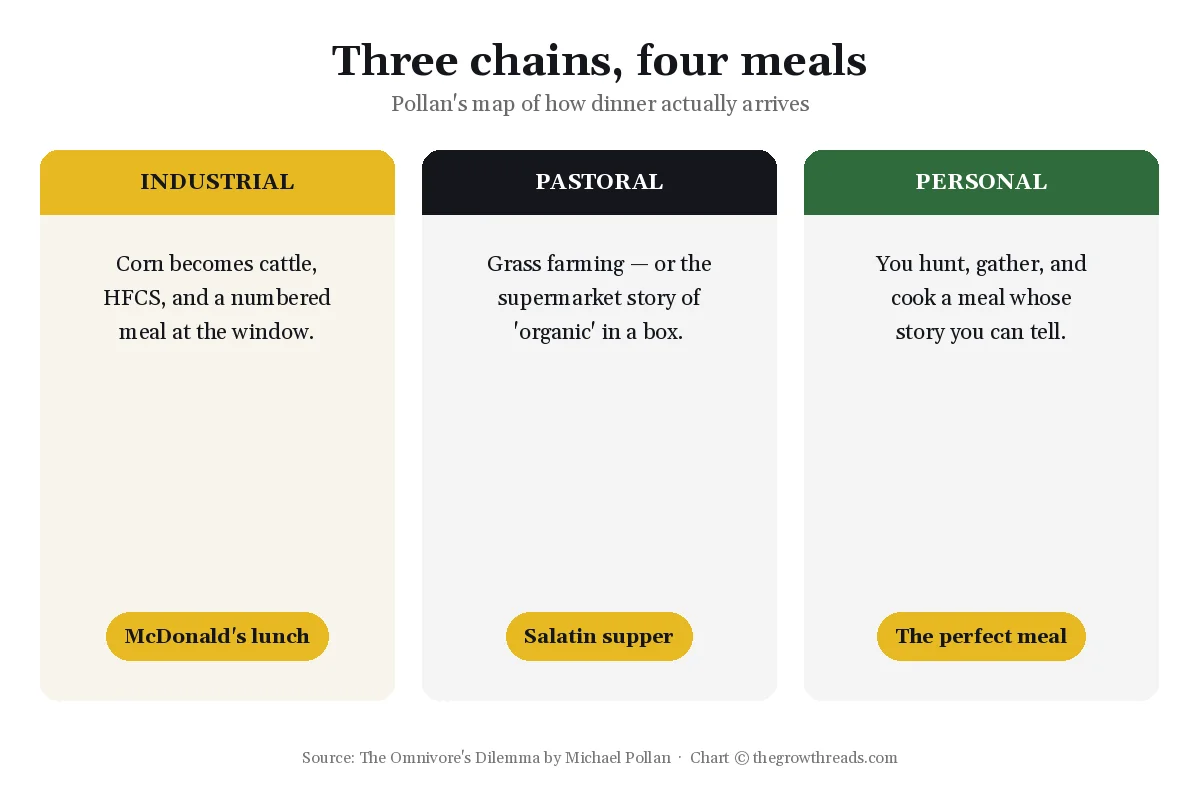
Michael Pollan’s 2006 investigation argues that “what’s for dinner?” stopped being a cultural question and became an industrial product — unless you walk the chain yourself. He follows four meals: a McDonald’s lunch built on commodity corn, a Big Organic supermarket supper, a grass-fed dinner from Joel Salatin’s Polyface Farm, and a hunted meal he cooks with friends. The usable move is literacy, not shame. If you can tell the story of the plate — plant, animal, place — the omnivore’s anxiety gets smaller. Diagnostic: last night’s dinner, in two sentences. If you cannot write them, the chain closed without you.
Key takeaways
- The dilemma is too many edible options with too little culture: Humans can eat almost anything. When tradition, season, and locality stop deciding, marketing does.
- Industrial eating is a corn system: Commodity maize becomes cattle, sweetener, and a numbered combo. Cheap calories are a farm-bill design, not a craving that appeared from nowhere.
- You are what what you eat eats: A steak is also the corn, drugs, and confinement of a feedlot. Health starts one trophic level down.
- The fast-food meal is a story that stops at the window: Pollan can still count the corn. The eater usually cannot.
- Supermarket pastoral is a genre, not a farm: Barns on labels sell a feeling. Scale can still mean sheds, trucks, and a chicken that never saw grass.
- Grass farming is a different physics: At Polyface, animals move, manure feeds pasture, and the farmer’s job is complexity rather than a single commodity.
- Slaughter you can watch is a moral technology: Hiding death does not make eating kinder. Seeing it makes the next purchase slower.
- Hunting and gathering are research methods: Pollan does not tell you to become a forager. He uses the wild pig and the chanterelle to remember that food was once a relationship.
What is The Omnivore’s Dilemma about?
The Omnivore’s Dilemma is Michael Pollan’s 2006 natural history of four American meals. He traces industrial corn, supermarket organic, a grass-based farm, and a hunted meal from source to plate, then argues that knowing the story of dinner is how an omnivore eats without outsourcing the choice to a logo.
About the author
Michael Pollan was born in 1955 on Long Island and became the journalist who made the American food chain a public subject. A longtime contributor to The New York Times Magazine, he has taught at the UC Berkeley Graduate School of Journalism and later at Harvard. The Botany of Desire (2001) asked what plants want from us. The Omnivore’s Dilemma (Penguin Press, 2006) asked where dinner comes from, became a New York Times bestseller, and won a James Beard Award. In Defense of Food (2008) distilled the reporting into seven words; Food Rules, Cooked, and How to Change Your Mind followed. He is not a diet doctor. He is a reporter who treats a plate as ecology, economics, and culture in one sitting. Explore all Michael Pollan book summaries →
Key concepts at a glance
| Concept | What it means | Use it when |
|---|---|---|
| The omnivore’s dilemma | A species that can eat almost anything must decide without getting poisoned — culture used to do that job | A supermarket aisle feels like a test you did not study for |
| Industrial corn | One subsidized plant becomes meat, sweetener, and most of the packaged middle | You cannot find a whole food on a label you just trusted |
| You are what what you eat eats | The animal’s diet and the plant’s soil show up in your body | You are shopping only by cut, sauce, or calorie count |
| Supermarket pastoral | Packaging that sells a farm feeling at industrial scale | A carton shows a barn and you stop asking questions |
| Big Organic | Certified inputs, still a long truck, still a shed | “Organic” is doing all the moral work on the package |
| Grass farming | Animals move; pasture is the factory; complexity is the method | You want meat or eggs whose place you could actually visit |
| The glass abattoir | Death you can witness, rather than a factory you cannot enter | You eat animals and have never pictured the last ten minutes |
| The personal meal | A plate whose chain you walked, cooked, and can narrate | Default dinners have no story except “it was on the way” |
Part 1: Industrial corn — the plant that ate the meal
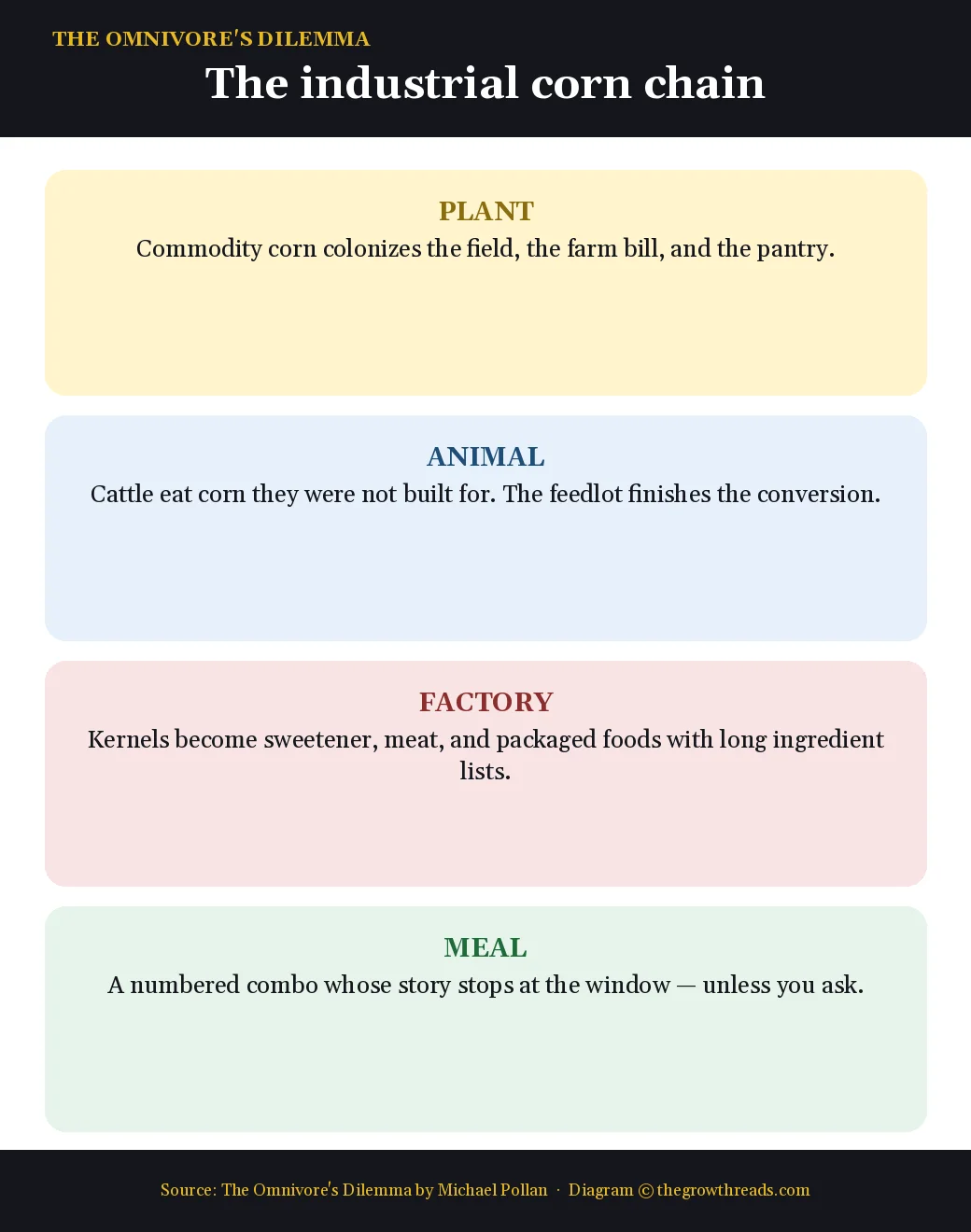
Pollan starts in an Iowa field because that is where a McDonald’s lunch is born, even when the bag never says “corn.” Hybrid maize, a farm bill, and an elevator that treats bushels as one yellow river turn a plant into an industrial input. Most supermarket products, he reports, contain corn as feed, sweetener, starch, or an unnamed cousin on the label. The omnivore thinks he is choosing a burger, a soda, and fries. He is mostly choosing maize, three ways.
The feedlot is where the conversion gets honest. Cattle evolved to eat grass. Corn finishes them fast, sours the rumen, and needs a veterinary toolkit to keep the animal upright until slaughter. “You are what what you eat eats” is a trophic fact: a cheap steak is a corn steak. Processing then takes kernels and animals apart and rebuilds foods that do not rot on nature’s schedule. Pollan’s McDonald’s meal, eaten in a moving car, is the chain’s masterpiece — numbered, calibrated, and almost impossible to narrate past the window. He can still count the corn. That is the literacy the rest of the book trains. Cheap food is expensive in soil, in animal physiology, and in an eater who cannot write two sentences about what he swallowed.
TGR Note: For the industry as labor, ads, and packing plants rather than as corn, read Fast Food Nation. Schlosser is in the parking lot. Pollan is in the field. For the 2020s clinical name for industrial formulations, add Ultra-Processed People.
Part 2: Big Organic — the barn on the label
The second chain looks like the answer: Whole Foods, a roasted chicken named Rosie, a barn on the carton. Pollan calls the genre supermarket pastoral — packaging that lets an urban eater feel he has left the industrial chain without leaving the store. Sometimes the feeling is earned. Often it is a shorter industrial chain with better inputs: certified feed, no synthetic pesticides, still a shed, still a truck, still a bird that may never have scratched dirt. Rosie is the teaching case. The label is not a lie. It is incomplete. Scale has its own physics, and grass tends to lose.
This section saves the book from an industrial-bad / organic-good cartoon. Pollan is grateful for the movement. He also walks far enough behind the label to see when “organic” is a compliance category rather than a place. After “is it organic?” ask “can I picture the place?” If the answer is only a logo, marketing is still writing the story. Certified inputs can cut pesticides and animal drugs. They are not automatically a meal you can narrate. The barn on the carton is a genre. Read it — then look for the farm.
TGR Note: Pollan’s sequel, In Defense of Food, is the seven-word rule this reporting earned. Use Dilemma to see the chain. Use Defense to shop. For snack-company bliss points, Salt Sugar Fat is the conference-room sequel.
Part 3: Polyface — grass, complexity, and a meal with a place
Joel Salatin’s Polyface Farm in Virginia is the pastoral chain when it is not a photograph. He calls himself a grass farmer. Cattle, chickens, pigs, and rabbits move across pasture so the last species sanitizes what the previous one left. Manure is inventory. Sunlight becomes grass becomes meat without a corn middleman. Pollan works the farm and watches slaughter done in daylight, on the property. The “glass abattoir” is not gore for its own sake. It is the opposite of a factory you cannot enter. If you eat animals, looking is part of the honesty of the meal.
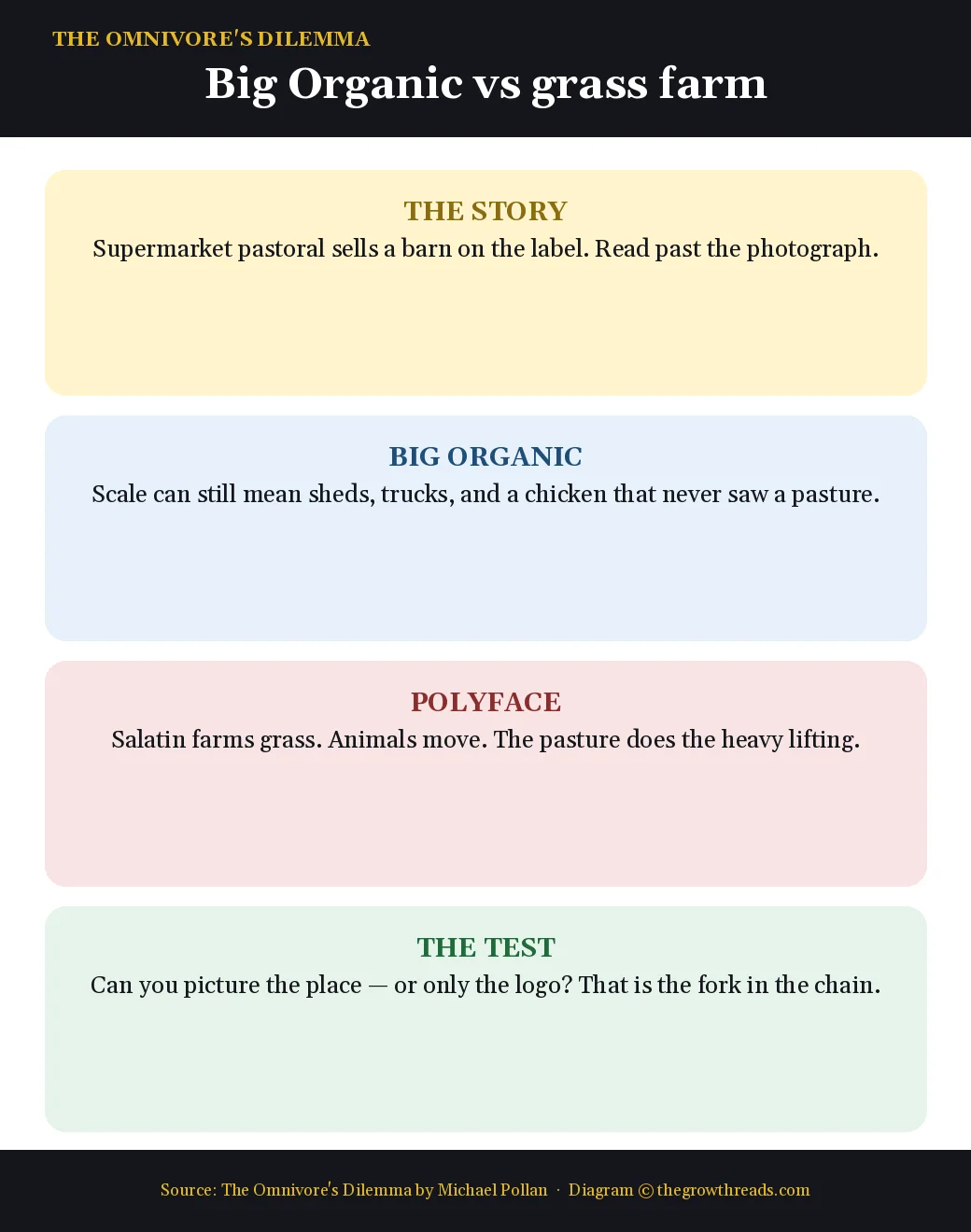
The grass-fed supper is slower, dearer, and narratable. You could take a guest to the field. A body is downstream of a place — fatty acids, dirt on eggs, no feedlot pharmacy — but the larger fact is that you know what you ate. If you will never keep chickens, steal Salatin’s test: can this food survive the first follow-up question, or does the story collapse into a logo? Complexity is the method. Convenience is allowed. Invisibility is the thing to refuse.
TGR Note: If you want a plant-forward protocol after the farm, How Not to Die and The China Study are the how-to shelves. Pollan will not write your grocery list.
Part 4: The personal meal — hunt, gather, cook, tell
The last chain is the one most readers will never copy literally, and Pollan knows it. He hunts a feral pig, gathers chanterelles, and cooks a “perfect meal” whose every ingredient he can introduce by name. Tuesday does not need to look like a documentary. The point is to remember what a meal was before it became a SKU. Hunting and gathering reinstall old omnivore software — caution, curiosity, knowledge that used to live in families and now lives in marketing. The ethics chapter sits here on purpose. After you have looked, you either accept the death or you don’t. What you may not do is pretend there was no death because a factory hid it.
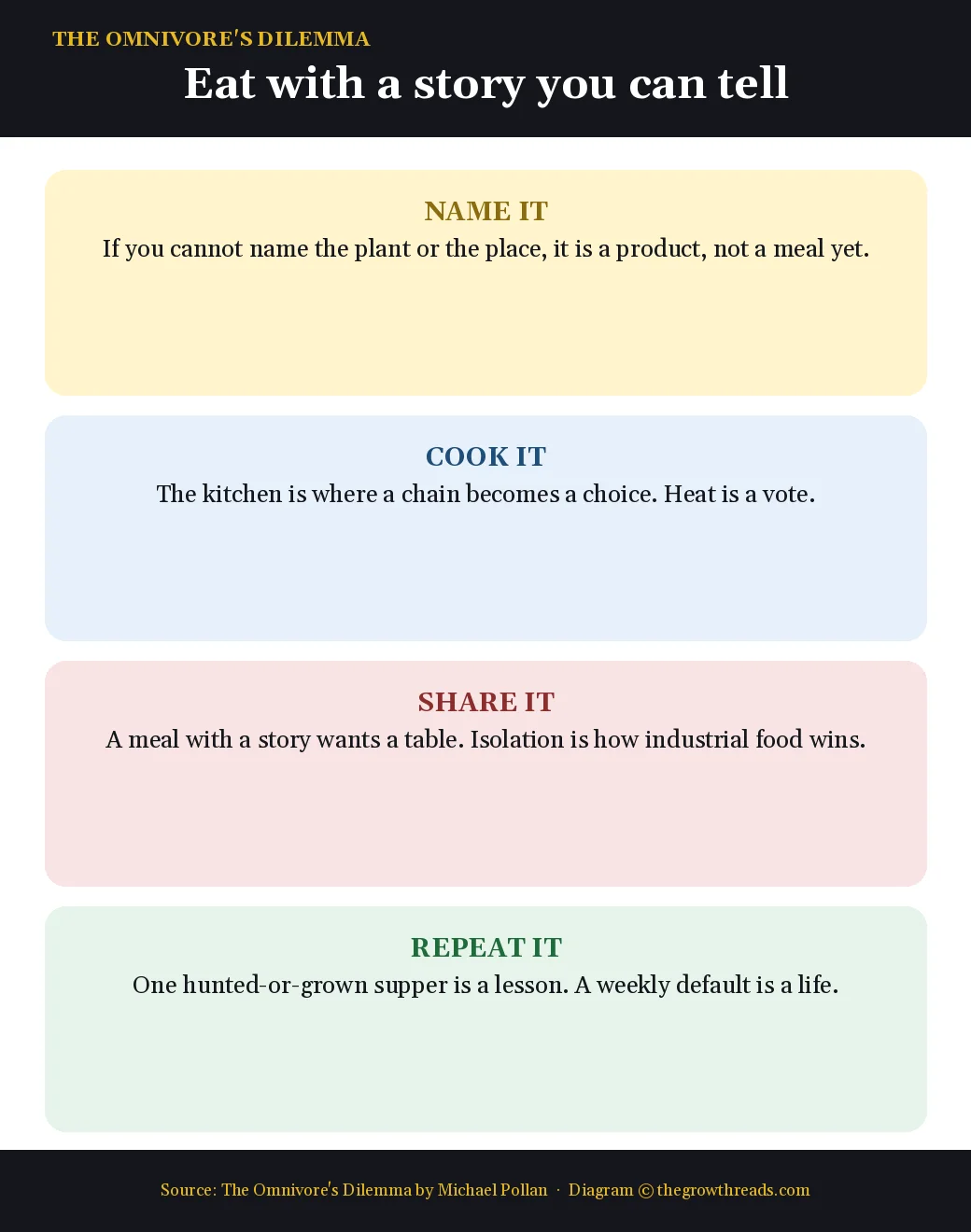
The perfect meal is cooked and shared. Isolation is how industrial food wins: a bag in a car, no witnesses. A table is how a personal meal sticks. You do not need a wild pig. You need one supper this week whose chain you can tell in two sentences. Later afterwords note that the industrial chain did not retire because a bestseller described it. Logos changed. Corn did not leave the building. Stop treating “what’s for dinner?” as weather. Walk the chain a little past the window. Then walk it again next Tuesday — which is how a dilemma becomes a habit.
TGR Note: Later Pollan on attention is How to Change Your Mind. For why your brain keeps saying yes to the numbered meal, The Hungry Brain is the neuroscience layer this book is not.
Who is The Omnivore’s Dilemma best for — and who should read something else first?
Read it if you eat a default meal you cannot narrate, you have used “organic” as a complete moral sentence, or you finished three diet books and still cannot explain why a burger, soda, and fries are mostly the same plant. It is reporting with meals, not a 30-day protocol.
Read something else first if you need a plate rule this week — start with In Defense of Food or How Not to Die. If you want the industry as ads and packing plants, Fast Food Nation. If you want the 2020s clinical name for industrial food, Ultra-Processed People. This is not medical advice and not a command to hunt. It is a map of four chains so the next supper can have a story.
Questions to reflect on
- Can you tell last night’s dinner in two sentences — plant, animal, place — or only the restaurant or brand?
- Where does corn hide in a meal you did not think of as corn?
- When a label shows a barn, what follow-up question would make the story collapse?
- If you eat animals, have you ever pictured the last ten minutes, or only the recipe?
- What would “a meal with a story” be this week as one concrete supper, not as a new identity?
🔥 Ready to follow dinner back to the field?
Start with the Iowa corn chapters, then read Polyface before you trust the next barn on a carton.
How to apply The Omnivore’s Dilemma (7-day plan)
- Day 1: Write last night’s dinner in two sentences. If you cannot, circle that meal. That is the chain you will walk this week.
- Day 2: Hunt corn on three packages or receipts. Mark every alias: starch, syrup, feed-lot meat, unnamed “natural flavors” sitting next to a maize cousin.
- Day 3: Cook one meal from ingredients you can name as plants or animals, not as brands. Heat is the first edit of an industrial story.
- Day 4: At the store, pick one “organic” item and ask the second question: can I picture the place, or only the logo?
- Day 5: Eat one serving from a named farm, a farmers’ market stall, or a butcher you can ask — or skip the serving. The point is a question, not a purity test.
- Day 6: Share a meal at a table with the story attached. Isolation is how the numbered combo wins.
- Day 7: Write a four-word house rule and put it on the fridge. Example: “Tell the dinner story.” Use it on the next busy Tuesday.
Frequently asked questions
What is The Omnivore’s Dilemma about?
It is Michael Pollan’s 2006 natural history of four American meals: a McDonald’s lunch built on industrial corn, a Big Organic supermarket supper, a grass-fed dinner from Joel Salatin’s Polyface Farm, and a hunted-and-gathered meal Pollan cooks himself. He argues that humans can eat almost anything, so culture used to decide dinner — and when culture thins out, industry writes the menu. The application is literacy. Follow the chain far enough that the next plate has a story. It is reporting, not a calorie-counting manual, and not a command to become a hunter.
Is The Omnivore’s Dilemma still relevant in 2026?
Yes — the logos aged; corn did not leave the building. Delivery apps, “better” burger chains, and organic private labels changed the storefront. Commodity maize, feedlot physics, supermarket pastoral, and an eater who cannot narrate dinner are still the chassis. The Penguin 10th-anniversary paperback we link adds an afterword; the four meals still teach. Read it as a map of chains, then update the examples with whatever app is on your home screen. If you only want 2020s product chemistry, add Ultra-Processed People. If you want where the meal was grown and killed, this is still the book.
The Omnivore’s Dilemma vs In Defense of Food vs Fast Food Nation — which should I read first?
Read The Omnivore’s Dilemma first if you want the full chain — field, feedlot, organic shed, grass farm, hunt — as narrative. Read In Defense of Food first if you want the seven-word shopping rule this reporting earned and you only have an evening. Read Fast Food Nation first if you want labor, child marketing, and packing plants more than agronomy. They stack. Pollan’s long book is the ecology. His short book is the mantra. Schlosser is the industry as jobs and ads. If you only have one weekend and you eat on autopilot, start here, then steal the mantra from Defense of Food for the store.
Do I have to hunt and forage to use this book?
No. The personal meal is a research method, not a lifestyle franchise. Pollan hunts a pig and picks mushrooms so he can feel, once, what a meal was before it became a SKU. Your version can be a farmers’ market chicken, a named-egg carton, or a pot of beans you cooked and can describe. The transferable habits are naming the plant, cooking it, sharing it, and refusing a default whose story stops at a logo. If the hunt chapter bores you, steal the Polyface test instead: can you picture the place? That question works in a city kitchen.
Is the book telling me to stop eating meat?
No. Pollan eats meat in three of the four meals. He insists that if you eat animals, looking at slaughter is part of the honesty, and that grass-based systems are a different physics from the feedlot. Vegetarians can use the same chain-literacy on plants, oils, and fake-farm packaging. The target is invisibility, not a single macro. A burger whose farm you could visit is a different act from a numbered combo you could not narrate. The book will not settle the ethics for you. It will stop you from pretending the ethics happened in a factory you never had to imagine.
How long is The Omnivore’s Dilemma and which edition should I buy?
The Penguin paperback we link is the 10th-anniversary edition, ISBN-13 9780143038580, about 450 pages, originally published by Penguin Press on 11 April 2006, with a later afterword. Most readers finish it in nine to ten hours, often in two sittings — industrial corn, then organic-and-Polyface, with the hunt last. There is a young-reader edition; this guide is about the adult book. This summary is about fourteen minutes and is not a replacement for the Iowa and Polyface chapters. Buy the edition you will actually finish. The 7-day plan above is our application layer, not his workbook.
Is The Omnivore’s Dilemma saying I can never eat fast food — and is this medical advice?
No, and no. Pollan’s dare is to stop eating a chain you cannot see, not to join a purity contest. A burger you chose, from a place you can describe, is a different act from a default you did not notice. The book will not tell you how to treat cholesterol, a child’s growth, or a GI diagnosis. Those are clinical decisions. Use this as a map of food chains, then take personal health questions to clinicians who have your chart. Education, not a prescription. The 7-day plan is literacy practice, not a treatment protocol.
Related summaries
- In Defense of Food — Pollan’s seven-word rule after you have seen the four meals.
- Fast Food Nation — the industry as labor, ads, and packing plants, not as corn.
- Salt Sugar Fat — the snack-company sequel: how craving gets engineered in a conference room.
- Ultra-Processed People — the 2020s clinical name for food that is not food.
Browse titles on our Best Health Books pillar page.
How we analyze books: our summaries are built from a full read of the source text, cross-referenced against the author’s published interviews and research where relevant, and structured around practical application rather than critique. Read our full methodology.