

★★★★★ 4.6/5 — Gabor Maté’s landmark case that chronic self-suppression isn’t just an emotional habit — it’s a measurable risk factor for physical illness.
Best for: Anyone who’s been told “it’s probably stress,” people managing chronic illness, caregivers and helping professionals, and anyone who struggles to say no.
Reading time: ~35 min guide (book ~9 hrs)
Difficulty to apply: Moderate — the ideas are simple to grasp but require honest self-reflection, and sometimes professional support, to act on.
When the Body Says No in one minute
Your personality may be shaping your biology more than you realize. In When the Body Says No, physician Gabor Maté draws on three decades of clinical practice to argue that chronic illness — from rheumatoid arthritis to certain cancers to multiple sclerosis — is not purely bad luck or bad genes. It is frequently linked to a lifelong pattern: suppressing emotion, especially anger, in order to keep the peace, stay attached, and be seen as “good.” Maté calls this the “Type C” pattern, and he traces it back to a childhood trade-off nearly everyone makes without knowing it — sacrificing authentic feeling to preserve connection with caregivers. The book is not a claim that stress alone causes disease, or that patients are to blame for getting sick. It is an invitation to see the body and mind as one interconnected system, and to notice where a lifetime of self-denial may be quietly costing you your health.
Key takeaways
- Mind and body are one system: Maté rejects the idea that psychology and physiology are separate — he calls this the biopsychosocial model of disease.
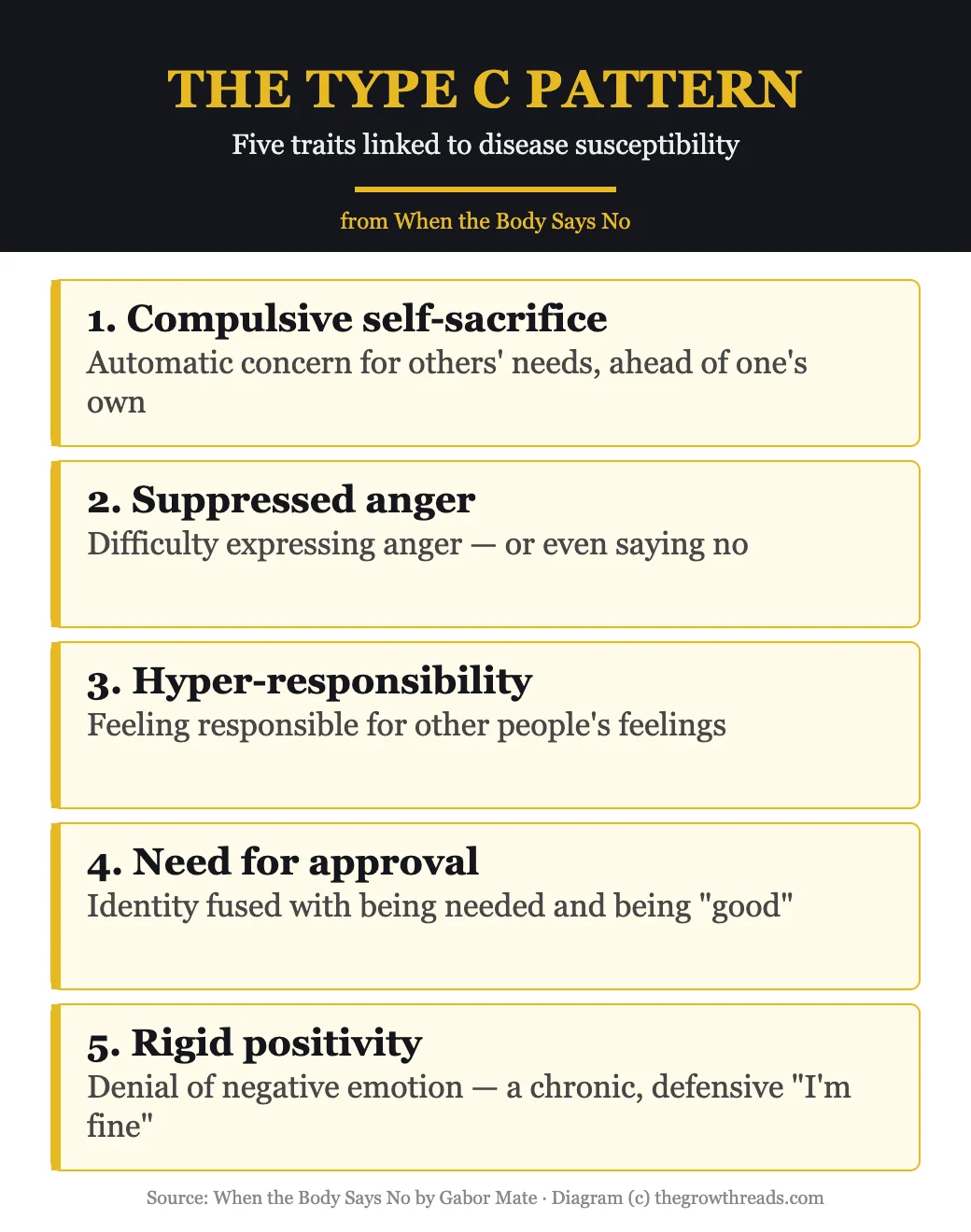
- The Type C personality: a pattern of compulsive self-sacrifice, anger suppression, and need for approval shows up disproportionately among patients with certain chronic illnesses.
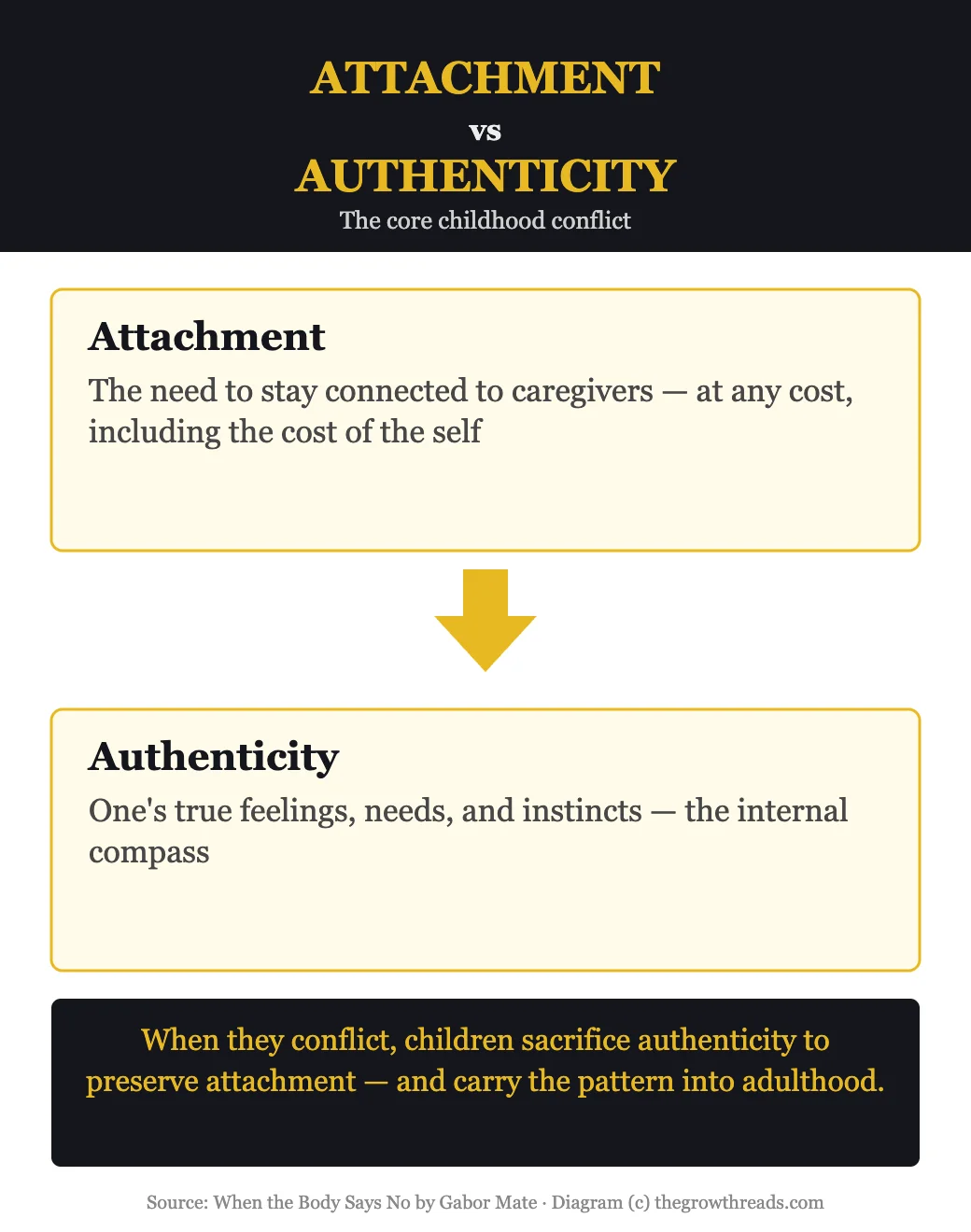
- Attachment beats authenticity in childhood: when a child’s true feelings threaten connection with a caregiver, the child learns to hide the feelings — not the need for connection.
- Repressed anger doesn’t vanish: it turns inward, keeping the nervous system in a low-grade, chronic state of activation.
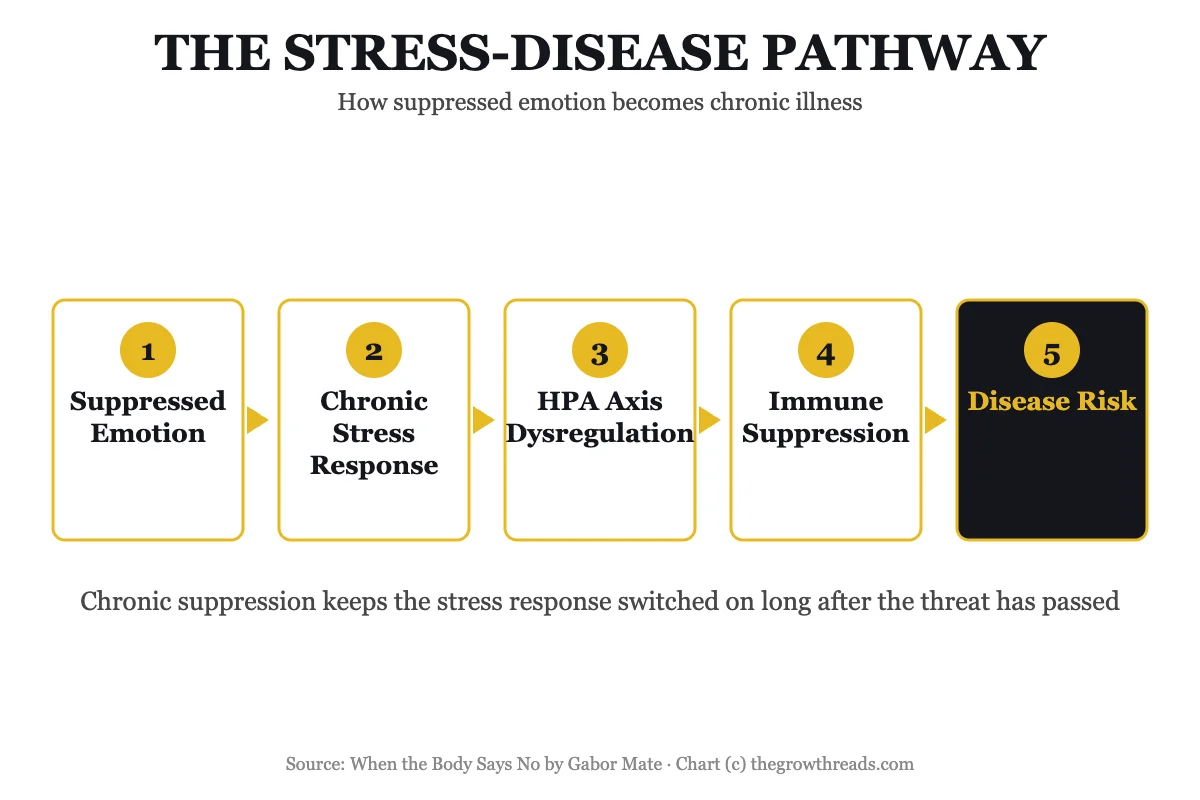
- The HPA axis stays switched on: chronic suppressed stress floods the body with cortisol long after any real threat has passed, weakening immune regulation.
- Case histories reveal patterns: Maté’s decades of patients with ALS, breast cancer, rheumatoid arthritis, and MS share strikingly similar emotional histories.
- “Boundary blindness” is a health issue: an inability to sense or enforce personal limits leaves the stress response perpetually activated.
- Healing isn’t about blame: the goal is compassionate self-inquiry, not guilt for having become ill.
- The Seven A’s of Healing offer a concrete framework for rebuilding emotional competence.
- Reclaiming the ability to say no and feel anger honestly is, physiologically, a health intervention — not just a self-help slogan.
What is When the Body Says No about?
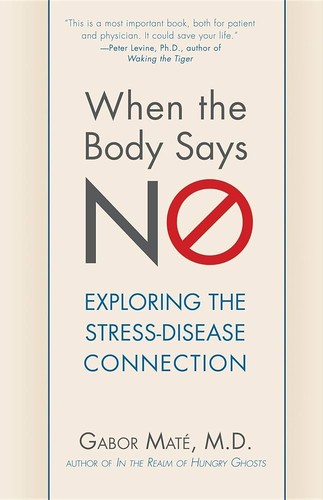
When the Body Says No is a 2003 book by physician Gabor Maté arguing that chronic illness is often connected to a lifetime of suppressed emotion, hidden stress, and self-denying personality patterns — making the case that emotional health and physical health cannot be meaningfully separated.
About the author
Gabor Maté is a Hungarian-born Canadian physician who spent over twenty years in family practice in Vancouver, later specializing in palliative care and addiction medicine at the Portland Hotel in the Downtown Eastside — the work behind his book In the Realm of Hungry Ghosts. Born in Budapest in 1944 to a Jewish family under Nazi occupation, Maté survived infancy during the Holocaust while his mother, separated from his father, endured constant fear for both their lives — an early history he later connected directly to his lifelong interest in trauma, attachment, and the body’s response to chronic stress. He has since become one of the most widely followed voices on trauma, addiction, and childhood development, through books including The Myth of Normal and Scattered Minds, and frequent long-form interviews and talks. Explore all Gabor Maté book summaries →
Key concepts at a glance
| Concept | What it means | Use it when |
|---|---|---|
| Type C personality | A disease-prone pattern: self-suppression, anger avoidance, need for approval | You notice you almost never say no |
| Biopsychosocial model | Disease arises from biological, psychological, and social factors together | Evaluating any diagnosis or symptom |
| HPA axis | The body’s central stress-response system (hypothalamus-pituitary-adrenal) | Understanding the physiology of chronic stress |
| Attachment vs. authenticity | The childhood trade-off between staying connected and staying true to your feelings | Tracing an adult habit back to its origin |
| Hidden grief | Unresolved loss stored in the body, often outside conscious awareness | Facing symptoms with no clear medical explanation |
| Boundary blindness | Difficulty sensing or enforcing your own limits | You’re always the reliable, “strong” one |
| Seven A’s of Healing | A practical framework for reclaiming emotional authenticity | Starting therapeutic or reflective work |
The four parts below follow the book’s own arc: first the clinical pattern Maté noticed, then where it comes from in childhood, then the biology that connects the two, and finally what can actually be done about it.
Part 1: The Hidden Connection — When Personality Becomes Pathology
Maté opens with something most doctors are trained to overlook: a personality pattern that shows up again and again among patients with serious chronic illness. Across his own family practice and the medical literature he reviews — covering ALS, breast cancer, rheumatoid arthritis, and multiple sclerosis — he keeps meeting the same kind of person. Someone who describes themselves, often with pride, as the one who never complains, never gets angry, and always puts everyone else first. He names this the “Type C” pattern (as researchers had used “Type A” for heart-disease-prone personalities): compulsive self-sacrifice, difficulty expressing anger or saying no, hyper-responsibility for other people’s feelings, and a chronic, almost automatic positivity that masks whatever is actually going on underneath.
This is where Maté’s biopsychosocial model does its real work. He isn’t proposing that stress alone causes cancer or MS — he’s careful, repeatedly, to reject simple cause-and-effect claims. Instead, he argues that a lifetime of suppressed emotional stress is a contributing physiological factor, alongside genetics, environment, and medical history, that shifts the odds. The book’s case studies are not meant as proof in the scientific sense; they’re meant to make a pattern visible that conventional medicine, focused narrowly on the biological, tends to miss entirely.
He describes a similarly patterned man with ALS, an engineer known for decades as unfailingly calm under pressure at work and at home, who could not recall a single instance of raising his voice in anger — not because he never felt it, Maté suggests, but because he had long since stopped registering the feeling as his own. Cases like this recur often enough across specialties that Maté treats them as data worth taking seriously, even without a controlled trial to back each one individually.
One of the clearest illustrations Maté returns to is a woman he treated with metastatic breast cancer, whose oncologists could find no medical explanation for how long she had lived symptom-free before her diagnosis. Her marriage, by her own account, had been quietly loveless for over a decade — but she had never once raised it, believing it was her duty to keep the peace. Maté isn’t arguing that her marriage caused her cancer. He’s pointing at a recurring shape: years of swallowed dissatisfaction, dressed up as resilience, in patient after patient with very different diagnoses. The pattern is what the book asks you to notice, not any single mechanism.
TGR Note: If the Type C pattern sounds uncomfortably familiar, our The Body Keeps the Score summary covers the trauma side of this same mind-body link — how the nervous system stores what the mind tries to forget. Read them together for a fuller picture of how experience becomes physiology.
Part 2: How We Learn to Suppress Ourselves — Attachment vs. Authenticity
The deepest question the book asks is: why would anyone learn to override their own feelings so completely? Maté’s answer starts in early childhood, with what he frames as the central developmental conflict every child faces — attachment versus authenticity. Children are entirely dependent on their caregivers, so maintaining that connection is, quite literally, a survival need. When a child’s authentic feeling — anger at a parent, sadness, a need that’s inconvenient — threatens to jeopardize that connection, something has to give. Because attachment is non-negotiable for a small child, authenticity is what gets sacrificed.
The trouble is that this trade-off, made thousands of times in childhood, becomes an automatic setting that persists long after it stops being necessary. The adult no longer needs to suppress anger to keep a parent’s love — but the wiring is already in place, and it keeps firing anyway, often for a lifetime, unless it’s consciously examined.
Maté illustrates this with a simple but uncomfortable observation from his own pediatric and family practice: children who are praised most for being “no trouble” are often the ones working hardest, invisibly, to manage their parents’ moods. That labor doesn’t disappear in adulthood — it just changes targets, from parents to partners, bosses, and friends. The adult who prides themselves on never being a burden is frequently the same child who learned, very early, that being a burden was dangerous.
TGR Note: This attachment-versus-authenticity trade-off pairs well with the self-worth work in our Self-Compassion summary — where Kristin Neff offers a practical way to relate to yourself once you notice how much of your “niceness” has been self-protective rather than freely chosen.
Part 3: The Biology of Stress — From Emotion to Illness
Here Maté turns to the physiology behind his clinical observations. The body’s stress-response system — the HPA axis, running from the hypothalamus through the pituitary gland to the adrenal glands — is designed for short bursts: a threat appears, cortisol and adrenaline surge, the threat passes, the system resets. But when stress is chronic and, crucially, unexpressed — when the anger or fear has nowhere to go — the system doesn’t reset. It stays partially activated, sometimes for years or decades.
The consequences run in two directions. Persistently elevated cortisol can suppress and dysregulate immune function, altering how the body handles inflammation, infection, and even cell repair — relevant, Maté argues, to autoimmune conditions and to how existing disease progresses. At the same time, chronic activation wears on cardiovascular and nervous system health more broadly. Maté walks through specific patient histories — women with breast cancer who describe decades of emotional isolation within their marriages, ALS patients who prided themselves on never needing help — not as anecdotal proof, but as a repeated pattern that maps cleanly onto what the stress physiology predicts.
Maté also points to a less obvious cost of this suppression: the loss of accurate self-perception. Patients frequently describe feeling “fine” right up until a diagnosis, unaware of how depleted their coping resources had become, because the emotional signals that would normally warn them had been muted for so long they no longer registered consciously. This isn’t a failure of willpower or intelligence — it’s what happens when a warning system is overridden often enough that it stops sending clear alarms at all.
TGR Note: For the cognitive side of chronic stress — how the thought patterns that keep this system activated actually work, and how to interrupt them — our Feeling Good summary is a useful companion, particularly if low mood accompanies the physical symptoms Maté describes.
Support for this way of reading the book also comes from how Maté frames his own limitations: he repeatedly reminds readers that correlation is not causation, that most of his evidence is clinical observation rather than randomized trials, and that any single patient’s story proves nothing on its own. What accumulates across the book is a pattern worth taking seriously — not a diagnosis to apply to yourself or anyone else.
Part 4: The Path to Healing — Reclaiming Emotional Competence
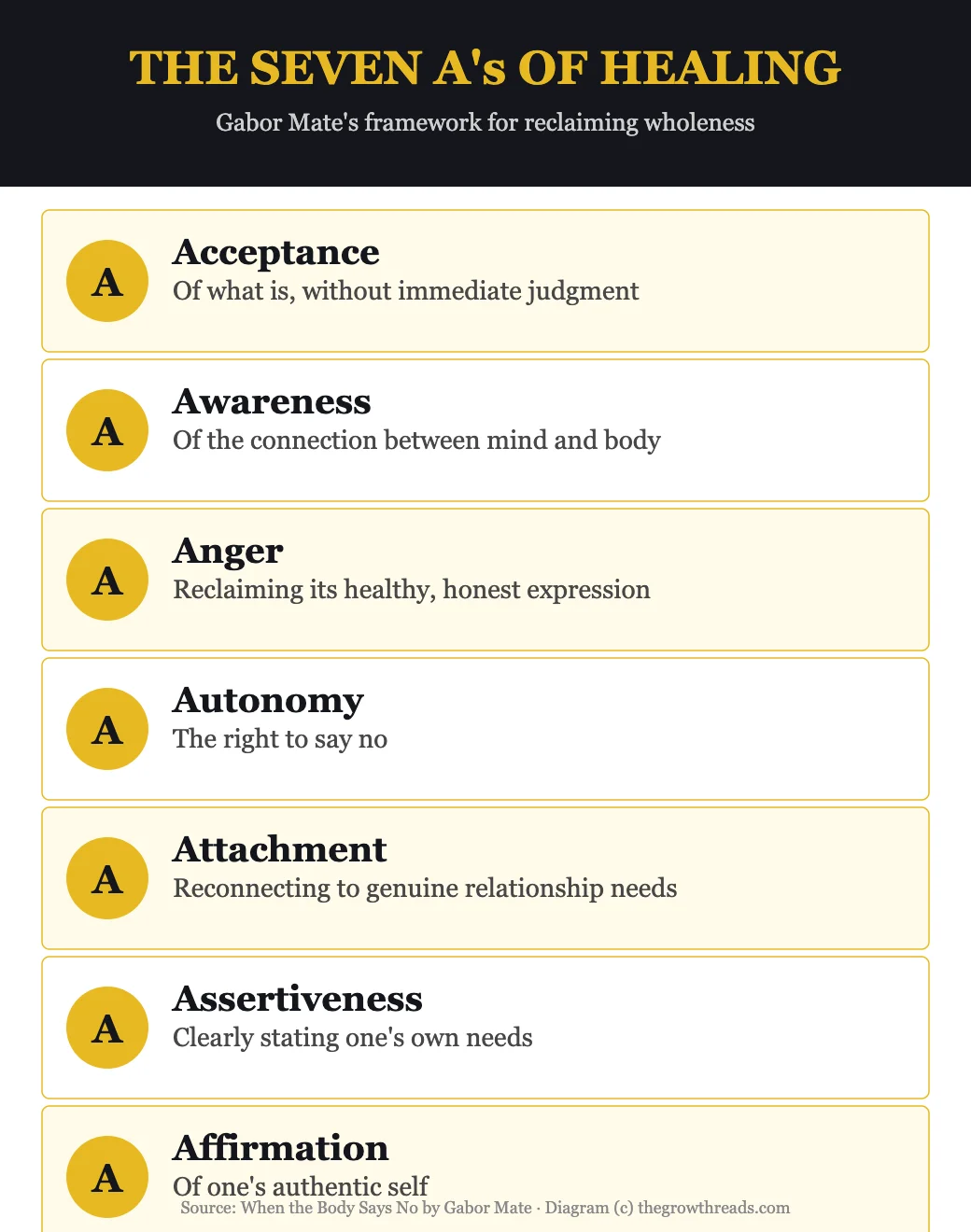
Maté is emphatic that none of this is about blame. Nobody chooses to develop a Type C pattern, and getting sick is never the patient’s fault. The point of the diagnosis, so to speak, is that if suppressed emotion is part of what got you here, then reclaiming emotional honesty is part of what can help going forward — alongside, never instead of, appropriate medical care. His practical framework for this work is the Seven A’s of Healing: Acceptance of what is without immediate judgment; Awareness of the mind-body connection; Anger reclaimed as a healthy, honest signal rather than a threat; Autonomy, especially the right to say no; Attachment renegotiated around genuine needs rather than fear; Assertiveness in stating what you actually want; and Affirmation of the self that was hidden away for the sake of others.
None of this happens overnight, and Maté is honest that it often requires therapeutic support, not just willpower. But he’s equally clear that the starting point is available to anyone: noticing, without judgment, the places where you’ve been saying yes when your body has been quietly saying no.
TGR Note: The Seven A’s overlap closely with the self-acceptance work in our Radical Acceptance summary — both books converge on the same idea from different directions: healing starts with truthfully naming what is actually there.
Maté is also careful to distinguish this healing work from simple positive thinking or forced gratitude, both of which can become just another layer of suppression if they’re used to bypass genuine feeling rather than process it. Real Acceptance, in his framework, means acknowledging anger, grief, or fear exactly as they are, before deciding what to do about them — not skipping straight to a cheerful reframe. That distinction is, in practice, what separates the Seven A’s from generic self-help advice to “just think positive.”
Not medical advice: When the Body Says No is a case for paying attention to the mind-body connection, not a substitute for diagnosis or treatment from a qualified physician. If you’re managing a chronic illness, use this alongside — never instead of — your existing medical care.
It’s worth being upfront about where the book sits scientifically: the psychosomatic research Maté draws on is real but contested, and few of the individual mechanisms he describes have been proven in the strict, controlled sense modern medicine demands. Read it as a compelling clinical hypothesis backed by decades of pattern-matching, not as settled fact — the value is in the questions it raises about your own life, not in treating any single claim as proven.
Who is When the Body Says No best for — and who should read something else first?
This book is best for people who’ve been told their symptoms are “probably just stress” and want a fuller framework for what that actually means, for people managing chronic illness who want to understand the emotional dimension alongside the medical one, for therapists and caregivers, and for anyone who recognizes themselves as the one who never says no. If you’re in the middle of an acute mental health crisis, start instead with something more immediately practical, like our Self-Compassion summary, and return to Maté’s deeper framework once you have more stability and, ideally, a therapist in your corner.
Questions to reflect on
- Where in my life do I regularly have trouble saying no?
- Whose emotional needs have I made more important than my own — and for how long?
- When did I last feel genuine anger, and what did I do with it?
- Which Type C traits do I recognize in myself, and where did I learn them?
- If my body could speak right now, what might it be trying to tell me?
🔥 Ready to hear what your body has been trying to tell you?
Get the full case studies and the complete Seven A’s framework in Gabor Maté’s own words.
How to apply When the Body Says No (7-day plan)
- Day 1: Read the introduction and Chapter 1. Alongside, jot a one-line inventory of any physical symptoms you’re currently carrying — no analysis yet, just notice.
- Day 2: Track every time today you say yes when part of you meant no. Just count them; don’t change anything yet.
- Day 3: Write for ten minutes about a time you suppressed anger. What happened in your body in that moment — and afterward?
- Day 4: Practice one small, low-stakes “no” with someone you trust. Notice how it feels physically, not just emotionally.
- Day 5: Reflect on your family’s pattern around self-sacrifice and emotional expression. Which parts are truly yours, and which were inherited?
- Day 6: Try one Seven A’s practice directly — spend the day on Awareness, checking in with body sensations every few hours and writing down what you notice.
- Day 7: Write a short letter to yourself acknowledging one need you’ve been putting last. You don’t have to act on it yet — just name it.
Frequently asked questions
What is the main message of When the Body Says No?
The book argues that chronic illness is frequently connected to a lifetime of suppressed emotion, hidden stress, and a self-denying personality pattern Maté calls “Type C.” Its core message is that emotional and physical health cannot be meaningfully separated, and that reclaiming emotional honesty — including the ability to feel anger and say no — is a legitimate part of supporting your health, alongside proper medical care.
Is the “Type C personality” scientifically proven?
The Type C concept draws on real psychosomatic research from the 1980s and 1990s, but it remains a debated framework rather than settled science — critics note that much of the supporting evidence is correlational and drawn from clinical observation rather than large controlled studies. Maté treats it as a clinically useful pattern worth taking seriously, not as a proven mechanism, and the book is best read with that distinction in mind.
Does Gabor Maté claim stress alone causes cancer?
No. Maté is explicit throughout the book that he is not proposing simple cause-and-effect — cancer and other chronic diseases involve genetics, environment, and medical history alongside any psychological factors. His argument is that chronic emotional suppression is a contributing factor worth taking seriously, not a sole or sufficient cause, and he explicitly warns against patients blaming themselves for their illness.
Who should read When the Body Says No?
It’s especially useful for people managing a chronic illness who want to understand the emotional dimension alongside their medical treatment, for people who’ve been told their symptoms are “probably stress” and want a fuller picture, for therapists and caregivers, and for anyone who recognizes themselves as chronically unable to say no or express anger honestly.
How is this different from The Body Keeps the Score?
Both books explore how the body stores emotional experience, but from different angles. The Body Keeps the Score by Bessel van der Kolk focuses specifically on trauma and its effects on the brain and nervous system, with an emphasis on treatment approaches like EMDR and somatic therapy. When the Body Says No focuses more broadly on personality patterns, chronic stress, and their links to physical disease across a wider range of conditions. They complement each other well and are frequently read together.
What are the Seven A’s of Healing?
The Seven A’s are Maté’s practical framework for reclaiming emotional authenticity: Acceptance of what is without immediate judgment, Awareness of the mind-body connection, Anger reclaimed as a healthy signal, Autonomy including the right to say no, Attachment renegotiated around genuine needs, Assertiveness in stating your needs clearly, and Affirmation of your authentic self.
Is this book medical advice?
No. When the Body Says No offers a psychological and emotional framework for thinking about chronic illness, not a substitute for diagnosis, treatment, or the advice of a qualified physician. If you’re managing a chronic illness, the book is best used alongside — never instead of — your existing medical care.
Related summaries
- The Body Keeps the Score Summary & Review
- Self-Compassion Summary & Review
- Feeling Good Summary & Review
- Radical Acceptance Summary & Review
- Best Psychology Books
How we analyze books: Every TGR summary is built from a full read of the source material, cross-checked against the author’s public interviews and later work, then structured around practical application rather than critique. We never reproduce chapters verbatim, and we flag where a book’s claims are debated rather than settled. Read our full methodology.