

⭐⭐⭐⭐ 4.3/5 — A practical system for becoming the person who does what they say they will do.
Best for: Anyone who feels pulled toward distractions despite good intentions — especially knowledge workers, parents, and people who have tried (and failed) with willpower alone.
Reading time: ~5 hours (240 pages)
Difficulty to apply: Medium — the techniques are simple, but surfacing your internal triggers takes honest self-examination.
Indistractable in one minute
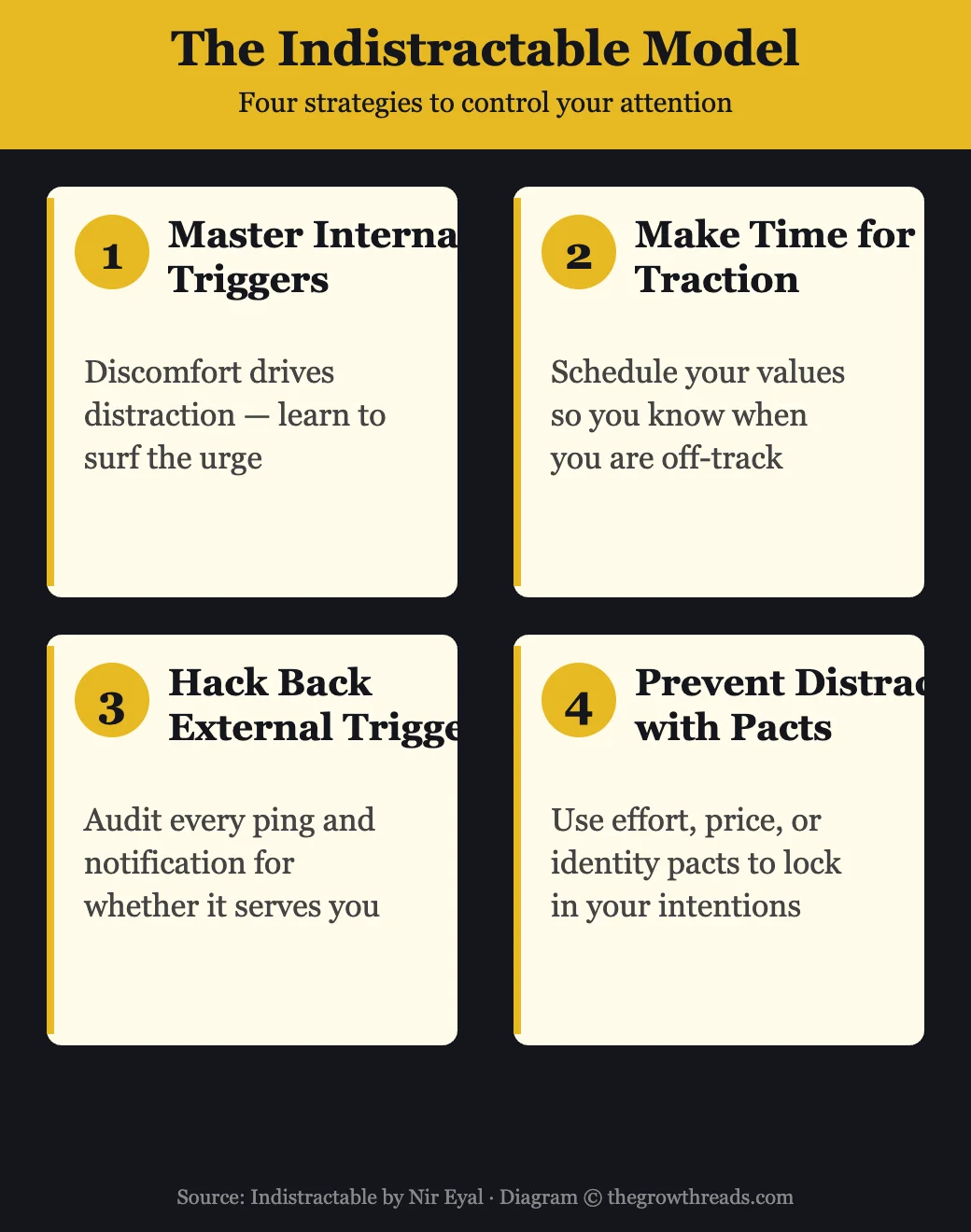
Distraction is not a technology problem — it is a human problem. Nir Eyal argues that every distraction begins with an internal trigger, an uncomfortable feeling we want to escape. The solution is not removing all technology but learning to manage discomfort, scheduling your values into your calendar, removing unhelpful external triggers, and locking in your intentions with pre-commitment pacts. Together, these four strategies make you indistractable — the kind of person who follows through on what they say they will do.
Key takeaways
- Distraction starts inside you: The root cause of distraction is not your phone — it is an uncomfortable internal state like boredom, anxiety, or loneliness that you want to escape.
- Traction vs. distraction: Any action that moves you toward your goals is traction; anything that moves you away is distraction — even work tasks done at the wrong time.
- Time-boxing beats to-do lists: Instead of a to-do list that never ends, turn your values into a time-boxed calendar so every minute of your day reflects what matters most.
- The 10-minute rule: When you feel an urge to get distracted, tell yourself you can give in — in 10 minutes. The urge usually passes.
- External triggers need an audit: Every notification, email ding, and open-plan interruption should earn its right to your attention or be removed.
- Effort pacts add friction: Making the distracted behavior harder to do (app blockers, leaving the phone in another room) is more reliable than willpower.
- Price pacts raise stakes: Putting money or reputation on the line creates a cost for breaking your commitment.
- Identity pacts are the strongest: Calling yourself “indistractable” shifts behavior from something you do to someone you are.
- Workplace distraction is a culture problem: Companies that do not give employees psychological safety and schedule control will always have distraction problems.
- Relationships need indistractable habits too: Being present with your children and partner requires the same scheduled, protected attention as deep work.
What is Indistractable about?
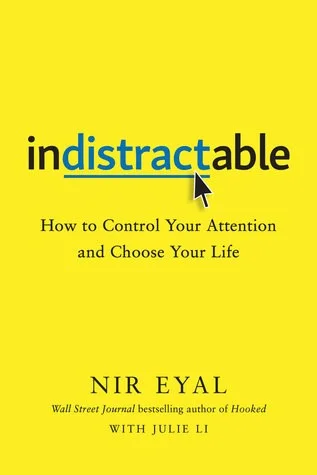
Indistractable is a behavioral-design guide to managing your attention. Nir Eyal presents a four-part model — mastering internal triggers, making time for traction, hacking back external triggers, and preventing distraction with pacts — that treats focus as a skill anyone can build rather than a gift only some people have.
About the author
Nir Eyal is an Israeli-American author, lecturer, and behavioral design consultant. He previously wrote Hooked: How to Build Habit-Forming Products, which taught companies how to make products people cannot put down. After years of hearing people blame technology for their distraction — partly inspired by techniques he had taught — Eyal turned the lens on the user side and wrote Indistractable as the antidote. He has taught at Stanford Graduate School of Business and his work has appeared in Harvard Business Review, The Atlantic, and Psychology Today. Eyal writes at NirAndFar.com, where he continues to explore behavioral design for good. Explore all Nir Eyal book summaries →
Key concepts at a glance
| Concept | What it means | Use it when |
|---|---|---|
| Internal triggers | Uncomfortable feelings (boredom, stress, loneliness) that drive the urge to escape | You catch yourself reaching for your phone without knowing why |
| Traction | Actions that pull you toward what you planned to do | You want a clear definition of productive behavior |
| Distraction | Actions that pull you away from your plans — even “productive” ones at the wrong time | You are busy but not making progress on what matters |
| Time-boxing | Scheduling every block of your day by intent, not by output | To-do lists are growing but nothing meaningful gets done |
| The 10-minute rule | Allow the urge but delay acting on it for 10 minutes | You feel an overwhelming pull toward a distraction |
| Effort pact | Adding friction between you and the unwanted behavior | Willpower is not enough to resist a temptation |
| Price pact | Attaching a financial or social cost to getting distracted | You want stakes that make breaking a commitment painful |
| Identity pact | Adopting a self-image (“I am indistractable”) that aligns with your goal | You want permanent behavior change, not a temporary fix |
Part 1: Master internal triggers
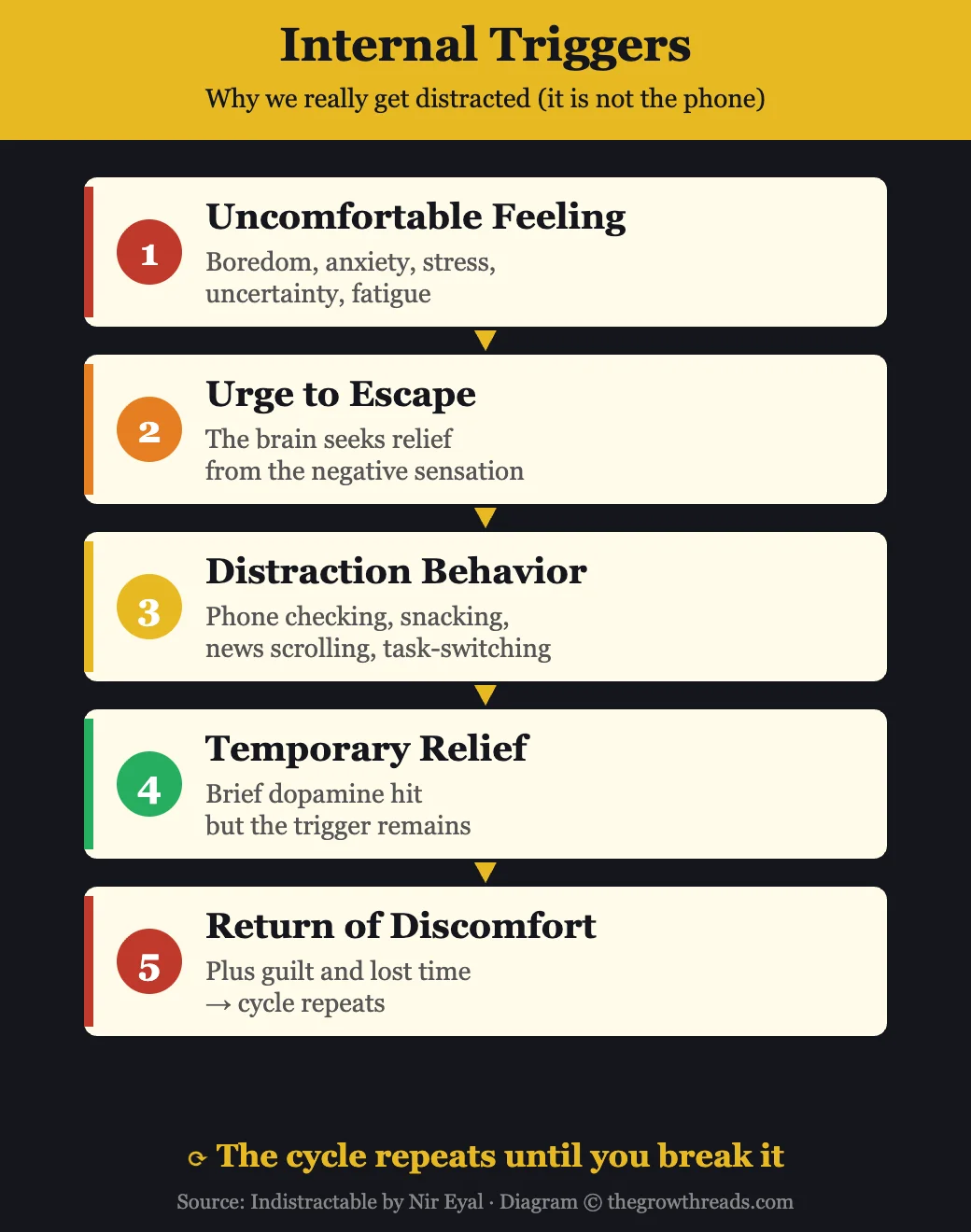
Eyal opens with what he calls the most important and most overlooked piece of the distraction puzzle: the internal trigger. Most people blame external factors — the smartphone, the notification, the chatty coworker — but research in behavioral psychology shows that 90 percent of our actions are motivated by the desire to escape discomfort. Even a millisecond of boredom, uncertainty, fatigue, or feeling inadequate can launch an automatic search for relief.
He introduces a framework for handling these triggers without suppression (which backfires, as research by Daniel Wegner on ironic process theory has shown). The method has four steps: identify the internal trigger, write it down, explore the sensation with curiosity rather than judgment, and “surf the urge” — ride the discomfort for 10 minutes, knowing it will almost always pass.
A study Eyal cites from Jonathan Bricker at the Fred Hutchinson Cancer Research Center found that acceptance-based techniques tripled the success rate of people trying to quit smoking compared to standard counseling. The same principle applies to any urge: rather than fighting the feeling, acknowledge it, get curious about it, and give it 10 minutes. Most of the time you will find the urge dissolves on its own.
Eyal also introduces “reimagining the trigger” — reframing the uncomfortable feeling as a signal, not a threat. When boredom strikes during deep work, you can interpret it as a sign that you are pushing into growth territory rather than as evidence that the task is wrong. This reframe alone can transform a distraction trigger into a traction cue.
Part 2: Make time for traction
The second pillar of the indistractable model is time-boxing — scheduling every block of your day according to your values, not your to-do list. Eyal argues that you cannot call something a distraction unless you know what it distracted you from, and most people never define that clearly enough.
The process begins with three life domains: You, Relationships, and Work. For each domain, you ask: “How much time do I want to spend on this, and when?” Then you place those blocks in your calendar. The result is not a rigid schedule but a template that reflects your priorities. If you planned to spend Tuesday from 6–7 PM playing with your children and you end up on your phone, that is distraction. But if you planned to spend 30 minutes on social media from 8–8:30 PM, that is traction — because you chose it in advance.
This reframe is liberating: there are no “bad” activities, only activities done at the wrong time. Eyal calls this “turning your values into time” and it eliminates the guilt that comes from a to-do list you never finish. Instead of asking “Did I complete everything?” you ask “Did I do what I said I would, when I said I would?”
He also recommends a weekly calibration: every Sunday evening, review the previous week and adjust your template. What blocks were unrealistic? What values got squeezed out? This iteration loop prevents the schedule from becoming stale and keeps it aligned with your evolving priorities.
Part 3: Hack back external triggers
With internal triggers managed and a time-boxed schedule in place, the third step is auditing external triggers — every notification, email, group chat ping, and open-office interruption that pulls your attention without your permission.
Eyal’s method is not to eliminate all technology but to evaluate each external trigger with one question: “Is this trigger serving me, or am I serving it?” Any notification that does not align with your time-boxed schedule should be turned off, batched, or redesigned. He walks through specific hacks for email (check at scheduled times, slow your response time so people stop expecting instant replies), group chat (set status to “Do Not Disturb” during focus blocks), smartphones (remove non-essential apps from the home screen, rearrange by function not habit), desktop (close tabs, use full-screen mode), and meetings (ensure every meeting has an agenda and a timer).
One of his most memorable suggestions is the “screen sign” — a simple card you place on your monitor that says “I am indistractable right now, please come back at [time].” This signals to coworkers that you are in a focus block without requiring an awkward conversation. In studies on workplace interruptions, a visible signal reduced interruptions by over 50 percent compared to verbal requests alone.
For articles and online feeds, Eyal recommends “multichannel multitasking” — saving articles to a read-later app and consuming them during commute or exercise time, rather than letting them hijack your work blocks. The principle is the same throughout: the content is not the problem; the timing and context are.
Part 4: Prevent distraction with pacts
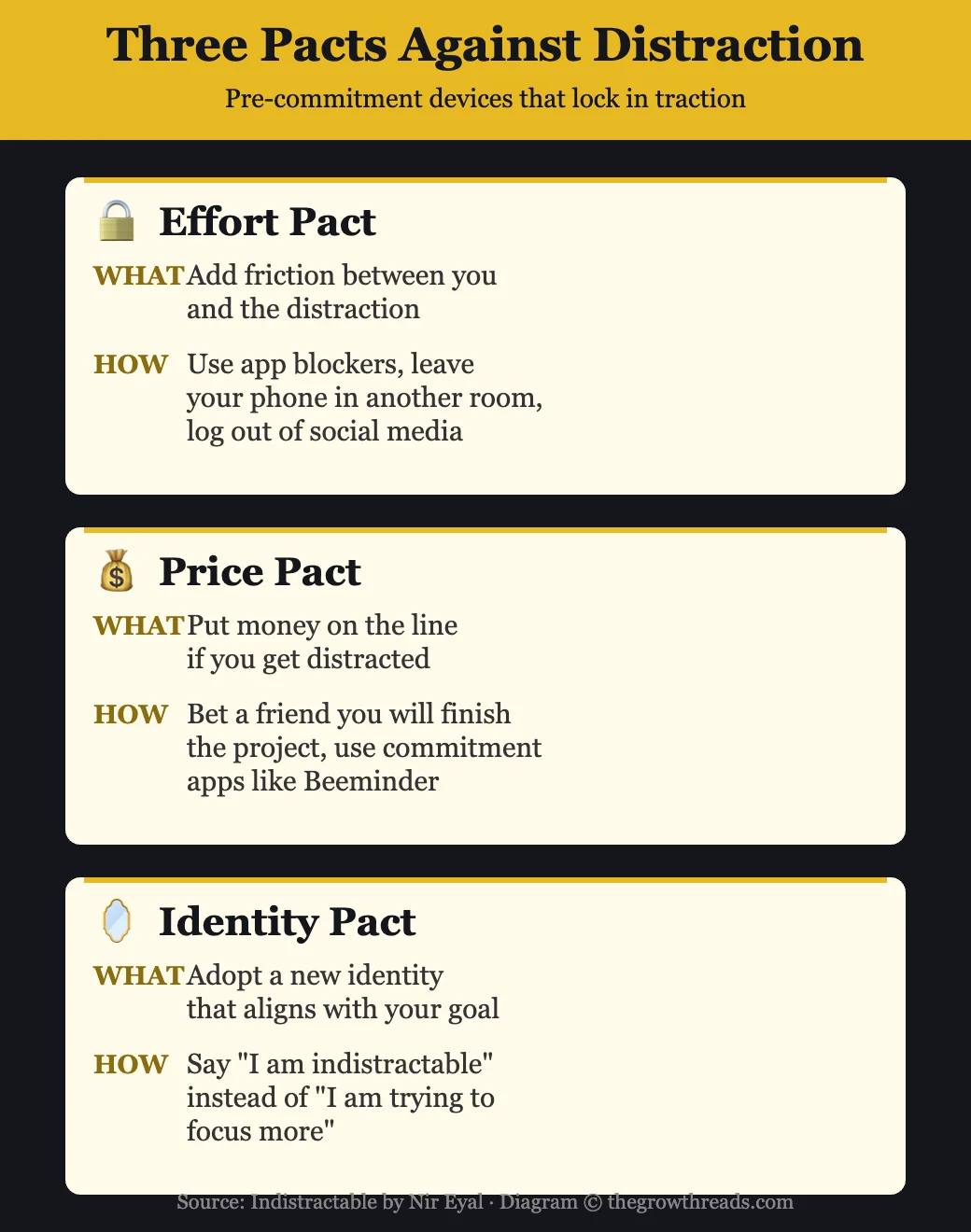
The final pillar is precommitment — using pacts to make distraction harder or more costly before the moment of temptation arrives. Eyal presents three types of pacts, each escalating in strength.
An effort pact adds friction between you and the distraction. Examples include using website blockers like Freedom or Cold Turkey during focus hours, keeping your phone in a timed lockbox during dinner, or simply logging out of social media so you have to re-enter your password each time. The goal is not to make distraction impossible but to add just enough delay for your rational brain to re-engage.
A price pact puts something valuable at stake. Eyal describes a friend who kept a $100 bill in his pocket: if he failed to exercise on a scheduled day, he burned the bill. The friend never missed a workout. Apps like Beeminder and StickK formalize this by charging you real money when you fail to meet your commitment. Price pacts are powerful but should only be used after the first three strategies are in place — otherwise you are punishing yourself for a system that was never set up to succeed.
An identity pact is the most enduring. Instead of saying “I am trying to cut back on social media,” you say “I am indistractable.” Research on identity-based behavior change — later popularized by James Clear in Atomic Habits — shows that people who adopt a new identity (e.g., “I am a non-smoker” vs. “I am trying to quit”) are far more likely to sustain the change long-term. By calling yourself indistractable, you create a cognitive commitment: every decision becomes a vote for or against the person you have decided to be.
Who is Indistractable best for — and who should read something else first?
Indistractable is ideal for knowledge workers who struggle with digital distraction, parents who want to model focused attention for their children, and anyone who has tried productivity systems before but found they could not stick with them. The emphasis on internal triggers makes it uniquely useful for people who sense that their distraction problem runs deeper than just too many notifications.
If you are looking for a system to build new positive habits (rather than block negative ones), start with Atomic Habits. If your distraction stems more from overcommitment than from impulsivity, Essentialism is a better first read. And if your issue is specifically about deep professional work and you want a rigorous case for eliminating shallow tasks, Deep Work goes deeper on the professional side.
Questions to reflect on
- What uncomfortable feeling am I usually trying to escape when I reach for my phone — boredom, anxiety, loneliness, or something else?
- If I time-boxed my entire week around my three domains (You, Relationships, Work), what would change first?
- Which external trigger in my environment costs me the most focus, and what would it take to remove or redesign it?
- Would an effort pact, a price pact, or an identity pact work best for my biggest current distraction?
- If I called myself “indistractable” starting today, what is the first decision I would make differently?
🔥 Ready to take back your attention?
Indistractable gives you the science and the system to become the person who follows through on what matters most.
How to apply Indistractable (7-day plan)
- Day 1 — Track your internal triggers: Carry a notepad and each time you feel the pull to get distracted, write down the feeling that preceded it (bored, anxious, restless). Do not judge — just observe.
- Day 2 — Try the 10-minute rule: When you notice a distraction urge, set a timer for 10 minutes and surf the urge. Journal what happens after the timer ends.
- Day 3 — Time-box your ideal week: Open your calendar and schedule blocks for You (exercise, reading, rest), Relationships (partner, children, friends), and Work. Leave no white space — even free time gets a block.
- Day 4 — Audit external triggers: Go through every notification on your phone and computer. For each one, ask: “Is this serving me?” Turn off anything that is not.
- Day 5 — Set up one effort pact: Install a website blocker for your top distraction site during your two deepest work blocks. Or move your phone to another room during dinner.
- Day 6 — Adopt the identity: Tell one person, “I am indistractable.” Write it on a sticky note near your desk. Notice how it changes your next three decisions.
- Day 7 — Calibrate and iterate: Review your week. Which blocks were realistic? Which triggers still caught you? Adjust the template for next week.
Frequently asked questions
What is the main message of Indistractable?
The core message is that distraction is not caused by technology but by our inability to deal with internal discomfort. By mastering internal triggers, scheduling your values, removing unhelpful external triggers, and using precommitment pacts, you can become “indistractable” — a person who consistently does what they say they will do, regardless of the temptations around them. The book frames focus as a learnable skill rather than a personality trait.
Is Indistractable worth reading if I already read Atomic Habits?
Yes — they complement each other well. Atomic Habits focuses on building positive habits through environmental design and identity change. Indistractable focuses on eliminating negative distractions through internal trigger management and precommitment pacts. Together they form a complete behavior-change system: one for creating traction, the other for removing distraction. Many readers find that the internal-trigger work in Indistractable fills gaps that Atomic Habits leaves open.
How is Indistractable different from Deep Work by Cal Newport?
Deep Work argues for eliminating shallow work and protecting blocks of intense concentration, primarily in a professional context. Indistractable casts a wider net: it applies the same focus principles to work, relationships, and personal wellbeing. Newport prescribes specific rituals and rules; Eyal offers a flexible model you adapt to your own values and schedule. Deep Work is stronger on the “why” of focused work, while Indistractable is stronger on the “how” of handling distraction triggers.
What is the 10-minute rule in Indistractable?
The 10-minute rule is Eyal’s core technique for handling distraction urges. When you feel the pull to check your phone, open social media, or abandon a task, you tell yourself you can give in — but only after 10 minutes. During those 10 minutes you “surf the urge” by observing the sensation with curiosity rather than acting on it. Research shows that most urges peak and fade within a few minutes, so by the time the timer expires, the desire has usually passed.
Does Indistractable say you should quit social media?
No — Eyal explicitly disagrees with the idea that technology is the enemy. His position is that any activity, including social media, can be traction if it is scheduled intentionally and serves your values. The problem is not the app itself but using it reactively to escape discomfort. His recommendation is to schedule social media use (e.g., 20 minutes after dinner), remove it from your home screen, and turn off notifications — keeping the benefits while eliminating the compulsive checking.
What are the three types of pacts in Indistractable?
The three pacts are effort pacts (adding friction to make distraction harder, like using website blockers or putting your phone in another room), price pacts (putting money or social reputation at stake if you break your commitment), and identity pacts (adopting the label “I am indistractable” so your self-image drives consistency). Eyal recommends using them in that order, starting pacts only after you have addressed internal triggers and external triggers first.
Can Indistractable help with workplace distractions?
Yes — Eyal dedicates several chapters to workplace distraction, arguing that it is often a symptom of a dysfunctional culture rather than individual weakness. Companies that do not give employees psychological safety, schedule autonomy, and clear expectations will always produce distracted workers. His advice includes using a “screen sign” to signal focus time, scheduling email and Slack checks in batches, and having honest conversations with managers about protecting deep work blocks. These techniques apply whether you work in an office or remotely.
Related summaries
- Atomic Habits Summary & Review — Build positive habits with identity-based behavior change
- Deep Work Summary & Review — Protect professional focus in a distracted world
- Digital Minimalism Summary & Review — A 30-day plan to reset your relationship with technology
- Stolen Focus Summary & Review — The systemic forces destroying your ability to concentrate
- Best Productivity Books — Our complete ranked guide