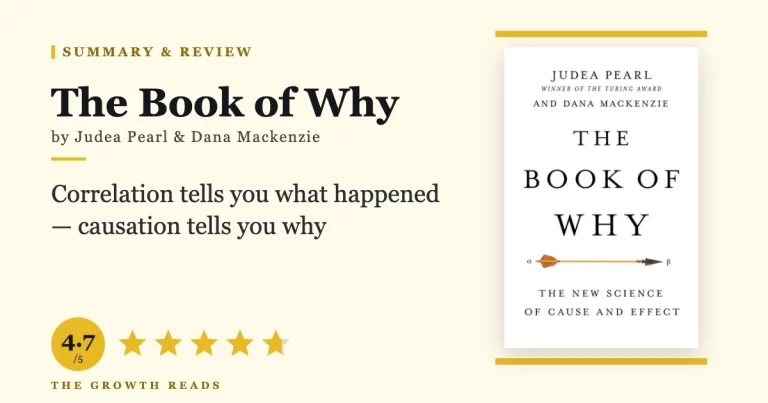
The Book of Why Summary & Review: How to Think in Causes, Not Just Correlations
Judea Pearl and Dana Mackenzie's Ladder of Causation, causal diagrams, and do-calculus — the framework for reasoning past correlation to real cause…
Read Summary →
"The Turing Award computer scientist who gave machines a formal language for why"
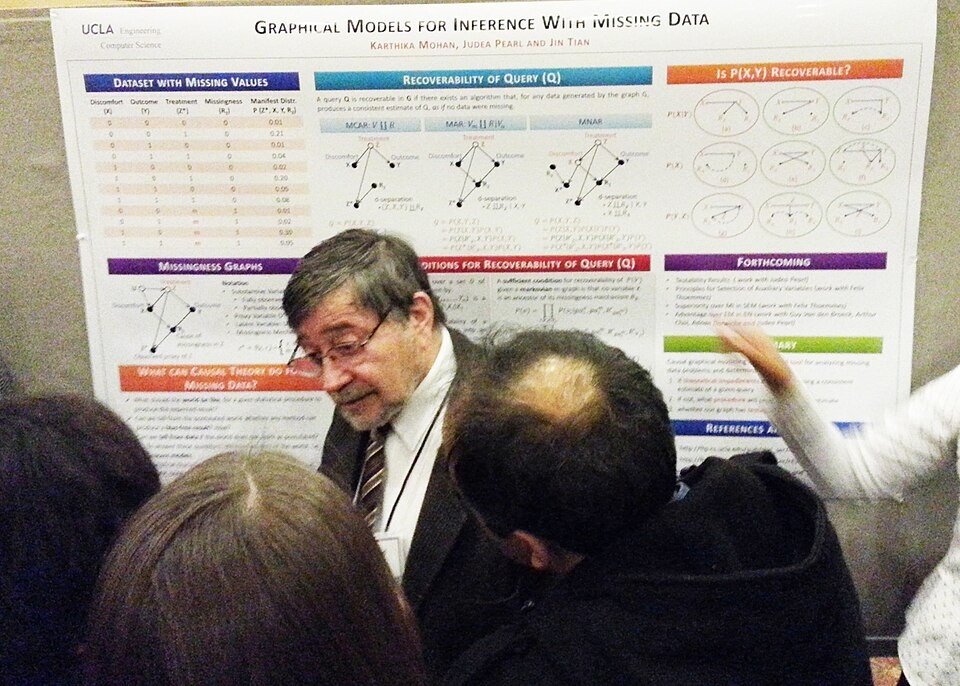
Judea Pearl is a computer scientist and statistician at UCLA, where his early work on Bayesian networks gave machines a formal way to reason under uncertainty. That work won him the 2011 Turing Award, computing's highest honor. In the 1990s and 2000s he turned to an even harder problem: bringing the same mathematical rigor to cause and effect, developing causal diagrams and do-calculus as a formal language for “why” questions that statistics had long treated as too dangerous to touch. With science writer Dana Mackenzie, he distilled decades of research into The Book of Why (2018), arguing that genuine machine intelligence — not just pattern-matching — requires causal reasoning. He continues to publish and speak on causal inference and the future of AI.

Our in-depth summaries and reviews of his work

Judea Pearl and Dana Mackenzie's Ladder of Causation, causal diagrams, and do-calculus — the framework for reasoning past correlation to real cause…
Read Summary →Three levels of reasoning — association, intervention, and counterfactuals — that define how far a mind (human or machine) can climb toward genuine understanding.
A formal, drawable language for stating causal assumptions explicitly, so they can be checked and debated instead of hidden inside a statistical model.
A rule-based method for computing the effect of an intervention from observational data and a causal diagram, without needing to run a real experiment.
"Data can tell you that two things are correlated, but it can never tell you why — for that, you need a model of how the world works."— The Book of Why
"Every causal claim rests on an assumption that no dataset, however large, can supply on its own."— The Book of Why
"An AI that has never asked “what if” has not yet learned to think."— The Book of Why

Judea Pearl and Dana Mackenzie's Ladder of Causation, causal diagrams, and do-calculus — the framework for reasoning past correlation to real cause and effect, and why AI needs it too.