The Book of Why Summary & Review: How to Think in Causes, Not Just Correlations
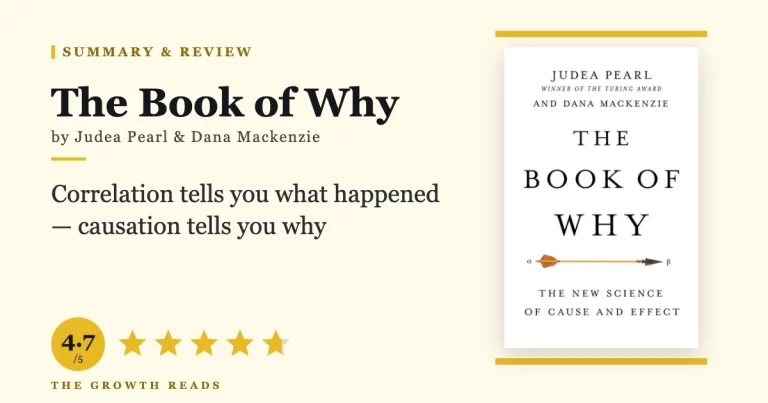
Judea Pearl and Dana Mackenzie's Ladder of Causation, causal diagrams, and do-calculus — the framework for reasoning past correlation to real cause…
Read Summary →"The science writer who turned causal inference into a book anyone can read"
Dana Mackenzie is a mathematician turned science writer, with a PhD in mathematics and years of teaching before he moved full-time into writing about science for a general audience. He is the author of several acclaimed books that translate advanced mathematics, physics, and the history of scientific ideas into accessible narrative, and his work has appeared in Science, New Scientist, and Discover. He partnered with Judea Pearl to co-write The Book of Why (2018), turning Pearl's decades of technical research on causal inference into a book general readers could actually follow — supplying the narrative structure and the everyday examples that carry the book's more demanding ideas.
Our in-depth summaries and reviews of his work

Judea Pearl and Dana Mackenzie's Ladder of Causation, causal diagrams, and do-calculus — the framework for reasoning past correlation to real cause…
Read Summary →Turning Pearl's formal mathematics — diagrams, do-calculus, counterfactuals — into stories and examples a general reader can follow without a statistics background.
A career built on translating advanced, technical scientific ideas into narrative nonfiction, across mathematics, physics, and the history of science.
Presenting real, counterintuitive statistical reversals — like the kidney-stone treatment study — as concrete narratives rather than abstract warnings.
"The hardest part of writing about causation wasn't the math — it was finding the story that made the math feel necessary."— On co-writing The Book of Why
"A good example is worth a thousand equations."— The Book of Why

Judea Pearl and Dana Mackenzie's Ladder of Causation, causal diagrams, and do-calculus — the framework for reasoning past correlation to real cause and effect, and why AI needs it too.