

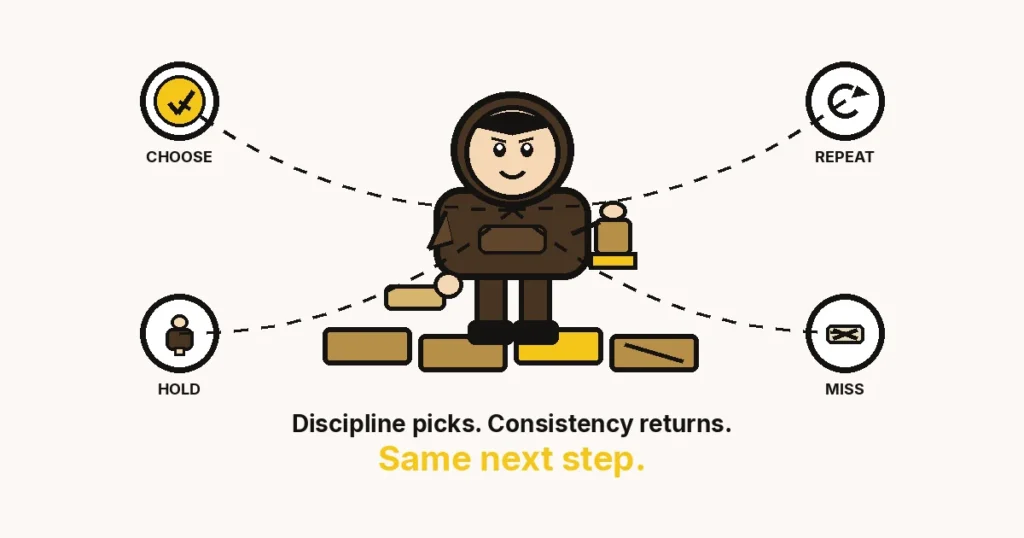
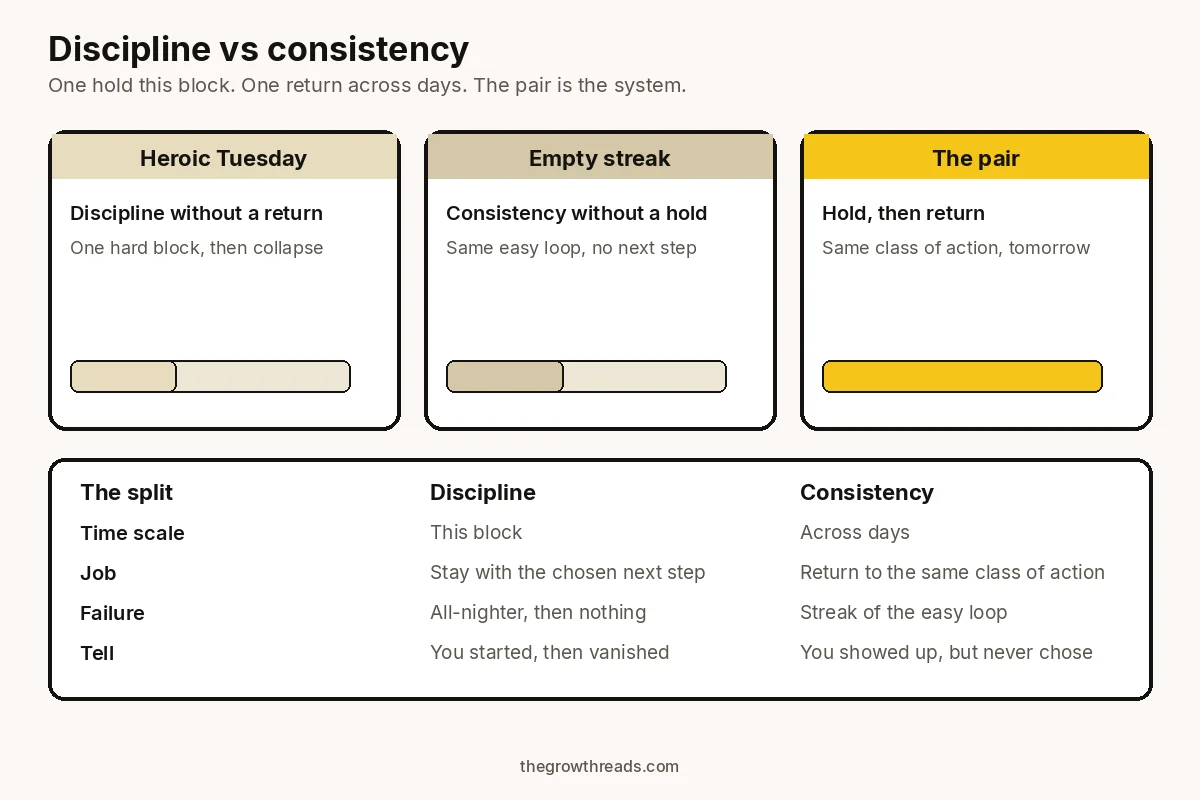
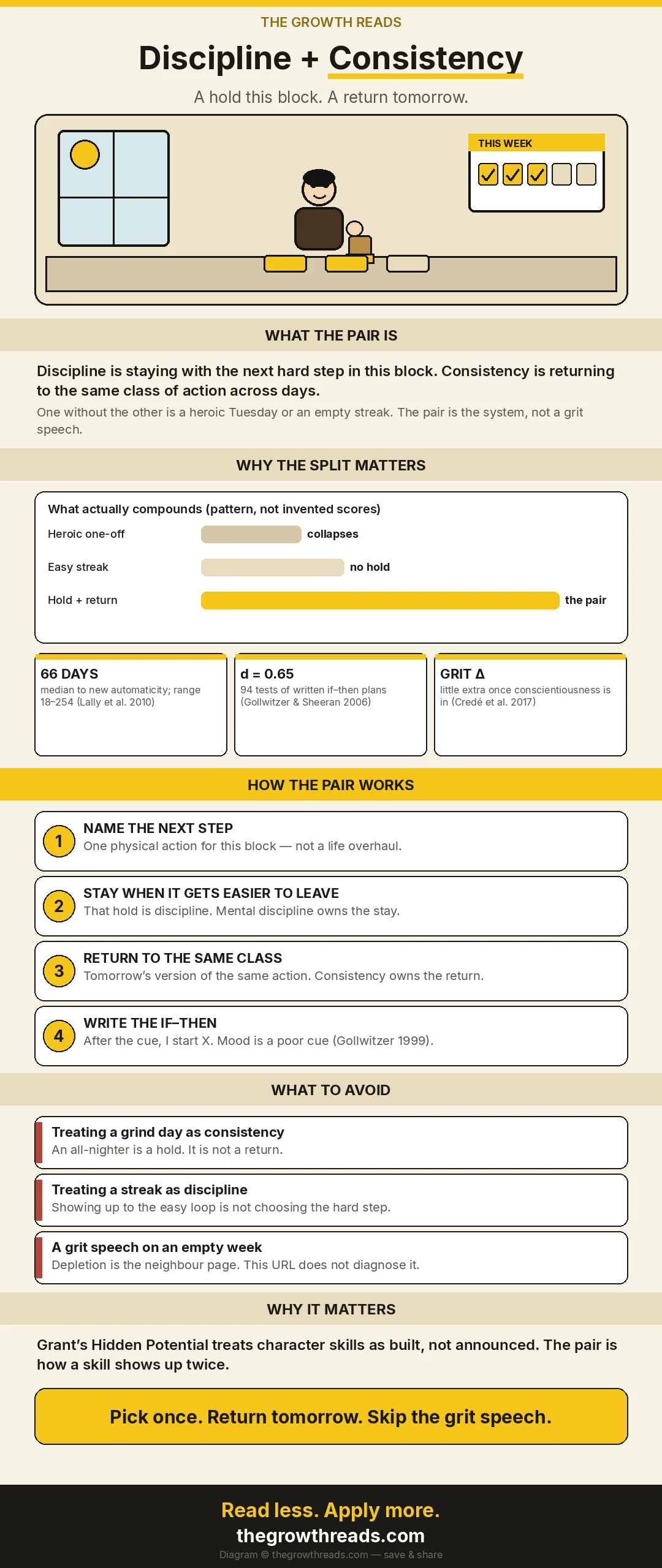
Discipline and consistency are two different work habits that only look the same from a distance. Discipline is staying with the next hard step in this block. Consistency is returning to the same class of action across days. One without the other is a heroic Tuesday or an empty streak — not a system.
Key takeaways
- Discipline and consistency are a pair: a hold in this block plus a return across days — not two names for the same grit speech.
- New everyday actions reached automaticity at a median of 66 days in 96 adults, with a range of 18–254, and simpler behaviours moved faster (Lally, van Jaarsveld, Potts & Wardle, 2010).
- A written if–then — exact cue plus exact action — raised follow-through across 94 tests with a medium effect (Gollwitzer, 1999; Gollwitzer & Sheeran, 2006).
- Grit added little once conscientiousness was already in the model; perseverance of effort did most of the work (Credé, Tynan & Harms, 2017).
- Grant’s Hidden Potential treats character skills as built in the room, not announced after one grind day — the pair is how a skill shows up twice.
What discipline and consistency actually are
Discipline and consistency are two different work habits: a hold in this block, and a return across days. Search treats them as one virtue with two names. The useful version is a pair. Discipline is staying with the next hard step when a more comfortable option is already in the room. Consistency is coming back to the same class of action tomorrow, in a context that can start it without a speech. Fuse them and you get a grit poster. Split them and you can see which file you actually have.
That is why this page sits under Discipline, next to the cluster’s live parent how to build discipline, rather than under a health silo or a motivation-hack silo. The sister hold page is mental discipline. Same cluster. Different file. That URL owns the designed stay versus a willpower tank. This URL owns the pair: that stay plus the return. The repeat-until-less-thought page is what consistency actually is, filed under Habits. Use it when the question is the repeat. Use this page when the question is why a hold and a return keep getting sold as the same muscle.
This is a work-and-habits page on the productivity library. It is not a burnout health page, not a diagnosis, and not a treatment list. It does not score your character. It does not tell you that a thin week means you have a disorder. The question is narrower: did you stay with the next step, and did you return to the same class of action. Burnout vs laziness is motivation versus depletion at work. This page is the pair. Do not paste an empty-tank story onto a missing return. Do not paste a laziness story onto a missing hold.
A one-off grind with no return is a pleasant legend by Friday. Repeat the same class of action in the same room and it starts to become a habit in Wood and Neal’s (2007) sense: a context that starts the next action without a speech. That is also the join to keystone habits and to why consistency is important. The named unused review on this row is Adam Grant’s Hidden Potential. The book is an argument for character skills and scaffolding, not a trial. Use it as the down-link for a pair you build, not as a second study and not as a grit costume.
Discipline vs consistency
Discipline answers “will you stay with this step?” Consistency answers “will you return to this class of action?” They share a family resemblance. They fail in opposite directions. Stay without a return and you get the all-nighter that never becomes a week. Return without a stay and you get the streak that never chooses the hard file. Is discipline a skill owns the trait-versus-practice question. Self-discipline examples owns what a hold looks like in an ordinary hour. This URL owns the comparison that those pages do not have to make.
Why people fuse the two
People fuse discipline and consistency because both look like “trying hard” from the outside, and English uses the words as synonyms for character. A grind day photographs well. A streak app photographs well. The pair does not photograph. The pair is a Tuesday hold that nobody claps for, then a Wednesday return that looks like nothing. Duckworth, Peterson, Matthews and Kelly (2007) gave the fused story a research name — grit as perseverance plus passion for long-term goals. That paper is useful as a description of how people talk. It is not a licence to treat every missed return as a missing personality.
Credé, Tynan and Harms (2017) then did the ungrateful work. In a meta-analysis, grit added little once conscientiousness was already in the model. Perseverance of effort carried most of what grit predicted. Passion-as-consistency-of-interest did less. The honest scrap for this page: a branded virtue that sounds like the pair often collapses into one trait you already had a name for. That is not a reason to stop practising a hold or a return. It is a reason not to buy a new identity for either.
The other fuse is fuel. Baumeister, Bratslavsky, Muraven and Tice (1998) reported that a first self-control task reduced persistence on a second one — the ego-depletion story. Hagger and colleagues (2016) ran a registered replication across 23 labs and found a near-zero effect. Vohs, Schmeichel and colleagues later reported mixed multilab results. The usable caution is simple: do not treat discipline as a tank you drain, and do not treat a thin week as proof the tank is empty. If the week is spent, that is the burnout-versus-laziness split — motivation versus depletion — and a different URL. This page does not diagnose depletion and does not treat it.
The four mix-ups
- The heroic Tuesday. You stay for six hours, finish the ugly draft, and treat the hold as a week. Lally, van Jaarsveld, Potts and Wardle (2010) found automaticity built across repetitions of a simple action, not across one long session. A hold without a return is still a hold. It is not consistency.
- The empty streak. You tick the box every day on the easy loop. Wood and Neal (2007) would call that a habit. This page asks whether the action you trained is the work you named. A streak of inbox-zero is not a hold on the hard file. The habit loop owns cue–routine–reward. This URL owns whether the routine is the pair.
- The mood cue. You wait to feel disciplined, then wait to feel consistent. Gollwitzer (1999) is the cheaper layer: after the kettle, I open the named file. Mood is a poor cue. Implementation intentions on this site live at implementation intentions. Write the sentence. Do not wait for a personality upgrade.
- The grit speech. You replace a missing return with a louder identity. Grant’s Hidden Potential is the down-link against that costume: character skills are built with scaffolding, not announced. A speech is not a next step. A next step is a next step.
Why the mix-up costs more than it feels like
Fusing the two feels efficient because you only have to buy one virtue; the bill is a week of heroics or a month of empty ticks, and no file that compounds. The heroic Tuesday costs recovery you then spend on a speech. The empty streak costs a clean calendar that still has no hard work on it. The pair costs boredom. Boredom is cheaper.
Gollwitzer and Sheeran (2006) summarised 94 tests of written if–then plans. The mean effect was a medium d of 0.65. That is not a personality transplant. It is a cheaper join between a cue you already have and an action you already named. Use it to attach the return to a room, not to attach a grit label to a mood. Wood, Tam and Guerrero Witt (2005) then showed that habits stayed put when the context stayed put and slipped when the context moved. If you change offices, the pair needs a new sentence. It does not need a new identity.
| Pattern | What it actually is | What it costs | The cheaper move |
|---|---|---|---|
| Heroic Tuesday | A hold with no return | A legend, then a gap. Automaticity never starts (Lally et al., 2010) | A smaller next step you can return to tomorrow |
| Empty streak | A return with no hold | A clean calendar and the same easy loop (Wood & Neal, 2007) | Name the hard file inside the streak |
| The pair | Hold this block, return to the same class of action | Feels boring. Then the file exists twice | Write the if–then tonight (Gollwitzer, 1999) |
| Empty tank, any pair | Motivation versus depletion — the neighbour page | A longer rules list on a week that is already spent | Do not use this URL as a grit speech. See burnout vs laziness |
Two honest caveats. Lally’s 66-day median is new automaticity for everyday actions, not a days-to-become-disciplined number, and the range was 18–254. Credé’s grit meta-analysis is about incremental validity, not a claim that effort is pointless. Hagger’s replication is a caution against the tank story, not proof that self-control never tires. This page does not invent a percentage for “how much more productive the pair makes you.”
Grant’s book is the organisational-feeling version of the same cheap layer: skills you can practise in a room, with help, rather than a trait you announce after a grind. That is not peer-reviewed. Pair it with the parent sequence on how to build discipline and with personal accountability if the missing piece is owning the return rather than performing the hold. A pair is not a personality upgrade. It is two jobs with two clocks.
Common mistakes
- Using the words as synonyms. If you cannot say which file you are missing — the hold or the return — you are still in the fuse. Split them before you add a rule.
- Treating a grind day as consistency. Lally’s group measured repetitions. One long session is a hold. It is not a return.
- Treating a streak as discipline. Wood and Neal’s habit can be the easy loop. Consistency owns the repeat. This page asks what you repeated.
- Buying grit as a third virtue. Credé, Tynan and Harms (2017) is why a branded trait is a weak extra once conscientiousness is already on the table. Practise the pair. Do not purchase an identity.
- Waiting to feel ready. Gollwitzer (1999) is the sentence. Mood is a poor cue. Write it on implementation intentions.
- Pasting an empty-tank story onto a missing return. Burnout vs laziness is motivation versus depletion. Do not diagnose it. Do not treat it. Do not add a longer pair-list to an empty week.
- Changing the room and keeping the old speech. Wood, Tam and Witt (2005) found the action slipped when the context moved. Write a new if–then for the room you will actually be in.
When it is more than a habit
A workplace pair that is missing a hold or a return is a routine question; a pattern that takes over sleep, money, or safety is a different conversation and this page is not that conversation. The discipline-and-consistency frame is for ordinary work: the all-nighter that never becomes a week, the streak that never chooses the hard file, the speech that replaces a next step. It is not a diagnosis, not a treatment list, and not a stand-in for help with compulsive use or anything that is harming health or relationships.
If you can name the next step and the room you will return in, this page applies. If weeks stay impossible after the pair is split and written down, stop asking this URL for a laziness test, a grit score, or a tighter streak. The honest next step is a qualified person, not a louder identity. This article does not diagnose, does not treat, and does not list clinical symptoms.
The evidence behind this
The usable evidence is a hold-versus-return split, a median time to new automaticity, a written if–then, and a grit meta-analysis that refuses a third virtue — not a days-to-become-disciplined score.
| Study | Design and size | Finding | What we used it for |
|---|---|---|---|
| Lally, van Jaarsveld, Potts & Wardle (2010) | 96 adults; daily self-report of a new everyday behaviour; automaticity over time | Median 66 days to a plateau; range 18–254; simpler behaviours automatized faster | A return needs repetitions. A heroic Tuesday is not a week. Not a days-to-discipline number |
| Wood & Neal (2007) | Review of habit as a context–response link | Context can start the next action without a fresh goal | Consistency can be the easy loop. Name the action you trained |
| Wood, Tam & Guerrero Witt (2005) | Field; students transferring universities; habit persistence when context stayed or moved | Habits held when the context held and slipped when it moved | A new room needs a new if–then, not a new identity |
| Gollwitzer (1999) | Review of implementation-intention experiments | A written if–then (exact cue + exact action) raises follow-through versus a vague goal | “After the kettle, I open the named file.” Mood is a poor cue |
| Gollwitzer & Sheeran (2006) | Meta-analysis; 94 tests of implementation intentions | Mean effect d = 0.65 | The sentence is cheaper than a grit speech. Not a personality transplant |
| Duckworth, Peterson, Matthews & Kelly (2007) | Scale development plus predictive studies of grit | Grit as perseverance and passion for long-term goals | Why English fuses the pair into one virtue. Description, not a third muscle |
| Credé, Tynan & Harms (2017) | Meta-analysis of grit | Little incremental validity over conscientiousness; perseverance of effort did most of the work | Do not buy grit as a third virtue. Practise the hold and the return |
| Baumeister, Bratslavsky, Muraven & Tice (1998) | Lab; sequential self-control tasks | A first control task reduced persistence on a second task | The tank story people still tell. See the next row |
| Hagger et al. (2016) | Registered replication; 23 labs | Near-zero ego-depletion effect | Do not treat discipline as a tank you drain. Not proof that a thin week is “laziness” |
Frequently asked questions
What is the difference between discipline and consistency?
Discipline is staying with the next hard step in this block. Consistency is returning to the same class of action across days. They only look the same from a distance. A heroic Tuesday is a hold with no return. An empty streak is a return with no hold. The pair is the system. This page sits under Discipline, next to how to build discipline, and is not a grit speech. Mental discipline owns the stay. What consistency actually is owns the repeat until less thought.
Which should you build first, discipline or consistency?
Build the smaller pair, not a personality. Name one next step you can hold for this block, then return to the same class of action tomorrow. Lally, van Jaarsveld, Potts and Wardle (2010) found simpler behaviours reached automaticity faster, with a median of 66 days and a range of 18 to 254. That is new automaticity, not a days-to-become-disciplined number. Gollwitzer (1999) is the sentence that makes the return cheap: after the cue, I start X. Do not wait to feel like a disciplined person.
Is discipline the same as grit or willpower?
No. Duckworth, Peterson, Matthews and Kelly (2007) defined grit as perseverance and passion for long-term goals. Credé, Tynan and Harms (2017) then found grit added little once conscientiousness was already in the model, and that perseverance of effort did most of the work. Mental discipline on this site is the designed hold when a more comfortable option is available — not a tank and not a speech. This URL is the pair: that hold plus a return. Willpower-as-fuel is a contested story (Baumeister 1998; Hagger 2016). Do not treat a thin week as a grit deficit.
Can you be consistent without being disciplined?
Yes. You can show up every day to the easy loop — the same snack, the same scroll, the same tidy inbox — and never choose the next hard step. That is consistency without a hold. Wood and Neal (2007) described habits as context–action links. Context will start whatever you trained, including the cheap action. The consistency page owns the repeat until less thought. This page asks whether the thing you are repeating is the work you named. A streak app cannot answer that.
Can you be disciplined without being consistent?
Yes. You can stay with a brutal block, finish the draft, and then vanish for a week. That is a hold with no return. It feels like character. It is a one-off. Lally’s group found automaticity built across repetitions of a simple action, not across one heroic session. Hidden Potential is the down-link here because Grant treats character skills as built in the room, not announced after a grind day. The cheaper next move is a smaller return tomorrow, not a louder speech tonight.
How long does it take for discipline and consistency to stick?
Lally, van Jaarsveld, Potts and Wardle (2010) tracked new everyday behaviours in 96 adults. Automaticity reached a plateau at a median of 66 days, range 18 to 254, and simpler actions moved faster. That paper measured new automaticity, not a days-to-gain-discipline score, and not a promise that your calendar “locks in” on day 21. Write one if–then (Gollwitzer, 1999). Keep the action small enough to return to. A twelve-step overhaul is how the pair is gone by Thursday.
Is missing a day a failure of discipline?
A miss is a gap in the return, not a verdict on character. Wood, Tam and Witt (2005) found habits persisted when the context stayed stable and slipped when the context moved. If Tuesday’s room is gone, Tuesday’s action needs a new cue, not a grit speech. Write the next if–then for the room you will actually be in. Do not turn one miss into a personality test. Do not use a miss as a diagnosis. This page does not treat a gap, and it does not list symptoms.
Is this the same as burnout versus laziness?
No. Burnout versus laziness is motivation versus depletion at work — a different URL, and not a health page. Discipline and consistency is the pair of a hold and a return. If the week is already spent, a longer rules list is the wrong layer. This article does not diagnose depletion, does not treat it, and does not list clinical symptoms. Name which file you have: a missing hold, a missing return, or an empty tank. Then open the matching URL.
Sources
- Lally, P., van Jaarsveld, C. H. M., Potts, H. W. W., & Wardle, J. (2010). How are habits formed: Modelling habit formation in the real world. European Journal of Social Psychology, 40(6), 998–1009. doi:10.1002/ejsp.674
- Wood, W., & Neal, D. T. (2007). A new look at habits and the habit-goal interface. Psychological Review, 114(4), 843–863. doi:10.1037/0033-295X.114.4.843
- Wood, W., Tam, L., & Guerrero Witt, M. (2005). Changing circumstances, disrupting habits. Journal of Personality and Social Psychology, 88(6), 918–933. doi:10.1037/0022-3514.88.6.918
- Gollwitzer, P. M. (1999). Implementation intentions: Strong effects of simple plans. American Psychologist, 54(7), 493–503. doi:10.1037/0003-066X.54.7.493
- Gollwitzer, P. M., & Sheeran, P. (2006). Implementation intentions and goal achievement: A meta-analysis of effects and processes. Advances in Experimental Social Psychology, 38, 69–119. doi:10.1016/S0065-2601(06)38002-1
- Duckworth, A. L., Peterson, C., Matthews, M. D., & Kelly, D. R. (2007). Grit: Perseverance and passion for long-term goals. Journal of Personality and Social Psychology, 92(6), 1087–1101. doi:10.1037/0022-3514.92.6.1087
- Credé, M., Tynan, M. C., & Harms, P. D. (2017). Much ado about grit: A meta-analytic synthesis of the grit literature. Journal of Personality and Social Psychology, 113(3), 492–511. doi:10.1037/pspp0000102
- Baumeister, R. F., Bratslavsky, E., Muraven, M., & Tice, D. M. (1998). Ego depletion: Is the active self a limited resource? Journal of Personality and Social Psychology, 74(5), 1252–1265. doi:10.1037/0022-3514.74.5.1252
- Hagger, M. S., Chatzisarantis, N. L. D., Alberts, H., Anggono, C. O., Batailler, C., Birt, A. R., … Zwienenberg, M. (2016). A multilab preregistered replication of the ego-depletion effect. Perspectives on Psychological Science, 11(4), 546–573. doi:10.1177/1745691616652873
Related reading on The Growth Reads
The books this page draws on
- Hidden Potential summary — character skills built in the room, not announced after a grind day
Related articles
- How to build discipline — this cluster’s parent
- Mental discipline — the sister: the designed hold, not a grit speech
- What is consistency — the return until less thought, under Habits
- Is discipline a skill — practice versus trait
- Self-discipline examples — what a hold looks like in an ordinary hour
- Implementation intentions — the written if–then
- Burnout vs laziness — motivation versus depletion, not this pair
Go deeper
How this article was researched
The Growth Reads editorial team writes from primary sources: the books themselves and the peer-reviewed literature behind the claims. Every study cited above was read in the original publication or its published abstract, and every figure is quoted with its design, sample and effect so you can judge its weight rather than take ours. Where a finding is a review, a meta-analysis, a student field sample, or a failed replication, we say so in the body rather than in a footnote. This page does not invent a days-to-become-disciplined score, because none of the cited papers measured one.
This article is a work-and-habits page. It is discipline and consistency as a hold plus a return — not a burnout health page, not medical advice, not a diagnosis, and not a treatment plan. A pattern that is harming sleep, money, safety, or relationships is outside this URL.
How we work: every article on The Growth Reads is built from the books in our library plus the research they rest on, and is reviewed and date-stamped when the evidence changes. Read our full methodology.