

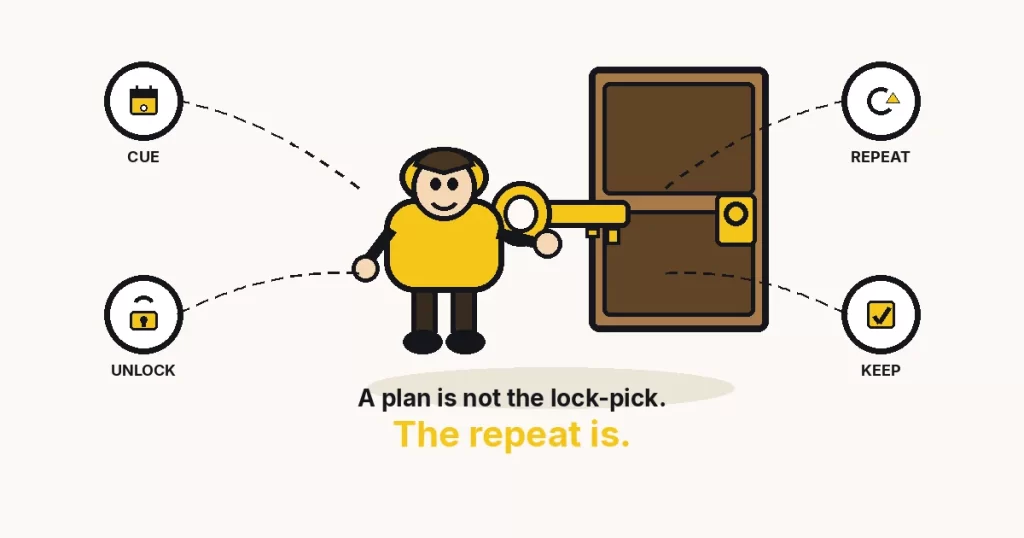
Consistency is key means the repeat is the lock-pick: the same small action, in the same context, is what unlocks plans, talent, and tools. A harder Monday is not the key. The lock yields to the cue that fires again on an ordinary Tuesday — which is why the cliché survives and a one-off burst does not.
Key takeaways
- Wendy Wood and David Neal (2007) treat a habit as a context–response association: once the cue is stable, the action can fire without a fresh goal — that is why consistency is the key, not a louder intention.
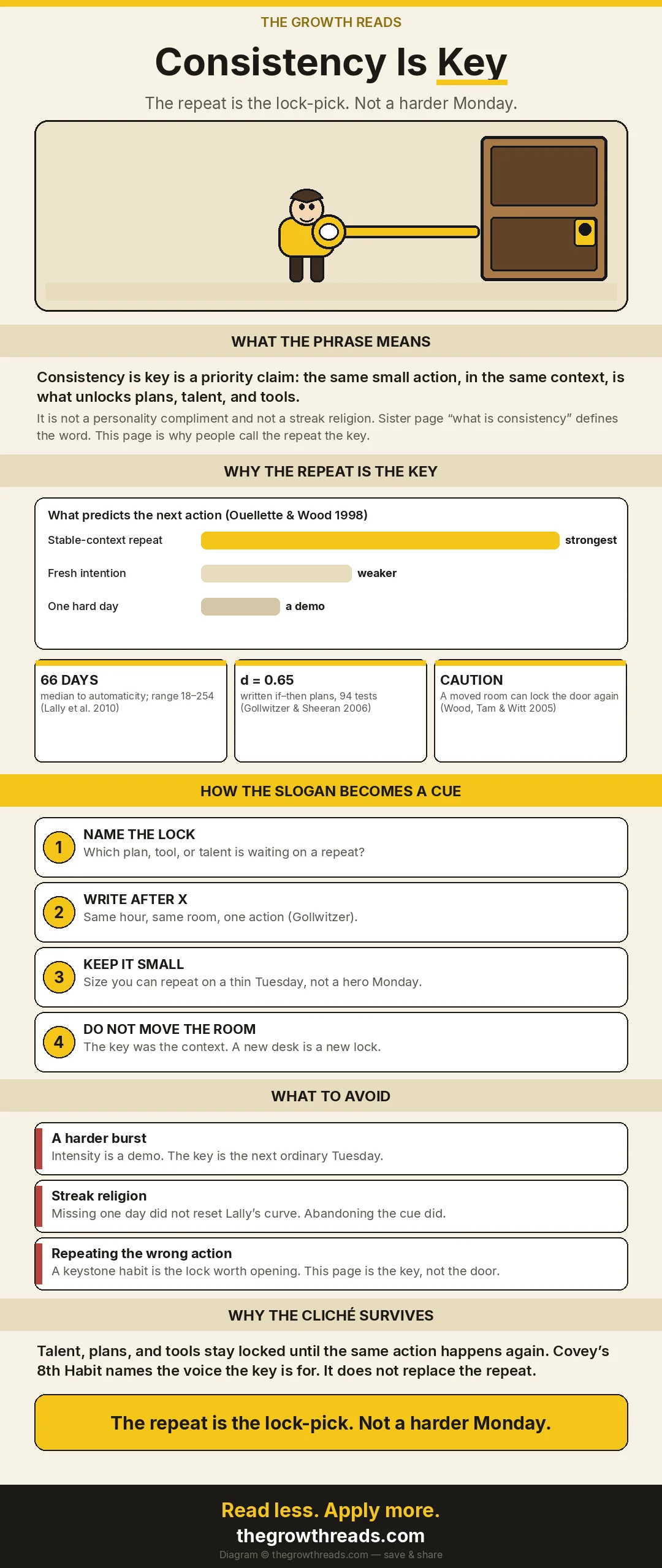
- In Lally, van Jaarsveld, Potts and Wardle’s 12-week field study (96 people), the median time to an automaticity plateau was 66 days (range 18–254); missing one day did not reset the next day’s automaticity.
- A written if–then plan — after X, in Y, I will Z — produced a medium-to-large average lift across 94 tests (Gollwitzer & Sheeran, 2006), which is how the slogan becomes a cue that can fire again.
- When students moved university, TV and exercise habits often stopped because the room changed, not because character failed (Wood, Tam & Guerrero Witt, 2005).
- Stephen Covey’s The 8th Habit names what the key is for — finding and expressing a voice — it does not replace the repeat that makes any habit, including that one, fire.
What “consistency is key” actually means
Consistency is key is a priority claim, not a personality compliment. The phrase says the repeat is the thing that unlocks the rest of the system: the plan, the talent, the tool, the burst of motivation. Without the same action happening again in the same context, those stay locked. That is a different job from the live definition page what is consistency, which names the word. This page is why people reach for the metaphor of a key.
A key is not the room. A key is not the furniture. A key is the small object that makes the rest of the house usable. In habit research the small object is a context–response bond. Wendy Wood and David Neal put it this way in their 2007 Psychological Review paper: once a response has been repeated in a stable context, the context can trigger the response without a fresh goal doing the work. Intention still matters when you are installing the cue. After that, the room does more of the lifting than the pep talk.
That is also how this page hangs off the Habits parent keystone habits. A keystone is the lock worth opening — the one habit that tends to pull others with it. “Consistency is key” is the claim that even a well-chosen keystone stays shut until the repeat happens. Pick the door, then use the key. Do not confuse the two.
What the phrase is not
The opposite of “consistency is key” is not “intensity is worthless.” A hard day can be a useful demo. It shows the work is possible. It is still a demo. Lally and colleagues’ 2010 field study is the picture most people skip: automaticity rose with repetition in a stable context, the median plateau was 66 days, and the range ran from 18 to 254. One heroic Monday does not buy that curve. Missing one day also did not flatten it. The expensive move is abandoning the cue, or “making up for it” with a size you cannot repeat.
The phrase is also not a streak religion. A calendar of unbroken boxes is a scoreboard. The key is the cue that is still there after a broken box. And it is not a medical claim. A stalled Tuesday is usually a context problem or a size problem, not a diagnosis.
Why the repeat is the lock-pick
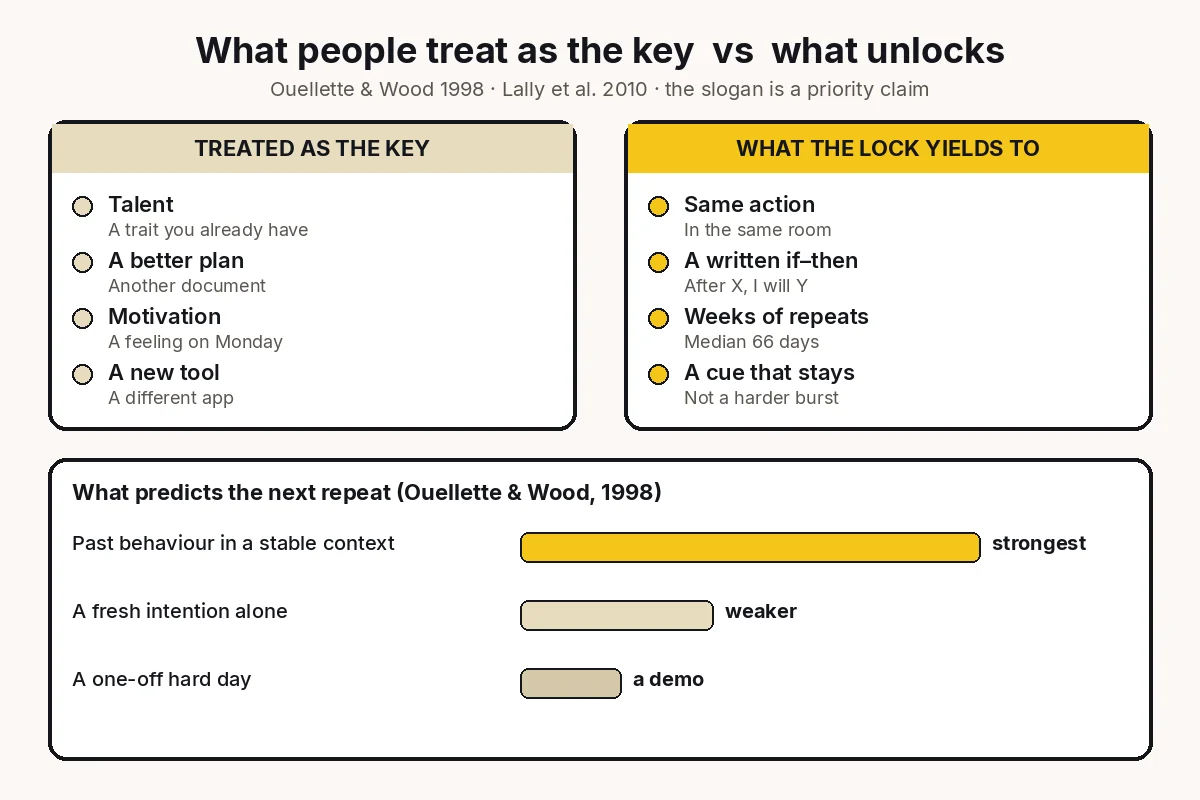
The lock is not a missing personality. The lock is a response that has not been bound to a cue yet. Judith Ouellette and Wendy Wood’s 1998 Psychological Bulletin review is the oldest clean version of that sentence. They compared how well intention versus past behaviour predicted later action. When a behaviour had been frequent and the context had been stable, past behaviour was the stronger predictor. When the behaviour was new or the context kept moving, intention did more of the work. In plain language: a fresh plan is useful on day one. After that, the key is whether the same room keeps asking for the same action.
That is why “just want it more” fails as a key. Wanting is an intention. Intention is what you use while the bond is weak. Once the bond is in, Wood and Neal (2007) argue the goal can step back. You still chose the habit. You do not have to re-choose it from scratch every Tuesday.
Peter Gollwitzer and Paschal Sheeran’s 2006 review of 94 tests is how the slogan becomes something a Tuesday can use. A goal intention (“I will write”) is not the same object as an implementation intention (“After I put the kettle on, at the counter, I will write the first ugly sentence”). The if–then form produced a medium-to-large average effect (d = 0.65). That is not magic and it is not a personality upgrade. It is a written cue. The phrase “consistency is key” is empty until it names an after-X.
Stephen Covey’s The 8th Habit is this row’s unused down-link because it names what the key is for. Covey’s claim is that effectiveness now needs a next habit beyond the original seven: find your voice, and help other people find theirs. Voice, in that book, is the whole-person mix of talent, need, conscience, and passion. It is a direction, not a cue. A voice without a Tuesday repeat is a speech. The 8th Habit is the door worth opening. This page is why the repeat is still the key that turns.
The four parts of the lock
Most “be more consistent” advice fails because it aims at the wrong part of the lock. Four pieces have to sit together:
- A stable cue. Same hour, same room, same preceding action. Wood, Tam and Guerrero Witt (2005) showed what happens when the cue moves: students who transferred university often lost TV and exercise patterns that had been automatic in the old room. The person did not become lazy. The lock changed.
- A small enough action. Lally’s slower formers were doing harder behaviours. The median 66 days is not a promise that your gym plan will lock in two months. It is a warning that size and context both tax the curve.
- Enough repeats that automaticity can rise. The same study’s range — 18 to 254 days — is the honest spread. Some cues bind fast. Some never quite do. Treating the median as a deadline is how people quit on day 67.
- A door worth opening. Repeating the wrong action is a key in the wrong lock. That is the job of keystone habits, not of this page.
Why treating something else as the key costs more
A harder burst feels like a key because it is visible, but the bill shows up in the week after, when the cue is gone. Intensity is easy to photograph. A 5 a.m. Monday, a cleaned inbox, a 4,000-word sprint — those look like progress. Ouellette and Wood’s split says they are the weaker predictor once a behaviour has a chance to become frequent. The expensive illusion is thinking the photo opened the lock.
The other common substitute key is a new tool. A different app can help you write the if–then. It cannot be the if–then. When the tool becomes the project, you are collecting keys and never turning one. The same trap shows up as a new plan: another document, another framework, another Sunday reset. The plan is useful on day one. After that it is furniture.
Two honest limits. Ouellette and Wood (1998) is a review of existing studies, not a single experiment that crowns “consistency” as a virtue. Lally’s 66-day median comes from 96 people forming one self-chosen health habit in a 12-week window — it is not a law about every skill. Wood, Tam and Witt (2005) watched students in a life transition; most Tuesdays are not a house move. We use those papers for the mechanism (cue, repeat, context), not as proof that any slogan will rank your life.
There is a third substitute key that looks inner and still fails: identity talk without a cue. “I am a writer” is a useful sentence. It is not a lock-pick. The lock-pick is “after the kettle, at the counter, the first ugly sentence.” Benjamin Gardner, Phillippa Lally and Jane Wardle’s 2012 British Journal of General Practice piece said the same thing in clinic language: decide the action, put it in a stable context, and persist long enough for the association to form. They were writing for GPs talking about walking and pills, not for a productivity blog. The mechanism is the same, and that is why this page lives in the productivity hub rather than in a slogans silo.
The cost that does not show up on a weekly scoreboard is the abandoned cue. Lally’s participants could miss a day without the next day’s automaticity falling. What wrecks the curve in practice is the story that says “I broke it, so I start over bigger.” That story trades the key for a harder Monday. The Monday is a demo. The key was the small Tuesday.
Nearby phrases that are not this key
Several neighbouring pages share a word with this one and answer a different question. Keep them linked, not merged.
| Idea | What it actually is | What it is not |
|---|---|---|
| Consistency is key | A priority claim: the repeat unlocks the rest | A personality type, or a streak religion |
| What is consistency | The definition: a repeated action in a stable context | This slogan page |
| Why is consistency important | Why the repeat compounds, and why a skip costs the bind | Why people call that repeat the key |
| Keystone habits | The lock worth opening — one habit that pulls others | The key that turns any lock |
| Habit stacking | Hanging a new action on an existing cue | A second definition of consistency |
| Implementation intentions | The written if–then that makes the slogan usable | A mood, or a vision board |
| Mental discipline | Staying put after the feeling thins | The cue that starts the action |
| How to build discipline | The Discipline parent: cues, reps, return | A rewrite of this Habits slogan |
| The 8th Habit | The voice the key is for — find it, then help others find theirs | A substitute for the Tuesday repeat |
If the problem is “I do not know which habit to install,” that is not this page — that is keystone habits. If the problem is “I know the word and I still skip,” start at why consistency is important and then come back here for the priority claim. If the problem is “I only start when I feel ready,” the key is still the cue, not a better feeling.
Common mistakes
- Treating a harder burst as the key. A photographed Monday is a demo. Ouellette and Wood’s split says frequent behaviour in a stable context is the stronger later predictor. The burst is useful as proof. It is a poor substitute for the Tuesday.
- Collecting plans and calling that consistency. Another framework is furniture. The key is the after-X you can still name when the framework is in a drawer.
- Moving the room and blaming character. Wood, Tam and Witt’s transfer students lost automatic TV and exercise when the context changed. A new desk, a new commute, a new kitchen is a new lock. Rewrite the if–then. Do not diagnose a new personality.
- Streak religion. Lally’s curve did not reset after one miss. The expensive story is “I broke it, so I start over bigger.” Keep the cue. Shrink the action if you have to.
- Repeating the wrong action. Consistency in a bad lock is still a closed door. Pick the keystone first. This page does not choose the door.
- Confusing Covey’s voice with a cue. The 8th Habit is the direction. “Find your voice” without an after-X is a speech you give yourself in the shower.
- Turning this slogan into a second how-to-be-consistent guide. The definition and the importance pages already exist. This one stops at the priority claim, the mechanism, and the cost of picking the wrong key.
The evidence behind this
| Study | Design and size | Finding | What we used it for |
|---|---|---|---|
| Ouellette & Wood (1998) | Review / meta-analytic synthesis of intention vs past behaviour | Frequent past behaviour in stable contexts predicted later action better than intention; intention mattered more for new or unstable behaviours | Why the repeat, not a louder plan, is the key once a cue exists |
| Wood & Neal (2007) | Theory review, Psychological Review | Habits are context–response associations that can run without a fresh goal once the cue is stable | The lock-pick: the bond, not the pep talk |
| Wood, Tam & Guerrero Witt (2005) | Field; university students in a transfer / context change | TV and exercise habits often stopped when the old room disappeared | The counter-case: the key was the context, not the character |
| Lally, van Jaarsveld, Potts & Wardle (2010) | Field; 96 adults, 12 weeks, one self-chosen daily habit | Median 66 days to an automaticity plateau (range 18–254); missing one day did not reduce the next day’s automaticity | Why a one-off burst is not the key, and why one miss is not a reset |
| Gollwitzer & Sheeran (2006) | Meta-analysis; 94 tests of implementation intentions | If–then plans produced a medium-to-large average effect (d = 0.65) | How the slogan becomes a cue a Tuesday can use |
| Gardner, Lally & Wardle (2012) | Practice paper, British Journal of General Practice | Decide the action, put it in a stable context, persist long enough for the association to form | The clinic version of the same three-part key |
| Lally & Gardner (2013) | Narrative review, Health Psychology Review | Habit formation is a process: cue selection, repetition, and a reduction in the need for deliberation | Why “be consistent” without a cue is not a method |
Frequently asked questions
What does “consistency is key” actually mean?
It is a priority claim: the same small action, repeated in the same context, is what unlocks plans, talent, tools, and motivation. Wendy Wood and David Neal (2007) describe that unlock as a context–response association — once the cue is stable, the action can fire without a fresh goal. The phrase is not a personality compliment and not a demand for a perfect streak. Sister page “what is consistency” defines the word. This page is why people call the repeat the key.
Why is consistency the key, and not talent or a better plan?
Talent and plans are the room. The key is whether the same action keeps happening in that room. Ouellette and Wood (1998) found that when a behaviour had been frequent and the context had been stable, past behaviour predicted later action better than a fresh intention. A plan is useful on day one. After that, the lock yields to the cue. A louder document does not replace the Tuesday.
How long does consistency take to become automatic?
In Lally, van Jaarsveld, Potts and Wardle’s 12-week field study of 96 adults, the median time to an automaticity plateau was 66 days, with a range of 18 to 254. Harder behaviours took longer. Missing one day did not reset the next day’s automaticity. Treat 66 as a median from one health-habit sample, not a personal deadline. The useful lesson is the shape: repeats in a stable context, not one heroic Monday.
Is missing a day the end of the streak that matters?
No. Lally’s participants could miss a day without the next day’s automaticity falling. The expensive move is the story that says the key is broken, so you start over bigger. Keep the cue. Shrink the action if the original size will not fit the next Tuesday. A calendar of unbroken boxes is a scoreboard. The key is the cue that is still there after a broken box.
What if I moved house or changed jobs and everything fell apart?
The key was probably the old room. Wood, Tam and Guerrero Witt (2005) watched students transfer university and lose TV and exercise patterns that had been automatic. That is a context change, not a character verdict. Rewrite the if–then for the new kitchen, the new commute, the new desk. Gollwitzer and Sheeran’s implementation-intention form — after X, in Y, I will Z — is how you cut a new key.
How do I turn the slogan into something I can do on Tuesday?
Write an if–then, not a vibe. “After I put the kettle on, at the counter, I will write the first ugly sentence” is a cue. “I will be more consistent” is a goal intention. Across 94 tests, Gollwitzer and Sheeran (2006) found the if–then form produced a medium-to-large average lift (d = 0.65). Keep the action small enough to repeat on a thin day. Then leave the room alone long enough for the bond to form.
How does this relate to Covey’s 8th Habit?
Stephen Covey’s The 8th Habit argues that effectiveness now needs a next habit beyond the original seven: find your voice, and inspire other people to find theirs. Voice, in that book, is a direction — talent, need, conscience, passion. It is the door worth opening. It is not a Tuesday cue. A voice without a repeat is a speech. This page keeps the book as the named unused review because it names what the key is for, not because it replaces the key.
Is consistency still the key if I am repeating the wrong habit?
No. Repeating a bad lock still leaves the house shut. A keystone habit is the load-bearing one that tends to pull others with it — sleep, the start of work, the first dirty draft. Pick that door first. “Consistency is key” then means: once you have the door, the repeat is what turns. This page does not choose the door. It refuses the idea that talent, a new app, or a harder Monday can stand in for the turn.
Sources
- Ouellette, J. A., & Wood, W. (1998). Habit and intention in everyday life: The multiple processes by which past behavior predicts future behavior. Psychological Bulletin, 124(1), 54–74. https://doi.org/10.1037/0033-2909.124.1.54
- Wood, W., & Neal, D. T. (2007). A new look at habits and the habit–goal interface. Psychological Review, 114(4), 843–863. https://doi.org/10.1037/0033-295X.114.4.843
- Wood, W., Tam, L., & Guerrero Witt, M. (2005). Changing circumstances, disrupting habits. Journal of Personality and Social Psychology, 88(6), 918–933. https://doi.org/10.1037/0022-3514.88.6.918
- Lally, P., van Jaarsveld, C. H. M., Potts, H. W. W., & Wardle, J. (2010). How are habits formed: Modelling habit formation in the real world. European Journal of Social Psychology, 40(6), 998–1009. https://doi.org/10.1002/ejsp.674
- Gollwitzer, P. M., & Sheeran, P. (2006). Implementation intentions and goal achievement: A meta-analysis of effects and processes. Advances in Experimental Social Psychology, 38, 69–119. https://doi.org/10.1016/S0065-2601(06)38002-1
- Gardner, B., Lally, P., & Wardle, J. (2012). Making health habitual: The psychology of ‘habit-formation’ and general practice. British Journal of General Practice, 62(605), 664–666. https://doi.org/10.3399/bjgp12X659466
- Lally, P., & Gardner, B. (2013). Promoting habit formation. Health Psychology Review, 7(sup1), S137–S158. https://doi.org/10.1080/17437199.2011.603640
- Covey, S. R. (2004). The 8th Habit: From Effectiveness to Greatness. Free Press. Growth Reads review: the-8th-habit-summary.
Related reading on The Growth Reads
The books behind this
- The 8th Habit summary — Covey’s voice chapter: the door the key is for. This row’s unused down-link.
Related articles
- Keystone habits — the Habits parent: the lock worth opening
- What is consistency — the sister: the definition of the word
- Why is consistency important — why the repeat compounds
- Habit stacking — hanging a new action on an existing cue
- Implementation intentions — the written if–then
- How to start a reading habit — one worked example of a small repeat
- Mental discipline — staying put after the feeling thins
- How to build discipline — the Discipline parent
Go deeper
How this article was researched
The Growth Reads editorial team read the primary papers behind the priority claim — Ouellette and Wood (1998); Wood and Neal (2007); Wood, Tam and Guerrero Witt (2005); Lally, van Jaarsveld, Potts and Wardle (2010); Gollwitzer and Sheeran (2006); Gardner, Lally and Wardle (2012); and Lally and Gardner (2013) — plus Covey’s The 8th Habit as the named unused review. Numbers in the takeaways and the evidence table are taken from those papers, not from secondary blog summaries. This is a slogan-and-mechanism page, not a second how-to-be-consistent guide and not a clinical article.
Limits. The 66-day median is one field sample of self-chosen health habits. The 1998 review synthesises older studies rather than running a new trial of the slogan. The transfer-student paper is a life transition, not an ordinary Tuesday. We state those limits in the body. We did not invent percentages. We did not treat “consistency is key” as a book title, and we did not name books that do not have a Growth Reads review except as already-live sister articles.
Method: primary papers and one named unused review. Last checked 12 September 2026. Play slot — no HowTo schema.