


A good client is a bad fit when they pay, they are pleasant, and the work they need is not the work you do. Name the line, offer one alternative, and put a date on the end. A 2016 summary of Essentialism states the rule as a clear yes or a clear no.
Key takeaways
- A good client is a bad fit when the invoice is fine and the person is easy, and the work they need is still not the work you do.
- Leaders Book Summaries (2016), condensing Greg McKeown’s Essentialism (Crown Business, 2014), states: if it isn’t a clear yes, then it’s a clear no.
- That summary’s 90 Percent Rule scores the single most important criterion from 0 to 100, and it changes anything under 90 into a zero.
- The same summary says you can regret a no for a few minutes, or a yes for days, weeks, months, or even years, and that the way out is to say no firmly, resolutely, and yet gracefully.
- The boundary note names the line, one alternative, and the date. That note is this article’s application. It is not a sentence from the book.
What a good client who is a bad fit actually is
A good client is a bad fit when the money clears, the calls are civil, and the work they need is a different business from the one you run. You are a solo founder, so the client is the account you are afraid to lose. You are a new manager, so the “client” is the stakeholder who keeps handing your team a kind of work the team does not do. Nobody is rude. The invoice, or the internal request, is not the problem. The work is.
Greg McKeown’s Essentialism: The Disciplined Pursuit of Less (Crown Business, 2014) is the book behind the filter. This article did not open a numbered page of that edition, and it did not verify an ISBN. The text in front of the draft is the 2016 executive summary published by Leaders Book Summaries (© 2016 The Growing Leader), read in full. In the section it heads “Chapter 9 • SELECT,” the summary states the test in McKeown’s terms: “If it isn’t a clear yes, then it’s a clear no.” It calls that the 90 Percent Rule. You score the single most important criterion from 0 to 100. “If you rate it any lower than 90 percent, then automatically change the rating to 0 and simply reject it.” The point, in the summary’s words, is to avoid “getting stuck with the 60s or 70s.”
A pleasant client who pays on time can still be a 60 on the only criterion that matters, which is whether the work is the work you do. Payment and manners are real. They are not that criterion. The summary says selective criteria are a trade-off, and that “sometimes you will have to turn down a seemingly very good option.” A good client who is a bad fit is that option. The summary does not write the email. The note below is ours.
Why you will not say so
You will not say so because the client is good, and a no to a good client feels like a mistake you will regret. The summary’s section on a graceful no names the feeling. “We feel guilty. We don’t want to let someone down.” Those emotions, it says, “muddle our clarity.” Then it states the trade: “either we can say no and regret it for a few minutes, or we can say yes and regret it for days, weeks, months, or even years.” The only way out, in that section, is “to learn to say no firmly, resolutely, and yet gracefully.”
A solo founder hears the years as revenue. The account is a third of the month. Saying no looks like choosing a quiet week over a sure invoice. A new manager hears it as politics. The stakeholder is senior, the ask is framed as urgent, and “we can probably fit it in” is how the team’s real work slips. The summary’s earlier line is the one to keep in the room: “I can do anything but not everything.” The trade-off section says that when you want both, the useful question is which problem you want. You can keep this client’s actual work, or you can keep reshaping the company around work you do not do. You do not get both, and a discount does not create a third option. That discount is the separate problem in the price that feels guessy.
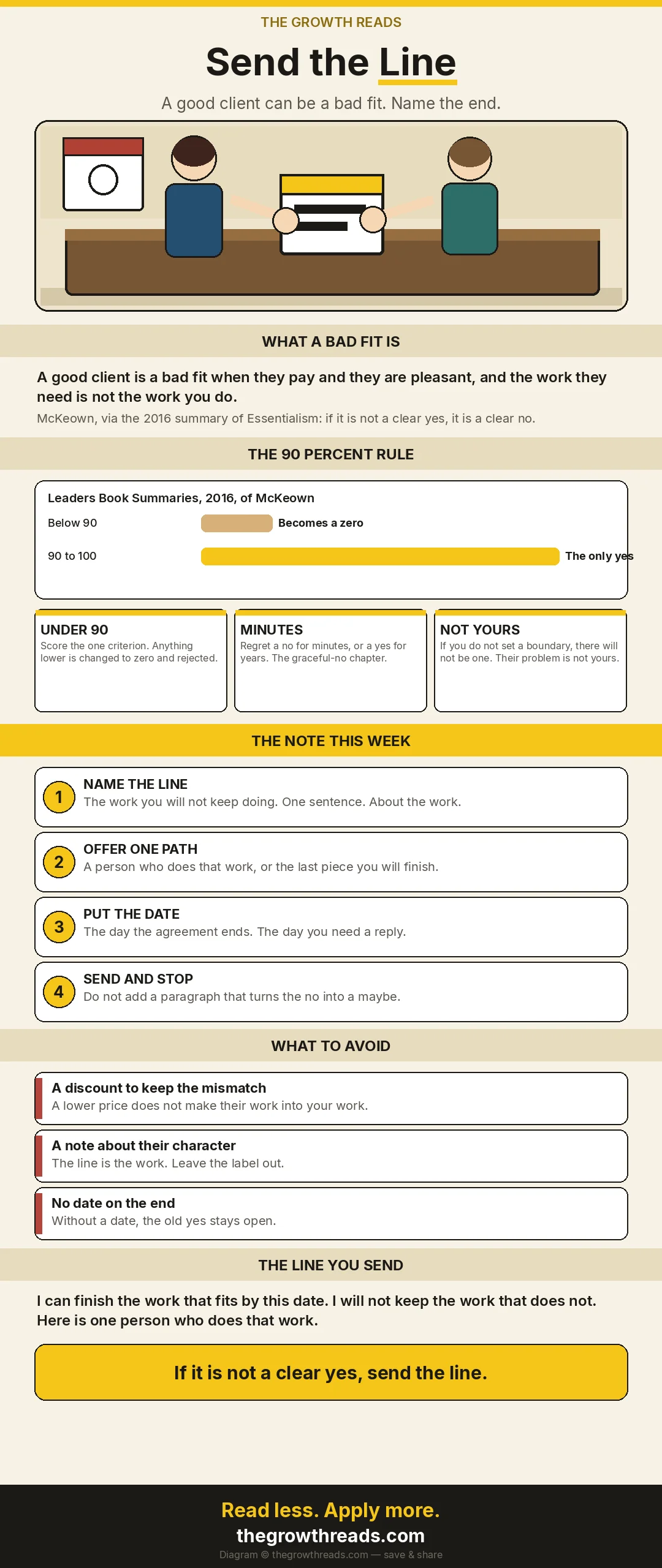
The summary also names why the boundary never appears on its own. In the section it heads “Chapter 14 • LIMIT,” it says: “If you don’t set boundaries—there won’t be any.” And, of other people’s demands: “Their problem is not your problem.” A client’s need for a kind of work you do not sell is their problem to place with someone who does sell it. It becomes your problem only when you keep accepting it. The summary is talking about limits on a life and a team, not about a termination clause. We use the line. We do not pretend it is a contract.
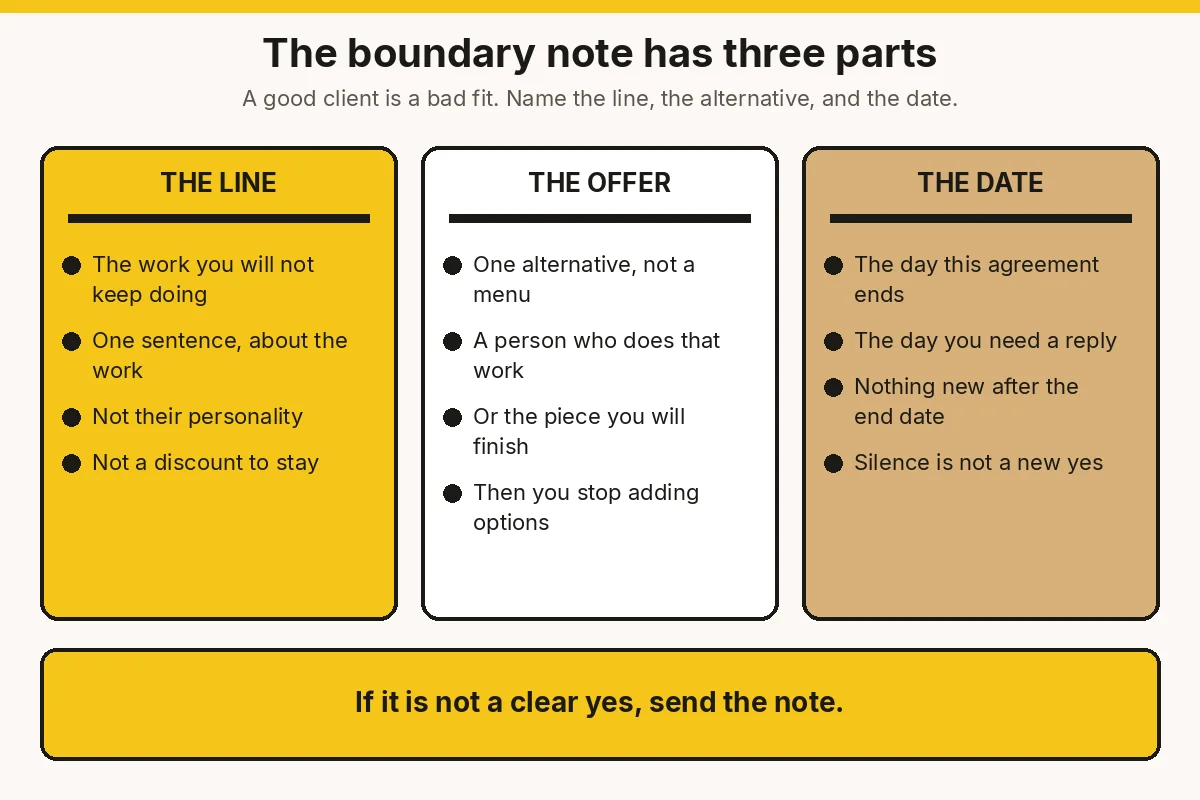
The boundary note: the line, the alternative, the date
The note has three parts: the work you will stop, the one alternative you offer, and the date the current agreement ends. These sentences are our application. They are not in the summary. The summary’s standard is the clear no, said firmly and gracefully. It does not supply a client email, a notice period, or a referral script. If a signed term or unpaid invoice is in play, read that agreement before you send a date. This note is not legal advice.
Subject: Where this work stops — [end date]
The line: I can keep [the work that fits] through [end date]. I will not take [the work that does not fit] after that. That work is not what I do.
The alternative: [Name] does that work, and I can introduce you this week. If you would rather not, I will finish [the last piece that fits] by [end date] and stop.
The date: This agreement ends on [end date]. I need a reply by [reply date] if you want the introduction. I will not start new work outside the line after the end date.
Then stop. A second paragraph that apologises, offers a discount, or says “unless you still need me” puts the yes back in the email. Graceful, in the summary’s wording, is firm and resolute. It is not vague. Do not describe the client. “You are a great client and this is not the work I do” is the whole judgment you need. “You are disorganised” is a personality comment, and it does not belong here. Name behaviour only if you are giving feedback that keeps turning into a label. This note is not that conversation.
| What you are looking at | What you send | What you do not send |
|---|---|---|
| They pay, they are pleasant, and the normal work is not your work. | The line, one alternative, and the end date. | A lower price, a “let’s see how the next month goes,” or a note about their character. |
| The work fits, and one ask is outside the price. | The scope line: what is in, what is a change. That is more than the price. | This ending. A single change request is not a bad-fit client. |
| The work fits, and your week cannot hold it. | A capacity cut: one thing you stop, who absorbs it. That is the company that still depends on your hours. | A breakup with a client who is the right work, because you are tired this week. |
| You are a new manager, and a stakeholder keeps assigning the wrong work. | The same three lines: the work you will not absorb, who should own it, the date you stop. | A silent no. The team still receives the ask, and you have not decided. |
How to send the note this week
Score one client on the work alone, write the three lines, and send them. Eight moves. Do not add a ninth that reopens the yes. The summary’s question, in the eliminate section, is “What will I say no to?” Answer it for one account, not for your whole pipeline.
- Write the criterion in one line. “The work I do is [the offer].” If the line needs a paragraph, you do not yet know what a clear yes is. The summary says to use the single most important criterion, not a pile of them.
- Score this client from 0 to 100 on that line only. Do not average in punctual payment, a friendly tone, or how long they have been with you. Under 90, the summary says to change the rating to 0 and reject it. A 70 who pays on time is still a 0 on this rule.
- Ask the sunk-cost question before you draft. The summary’s uncommit section says to assume previous commitments are gone, then ask what you would add today. If you would not take this client today, the history is not a reason to keep them. “If it no longer fits, eliminate it altogether.”
- Separate the person from the decision. You can like them. The summary’s fear is guilt and not wanting to let someone down. The decision is still about the work. Write the work.
- Name one alternative. A person who does the other work, or the last piece of your work you will finish. Not three options, and not “happy to discuss.” One path.
- Put two dates in the note. The day the agreement ends. The day you need a reply if they want the introduction. Silence after the reply date is not a new yes. You already said what happens.
- Send it, and do not follow it with a softer version. The summary’s way out is a no that is firm, resolute, and graceful. A second email that adds “we can play it by ear” is the 60 you just refused to reject.
- Keep the decision. A report, a contractor, or a first hire can draft the facts. They do not end your client. That call stays with you, the same way the decision you are the bottleneck on stays with you.
If you are a new manager, run the same eight moves on one internal ask, not on a customer you do not own. The line is the work your team will stop absorbing. The alternative is the team, or the person, who should own it. The date is when you will send that work back. You may be told to keep it. Then you have a different problem, which is a priority you cannot cut, and you handle it as a week where everything is marked urgent. You do not pretend the note was sent.
When it is a scope change, not a bad fit
One request outside the price is a change. A client whose ordinary work is the wrong work is a bad fit. Do not use this note to dodge a change you should price. If the engagement is the work you do, and they want more of it than the price covers, send the in-or-a-change sentence in more than the price. Ending the relationship because one ask was inconvenient is the opposite of the 90 Percent Rule. The work was a clear yes. The extra is a separate decision.
Do not use this note because you are at capacity on the right work either. The summary’s buffer section mentions, as an example of the unexpected, that a client may change direction late. That sentence is about slack in a plan, not about ending the account. If the fit is a clear yes and the week is full, stop something else. The capacity cut is a different article. Firing the right client to relieve a crowded Tuesday trades away the essential thing to protect a calendar accident.
Two cases this note also does not cover. A client who does not pay is not a “good client.” The problem there is the invoice, and this script will not collect it. A client who is abusive is not a tone problem for a graceful paragraph. Get help with that relationship. The summary’s graceful no is for a nonessential yes you are afraid to refuse, not for harm.
When you already said yes
The hard version is the client you have already accepted. The summary’s move is to uncommit, not to pretend you never said yes. It names sunk-cost bias as investing more because you have already spent something you cannot get back. The instruction is to get over the fear of waste. If you keep the account only because the last six months would “go to waste,” you are spending the next six months on the same mismatch.
The practical test in that section is zero-based. Treat the current commitment as gone. Ask whether you would add this client today. If you would, this is not the article. If you would not, “eliminate it altogether.” You still finish the piece you already promised, and you put that finish on the date in the note. Uncommitting is not disappearing. The summary says uncommitting is harder than not committing, because nobody likes to go back on their word. The date is how you go back on it cleanly: you name the last day, you do the work until that day, and you do not take the next piece.
Pause for the next ask, even if you are not ready to end the account today. The same section says that pausing for five seconds before you offer your services reduces the chance of a commitment you will regret. The next “quick extra” is the five-second pause. Do not accept it on the call. The note can wait until the morning. The new yes cannot.
Common mistakes
- Averaging the scores. The summary says to use the single most important criterion. A 100 on payment plus a 40 on the work is not a 70 you can live with. On this rule the 40 becomes a zero.
- A discount that keeps the mismatch. A lower price does not turn their work into your work. Price the work you do. End the work you do not do.
- Ending a client over one change request. If the ordinary work is a clear yes, answer the extra as a change. Do not send this note.
- No alternative. The summary wants a graceful no, not a vanished one. One introduction, or one last piece, is the grace. A menu of maybes is not.
- No date. Without an end date, the old yes stays open. “Let’s revisit next quarter” is how a 60 survives.
- A paragraph about their personality. Guilt wants a long explanation. The summary says those emotions muddle the decision. One sentence on the work is the line.
- Sending the note and then a softer one. The second email is the yes you regret for years, written as a courtesy.
- Treating the summary as a page of the book. The lines above are in the 2016 Leaders Book Summaries condensation. They are not a Crown page number. We did not invent one.
What the source does and does not say
The summary gives the clear-yes rule, the 90 Percent Rule, the graceful no, and the instruction to uncommit. It does not give this email, a client sample, or a revenue result.
| Source | What it is | What we took | What it does not show |
|---|---|---|---|
| Leaders Book Summaries (© 2016 The Growing Leader), executive summary of Greg McKeown, Essentialism, Crown Business, 2014. Read in full. No numbered page of the Crown edition was opened. No ISBN was checked on this run. | A condensation. The header names the author, the title, Crown Business, and 2014. It is not the book, and it is not a study of founders. | “If it isn’t a clear yes, then it’s a clear no.” The 90 Percent Rule: one criterion, 0 to 100, under 90 becomes 0. Turning down “a seemingly very good option.” “I can do anything but not everything.” Guilt, and not wanting to let someone down. Regret for a few minutes, or for days, weeks, months, or years. Say no “firmly, resolutely, and yet gracefully.” “What will I say no to?” Sunk cost, zero-based recommitment, “if it no longer fits, eliminate it altogether,” and a five-second pause. “If you don’t set boundaries—there won’t be any.” “Their problem is not your problem.” | A page number. A client email. A notice period. Proof that ending an account raises revenue. The seven refusal tactics that appear in other people’s summaries and do not appear in this text. Permission to fire a client who does not pay, or who is abusive, with this paragraph. |
Limit: a summary can compress a line until it sounds cleaner than the chapter. Where this article quotes, the sentence is in that 2016 text. Where it tells you what to write to a client, that writing is ours. A clear yes on the work means you keep the client and solve the other problem, whether that problem is scope, price, or a week that is too full. The rule is a filter. It is not a reason to shrink the business until nobody is left.
Frequently asked questions
What do you do when a good client is a bad fit?
A good client is a bad fit when they pay, they are pleasant, and the work they need is not the work you do. Send one note. The line names the work you will stop. The alternative is one person who does that work, or the last piece you will finish. The date is when the agreement ends, and when you need a reply. A 2016 summary of Greg McKeown’s Essentialism states the filter as a clear yes or a clear no. The wording of the note is ours. We did not read a numbered page of the Crown edition.
How is a bad fit different from a client who wants more than the price?
Look at the ordinary work, not the latest ask. If the engagement is the work you do, and they want more than the price covers, that is a change. Say what is in and what is extra, and price the extra or cut it. If the work they hire you for, month after month, is a different business, the client is a bad fit even when every invoice matches the quote. Do not end a clear yes because one request spilled. Do not keep a clear no because one project happened to fit. The two notes are different tools, and sending the wrong one leaves the real problem in place.
What do you write in the boundary note?
Write three things and then stop. The line: the work you will keep until the end date, and the work you will not take after it. The alternative: one introduction, or the last piece you will finish. The date: the day the agreement ends, and the day you need a reply if they want the introduction. Say the decision is about the work. Do not add a discount, a review of their personality, or a sentence that reopens the yes. These lines are our application. The 2016 summary of Essentialism does not print them. It does say a graceful no is still a firm one.
How do you use the 90 percent rule on a client?
Pick the single most important criterion, which here is whether the work is the work you do. Score the client from 0 to 100 on that line alone. The 2016 summary of Essentialism says that if you rate it any lower than 90 percent, you change the rating to 0 and reject it. Do not average in how promptly they pay or how easy the calls are. A client who is wonderful and wrong for the work fails the rule. A client who is difficult and right for the work is a different problem. The rule is the summary’s. The choice of criterion is ours.
What if you already said yes and they have paid you for months?
Treat the commitment as gone for a moment, and ask whether you would add this client today. That is the summary’s zero-based test for a sunk cost. If you would, keep them. If you would not, it says to eliminate what no longer fits, rather than spend more because the earlier months cannot be refunded. You still finish the work you already promised, and you put that finish on the date in the note. Uncommitting is not vanishing. The summary says it is harder than never committing, because you are going back on a word. The date is how you do that without a second, softer yes.
How do you say no without attacking the client?
Talk about the work, in one sentence, and offer one alternative. “This is not the work I do, and I can introduce you to someone who does it” is the line. “You are difficult” is a personality comment, and it does not help them place the work. The 2016 summary says guilt, and not wanting to let someone down, muddies the decision. It also says you can regret the no for a few minutes or the yes for years. Write the short version. Then do not send a second email that apologises the decision away. Graceful, in that summary, still means resolute.
What if the bad fit is an internal stakeholder, not a paying client?
Use the same three lines if you are a new manager and a senior person keeps assigning work your team does not do. Name the work you will stop absorbing, name who should own it, and name the date you will send it back. You may not have the authority to end the relationship. If you are told to keep the work, say so to the team and cut something else, the way you would cut a week where everything is marked urgent. Do not send a customer-breakup note to a colleague. Silence is how their problem becomes your backlog.
What does Essentialism actually show about firing a client?
The book is Greg McKeown’s Essentialism, Crown Business, 2014, as named on the summary we read. We did not open a numbered page, and we did not check an ISBN. The 2016 Leaders Book Summaries text gives the clear-yes rule, the 90 Percent Rule, the instruction to say no firmly and gracefully, and the sunk-cost test. It does not show a client sample, a notice period, or a change in revenue. Refusal scripts from other summaries are not in the text we read. The boundary note is our application of that filter to one good client who is the wrong work.
Sources
- Leaders Book Summaries (2016). Executive summary of McKeown, G. Essentialism: The Disciplined Pursuit of Less. Crown Business, 2014. Published by Leaders Book Summaries, Carol Stream, Illinois. © 2016 The Growing Leader. Read in full. Used for the clear-yes sentence, the 90 Percent Rule, “a seemingly very good option,” “I can do anything but not everything,” the graceful-no trade (minutes versus years), guilt and not letting someone down, “What will I say no to?”, the sunk-cost and zero-based uncommit test, the five-second pause, “If you don’t set boundaries—there won’t be any,” and “Their problem is not your problem.” No numbered page of the Crown edition was read. No ISBN was verified on this run. The boundary note is not in this summary. Leaders Book Summaries, Essentialism (PDF).
Related reading on The Growth Reads
The decision next to this one
- Essentialism summary — the wider book, when the problem is too many good commitments
- More than the price — one ask outside the price, on a client who still fits
- The price feels guessy — do not discount your way out of a mismatch
- The company still depends on your hours — stop one thing when the fit is right and the week is full
- You are the bottleneck — the ending stays your decision
- Feedback turns into a personality comment — do not put a character verdict in the note
- The Win Without Pitching Manifesto — a different client book, already reviewed, not the source of this note
Where this sits
How this article was researched
The filter is Greg McKeown’s, as stated in the 2016 Leaders Book Summaries condensation of Essentialism (Crown Business, 2014). That summary was read in full. No numbered page of the Crown edition was opened, and no ISBN was checked, so this article does not invent either. The boundary note — the line, one alternative, and the date — is our application for a solo founder or a new manager. It is not a quotation. Refusal scripts that circulate in other summaries, and that do not appear in the text we read, are not used.
Limit: a summary can make a chapter sound simpler than it is. The quotes above are sentences in that 2016 text, not page-cited lines from Crown. Ending a client is a decision. It is not evidence of a revenue change. If the work is a clear yes, keep the client and solve scope, price, or capacity instead. If a contract, a notice period, or unpaid money is involved, read the agreement. This note is not legal advice. If the relationship is abusive, do not handle it with this paragraph.
How we work: every article on The Growth Reads is built from sources we can check, and it is date-stamped when those sources change. Read our methodology.