

★★★★½ 4.5/5 — Create a customer. Manage by objectives. Make work something a person can do well.
Best for: New managers, founders who now have reports, and anyone whose org chart is busier than the customer.
Reading time: ~10 hrs (guide: 13 min)
Difficulty to apply: Easy to write the purpose sentence; hard to let managers score themselves.
The Practice of Management in one minute
Management is a practice, and a business exists to create a customer. Peter Drucker’s 1954 book is the one that turned “manager” from a rank into a job you can learn. You manage a business (purpose, objectives, results). You manage managers (structure, spirit, management by objectives and self-control). You manage worker and work (so the work is productive and the person can achieve). Marketing and innovation are the only two entrepreneurial functions; everything else is cost. If your week is meetings that do not serve a customer, this is the reset. Write what the business is for. Then manage that, not the org chart.
Key takeaways
- Management is a practice: It can be learned. Title is not the work.
- Create a customer: That is the purpose of a business. Profit tests it; it is not the purpose.
- Marketing is not selling: Know the customer well enough that selling becomes superfluous.
- Innovation is the twin: A new satisfaction, product, or way of doing the work.
- Three jobs, always: The business, the managers, worker and work. Neglect one and the others rot.
- Management by objectives: Each manager writes goals that serve the whole, then self-controls against the score.
- Spirit is a decision: Promotions, standards, and integrity teach more than posters.
- Work must be designed: The job is a product. People perform when the work is fit to do.
- The manager’s own work: Make decisions, develop people, and take responsibility for the enterprise.
What is The Practice of Management about?
The Practice of Management is Peter Drucker’s 1954 handbook that defines management as a distinct practice: create a customer, run the business by objectives, structure managers for self-control, and design work so people can perform — illustrated with Sears, Ford, and IBM rather than slogans.
About the author
Peter F. Drucker (1909–2005) was the Austrian-American writer and consultant who made management a discipline you could teach. He left Vienna, worked as a journalist and banker, then watched General Motors and wartime production close enough to argue that the manager’s job was not to be a hero but to get the right things done through other people. The Practice of Management (1954) is the book that named the practice. Later came The Effective Executive and Managing Oneself — shorter, more personal. This one is the company: purpose, structure, work, and the spirit that either lets people perform or quietly forbids it. He taught at Claremont for decades and kept asking the same question of every firm: what is our business, and what should it be? Explore all Peter Drucker book summaries →
Key concepts at a glance
| Concept | What it means | Use it when |
|---|---|---|
| Create a customer | The purpose of a business is a satisfied customer, not a factory. | You can describe the product and not the buyer. |
| Marketing vs selling | Marketing knows the want. Selling pushes what you already made. | The pipeline is all push and no pull. |
| Innovation | A new satisfaction, product, or method — the other entrepreneurial job. | You are efficient at last year’s offer. |
| Three jobs | Manage the business, the managers, and worker-and-work. | One of those rooms has no owner this month. |
| Management by objectives | Goals that serve the whole; self-control against a score. | Managers wait to be told, or they freelance. |
| Federal decentralization | Autonomous units plus a few central controls that actually matter. | Every decision climbs to the same desk. |
| Spirit of the organization | Standards, promotions, fairness, integrity — taught by what you reward. | The values page and the raise list disagree. |
| The whole person at work | Jobs designed so a human can achieve, not just comply. | Turnover is “a labor issue” and the work is still badly designed. |
Part 1 — Management is a distinct practice
Drucker opens by separating the job from the badge. Management is not ownership, not a personality type, and not a pile of techniques borrowed from engineering. It is a practice with its own work: to make an institution perform. A business does not run itself. Someone has to decide what results are, who the customer is, and how work is organized so that other people can contribute. That someone is a manager, whether the card says founder, plant superintendent, or chief.
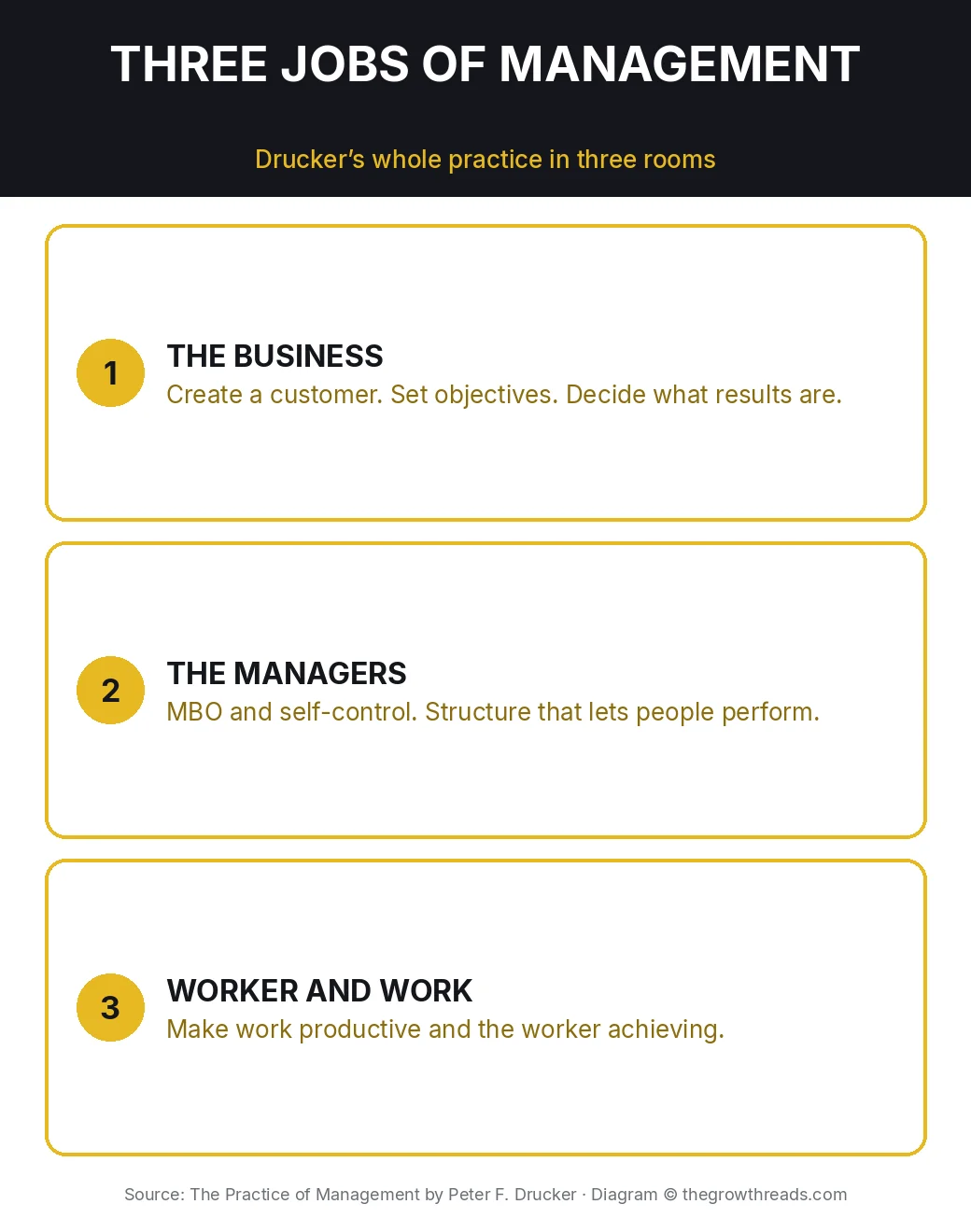
He gives the manager three jobs and refuses to let you pick two. First, manage the business — purpose, objectives, today’s decisions that create tomorrow’s results. Second, manage managers — structure, development, the spirit of the place. Third, manage worker and work — so the job is productive and the person can achieve. The Sears chapters show a firm that asked what the American farmer needed and built a business around the answer, not around what the warehouse happened to hold.
The challenge, already in 1954, is the knowledge-using organization. You cannot stand over a professional the way a foreman stood over a line. You have to manage by making the purpose clear and the score visible. That is why this book is a practice manual, not a charm school for bosses.
TGR Note: Once the company has a purpose, the personal handbook is The Effective Executive — time, contribution, strengths, a few decisions. Managing Oneself is the still-shorter cut: how you perform, not how the org is drawn. Stay in this book until “what is our business?” has a sentence a stranger could repeat.
Part 2 — A business exists to create a customer
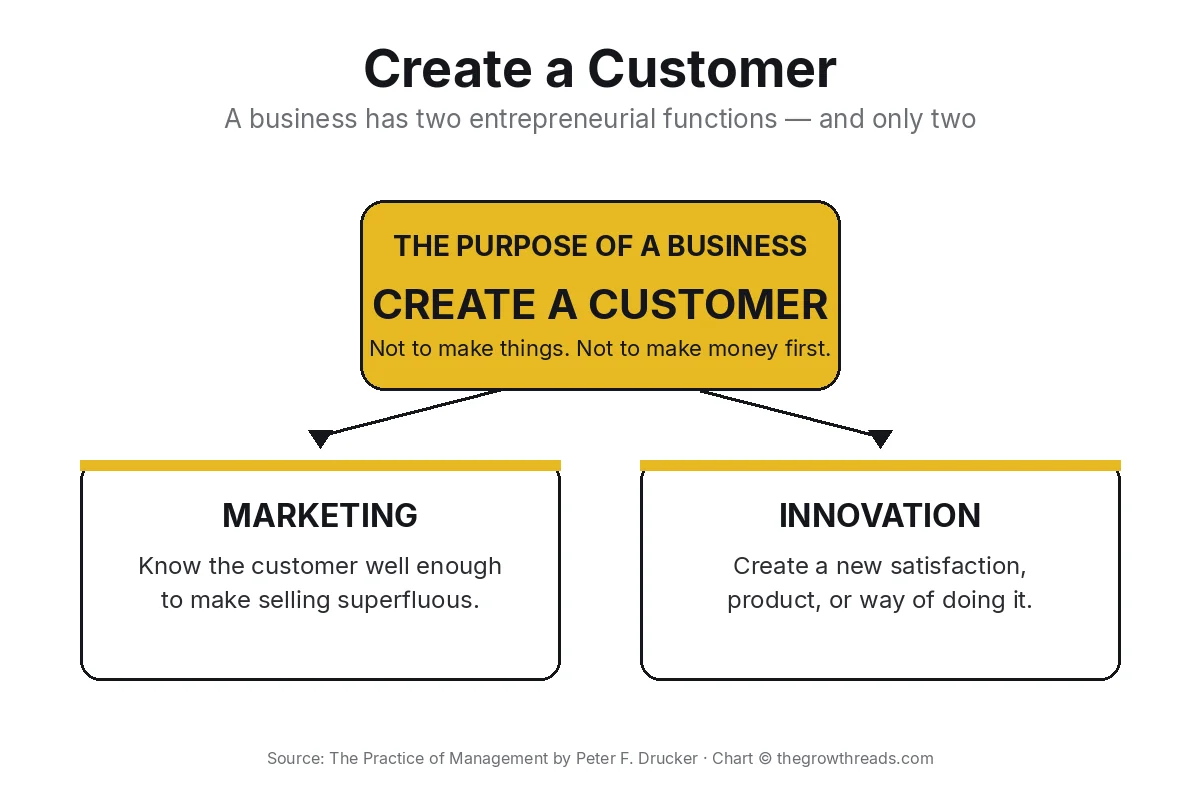
The most famous page in the book is also the most useful. There is only one valid definition of business purpose: to create a customer. A firm is not defined by what it makes, by the capital it raised, or by the hours it billed. It is defined by a person who is willing to exchange something of value for a satisfaction. Profit matters as a result and as a test. It is not the purpose. Aim at profit as the purpose and you start cutting the work that would have created the next customer.
From that definition Drucker names two entrepreneurial functions — and only two. Marketing is not a department that makes brochures. It is the whole business seen from the customer’s side: who buys, why, what they are trying to get done. Selling is what you do when marketing failed. Innovation is the twin: a new satisfaction, a new product, a new way of doing the work. Production, finance, and personnel are costs unless they serve those two. “What is our business — and what should it be?” is the question most teams skip because it is embarrassing. The Sears story is the positive case: ask the farmer. The opposite is a company that keeps making a thing after the customer has moved.
Objectives fall out of that purpose. Drucker wants a small set that cover market standing, innovation, productivity, resources, profitability, manager performance, worker performance, and public responsibility — not a wallpaper of KPIs. Today’s decisions are for tomorrow’s results. If the list cannot be used by a manager to choose Tuesday’s work, it is decoration.
TGR Note: If the bottleneck is a single constraint on the floor rather than a missing customer sentence, The Goal is the novel that makes the constraint visible. If the firm is a system of delays and loops, Thinking in Systems is the diagram layer. Drucker still wants the purpose first: create a customer, then manage the constraint that keeps you from serving them.
Part 3 — Manage managers with objectives and self-control
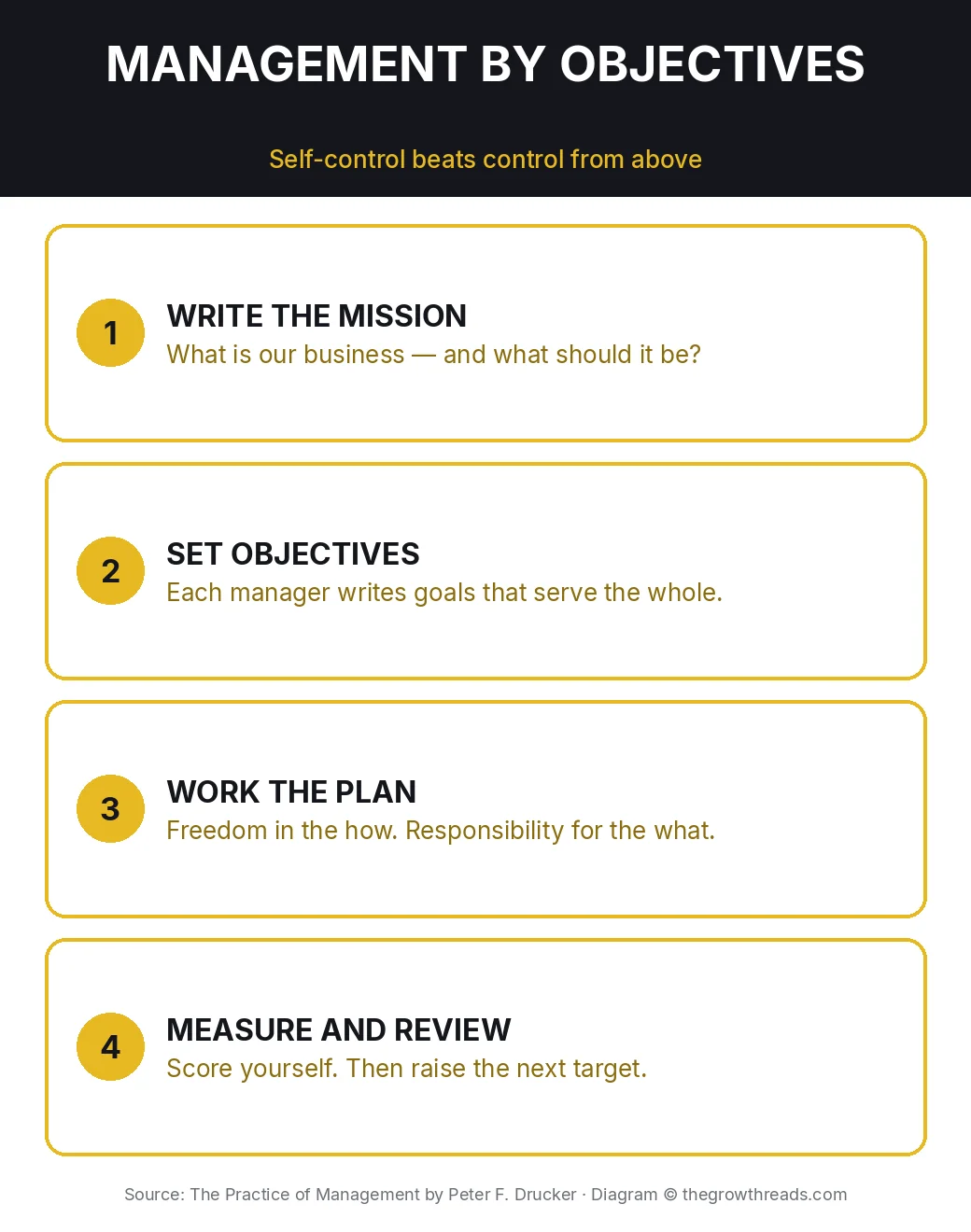
The Ford chapters are a warning dressed as history. A genius who will not build managers builds a one-man firm that cannot outlive the one man. Drucker wants managers who manage: they set objectives, organize, motivate, measure, and develop people. The tool is management by objectives and self-control. Each manager writes goals that serve the enterprise, not a private silo. The how stays with the person. The what is public. Measurements exist so a professional can correct their own work — the opposite of a dashboard used as a leash.
Structure follows that idea. What kind of structure? One that lets people perform close to the customer and the work, with a few central controls that actually matter — Drucker calls the pattern federal decentralization. Small enough units to have a real result; large enough to afford a manager. Developing managers is not a course. It is putting people on real objectives and watching whether they can take responsibility.
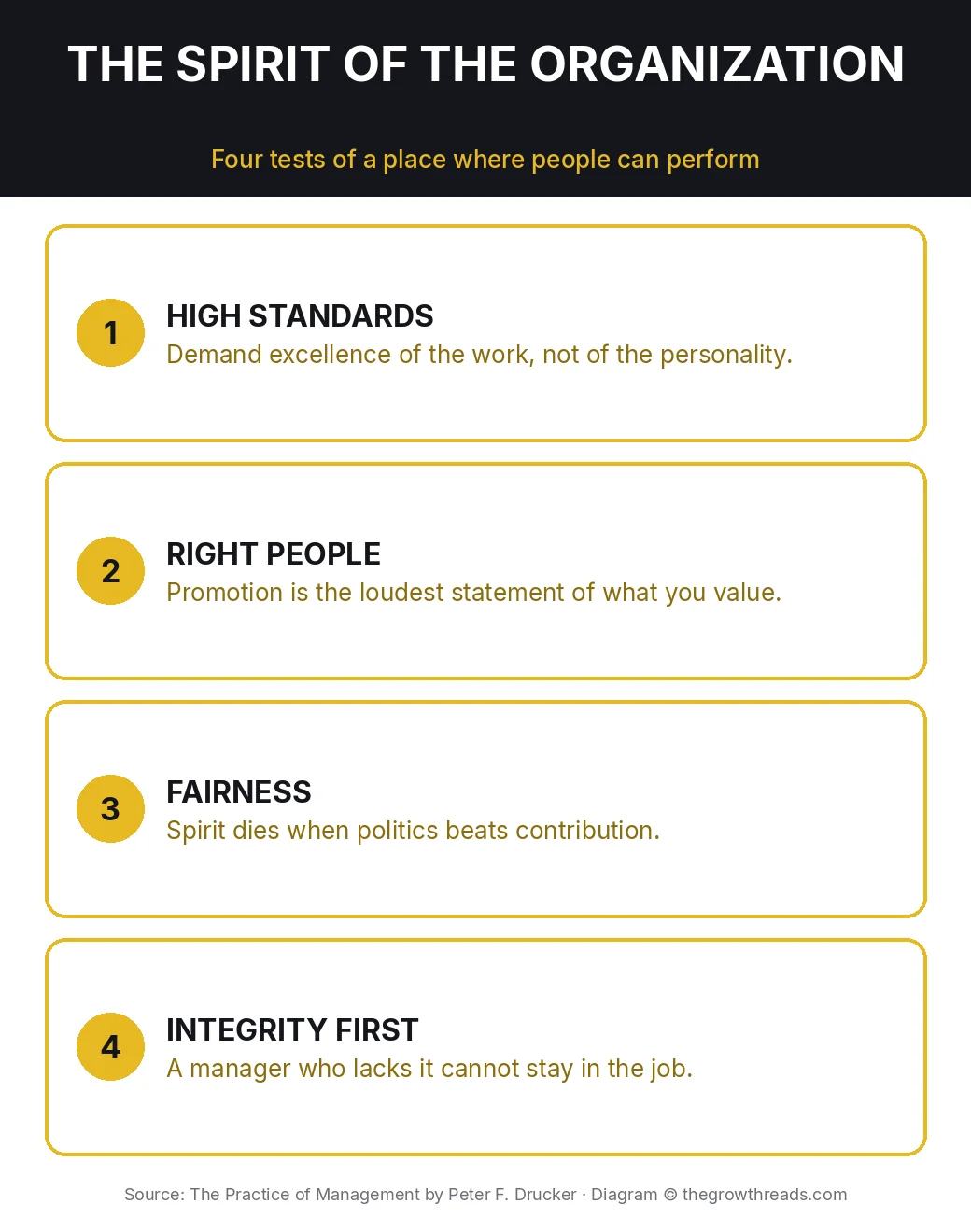
Then the spirit of the organization — the part that looks soft and is not. High standards for the work. The right people promoted, because promotion is the loudest teaching device you have. Fairness, or the place fills with politics. Integrity as the one trait you cannot train around: a manager who lacks it cannot stay. Posters do not create spirit. The last three people you advanced do.
TGR Note: Andy Grove took this operating layer into a chip company. High Output Management is the later, more tactical sibling: leverage, meetings as work, task-relevant maturity. Read Grove when you already believe managers are supposed to produce output through others. Stay with Drucker when the missing piece is still purpose and spirit, not a meeting cadence.
Part 4 — Work, workers, and the manager’s own job
The IBM story is Drucker’s picture of employing the whole person. Personnel programs that treat people as a cost to be administered are, in his phrase, close to bankrupt. Peak performance comes from a job a human can be proud of: clear, demanding, and designed. Motivation is not a pizza Friday. It is a chance to achieve. The supervisor is a manager of work, not a cop. The professional employee — already visible in 1954 — cannot be hovered over. They need a purpose, a score, and a job that uses a mind.
What it means to be a manager, in the closing parts, is work of its own. The manager organizes, makes decisions, and lives with the time lag between a choice and a result. Making decisions is a process: define, specify what is right, convert into action, and build feedback. The manager of tomorrow, Drucker already saw, would manage knowledge and people who know more about their specialty than the boss does. That only works if the boss practices management instead of improvising status.
The last word is responsibility. Management is a public role inside a private firm. You are responsible for the economic performance that keeps people employed, and for the social impact of how the work is done. The practice is ordinary, and it is rare: create a customer, then build an organization that can keep creating one without you in every meeting.
Who is The Practice of Management best for — and who should read something else first?
Best for first-time managers, founders who now have a second line, and operators who can hit a number but cannot say what the business is for. Also for the person who inherited an org chart and a calendar of status meetings.
Read something else first if the bottleneck is your own week — start with The Effective Executive or Getting Things Done. If you need a tiny product team to ship, Getting Real and Rework are closer to the screen. If you want a 2020s product-coaching model, Inspired is the next floor. High Output Management is the operating manual once you already believe the manager’s job is output through others. Come back here when the company itself still lacks a purpose sentence.
Questions to reflect on
- What is our business, in one sentence a customer would recognize — not a sentence the org chart would?
- Where are we selling hard because we never did the marketing work of knowing the want?
- Which of the three jobs — business, managers, worker-and-work — had no owner last month?
- If every manager wrote three objectives that serve the whole, which current goal would not survive?
- What did our last three promotions teach the company about standards and integrity?
🔥 Ready to make management a practice?
Write what the business is for, then manage by that — this week.
How to apply The Practice of Management (7-day plan)
- Day 1 — Write the business. One sentence, from the customer’s side: what want do we satisfy? No jargon, no “and also.”
- Day 2 — Name the real customer. The person who pays or chooses, not the persona in last year’s deck. List what they hire you to do.
- Day 3 — Draft objectives. Each manager who reports to you writes three to five goals that serve Day 1, plus the score they will use.
- Day 4 — Kill one leash. Delete or pause one report that nobody uses to self-correct. If it only exists for a meeting, it is a leash.
- Day 5 — Audit the three jobs. Business, managers, worker-and-work: which room had no owner last month? Put a name on it.
- Day 6 — Read the promotions. The last three people you advanced: what did that teach about standards and integrity?
- Day 7 — One marketing move, one innovation. A better way to know the customer, and one new satisfaction or method. Score both by whether a customer is created.
Frequently asked questions
What is The Practice of Management about?
The Practice of Management is Peter Drucker's 1954 book that treats management as a distinct practice, not a rank or a bag of tricks. A business exists to create a customer. A manager then has three jobs: run the business, manage other managers, and make work productive for the people who do it. Management by objectives and self-control is how that happens without hovering. The Sears, Ford, and IBM stories show the practice inside real firms. Read it when the org chart is busy and the customer is still a rumor.
What does Drucker mean by "create a customer"?
Drucker's line is blunt: there is only one valid definition of business purpose — to create a customer. A company is not defined by what it makes or by the capital it parked. It is defined by a person whose want it satisfies. Marketing finds and keeps that person; innovation creates a new satisfaction, product, or way of serving. Profit is a result and a test, not the purpose. If nobody chooses you, you do not have a business. You have a cost center with a logo. Write who the customer is before you write another objective.
What is management by objectives in this book?
Management by objectives is Drucker's answer to the manager who is either neglected or smothered. Each manager writes goals that serve the whole business, not a private empire. The how stays with the person doing the work; the what is public and scored. Self-control beats control from above because a professional can see the scoreboard. Measurements exist so people can correct themselves, not so headquarters can pounce. If your OKRs are a theatre of cascading slides, you have the paperwork without the practice. Start with a handful of goals a manager can actually own this quarter.
Is The Practice of Management still relevant in 2026?
The examples are Sears, Ford, and IBM, not a SaaS org chart. The practice is current: know what business you are in, create a customer, let managers write objectives they can score, and treat work as something to be designed. Knowledge work made the book more true, not less. Remote tools did not retire the three jobs. They made neglected jobs more expensive. Read it as a practice manual, not as a period piece about department stores. Pair it with a later Drucker cut if you want a shorter personal handbook, then come back here when the company itself needs a purpose.
How is this different from The Effective Executive?
The Practice of Management is the company book. It asks what a business is for, how managers are structured, and how work is organized so people can perform. The Effective Executive is the personal book: time, contribution, strengths, and a few decisions. You can run a clean calendar and still lead a firm that has not decided what its customer is. Start with The Practice of Management if you own a P&L or a team whose goals do not add up. Start with The Effective Executive if the bottleneck is your own week. Most readers eventually need both, in that order, once the title is real.
Who should read The Practice of Management first?
New managers who inherited a team and a stack of meetings. Founders who are still the product and now have people reporting through them. Operators who can hit a number and cannot say what the business is for. Skip it as a first read if you need a two-hour personal system — Getting Things Done or The Effective Executive will meet you faster. Skip it if you want a 2020s product-team coach; Inspired and Shape Up are closer to that room. Come back when you are designing the enterprise, not decorating a sprint board.
How do I apply The Practice of Management this week?
Write one sentence: what is our business, said as a customer would say it. Name the actual customer, not the persona in last year's deck. Ask every manager who reports to you for three to five objectives that serve that sentence, and for the score they will use. Kill one report that nobody uses to self-correct. Look at the last three promotions and ask what they taught the company. Then pick one marketing action and one innovation — a new satisfaction or a new way — that would create a customer this quarter. Small, visible, scored. That is the practice.
Related summaries
- The Effective Executive Summary & Review — the personal practice after the company has a purpose
- Managing Oneself Summary & Review — how you perform, in one sitting
- High Output Management Summary & Review — Grove’s operating layer on top of Drucker
- The Goal Summary & Review — find the constraint once the customer is clear
- Best productivity books — the full Productivity silo
How we analyze books: we paraphrase arguments, add original application notes, and skip chapter-by-chapter reproduction. Read our full methodology.