

★★★★☆ 4.3/5 — A paradigm-shifting look at human motivation that replaces carrots and sticks with autonomy, mastery, and purpose.
Best for: Leaders, managers, educators, parents, and anyone who wants to understand what truly drives human performance.
Reading time: ~5 hrs (guide: 18 min)
Difficulty to apply: Moderate — requires rethinking incentive structures and management habits.
Drive in one minute
The carrot-and-stick approach to motivation is not just outdated — it actively undermines the kind of work that matters most in the 21st century. Daniel Pink synthesizes decades of behavioral science research to argue that for creative, cognitive, and complex work, external rewards (bonuses, promotions, threats) can actually reduce performance. What drives us instead are three deeply human needs: autonomy (the desire to direct our own lives), mastery (the urge to get better at something that matters), and purpose (the yearning to serve something larger than ourselves). Pink calls this upgrade “Motivation 3.0” and shows how organizations that embrace it consistently outperform those stuck on the old reward-and-punishment model.
Key takeaways
- Motivation 2.0 is broken: The carrot-and-stick model was designed for routine, mechanical work — it fails spectacularly for creative, heuristic tasks that define the modern economy.
- External rewards can backfire: For tasks requiring creativity, offering rewards narrows focus and reduces the kind of broad, playful thinking that produces breakthroughs.
- Autonomy is not the same as independence: Autonomy means acting with choice — having a say over your task, your time, your technique, and your team.
- Mastery is an asymptote: You can approach it but never fully reach it, which is what makes the pursuit endlessly engaging rather than frustrating.
- Purpose provides the context: Autonomy and mastery without purpose produce skilled people doing meaningless work. Purpose connects effort to impact.
- Type I behavior outperforms Type X: People fueled by intrinsic motivation (Type I) are more productive, more creative, and less prone to burnout than those driven by external rewards (Type X).
- Flow is the oxygen of mastery: Goldilocks tasks — not too easy, not too hard — produce the flow state that accelerates skill development and sustains engagement.
- The baseline must be fair: Intrinsic motivation only works when people feel they are paid fairly. Remove compensation anxiety first, then build autonomy, mastery, and purpose on top.
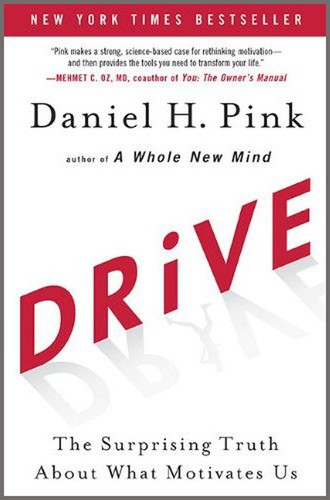
What is Drive about?
Drive is a behavioral science book that argues traditional reward-and-punishment motivation fails for modern creative work, and that sustainable high performance comes from three intrinsic drives: autonomy (self-direction), mastery (continuous improvement), and purpose (meaningful contribution).
About the author
Daniel H. Pink is a bestselling author and former speechwriter for Vice President Al Gore whose books on work, management, and behavioral science have sold millions of copies worldwide. His previous books, A Whole New Mind and Free Agent Nation, explored the changing nature of careers in the conceptual economy. Pink holds a J.D. from Yale Law School but left the legal profession to pursue writing. He is known for his ability to translate dense academic research into accessible, engaging narratives. His TED Talk on the science of motivation is one of the most-viewed in TED history, with over 30 million views. He lives in Washington, D.C. Explore all Daniel H. Pink book summaries →
Key concepts at a glance
| Concept | What it means | Use it when |
|---|---|---|
| Motivation 3.0 | Operating system built on autonomy, mastery, and purpose | You want to redesign how your team or organization motivates people |
| Type I Behavior | Intrinsically motivated, self-directed, mastery-oriented | You want to cultivate high-performing individuals |
| Type X Behavior | Extrinsically motivated, reward-dependent, short-term focused | You recognize burnout patterns in yourself or your team |
| The Sawyer Effect | Rewards turn play into work; removing rewards can turn work into play | You notice creative work declining after introducing bonuses |
| Goldilocks Tasks | Challenges matched to skill level that produce flow states | Team members are bored (task too easy) or anxious (task too hard) |
| FedEx Days | 24-hour sprints where employees work on anything they choose | You want to spark innovation with a low-risk experiment |
| 20% Time | Dedicating one-fifth of work hours to self-directed projects | You want sustained innovation, not just occasional sparks |
Part 1: A new operating system — the rise and fall of Motivation 2.0
Pink structures his argument as a software upgrade. Motivation 1.0 was biological survival — the drive to eat, drink, and reproduce. Motivation 2.0 was the reward-and-punishment system that powered the Industrial Revolution: do good work, get a bonus; do bad work, get fired. This system worked brilliantly for routine, algorithmic tasks where the process is clear and the outcome is defined.
The problem, Pink argues, is that Motivation 2.0 was not designed for the kind of work that dominates the modern economy. When work is creative, conceptual, or requires problem-solving — what psychologists call “heuristic” tasks — external rewards produce a paradoxical effect. The famous candle problem experiments by Karl Duncker and later Sam Glucksberg demonstrated that offering cash prizes for solving a creative puzzle actually slowed participants down. The reward narrowed their focus at precisely the moment when broad, exploratory thinking was needed.
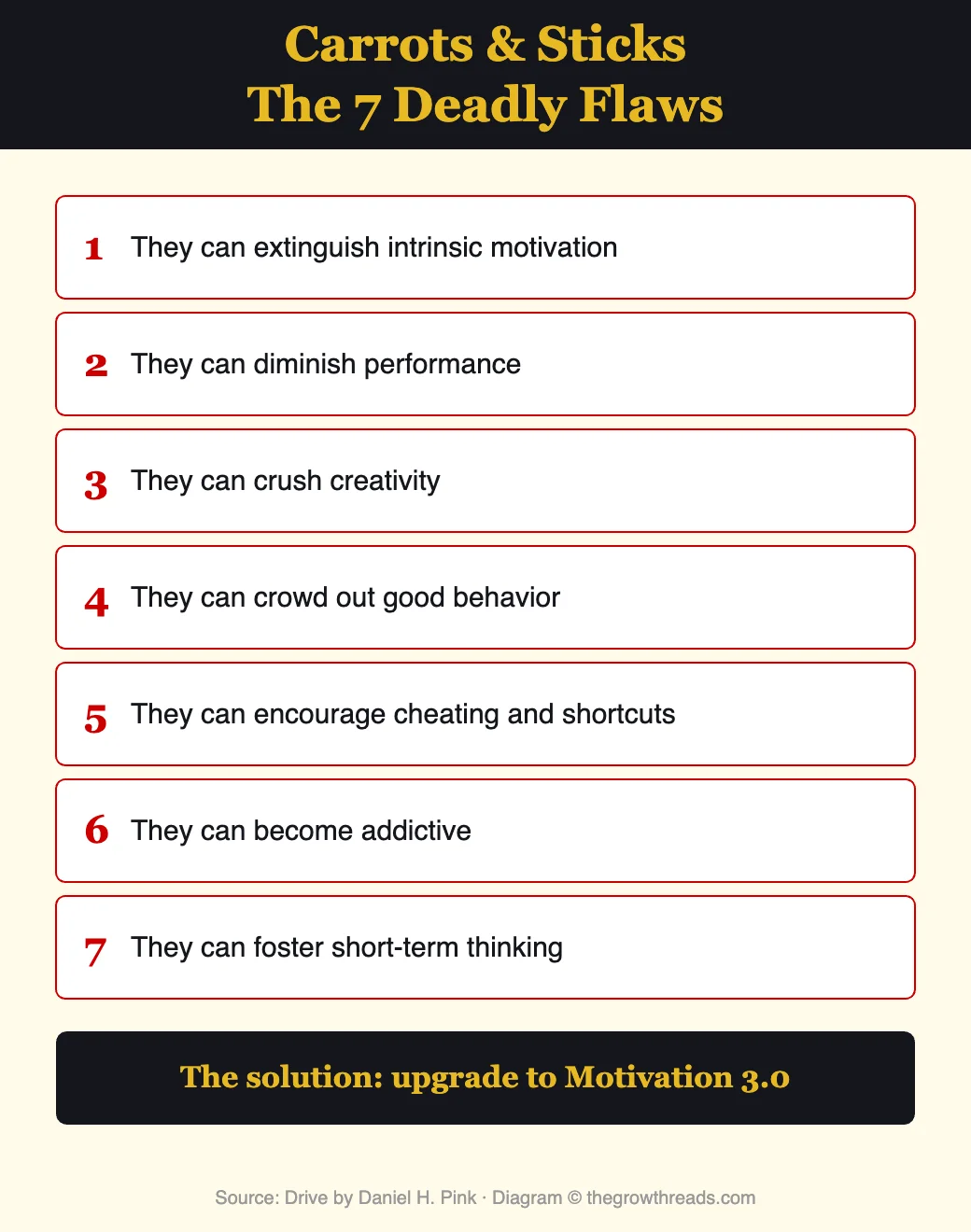
Pink catalogs what he calls the “seven deadly flaws” of carrots and sticks: they can extinguish intrinsic motivation, diminish performance, crush creativity, crowd out good behavior, encourage cheating, become addictive, and foster short-term thinking. The evidence is not anecdotal — it comes from dozens of peer-reviewed studies across multiple decades and cultures. The case against external rewards for creative work is, Pink argues, one of the most robust findings in social science.
Part 2: The three elements — autonomy, mastery, and purpose
The heart of the book unpacks the three pillars of Motivation 3.0. Autonomy, Pink emphasizes, does not mean working in isolation — it means having meaningful choice over four dimensions of your work: task (what you do), time (when you do it), technique (how you do it), and team (who you do it with). Companies like Atlassian and Google have experimented with giving employees dedicated time for self-directed projects, and the results consistently show spikes in innovation and engagement.
Mastery is defined as the desire to get progressively better at something that matters. Pink identifies three laws of mastery. First, mastery is a mindset — you must believe your abilities are improvable (what Carol Dweck calls a “growth mindset”). Second, mastery is a pain — it requires effort, grit, and the willingness to push through difficulty. Third, mastery is an asymptote — you can approach it but never fully reach it, which is paradoxically what makes the pursuit sustaining rather than disappointing.
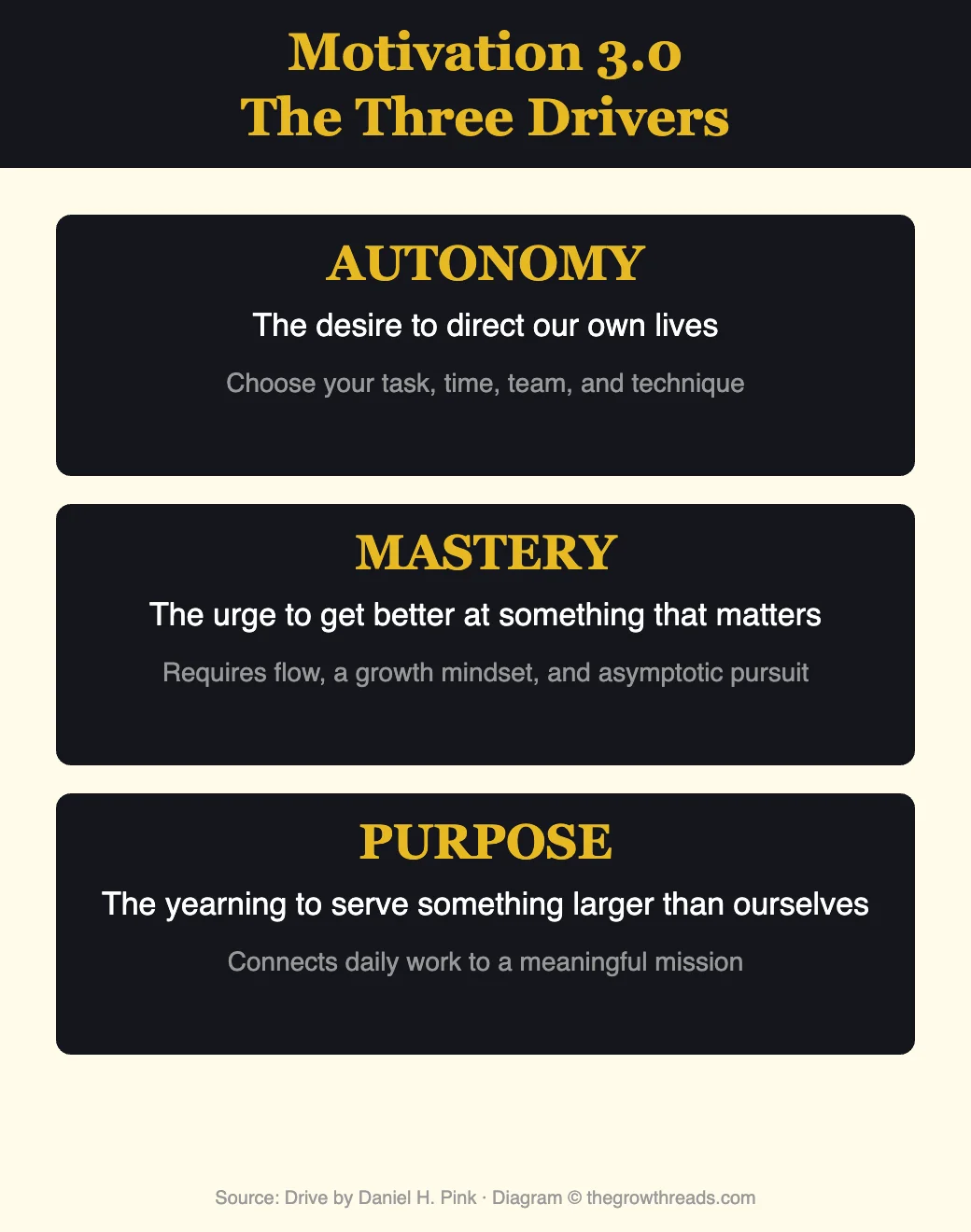
Purpose is the often-overlooked third element. Pink argues that the most deeply motivated people connect their daily work to a cause larger than themselves. This does not require working for a nonprofit — it requires understanding how your contribution matters. A hospital janitor who sees himself as helping patients heal is more motivated than one who sees himself as mopping floors, even though the task is identical.
Part 3: The Type I toolkit — putting Drive into practice
The final section provides practical tools for individuals and organizations. Pink introduces the concept of “FedEx Days” (named after the delivery company’s overnight guarantee) — 24-hour periods where employees can work on anything they choose, as long as they deliver something the next day. Atlassian’s implementation of this concept produced a wave of product fixes and innovations that would never have emerged through normal channels.
For individuals, Pink prescribes a “flow audit” — tracking when you enter flow states during a typical week and then redesigning your schedule to create more of those conditions. He also recommends setting aside time for deliberate practice (not just doing the work, but specifically working on the components you find most challenging) and writing a personal purpose statement that connects your daily actions to a larger mission.
Who is Drive best for — and who should read something else first?
Drive is essential for anyone in a leadership or management role who influences how other people work. If you set incentive structures, design performance reviews, or manage creative teams, this book will fundamentally change how you think about motivation. It is also valuable for individuals who feel disengaged at work and want to understand why — and what to do about it.
If your primary challenge is building personal discipline rather than understanding motivation, start with Atomic Habits. If you lead in high-stakes environments where motivation is less of an issue than execution under pressure, Extreme Ownership may be more immediately applicable.
Questions to reflect on
- On a scale of 1-10, how much autonomy do you have over your task, time, technique, and team at work — and which dimension needs the most improvement?
- When was the last time you entered a flow state at work, and what conditions made it possible?
- What would you work on if you had a “FedEx Day” — 24 hours to pursue any project with no restrictions?
- Are the incentive structures in your organization (or your personal reward system) accidentally undermining the intrinsic motivation you want to cultivate?
- Can you articulate in one sentence the purpose behind your daily work — the impact it has beyond your own advancement?
🔥 Ready to unlock what truly motivates you?
Discover why autonomy, mastery, and purpose outperform any carrot or stick.
How to apply Drive (7-day plan)
- Day 1: Conduct a motivation audit. List your top five work activities and rate each on a 1-10 scale for autonomy, mastery potential, and purpose connection.
- Day 2: Identify one area where you can increase your autonomy today — choose a different technique, schedule, or approach for a recurring task.
- Day 3: Set a “Goldilocks task” — find one challenge that is slightly beyond your current skill level and dedicate focused time to it.
- Day 4: Write a one-sentence purpose statement that connects your daily work to a larger impact. Post it where you will see it each morning.
- Day 5: Run a personal flow audit. Note every time you enter a flow state today and identify what triggered it — task type, environment, time of day.
- Day 6: Remove one extrinsic motivator from your system. If you reward yourself with treats for completing tasks, try replacing it with the intrinsic satisfaction of tracking mastery progress.
- Day 7: Propose a “FedEx Day” (or mini version: two unstructured hours) to your team or manager. Frame it as an innovation experiment, not a perk.
Frequently asked questions
Does Drive say we should stop paying people?
Absolutely not. Pink is emphatic that fair compensation is a prerequisite for intrinsic motivation — he calls it the “baseline.” People who feel underpaid or unfairly compensated cannot focus on autonomy, mastery, or purpose because their attention is consumed by financial anxiety. The argument is that once the baseline is met, additional monetary rewards do not produce proportional gains in performance for creative work. Pay people well and fairly, then build motivation through autonomy, mastery, and purpose on top of that foundation.
What is the Sawyer Effect?
The Sawyer Effect, named after the scene in Tom Sawyer where Tom convinces his friends that painting a fence is fun, describes how external rewards can transform an enjoyable activity into a chore. When you start paying someone for something they were doing for free, the payment reframes the activity as work rather than play. Studies show that children who are rewarded for drawing produce less creative drawings and draw less often once the rewards stop. The effect works in reverse too: removing rewards from a task can sometimes restore its intrinsic appeal.
Do rewards ever work?
Yes — for routine, algorithmic tasks where the process is clear and creativity is not required. Pink acknowledges that for straightforward work (data entry, assembly line tasks, basic compliance), extrinsic rewards can boost performance. The problem arises when organizations apply the same incentive model to creative, heuristic work. His rule of thumb: if a task requires even rudimentary cognitive effort or creativity, external rewards are more likely to harm than help.
How do I apply Drive as a manager?
Start with the four T’s of autonomy: give team members increasing control over their task (what they work on), time (when they work), technique (how they approach problems), and team (who they collaborate with). Redesign goals around mastery — instead of quotas, set “learning goals” that emphasize skill development. Connect every project to its broader purpose. And critically, ensure compensation is fair before attempting any of this; intrinsic motivation cannot overcome a perceived injustice in pay.
What is the difference between Type I and Type X behavior?
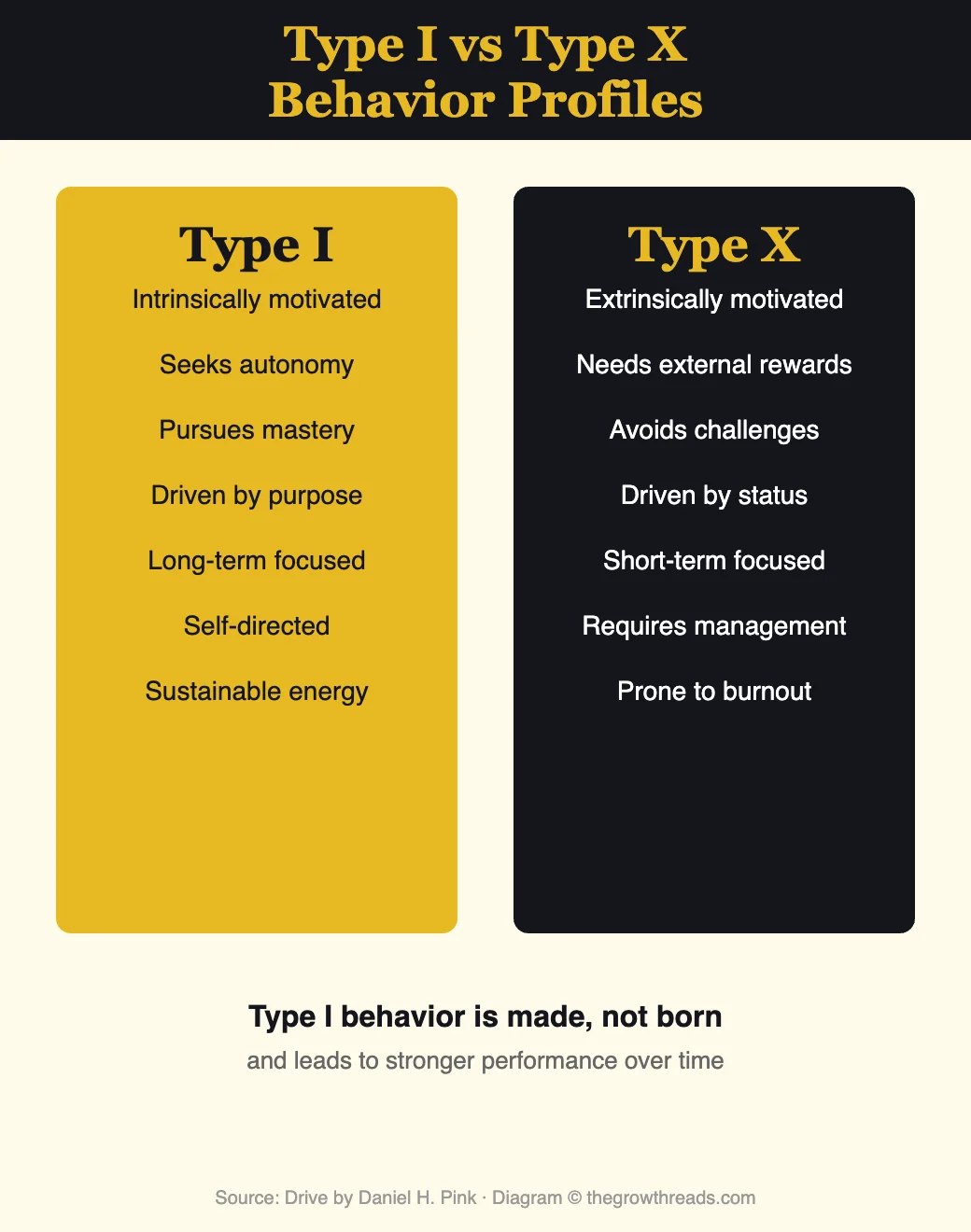
Type X behavior is fueled primarily by extrinsic desires — external rewards, recognition, status, and the avoidance of punishment. Type I behavior is fueled primarily by intrinsic desires — the inherent satisfaction of the activity itself. Pink emphasizes that these are not fixed personality types but behavioral tendencies that can be cultivated. Type I behavior is made, not born, and environments play a crucial role in shaping which type emerges. Type I behavior tends to produce stronger long-term performance and greater well-being.
Is Drive still relevant in 2026?
More than ever. The shift to remote and hybrid work has made autonomy the default expectation for knowledge workers. Companies that try to reassert control through surveillance software and mandatory office time are experiencing record turnover. Meanwhile, organizations that embrace the principles in Drive — genuine autonomy, opportunities for mastery, and clear purpose — consistently rank among the best places to work. The science behind the book has only been strengthened by subsequent research in self-determination theory.
How does Drive relate to self-determination theory?
Drive is essentially a popular translation of self-determination theory (SDT), the framework developed by psychologists Edward Deci and Richard Ryan. SDT identifies three basic psychological needs — autonomy, competence, and relatedness — that, when satisfied, produce intrinsic motivation. Pink’s “autonomy” maps directly to SDT’s autonomy, “mastery” maps to competence, and “purpose” is his interpretation of relatedness (connecting to something larger). The academic foundation is decades deep, with hundreds of studies across cultures confirming the core findings.
Related summaries
- Start with Why Summary & Review — Simon Sinek on the power of purpose-driven leadership.
- Mindset Summary & Review — Carol Dweck on the growth mindset that enables mastery.
- Dare to Lead Summary & Review — Brene Brown on courageous, human-centered leadership.
- Best Leadership Books — Our complete guide to the top books on leading teams and organizations.
How we analyze books: Every summary on The Growth Reads is built from a close reading of the full text, cross-referenced with the author’s published interviews, peer-reviewed research where applicable, and reader feedback from multiple platforms. We focus on extracting actionable frameworks rather than abstract theory. Read our full methodology.
Related Leadership Summaries
Legacy Summary and Review
The Art of War Summary & Review: Timeless Strategy for Modern Leaders
The Culture Map Summary & Review: Decode Any Culture Before It Costs You a Deal
The Ideal Team Player Summary & Review: Hire for Humility, Hunger, and People Smarts
The Lean Startup Summary & Review: Build, Measure, Learn