

★★★★½ 4.5/5 — a case file of lives you can copy, not a quote pack you can recite.
Best for: people who already own Stoic maxims and still freeze when the bill comes due
Reading time: ~8 hrs (352 pages) · this guide ~12 min
Difficulty to apply: Medium — the work is imitation, not annotation
Lives of the Stoics in one minute
Stoicism is a life you copy under pressure, not a stack of portable quotes. Ryan Holiday and Stephen Hanselman walk the line from Zeno’s shipwreck to Marcus Aurelius’s campaign tent and ask the only question that counts: what did this person do when the virtue cost them?
The book’s engine is the four virtues — courage, justice, temperance, wisdom — lived by merchants, water-carriers, senators, a slave, and an emperor. You do not finish it with a better highlighter. You finish it with one person to imitate this week and one deed that would still make sense if nobody clapped.
Key takeaways
- Deeds, not words: A philosophy you can only explain has not been installed. The test is Tuesday, not the thread.
- Study a life, not a maxim: Pick one Stoic. Watch where they paid. Quotes without a biography are decorations.
- The four virtues are the OS: Courage starts, justice aims, temperance keeps the edge, wisdom sees. Drop one and the others drift.
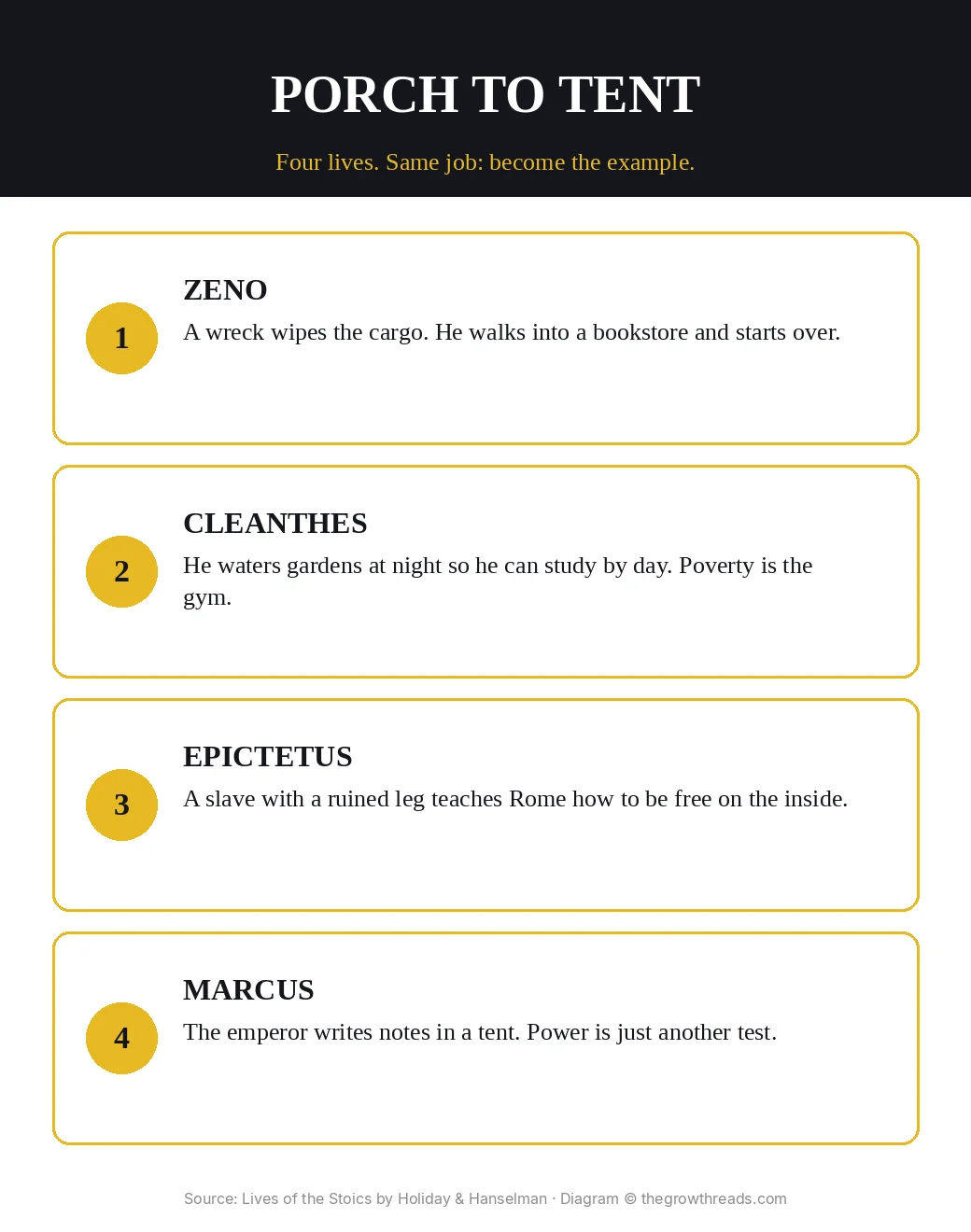
- Fortune is a teacher, not a verdict: Zeno loses the cargo and walks into a bookstore. The wreck is the curriculum.
- Poverty can be a gym: Cleanthes waters gardens at night so he can study by day. Ease is not a prerequisite for practice.
- Character shows when it costs: Cato and Porcia keep the line when Rome would pay them to blur it. Cheap integrity is not integrity.
- Power is just another test: Seneca’s wealth and Nero’s court do not cancel the philosophy. They raise the price of it.
- Freedom starts inside: Epictetus, a slave with a ruined leg, teaches Rome how to be ungovernable in the one place a master cannot reach.
- The emperor still needs notes: Marcus writes in a tent because the job does not make you wise. The reps do.
- Copy one deed this week: Translate a life into an action you can finish before dinner. Then stop announcing it.
What is Lives of the Stoics about?
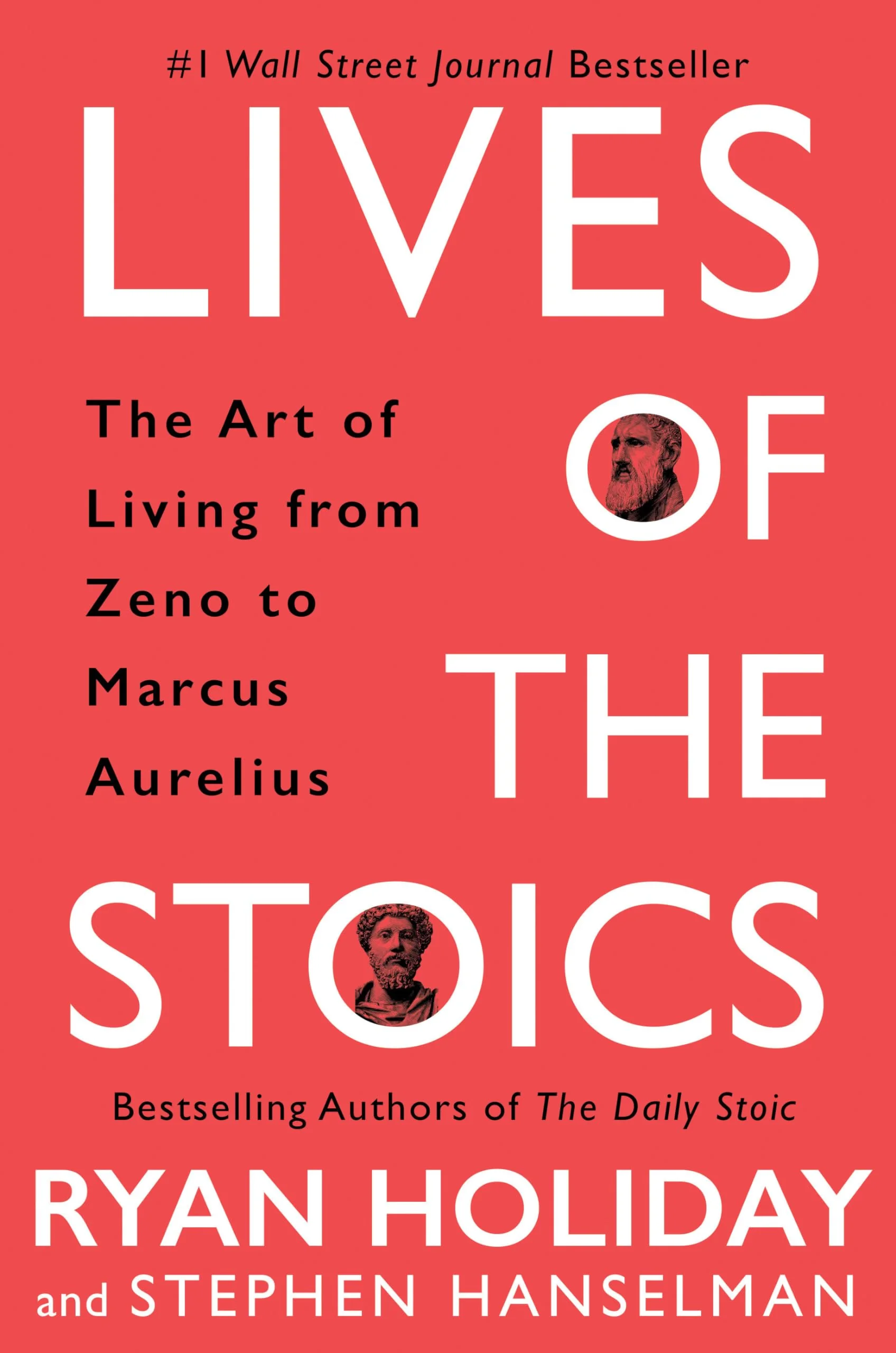
Lives of the Stoics is a biographical tour of the people who practiced Stoicism from Zeno of Citium to Marcus Aurelius. Holiday and Hanselman argue that the philosophy is a life you copy under pressure — four virtues in action — not a stack of quotes you can recite when the room is easy.
About the author
Ryan Holiday dropped out of college, apprenticed with Robert Greene, then ran marketing at American Apparel before the Stoic books made his name. The Obstacle Is the Way turned a Roman idea into a working reframe. The Daily Stoic, built with editor Stephen Hanselman, put a page of practice on the calendar. Lives of the Stoics (2020) is the case file behind those pages: merchants, water-carriers, senators, and one emperor who spent the virtues when they were expensive. Holiday still runs a bookstore in Bastrop, Texas — the dead stay on the shelf so the living can argue with them. Hanselman is the quieter half: a longtime editor who keeps the sources honest while Holiday aims the story. Explore all Ryan Holiday book summaries →
Key concepts at a glance
| Concept | What it means | Use it when |
|---|---|---|
| Deeds, not words | Virtue is what you do when it costs, not what you can explain. | You have a quote for every mood and a stall for every bill. |
| The four virtues | Courage, justice, temperance, wisdom — one OS, four jobs. | You are brave in the wrong direction, or wise only in notes. |
| The porch | Zeno taught in a painted stoa. Philosophy was public practice, not a seminar. | Your “practice” never leaves the notebook. |
| The wreck as curriculum | Fortune wipes the cargo so you can start the real work. | A setback feels like a verdict instead of a syllabus. |
| Poverty as gym | Cleanthes works nights so study can happen by day. | You wait for a clean calendar before you train. |
| The Cato test | Keep the line when the room would pay you to blur it. | A compromise would be cheaper than a reputation. |
| Inner freedom | Epictetus: a master can take the leg, not the choice. | You treat the inbox as if it owns your consent. |
| The tent notebook | Marcus writes because power does not install wisdom. | The title arrived and the reps quietly stopped. |
Part 1: A wreck, a porch, and a job
The origin story is almost too clean, which is why Holiday tells it as a working myth. Zeno of Citium is a merchant. The ship goes down. The purple cargo is gone. A lesser biography would stop at resilience. This one sends him into an Athenian bookstore, where he hears Socrates and treats the loss as an invitation. “Well done, Fortune,” the line goes, “to drive me to philosophy.” The wreck removed the life that was in the way of the life he could actually live.
He studies with Crates the Cynic, then teaches in the Stoa Poikile — the painted porch that gave the school its name. Philosophy here is a public job: show up, argue, live so the argument is not embarrassing. Cleanthes copies lectures on oyster shells and waters gardens at night so he can stand in the porch by day. Chrysippus, the “second founder,” builds the logic that keeps the school from dissolving into vibe. They did not collect insights. They built a gym.
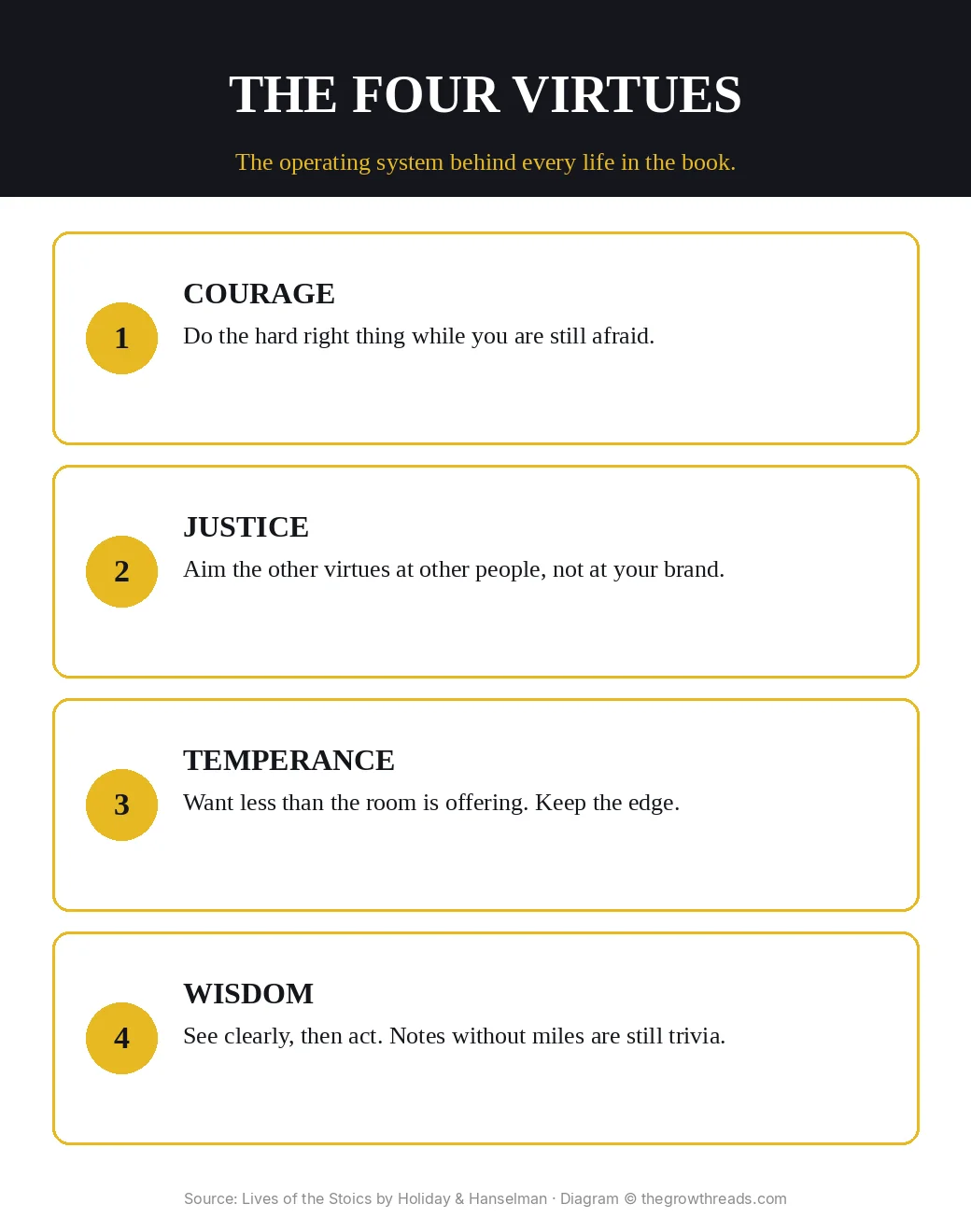
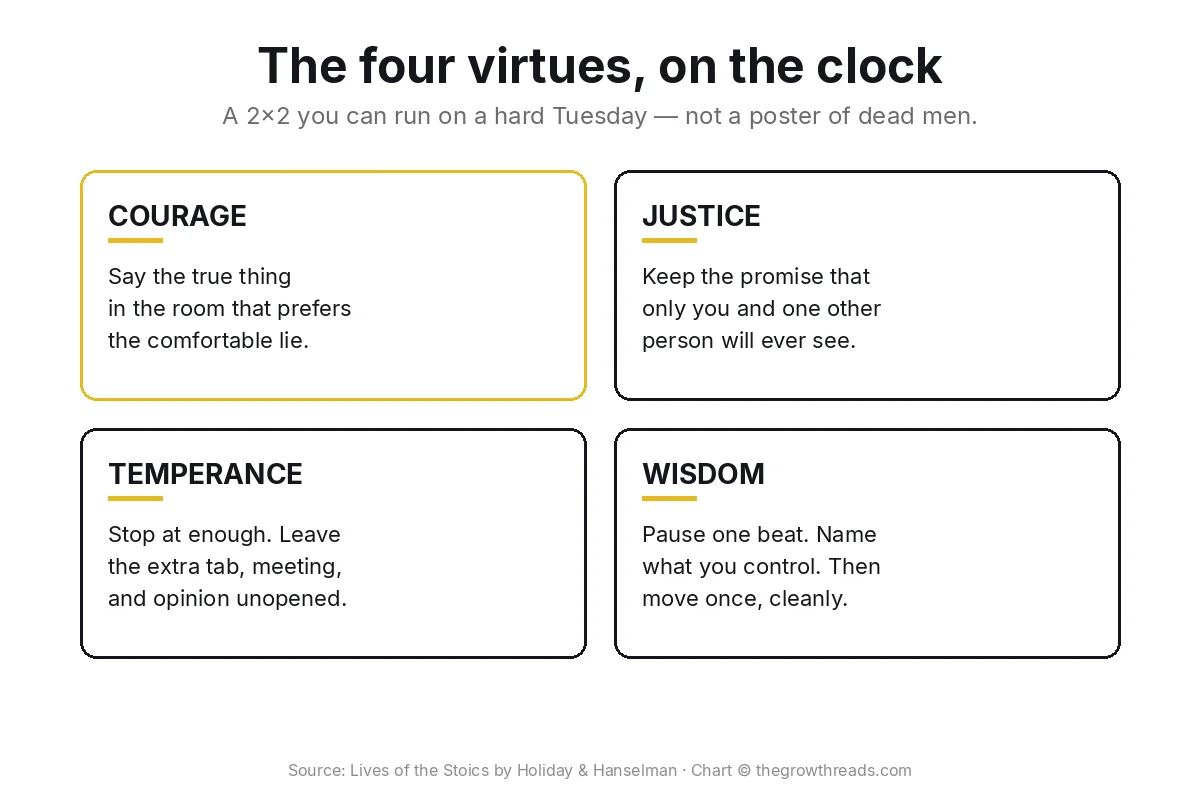
The four virtues arrive as an operating system, not a poster. Courage starts the hard right thing while you are still afraid. Justice aims that energy at other people instead of at your brand. Temperance keeps the edge — want less than the room is offering. Wisdom sees clearly, then moves. Drop wisdom and courage becomes a stunt. Drop justice and temperance becomes a diet. The early Stoics argued about physics and logic; Holiday keeps the camera on the part you can spend this week: a virtue is a job description.
TGR Note. If you already do a page a day, The Daily Stoic is the reps. This book is the case file behind the reps — the lives the pages were compressed from. If the bottleneck is still “I know the maxim and I do not move,” skip ahead to Part 2 and steal Cato’s test, then come back for Zeno’s wreck when you need the origin story.
Part 2: Character when it costs
Rome does not import Stoicism as a lifestyle brand. It imports a way to stay unbought. Cato the Younger is the expensive example: the senator who would rather lose than oil the machine. Holiday does not ask you to copy Cato’s politics. He asks you to notice the price tag. Character that only appears when it is free is a costume. The Cato test: what would you still do if the room paid you — in ease, access, or applause — to blur the line?
Porcia gets a chapter because the school is not a men’s club in this telling. She tests herself on purpose, in private, without an audience. Stoicism without a cost is a hobby. You do not need a civil war. You need one place this week where the honest move is more expensive than the smooth one — and you pay it without posting the receipt.
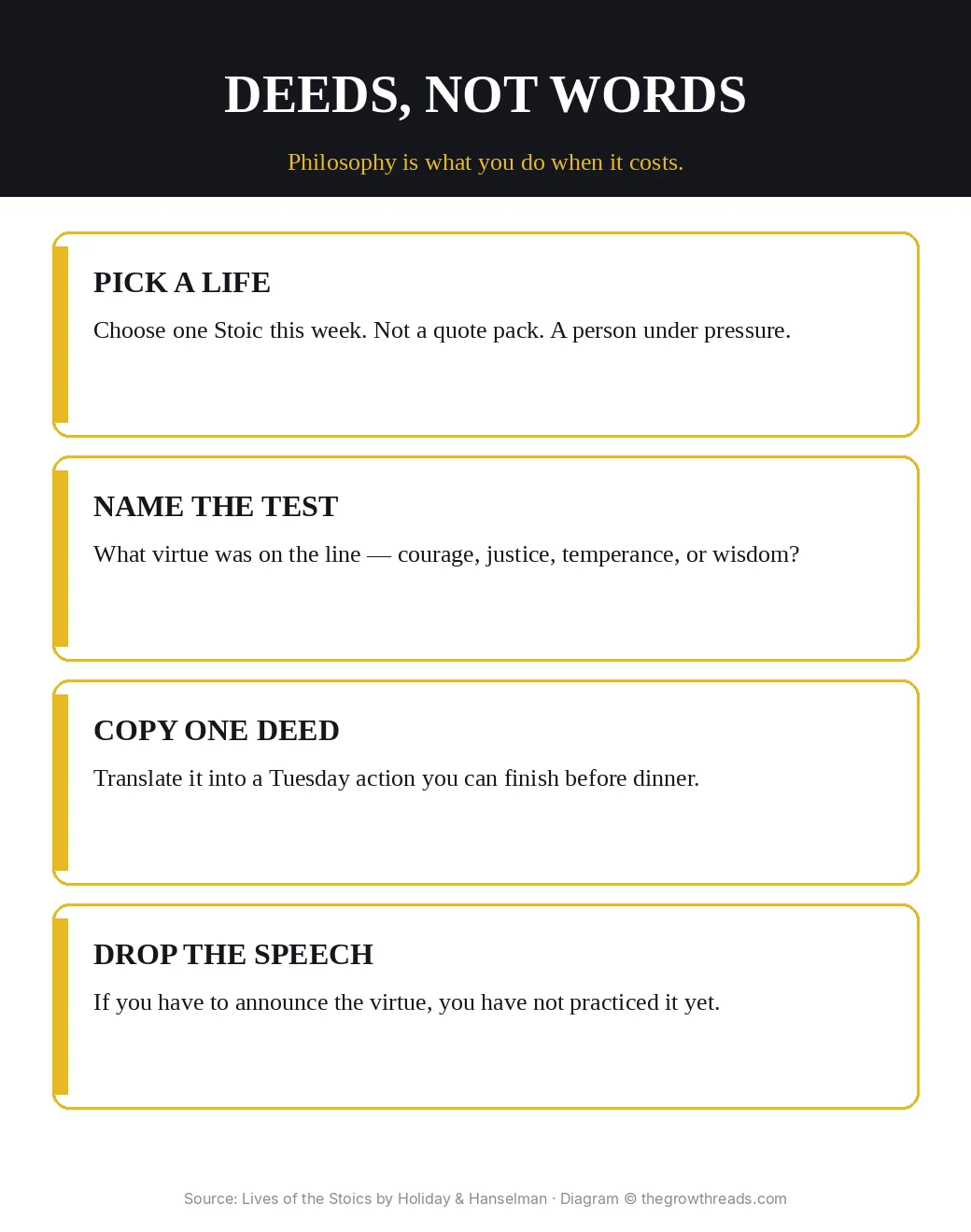
The method in this section is the book’s method: pick a life, name the virtue on the line, copy one deed, drop the speech. If you have to announce the virtue, you have not practiced it yet. That sentence will annoy anyone who treats Stoicism as content. Good. Content is cheap. The deed is the product.
TGR Note. Cato is the lived cousin of The Obstacle Is the Way: the obstacle is not a poster, it is the bill. If the thing in your way is actually your own need to look composed, Ego Is the Enemy is the cleaner next read. If you need courage as a decision rather than a feeling, Courage Is Calling is the drill book.
Part 3: Power, the classroom, and compromise
Seneca is the chapter people argue with, which is why it belongs here. He is rich, in Nero’s court, writing like a saint and living like a courtier. Holiday does not wash him clean and does not throw him out. Proximity to power is not a free pass. It is a harder exam. If your philosophy only works in a cabin, it is a vacation.
Musonius Rufus treats philosophy as training — food, exile, the boring disciplines that do not photograph. Then Epictetus, born a slave, left with a ruined leg, turns the classroom into a freedom school. The dichotomy of control is not a productivity hack in his mouth. It is how you stay ungovernable in the one place a master cannot reach: the choice to assent or refuse. Stop treating other people’s urgency as if it were your consent. Epictetus told students to live the sentences, not to recite them. A commonplace book you never open on a tired Tuesday is a museum.
TGR Note. Seneca is the warning label on Ego Is the Enemy — status can wear a humble costume. If your issue is follow-through rather than vanity, Discipline Is Destiny is the self-command drill. If the work is aiming the virtues at other people, Right Thing, Right Now is justice as a calendar, not a mood.
Part 4: The emperor in the tent
Marcus Aurelius is the famous ending, and Holiday treats him as a worker, not a marble bust. The most powerful man in the world writes notes to himself on campaign because the title does not install wisdom. If the emperor still needs reps, your promotion will not save you from the same homework. Meditations is the private workbook; this biography is the public cost of keeping it.
Do not become a collector of lives. Become a copier of one. Choose Zeno’s restart, Cleanthes’ night work, Epictetus’ inner veto, or Marcus’s evening notes. Run it for seven days. If it earned its keep, keep it. The porch was never a content brand. It was a place people stood and practiced in daylight.
TGR Note. If you want Marcus in his own voice, use Meditations next — this book is the life around those notes. If you want the training plan for the hinge virtue, Wisdom Takes Work is the drill. If you need the artist’s version of “do the work anyway,” The War of Art is the cousin in a different dialect.
Who is Lives of the Stoics best for — and who should read something else first?
Best for: operators who already own the maxims and still stall when the honest move is expensive. Founders, managers, and anyone whose job now includes other people’s weather. Readers who like biography more than treatises. People who will actually pick one life and copy a deed this week.
Read something else first: if you want a page-a-day without the history, start with The Daily Stoic. If you need the obstacle reframe before you care who Cato was, The Obstacle Is the Way is tighter. If your problem is starting while afraid, Courage Is Calling. If you need self-command more than heroes, Discipline Is Destiny. If you wanted a critique of Stoicism as a brand, this is the wrong house — TGR writes for application, and this book is a case file, not a takedown.
Questions to reflect on
- Which Stoic in the book had a week that looks like yours — wreck, court, classroom, or tent?
- Where did you recite a virtue last month instead of spending it?
- What would the Cato test name as your cheapest compromise this week?
- What can a “master” (inbox, client, title) not actually take from you?
- If you copied one deed for seven days, which deed would still matter if nobody saw it?
🔥 Ready to copy a life instead of collecting quotes?
Pick one Stoic this week. Spend one virtue before dinner. Skip the announcement.
How to apply Lives of the Stoics (7-day plan)
- Day 1 — Pick the life. Write one name at the top of a card: Zeno, Cleanthes, Cato, Seneca, Epictetus, or Marcus. One. Not a rotation.
- Day 2 — Name the virtue. Next to the name, write which of the four was on the line in their hardest scene. Circle the one that is on the line in yours.
- Day 3 — Copy one deed. Translate it into an action that ends before dinner. Send the true email. Keep the quiet promise. Stop at enough.
- Day 4 — The Cato test. List one place the room would pay you to blur a line. Do not blur it. Do not announce that you did not.
- Day 5 — Inner veto. From Epictetus: pick one incoming ask you will not automatically assent to. Reply after a beat, or not at all.
- Day 6 — Tent notes. Ten minutes at night. What did you control. What you pretended to. One line you will spend tomorrow.
- Day 7 — Teach one story. Tell one person the life you copied, without the TED ending. If you cannot describe the deed, you did not do it. Run the week again.
Frequently asked questions
What is Lives of the Stoics about?
Lives of the Stoics is Ryan Holiday and Stephen Hanselman’s biographical tour of the people who practiced Stoicism from Zeno of Citium to Marcus Aurelius. Instead of another stack of maxims, it follows merchants, water-carriers, senators, a slave, and an emperor through the moments when courage, justice, temperance, or wisdom actually cost them. The thesis is practical: study a life you can copy, then spend one deed this week. You do not finish the book with a better highlighter. You finish it with a name on a card and a Tuesday action that would still count if nobody clapped.
Who should read Lives of the Stoics?
Read it if you already know the famous lines and still stall when the honest move is expensive. It is built for operators, managers, and anyone whose job now includes other people’s weather. Biography readers will like it more than treatise readers. If you want a page-a-day without the history, start with The Daily Stoic. If you need the obstacle reframe first, read The Obstacle Is the Way. If you wanted a takedown of Stoicism as a brand, this is the wrong house — TGR writes for application, and this book is a case file you can spend, not a critique you can quote.
How is Lives of the Stoics different from The Daily Stoic?
The Daily Stoic is the calendar: one page, one rep, every day. Lives of the Stoics is the case file behind those pages — the people the maxims were compressed from. Use the daily book when you need a habit. Use the biographies when the habit has gone stale and you need a human being to imitate, not another sentence to underline. They stack. A useful week is one name from this book on a card, one virtue on the line, and the Daily Stoic page as the morning cue to spend it before dinner. Quotes without a life stay decorative.
Is Lives of the Stoics a biography or a philosophy manual?
Both, on purpose. Each chapter is a life under pressure, then a virtue you can spend. Holiday and Hanselman are not trying to replace primary texts; they are trying to stop you from treating primary texts as interior design. You will meet Zeno’s wreck, Cleanthes’ night work, Cato’s price, Seneca’s court, Epictetus’ classroom, and Marcus’s tent. The manual is the method: pick a life, name the test, copy one deed, drop the speech. If you want Marcus in his own voice afterward, read Meditations. If you want a training plan for wisdom, read Wisdom Takes Work next.
What are the four Stoic virtues in Lives of the Stoics?
Courage, justice, temperance, and wisdom — one operating system, four jobs. Courage starts the hard right thing while you are still afraid. Justice aims that energy at other people instead of at your image. Temperance keeps the edge: want less than the room is offering. Wisdom sees clearly, then moves once. Holiday’s warning is that the virtues fail in isolation. Courage without wisdom is a stunt. Temperance without justice is a private diet. Wisdom without courage is a notebook. Use the 2×2 in this review as a Tuesday check, not as a poster of dead men.
How long does it take to read Lives of the Stoics?
Plan about eight hours for the 352-page Portfolio edition, or a couple of commute weeks on audio. You do not need to memorize the full roster of minor Stoics to get the value. Read for the method, then slow down on the four or five lives that look like your week — wreck, court, classroom, or tent. This TGR guide is about twelve minutes and is meant to put one name on a card before you open the book. If a chapter is only adding names you will never imitate, skip it and spend the deed. Coverage is not the same as practice.
What is the best way to apply Lives of the Stoics this week?
Run the seven-day plan in this review. Day 1: pick one Stoic, not a rotation. Day 2: name which of the four virtues was on the line for them and for you. Day 3: copy one deed that ends before dinner. Day 4: pay the Cato test — do not blur the cheap compromise. Day 5: practice Epictetus’ inner veto on one incoming ask. Day 6: ten minutes of tent notes. Day 7: tell one person the story without a TED ending. If you cannot describe the deed, you did not do it. Then keep the one rep that earned its keep.
Related summaries
- The Daily Stoic — the daily reps
- Ego Is the Enemy — empty the cup
- Discipline Is Destiny — self-command as a skill
- Wisdom Takes Work — train judgment, then use it
- Best productivity books — the full TGR pillar
How we analyze books: we reconstruct the argument, add original application notes, and skip chapter-by-chapter reproduction. Read our full methodology.