

★★★★★ 4.6/5 — Character is real. The barrel still wins if you leave it unbuilt.
Best for: Managers, teachers, moderators, and anyone who still thinks “good people” is a safety system
Reading time: ~12 hrs for the Random House trade paperback · ~10 min for this guide
Difficulty to apply: Medium — you have to redesign a situation, not take a vow to be better
The Lucifer Effect in one minute
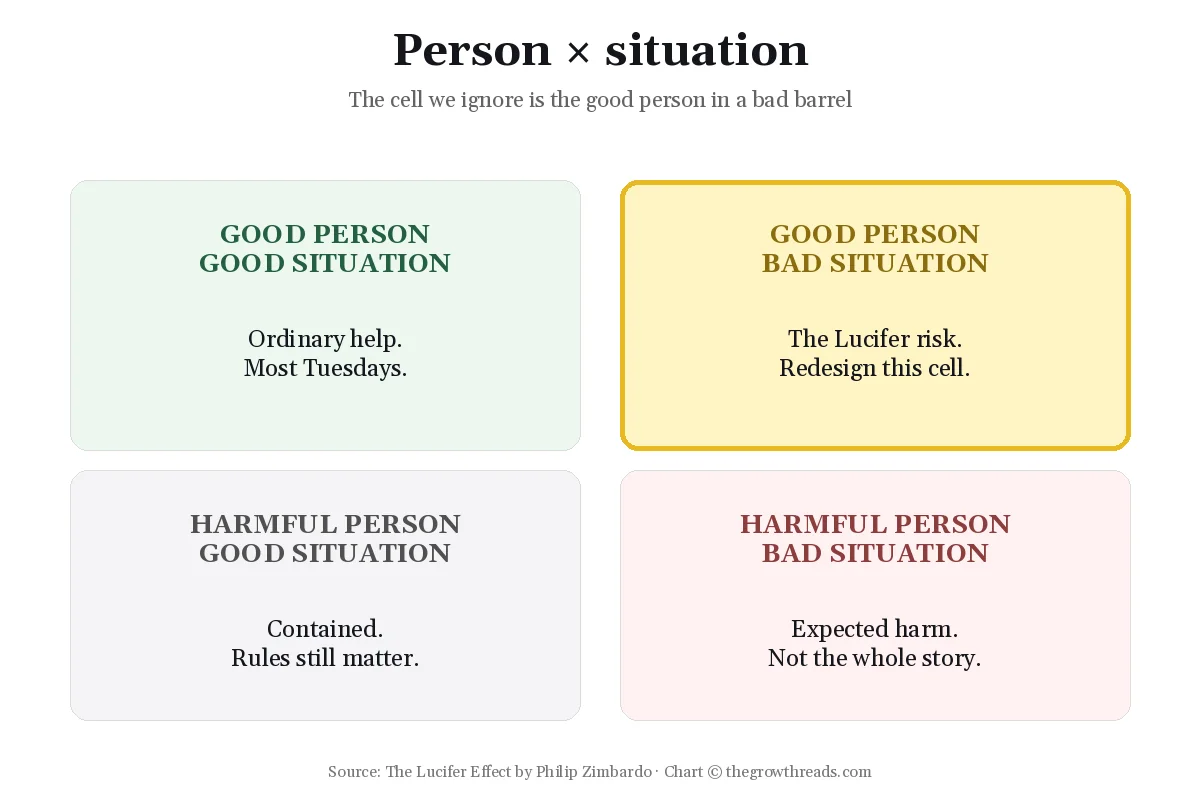
Good people turn when the situation is built for it. Philip Zimbardo’s 2007 book is a long report on that sentence. In 1971 he put student volunteers in a Stanford basement, flipped a coin for guard or prisoner, and watched a two-week study die in six days. He then walks conformity, obedience, deindividuation, and moral disengagement, and applies the map to Abu Ghraib, where he sat as an expert witness. The steal for Tuesday: heroism is a practice. Name the role. Keep a name. Ask for the rule in writing. Get one witness outside the game. Redesign the barrel.
Key takeaways
- Disposition is not the whole story: Who you think you are matters. The room you walk into often matters more.
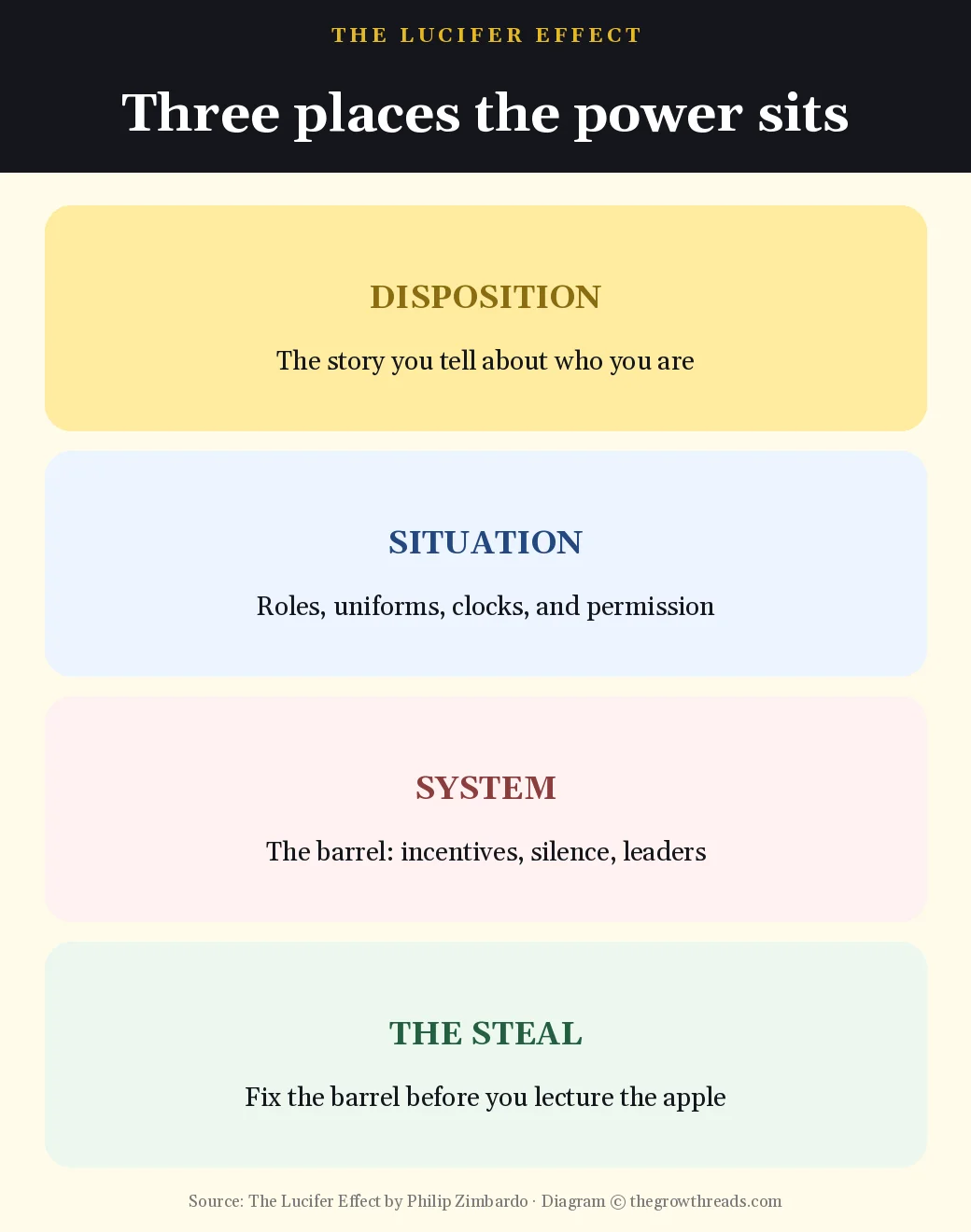
- Three layers of power: Person, situation, system. Most ethics talks stay on the first and skip the other two.
- Roles do work: A title, a uniform, a night shift, and a number can move a decent person faster than a speech.
- Anonymity is a solvent: Masks, group accounts, and “we” without a name make harm cheaper.
- Permission can be unofficial: A wink, a laugh, a silence from above is still a rule.
- The observer can be inside the barrel: Zimbardo played superintendent. Watching is not the same as standing outside.
- Systems outlive the shift: Incentives, staffing, and what gets rewarded will beat a poster about values.
- Heroism is small and early: A witness, a written rule, a kept name — before the slide looks dramatic.
- The steal is design: Change one physical fact in a situation you will actually enter this week.
What is The Lucifer Effect about?
The Lucifer Effect is Philip Zimbardo’s 2007 account of how ordinary people commit harm when roles, anonymity, and systems make it easy — told through the Stanford prison study, later social-psychology research, Abu Ghraib, and a closing argument that everyday heroism is a skill you practice before you need it.
About the author
Philip Zimbardo (23 March 1933 – 14 October 2024) was an American social psychologist who taught for decades at Stanford. He grew up in the South Bronx, took a psychology doctorate at Yale, and became the public face of the 1971 Stanford prison study — a six-day simulation that still sits in every intro course. He later hosted PBS’s Discovering Psychology, served as president of the American Psychological Association, and wrote The Time Paradox with John Boyd, already on The Growth Reads in the time-management silo. After The Lucifer Effect he founded the Heroic Imagination Project to treat “getting a witness” as a trainable act. The usable thread is not the celebrity experiment. It is the habit of asking what the barrel is doing to the apple. Explore all Philip Zimbardo book summaries →
Key concepts at a glance
| Concept | What it means | Use it when |
|---|---|---|
| Lucifer Effect | A good person slides into harm because the situation is built for it | You keep blaming “a few bad apples” and the barrel is still open |
| Disposition | The story you tell about character, values, and who you are | A values poster is doing all the ethical work |
| Situation | Roles, uniforms, clocks, audience, and unofficial permission | The same people behave differently after 10 p.m. |
| System | Incentives, staffing, silence from above — the barrel itself | One “bad shift” keeps repeating with new names |
| Deindividuation | Losing a name inside a role, mask, or group account | People start saying “we” and nobody can be found |
| Moral disengagement | Bandura’s tools for doing harm without feeling like a harmful person | Euphemism and “everyone does it” show up in the chat |
| Bad barrel | A system that produces harm without needing monsters | You are hiring for character and ignoring night, load, and rules |
| Everyday heroism | A small refusal: keep a name, write the rule, get a witness | You are waiting to feel brave instead of practicing an exit |
Part 1: The basement that would not stay a game
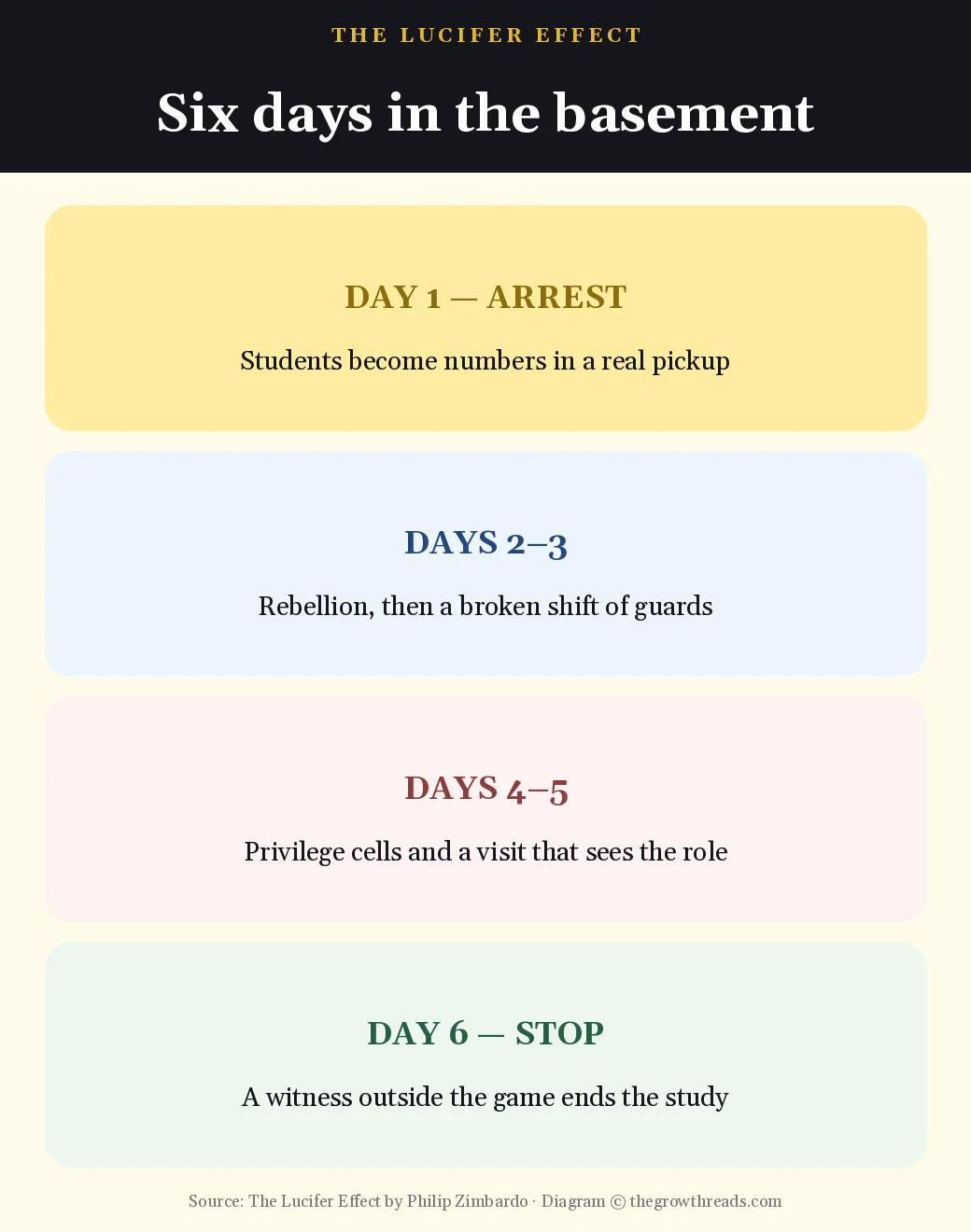
The first third of the book is a day-by-day account of the Stanford Prison Experiment. Zimbardo wanted a clean demonstration: take screened, healthy students, assign roles at random, and watch what a prison-like situation does. Palo Alto police helped with real arrests. Prisoners got smocks, numbers, and a chain. Guards got khaki, glasses, and a night. The study was booked for two weeks. It lasted six days.
What the diary shows, without turning it into a thriller, is speed. Day 1 still has nervous laughter. Day 2 has a rebellion. By the middle of the week the guards have invented punishments and a privilege cell, and several prisoners are breaking. The coin flip is doing more work than anyone’s self-story. Nobody arrived as a sadist on a résumé. The role arrived, then the inventions. If you only remember the photographs, you miss the quieter fact: the script was thin, and the situation filled it.
Zimbardo is honest that he was not a clean observer. He took the part of superintendent and lived inside the clock he had built. Christina Maslach walked in from outside the game and refused to treat the suffering as data. A witness who still has a name that is not “staff” is a review. A room of people who already live the role is a chorus.
TGR Note: Influence is the shorter map of authority and social proof — the levers a situation uses. Talking to Strangers is Gladwell on how badly we read people we do not know, which is what a number and a uniform are designed to produce.
Part 2: The tools that make a slide feel normal
After the basement, Zimbardo zooms out. The Lucifer Effect is not only a prison story. It is a tour of the social tools that let a decent person do a harmful thing and still sleep. Asch’s line studies show how a room can talk you out of what your eyes see. Milgram’s shock studies show how a lab coat and a script can keep a volunteer pressing a switch. Deindividuation research — including Zimbardo’s own earlier work — shows what happens when a face becomes a mask. Bandura’s moral disengagement is the language kit: euphemism, diffusion of responsibility, blaming the target, comparing your act to a worse one.
None of this asks you to throw away character. It asks you to stop treating character as a force field. A person with a clean self-story can still accept a role that comes with unofficial permission. “We do it this way on nights” is a system. “Nobody wrote it down” is not a defense. It is a design choice. The book’s most useful move is to put those tools on one table so you can spot them in a Slack channel, a locker room, or a hiring loop — not only in a famous prison.
Read it as a checklist. Where are people anonymous? Where does the clock change the rules? Where does a joke do the work of an order? Where would a written rule look embarrassing? You do not need a basement. You need a Tuesday with a vague brief and no witness.
TGR Note: Behave is Sapolsky’s longer biology of the same question: context before character. Thinking, Fast and Slow is the catalog of shortcuts a tired mind will take when the situation does not force a pause.
Part 3: Abu Ghraib and the barrel with a flag on it
The second half of the book takes the Stanford map to Abu Ghraib. Zimbardo sat as an expert witness for Sergeant Ivan Frederick and argues, at length, that the abuse was not a few rotten soldiers in an otherwise clean barrel. Night shifts, understaffing, mixed signals, a reward for toughness, and a long commute from any written law built a situation where ordinary people could take part. He is not offering a pardon. He is refusing the “bad apples” sentence that lets the barrel keep its job.
This is the chapter that makes managers uncomfortable, which is the point. If harm requires a monster, you only screen for monsters. If harm can be produced by load, anonymity, and unofficial permission, you have to design. Who is tired? Who is unseen? Who thinks the real rule is the one that cannot be emailed? Who would notice if the line moved two inches this week? Those questions fit a hospital, a warehouse, a sales floor, and a moderation queue. The military facts are specific. The design questions travel.
The situation layer is not enough. You can coach one shift and leave the incentives untouched; a new person will fill the same night. The gift is vocabulary: apple, barrel, barrel-maker. Lecture apples and you chose a cheap intervention. Name the staffing plan, the metric, the silence — and you have started the last chapter’s work.
TGR Note: The Righteous Mind is Haidt on how groups moralize their own side and go blind. Lost Connections is Hari on how environments, not only brains, produce what we then treat as a private defect — a cousin argument in a different silo of pain.
Part 4: Heroes are people who still have a name
The last movement of The Lucifer Effect is the one most summaries skip because it is less famous than the basement. Zimbardo wants an opposite of the slide. He calls it everyday heroism. Not a cape. A practice. Christina Maslach ending the study. Joe Darby handing over the Abu Ghraib photographs. The person in your office who says, “Write that order,” or “I will not do this without a name on it.” The Heroic Imagination Project later tried to teach that as a skill: notice the barrel, keep your identity, act while the cost is still small.
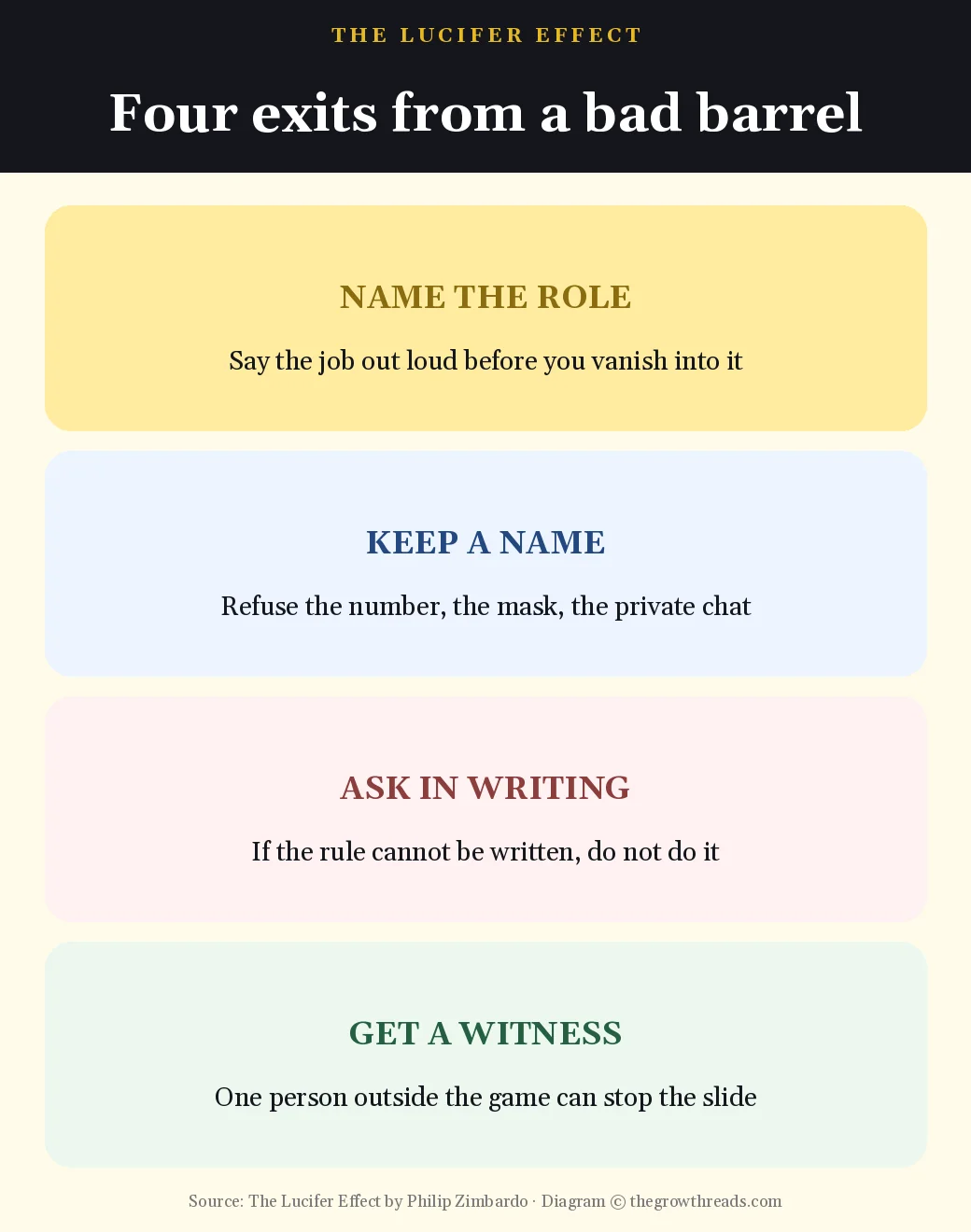
The four exits in this guide are stolen from that close. Name the role before you vanish into it. Keep a name — refuse the number, the mask, the shared login. Ask for the rule in writing; if it cannot be written, do not do it. Get a witness outside the game, the way Maslach was outside. None of these require a speech about being a good person. They require a Tuesday habit. If you wait until you “feel brave,” the situation has already chosen for you.
His later Time Paradox, already on this site, rhymes: a person trapped in the shift cannot see the morning after. You do not need the whole time theory. You need one situation you will enter, and one exit you will practice before the lights go down.
TGR Note: Man’s Search for Meaning is the other pole: what a person can still choose when the barrel is real. The Gift of Fear is de Becker on listening to the early signal that a situation is wrong — the private version of Maslach’s “stop.”
Who is The Lucifer Effect best for — and who should read something else first?
Best for people who run rooms: managers, teachers, moderators, night-shift leads — anyone who still treats “we hire good people” as a control system. The book is long. This guide is the steal: three layers, four exits, one redesigned Tuesday.
Read something else first if you want a short map of persuasion levers — start with Influence. If you want a catalog of mental shortcuts, Thinking, Fast and Slow. If you want biology under behavior, Behave. If you want meaning under pressure rather than systems of harm, Man’s Search for Meaning. If the situation you actually have is phones and kids, The Anxious Generation. If you came for a personal habit loop, Atomic Habits is that book; this one is a barrel manual.
Questions to reflect on
- Which role will you play tomorrow, and what unofficial permissions come with it?
- Where in your week are you a number, a mask, or a group account?
- What rule are you following that you would not sign with your real name?
- Who is your witness outside the game — the person who can still say stop?
- What is one physical fact in the situation you can change this week: pairing, hour, checklist, audience?
🔥 Ready to redesign the barrel before character fails?
Get The Lucifer Effect and steal a Tuesday map for roles, permission, and exits.
How to apply The Lucifer Effect (7-day plan)
- Day 1 — Name the role. Write the job you will play tomorrow in one line: chair, reviewer, closer, moderator. Not your values. The role.
- Day 2 — Keep a name. In one meeting, refuse the group login, the joke title, or the “we.” Use your name when you decide.
- Day 3 — Write the rule. Put the unofficial rule on paper. If you would not sign it, do not do it today.
- Day 4 — Get a witness. Tell one person outside that room the line you will not cross. Do it before you need them.
- Day 5 — Change one physical fact. Pairing, hour, checklist, or audience. One fact. Not a speech.
- Day 6 — Practice “I was wrong.” Correct one small call out loud. Permission to reverse is an exit.
- Day 7 — Map the barrel. Incentives, silence, who benefits if the line moves. Circle one barrel-maker you can name at work on Monday.
Frequently asked questions
What is The Lucifer Effect about?
The Lucifer Effect is Philip Zimbardo’s 2007 book on how ordinary people slide into harm when a situation is built for it. He retells the 1971 Stanford prison study he ran, then widens the lens to conformity, obedience, deindividuation, and moral disengagement. The second half applies that map to Abu Ghraib and to everyday systems — night shifts, uniforms, vague orders, silence. The last chapter is the usable steal: heroism is a practice, not a personality, and you can design exits before the barrel closes. This summary turns that into a Tuesday plan: name the role, keep a name, write the rule, get a witness.
What was the Stanford Prison Experiment?
In August 1971, Zimbardo paid student volunteers to live in a mock prison in a Stanford basement. A coin flip made some guards and others prisoners. The study was meant to last two weeks. It lasted six days. Guards invented punishments. Prisoners were given numbers and clothes that erased ordinary identity. Zimbardo played superintendent and was inside the system he was supposed to observe. Christina Maslach, a colleague who was not living the role, told him to stop. The book’s point is not that students are secretly cruel. It is that roles, anonymity, and permission can move good people faster than they expect.
Is the Stanford Prison Experiment still useful after later debate?
Yes, as a situation-design manual, not as the last word on every lab detail. Later scholars have asked how much the guards were guided and whether a basement study is a true experiment. Those questions belong in a methods class. Zimbardo’s practical claim is quieter and still useful: uniforms, night, vague authority, and an audience that looks away change what people will do. You do not need to settle every SPE argument to steal the Tuesday work. If a process only works when nobody writes it down, redesign the process. The book is for that work.
How does the book explain Abu Ghraib?
Zimbardo served as an expert witness for Sergeant Ivan Frederick and treats Abu Ghraib as a “bad barrel,” not a handful of “bad apples.” Night shifts, understaffing, mixed signals from above, and a culture that rewarded toughness built a situation where ordinary soldiers could take part in abuse. He is not erasing individual choice. He is insisting that choice happens inside a system, and systems can be named. The usable steal for a civilian workplace is the same map: who is tired, who is anonymous, who thinks the rule is unofficial, and who would notice if the line moved.
What is the opposite of the Lucifer Effect?
Zimbardo calls the opposite everyday heroism — the person who stays a name, says no, or gets a witness when the barrel starts to close. Christina Maslach stopping the Stanford study is the model inside the book. Joe Darby turning over the Abu Ghraib photographs is the public one. Heroism here is not a cape. It is a small refusal practiced before you need it: keep your name, ask for the rule in writing, tell one person the line you will not cross. The Heroic Imagination Project later tried to teach that as a skill, not a mood.
Who should read The Lucifer Effect?
Read it if you run a team, a classroom, a night shift, or a comment thread — any place where roles and uniforms do more work than speeches about values. It is long. You do not have to memorize the six-day diary. Steal the three-layer map and the four exits. If you want a shorter book on persuasion levers, start with Influence. If you want a catalog of mental shortcuts, start with Thinking, Fast and Slow. If you want meaning under pressure rather than systems of harm, start with Man’s Search for Meaning. This book is for people who still believe character is enough.
How do you apply The Lucifer Effect at work this week?
Pick one situation you will actually enter. Name the role out loud: chair, reviewer, closer, moderator. Keep your real name in the room — no disappearing into a group account or a joke title. Write the rule you think you are following. If you would not sign it, do not do it. Tell one person outside that room the line you will not cross, so you have a witness before you need one. Then change one physical fact: the pairing, the hour, the checklist, the audience. Character speeches come after the barrel is redesigned. That is the week’s work.
Related summaries
- Influence — the levers a situation uses on a decent person.
- Thinking, Fast and Slow — the shortcuts a tired mind takes when the room does not pause.
- Behave — context before character, from the biology side.
- The Righteous Mind — how groups go blind to their own barrel.
Browse the full list on our Best Psychology Books pillar.
How we analyze books: our summaries are built from a full read of the source text, cross-referenced against the author’s published interviews and research where relevant, and structured around practical application rather than critique. We disclose our editorial process and affiliate relationships in full. Read our full methodology.