

★★★★½ 4.5/5 — a brutal, electrifying memoir-manual on mental toughness. Extreme by design, but few books light a fire under you like this one.
Best for: anyone who knows they are capable of more and wants a raw, no-excuses push to prove it · Reading time: ~9 hours (this guide: 16 min) · Difficulty to apply: Hard — the ideas are simple, the discomfort is real
Can’t Hurt Me in one minute
Most of us tap out at about 40% of our true capacity — and David Goggins built his life around finding the other 60%. Part memoir, part manual, Can’t Hurt Me tells the almost unbelievable story of a man who transformed himself from an abused, overweight, directionless young man into a Navy SEAL, an Army Ranger, and one of the world’s toughest endurance athletes. But the story is really a delivery system for a philosophy: that the mind gives up long before the body does, that greatness is available to anyone willing to callous their mind through relentless, voluntary discomfort, and that we are all capable of vastly more than we believe. Goggins is uncompromising and his methods are extreme, but his core message is genuinely empowering — you are your own biggest obstacle, and you have far more in the tank than you think.
Key takeaways
- The 40% Rule: when your mind says you are finished, you have usually used only about 40% of your true capacity.
- The Accountability Mirror: face your flaws honestly in the mirror every day and hold yourself accountable with brutal truth.
- Callous your mind: like a callus on the hand, mental toughness is built by repeatedly exposing yourself to discomfort.
- The Cookie Jar: in moments of doubt, reach back to past victories as proof you can endure and win again.
- Take souls: turn other people’s doubt and disrespect into fuel that powers you past them.
- Embrace the suck: seek out hard things on purpose, because comfort is where growth goes to die.
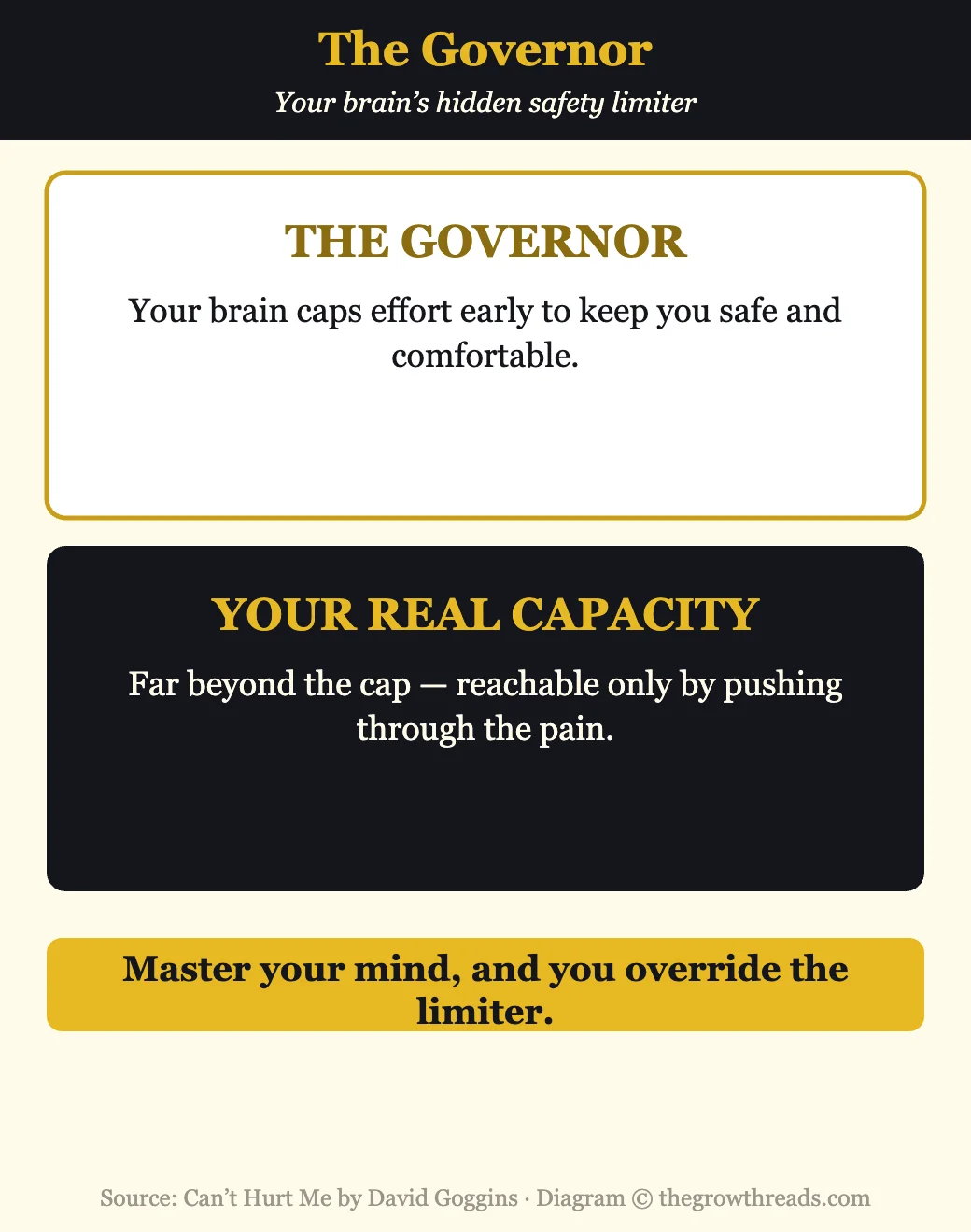
- The Governor: your brain has a built-in limiter that stops you early to keep you safe; you can learn to override it.
- Own your story: your past and disadvantages are real, but they are your responsibility to overcome, not your excuse.
- Be uncommon amongst the uncommon: most people never push hard; the rare few who do must then push even further.
- Stay hard: toughness is not a one-time achievement but a daily practice you renew again and again.

What is Can’t Hurt Me about?
Can’t Hurt Me is a memoir and self-development book by David Goggins about overcoming extreme adversity through mental toughness. Weaving his life story with practical challenges, it argues that most people vastly underestimate their capacity, and that anyone can build resilience by taking ownership of their life and voluntarily embracing discomfort.
About the author
David Goggins is a retired US Navy SEAL and the only person to complete SEAL training (including Hell Week three times), US Army Ranger School, and Air Force Tactical Air Controller training. He went on to become an accomplished ultramarathon runner and once held the Guinness World Record for pull-ups in 24 hours. His origin is the opposite of that résumé: he grew up facing abuse, poverty, and racism, struggled with a learning disability, and was working as an overweight exterminator, weighing nearly 300 pounds, when he decided to change his life. Published in 2018, Can’t Hurt Me became a word-of-mouth phenomenon, powered in part by its unusually raw audiobook, in which Goggins is interviewed between chapters. He writes not as a detached expert but as living proof of his own thesis — that the human capacity for endurance is far greater than we allow ourselves to believe. Explore all David Goggins book summaries →
Key concepts at a glance
| Concept | What it means | Use it when |
|---|---|---|
| The 40% Rule | You quit far before your real limit | You feel like giving up |
| Accountability Mirror | Brutally honest daily self-assessment | You keep making excuses |
| Callousing the mind | Building toughness through discomfort | Life feels too comfortable |
| The Cookie Jar | Recalling past wins for strength | Doubt hits mid-struggle |
| Taking souls | Using doubters as fuel | Someone underestimates you |
| The Governor | The brain’s early-stopping limiter | Pushing a physical or mental limit |
Part 1: From broken to unbreakable — the accountability mirror
Goggins does not spare the reader his beginnings. He describes a childhood shaped by an abusive father, poverty, and the corrosive experience of racism, along with an undiagnosed learning disability that left him functionally unable to read for years. By his early twenties he was overweight, depressed, and drifting, spraying for cockroaches at night and eating himself numb. The turning point was not a motivational seminar but a decision to stop lying to himself. Watching a documentary about Navy SEALs, he resolved to become one — a near-impossible goal given his condition — and confronted the gap between where he was and where he wanted to be.
His first tool is the Accountability Mirror. Goggins began writing his goals and his hard truths on sticky notes stuck to his bathroom mirror, then facing himself every day and telling himself, without flinching, exactly what he needed to do and where he was falling short. The mirror is a practice of radical self-honesty: not self-esteem affirmations, but an unfiltered reckoning with your own excuses. Underneath it is the book’s foundational move — taking complete ownership. Goggins is emphatic that his disadvantages were real and unfair, and equally emphatic that overcoming them was nobody’s job but his own. Blaming your circumstances, however justified, keeps you stuck; owning your response is the only thing that sets you free.
TGR Note: The Accountability Mirror is Goggins’ visceral version of the identity work in Atomic Habits — becoming the type of person who does hard things — and the ownership he demands is the same first principle Jordan Peterson opens 12 Rules for Life with: stop blaming, start taking responsibility. Goggins simply removes every comfortable off-ramp.
Part 2: The 40% Rule and callousing the mind
The heart of the book is what Goggins learned pushing through the most demanding military training on earth. Repeatedly, at the point where his body screamed to quit, he discovered he could keep going — and from this he draws his most famous idea, the 40% Rule.
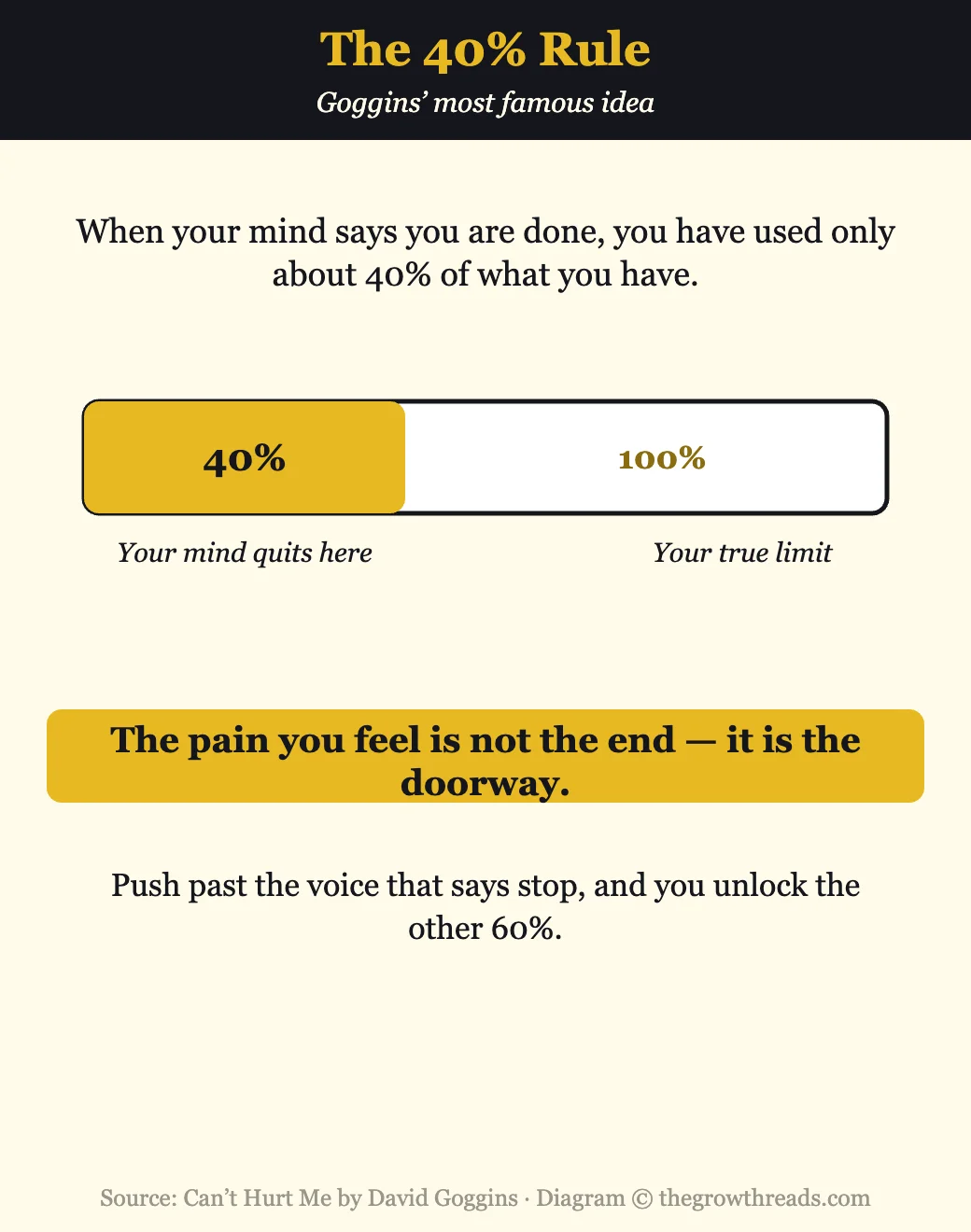
When your mind tells you that you are done, Goggins argues, you have typically tapped only about 40% of your actual capacity. That sensation of being finished is not a physical wall but a psychological one — a protective mechanism he calls the Governor, the brain’s tendency to shut you down early to keep you within a safe, comfortable zone. The good news is that the Governor can be pushed back. Every time you continue past the point where you wanted to stop, you expand the range of what you believe is possible and build what Goggins calls a callused mind. Just as skin toughens where it is repeatedly stressed, the mind grows resilient through repeated, voluntary exposure to discomfort. The way to become tougher is not to avoid suffering but to seek it out in controlled doses and refuse to fold.
Part 3: The mental tools — cookie jar, taking souls, embrace the suck
Goggins offers concrete techniques for the moments when willpower alone runs dry. The first is the Cookie Jar. When he is deep in a struggle and doubt creeps in, he reaches mentally into a “cookie jar” filled with the memory of every hard thing he has already overcome — every finish line, every impossible course completed. These memories are evidence, and evidence beats fear: if you have endured before, you can endure now. He recommends everyone build their own cookie jar by cataloguing their past victories, especially the ones that came through adversity, so they are available as fuel when it matters.
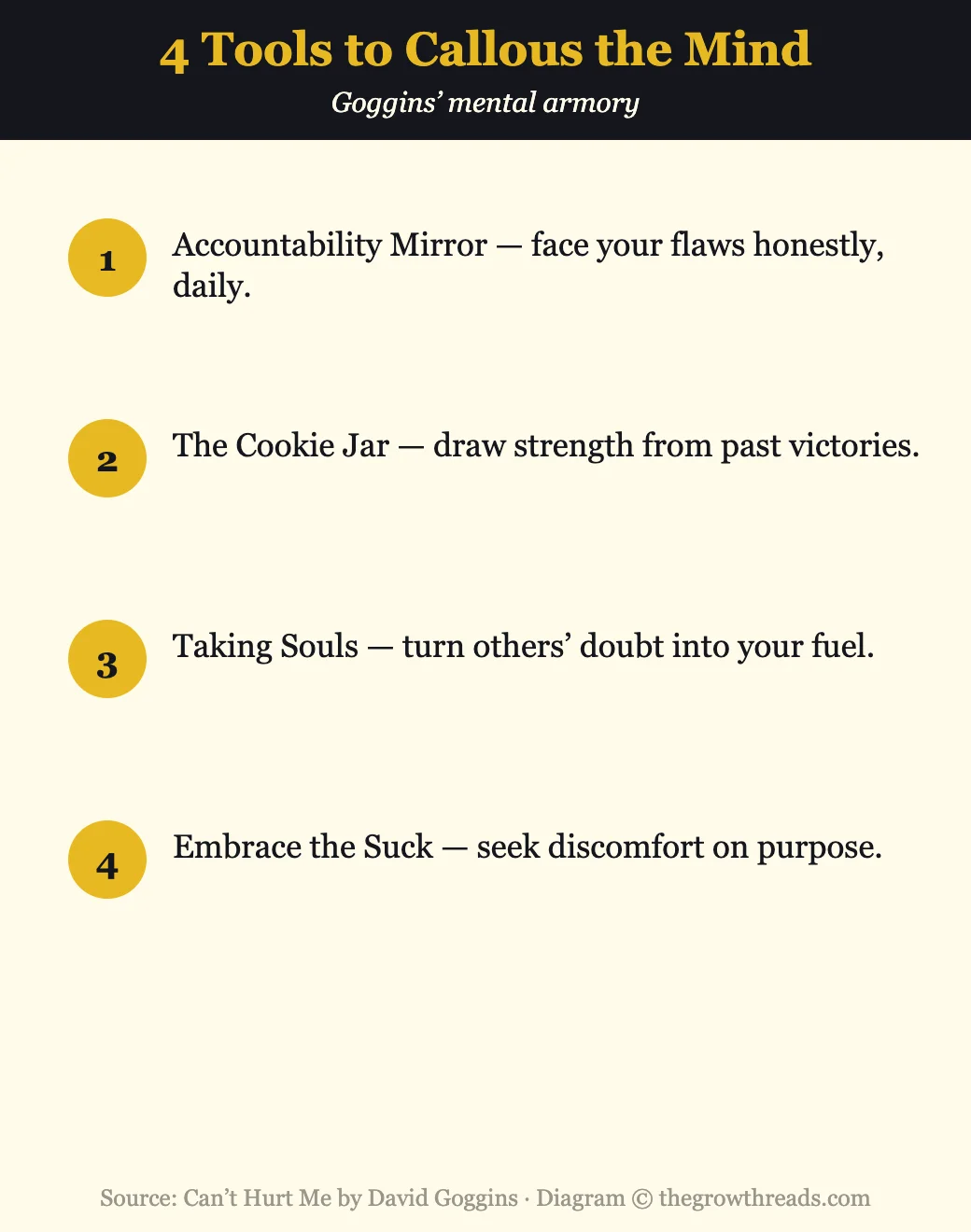
The second technique is Taking Souls — flipping other people’s doubt into your own power. When someone underestimates you, tries to break you, or expects you to fail, Goggins uses that disrespect as rocket fuel, outperforming so dramatically that he takes the wind out of them. It is a way of converting a negative into energy rather than letting it drain you. The third is to Embrace the Suck: to deliberately choose the harder path, the cold, the early morning, the extra mile, because comfort quietly erodes capability while difficulty builds it. None of these are comfortable, and that is the point — Goggins insists that a meaningful, powerful life is built on the far side of the things we most want to avoid.
TGR Note: Goggins’ callused mind is grit taken to its extreme. Angela Duckworth’s Grit supplies the research showing perseverance predicts success more than talent, and Carol Dweck’s Mindset explains why believing you can grow makes you push harder. Goggins is the raw, lived version of what those two prove in the lab.
Part 4: Uncommon amongst the uncommon — mastering your mind
The final movement widens the lens from technique to way of life. Goggins introduces the idea of being “uncommon amongst the uncommon.” Most people, he observes, never push themselves at all. A smaller group does push and achieves impressive things. But the truly exceptional are those who, having reached that uncommon level, keep going further still, refusing to settle even when they have already done more than almost anyone else. This is why he keeps setting new, punishing challenges long after he has nothing left to prove — mastery of the mind is not a destination you arrive at but a state you must renew.
He is candid that this is a lifelong fight. The mind that has been callused can soften again; the Governor is always trying to reassert its limits. His answer is the mantra to “stay hard” — to treat mental toughness as a daily discipline rather than a trophy. Each chapter of the book ends with a specific challenge designed to make you practice, not just read: assess yourself honestly, do the thing you have been avoiding, add a little more discomfort. The overall argument circles back to where it began — you are capable of far more than you think, no one is coming to do it for you, and the only way to find your real limits is to keep walking toward the pain.
It is worth reading Goggins with a clear head: his methods are intentionally extreme and rooted in his own singular story, and callousing the mind is not a substitute for rest, health, or professional support when it is needed. Taken wisely — as a challenge to stop selling yourself short rather than a mandate to punish yourself — the book’s central gift is real. It hands most readers back a belief they had quietly given up on: that they can do hard things.
Who is Can’t Hurt Me best for — and who should read something else first?
This book is ideal for anyone who feels stuck in comfort or excuses and needs a jolt of raw motivation and personal accountability — athletes, career-changers, and anyone rebuilding after a setback. Its intensity is the whole appeal. It is not the right book if you prefer gentle, research-driven guidance, or if you are in a fragile place where a “no excuses, push through the pain” message could do more harm than good; the tone is deliberately harsh. For a kinder route to resilience backed by science, start with Grit or Mindset, then come to Goggins when you want the fire.
Questions to reflect on
- Where in your life are you quitting at 40%, convinced you have nothing left?
- What would your Accountability Mirror say to you this morning if you were fully honest?
- What belongs in your cookie jar — which past victories can you draw on when doubt hits?
- What discomfort have you been avoiding that is exactly where your growth is waiting?
- Whose doubt could you turn into fuel instead of letting it slow you down?
🔥 Ready to find your other 60%?
This guide is the map — Goggins’ story and the end-of-chapter challenges are what make it hit.
How to apply Can’t Hurt Me (7-day plan)
- Day 1 — Set up your Accountability Mirror. Write your goals and hard truths on notes and face yourself honestly each morning.
- Day 2 — Fill your cookie jar. List past victories won through adversity so you can draw on them later.
- Day 3 — Do one thing you have been avoiding. Pick the task you dread most and do it first.
- Day 4 — Embrace one discomfort. Take the cold shower, the early workout, the extra mile — on purpose.
- Day 5 — Test the 40% Rule. When you want to stop an effort, push a little further and notice what was left.
- Day 6 — Take a soul. Channel one piece of doubt or disrespect into an outsized effort.
- Day 7 — Stay hard. Choose one hard habit to keep daily, and reassess honestly in the mirror.
Frequently asked questions
Is Can’t Hurt Me worth reading?
Yes, if you want a powerful jolt of motivation and personal accountability. Few books convey the sheer possibility of the human mind as vividly, and its practical concepts — the 40% Rule, the Accountability Mirror, the Cookie Jar — are memorable and genuinely useful. The trade-off is intensity: Goggins is uncompromising and his methods are extreme, so readers who prefer gentle, research-driven advice may find the tone harsh. Read as a challenge to stop underestimating yourself, it delivers a rare kind of fire.
What is the 40% Rule in Can’t Hurt Me?
The 40% Rule is Goggins’ idea that when your mind tells you that you are completely done, you have usually used only about 40% of your true capacity. That feeling of being finished, he argues, is largely psychological — a protective limiter he calls the Governor — rather than a genuine physical wall. By deliberately pushing past the point where you want to quit, you gradually expand what you believe is possible and access reserves you did not know you had. It is a mental estimate, not a precise measurement, but a powerful reframe.
What is the main message of Can’t Hurt Me?
That you are capable of far more than you think, and that the only path to your real potential runs through discomfort and radical self-ownership. Goggins argues the mind quits long before the body must, that adversity is your responsibility to overcome rather than your excuse, and that toughness is built like a callus — through repeated, voluntary exposure to hard things. The book is ultimately about reclaiming the belief that you can do difficult things.
Are David Goggins’ methods safe to follow?
His methods are intentionally extreme and grew out of his own singular circumstances, so they should be adapted, not copied literally. Voluntarily embracing discomfort to build resilience can be valuable, but pushing through genuine pain, ignoring injury, or using self-punishment as a coping strategy can be harmful. The wisest reading treats callousing the mind as a challenge to stop selling yourself short, not a mandate to hurt yourself, and recognizes that toughness is not a substitute for rest, health, or professional support when it is needed.
How long does it take to read Can’t Hurt Me?
The book is around 360 pages and most readers take about nine hours to finish it. Many people prefer the audiobook, which is famous for the candid interviews Goggins gives between chapters. Our summary above captures the core ideas and tools in roughly 16 minutes, though the power of the book comes largely from the story and the end-of-chapter challenges.
What is the Cookie Jar in Can’t Hurt Me?
The Cookie Jar is a mental technique for hard moments. Goggins keeps a store of memories of past struggles he has overcome, and when doubt strikes mid-effort, he reaches into that “jar” to remind himself that he has endured and won before. The point is that these memories are evidence of your capability, and evidence is more persuasive than fear. He recommends everyone deliberately build their own cookie jar so they have real proof to draw on when they need to keep going.
Is Can’t Hurt Me a self-help book or a memoir?
It is both. The backbone is Goggins’ extraordinary life story — from an abusive childhood and obesity to elite military service and endurance sports — but that story is used to deliver a practical philosophy of mental toughness, complete with named concepts and specific challenges at the end of each chapter. This blend is a large part of its appeal: the lessons feel earned rather than theoretical, because you watch the author live every one of them.
Related summaries
- Grit Summary — the research on perseverance behind Goggins’ intensity.
- Mindset Summary — why believing you can grow makes you push harder.
- Atomic Habits Summary — the identity and habit mechanics to sustain toughness.
- 12 Rules for Life Summary — responsibility and meaning as a foundation.
- Browse all our best psychology books.
How we analyze books: We work from the full book — reconstructing its core arguments in our own words, adding commentary that connects it to related research and other books in our library, and pressure-testing the advice against how it plays out in real life. We never reproduce the text; we synthesize it. Read our full methodology.
Disclosure: The Growth Reads is reader-supported. When you buy through links on our site we may earn an affiliate commission at no extra cost to you. We only recommend books we believe are worth your time, and our summaries and opinions are written independently.
Related Psychology Summaries
Man’s Search for Meaning Summary & Review: Finding Purpose in Any Circumstance
Noise Summary & Review: The Hidden Flaw in Human Judgment
Radical Acceptance Summary and Review
Superforecasting Summary and Review
Talking to Strangers Summary & Review: Why We Misread Everyone