

★★★★½ 4.5/5 — the shortest useful manual for starting a business by helping someone, then refusing to grow a life you would hate.
Best for: makers and freelancers stalling on a tiny useful offer because it does not look like a startup yet
Reading time: ~2 hours (96 pages) · this guide ~12 min
Difficulty to apply: Easy — Day 1 is helping one person before you name the company
Anything You Want in one minute
If nobody is helped yet, you do not have a business. You have a slide. Derek Sivers’ Anything You Want: 40 Lessons for a New Kind of Entrepreneur is a 2011 field report (Portfolio 2015, ninety-six pages) from CD Baby. He was a musician who wanted to sell his own CD. Friends asked him to sell theirs. Strangers followed. He accidentally built the largest independent-music store on the web, paid musicians tens of millions, sold the company, and put the money in a charitable trust.
Later books made scale and personal brand famous. Sivers’ leftover is still the cheapest test: are you helping a real person this week, would you enjoy the company if it stayed this size, and is the next yes a Hell Yeah or a polite trap? This Anything You Want summary is that test, plus a week of small actions so the idea does not stay in a notes app.
Key takeaways
- Start by helping: CD Baby began as a yes to friends, not a five-year plan.
- You do not need money first: Starting broke forces a useful offer instead of a deck.
- The plan is moot until launch: You learn what people want after they can buy it.
- Care more than you bill: Thrill one customer, even at a short-term loss. Loyalty is the return.
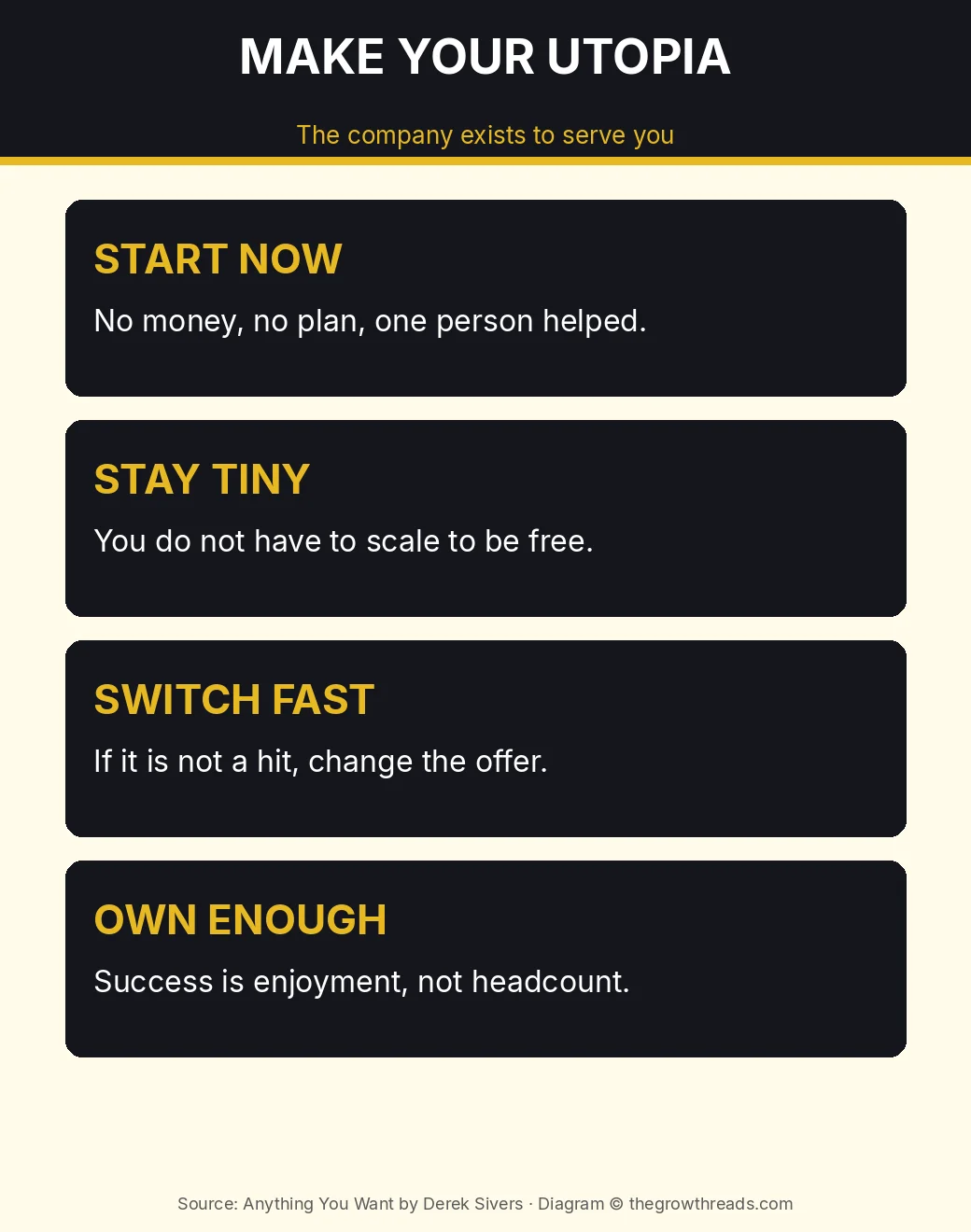
- Your company is your utopia: Build a place you would want to work, then keep it that way.
- No more polite yes: If it is not Hell Yeah, it is no — or it steals the real work.
- If it is not a hit, switch: Protecting a dead offer is pride, not persistence.
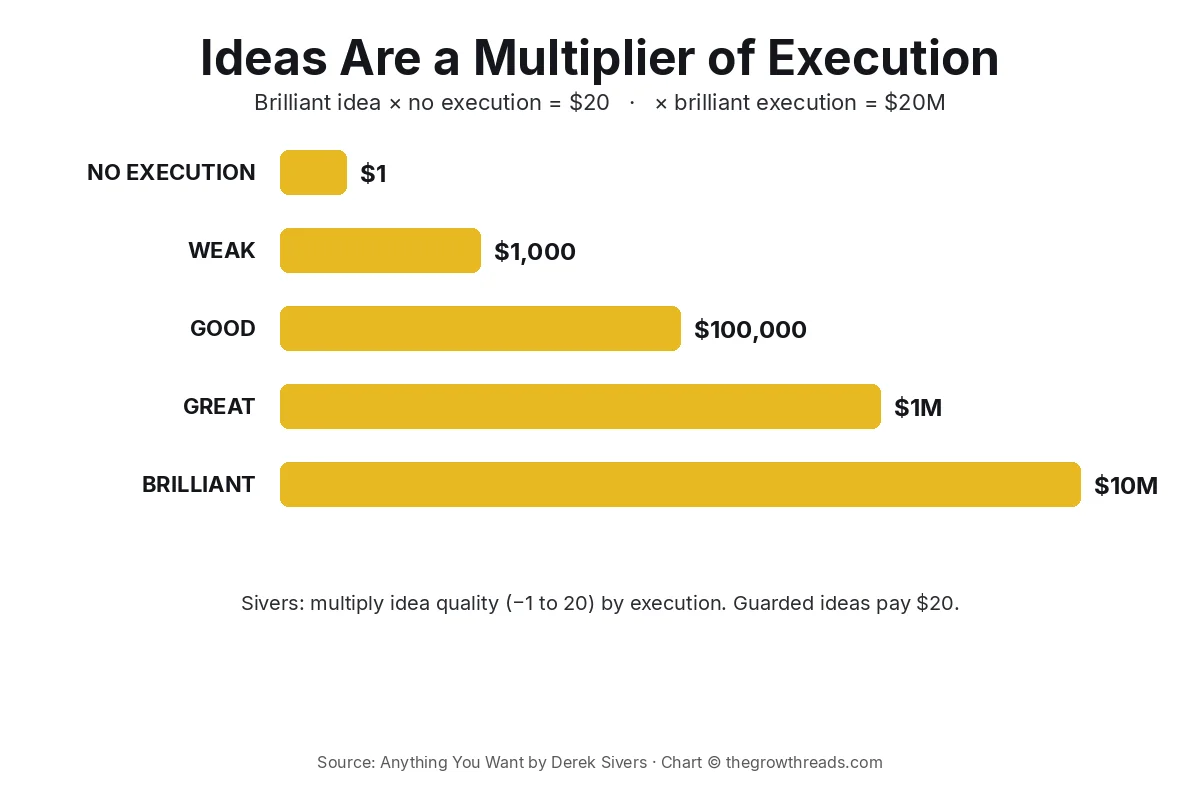
- Ideas multiply execution: A brilliant idea with no execution is worth about twenty dollars.
- Tiny can be the win: You do not have to scale to be free, paid, and proud of the week.
- Success is enjoyment: Headcount and exit stories are optional. A life you like is not.
What is Anything You Want about?
Anything You Want is Derek Sivers’ forty short lessons from founding and selling CD Baby. A business is how you help people and design a life, not a machine that must get huge. Start with what you have, wow the customer, decide with Hell Yeah or no, and treat ideas as a multiplier of execution.
About the author
Derek Sivers is a musician, programmer, and writer who founded CD Baby in 1998 after friends asked him to sell their CDs the way he was selling his own. The store became the largest independent-music seller on the web, with more than $100 million in sales for about 150,000 musicians. In 2008 he sold the company and directed the proceeds toward a charitable trust for music education. He later wrote Hell Yeah or No, spoke at TED, and kept publishing short, usable essays at sive.rs. The voice in this book is first-person, numbered, and built for a notebook: help someone, keep the company human, and do not confuse size with success. That stance is why the 2015 Portfolio edition still earns a working week, even after a decade of louder startup books. Explore all Derek Sivers book summaries →
Key concepts at a glance
| Concept | What it means | Use it when |
|---|---|---|
| Help first | The business starts when one person is served, not when the logo is done. | You have a deck and no customer. |
| No money as advantage | Broke forces a useful offer instead of a fundraise. | You are waiting for a round to start. |
| Utopia company | Build a workplace you would want, then refuse to wreck it for scale. | Growth would make you hate Mondays. |
| Customer over self | Wow them even at a short-term loss. Word of mouth is the return. | Policy is cheaper than a human reply. |
| Hell Yeah or no | A polite yes steals the week from the thing you mean. | Your calendar is full of maybes. |
| Not a hit, switch | Change the offer instead of protecting a dead product. | You keep explaining why people “don’t get it.” |
| Idea × execution | Ideas multiply the dollars of execution. No execution pays about $20. | You are guarding a slide with an NDA. |
| Tiny is allowed | Enough customers, enough pay, enough joy. Headcount is optional. | You feel behind because you are not a unicorn. |
Part 1: Start by helping someone
Sivers’ origin story is almost rude in how little strategy it contains. He needed a merchant account to sell his own CD. Friends asked if he could sell theirs. He said yes. Strangers emailed. CD Baby was not a vision of disrupting music retail. It was a musician doing a favor until the favor became a queue. The lesson he wants you to steal is not “become a distributor.” It is: start with the person already asking, using the tools you already have. If you cannot name that person, you do not have a start date. You have a hobby with a slogan.
He is blunt about money. Starting with none is an advantage because it kills the fake work of looking funded. You cannot hide in a brand workshop when someone is waiting for a CD to ship. You also cannot hide in a business plan. Sivers treats the plan as a guess you will throw away the week real orders arrive. Launch is how you learn the offer. Research that never meets a checkout is still a wish. The first version can be ugly if it completes the job the friend asked for.
A useful check: write the one-sentence favor you can finish this week. “I will list your album and pay you when it sells” was CD Baby. Yours might be “I will edit your homepage by Friday” or “I will ship the first ten jars to the people who already asked.” If the sentence needs a co-founder, a raise, or a trademark, it is still a slide. Cut until one person is helped without a committee.
TGR Note. If the first offer is still theoretical, The $100 Startup is the companion that wants a skill you already have and a customer you can name. Rework makes the same “start now, stay small” argument from a product studio. Use Sivers when you need permission to help one person; use those two when the person is named and the calendar is still a junk drawer of branding tasks.
Part 2: Build a company that serves the customer — and you
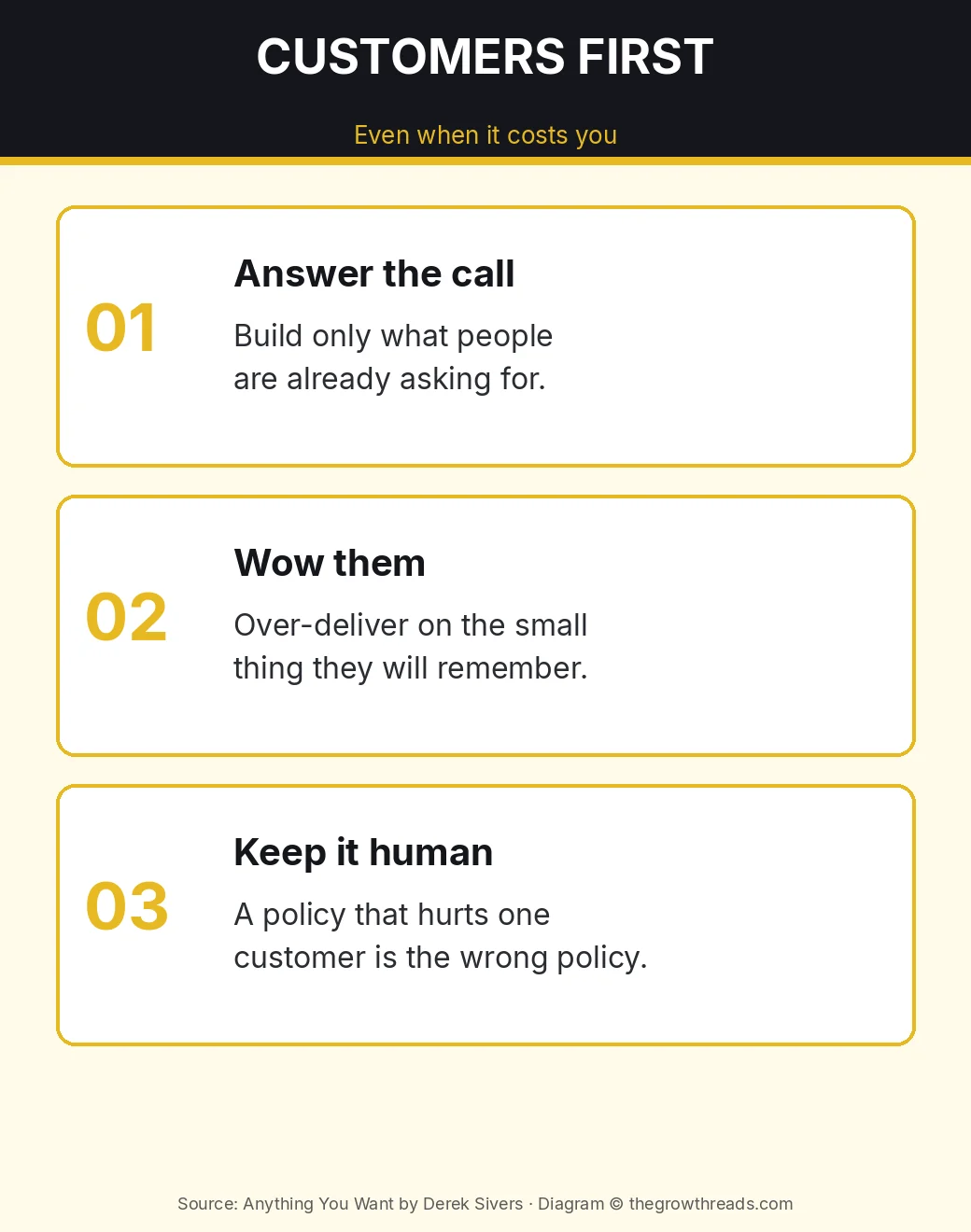
Once orders exist, Sivers’ operating rule is almost too simple to respect: care about the customer more than you care about looking efficient. CD Baby became famous for packing slips that talked like a human, for saying yes to odd requests, and for refunding with warmth instead of a policy wall. He will spend money to wow someone because the story they tell is cheaper than ads and truer than a slogan. A policy that saves ten minutes and hurts one musician is, in this book, the wrong policy. The company exists to make people happy, including you.
That last clause is the utopia chapter. You are not required to build a place you would hate in order to look serious. If you want a quiet office, few meetings, and musicians paid fast, build that. If growth would force the opposite, decline the growth. Sivers is not anti-ambition. He is anti-accidental misery. The moment the company needs you to become someone you do not respect, you have the wrong success metric. Tiny, proud, and profitable is a complete score, not a participation trophy.
Keep the wow cheap and specific. A faster reply. A handwritten line. A replacement sent before they finish apologizing. You do not need a loyalty program. You need one extra that a customer would repeat at dinner. If your week is all dashboards and no delighted human, you have already drifted from the book. Put one wow on the calendar the way other books put a frog.
TGR Note. Seth Godin published the first edition of this book. The customer-wow chapter sits next to Purple Cow (be remarkable enough to talk about) and The Practice (ship the work instead of waiting to feel ready). Sivers is less about being seen and more about being useful to the person already in your inbox.
Part 3: Decide with Hell Yeah — and switch if it is not a hit
The line most people quote from Sivers showed up here first as an operator’s rule, not a lifestyle brand: no more yes. Either it is Hell Yeah, or it is no. A polite yes feels kind and quietly empties the week. Every maybe uses the same hours the Hell Yeah needed. He wants you to decline work that is fine so you can finish work that is alive. If your mouth says yes while your stomach says later, that is already a no. Practice saying it without a three-paragraph apology.
The sibling rule is just as sharp: if it is not a hit, switch. Pride wants you to explain the market. Sivers wants you to change the offer. CD Baby’s early versions were whatever musicians needed that week. When something sat there unloved, he did not hold a branding offsite. He tried the next useful thing. Persistence, in this book, is persistence at helping, not persistence at a dead SKU. The hit is evidence. Your speech is not.
Use both rules on the same page. Hell Yeah chooses the project. “Not a hit, switch” edits the offer inside that project. Together they stop two failures: a calendar of favors, and a museum of unsold ideas. Write the current offer in one sentence. If you cannot Hell Yeah it, cut it. If customers cannot either, change it before you spend another month polishing the about page.
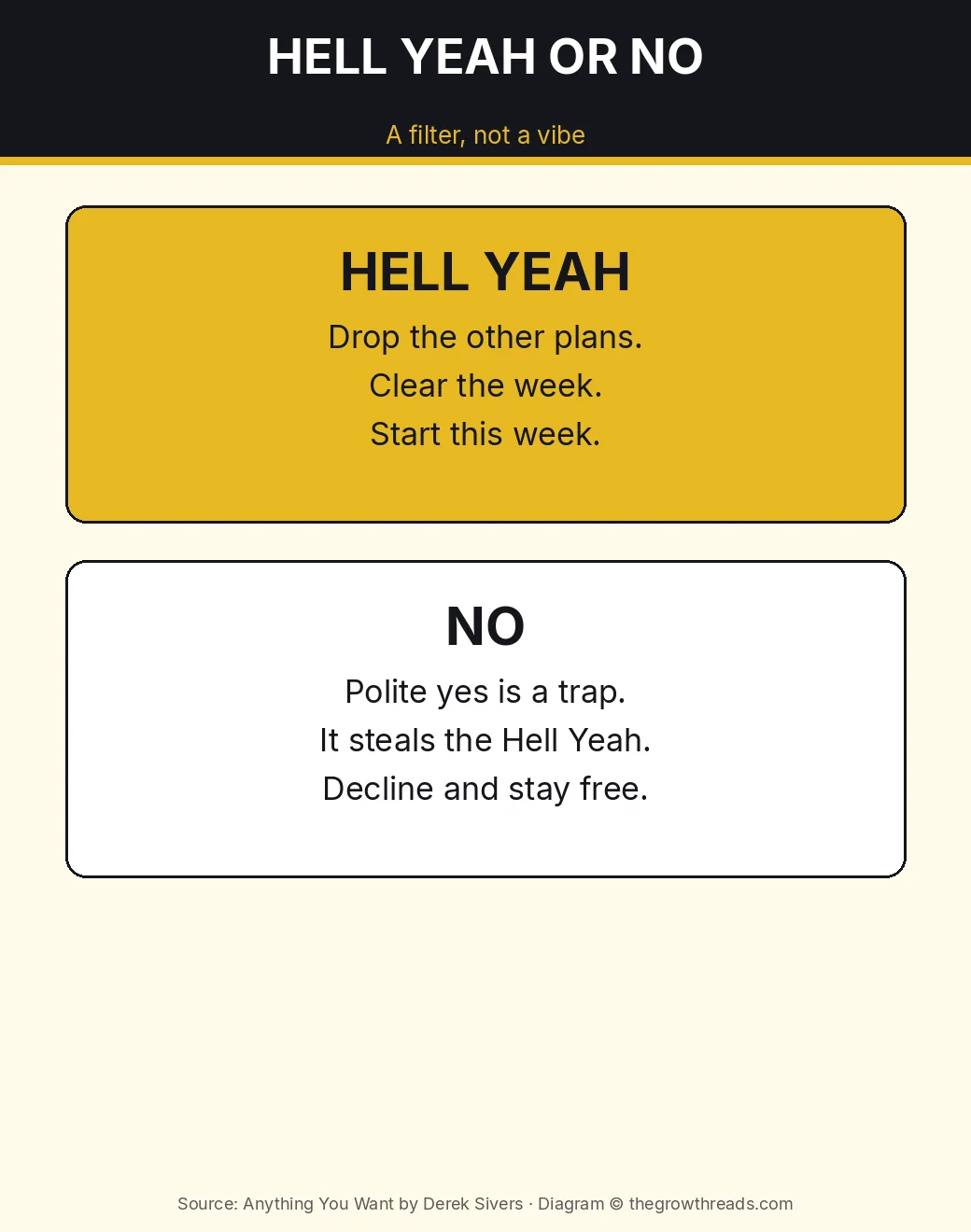
TGR Note. The later essay book Hell Yeah or No expands this filter into a life manual. Keep this chapter for the business version: say no so the customer you already have gets a wow, not a delayed ticket. If your problem is a crowded calendar more than a missing offer, start there, then return for execution.
Part 4: Execution, exit, and enough
Sivers’ most stolen diagram is the multiplier. Score the idea from awful to brilliant. Score execution from none to brilliant. Multiply. A brilliant idea with no execution is worth about twenty dollars — enough for the Cokes, not a company. The same idea with great execution is the life-changing number. That is why he will not sign your NDA to hear a sentence. He wants to see the clumsy public version. Guarding the idea is how people avoid the work that would make it worth anything.
The ending of CD Baby is the other half of enough. He sold the company, funded a charitable trust, and left. The story is easy to misread as “raise and exit.” His point is closer to: know what the company is for, and stop when it has done that job. You can stay tiny. You can sell. You can give the money away. You cannot pretend that headcount is the only adult ending. Success, in the last lessons, is whether you like the days. If the exit would buy a life you already have by staying small, staying small is the win.
That is the whole machine: help someone, wow them, Hell Yeah or no, switch what is not a hit, execute in public, and do not grow a cage. The 2015 stories show their age; the tests do not. If you leave this summary with one person helped and one idea shipped instead of guarded, you have read the book correctly.
Who is Anything You Want best for — and who should read something else first?
Best for musicians, freelancers, and one-person shops who can describe a clever idea and still have not helped anyone this month. It is also a good first Sivers if you liked the TED talks and need the CD Baby origin in one sitting.
Read something else first if the company already has customers and is eating your week — go to Clockwork or The E-Myth Revisited. If you need a priced offer more than a philosophy, start with The $100 Startup. If you want product systems over memoir, Rework or The Lean Startup will feel tighter. If the only problem is a crowded yes-list, Hell Yeah or No is the later, sharper filter.
Questions to reflect on
- Who, by name, can I help by Friday without a logo or a co-founder?
- Which current “yes” is polite, and what Hell Yeah is it stealing hours from?
- If this company stayed this size for ten years, would I still want the Tuesday?
- What idea am I guarding that has never met a real checkout?
- What is the smallest public execution I could ship this week that would make the idea worth more than $20?
🔥 Ready to help one person before you name the company?
Use Sivers’ tests: start now, wow the customer, Hell Yeah or no, execute in public.
How to apply Anything You Want (7-day plan)
- Day 1 — Help one person. Name them. Finish the favor without a brand. Write the one-sentence offer they actually used.
- Day 2 — Make the first version public. A page, a checkout, an email they can answer. No NDA. Ugly is allowed.
- Day 3 — Wow one customer. Faster reply, extra care, or a refund with warmth. Note what they repeat back.
- Day 4 — Draw the utopia. Three rules for a company you would want to run at this size. Strike any rule that only exists to look big.
- Day 5 — Hell Yeah or no. List this week’s yeses. Cut every polite one. Protect the one project that is alive.
- Day 6 — Switch what is not a hit. If nobody used the offer, change the sentence. Do not explain the market to an empty inbox.
- Day 7 — Execute, then stop decorating. Ship one improvement in public. Review the multiplier: did you do the work, or guard the idea?
Frequently asked questions
What is Anything You Want about in one paragraph?
Anything You Want is Derek Sivers’ hour-long field report from CD Baby: forty short lessons on starting by helping someone, treating customers as the point, and refusing to grow a company you would hate to run. He started by selling his own CD, said yes to friends, and accidentally built the largest independent-music store on the web. This Anything You Want summary keeps the 2015 Portfolio edition practical — start now, wow one customer, treat ideas as a multiplier of execution — not a scale-at-all-costs pep talk.
Is Anything You Want still worth reading in 2026?
Yes, if you are stalling on a tiny useful business because the plan is not impressive yet. Later books added funnels and headcount. Sivers’ leftover is still the cheapest test: are you helping a real person this week, and would you enjoy the company if it stayed this size? Read it when you are hiding behind a deck. Skip the urge to copy CD Baby. The 7-day plan below is the 2026 use case: one person helped, one policy that thrills them, one Hell Yeah or a clean no.
How is Anything You Want different from Hell Yeah or No?
Hell Yeah or No is the later essay book that expands the decision filter. Anything You Want is the CD Baby origin story that filter came from — start by helping, wow the customer, stay tiny if tiny is freedom, switch if it is not a hit. If you already live the filter and need origin stories, start here. If you only need a yes/no rule for a crowded calendar, read Hell Yeah or No first, then come back for the customer and execution chapters.
What does Sivers mean by ideas are a multiplier of execution?
He scores idea quality from awful to brilliant and execution from none to brilliant, then multiplies. A brilliant idea with no execution is worth about twenty dollars. The same idea with brilliant execution can be worth tens of millions. That is why he does not want your NDA. He wants to see the thing actually in the world. Use the table when you are protecting a slide instead of shipping a clumsy first version to one customer who already asked.
How long does it take to apply Anything You Want?
The book is about an hour on the page. The useful unit is a week of contact with a real person, not a quarter of branding. Hour one is the one-person offer. Hour two is the wow — a reply, a refund, a handmade extra — that would make them tell a friend. The rest of the week is one Hell Yeah, a list of polite yeses to cut, and one public execution step. Day 1 in this guide is helping one person before you name the company.
Who should read something else first?
If you already have customers and the company is running you, start with Clockwork or The E-Myth Revisited and come back for the utopia chapter later. If you need a tiny offer more than a philosophy, The $100 Startup is closer. If you want systems over stories, Rework or The Lean Startup will feel tighter. Anything You Want is for the person who is still waiting for permission, funding, or a perfect idea before they help anyone this month at all.
How do I start Anything You Want this week?
Pick one person you can help by Friday without a logo. Do the help in full. Write the one-sentence offer they actually used. Wow them once — a faster reply, a better file, a refund with a smile. Then apply Hell Yeah or No to every new request that appears. Publish a clumsy version instead of guarding the idea. The 7-day plan in this Anything You Want summary names each day so you do not invent a new company midweek.
Related summaries
- Rework — start now, stay small
- The $100 Startup — begin with a skill you have
- Purple Cow — be remarkable enough to talk about
- The Practice — ship instead of waiting to feel ready
- Best productivity books — the full TGR pillar
How we analyze books: we reconstruct the argument, add original application notes, and skip chapter-by-chapter reproduction. Read our full methodology.