

★★★★☆ 4.4/5 — a year-long field test you can copy if you are “fine” and still want a brighter ordinary life.
Best for: High-achievers who like experiments more than slogans, and anyone whose calendar is full while the years still vanish
Reading time: ~8 hours (315 pages) · this guide ~12 min
Difficulty to apply: Easy to start — the work is keeping a few resolutions when the month is no longer new
The Happiness Project in one minute
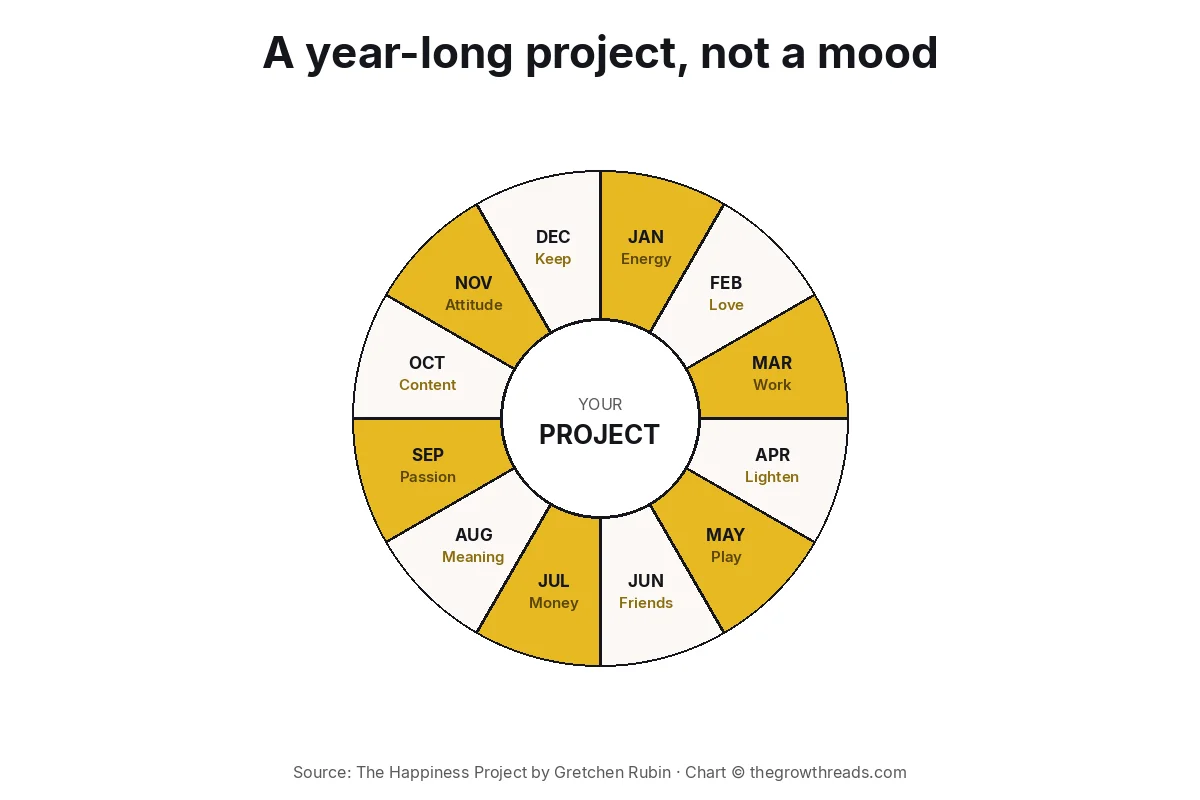
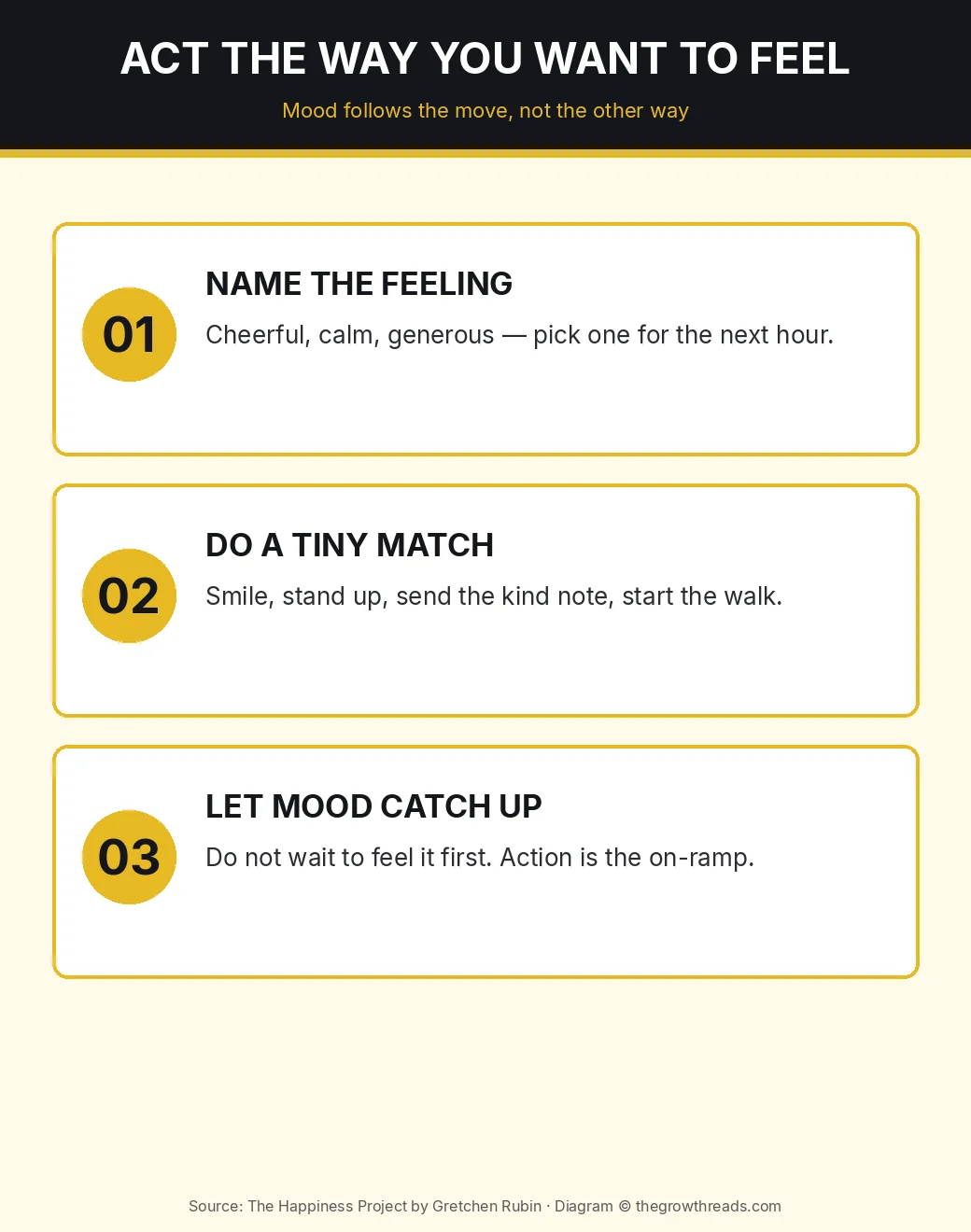
Happiness is not a personality that arrives. It is a project you run on purpose. Gretchen Rubin, then a former Supreme Court clerk living a “good enough” New York life, caught herself on a city bus with a sentence that will not leave: the days feel long and the years still disappear. She gave herself twelve months. Each month got a theme — energy, love, work, play, friends, money, meaning, passion, contentment, attitude — and a short list of resolutions she could actually keep. Underneath the calendar sat twelve commandments she refused to drop, starting with Be Gretchen. The book is her lab notebook, not a TED talk. You do not wait to feel cheerful before you sing, walk, call, or clear the closet. You act the way you want to feel, then let the mood catch up.
Key takeaways
- Treat it as a project: a year, twelve themes, written resolutions. Mood is a lagging indicator.
- Be Gretchen first: copy the method, not someone else’s 5 a.m. club or desert retreat.
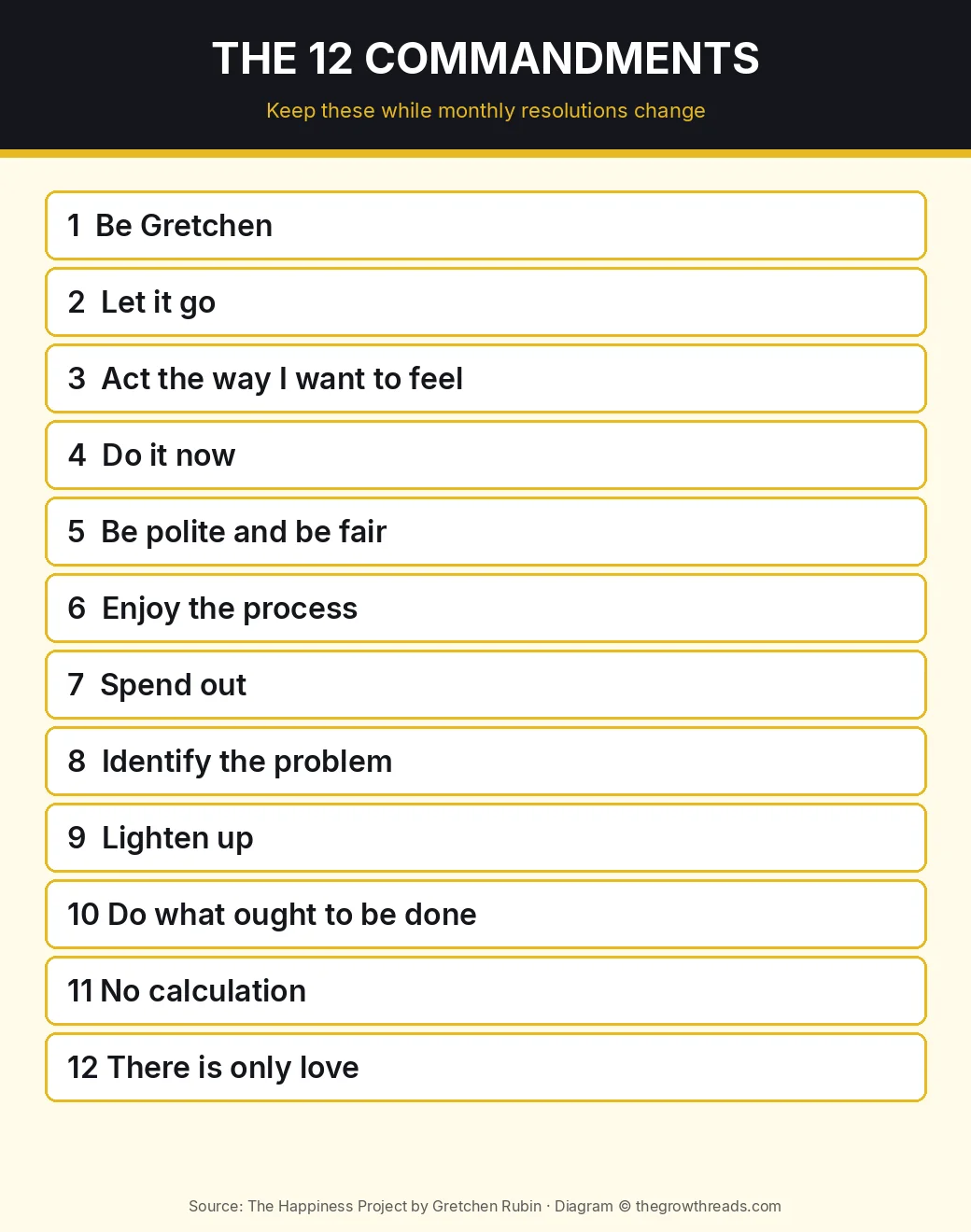
- Commandments outlast months: “Let it go,” “Do it now,” and “Act the way I want to feel” stay up all year.
- Boost energy before you chase purpose: sleep, move, and a clearer room change the weather you think in.
- Relationships are not a side quest: quit nagging, fight cleaner, show up, and stop treating family as logistics.
- Aim higher at work without a new identity: ask for help, enjoy the craft, and find a purpose inside the job you have.
- Play is serious: fun, collections, and going off-path are happiness skills, not rewards you earn later.
- Money can buy happiness when spent well: tools, experiences, and other people — not status props.
- Keep a one-sentence journal: what you monitor, you can actually change. December is for keeping, not reinventing.
What is The Happiness Project about?
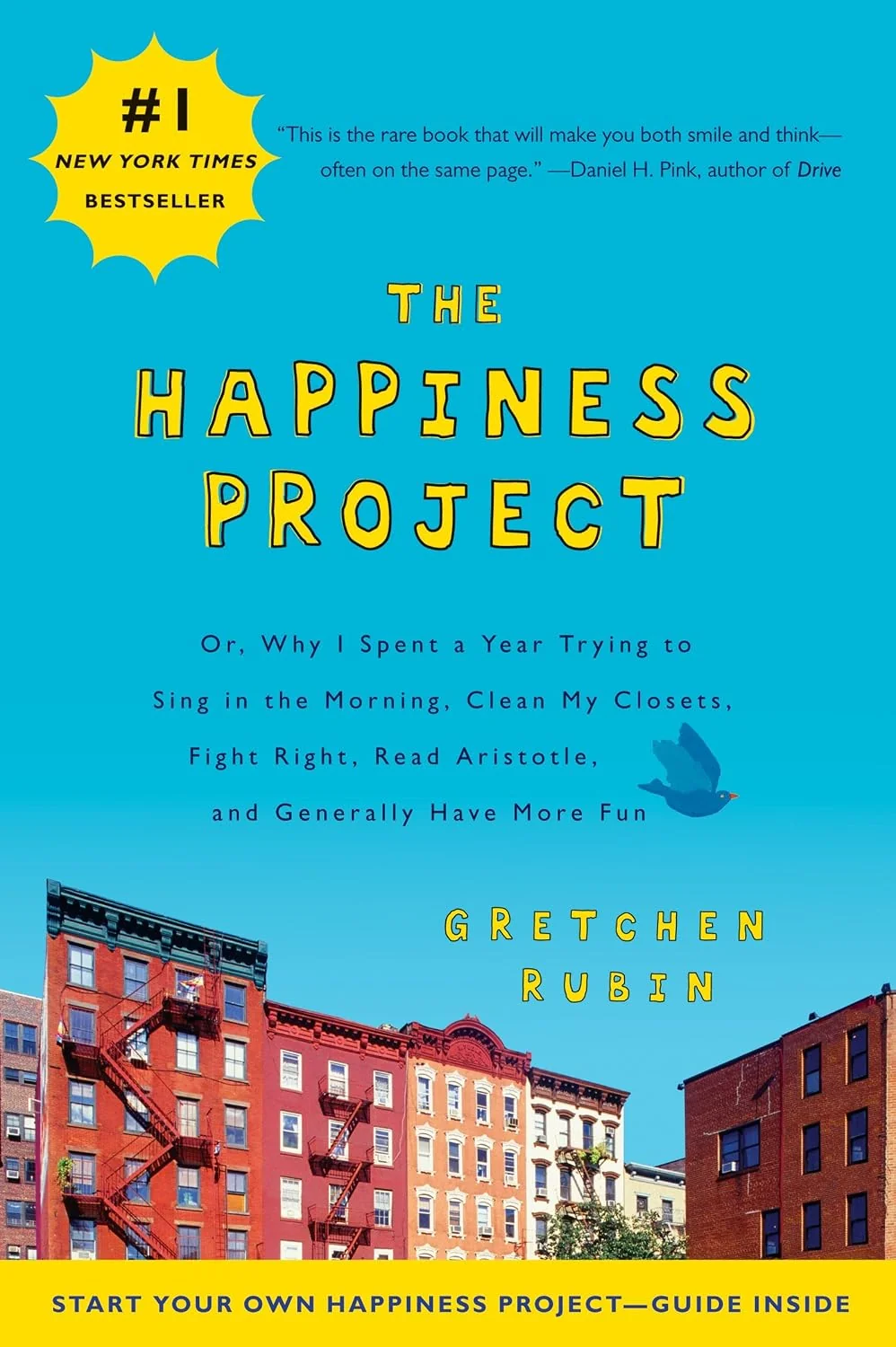
The Happiness Project is Gretchen Rubin’s 2009 year-long experiment: one monthly theme, a handful of resolutions, and twelve commandments she kept all year. She treats happiness as a design problem you can test at home, not a personality you wait to arrive.
About the author
Gretchen Rubin trained as a lawyer — Yale College, Yale Law, a clerkship with Supreme Court Justice Sandra Day O’Connor — then noticed, mid-clerkship, that the work she wanted was writing, not arguing cases. A rainy ride on a New York City bus supplied the sentence that starts this book: the days feel long and the years still vanish. She spent a year running a documented experiment on her own life, reading the research, keeping score, and publishing the result in 2009. The Happiness Project sat on the New York Times list for more than two years. She later wrote Better Than Before and The Four Tendencies, and co-hosts the Happier podcast. The through-line is self-knowledge first: you cannot copy someone else’s happiness any more than you can copy their metabolism. Explore all Gretchen Rubin book summaries →
Key concepts at a glance
| Concept | What it means | Use it when |
|---|---|---|
| Happiness as a project | A year, themes, written resolutions, a scoreboard | You keep waiting to “feel ready” |
| Be Gretchen | Build the life that fits you, not a borrowed aesthetic | You are cloning someone else’s morning |
| Twelve Commandments | Year-round rules under the monthly experiments | A new month makes you drop last month’s gains |
| Act the way you want to feel | Behavior first; mood follows | You postpone kindness or energy until you “mean it” |
| First Splendid Truth | Feel good, cut feel-bad, feel right, plus growth | You chase one treat and call it a life |
| Boost energy | Sleep, move, clear space, act more energetic | Purpose talks are not landing |
| One-sentence journal | One line a day so the year does not blur | You cannot remember what actually helped |
| Spend out | Use the good stuff; don’t hoard “for later” | The nice soap and the good tea wait in a drawer |
Part 1: Start a project, not a mood
Rubin does not open with a manifesto. She opens with a bus. She had the résumé, the marriage, the daughters, the apartment — and a low-grade sense that time was leaking. “The days are long, but the years are short.” That is the whole brief. If the years are short, waiting for a better personality is an expensive strategy. She did what a clerk would do: she read, she listed, she designed a trial.
The architecture is the useful part. Resolutions are monthly and specific — go to bed earlier, walk more, stop nagging, start a collection. Commandments sit underneath and do not rotate off the wall in February. Be Gretchen is the load-bearing one. She likes children’s literature, a made bed, and a clear closet more than she likes nightlife, and pretending otherwise made her less herself. Let it go stops the mental replay. Do it now kills the errand that poisons an afternoon. Act the way I want to feel is the engine: you do not wait for cheer to start the walk.
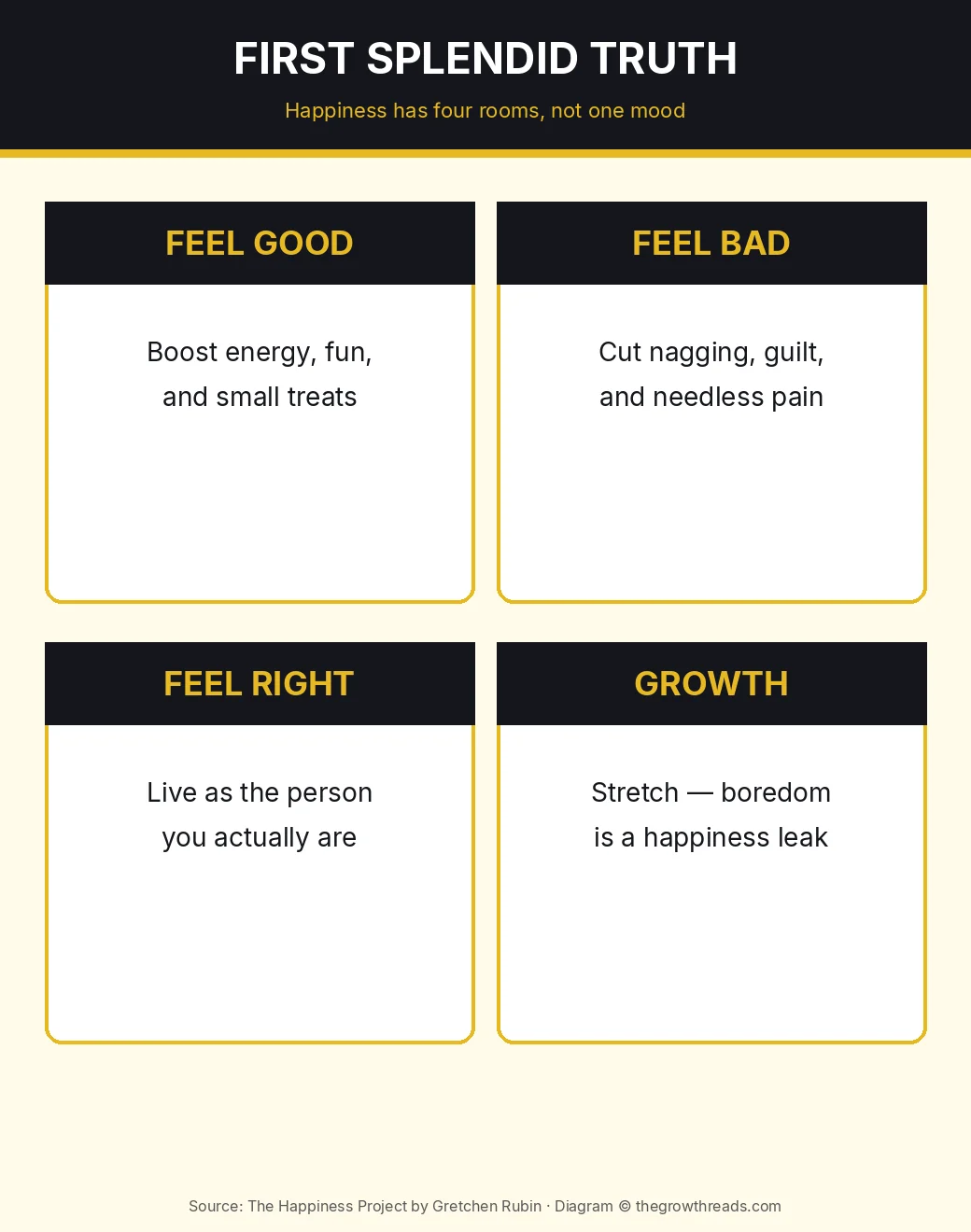
She also names four rooms happiness has to pass through — feeling good, cutting needless bad feeling, feeling right as the person you are, and enough growth that boredom does not pass for peace. The project is not “more pleasant.” It is a better-fitted life you can test in thirty-day blocks.
TGR Note: Years later Rubin mapped why other people’s systems bounce off you. If your resolutions die because you only keep rules you write yourself, or because you need outer accountability, start with our Four Tendencies summary. For the habit-mechanics sequel, use Better Than Before. Come back here for the year-shaped experiment, not for a personality quiz.
Part 2: Energy, love, and the people in the room
January is unromantic on purpose. Boost energy. Sleep earlier. Exercise in a way you will actually repeat. Clear the piles. Act more energetic even before the body has voted. Rubin’s claim is practical: a depleted person cannot use a philosophy. If you are arguing about “finding your purpose” on five hours of sleep, you are holding the wrong meeting. The outer order of a closet is not a personality transplant. It is fewer open loops stealing attention you could spend on a daughter or a page of work.
February turns the camera on the marriage. Remember love is not a weekend away. It is quitting the nag, dropping the hope that someone will praise you for the invisible work, fighting without contempt, and refusing the snap that turns a kitchen into a courtroom. April’s parenthood chapter — lighten up — is the same muscle with smaller witnesses: sing in the morning, acknowledge a child’s feeling without a lecture, model the mood you keep demanding. June’s friendship month is showing up, remembering the birthday, and cutting the gossip that feels like closeness and is actually cheap.
None of this is abstract. You either send the text or you don’t. The through-line is act the way you want to feel in the rooms that already have your name on them. You do not need a new social circle. You need the one you have, treated as if it mattered this Tuesday.
TGR Note: If the missing piece is not a theme but a loop you can repeat at 6 a.m., our Atomic Habits summary is the companion. Rubin gives you a year-shaped experiment. Clear gives you cue, craving, response, reward. For even smaller starts, Tiny Habits is the two-minute on-ramp. Do not collect all three as a way to delay the first early night of sleep.
Part 3: Work, play, money, and a passion
March — aim higher — is the chapter ambitious readers skip at their peril. Rubin does not quit law in this book; she had already left. The work lesson is still for people who kept the job. Ask for help instead of performing competence. Enjoy the craft inside the task. Look for purpose in the assignment you already have, not in a fantasy title. “Aim higher” is not “blow up your life.” It is refusing to phone in the hours you will spend anyway.
May insists that play is not a prize for finishing. Be serious about fun. Start a collection. Take the odd path home. Adults treat leisure as leftover minutes. Rubin treats it as a skill that atrophies. If your only hobby is recovering from work, the year will feel like a corridor. September’s passion month is her writing the novel and, more usefully, dropping the fantasy of being fully caught up. The inbox will not empty. The passion has to sit next to the mess.
July — buy some happiness — is the chapter people quote badly. Money is a tool: buy what you will use, spend on other people, and skip the lobby props. “Spend out” belongs here too: use the nice soap. The future you is not a more deserving person. The future you is just later.
TGR Note: If you want the research sibling — happiness as fuel for performance, not only as a private experiment — our Happiness Advantage summary lives in the psychology silo. Shawn Achor starts at the brain’s positivity ratio. Rubin starts at the closet and the calendar. Use Achor when the team is gray. Use Rubin when your own Tuesday is gray and you need a month with a name.
Part 4: Inner weather, then keep the year
August turns toward meaning without a conversion. In her practice that looks like reading people who have suffered, keeping a one-sentence journal so the days do not smear, and copying a spiritual master in small behavior rather than in costume. You need a scale larger than the inbox now and then, or the project collapses into self-improvement as a hobby.
October’s contented heart and November’s “become more personable” sound soft until you try them at a meeting. Laugh more. Use good manners when you could get away with none. Examine your conscience without turning it into a self-hate sport. Smile on purpose. Make the extra effort for the person who cannot promote you. This is the First Splendid Truth in street clothes: cut needless bad feeling, add good feeling, feel right (stop performing a colder self), and keep growing so you do not curdle.
December is boot camp: keep the resolutions that worked. The point is not a new personality on January 1. It is a shorter list you will still do when nobody is watching. Rubin’s year ends the way good experiments end — with data, not a rebrand. You will not finish twelve themes. You will know which two changed the weather.
Who is The Happiness Project best for — and who should read something else first?
Best for people whose life works on paper and still feels slightly gray. If you like lists, experiments, and a memoir that is also a kit, this is the book. Parents, knowledge workers, and anyone who has ever said “I’ll be happier when…” will recognize the trap. The method transfers even if you do not live in a Manhattan walk-up: pick a theme, write three resolutions, keep commandments, journal one line.
Read something else first if you cannot start a two-minute habit — use Atomic Habits or Tiny Habits. If every system dies because of how you respond to expectations, read The Four Tendencies before you design a year. If you want lab-backed workplace positivity rather than a personal field test, start with The Happiness Advantage. If you wanted a critique of the happiness industry, this is the wrong shelf — Rubin is building a project, not a takedown.
Questions to reflect on
- Where am I waiting to feel a mood before I take a two-minute action that would create it?
- Which “Be Gretchen” facts am I still pretending are not true (bedtime, noise, social battery, taste)?
- What is one piece of nagging, snapping, or score-keeping I could drop this week?
- If this month had a single theme, what would it be — energy, people, work, play, or money?
- What would a one-sentence journal say about yesterday that my memory is already smoothing over?
🔥 Ready to run a year as a project, not a mood?
Get The Happiness Project, then use the 7-day plan to pick one theme and three resolutions.
How to apply The Happiness Project (7-day plan)
- Day 1 — Write three commandments. Steal Rubin’s if they fit (Be Gretchen, Let it go, Do it now) or rewrite them in your words. Put them where you will see them.
- Day 2 — Name this month’s theme. One word: Energy, People, Work, Play, or Money. Not five. One.
- Day 3 — Write three resolutions under that theme. Must fit in a Tuesday. “Walk 20 minutes,” not “become an athlete.”
- Day 4 — Act the way you want to feel once. Pick cheerful, calm, or generous. Do one matching move before noon. Do not wait to mean it.
- Day 5 — One relationship play. Drop a nag, send a birthday note, fight without the extra sentence, or show up when you could flake.
- Day 6 — Start the one-sentence journal. One line: what you did, not how you rated your soul. Use the same notebook tomorrow.
- Day 7 — Review and keep. Which resolution actually moved the day? Keep that one. Drop the other two without a speech. December logic, in one week.
Frequently asked questions
What is The Happiness Project about in one paragraph?
The Happiness Project is Gretchen Rubin’s 2009 memoir of a year she spent testing happiness research on her own New York life. Each month got a theme — energy, love, work, play, friends, money, meaning — plus a few resolutions she could actually keep. Underneath sat twelve commandments, starting with Be Gretchen. The load-bearing idea is simple: happiness is a project you run, not a mood you wait for. This summary turns that year into a method, a concepts table, and a seven-day plan you can start without moving to Manhattan or quitting your job.
Who should read The Happiness Project?
Read it if your life works on paper and still feels slightly gray, and if you like experiments more than slogans. Parents, knowledge workers, and anyone who has said “I’ll be happier when…” will recognize the trap. Skip it as a first habit book if you cannot start a two-minute loop — Atomic Habits or Tiny Habits will help you move. Skip it if you wanted a critique of the happiness industry; Rubin is building a kit. If every system dies because of how you handle expectations, read The Four Tendencies first, then come back to design the year.
How long does it take to read The Happiness Project?
The Harper paperback is a comfortable week of forty-minute evenings for most busy readers, or about eight hours in a couple of sittings. It is a memoir with lists, not a dense textbook and not a parable you finish on a commute. This TGR guide is a twelve-minute reconstruction of the method, not a replacement for her stories. If you only have one evening, read the one-minute section, the key concepts table, and run Day 1 of the plan. Come back for the parts when you actually pick a monthly theme, rather than rereading the introduction for a feeling.
How is this different from The Four Tendencies or Better Than Before?
The Happiness Project is the year-shaped experiment: themes, resolutions, commandments, a journal. Better Than Before is the sequel on how habits actually form once you know you want them. The Four Tendencies is the personality map — Upholder, Questioner, Obliger, Rebel — that explains why a resolution that works for a friend bounces off you. Read this book to start a project. Read Better Than Before when the project keeps slipping. Read The Four Tendencies when you keep blaming willpower for what is really a mismatch with expectations. They stack; they are not the same kit.
Does The Happiness Project say money can buy happiness?
Rubin says money can help when you spend it on the right things: tools you will use, experiences, and other people. Status props and unused “someday” treasures do not. July’s chapter is “buy some happiness,” paired with the commandment spend out — use the good soap, stop hoarding for a more deserving future self. That is not a shopping spree and not an austerity lecture. If money is chaos in your life, pair this with a money-silo book rather than using Rubin as a budget. If money is fine and still not making Tuesday nicer, her spending rules are the useful layer.
Can I run a happiness project if I do not have kids or a Manhattan apartment?
Yes. The memoir is set in her New York family life; the method is not. You still pick a monthly theme, write three resolutions that fit a Tuesday, keep a few commandments all year, and log one sentence a night. Energy, work, play, friends, money, and meaning show up in a studio, a night shift, and a house with no children. Skip the chapters that are not your rooms and keep the architecture. Do not wait until your life looks like hers. The point of Be Gretchen is the opposite: build the project that fits the person you already are.
What is the one idea to steal from The Happiness Project this week?
Steal the month. Give the next thirty days a single theme — energy, people, work, play, or money — and write three resolutions small enough to do on a tired Tuesday. Add one commandment you will not rotate off the wall, preferably Act the way I want to feel or Be Gretchen. Keep a one-sentence journal so you can see what actually moved. Do not announce a year. Rubin’s whole argument is that the years are short and a project beats a mood. Start the project while the month is still in front of you.
Related summaries
- The Four Tendencies by Gretchen Rubin
- Better Than Before by Gretchen Rubin
- Atomic Habits by James Clear
- Tiny Habits by BJ Fogg
- Best productivity books
How we analyze books: every book on The Growth Reads is read cover to cover, summarized in thousands of words of original analysis, and rated against our five-criteria rubric (lasting impact, evidence quality, practical application, writing & originality, external consensus). Read our full methodology.