

⭐⭐⭐⭐ 4.3 / 5 — The proof that small, consistent actions compound into extraordinary results — and the blueprint for harnessing that force in your favor.
Best for: Anyone who wants massive results but struggles with consistency, or who underestimates the power of tiny daily choices.
Reading time: ~4 hours (this guide: 14 min)
Difficulty to apply: Low to medium — the concepts are simple, but maintaining consistency through the invisible early period requires discipline.
The Compound Effect in one minute
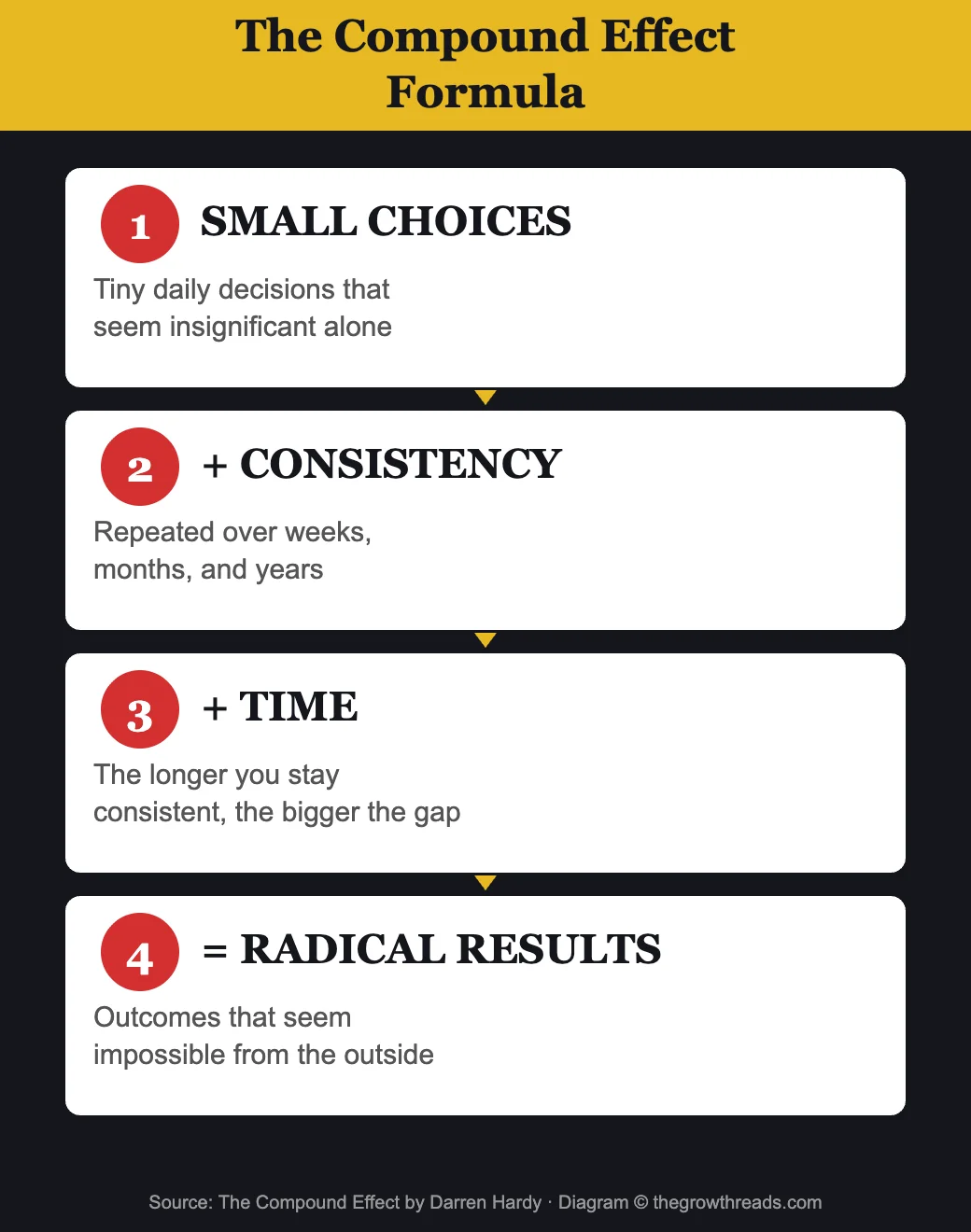
Small, smart choices + consistency + time = radical difference. Darren Hardy, former publisher of SUCCESS magazine, argues that the most powerful force in personal development isn’t talent, luck, or dramatic action — it’s the compound effect of small daily decisions accumulated over time. Just as compound interest turns modest savings into millions, compound daily habits turn modest improvements into extraordinary outcomes. The catch: the results are invisible at first, which is why most people quit before the magic happens. Hardy provides a complete system for harnessing this force: track your choices, build momentum-creating habits, guard your influences, and exceed the expected effort threshold. The book’s central metaphor — three friends who make tiny different choices and end up in wildly different places after 31 months — illustrates that your daily decisions, not your intentions, determine your destiny.
Key takeaways
- Small choices compound into massive outcomes: The difference between success and mediocrity isn’t dramatic decisions — it’s the hundreds of tiny daily choices that seem insignificant in the moment but compound over months and years.
- Track everything: What you measure improves. Hardy recommends tracking spending, calories, time use, or any habit you want to change — because awareness alone changes behavior.
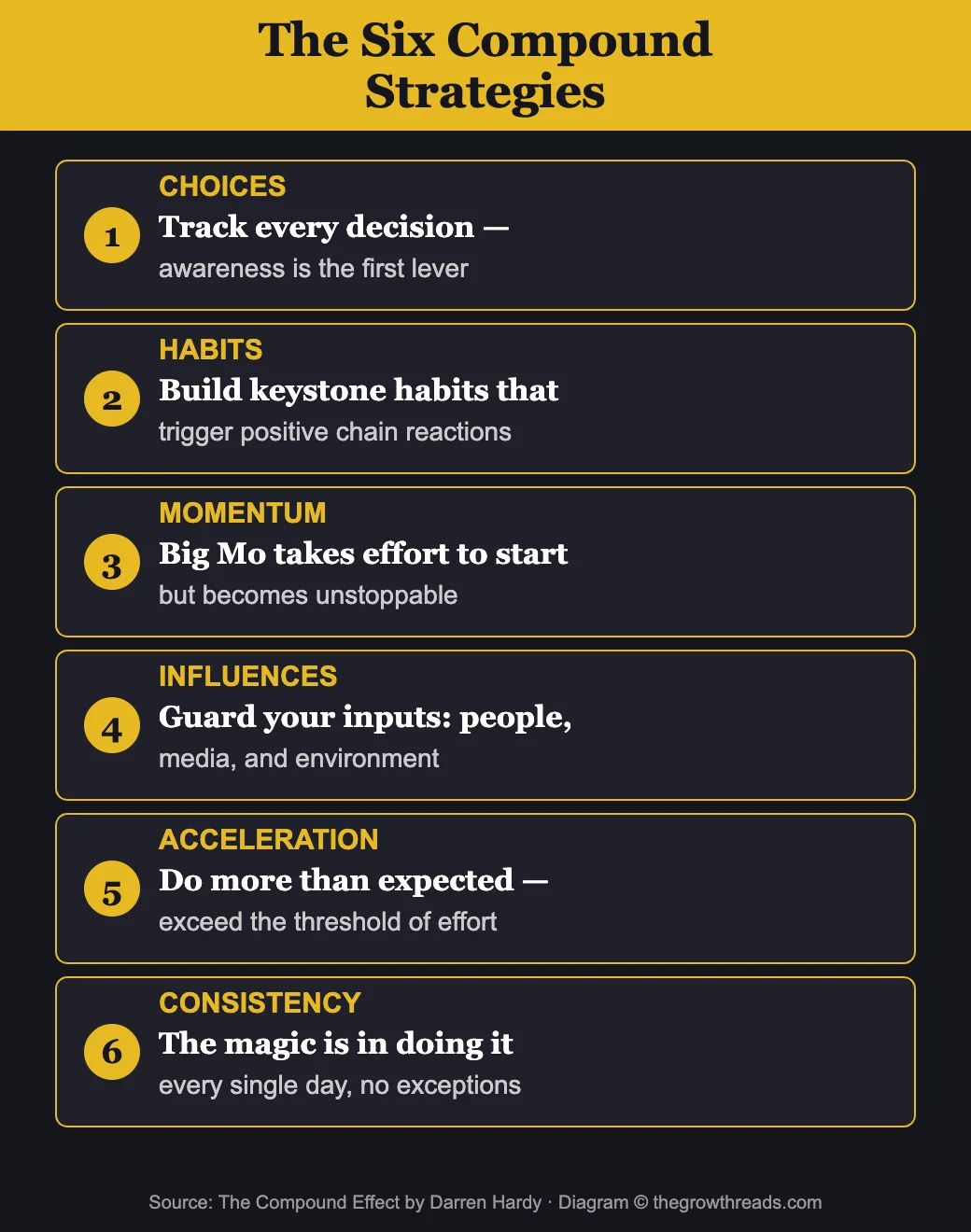
- Momentum (Big Mo) is your greatest ally: Getting started is the hardest part. Once you build momentum through consistent action, the flywheel effect takes over and results begin to accelerate.
- Your influences shape your outcomes: You become the average of the five people you spend the most time with. Guard your inputs — the books, media, and conversations you consume shape your thinking.
- Exceed the threshold: Average effort produces average results. To trigger compound growth, you need to push slightly beyond what’s expected — the “extra” is where the magic happens.
- Habits are the delivery system: Your habits automate your choices. Build keystone habits that trigger positive chain reactions across multiple areas of your life.
- Eliminate the negative compounds: Bad habits compound too. A daily cookie, fifteen minutes of social media scrolling, or skipping exercise seem harmless but accumulate into significant damage over time.
- The early period is invisible: Results from compounding are invisible for months. This is when most people quit. Understanding the pattern helps you persist through the “grind” phase.
- Gratitude accelerates results: Daily gratitude practice shifts your mental filter from scarcity to abundance, which changes your behavior and the opportunities you notice.
- Take 100% responsibility: Until you accept that you are 100% responsible for your life — no excuses, no blame — the compound effect works against you instead of for you.
What is The Compound Effect about?
The Compound Effect is a personal development book that reveals how small, consistent daily actions create massive results over time through the power of compounding. Darren Hardy provides a practical system for tracking choices, building habits, creating momentum, managing influences, and exceeding effort thresholds to harness this natural force in every area of life.
About the author
Darren Hardy is an American author, keynote speaker, and media personality who served as publisher and editorial director of SUCCESS magazine for over a decade. He started his first business at age 18 and became a self-made millionaire by 24, building a real estate company with annual revenues exceeding $50 million. Hardy has mentored thousands of entrepreneurs and executives, and his work draws heavily from his personal relationships with thought leaders including Jim Rohn (his primary mentor), Tony Robbins, Brian Tracy, and Jack Canfield. The Compound Effect, published in 2010, distills three decades of success principles into what Hardy calls “the operating system of personal achievement.” Explore all Darren Hardy book summaries →
Key concepts at a glance
| Concept | What it means | Use it when |
|---|---|---|
| The Compound Effect | Small choices + consistency + time = massive results | You want to understand why tiny daily actions matter more than big ones |
| Big Mo (Momentum) | Consistent action builds a flywheel that becomes self-reinforcing | You’re struggling to get started or maintain early consistency |
| Tracking | Measuring any behavior automatically improves it | You want to change a habit but lack awareness of your patterns |
| The Influence Filter | Guard your inputs: people, media, and environment shape outcomes | You feel stuck and suspect your environment is part of the problem |
| The Effort Threshold | Average effort = average results; exceeding expectations triggers compound growth | You’re doing “enough” but not seeing extraordinary results |
| 100% Responsibility | Own every outcome in your life without excuses or blame | You catch yourself blaming circumstances or other people |
Part 1: The compound effect — small choices, massive outcomes
Hardy opens with his most powerful illustration: three friends — Larry, Scott, and Brad — who start in identical circumstances. Larry makes no changes and coasts. Scott makes small, positive daily adjustments: reading ten pages per day, cutting 125 calories, and walking more. Brad makes equally small but negative adjustments: adding one alcoholic drink per day, subscribing to a new streaming service, and eating slightly more at each meal.
After five months, the three friends look almost identical. After ten months, the differences are barely noticeable. But after 31 months, the gap is staggering. Scott has lost 33 pounds, earned a promotion from the skills he gained reading, and transformed his marriage. Brad has gained 33 pounds, his career has stalled, and his relationship is struggling. Larry is somewhere in between, slowly declining from inertia. The same small daily choices, compounded over time, created radically different lives.
This is the core insight: the compound effect is always working, in every area of your life, whether you’re aware of it or not. Every choice you make today — what you eat, what you read, how you spend your time — is adding to your compound curve. The question isn’t whether compounding is happening but whether it’s working for you or against you.
Part 2: Choices and habits — the delivery system
Hardy argues that you make hundreds of choices daily, most of them unconsciously. The first step to harnessing the compound effect is awareness — and the most powerful awareness tool is tracking. He recommends carrying a small notebook (or using an app) and recording every relevant data point: every dollar spent, every calorie consumed, every minute allocated. The data doesn’t lie, and seeing the patterns in writing often triggers immediate change.
From awareness, Hardy moves to habit formation. He describes habits as the “delivery system” for the compound effect — they automate your good choices so you don’t have to rely on willpower for every decision. The key is identifying “keystone habits” — small habits that trigger positive chain reactions. For example, the habit of exercising in the morning often leads to better eating, more energy, improved mood, and higher productivity throughout the day, all from one anchor habit.
Hardy also addresses habit elimination, arguing that removing one bad habit can be as powerful as adding a good one. He provides a formula: identify the cue (what triggers the habit), understand the routine (the behavior itself), and replace the reward (find a healthier way to get the same emotional payoff). This cue-routine-reward model, which he credits in part to behavioral research, allows systematic dismantling of harmful patterns.
Part 3: Momentum — why Big Mo changes everything
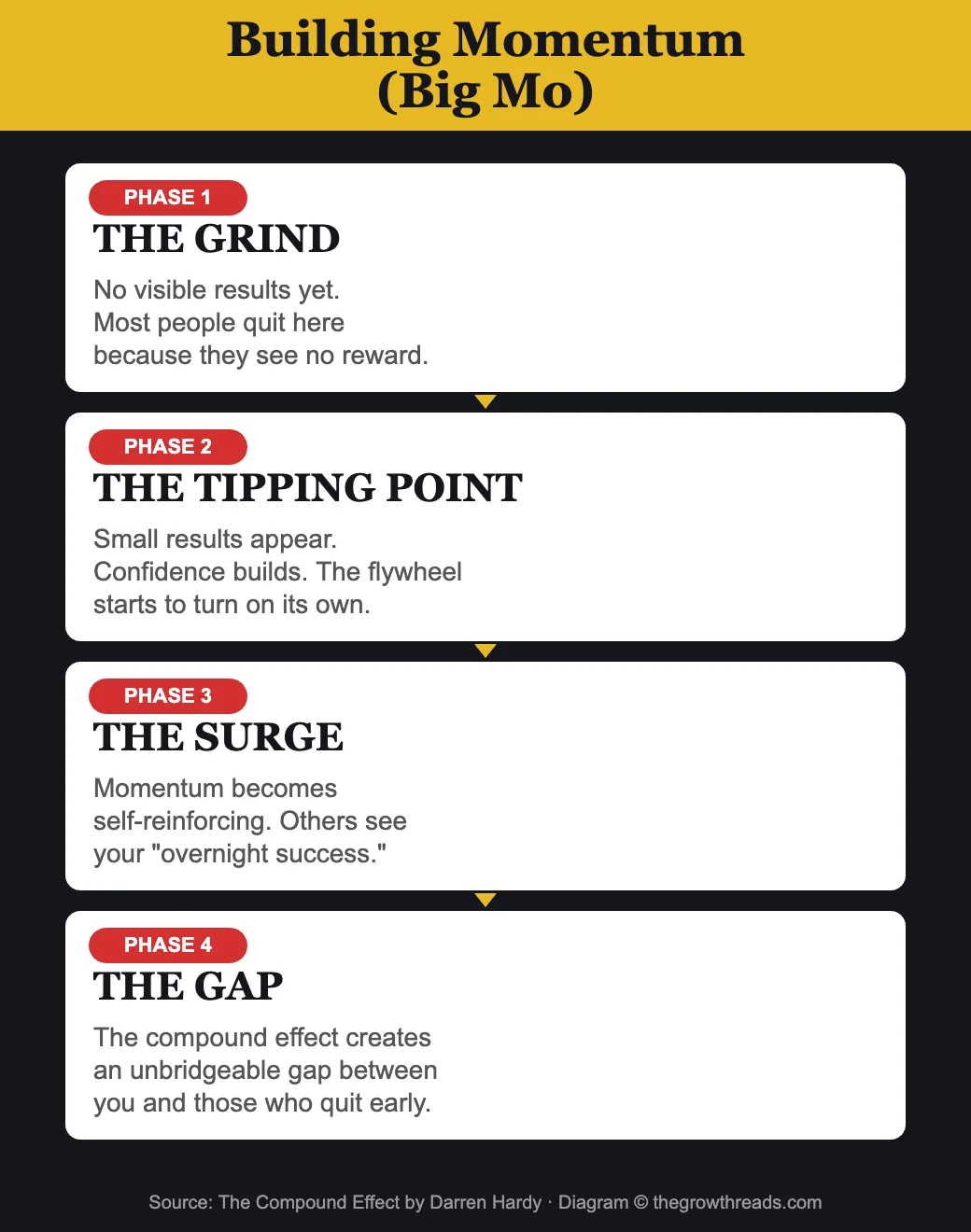
Hardy introduces momentum as the most powerful force in the compound effect system. He calls it “Big Mo” and argues that once you build it, momentum becomes almost self-sustaining — but getting it started requires significant initial effort with zero visible results.
The momentum curve follows a predictable pattern. Phase one is the grind: you’re doing the work but seeing no results. This is where 95% of people quit. Phase two is the tipping point: small results begin appearing, confidence builds, and the effort starts to feel worthwhile. Phase three is the surge: momentum becomes self-reinforcing, results accelerate, and others begin noticing your “overnight success.” Phase four is the gap: the compound effect has created such a dramatic difference between you and those who quit early that the distance becomes unbridgeable.
The key insight about momentum is that it requires consistency, not intensity. Working out for eight hours on Saturday is less effective than working out for 30 minutes each day for a month. The daily repetition builds neural pathways, creates habits, and generates momentum in a way that sporadic intense effort never can.
Part 4: Influences and acceleration
Hardy dedicates the final section to two powerful compound multipliers: managing your influences and exceeding effort thresholds. He argues that you become the average of the five people you spend the most time with — not just in income but in health, happiness, relationships, and ambition. If your five closest associates are negative, stagnant, or undisciplined, those qualities compound into your own life regardless of your intentions.
The prescription is deliberate: audit your relationships, seek out people who are where you want to be, and limit exposure to influences that drag you toward mediocrity. This extends beyond people to media, environment, and information diet. Every podcast, news feed, and social media account is either compounding your growth or compounding your decline.
The acceleration principle addresses why some people get dramatically better results than others doing seemingly similar things. Hardy argues that there’s an “effort threshold” — a point beyond which results suddenly accelerate. Average effort gets average results. But a little extra effort — going slightly beyond what’s expected, following up one more time, spending ten more minutes refining your work — pushes you past the threshold into the zone where compound growth explodes.
Who is The Compound Effect best for — and who should read something else first?
This book is perfect for anyone who wants a simple, actionable framework for building better habits and achieving long-term goals. It’s particularly valuable for people who’ve tried dramatic change and failed — Hardy shows why small, consistent actions succeed where willpower-intensive overhauls don’t. The concepts are simple enough for teenagers and powerful enough for CEOs.
If you want a deeper dive into the science of habit formation, Atomic Habits provides more mechanisms and research. If you need a complete productivity system rather than a mindset shift, Getting Things Done offers the structural framework. For a narrower focus on eliminating one specific bad habit, The Power of Habit goes deeper into the neuroscience.
Questions to reflect on
- What three small daily habits are currently compounding in your favor — and what three are compounding against you?
- If you continued your exact current daily routine for five years, where would you end up — and is that where you want to be?
- Who are your five closest influences, and are they pulling you toward the life you want or away from it?
- Where in your life are you putting in “average” effort and expecting extraordinary results?
- What is one thing you could track starting today that would immediately increase your awareness and improve your choices?
🔥 Ready to harness the most powerful force in personal growth?
Small choices + consistency + time = radical results. Start your compound journey today.
How to apply The Compound Effect (7-day plan)
- Day 1 — Start tracking one thing. Pick the area of your life you most want to improve and track it obsessively for 24 hours: every dollar, calorie, or minute. Write it all down.
- Day 2 — Add one small positive habit. Choose one tiny daily action that moves toward your biggest goal: 10 pages of reading, 10 push-ups, 5 minutes of meditation. Do it today.
- Day 3 — Remove one small negative habit. Identify one daily choice that’s compounding against you and eliminate it for today: the morning doomscroll, the afternoon cookie, the third cup of coffee.
- Day 4 — Audit your five closest influences. List the five people you spend the most time with. For each, ask: are they pulling me toward my goals or away? Plan to increase time with the best influence and reduce time with the worst.
- Day 5 — Exceed one expectation. In one interaction today — at work, at home, with a friend — give 10% more than expected. Follow up, add a personal touch, go the extra step. Notice the response.
- Day 6 — Build a keystone habit. Identify the one habit that, if you did it consistently, would trigger positive changes in multiple areas. Commit to doing it every morning for the next 30 days.
- Day 7 — Write your compound commitment. In one paragraph: “For the next 90 days, I will [daily action] every single day, track [metric], and eliminate [negative habit]. I accept that results will be invisible at first but will compound into something extraordinary.”
Frequently asked questions
What is the compound effect in simple terms?
The compound effect is the principle that small, consistent daily actions accumulate into massive results over time — just as compound interest turns modest savings into large sums. A person who reads ten pages daily reads roughly 18 books a year. Someone who improves 1% daily is 37 times better in a year. The force works in both directions: small positive habits compound into success, and small negative habits compound into decline.
How is The Compound Effect different from Atomic Habits?
Both books address the power of small daily actions, but from different angles. The Compound Effect focuses on personal responsibility, choice awareness, and the role of influences and momentum. Atomic Habits focuses on the science of habit formation, identity-based behavior change, and specific systems for building and breaking habits. Hardy provides the motivational framework; Clear provides the implementation system. Reading both gives you the complete picture.
What is Big Mo (momentum)?
Big Mo is Hardy’s term for the momentum that builds from consistent daily action. Like a merry-go-round, it takes enormous effort to get spinning but becomes nearly self-sustaining once moving. The critical insight is that momentum requires consistency, not intensity — daily 30-minute sessions beat weekly 4-hour marathons. Once Big Mo is on your side, results accelerate dramatically and the effort required decreases.
How long do compound results take to show?
Hardy’s illustration suggests noticeable differences appear around 10-12 months, with dramatic differences at 24-31 months. The exact timeline depends on the domain and the size of your daily improvement. The critical insight is that results are invisible at first, which is why most people quit too early. Understanding the compound curve helps you persist through the initial “grind” phase where nothing seems to be happening.
Does tracking really change behavior?
Yes — research consistently shows that measuring a behavior automatically improves it, a phenomenon psychologists call the Hawthorne Effect or reactivity to measurement. Hardy cites studies showing that people who track food intake eat 20-30% fewer calories, people who track spending save significantly more, and people who log workouts exercise more consistently. The act of writing down a behavior creates awareness that disrupts autopilot patterns.
What is the effort threshold?
The effort threshold is the point beyond which results suddenly accelerate. Average effort produces average (linear) results. But a little extra effort — what Hardy calls “doing more than expected” — pushes you past a threshold into compound (exponential) territory. In sales, it might be one extra follow-up call. In fitness, it might be 5 more minutes per workout. The “extra” is small but the compound effect of consistently exceeding expectations creates enormous differentiation over time.
How long does it take to read The Compound Effect?
The book is approximately 176 pages and takes about 4 hours to read — one of the shortest books on our recommended list. Hardy writes in a punchy, direct style typical of business books, with plenty of stories and examples from his career and the entrepreneurs he’s mentored. The audiobook runs about 5 hours. Many readers finish it in one or two sittings and report implementing at least one strategy immediately.
Related summaries
If you enjoyed this summary, explore more from our best productivity books collection:
- Atomic Habits Summary — the science of building good habits and breaking bad ones.
- The Power of Habit Summary — the neuroscience behind why habits work.
- Getting Things Done Summary — the complete productivity system.
- Deep Work Summary — how focused work compounds into career advantage.
Related Productivity Summaries
Limitless Summary & Review: Unlock Your Brain’s Full Potential
So Good They Can’t Ignore You Summary & Review: Why Skills Beat Passion
The 12 Week Year Summary & Review: Get More Done in Less Time
The 7 Habits of Highly Effective People Summary & Review: The Principles That Still Define Effectiveness
Ultralearning Summary & Review: Master Any Skill Faster