

★★★★★ 4.5/5 — The clearest rule in software management: extra people do not buy extra calendar — they buy more talk.
Best for: Tech leads, engineering managers, and anyone tempted to “staff up” a late project this week
Reading time: ~9 hrs for the full book · ~14 min for this guide
Difficulty to apply: The law is easy to quote; using it means protecting one design mind and saying no to a hire
The Mythical Man-Month in one minute
A man-month is not a unit of work. Months are calendar. People are not interchangeable hours. Fred Brooks learned that while IBM’s OS/360 software ran late, then wrote the debrief so the rest of us would not re-learn it on a live team. Some tasks are sequential: nine people cannot make a baby in one month. The rest explode into conversations — n people create n(n−1)/2 paths — and every new person needs briefing before they can help. Steal this week’s habit: freeze a hire on the late path, name the one mind who owns the design, and count the conversations you just refused to add.
Key takeaways
- Men and months do not trade: Calendar time is not a pile of hours you can chop among more heads when the work has sequence and talk.
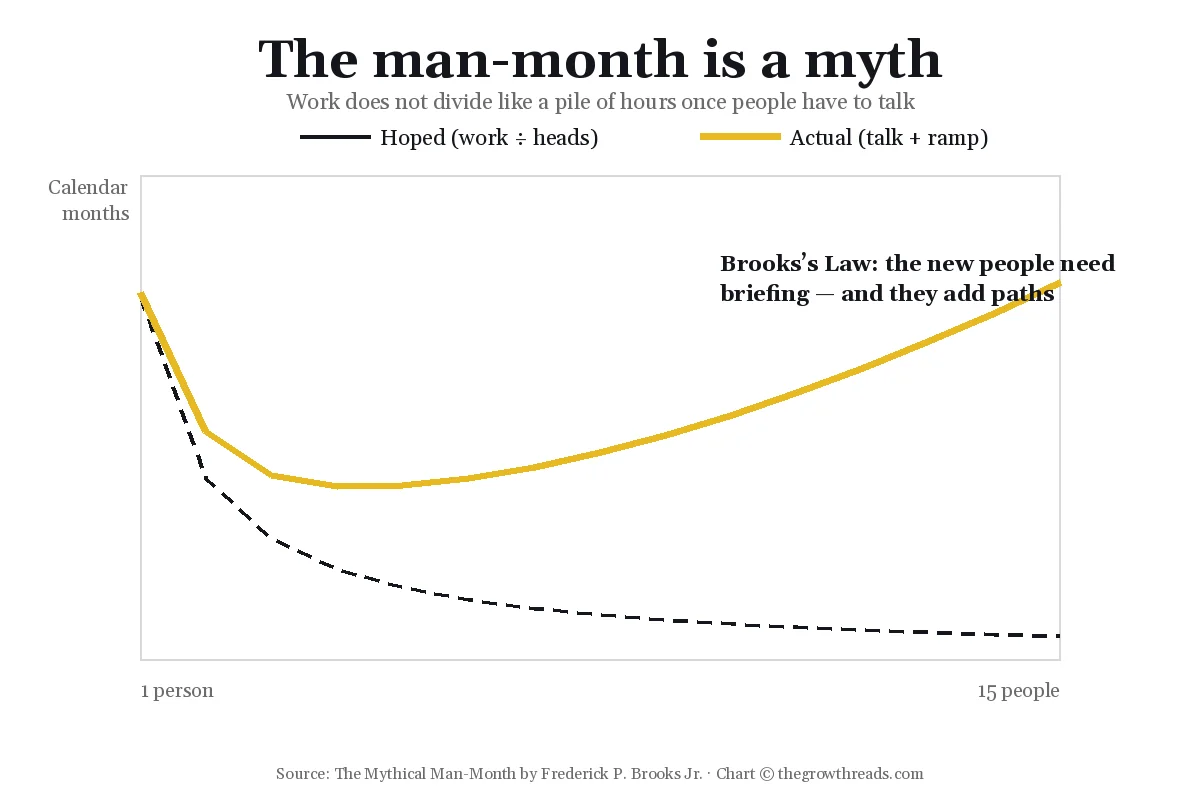
- Brooks’s Law: Adding manpower to a late software project makes it later. Training and new paths cost more than the new hands return, at first and often altogether.
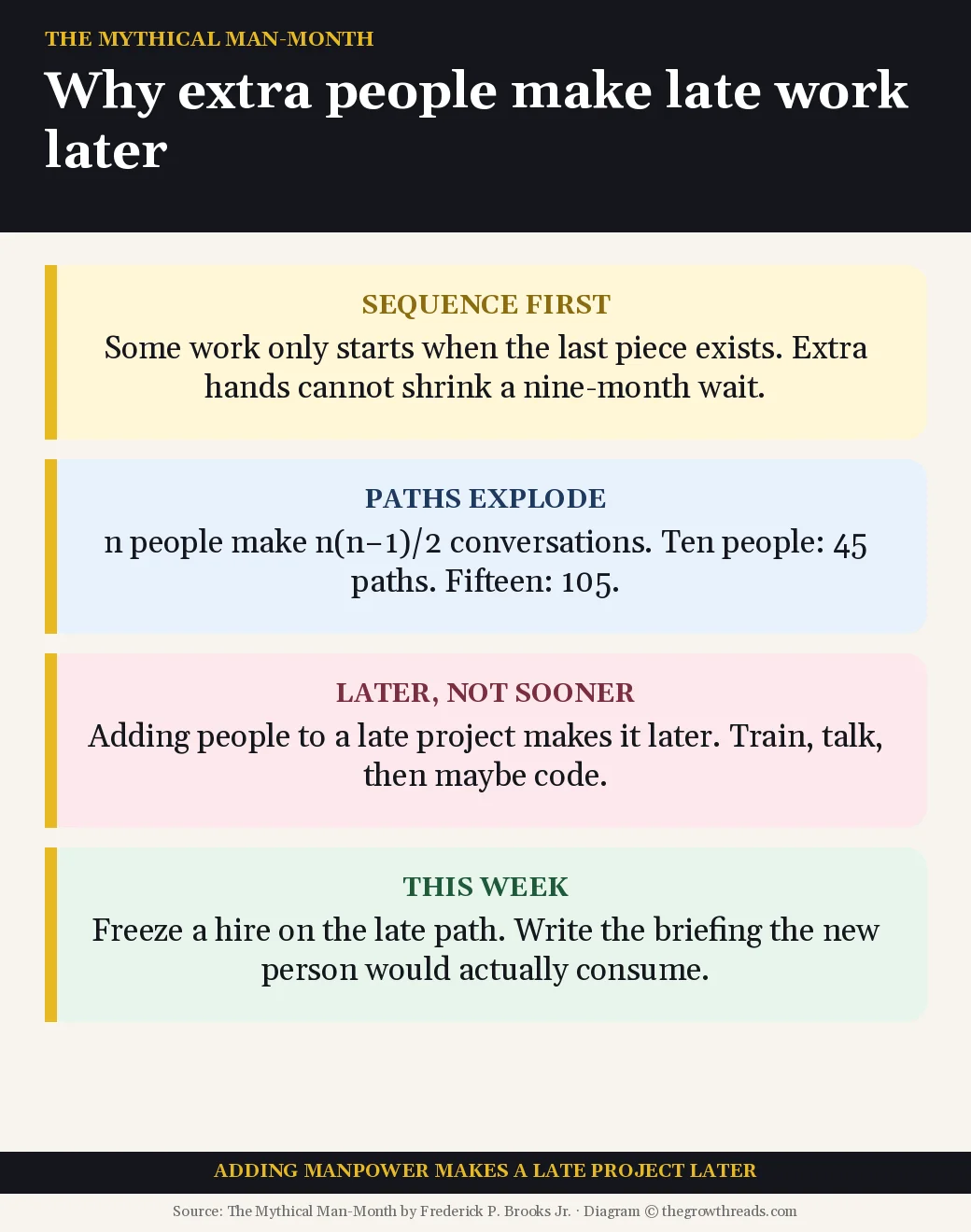
- Communication paths explode: Ten people: 45 two-way paths. Fifteen: 105. The org chart is not the cost. The conversations are.
- Conceptual integrity is the product: A coherent system comes from few minds. Democracy of ideas is a good workshop and a bad architecture.
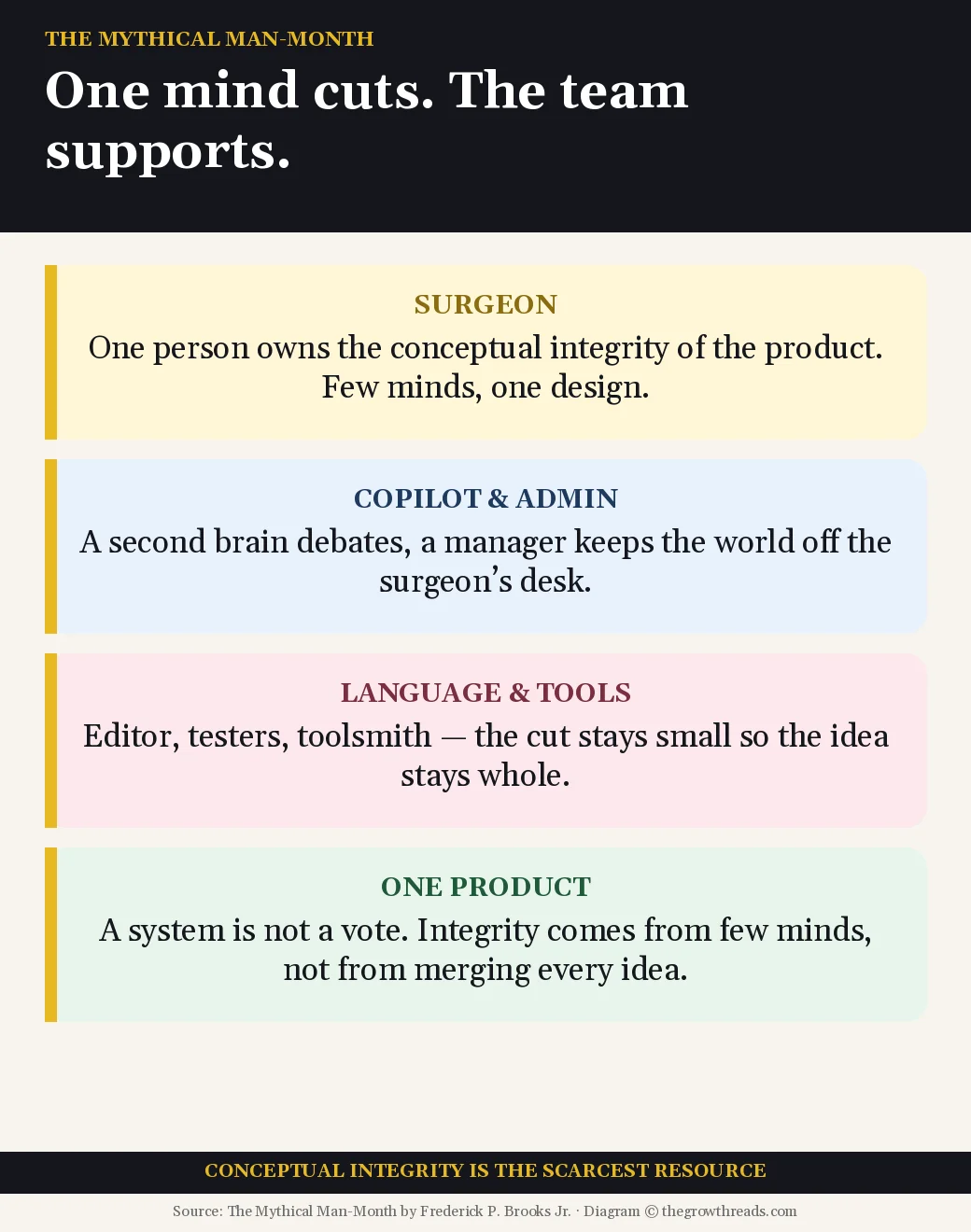
- The surgical team: One “surgeon” cuts; a small support cast keeps the world off that desk so the idea stays whole.
- Second-system effect: After a modest first success, the next design tries to include every leftover wish. That gold-plating is the danger.
- Plan to throw one away: You will ship a first version that teaches you the real problem. Budget the lesson instead of pretending it is the cathedral.
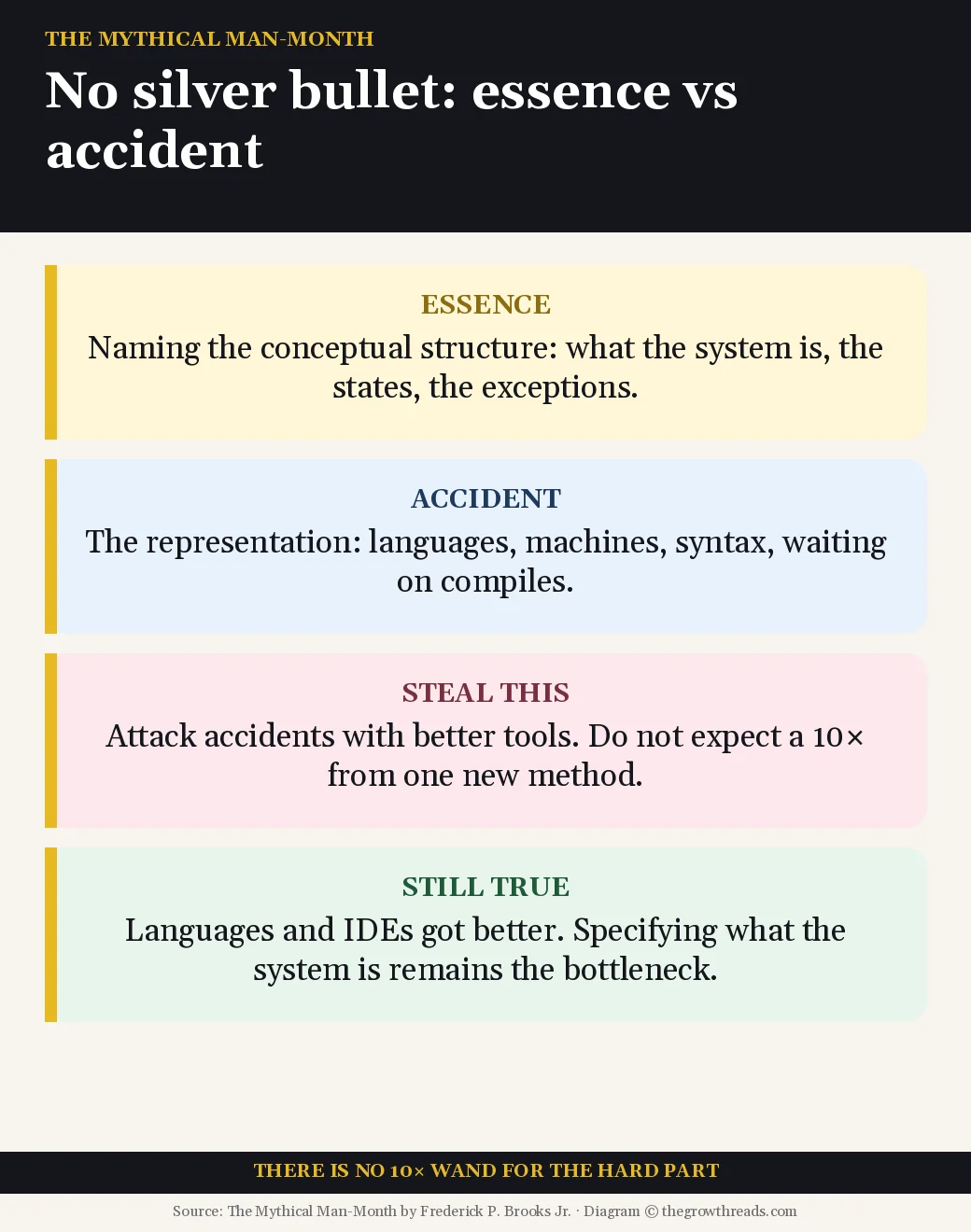
- No silver bullet: Tools attack accidental difficulty (languages, machines, wait time). They do not 10× the essential work of specifying what the system is.
- Documents are the project: If the spec and the interface sheet are not written, the project is still a conversation — and conversations do not compile.
What is The Mythical Man-Month about?
The Mythical Man-Month is Fred Brooks’s 1975 debrief of IBM’s OS/360: why adding people to a late software project makes it later, why one mind must own the design, and why no tool will 10× the hard part of specifying what the system is.
About the author
Frederick P. Brooks Jr. (1931–2022) managed IBM’s System/360 family and then the OS/360 software meant to make those machines usable. The hardware bet reshaped the industry. The software ran late, and Brooks spent a second career teaching others not to repeat his staffing mistakes. He founded UNC Chapel Hill’s computer-science department, received the National Medal of Technology and the ACM Turing Award, and kept returning to one claim: large programming projects fail for management reasons that small ones never see. The Mythical Man-Month is that debrief — essays, not a manual — written so a working manager can steal a rule the same afternoon. Explore all Frederick P. Brooks Jr. book summaries →
Key concepts at a glance
| Concept | What it means | Use it when |
|---|---|---|
| Man-month myth | People and calendar months are not interchangeable units of work | Someone “does the math” by dividing remaining work by new heads |
| Brooks’s Law | Adding people to a late software project makes it later | A late path is about to get a “rescue” hire |
| Communication paths | n people create n(n−1)/2 two-way links | A standup or review circle is growing without a reason |
| Conceptual integrity | The product feels like one mind designed it | Features are being merged from every stakeholder wish |
| Surgical team | One surgeon cuts; a small cast supports | You need speed without a design-by-committee blob |
| Second-system effect | The next system after a success tries to include everything left out | A rewrite is being sold as “doing it properly this time” |
| Plan to throw one away | The first version is a paid lesson; budget it | A first interface is being treated as the cathedral |
| Essence vs accident | Specifying the concept vs representing it in a language or machine | A new tool is being pitched as a 10× for the whole job |
| No silver bullet | No single method gives an order-of-magnitude jump in a decade | A vendor or framework is promising to erase the hard part |
Part 1: The tar pit and the mythical man-month — Brooks’s Law
Brooks opens in a tar pit. Large-system programming looks like ordinary building from a distance: you hire, you plan, you pour. Up close it is sticky. IBM’s OS/360 software shop was not short of talent. It was short of a true picture of how work actually moves.
The false picture is the man-month. A manager looks at remaining work, divides by available people, and reads a date. That arithmetic only holds when the tasks are independent and the people need no conversation. Programming is not bricklaying. Some work is strictly sequential: you cannot code the second module until the interface exists, and you cannot ship until the last defect that blocks the user is gone. Brooks’s homely test is pregnancy. The work takes nine months. Extra people do not buy extra calendar.
The rest of the work is partitionable in theory and expensive in practice because people have to talk. Each new person must be trained. Each pair needs a path. Ten people already have 45 two-way paths; fifteen have 105. Brooks watched IBM add programmers to a late OS/360 effort and later named the result: adding manpower to a late software project makes it later. On a late project, the new hands consume the people who still know the system before they produce.
The steal is a two-column estimate: sequential floor versus talk tax. If a proposed hire does not beat that tax inside the remaining calendar, the hire is a delay dressed as help. Count the paths before you open the req.
TGR Note: Brian Christian and Tom Griffiths’s Algorithms to Live By is the personal version of the same honesty: some jobs are sorting, some are caching, some cannot be sped up by throwing cores at them. Brooks is the team-scale chapter. If the late work is actually attention residue, not staffing, use Nicholas Carr’s The Shallows before you add another meeting.
Part 2: The surgical team and conceptual integrity
If you cannot buy calendar with a crowd, what can you buy? Brooks’s answer is conceptual integrity: the system feels as if one mind designed it. Users forgive missing features more readily than they forgive a product that changes personality every screen. Integrity is scarce because it lives in a small number of heads. A democracy of good ideas produces a workshop. It rarely produces a cathedral with one nave.
Harlan Mills’s surgical team is the org chart that protects that scarcity. One surgeon performs the cut — writes the core, owns the names, decides what the product is. A copilot debates and shares the model. An administrator keeps the world off the desk. Language lawyers, testers, and a toolsmith support the cut without voting on the anatomy. The team is not tiny out of romance. It is small so the conversation stays inside one design.
Brooks is not arguing for a lone genius locked in a room. He is arguing against a merge of six architectures. A few people decide what the system is; many can still build and test it. When every stakeholder gets a wing, you get corridors that do not meet. Write, on one page, who may change the conceptual model this month — and who may only implement it.
TGR Note: Douglas Hofstadter’s Gödel, Escher, Bach is about a system that can model itself. Brooks is about a team that must not model six selves at once. Keep both on the shelf if you design software: one book for the loop inside the product, one for the loop inside the org. For the hardware constraint that no amount of staffing rewrites, Chris Miller’s Chip War is the other tar pit.
Part 3: Second systems, Babel, and the plan to throw one away
Brooks’s most affectionate warning is the second-system effect. An architect’s first system is usually modest. Constraints were real; wishes were cut. The second system is where those leftover wishes return, plus a few new ones, plus the urge to show that this time the designer really knows how. The result is extra knobs, extra generality, extra “while we’re here.” None of those is evil in isolation. Together they are how a two-year project becomes a five-year museum of good intentions.
Communication is the other slow leak. Brooks retells Babel as an org-design story: a common language and a clear structure beat talent that cannot pass the word. If the spec lives only in threads and hallway memory, you have a folk tradition. His documentary list — objectives, specification, schedule, interface, test plan — is how a second person works without stealing a first person’s afternoon.
Then the sentence people quote and rarely budget: plan to throw one away; you will anyway. The first running version teaches you which exceptions were real. Label a milestone “throwaway on purpose” before shame makes it permanent.
Brooks wanted milestones that were binary — done or not — because “90% done” is how catastrophes hatch. If your dashboard is a gradient of hope, you do not yet have a schedule. You have a mood.
Part 4: No silver bullet — essence, accidents, and what still holds
The 1995 anniversary edition reprints Brooks’s 1986 essay “No Silver Bullet.” The claim is careful. Accidental difficulty is the pain of representing a program on a given machine: syntax, waits, clumsy languages, the gap between idea and keystroke. Essential difficulty is specifying the conceptual construct itself — the states, the exceptions, the interactions users will actually have. High-level languages, time-sharing, unified programming environments, and even AI-as-then-imagined attack accidents. They help. They do not give an order-of-magnitude jump in a decade on the essential work. There is no werewolf, and there is no silver bullet.
Brooks was not anti-tool. He wanted better tools aimed at the right tax. If your week is lost to waiting, buy speed. If your week is lost to not knowing what the product is, no compiler will save you. The 1995 look-back finds real gains — and still no 10× from one method.
Read from 2026 and the names of the accidents have changed. The split has not. Generated code can draft the accidental layer faster. It cannot own conceptual integrity, and it cannot shrink a sequential floor by joining the standup. If you staff a late project with more people and more tools at once, you have added paths and hope. Count the paths first.
TGR Note: Yudkowsky and Soares’s If Anyone Builds It, Everyone Dies is a different scale of “do not scale the team on a late, underspecified goal.” Brooks is the project-management version; they are the species-level version. For a calmer map of machine goals that drift from yours, keep Brian Christian’s The Alignment Problem nearby.
Who is The Mythical Man-Month best for — and who should read something else first?
Read it if you ship software, hardware-adjacent systems, or any project where “we’ll just add people” is the standing late-game move. You do not need to love 1960s IBM. You need a live team and a date that is already slipping.
Read something else first if you want personal decision algorithms rather than org design — start with Algorithms to Live By. If the tar pit is attention, not staffing, use The Shallows. If you want a picture of how an “I” appears in a system, use Gödel, Escher, Bach. The Mythical Man-Month is a poor first AI book if you need prompting tips this afternoon, and a superb first management book if you were about to open a req.
Questions to reflect on
- Which path on your team is late because of sequence, and which is late because of talk?
- If you add one person this week, whose hours will they consume before they produce?
- Who is allowed to change the conceptual model, and who is only allowed to implement it?
- What leftover wishes are sneaking into your “second system” rewrite?
- Which current tool is being treated as a silver bullet for work that is still unspecified?
🔥 Ready to stop buying calendar with extra people?
Get The Mythical Man-Month and start reading.
How to apply The Mythical Man-Month (7-day plan)
- Day 1: Pick one live project. Write n = number of people who must talk for it to move. Compute n(n−1)/2 and put the number on the team doc.
- Day 2: Split remaining work into sequential floor vs partitionable. Circle one task that extra people cannot shrink.
- Day 3: Freeze adding people to the late path for seven days. Write the briefing a new person would actually have to read.
- Day 4: Name the surgeon: one person who may change the conceptual model this month. Write that name where the team can see it.
- Day 5: Cut one leftover wish from a rewrite or “v2.” If it was not required for v1 users, it is second-system gold-plating until proven otherwise.
- Day 6: Label one interface or spike “throwaway on purpose.” Time-box it. Do not let shame promote it into the cathedral.
- Day 7: Split this week’s pain into essence (specifying) vs accident (tools, waits). Attack one accident with a tool. Attack one essence item with a written spec, not a hire.
Frequently asked questions
What is Brooks’s Law?
Brooks’s Law says that adding manpower to a late software project makes it later. New people need briefing from the people who still know the system, and every extra person adds communication paths. Those costs land immediately; the new output lands later, if it lands at all. The law is not a ban on hiring. It is a warning that a late calendar is the worst moment to pay the training tax. Count sequential work and talk tax before you treat a req as a date-recovery plan.
What is a man-month, and why is it mythical?
A man-month treats one person’s month of work as a unit you can freely swap for two people for half a month. That swap only works when tasks are independent and need no conversation. Software has sequence (some work cannot start until other work exists) and talk (people must share names, exceptions, and interfaces). Months are calendar. People are not interchangeable hours. Brooks called the unit mythical because the arithmetic looks clean and then the date still slips. Use it as a rough cost number, never as a schedule.
Is The Mythical Man-Month still relevant in 2026?
Yes, because the delays Brooks named were never about punch cards. They were about sequence, briefing, and too many minds on one design. Cloud, sprints, and generated code changed the accidental layer — the waits and the syntax. They did not make nine people able to finish a nine-month sequential chain in one month, and they did not make a late project cheaper to staff. Read the OS/360 stories as case studies, not as a museum of hardware. The 1995 chapters on “No Silver Bullet” are the bridge into tool hype you still hear.
What is the surgical team in The Mythical Man-Month?
The surgical team, from Harlan Mills and popularized by Brooks, is a small group organized like an operating room. One surgeon owns the cut: the conceptual integrity of the program. A copilot shares the model and debates. An administrator keeps interruptions off the desk. Specialists — testers, a toolsmith, editors — support without each getting a vote on the anatomy. The point is not hierarchy for its own sake. It is to keep the product feeling like one mind designed it while still letting many people help. Write down who the surgeon is this month.
What is the second-system effect?
The second-system effect is Brooks’s name for the danger after a modest first success. The first system was constrained; wishes were cut. The second system tries to include every leftover idea, plus extra generality to prove the designer has grown. Each extra is defensible. The pile is how a rewrite becomes a museum. Use the effect as a cutting rule: if a v2 feature was not required by v1 users, it needs a new, present-tense reason — not “we always wanted this.” Plan to throw a prototype away so the second system is a choice, not an accident.
What does “no silver bullet” mean?
“No silver bullet” is Brooks’s 1986 claim that no single tool or method would give an order-of-magnitude jump in software productivity within a decade. Accidental difficulty — languages, machines, waiting — can be attacked with better tools. Essential difficulty is specifying the conceptual construct: what the system is. That part does not 10× because a compiler got nicer. The anniversary edition looks back and still finds no werewolf-killing wand. Steal the split, not the pessimism: buy tools for accidents; write the spec for essence. A new generator is not a substitute for knowing the product.
How long is The Mythical Man-Month and who should read it?
The anniversary paperback is about 336 pages of essays, not a single plot. Most working managers can read it in a long weekend and steal one rule per chapter. It is best for tech leads and anyone about to staff a late project. Skip it as a first book if you need personal productivity tactics or an AI how-to; use Algorithms to Live By or a current AI title instead, then come back when your problem is a slipping date and a growing guest list. Pair it with a written path-count of your own team the same week you finish.
Related summaries
- Algorithms to Live By — computer-science moves for ordinary decisions.
- The Shallows — when the tar pit is attention, not headcount.
- Gödel, Escher, Bach — how meaning and minds climb out of looping rules.
- Chip War — the hardware constraint no software hire can staff around.
Browse every title in our Best AI Books pillar page.
How we analyze books: our summaries are built from a full read of the source text, cross-referenced against the author’s published interviews and research where relevant, and structured around practical application rather than critique. We disclose our editorial process and affiliate relationships in full. Read our full methodology.