

⭐⭐⭐⭐⭐ 4.5 / 5 — A true story of how one submarine captain transformed the worst-performing crew in the Navy into the best by giving up control.
Best for: Leaders, managers, and anyone who wants to build teams that think for themselves instead of waiting to be told what to do.
Reading time: ~5 hours (this guide: 14 min)
Difficulty to apply: High — the leader-leader model requires you to give up control, which feels risky even when it’s the right thing to do.
Turn the Ship Around in one minute
The traditional leader-follower model creates obedient teams that collapse the moment the leader leaves — the leader-leader model creates thinking organizations that thrive without a single point of failure. Captain L. David Marquet took command of USS Santa Fe, the worst-performing nuclear submarine in the US Navy fleet. Instead of issuing more orders, he did the opposite: he pushed decision-making authority down to the people closest to the information. The results were extraordinary — Santa Fe went from worst to first in virtually every performance metric, and the crew produced a record number of future commanders. Marquet’s leader-leader model rests on three pillars: Control (give people authority), Competence (ensure they have the knowledge to use it), and Clarity (make sure everyone understands the goal).
Key takeaways
- Replace “leader-follower” with “leader-leader”: Instead of one person making all decisions, create an organization where everyone at every level thinks and acts like a leader.
- “I intend to…” changes everything: Replace “Request permission to…” with “I intend to…” This single language shift transfers ownership from the boss to the person doing the work.
- Don’t move information to authority — move authority to information: The people closest to the problem have the best information. Give them the power to decide, not just report.
- Competence enables control: You can only safely push authority downward if people have the technical knowledge to make good decisions. Invest relentlessly in learning at every level.
- Clarity enables control too: People need to understand not just what to do but why. When everyone shares the same goals and values, they make consistent decisions without centralized orders.
- Think out loud: When team members share their reasoning before acting, others can spot errors in real time — before they become disasters.
- Certify, don’t brief: Instead of one-way briefings where people passively listen, test understanding actively. Ask “What do you think?” rather than “Do you understand?”
- Resist the urge to provide solutions: The moment you tell someone what to do, you’ve taken their thinking away. Ask questions that guide them to their own answer instead.
- Embrace inspections: Treat external scrutiny as an opportunity to learn and improve, not as a threat. Transparency builds trust and catches problems early.
- Take deliberate action: Pause before executing. State aloud what you’re about to do and why. This small habit prevents countless errors and accidents.
What is Turn the Ship Around about?
Turn the Ship Around is the true story of how Captain L. David Marquet transformed USS Santa Fe from the worst-performing submarine in the US Navy to the best by replacing the traditional command-and-control model with a “leader-leader” approach. The book presents a practical framework for distributing authority, building competence, and creating organizational clarity so that every team member thinks and acts like a leader.
About the author
L. David Marquet is a retired United States Navy captain who commanded the nuclear-powered submarine USS Santa Fe from 1999 to 2001. A graduate of the US Naval Academy where he finished top of his class, Marquet was originally trained for a different submarine and had to adapt his leadership approach when assigned to Santa Fe — a boat he knew nothing about. This forced improvisation led to the leader-leader model described in the book. After retiring from the Navy, Marquet became a leadership consultant, speaker, and author. His TED talk on the leader-leader model has been viewed millions of times, and Turn the Ship Around, published in 2013, has become required reading at business schools and Fortune 500 companies worldwide. Explore all L. David Marquet book summaries →
Key concepts at a glance
| Concept | What it means | Use it when |
|---|---|---|
| Leader-Leader | Every person thinks and makes decisions, not just the person at the top | Your team waits for orders instead of taking initiative |
| “I Intend To…” | Replace permission-seeking with proactive ownership statements | People always ask “What should I do?” instead of proposing action |
| Control | Push decision-making authority down to the people with the information | Decisions bottleneck at the top while people on the ground wait |
| Competence | Invest in technical knowledge at every level so authority can be safely distributed | You want to delegate but worry about quality |
| Clarity | Ensure everyone understands the goals, values, and priorities | People make inconsistent decisions because they lack shared context |
| Think Out Loud | Share reasoning before acting so others can catch errors | You want to reduce mistakes without adding bureaucracy |
| Deliberate Action | Pause and verbalize what you are about to do before doing it | Errors happen because people act on autopilot |
Part 1: From worst to first — why Marquet gave up control
Marquet takes command of Santa Fe expecting to apply the leadership principles he learned at the Naval Academy and during his career: study the boat’s systems, make expert decisions, and issue clear orders. But there’s a problem — he’d spent a year preparing to command a different submarine. He knows nothing about Santa Fe’s specific systems. His usual approach of being the technical expert who makes every decision is impossible.
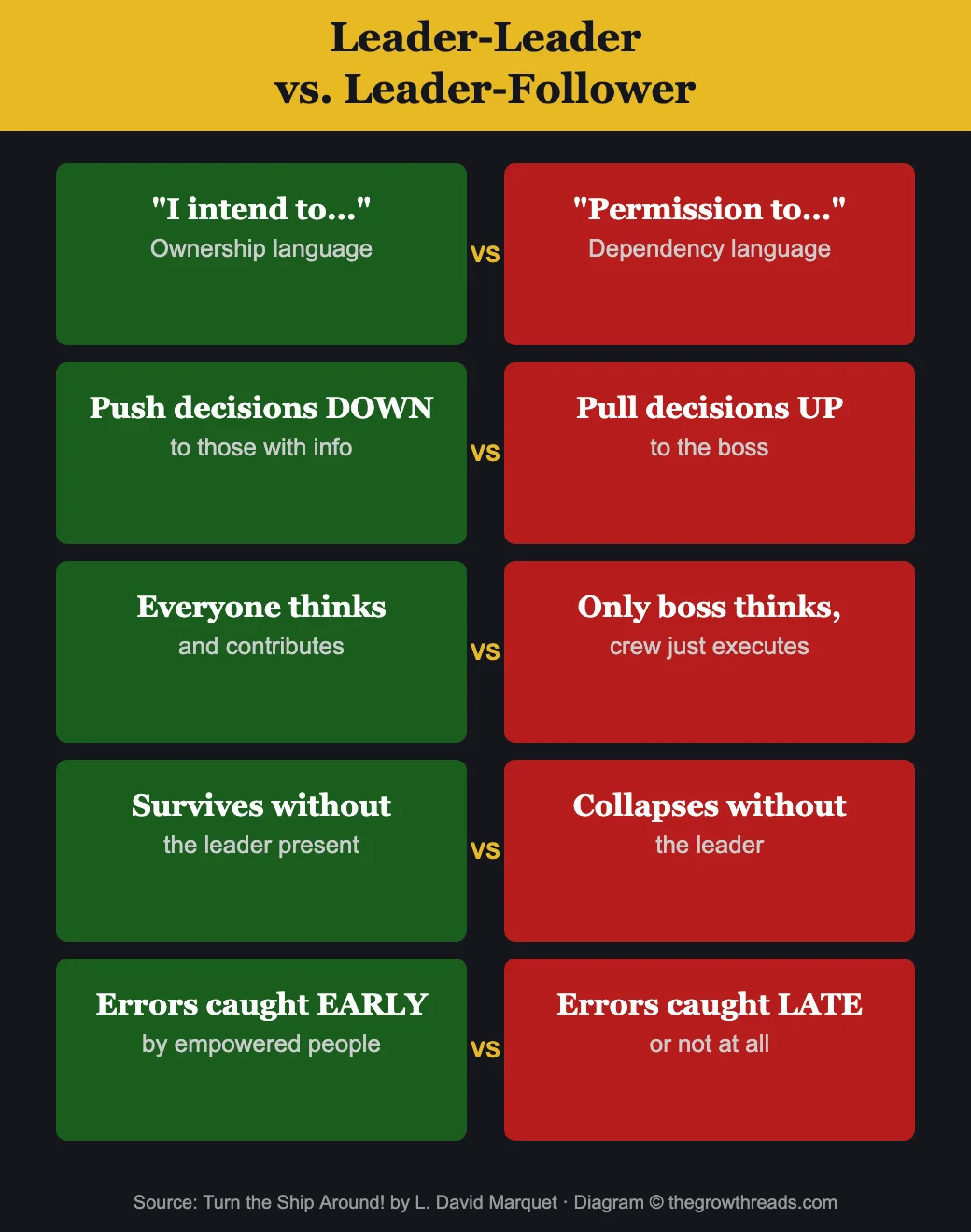
This accidental ignorance becomes his greatest asset. In one pivotal moment, Marquet orders the officer of the deck to increase speed to “ahead two-thirds” — a setting that doesn’t exist on Santa Fe. The officer repeats the order and the helmsman acknowledges it, even though both know it’s wrong. When Marquet asks the officer why he followed an impossible order, the officer replies simply: “Because you told me to.” That moment reveals the fatal flaw of leader-follower: when everyone is trained to follow orders, nobody catches errors.
Marquet realizes that his crew has been trained out of thinking. They’re competent submariners but passive followers. The previous command structure punished initiative and rewarded obedience. Santa Fe’s poor performance isn’t a people problem — it’s a system problem. The people are capable; the system prevents them from using their capability.
Part 2: The three pillars — control, competence, and clarity
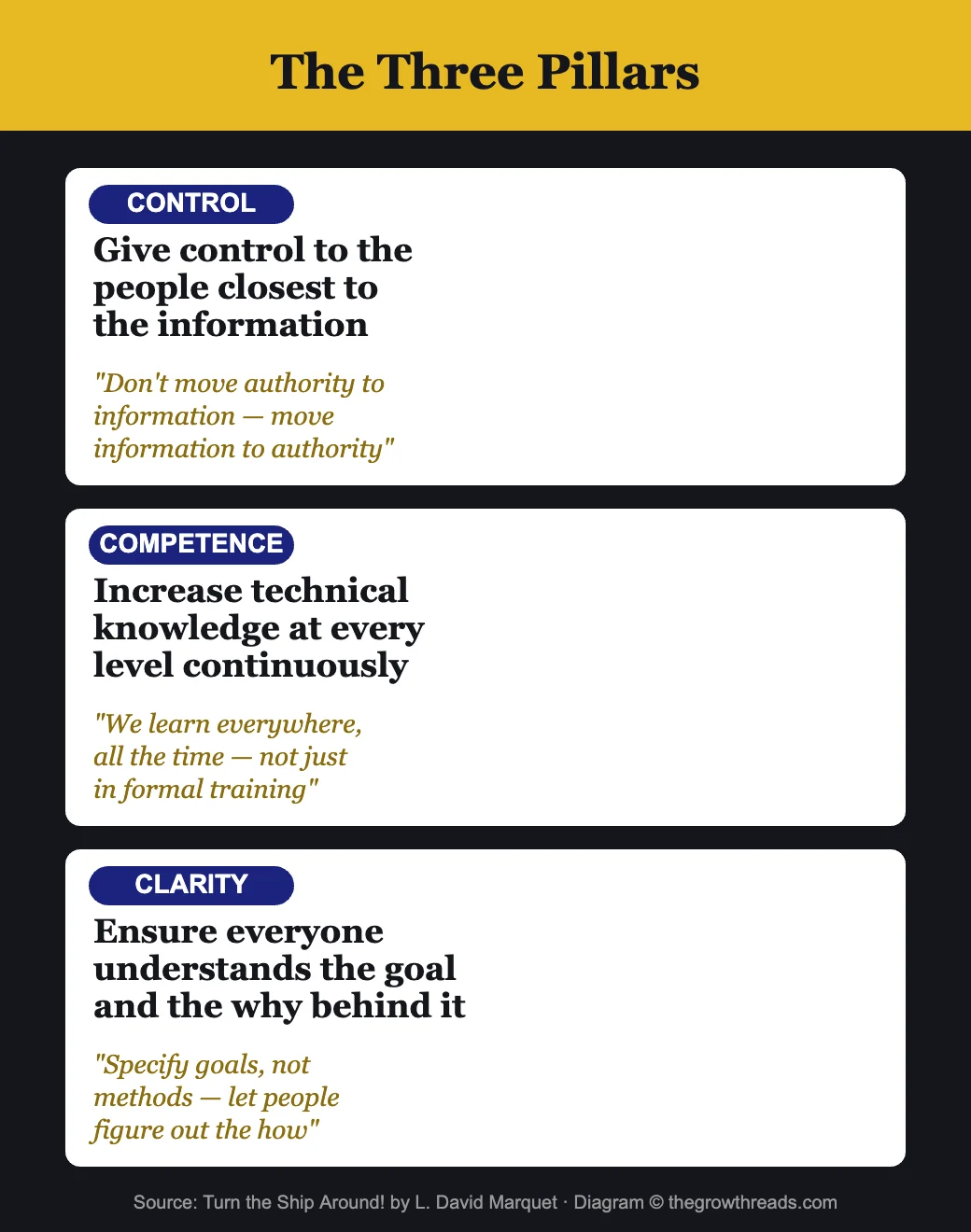
Marquet’s leader-leader model rests on three interdependent pillars. Control means pushing decision-making authority down to the lowest level at which decisions can be made well. Competence means ensuring that everyone has the technical knowledge to use that authority wisely. And Clarity means ensuring everyone understands the organization’s goals, values, and priorities so they make decisions that are aligned even without central direction.
The three pillars are deliberately interdependent. Give people control without competence, and they’ll make well-intentioned but dangerous mistakes. Give them control without clarity, and they’ll optimize for the wrong things. Build competence without control, and you have frustrated experts who aren’t allowed to use their skills. All three must increase together.
The first mechanism Marquet implements is the “I intend to…” language. Instead of asking “Captain, request permission to submerge the ship,” the officer of the deck says “Captain, I intend to submerge the ship.” This seemingly small change has enormous implications: the officer is now stating a decision they’ve already thought through, not asking the boss to think for them. The captain’s role shifts from decision-maker to decision-certifier — a much more scalable role.
Part 3: Mechanisms that change behavior
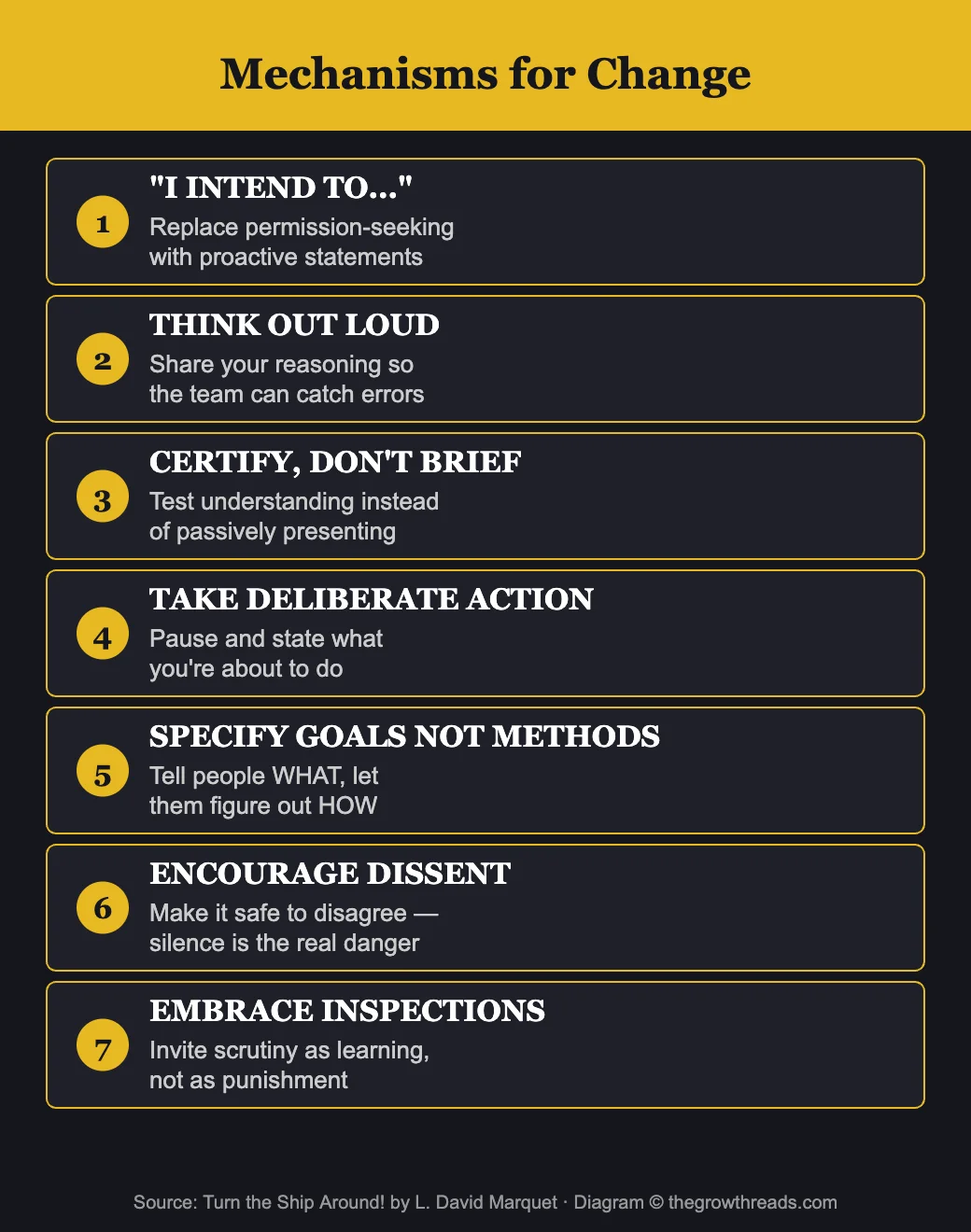
Marquet introduces specific mechanisms for changing organizational behavior. “Think out loud” requires crew members to share their reasoning before taking action. When someone says “I intend to change course to 270 because we need to avoid the shoal on our current heading,” others can check the logic in real time. Errors are caught when they’re still intentions, not consequences.
“Deliberate action” means pausing before executing any critical step and stating aloud what you’re about to do. This small discipline interrupts autopilot behavior — the kind of unconscious action that causes accidents in high-stakes environments. On Santa Fe, every control switch operation was preceded by a verbal statement and a physical gesture toward the switch.
“Certify, don’t brief” replaces passive information dumps with active knowledge checks. Instead of the traditional briefing where one person talks and everyone else pretends to listen, Marquet’s officers test their team’s understanding through questions. “What would you do if the reactor scrammed right now?” is more useful than a thirty-minute lecture on reactor safety.
The cumulative effect of these mechanisms transformed Santa Fe’s culture. Within months, re-enlistment rates jumped from the lowest to the highest in the submarine force. Inspection scores went from worst to best. And critically, the improvements persisted after Marquet left — because the system didn’t depend on him.
Part 4: Legacy — what happened after Marquet left
The ultimate test of the leader-leader model came when Marquet left Santa Fe. Under the traditional leader-follower model, organizations typically decline when a strong leader departs. But Santa Fe continued to excel, winning additional awards and producing a disproportionate number of officers who went on to command their own submarines — more than any submarine in the fleet’s history.
This is Marquet’s strongest argument: the leader-follower model scales only as far as one person’s attention and energy. The leader-leader model scales with the organization. Every person who learns to think and decide becomes a multiplier of organizational capability, and that capability doesn’t walk out the door when any single person leaves.
Who is Turn the Ship Around best for — and who should read something else first?
This book is essential for any leader managing a team — from military commanders to startup founders to middle managers. It’s particularly powerful for anyone frustrated by a team that waits for instructions instead of taking initiative. The mechanisms are specific enough to implement immediately, and the submarine context makes abstract leadership concepts viscerally concrete.
If you’re looking for leadership principles focused on personal courage rather than organizational design, start with Dare to Lead or Extreme Ownership. For understanding why some organizations make the leap to greatness while others don’t, Good to Great provides the broader organizational perspective that complements Marquet’s operational focus.
Questions to reflect on
- How often do people on your team ask “What should I do?” versus stating “I intend to…”?
- If you were absent for a week with no communication, would your team’s performance improve, stay the same, or decline?
- Are you holding onto decisions that the people closest to the information could make better than you?
- Does your team “think out loud” before taking action — or do you only learn about decisions after they’ve been made?
- When was the last time someone on your team respectfully disagreed with you — and what does the absence of dissent tell you?
🔥 Ready to build a team that thinks for itself?
The Navy captain’s playbook for turning followers into leaders — applicable to any organization.
How to apply Turn the Ship Around (7-day plan)
- Day 1 — Audit your decision flow. Track every decision made on your team today. How many required your input? How many could the person closest to the information have made independently?
- Day 2 — Introduce “I intend to…” Ask your team to replace “Can I…?” and “Should I…?” with “I intend to…” for one day. Notice how it shifts the ownership of thinking.
- Day 3 — Practice “think out loud.” Before making a decision today, share your reasoning aloud. Ask one team member to do the same. Notice whether anyone catches a gap in logic.
- Day 4 — Certify, don’t brief. In your next meeting, instead of presenting information, ask questions to test understanding. Replace slides with dialogue.
- Day 5 — Push one decision down. Identify one decision you currently make that could be made by someone with better information. Transfer that authority today, with clear guardrails.
- Day 6 — Encourage dissent. In a meeting, explicitly ask: “What am I missing?” or “Who disagrees with this direction and why?” Create space for the answer by waiting in silence.
- Day 7 — Write your leader-leader charter. Document which decisions your team can make without your approval, what competencies they need, and what goals should guide their judgment.
Frequently asked questions
What is the leader-leader model?
The leader-leader model is an organizational approach where decision-making authority is distributed to every level rather than concentrated at the top. Instead of one leader giving orders and everyone else following, every person is empowered to think, decide, and act within their area of competence. It was developed by Captain L. David Marquet aboard USS Santa Fe and rests on three pillars: Control (pushing authority down), Competence (building knowledge), and Clarity (ensuring shared goals).
What does “I intend to” mean in leadership?
“I intend to…” is a language mechanism that replaces permission-seeking (“Request permission to…”) with proactive ownership. When someone says “I intend to change course to 270 to avoid the approaching vessel,” they’ve already thought through the decision, analyzed the situation, and are now informing their supervisor rather than asking them to think for them. This single phrase shift transfers cognitive ownership from the boss to the person with the best information.
Can the leader-leader model work outside the military?
Absolutely — and it’s often easier to implement in civilian organizations because there’s less institutional resistance to changing hierarchical traditions. Companies from tech startups to manufacturing firms have adopted Marquet’s mechanisms. The principles translate directly: “I intend to…” works in any meeting, “think out loud” improves any team’s decision quality, and pushing decisions to the people with the best information is universally applicable.
What are the three pillars of the leader-leader model?
The three pillars are Control (distributing decision-making authority to the people closest to the information), Competence (ensuring everyone has the technical knowledge to use that authority well), and Clarity (aligning everyone around shared goals and values so decisions are consistent without central direction). All three must increase together — giving control without competence is dangerous, and competence without control is frustrating.
What happened to USS Santa Fe after Marquet left?
Santa Fe continued to excel after Marquet’s departure — which was the ultimate proof of the model. The submarine won additional awards and produced a disproportionate number of officers who went on to command their own submarines, more than any other submarine in fleet history. This proved that the leader-leader model creates sustainable organizational capability rather than dependence on a single charismatic leader.
How is this different from Extreme Ownership?
Both books advocate for pushing decision-making authority to frontline leaders, but they approach it from different angles. Extreme Ownership by Jocko Willink focuses on personal accountability — the leader takes ownership of every outcome. Turn the Ship Around focuses on organizational design — creating systems where everyone leads. Marquet would say that Extreme Ownership, while powerful, still depends on one leader’s willingness to own everything, while leader-leader is designed to work even after the leader leaves.
How long does it take to read Turn the Ship Around?
The book is approximately 236 pages and takes about 5 hours to read. Marquet writes in a compelling narrative style, alternating between submarine action scenes and leadership principles. Each short chapter ends with practical “questions to consider” that help readers apply the ideas immediately. The audiobook runs about 6 hours and is particularly engaging because the submarine setting translates well to audio storytelling.
Related summaries
If you enjoyed this summary, explore more from our best leadership books collection:
- Extreme Ownership Summary — Navy SEAL principles for taking full responsibility.
- Multipliers Summary — how the best leaders amplify everyone’s intelligence.
- Good to Great Summary — what separates good organizations from truly great ones.
- Radical Candor Summary — a framework for caring and challenging your team.
Related Leadership Summaries
Leadership Is Language Summary & Review: The Power of What You Say
Leading Change Summary & Review: The 8-Step Transformation Process
Primal Leadership Summary & Review: Lead With Emotional Intelligence
The Art of War Summary & Review: Timeless Strategy for Modern Leaders
Zero to One Summary & Review: How to Build Companies That Create the Future