

★★★★☆ 4.4/5 — a clear picture of the hours hiding under what we keep calling talent.
Best for: People who stall because they think they were not born with the skill
Reading time: ~8 hours (320 pages) · this guide ~12 min
Difficulty to apply: Easy to believe — hard to schedule the boring, targeted hour
Bounce in one minute
Talent is what practice looks like from far away. Matthew Syed’s Bounce (Harper / Fourth Estate, 2010) is a reporter’s tour of that sentence. Syed was England’s table-tennis number one. He watched a cluster of national players come out of one club, not one bloodline, and spent the book showing why the graceful tip we applaud sits on a mass of purposeful hours we never see. Child prodigies look magical because we start the clock late. Choking happens when you watch a skill that already lives in the body. The usable move is not a pep talk about potential. It is one session this week with a target just past easy, a signal on the miss, and a note you will actually read tomorrow. This summary is the application layer — iceberg, purposeful practice, choke exit, 7-day plan — not a highlight reel of Federer and Mozart.
Key takeaways
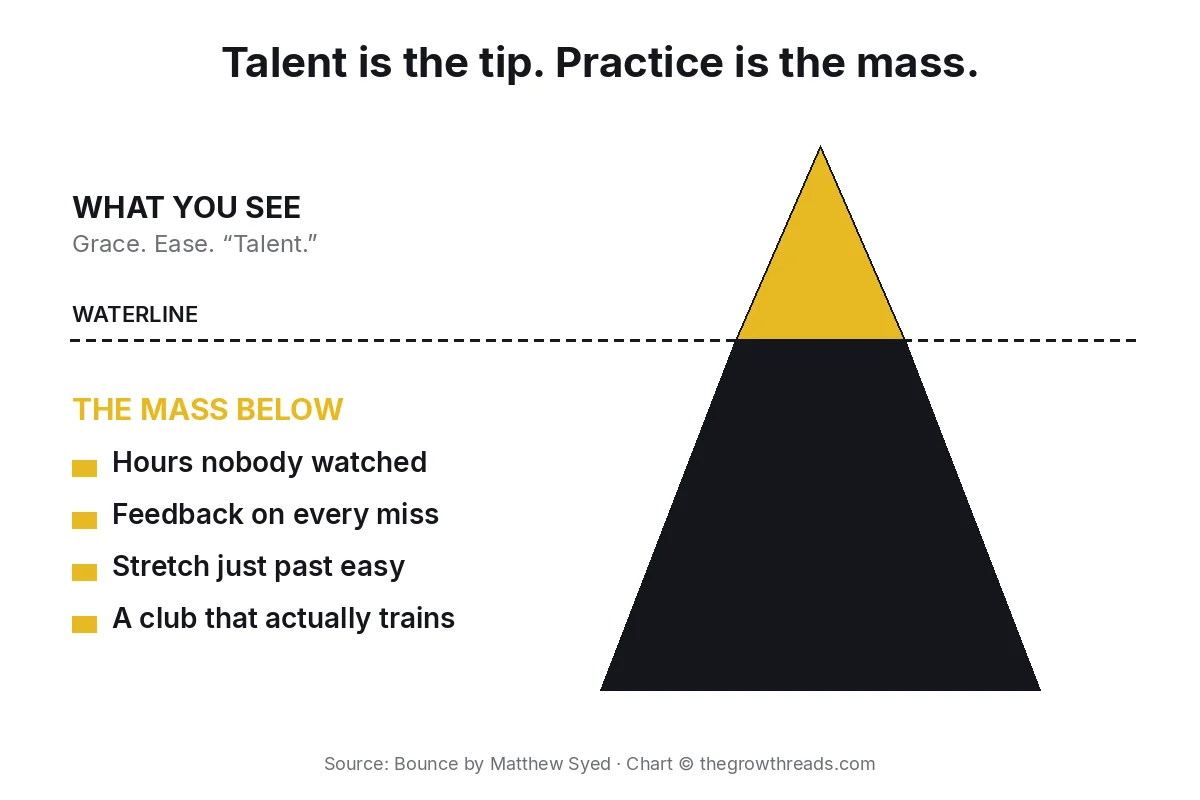
- The iceberg illusion: You see the performance. You miss the years under the waterline. Credit the mass, not a mysterious gift.
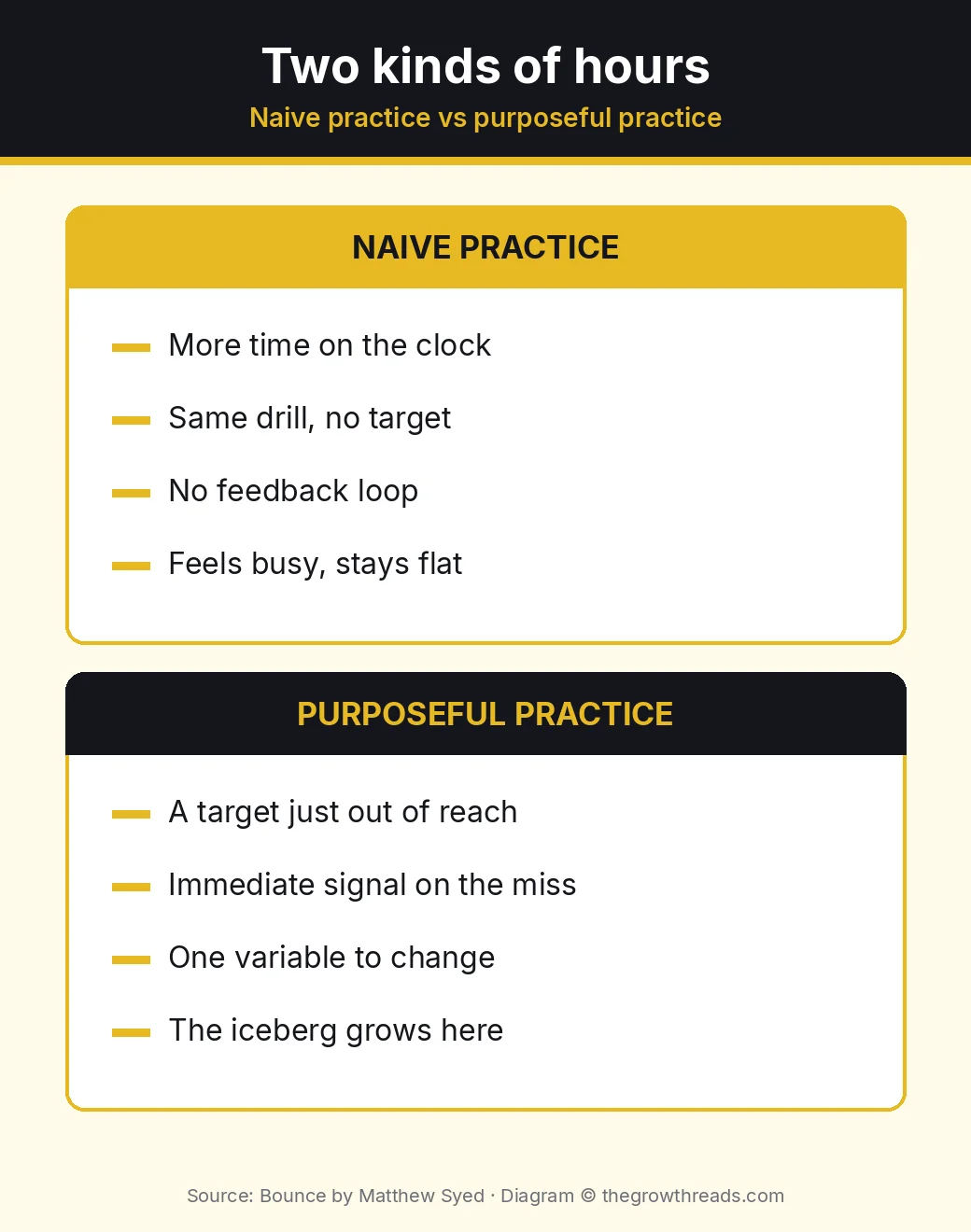
- Purposeful beats naive: A target, feedback, stretch, and an adjustment beat more clock time on the same easy drill.
- Hours are not a receipt: Ten thousand is a headline. Quality decides whether the iceberg grows.
- Prodigies start the clock late: Mozart, chess sisters, and street clusters look born because we ignore the hidden practice.
- Environment trains: One serious club beats a lonely year of casual reps. Borrow a stronger room.
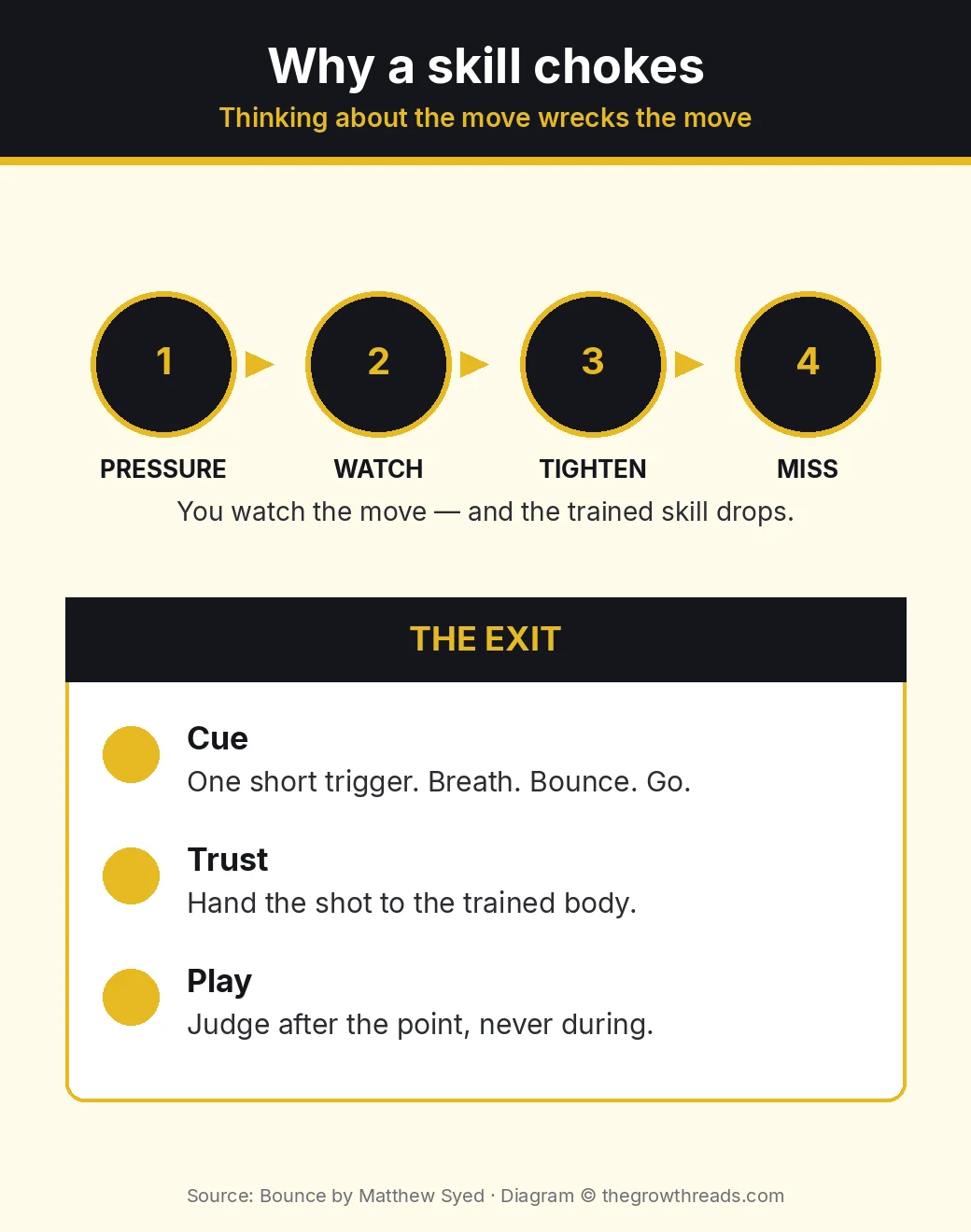
- Choking is extra thinking: Pressure makes you watch the move. The trained skill drops. Cue, then trust.
- Belief is equipment: If you think ability is fixed, you stop stretching. Treat a miss as data, not identity.
- Feedback must be fast: Table tennis tells you now. Knowledge work hides the miss. Build a signal on purpose.
- Practice is a culture: The Reading club, Brazilian futsal touches, a coach who scores the hour — the mass is social.
What is Bounce about?
Bounce argues that excellence looks like talent from a distance because we see the performance and not the purposeful practice underneath it. Syed uses sport, music, and choking research to show how to grow that hidden mass — and how extra thinking wrecks a skill you already have.
About the author
Matthew Syed is a British journalist and former table-tennis Olympian who writes about how people actually get better. Raised in Reading, he became England number one from a club that produced a cluster of national players — the local proof that environment and practice can look like a gift from the outside. A columnist at The Times, he turned that playing life into Bounce, then later into Black Box Thinking, where the subject shifts from building skill to logging failure. He is a translator, not a lab scientist: Ericsson, Dweck, and sport stories aimed at a Tuesday you can change. Start with Bounce if the myth in your way is talent. Start with Black Box Thinking if you already train and still hide the miss. Explore all Matthew Syed book summaries →
Key concepts at a glance
| Concept | What it means | Use it when |
|---|---|---|
| Iceberg illusion | We praise the tip and ignore the mass of hours | You call someone a natural |
| Purposeful practice | Target, feedback, stretch, adjust | The hour felt busy but flat |
| Naive practice | More time, same drill, no signal | You have “put the hours in” |
| Child-prodigy myth | We start counting after the work is invisible | A skill looks born |
| Practice culture | A club, coach, or street that trains on purpose | You only ever practice alone |
| Choking | Watching a trained move under pressure | You can do it in practice, not live |
| Cue and trust | A short trigger, then let the body run | You tighten at the moment of action |
Part 1: The iceberg illusion
Syed’s opening picture is almost rude in its simplicity. Spectators see Federer’s ease, a pianist’s hands, a colleague who “just gets it.” They name that tip talent. Under the water is the mass: years of targeted reps, a coach who scored the miss, a room that expected the work. Syed grew up inside one of those rooms. A table-tennis club in Reading produced a startling share of England’s top players. Outsiders reached for genes. Insiders remembered the table, the hours, and the people who already knew how to train. The cluster was an environment, not a bloodline.
The iceberg illusion is useful because it is visual. You cannot argue with a gift. You can grow a mass. If you have been waiting to feel talented before you practice, Bounce reverses the order: the feeling is what the mass looks like later, from far away. Write the hidden hours for one skill this week. If the list is short, that is not a verdict on your identity. It is the size of the iceberg so far.
TGR Note: If you want the social plot around the 10,000-hour headline, our Outliers summary is the sibling. If you want the lab protocol those hours were built on, Peak is Ericsson in workbook form. Bounce is the picture that makes both feel less optional on a Tuesday.
Part 2: Purposeful practice, not more hours
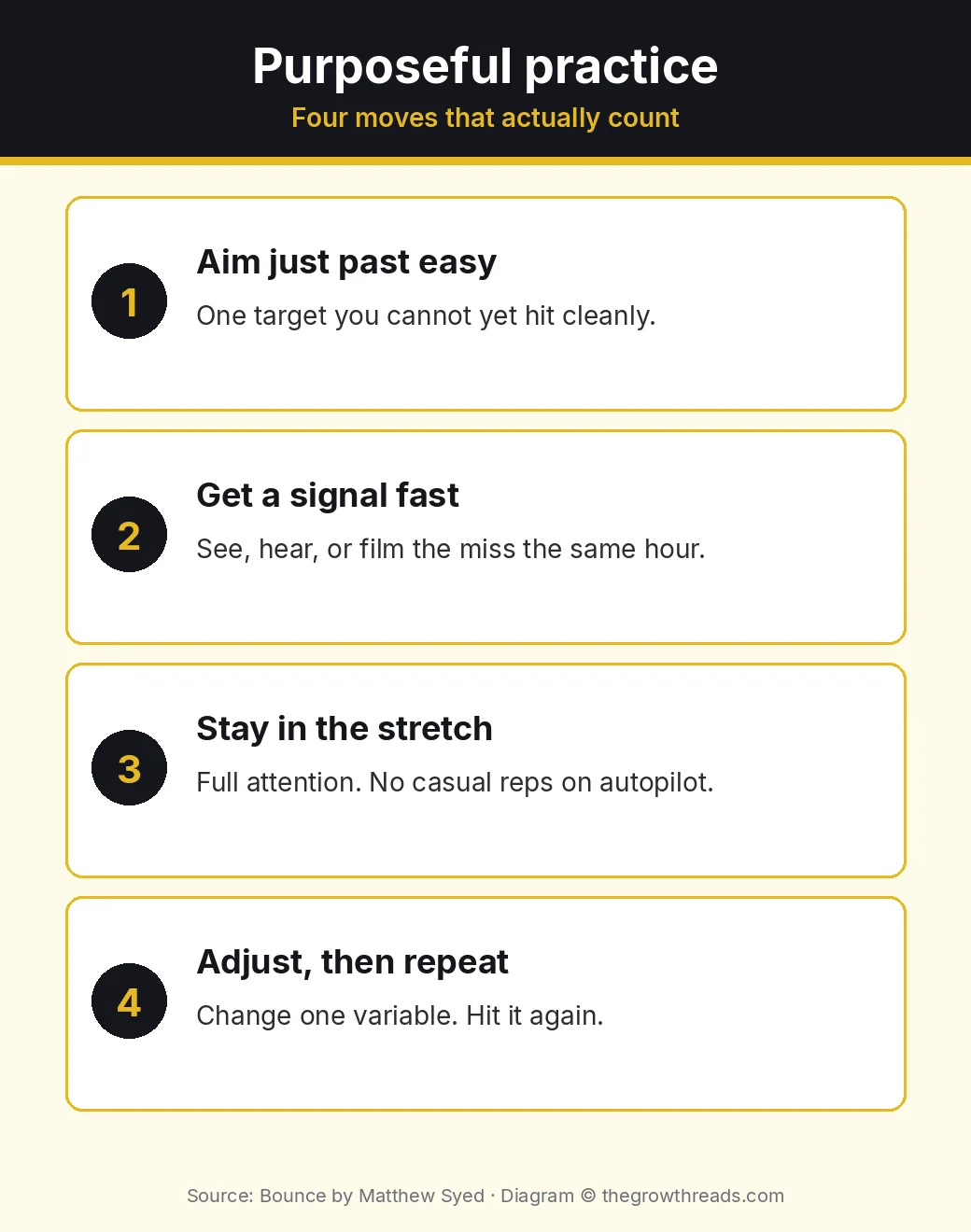
Syed is careful with the famous number. Ericsson’s violinists and Gladwell’s popular “10,000 hours” show up, then the book spends its energy on quality. Naive practice is more time on the clock with the same easy drill. It feels like work. The iceberg does not move. Purposeful practice names a target just past easy, catches the miss while it is still loud, and changes one variable before the next rep. Table tennis is a brutal teacher because the ball reports instantly. Knowledge work often does not. If your job hides the miss until a quarterly review, you have to build the signal on purpose — a score, a film, a second pair of eyes the same day.
Child prodigies get a similar audit. Mozart’s childhood was not a blank calendar with a miracle in the middle. The hours started early, under a father who treated music as a trade. The Polgár sisters were trained, not discovered. Syed’s point is not to scold anyone who lacked that childhood. It is to stop using “prodigy” as permission to skip the next targeted hour. You cannot retro-fit a Reading club onto age six. You can still run one purposeful session at 9 p.m.
TGR Note: The Talent Code is the myelin-and-deep-practice cousin. Talent Is Overrated is Colvin’s business-side version of the same argument. If Bounce is the iceberg picture, those two are extra maps of the mass. Do not collect maps. Run Day 3.
Part 3: Choking and the paradox of thinking
The cruel chapter in Bounce is that more thinking can wreck a skill you already own. Under pressure the explicit system — the voice that names the wrist, the send button, the opening line — grabs a move that lives in the trained body. You watch. You tighten. You miss a shot you can make on a quiet Tuesday. Syed walks through sport chokes because they are filmed, but the loop is familiar at a desk: the presentation you can give in the kitchen and freeze in the room; the exam answer you knew until you watched yourself know it.
The exit is not “try harder to concentrate.” It is a short cue, then trust, then judge after the point. Breath. Bounce. Go. Hand the shot to the hours you already paid for. If you have no hours under the water, cue-and-trust will not invent them — go back to Part 2. If the hours exist and still drop in public, the job is to stop coaching the move while it is in the air. Film one live attempt this week and circle the moment the watcher arrived. That circle is the whole chapter.
TGR Note: If the problem is the inner voice more than the missing hours, our Inner Game of Tennis summary is the closer sibling — Self 1 grabbing Self 2. Bounce tells you why the grab happens under heat. Gallwey gives you more reps on quieting it.
Part 4: Belief, clubs, and a culture that trains
The last movement of Bounce is easy to skip because it sounds softer than icebergs and chokes. It is not. If you believe ability is a fixed gift, you protect the gift. You pick easy drills. You avoid the stretch that might prove you were never special. Dweck’s mindset research is the belief layer Syed needs: a miss has to be information, or purposeful practice feels like an attack on identity. Placebo and expectation show up as performance equipment, not mysticism — the body runs differently when it expects to be able to continue.
Culture does the rest. Brazilian kids racking futsal touches, a club that already knows how to train, a coach who scores the hour: the mass is social. You do not need to move to Reading. You need one borrowed room this week — a stronger player, a prompt, a group that treats the miss as normal. Syed’s later book, Black Box Thinking, is what to do once the skill exists and you still hide the crash. Bounce is the book before that: grow the iceberg, then learn not to narrate every miss as a talent verdict.
Who is Bounce best for — and who should read something else first?
Best for people who stall because they think they lack a gift. Writers waiting to feel like writers. Analysts who say they are “not a numbers person.” Athletes who trained casually for years and called the plateau proof. Bounce will not give you a new calendar app. It will take away the story that the next targeted hour is optional.
Read something else first if you already believe practice works and still freeze on the miss — Black Box Thinking is Syed’s next job. If you want the lab manual, start with Peak. If the block is a fixed identity, Mindset is the belief layer. If you quit when the work stops feeling special, Grit will serve you faster. If you need a tiny daily wedge rather than a talent argument, Atomic Habits is the habit book. Bounce is the talent-myth picture. Use it for that.
Questions to reflect on
- Which skill do you still explain with the word talent — in yourself or in someone you watch?
- If you listed only hours that had a target and a signal, how small is the iceberg?
- Where did you last choke, and what thought arrived just before the miss?
- Who already trains this skill better than you, and what room of theirs could you borrow this week?
- What would change if a miss this month counted as data rather than a verdict on your gift?
🔥 Ready to train the part of the iceberg nobody sees?
Get Bounce, then run the 7-day plan on one skill you have been calling talent — not on someone else’s highlight reel.
How to apply Bounce (7-day plan)
- Day 1 — Name the talent story. One skill you call a gift or a gap. Write the sentence you actually use: “I am not a numbers person,” or “She is just talented.” That sentence is the waterline.
- Day 2 — Count the hidden hours. List practice that had a target and a signal. Ignore busy time. If the list is thin, you found the iceberg, not a personality.
- Day 3 — One purposeful session. Twenty to forty minutes. One target just past easy, full attention, one variable you will change if you miss.
- Day 4 — Log the miss the same day. What you tried, what happened, what you will alter tomorrow. No identity speech. Facts only.
- Day 5 — Catch the choke. Notice one moment you watched yourself and tightened. Circle the thought. That is explicit monitoring, not a lack of talent.
- Day 6 — Install a cue. One short trigger before the move: breath, bounce, “go.” Then do not coach the shot while it is in the air.
- Day 7 — Borrow a better room. One session with a stronger player, a coach prompt, or a group that trains. Culture is part of the mass under the water.
Frequently asked questions
What is Bounce about in one paragraph?
Bounce is Matthew Syed’s 2010 case that what looks like talent is usually the visible tip of purposeful practice. He uses table tennis, music, and sport — plus the science of choking — to show that hours without a target stay flat, while hours with feedback and stretch compound. Child prodigies look magical because we start the clock late. This summary is the application layer: pick one skill you have been calling a gift, design one purposeful session, and run the 7-day plan. You do not need a national coach. You need a target just past easy and a note on the miss.
Is the 10,000-hour rule the point of Bounce?
No. Syed borrows Ericsson’s research and Gladwell’s popular number, then spends the book on quality. Naive hours — more time, same drill, no signal — do not grow the iceberg. Purposeful hours name a target, catch the miss, and change one variable. Ten thousand is a headline, not a receipt. If you have already logged a decade of casual reps, Bounce will not congratulate the calendar. It will ask whether any hour last week left the comfort zone with a score attached. Day 3 of the plan is that test: one session you could not sleepwalk.
How is Bounce different from Outliers or Peak?
Outliers explains why success is never a solo act — timing, culture, the 10,000-hour frame. Peak is Ericsson’s lab manual for deliberate practice. Bounce sits between them as a reporter’s tour: Syed was England’s table-tennis number one, so the iceberg is a story he lived, not only a study he cites. Read Outliers if you want the social plot. Read Peak if you want the protocol. Read Bounce if you keep calling a skill talent and need the picture that makes practice feel less optional. Black Box Thinking is the later Syed book, about logging failure after the skill exists.
What is the iceberg illusion?
You see Federer’s ease, a concert pianist’s hands, a colleague who “just gets it.” You do not see the years of targeted reps under the waterline. Syed calls that the iceberg illusion: we credit the tip with a gift and ignore the mass — hours, coaching, feedback, a club that trains. The practical move is to stop arguing about whether you were born with the tip and start growing the mass this week. Write the hidden hours for one skill. If the list is short, that is information, not a verdict on your identity.
Why do skilled people choke?
Under pressure the explicit system grabs a skill that already lives in the trained body. You watch the swing, tighten, and miss a shot you can make in practice. Syed’s choke chapters are a warning against more thinking at the worst moment. The exit is a short cue, then trust, then judge after the point. If your freeze is a blank exam or a frozen send-button, the same loop applies: name the watcher, install a one-word trigger, and let the practiced sequence run. Inner Game of Tennis is the sibling if the problem is the voice, not the hours.
Who should read Bounce — and who should start elsewhere?
Read Bounce if you stall because you think you lack a gift. Skip it as a first book if you already believe practice works and still hide the miss — Black Box Thinking is that next job. If you need the lab protocol, start with Peak. If the block is “I am not a math person,” Mindset is the belief layer Bounce assumes. If you quit when the work stops feeling special, Grit or The Dip will serve you faster. Bounce is the talent-myth book. It is not a time-management system and not a failure log.
How do I apply Bounce this week if I am not an athlete?
Pick a skill with a score: a pitch, a piece of code, a language drill, a free-throw equivalent at your desk. Day 1 name the talent story. Day 2 write the real hours. Day 3 run one purposeful session — target, stretch, feedback. Day 4 log the miss without a personality lecture. Day 5 notice where you watched yourself and froze. Day 6 install a cue. Day 7 borrow a stronger room: a better player, a coach prompt, a club. Bounce transfers because the iceberg is a structure, not a sport. The racket is optional. The target is not.
Related summaries
- Black Box Thinking — Syed’s later book: log the miss once the skill exists
- Peak — Ericsson’s lab manual for deliberate practice
- The Talent Code — deep practice and the biology of reps
- The Inner Game of Tennis — the voice that grabs the shot
- Best productivity books — the full silo list
How we analyze books: every book on The Growth Reads is read cover to cover, summarized in thousands of words of original analysis, and rated against our five-criteria rubric (lasting impact, evidence quality, practical application, writing & originality, external consensus). Read our full methodology.