

★★★★ 4.4/5 — The memoir that still teaches pleasure, devotion, and a Tuesday that can hold both.
Best for: Anyone living a finished-looking life that feels empty at 4 a.m., readers who treat joy as a moral failure, and people who want a self that can love without using a partner as anesthesia
Reading time: ~7–9 hrs for the Riverhead 400-page paperback · ~14 min for this guide
Difficulty to apply: Copying the itinerary is a fantasy. Running one meal, one sit, and one honest sentence this week is a practice.
Eat Pray Love in one minute
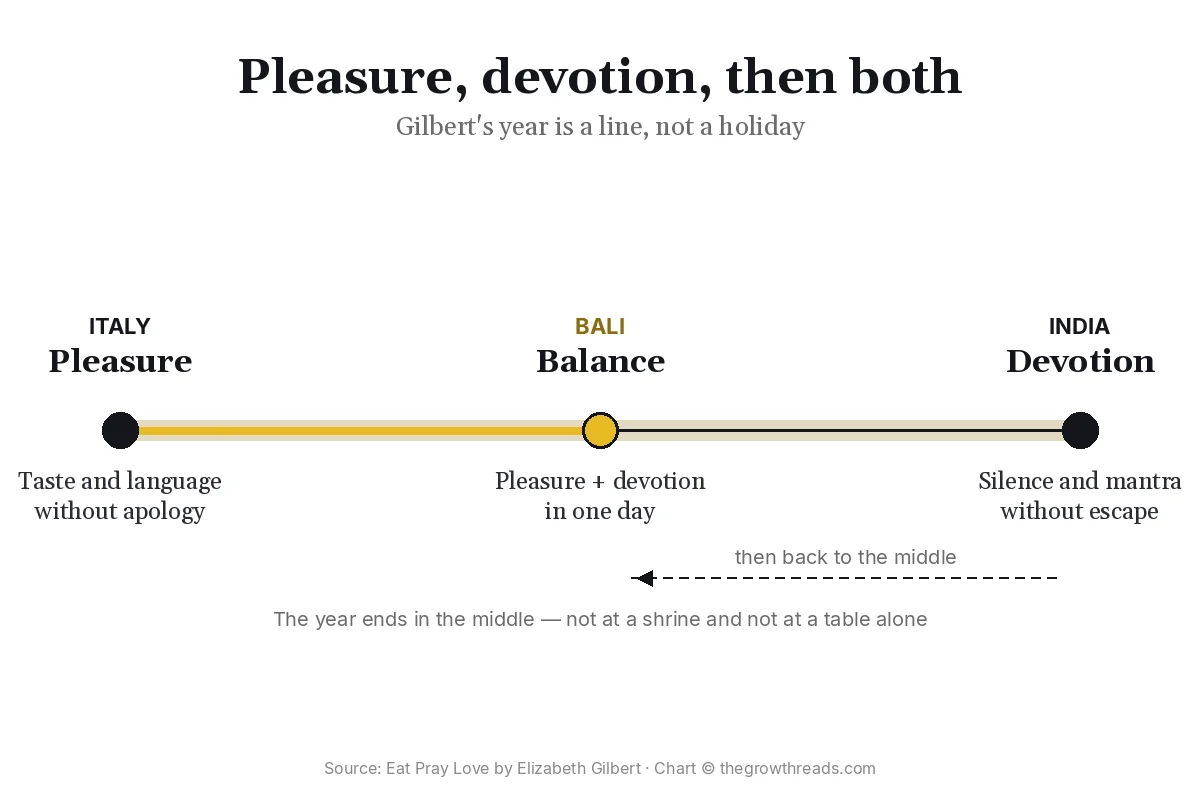
Elizabeth Gilbert’s 2006 memoir argues that a life can intern in pleasure, intern in devotion, and then refuse to pick a side. After a marriage she can no longer tell the truth in, she spends four months in Italy learning to eat and to speak, four months in an Indian ashram learning to sit, and four months in Bali learning to hold both in one ordinary day. The usable move is not a plane ticket. It is taste something, stay with your mind, tell the truth, then do the first two on the same Tuesday. Diagnostic: last night, did you have a pleasure and a devotion — or only a role?
Key takeaways
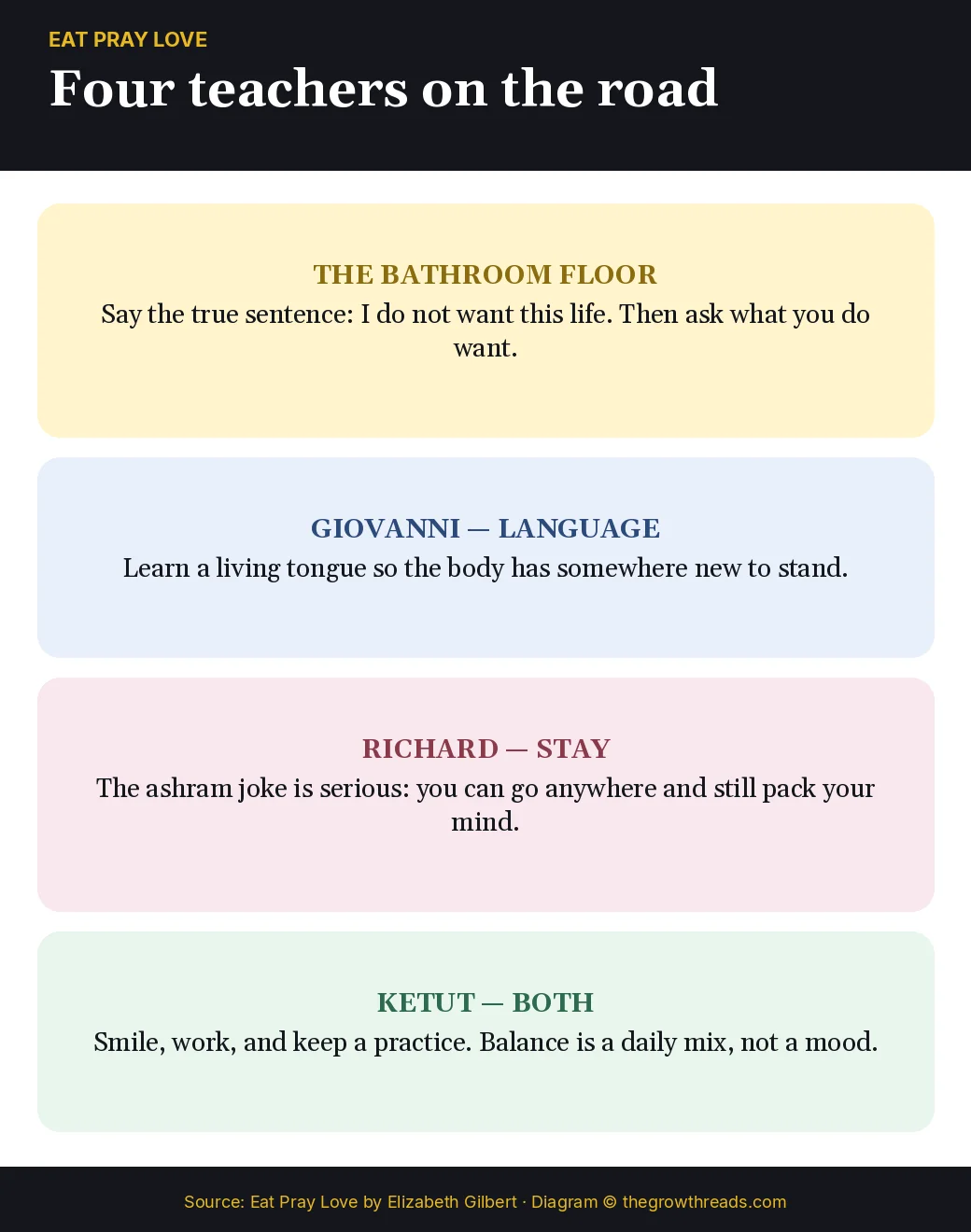
- The crisis is a true sentence you have been postponing: Gilbert’s 4 a.m. bathroom floor is not scenery. It is the moment she says she does not want the life she built — then asks what she does want.
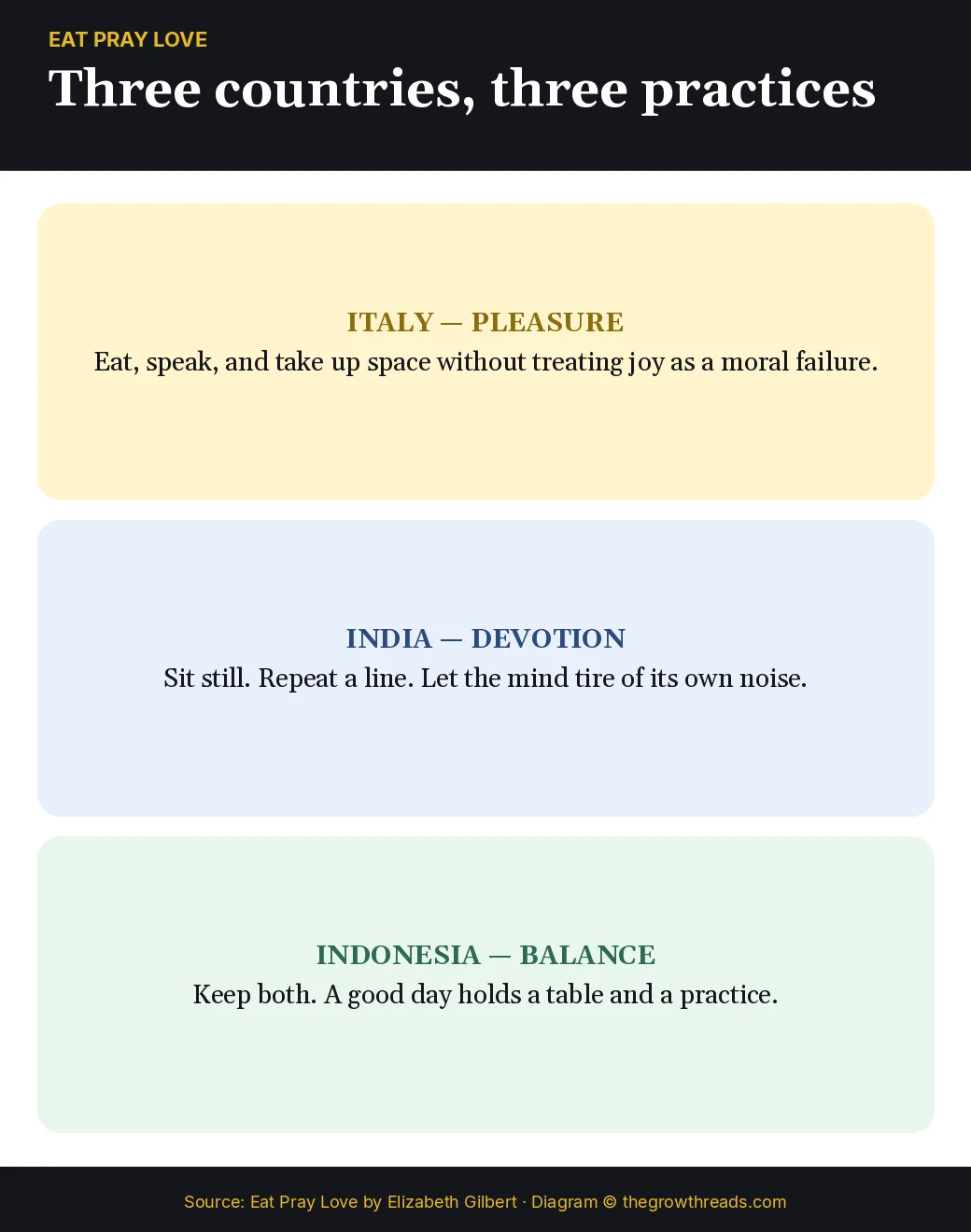
- Pleasure is a practice, not a prize: Italy is food, language, and taking up space without treating joy as evidence you are unserious.
- Language relocates the body: Italian is not a hobby. It is a room that is not wife, not deadline, not the old house.
- Devotion is staying when the mind wants a new country: Richard from Texas’s joke is that you can fly anywhere and still pack your personality.
- Silence is a workout: Mantra and chanting are reps. The mind tires of its own noise only if you keep showing up.
- Friendship is on the curriculum: Giovanni, Richard, Wayan, and Felipe are not souvenirs. Honest company is how a practice becomes a life.
- Balance is both poles in one day: Ketut’s medicine is mix, not a third exotic. Smile, work, keep a practice. A good day holds a table and a prayer.
- Love arrives after a self exists: The romance is the last movement. A partner cannot be anesthesia for a life you will not inhabit.
- Happiness is effort you can schedule: Meals, sits, sentences — not a personality you wait to feel. Gilbert’s line is a method.
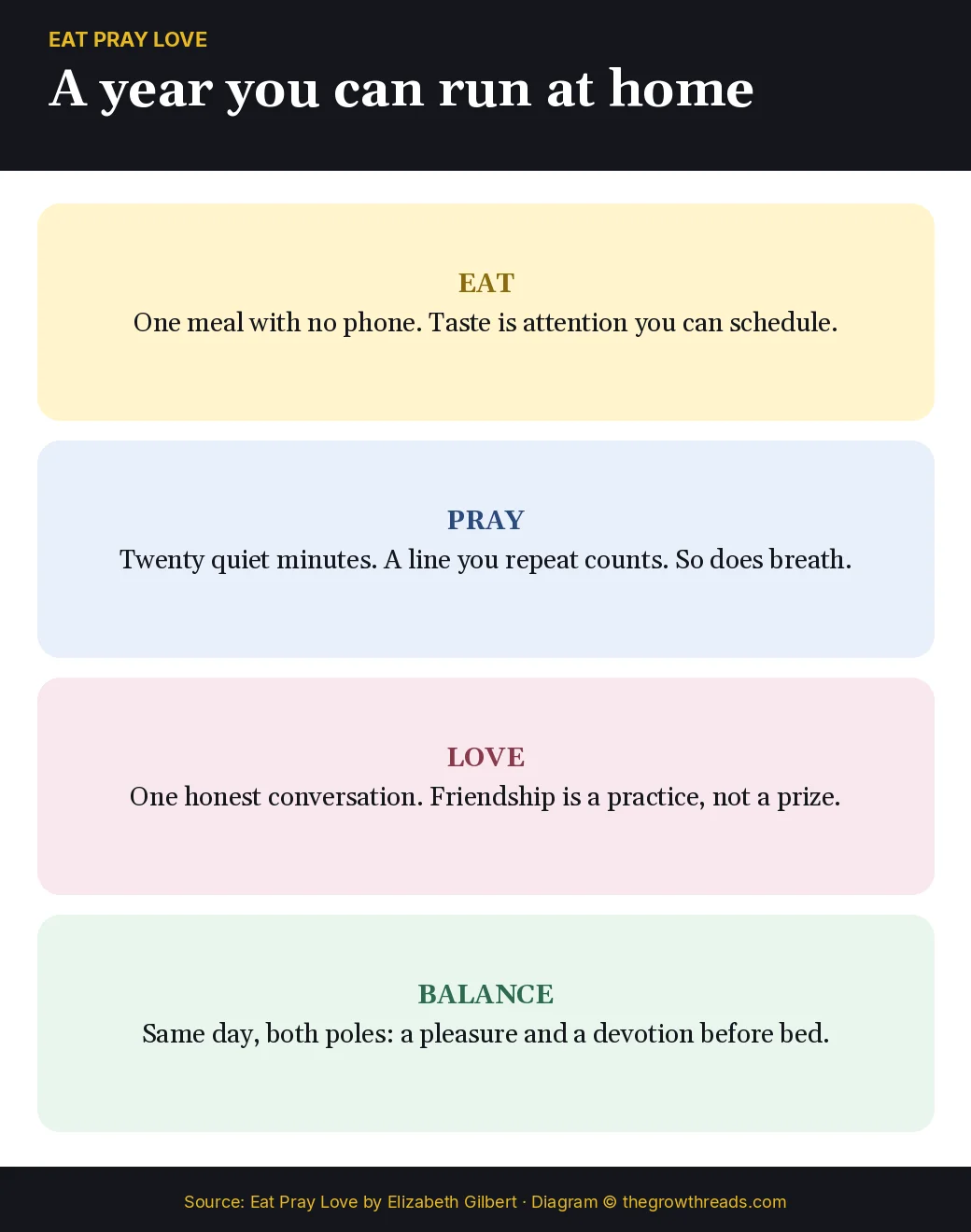
- You do not need her year to steal her week: One tasted meal, twenty quiet minutes, one honest conversation, then both poles before bed.
What is Eat Pray Love about?
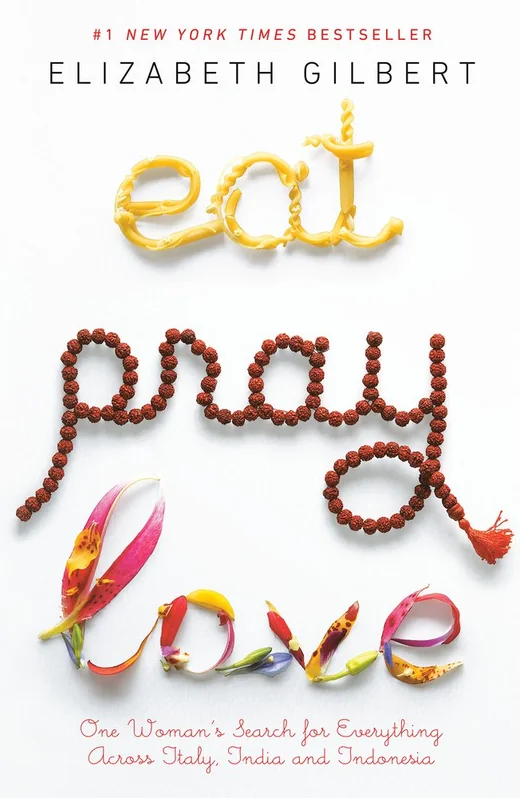
Eat Pray Love is Elizabeth Gilbert’s 2006 memoir of a year in Italy, India, and Indonesia after divorce. She practices pleasure, then devotion, then balance — a life that can hold a table and a prayer — and argues that those three internships are how a person becomes someone who can love without disappearing.
About the author
Elizabeth Gilbert was born in 1969 in Waterbury, Connecticut, and became the journalist who made a private collapse a public curriculum. She wrote for GQ and The New York Times Magazine, published Stern Men and The Last American Man, then turned a year of travel into Eat Pray Love (Viking, 2006), a #1 New York Times bestseller later adapted for film. Committed followed as a sequel on marriage; Big Magic (2015) turned her TED talk on genius as a visitor into a book on creative living beyond fear. She is not a couples therapist. She is a reporter who treated her own 4 a.m. as fieldwork and came back with three practices a reader can run without her passport. Explore all Elizabeth Gilbert book summaries →
Key concepts at a glance
| Concept | What it means | Use it when |
|---|---|---|
| The true sentence | Saying I do not want this — then asking what I do — before decorating the old life | Your days look finished and your 4 a.m. does not |
| Pleasure as internship | Food, language, and rest practiced on purpose, not earned after suffering | Joy feels like evidence you are unserious |
| Language as a new room | A living tongue gives the body a place that is not the old role | Every room you enter still calls you by the last job |
| Devotion as staying | Silence, mantra, and showing up when the mind wants a new city | You keep solving restlessness with logistics |
| The packed mind | You can change countries and still travel with the same personality | A trip, a job, or a breakup is doing all the spiritual work |
| Balance | Pleasure and devotion in one ordinary day — Ketut’s mix, not a mood | You are either at a table or on a cushion, never both |
| Friendship as practice | Honest company is part of the path, not a reward at the end | You are doing the year as a solo performance |
| Love after a self | A partner is not anesthesia for a life you will not inhabit | You are shopping for a person to finish your sentence |
Part 1: The bathroom floor — tell the true sentence
The book opens where a lot of “fine” lives actually live: a house, a marriage, a career that photographs well, and a 4 a.m. that will not. Gilbert is in her early thirties, on a bathroom floor, trying to pray to a God she is not sure she believes in. The scene is famous because it is specific. She can no longer tell the truth inside the life she built. Depression, panic, a divorce, and a rebound that also will not hold are the weather. Underneath: I do not want this. Then: What do I want?
She does not skip from the floor to a boarding pass. She writes the want as three internships — pleasure, devotion, balance — and assigns each a country she already has a thread to. Italy is the language she loved as a girl. India is an ashram tied to a guru whose photograph she already keeps. Bali is Ketut Liyer, a medicine man she met years earlier while reporting. Four months each. Eat. Pray. Then try to hold both. The year is unusual. The diagnostic is not. If you cannot say the true sentence, you will decorate the old life and call it gratitude. If you can say it, you still need practices, not a personality transplant. Collapse is information. Information needs a curriculum or it becomes a mood.
TGR Note: If the bathroom floor is a cage you cannot name, Untamed is the sharper permission slip. If you need love defined as a practice rather than as a flight, add All About Love.
Part 2: Italy — pleasure without apology
Rome is not a reward for surviving the divorce. It is the lab where Gilbert practices being a body that is allowed to want things. She enrolls in language school, eats, sleeps, and walks until the city is in her legs. The Italian lessons matter more than the gelato photographs. A new grammar gives her a room that is not “wife” and not “woman who left.” Giovanni, a young speaker she befriends, is a language partner and a reminder that conversation can be play. Pleasure here is competence plus sensation, not shopping.
She gains weight and writes about it without a before-and-after plot. Naples pizza is a pilgrimage because flavor is attention. Joy is not the opposite of a serious life. A person who cannot take pleasure will outsource aliveness to drama, work, or a partner. Italy is where she stops treating rest as laziness: taste this, name it, do not apologize. If your version cannot be Rome, it can still be one meal with the phone in another room and ten phrases of a skill you have been calling impractical. Pleasure you can schedule is the part of the book that survives a budget.
TGR Note: Gilbert’s later, shorter book on making things without waiting to feel brave is Big Magic. For agreements you keep with yourself while you learn to take up space, The Four Agreements is the pocket version.
Part 3: India — devotion means staying
The ashram is the correction to Italy, not the cancellation of it. Gilbert goes to sit, chant, work, and stop using motion as medicine. Days are structured: early rising, the Guru Gita, service, meals, silence. Richard from Texas names the trick the rest of us use. You can change the scenery and keep the mind. If you will not stay on the cushion, you will lease a new country every time you feel restless. Devotion, here, is reps. A mantra is a tool for returning. The point is not a mystical personality. It is to be in the room when your thoughts try to leave it.
She fails at sitting, then fails less. Spiritual life includes being terrible at it on a Wednesday. Friendship stays on the curriculum — Richard is proof that devotion is not a solo brand. When she leaves India she is not enlightened. She is someone who has practiced not bolting. Twenty minutes with no input will not make you a nun. It will show you whether restlessness is a travel problem or a staying problem. Most of us have been solving a staying problem with logistics.
TGR Note: If sitting with the mind is the whole job, Maybe You Should Talk to Someone is the therapy-room sequel. For vulnerability as a skill rather than as a pilgrimage, Daring Greatly.
Part 4: Bali — balance is both, in one day
Indonesia is where the book refuses a false choice. Ketut Liyer, the Balinese medicine man Gilbert met years before, teaches mix: smile, work, keep a practice. Wayan, a healer and friend, pulls her into practical love — helping, being of use — so the year does not become a private spa. Felipe, the man she falls for, arrives late on purpose. The romance is allowed. It is not allowed to be the meaning of the year. A partner who meets a person with a practice is different from a partner hired to finish a sentence the speaker will not say.
Balance, as Ketut frames it, is not a vibe and not a third country you visit after you have been good. It is pleasure and devotion on the same ordinary day: a meal you taste and a prayer you keep. Gilbert’s line that happiness is the consequence of personal effort sits here as a method. Effort means scheduled pleasure, scheduled sitting, then telling the truth in company. The year ends in the middle of the continuum, not at a shrine and not at a table alone. You do not need Bali for that geometry. You need a Tuesday that holds both poles and a rule you can put on a fridge. “Taste, sit, tell truth” is enough. A serious life can include pasta. A joyful life can include silence. Love, when it comes, meets a person who already lives there.
TGR Note: When a self exists and you want the science of how two people bond, Attached and Mating in Captivity are the relationship shelves this memoir is not. The 5 Love Languages is the simpler decoder ring.
Who is Eat Pray Love best for — and who should read something else first?
Read it if your life looks complete and your 4 a.m. does not, you treat pleasure as proof you are unserious, or you keep using travel, work, or a partner as the only way to feel alive. A memoir with three practices, not a 30-day protocol.
Read something else first if you need bids, repair, and fight ratios this week — start with The Seven Principles for Making Marriage Work or Attached. If you need a sharper permission slip to stop performing, Untamed. If you want love as an ethic rather than as a year, All About Love. This is not therapy advice and not a command to leave. It is a map of pleasure, devotion, and balance so the next Tuesday can hold both.
Questions to reflect on
- What true sentence have you been postponing — I do not want ______ / I want ______ — and can you say it in one line?
- Where do you treat pleasure as a moral failure instead of as attention you can schedule?
- When restlessness hits, do you change the scenery, or can you stay for twenty minutes?
- Who in your life is a Richard or a Giovanni — honest company, not an audience?
- Did yesterday include both a pleasure and a devotion, or only a role?
🔥 Ready to run the year at home scale?
Start with the bathroom-floor chapters, then read Italy and the ashram before you treat Bali as a romance.
How to apply Eat Pray Love (7-day plan)
- Day 1: Write the 4 a.m. sentence: I do not want ______. Then write I want ______ in one line you could say out loud.
- Day 2: Eat one meal with the phone in another room. Name three flavors before you name the day.
- Day 3: Practice ten phrases of a language — or a skill — you have been postponing. Pleasure includes competence.
- Day 4: Sit twenty minutes with no input. When the mind runs, return to one line or to the breath.
- Day 5: Do a small devotion you will repeat tomorrow: a mantra, a prayer, a walk without headphones.
- Day 6: Have one honest conversation. Friendship is how the ashram joke becomes a life.
- Day 7: Same day, both poles: one pleasure and one devotion before bed. Write a four-word house rule. Example: “Taste, sit, tell truth.”
Frequently asked questions
What is Eat Pray Love about?
Eat Pray Love is Elizabeth Gilbert’s 2006 memoir of a year in Italy, India, and Indonesia after her marriage collapsed. Rome is pleasure (food and language), an Indian ashram is devotion (silence, mantra, staying), and Bali is balance — a life that can hold a table and a prayer. The usable move is not booking a year off. It is those three practices in ordinary weeks: one meal you taste, one quiet sit, one honest conversation, then both poles on the same day. A memoir with a curriculum, not a travel brochure and not a couples-therapy manual.
Is Eat Pray Love still relevant in 2026?
Yes — the airports aged; the split did not. Plenty of readers still live a life that looks finished from the outside and empty at 4 a.m. Apps changed the props. Pleasure without apology, devotion without escape, and a Tuesday that holds both are still the chassis. The Riverhead paperback we link is the trade edition of the 2006 Viking book. Read it as three practices, then ignore any pressure to copy her itinerary. If you only want a later, shorter Gilbert, Big Magic is the creativity sequel. If you want love as ethics rather than as a year abroad, start with All About Love.
Eat Pray Love vs Untamed vs All About Love — which should I read first?
Read Eat Pray Love first if you need a story that shows pleasure, devotion, and balance as practices, not slogans. Read Untamed first if you are still performing a good-girl script and need a sharper permission slip to stop. Read All About Love first if you want love defined as a verb and an ethic, not as a trip. They stack. Gilbert is the year. Doyle is the cage. hooks is the standard. If you only have a weekend and your life looks fine while your 4 a.m. does not, start here, then steal hooks’s definition before you call the year a personality.
Do I have to travel for a year to use this book?
No. The year is a research method, not a franchise. Gilbert can go to Rome because she had a book advance, a passport, and a body that could leave. Your version can be a trattoria two bus stops away, twenty minutes of silence before email, and a walk you do not narrate on a phone. The transferable habits are tasting, sitting, telling the truth, and refusing to live at only one pole. If the travel chapters bore you, steal Ketut’s mix: work, smile, keep a practice. That mix works in a city kitchen.
Is Eat Pray Love a relationship book or a memoir?
Both, and neither is a couples workbook. The marriage is the opening wound. The rest of the book is how a person rebuilds a self that can later love without using a partner as anesthesia. If you need bids, repair, and fight ratios, read The Seven Principles for Making Marriage Work or Attached. If you need to stop disappearing into a role, this is the better first read. It will not tell you whether to stay. It will ask whether the life you are defending is one you can tell the truth in at 4 a.m.
How long is Eat Pray Love and which edition should I buy?
The Riverhead paperback we link is ISBN-13 9780143038412, about 400 pages, published 30 January 2007, originally Viking on 16 February 2006. Most readers finish it in seven to nine hours, often as three sittings — Italy, India, then Bali. There is a 10th-anniversary jacket with an updated introduction; the curriculum is the same. This summary is about fourteen minutes and is not a replacement for the ashram and Ketut chapters. Buy the edition you will actually finish. The 7-day plan above is our application layer, not her itinerary.
Is the book telling me to leave my marriage — and is this therapy advice?
No, and no. Gilbert leaves a marriage she can no longer tell the truth in. That is her case, not a template. Plenty of readers need to stay, repair, and tell the truth inside the house. The book will not diagnose depression, advise on custody, or replace a licensed therapist. Use it as a map of three practices, then take personal mental-health and relationship decisions to clinicians who have your chart. Education, not a prescription. The 7-day plan is literacy practice for pleasure and devotion, not a treatment protocol.
Related summaries
- All About Love — hooks’s ethic: love as a verb, not a year abroad.
- Untamed — Doyle’s permission slip if you are still performing the good-girl script.
- Attached — the science of how you bond once a self exists.
- Big Magic — Gilbert’s later book: fear can ride, it cannot drive.
Browse titles on our Best Relationship Books pillar page.
How we analyze books: our summaries are built from a full read of the source text, cross-referenced against the author’s published interviews and research where relevant, and structured around practical application rather than critique. Read our full methodology.