

★★★★☆ 4.4/5 — A campus operating system: five-minute planning, a closed door, and notes you can quiz.
Best for: students drowning in rereading, and professionals who still treat a hard week like a mood instead of a job.
Reading time: ~4 hours (224 pages) · this guide ~13 min
Difficulty to apply: Easy to start — one Sunday list. Medium to keep — isolation and self-testing feel rude at first.
How to Become a Straight-A Student in one minute
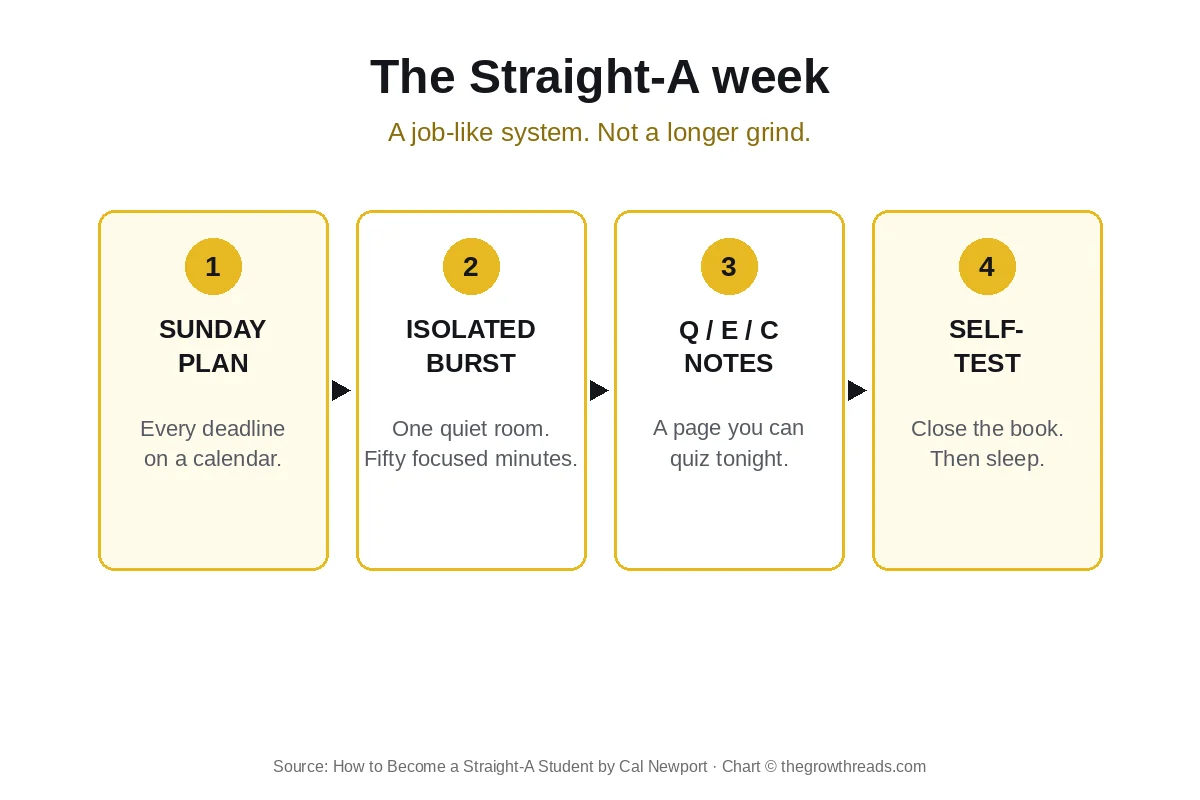
Straight-A students do not study more. They waste less. Cal Newport wrote this Broadway book in 2006 after interviewing classmates who earned A’s without living in the library. The pattern was a job, not a personality: a Sunday list that takes five minutes once it is a habit, the same quiet rooms, short isolated bursts, and notes built as Question / Evidence / Conclusion so review is a quiz. Exam week is self-testing and practice problems, not a highlight marathon. Papers move through research, outline, prose, and edit as separate stages. Sleep is part of the method. If you only remember one sentence, remember this: put the week on a calendar, close the door, and quiz the page — then stop.
Key takeaways
- Treat school like a job: limited hours, written commitments, then you clock out.
- The Sunday list: every test, paper, and problem set gets a block. Five minutes, not a lifestyle redesign.
- Daily update: move what slipped. A dead plan is how all-nighters get scheduled.
- Isolate the work: same quiet rooms. Dorms and group tables are social, not study.
- Short bursts beat fog: fifty focused minutes outperform a six-hour “I’m at the library” session.
- Q/E/C notes: Question, Evidence, Conclusion. If you cannot quiz the page, it is a transcript.
- Exams are retrieval: non-technical classes become quizzes you wrote. Technical classes become problems you do.
- Papers in stages: research, annotated outline, write, edit. Collapse them and the night collapses.
- Sleep is a study tool: an all-nighter steals the recall you just built.
- The goal is wasted-hour reduction: not a longer grind with better stationery.
What is How to Become a Straight-A Student about?
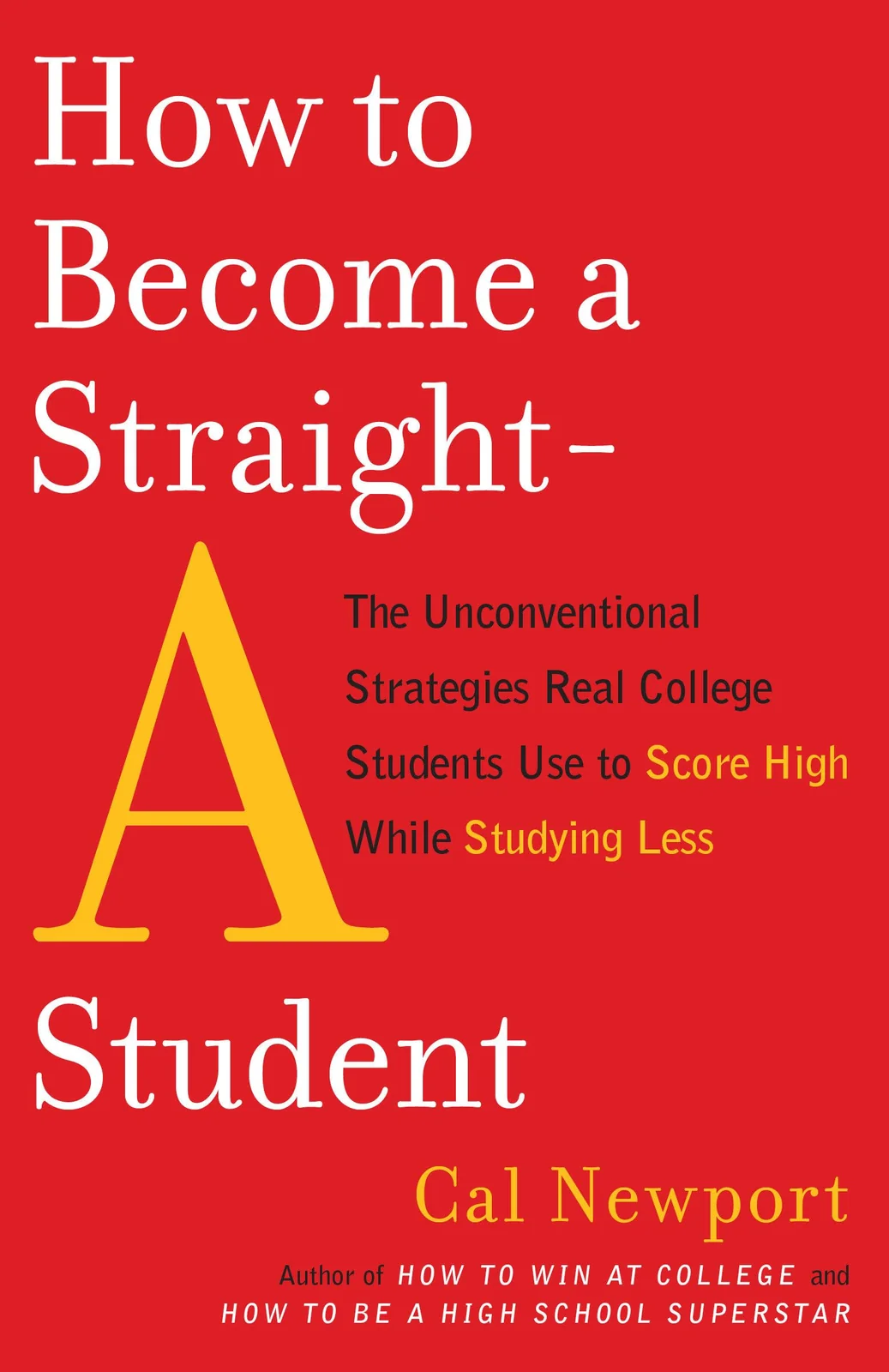
How to Become a Straight-A Student is Cal Newport’s field manual for high marks without library marathons. Straight-A students ran a job-like system: a five-minute weekly plan, isolated work, Q/E/C notes, quiz-and-recall exams, and papers in stages. The promise is fewer wasted hours, not more of them.
About the author
Cal Newport was a Dartmouth undergraduate when he started interviewing the classmates who earned A’s without disappearing into the stacks. That reporting became How to Win at College (2005) and then this book (2006), written while he was still close to the desks he was describing. He later earned a Ph.D. in computer science at MIT and joined Georgetown as a professor. Deep Work, So Good They Can’t Ignore You, Digital Minimalism, A World Without Email, and Slow Productivity are the grown-up versions of the same argument: intensity beats duration, and a system beats a mood. Straight-A Student is the campus original. He writes the Study Hacks blog and has become one of the clearest voices against the hyperactive hive mind. Explore all Cal Newport book summaries →
Key concepts at a glance
| Concept | What it means | Use it when |
|---|---|---|
| Sunday 5-minute plan | List every deadline and give it a block. | The week lives in your head and in panic. |
| Daily update | Five minutes to move, add, and drop. | Yesterday’s plan is already fiction. |
| Declared locations | The same quiet rooms, used on purpose. | You “study” in a dorm or a café with friends. |
| Isolated bursts | Short, closed-door sessions. Then a break. | A six-hour library sit produced three pages of highlighting. |
| Q/E/C notes | Question, Evidence, Conclusion per chunk. | Your notebook is a transcript you cannot quiz. |
| Quiz-and-recall | Close the book and answer questions you wrote. | Exam prep is rereading chapters you already marked. |
| Technical practice | Do the problems. Reading is not the work. | A STEM class is being “reviewed” with a highlighter. |
| Paper stages | Research, outline, write, edit — separately. | The paper appears the night before as one blob. |
Part 1: Study basics — five minutes and a closed door
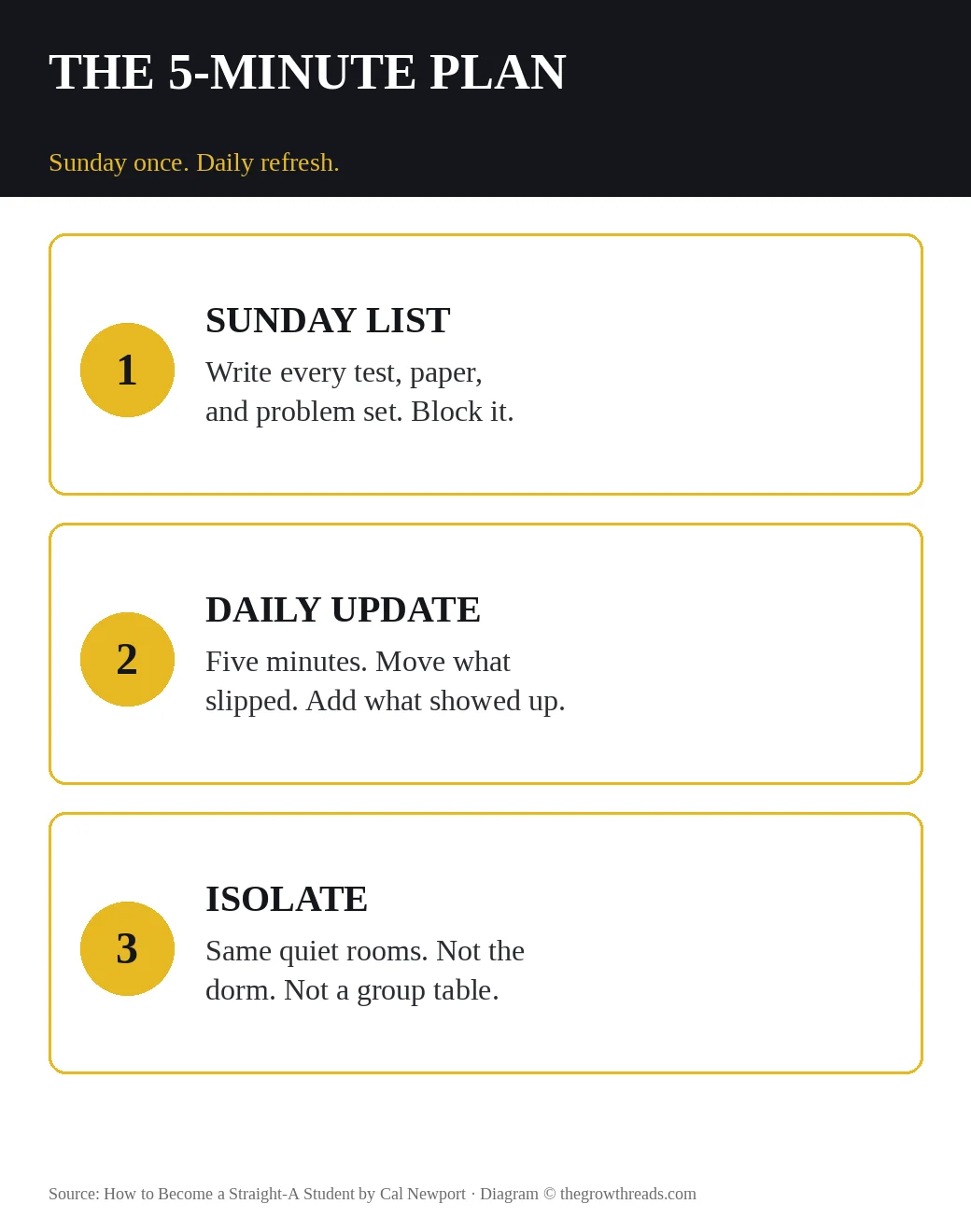
The opening move is almost insultingly small, which is why people skip it. Once a week — Newport’s students used Sunday — you write down every assignment, quiz, paper, and problem set that will come due. You give each item a block. The first week takes longer than five minutes. The habit, once the calendar exists, is a short scan: what is still true, what moved, what you were pretending was optional. Each morning or each night you spend another five minutes updating. That is the whole “time management system.” It is not a color-coded life OS. It is a refusal to keep a semester in working memory, where it turns into 1 a.m. surprise.
The second basic is place. Straight-A students declared a few work locations and returned to them. A quiet floor of the library. A unused classroom. Not the dorm, where the bed and the roommate and the chat window all vote for fog. Not the “study group” table that is a social event with books as props. Isolation is not antisocial as a personality. It is a design choice for the hour that has to produce a problem set. The hour itself is short. Newport’s reporting favored focused bursts — roughly a class period — over the heroic six-hour sit. Eat when you are hungry. Sleep. The body is not a footnote. An all-nighter is how you spend tomorrow’s recall to soothe tonight’s anxiety.
TGR Note: If the grown-up version of this closed door is what you actually need, start with our Deep Work summary — same author, office instead of dorm. If the list is the leak, Getting Things Done is the heavier capture system. Straight-A Student is the campus-sized slice: one week, one calendar, one quiet room.
Part 2: Notes that think — Question, Evidence, Conclusion
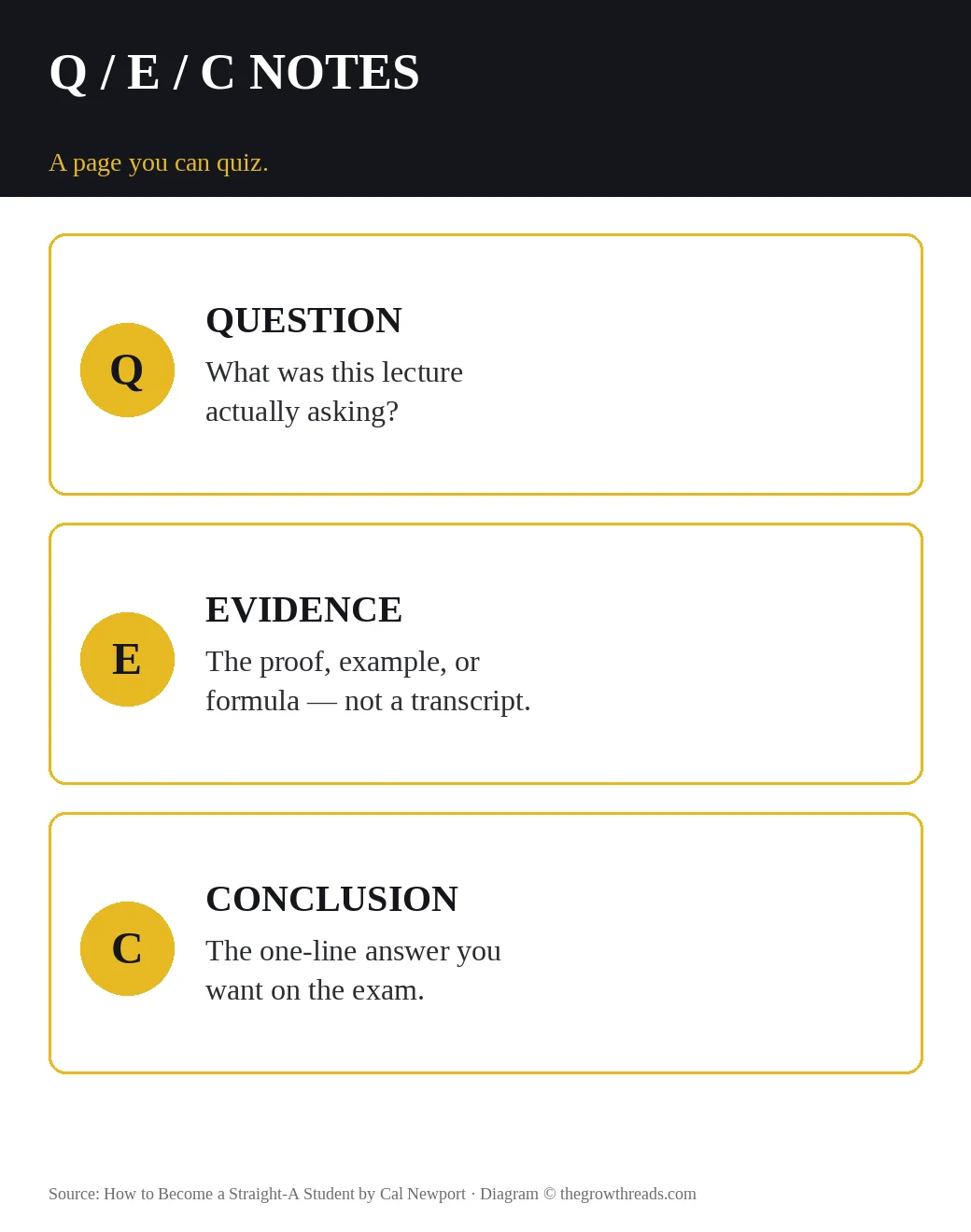
Most notes are a fear of missing the slide. They feel responsible and they die in the bag. Newport’s straight-A students built notes they could quiz. The format is Q/E/C. For each chunk of a lecture or a chapter you write the question that chunk was answering, the evidence — the proof, the example, the formula, the case — and a one-line conclusion you want available under exam lights. You do this while the class is still warm, not three weeks later when the handwriting is archaeology. The page is no longer a transcript. It is a set of prompts.
That is the whole trick. Review becomes retrieval. You cover the evidence and try to answer the question. You fail, look, and try again. Highlighting a sentence you already understood is a mood. Answering a question you wrote is practice. Technical classes use the same idea with a different object: the “question” is a problem type, the evidence is a worked method, the conclusion is the move you will need on a blank sheet. If a line in your notebook cannot become a question, it is decoration. Cut it or rewrite it until it can. The goal is not a beautiful binder. The goal is a page that still works when the book is closed.
TGR Note: The science later caught up. Make It Stick is the research case for retrieval and spacing — do not republish it, just use it. A Mind for Numbers is the STEM cousin: practice problems, not reread-first. How to Take Smart Notes is the research-life version of notes that think. Q/E/C is the student-sized drill those books assume you will invent.
Part 3: Quizzes and exams — quiz yourself, don’t reread
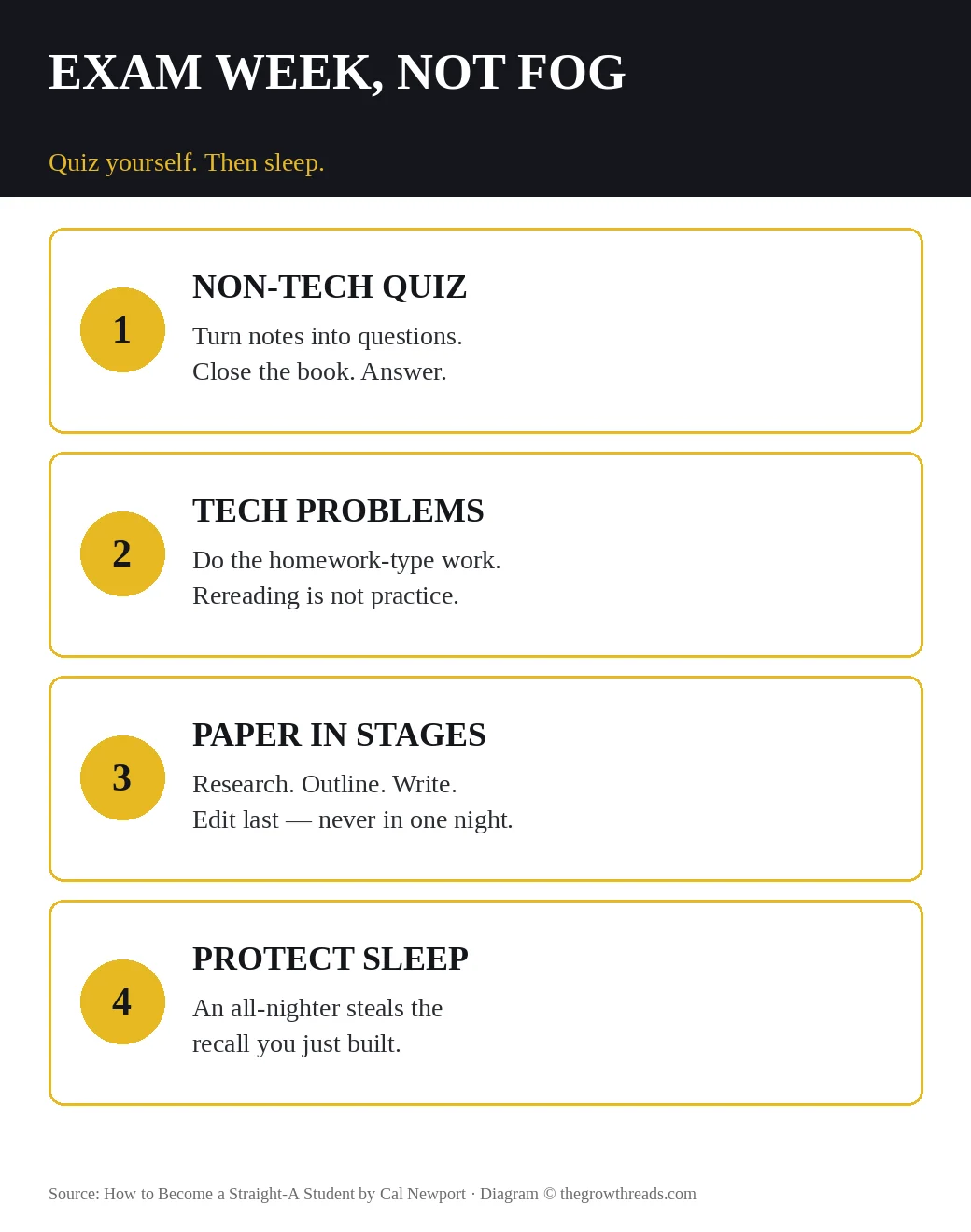
Exam week is where the average student doubles the worst habit: reread the chapter, reread the notes, feel a glow of familiarity, call it ready. Familiarity is not recall. Newport splits the work. In non-technical classes you turn the Q/E/C pages into an actual quiz. You write the questions on a fresh sheet, close the notebook, and answer. You cluster related ideas so the exam’s “compare and contrast” is not a surprise. You start this early enough that the first failure happens on a Tuesday, not at 1 a.m. the night before. The calendar from Part 1 is what makes “early” real.
Technical classes punish rereading even harder. The exam will ask you to do a thing, not recognize a paragraph. The work is practice problems — homework-type work, old questions, variations — with the book shut until you are stuck. Reading the solution and nodding is the highlight-pen of STEM. Do the problem. Then do a cousin of it. Sleep before the test. The all-nighter is a trade: you buy a feeling of virtue and sell the memory consolidation the last three days of quizzes were building. Newport is blunt because the students he interviewed were blunt. The ones with the A’s were in bed.
TGR Note: If the skill you are building is bigger than one midterm, Peak and Talent Is Overrated are the deliberate-practice books. Ultralearning is the aggressive self-taught version. This chapter is narrower on purpose: one course, one exam date, one closed-book quiz tonight.
Part 4: Papers and the week as a job
Papers die when four jobs share one night. Newport’s students separated them. Research is a hunt: sources, quotes, facts, all dumped before you argue. The annotated outline is the argument on paper — claim, support, order — while you are still allowed to move a section with an arrow instead of a rewrite. Prose is a later block. Editing is later than that. If you outline while you write, you will polish a paragraph that does not belong. If you research while you write, you will stop every four minutes to hunt a citation and call the evening “working on the paper.” The Sunday plan is what keeps the stages from stacking on Thursday at 11.
The last movement of the book is the posture. School is a job you can leave. You plan the week, you do the isolated hours, you quiz the page, you sleep, you have a life that is not a performance of suffering. That is not laziness. It is how the straight-A students he interviewed stayed sharp enough to do the next burst. Translate it and it is still the book: a weekly list of deliverables, a room that is not a café, notes you can quiz, drafts in stages, and a bedtime that is part of the method. The grown-up titles — Deep Work, Slow Productivity — are this argument with a salary. Start here if the unit of work is still a course.
TGR Note: If the paper problem is really a life-design problem, Designing Your Life is the Stanford prototype kit. If you cannot sit down at all, Atomic Habits or Mini Habits get you in the chair. This book assumes you will sit. It tells you what the hour is for.
Who is How to Become a Straight-A Student best for — and who should read something else first?
Read this if you are in school — or still taking courses — and your default is rereading, highlighting, and a late-night panic that feels like work. It is especially sharp if you are already putting in hours and the grades do not match the suffering. Professionals can steal the nouns: Sunday list, isolated burst, notes you can quiz, drafts in stages. It is a good first Newport if Deep Work felt like it assumed a calendar you do not have yet.
Read something else first if the problem is getting into the chair at all — start with Atomic Habits. If the classroom is now a Slack channel and the issue is fragmented days, start with Deep Work or A World Without Email. If you want the science of why quizzing beats rereading, Make It Stick is the lab coat. Newport will not build your company’s meeting culture. He will tell you what to do with Tuesday’s fifty minutes.
Questions to reflect on
- Where, exactly, do your study hours go that could not survive a closed-book quiz?
- If Sunday night listed every deadline in ten minutes, what would stop being a surprise?
- Which two rooms could become declared work locations this week — and which “study” place is actually social?
- Take last lecture’s notes: can each chunk become a Question, Evidence, and Conclusion?
- Which paper or memo is currently stuck because research, outline, and prose are sharing one night?
🔥 Ready to study less and score more?
Put this week on a calendar, close a door, and quiz one page tonight.
How to apply How to Become a Straight-A Student (7-day plan)
- Day 1 — Open a blank week. List every test, paper, and problem set. Give each a block.
- Day 2 — Pick two isolated rooms. Run one 50-minute burst on the hardest item with the phone in a bag.
- Day 3 — Convert one lecture to Q/E/C. If a line cannot become a question, cut it.
- Day 4 — Write a 10-question quiz from this week’s notes. Close the book and answer.
- Day 5 — For a technical class, do five practice problems before you reread the chapter.
- Day 6 — For a paper, dump sources and write an annotated outline only. No prose yet.
- Day 7 — Sleep 7 hours. Put next Sunday’s planning block on the calendar. Cancel one planned all-nighter.
Frequently asked questions
What is How to Become a Straight-A Student about in one paragraph?
How to Become a Straight-A Student is Cal Newport’s 2006 field manual for earning high marks without living in the library. He interviewed campus straight-A students and found a job-like system: a five-minute weekly plan, isolated work blocks, Q/E/C notes you can quiz, exam prep that is self-testing instead of rereading, and papers built in stages. The promise is not more hours. It is fewer wasted ones. Read it as an operating system for a semester, not a motivational speech.
Who is Cal Newport and when was this book written?
Cal Newport wrote the book as a young computer-science student who had already published How to Win at College. Broadway released How to Become a Straight-A Student on 26 December 2006 (224 pages). He later earned a Ph.D. at MIT and became a Georgetown professor. Deep Work, So Good They Can’t Ignore You, Digital Minimalism, A World Without Email, and Slow Productivity are the grown-up versions of the same argument. This title is the campus original. You do not need those later books first if you are still in school.
What is the Q/E/C note-taking method?
Q/E/C means Question, Evidence, Conclusion. After a lecture chunk, you write the question the class was actually asking, the proof or example that answers it, and a one-line conclusion you want available on the exam. You do not transcribe slides. The page becomes a quiz. Close the notebook and try to answer the Qs. That is the same retrieval practice later popularized in Make It Stick, written here as a student habit. If your notes cannot be quizzed, they are a souvenir, not a tool.
Does this work in high school, or only in college?
The interviews were college students, but the machinery is grade-level agnostic. A high-school week still has tests, papers, and problem sets. Sunday still needs a list. Isolation still beats a kitchen table with a phone. Q/E/C still turns a history lecture into something you can quiz. Papers still die when research, outline, and prose collapse into one Sunday night. If your school is more worksheet than seminar, lean on the exam half. If you already have Deep Work habits, this book will feel like the freshman edition — still useful if your calendar is a mess.
How is this different from Deep Work or Getting Things Done?
Getting Things Done empties your head into a trusted list. This book does a thinner version of that for a semester: Sunday plus a daily five-minute update. Deep Work is the grown-up case for isolation and intensity; Straight-A Student is the campus drill that came first. Use Allen if your whole life is leaking. Use Deep Work if the classroom is now Slack. Use this book if the unit of work is a course, a problem set, and an exam date. They nest. None of them replace a closed door and a quiz you wrote yourself.
Can working professionals use this system?
Yes, if you translate the nouns. Sunday becomes a weekly review of deliverables. Isolated locations become a library floor or a booked room, not a café with Slack open. Q/E/C becomes notes from a meeting or a course you are taking at night. Exam week becomes the deadline week: self-test the brief, do the actual work, sleep. Papers become memos built in stages. The book will not design your company. It will stop you treating a hard week as a mood you endure in a noisy room.
Is this just “study more” in disguise?
No. Newport’s reporting cut the other way. The straight-A students he interviewed often studied fewer hours than classmates who lived in the library. They cut the fog: rereading, highlighting, group tables that were social, all-nighters that stole recall. They spent the saved time on planning, isolated bursts, and questions they could not yet answer. If you add this system on top of a six-hour highlight session, you missed the point. Drop one reread block this week and replace it with a closed-book quiz. That is the book.
Related summaries
- Deep Work — the grown-up case for isolation and intensity, from the same author.
- Make It Stick — why quiz-and-recall beats rereading — the research behind Part 3.
- So Good They Can’t Ignore You — career capital after the campus system.
- A Mind for Numbers — practice problems for technical classes.
- Best productivity books — the full Productivity pillar.
How we analyze books: every book on The Growth Reads is read cover to cover, summarized in thousands of words of original analysis, and rated against our five-criteria rubric (lasting impact, evidence quality, practical application, writing & originality, external consensus). Read our full methodology.