

★★★★☆ 4.4/5 — a one-day Life Plan so a full calendar stops steering a life you never chose.
Best for: high-capacity people whose weeks are packed and whose years still feel unchosen
Reading time: ~5 hours (208 pages) · this guide ~12 min
Difficulty to apply: Easy to write in a day. Hard to keep honest when the inbox wants to vote instead
Living Forward in one minute
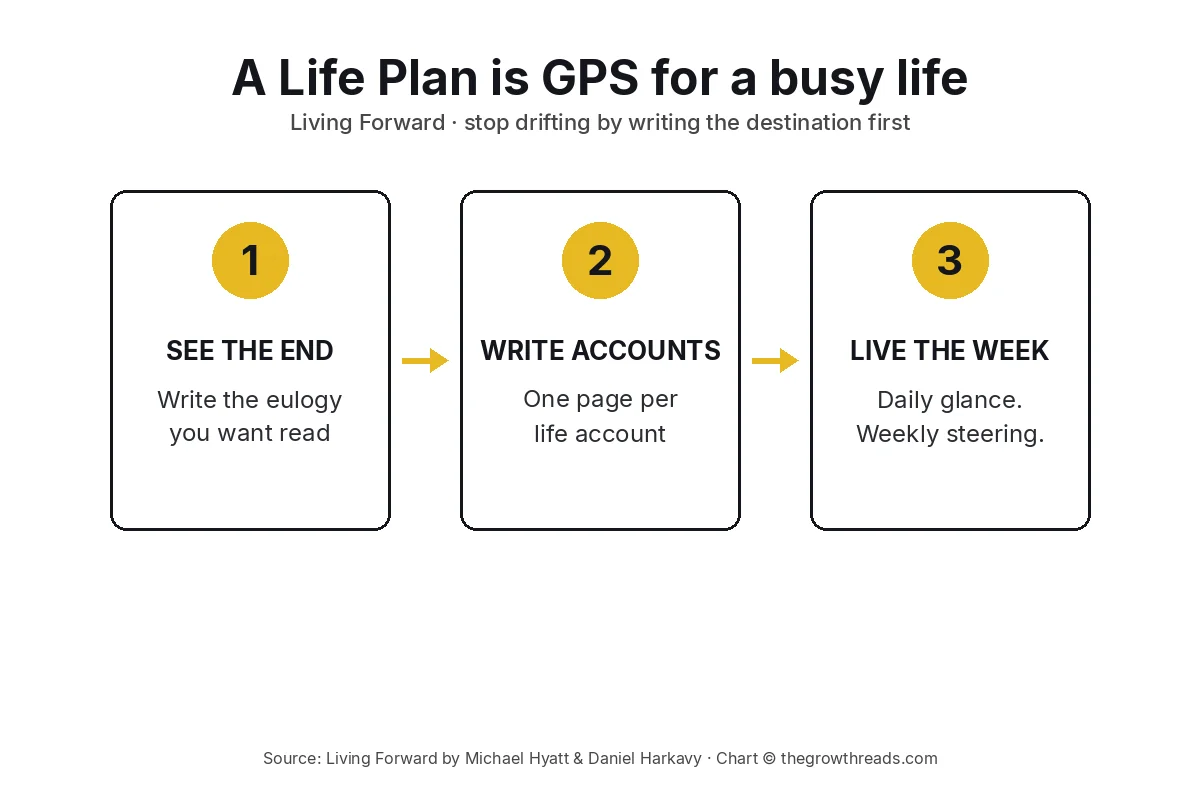
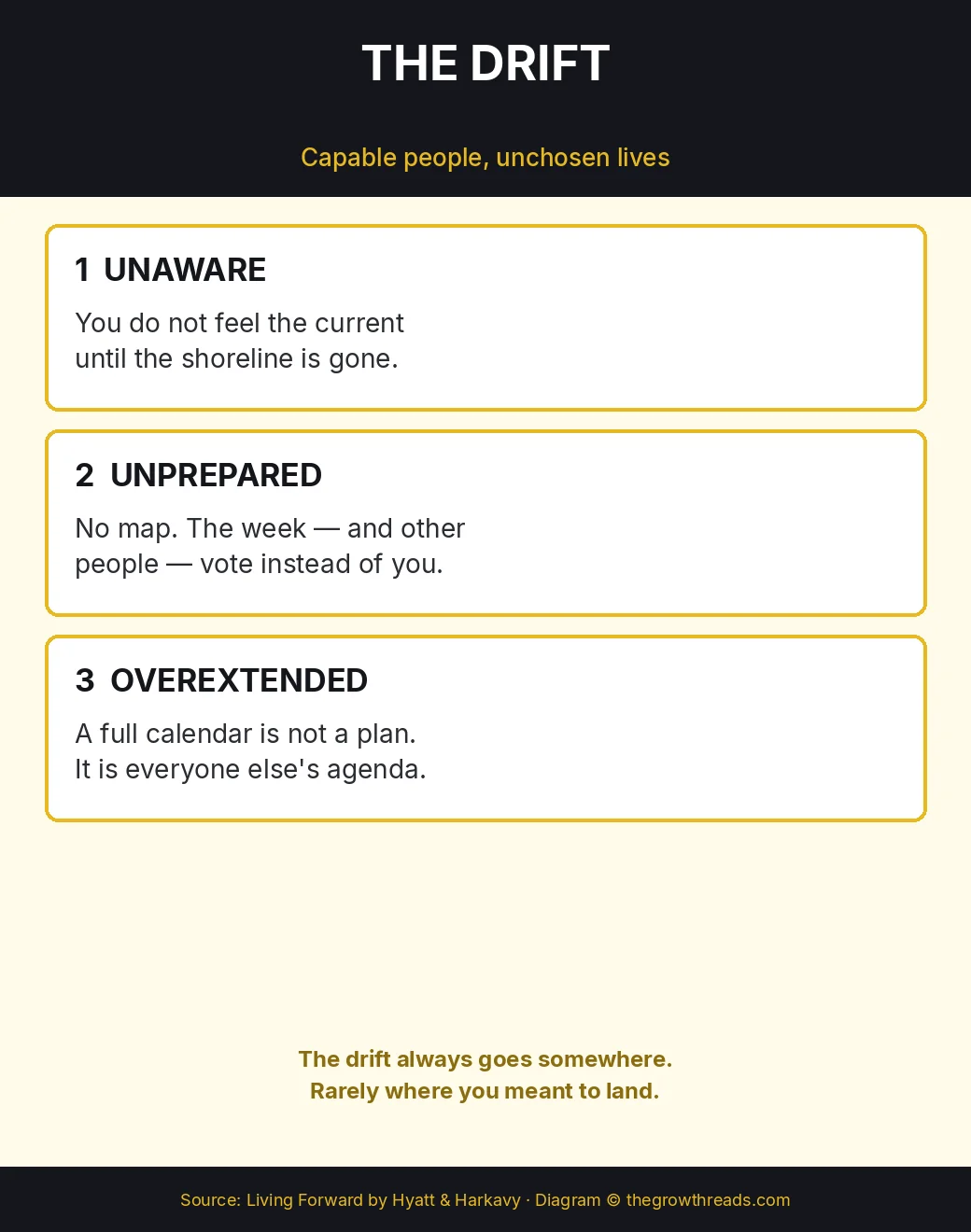
A busy week is not a life. It is a current. Michael Hyatt and Daniel Harkavy wrote Living Forward for the person who can fill a calendar, hit a number, and still wake up unable to explain where the last five years went. They call that the drift: unaware, unprepared, overextended. The counter is blunt on purpose. Clear a day. Write a short Life Plan with the end in mind — the eulogy you want read — then give every life account a page. Purpose, envisioned future, an honest current reality, and a few commitments. Glance at it daily. Steer with it weekly. Rewrite it once a year. Hope is not a strategy. A written destination is.
If your planner is already full and your life still feels like other people’s agenda, read this before buying another goal kit.
Key takeaways
- The drift is the default: unaware, unprepared, or overextended, the week votes and you call it a life.
- A full calendar is not a plan: activity can starve the accounts that would actually make the eulogy true.
- Begin with the end: write the eulogy you want read, then work backward. Vague values do not steer Tuesdays.
- Life accounts overdraft: health, marriage, kids, friends, work, money, spirit, play — ignore one and it bills the others.
- One account, one page: purpose, envisioned future, inspiring line, current reality, specific commitments.
- Write it in a day: a Life Planning Day beats a six-month “someday document” you never finish.
- GPS, not a tattoo: you will recalculate. That is the point of a written destination, not a failure of character.
- Daily glance, weekly steer: a plan you never open is décor. A weekly review is how it becomes a life.
- Annual rewrite: the person who wrote last year’s plan is not this year’s person. Update the map.
- Done beats poetic: a plain page you use beats a manifesto you do not.
What is Living Forward about?
Living Forward is Michael Hyatt and Daniel Harkavy’s 2016 guide for people whose calendars are packed and whose lives still feel unchosen. It names the drift, then shows how to write a Life Plan in one day — eulogy first, accounts next — so ordinary weeks aim at the life you want.
About the author
Michael Hyatt spent years as CEO of Thomas Nelson, then built a second career helping leaders design their days on purpose: Your Best Year Ever, Free to Focus, and this earlier book with his coach. Daniel Harkavy founded Building Champions and had already spent two decades sitting with executives who could run a P&L and could not answer what their funeral was supposed to mean. Harkavy had a Life Plan. Hyatt did not. Together they turned that gap into a short Baker Books hardcover so a busy operator could steal the day they wished they had taken sooner — before the inbox voted again. Explore all Daniel Harkavy book summaries →
Key concepts at a glance
| Concept | What it means | Use it when |
|---|---|---|
| The drift | Living by current, not by choice — unaware, unprepared, or overextended | The years feel fast and the weeks feel full |
| What’s at stake | The cost of not changing, imagined in each life account | You intellectually “should” plan and still do not |
| Life Plan | A short written document that names destination, location, and next moves | Goals live in your head or in a forgotten January file |
| Eulogy first | Write how you want to be remembered, then reverse-engineer the weeks | Your goals are all professional and strangely empty |
| Life accounts | The roles you will fund: body, people, work, money, spirit, play | One area is winning by starving the others |
| One-page template | Purpose, envisioned future, quote, current reality, commitments | The plan is a vibe instead of a page |
| Life Planning Day | One protected day to write the whole document | You have been “meaning to” for a year |
| Weekly steering | A standing review that assigns the next seven days to accounts | The plan was beautiful on Sunday and dead by Wednesday |
Part 1: The drift — a full calendar with no destination
The opening diagnosis is almost rude in its kindness. You are not lazy. You are in a current. Hyatt and Harkavy name three ways capable people drift. Unaware: the job is fine, the marriage is “busy,” the body will be dealt with later, and nobody is holding up a mirror. Unprepared: you have never written where this is supposed to go, so every invitation is equally legitimate. Overextended: you said yes until the week belonged to other people’s emergencies, and you started calling that leadership.
Hyatt’s own version is the operator’s version. The company can be growing while sleep, health, and the people who share your last name quietly take a number. Harkavy’s clients add the title that photographs well and a private life that would not survive a truthful eulogy. Drift is ordinary. That is why it works.
The “what’s at stake” chapter is the cold shower. They ask you to imagine the cost of not changing in each account if this year repeats: roommate logistics, a kid who stops asking, a body that cash-pays for “I’ll start in January,” a funeral about how hard you worked. The point is not shame. Shame is another current. The point is to make the default expensive enough that a blank Saturday looks cheap.
TGR Note: If the drift is not a missing document but a missing daily cue — no time, no place, no next action — start with our Atomic Habits review and the Tiny Habits summary. Living Forward will not install the 7:00 a.m. walk. It will tell you why that walk belongs on a page with your name on it. Pair, do not binge.
Part 2: Begin with the end — write the eulogy first
The design half of the book steals a move Covey made famous and refuses to leave it as a poster. Begin with the end in mind, then write the end. Hyatt and Harkavy want a eulogy, not a mood board. Who is in the room. What they actually say. Which relationships got the years. Which work was worth the cost. Which body showed up. It feels theatrical until you try it and notice how fast your current week disagrees with the speech.
That disagreement is the method. A Life Plan, in their GPS metaphor, needs three facts: where you want to go, where you are, and the next turn. Most productivity systems skip the first and overbuild the third, so you get a beautiful task list aimed at nowhere. Recalculating is expected. A written eulogy is the destination pin. Without it, every shiny project can claim to be north.
They are not asking for a novel. A few honest pages beat a leather journal you are too impressed by to mess up. If the eulogy is smooth, you probably wrote a brand. If it names a person and a scene, you can reverse-engineer a Tuesday. The only test: can this paragraph veto a meeting?
TGR Note: Covey’s original “begin with the end in mind” lives in our 7 Habits summary and the roles-and-quadrants field manual First Things First. How Will You Measure Your Life is Christensen’s later, quieter version of the same question from a hospital bed. Living Forward is the worksheet those books assume you will somehow produce. Use Covey for the philosophy. Use this for the afternoon you actually write.
Part 3: Life accounts and the one-page plan
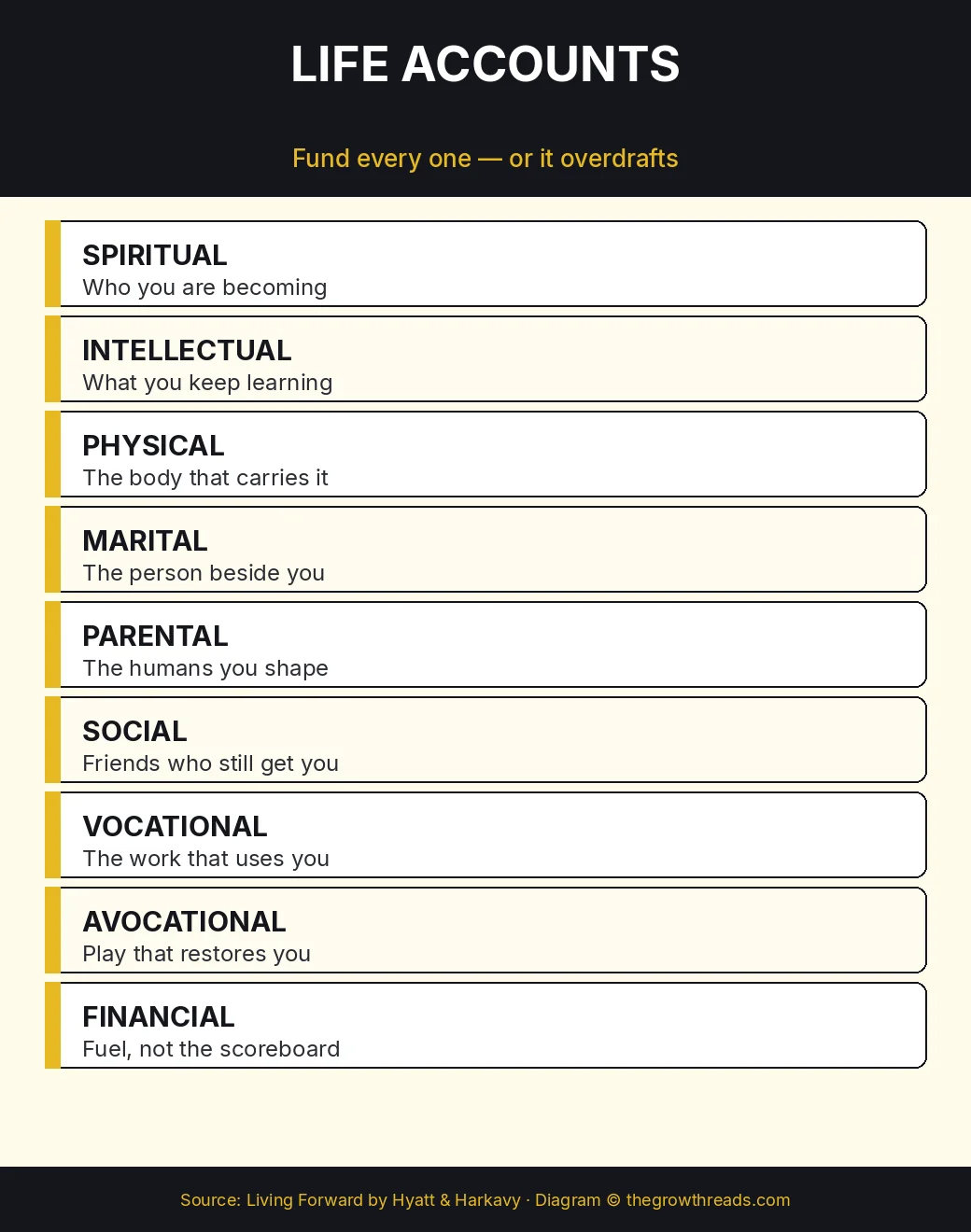
Once the end is named, the book gets operational. You do not have one life. You have accounts — spiritual, intellectual, physical, marital, parental, social, vocational, avocational, financial. The list is a starting kit, not a dogma. A founder will be tempted to let vocational eat the page. That temptation is the tell. The account you do not want to fund is usually the one already overdrafting.
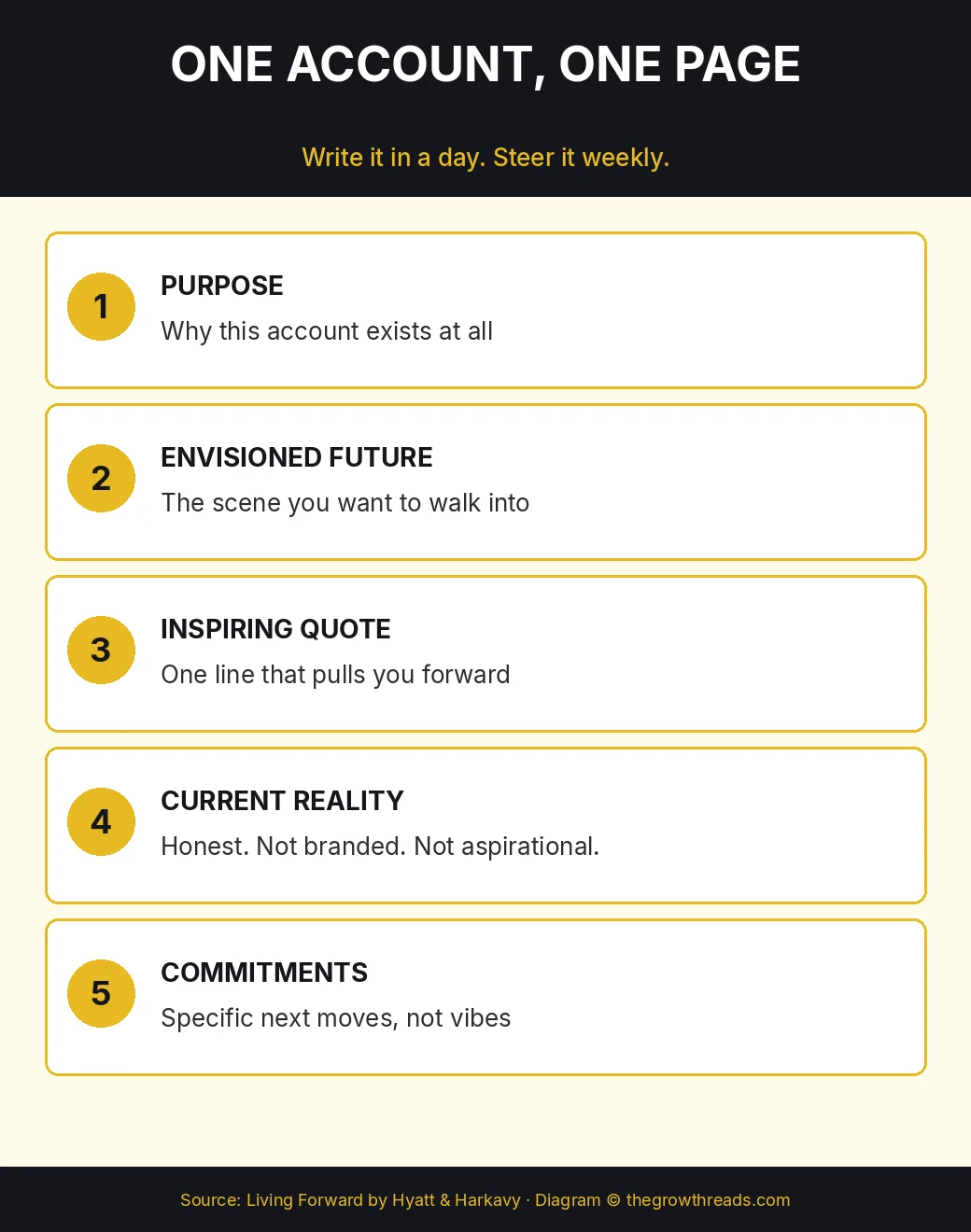
Each account gets one page. Purpose: why this account exists, in a sentence you could tape inside a cabinet. Envisioned future: a scene, not a KPI. An inspiring line for when the week gets loud. Current reality: honest, not branded. Then commitments: a few specific next moves. “Walk 20 minutes after dinner, four nights.” “Phone with Dad on Sundays.”
You cannot hide inside a vision board. Current reality sits next to envisioned future on the same page, which is how GPS works. Skip current reality and you write fiction. Skip the future and you write chores. Skip commitments and you write an essay. The page wants all five, short.
TGR Note: If nine accounts feels like nine new jobs, read our Essentialism summary and The One Thing before you write a novel. McKeown and Keller will stop you from turning a Life Plan into a second career. Then come back and fund fewer accounts with real commitments. Designing Your Life is the cousin if the vocational account is the one that is actually stuck — prototype a job, do not just write a prettier purpose line.
Part 4: Live it — one day to write, every week to steer
Implementation is where most life-design books evaporate into “be more intentional.” Hyatt and Harkavy put a day on the calendar. Clear it, leave the house if you can, and write the whole document before you tinker with fonts. One day is aggressive on purpose. A six-week project becomes a personality. A day becomes a draft you can improve.
Then the cadence, which is the actual product. Daily: open the plan for a few minutes before the inbox. Weekly: a standing review that assigns the next seven days to accounts — a steering meeting, not a guilt tribunal. Quarterly: which commitments died, which accounts overdrafted. Annually: another Life Planning Day, because last year’s eulogy was written by last year’s person. Recalculating is maintenance.
A printed page in a folder beats an app you reorganize instead of read. You do not need Hyatt’s later planner products to run this book. You need a document you will actually open on Sunday night. If you already run Free to Focus, this is what the freedom is for. If you already run Your Best Year Ever, this is the life underneath the SMARTER goals.
TGR Note: A weekly review without a destination is just a nicer to-do list. If you want the calendar mechanics, Getting Things Done still owns the capture-and-clarify loop. Living Forward owns the question GTD never answers: capture for what? Use Allen to empty the head. Use Hyatt and Harkavy to aim the empty head at a eulogy you would be willing to hear.
Who is Living Forward best for — and who should read something else first?
Best for: operators, managers, parents, and founders whose weeks already look successful from the outside. You do not need another morning routine. You need a written destination so the routine has somewhere to go. It is especially sharp if you have a graveyard of January goals and no page that mentions the people you live with.
Read something else first if: you cannot start a daily practice at all — go to Atomic Habits or Mini Habits. If the vocational account is the stuck one and you need prototypes, not a eulogy, start with Designing Your Life. If you want this year’s goals before a life document, Your Best Year Ever is Hyatt’s later, more tactical book. If you need roles and quadrants rather than a GPS metaphor, start with The 7 Habits. Living Forward will not rescue a life that has no next action. It will stop a busy life from pretending the next action is the point.
Questions to reflect on
- If this year repeated five times, which life account would be bankrupt — and who would notice first?
- What would people actually say at your funeral if it were held this Friday, not in a speech you wrote?
- Which account is currently funding the others by starving itself?
- When was the last time a written destination vetoed a meeting, a project, or a yes?
- If you had one protected day this month, what would you be afraid to put on the page?
🔥 Ready to stop drifting?
Get Living Forward, then spend one day writing the Life Plan the rest of your weeks will follow.
How to apply Living Forward (7-day plan)
- Day 1 — Name the drift. Write three sentences: where you are unaware, unprepared, or overextended. Circle the account that is already overdrafting.
- Day 2 — Draft the eulogy. One page, awkward on purpose. Who is in the room, what they say, which relationships and work were worth the cost. Do not brand it.
- Day 3 — List the accounts. Keep Hyatt’s nine as a menu. Drop the ones that are not your life. Do not add a tenth to look thorough.
- Day 4 — Write two pages. The overdrafting account and the one that matters most in the eulogy. Use all five fields. Commitments must fit this month.
- Day 5 — Book the Life Planning Day. Put a four-to-six-hour block on the calendar within two weeks. Leave the house if you can. Treat it like a client.
- Day 6 — Install the weekly steer. A 30-minute Sunday or Friday block. Title it with an account name, not “planning.” Assign next week’s first moves.
- Day 7 — Open it tomorrow morning. Two minutes, before the inbox. If you do not open it, the document is décor. Move it to where you will actually see it.
Frequently asked questions
What is Living Forward about in one paragraph?
Living Forward is Michael Hyatt and Daniel Harkavy’s short 2016 field guide for people whose calendars are full and whose lives still feel unchosen. They name that pattern the drift — unaware, unprepared, or overextended — then hand you a Life Plan you can write in a day: start with the eulogy you want read, give every life account a page, and steer the week from that document instead of from other people’s emergencies. Practical, a little earnest, and aimed at a written destination rather than another burst of January motivation.
What is a Life Plan in Living Forward?
A Life Plan is a short written document, usually a handful of pages, that names where you want to go, where you are, and what you will do next in each life account. Hyatt and Harkavy treat it like GPS, not a tattoo. Each account gets a purpose statement, an envisioned future, an inspiring line, an honest current reality, and a few specific commitments. You write a first draft in a day, glance at it daily, steer with it weekly, and rewrite it yearly. It is not a vision board and not a five-year corporate strategy. It is a page that can veto a meeting.
What do Hyatt and Harkavy mean by the drift?
The drift is what happens when you never choose a destination, so the current chooses for you. They break it into three flavors. Unaware: you do not notice the cost until a relationship, a body, or a decade is already gone. Unprepared: you have no written map, so every invitation looks equally legitimate. Overextended: you said yes until the week belonged to other people’s agendas and you started calling that success. Drift does not require a crisis. It loves high-capacity people. A Life Plan is how you stop confusing motion with direction.
How long does it take to write a Life Plan?
The authors want a Life Planning Day — one protected stretch, often four to eight hours, preferably away from home — not a six-month side project. The first draft is supposed to be finished, not perfect. You can improve a draft the following Sunday. You cannot improve a document you never start because you are waiting to feel ready. After the day, the real work is the weekly review. If you cannot clear a day this month, write two accounts this week and book the day anyway. A partial map still beats hope.
Is Living Forward the same as Your Best Year Ever?
No. Living Forward (2016) is the life-design book: eulogy, accounts, a document you steer all year. Your Best Year Ever is Hyatt’s later, more tactical goal book — SMARTER goals, a year at a time, more dashboard than funeral. They nest. Read Living Forward if you keep hitting goals that do not add up to a life. Read Your Best Year Ever if the life is named and you need this year’s numbers. Free to Focus is the third sibling: how to cut the calendar so the plan has room. Do not buy one thinking you already read the other.
How long does it take to read Living Forward?
The Baker Books hardcover is 208 pages. Most readers finish it in four to six hours, or a couple of evenings. This summary is a twelve-minute map plus a seven-day plan; it is not a substitute for the stories that make the drift feel expensive enough to cancel a Saturday. If you only steal two chapters, steal the drift diagnosis and the one-page account template, then book a Life Planning Day before you buy a new planner. Reading without a date on the calendar is how this becomes another book you admired.
Who should read Living Forward by Hyatt and Harkavy?
People whose weeks already look full: managers, founders, professionals, parents who can execute a plan and still cannot explain where the last five years went. It is sharp if your January goals are all vocational and your eulogy would not mention them. Skip it as a first book if you cannot start a daily practice — go to Atomic Habits — or if the stuck thing is a career you need to prototype, in which case Designing Your Life is the better studio. Pair it with Your Best Year Ever once the destination is on paper.
Related summaries
- Your Best Year Ever Summary & Review
- Free to Focus Summary & Review
- How Will You Measure Your Life Summary & Review
- Designing Your Life Summary & Review
- Best Productivity Books
How we analyze books: every book on The Growth Reads is read cover to cover, summarized in thousands of words of original analysis, and rated against our five-criteria rubric (lasting impact, evidence quality, practical application, writing & originality, external consensus). Read our full methodology.