

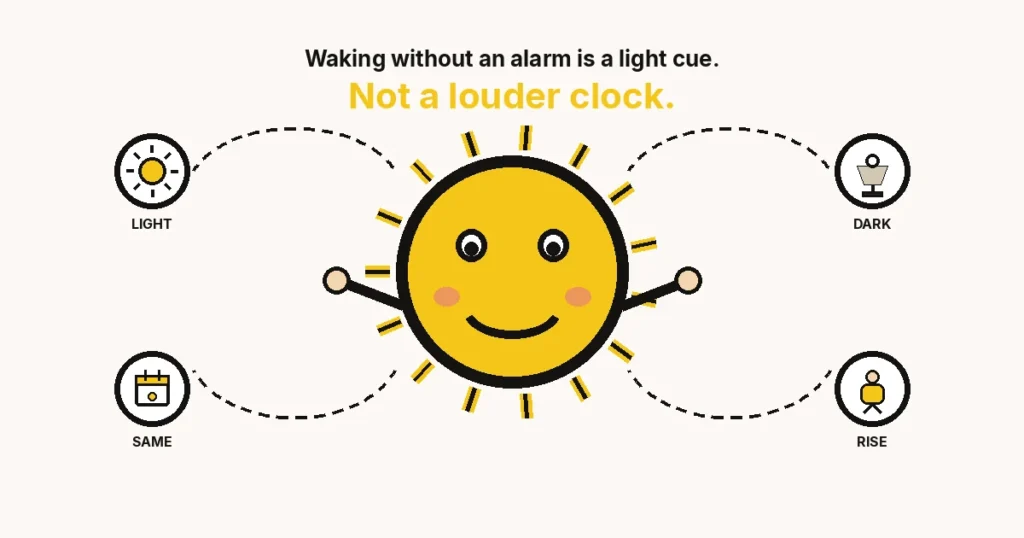
How to wake up without an alarm is a light-and-regularity problem, not a louder-clock problem. Morning light and a stable sleep window become the first cue, so the body clock fires before the buzzer. Cutting last night’s sleep with an earlier alarm is a different page, not a sleep-clinic fix.
Key takeaways
- Waking without an alarm holds when morning light and a regular sleep window become the first cue — the buzzer is a backup cut, not the mechanism.
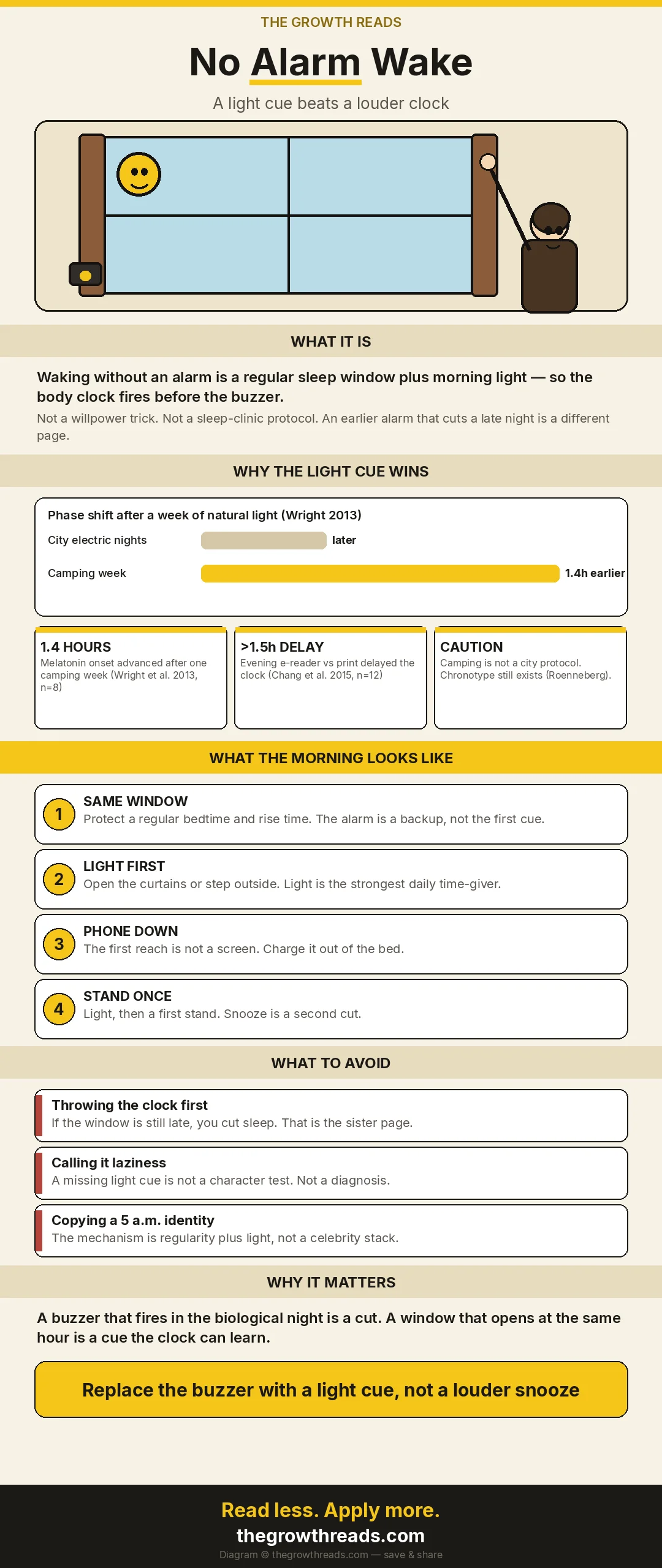
- A week of camping under the natural light–dark cycle advanced melatonin onset by 1.4 hours in eight adults; that is a field sample, not a city protocol (Wright, McHill, Birks, Griffin, Rusterholz & Chinoy, 2013).
- Five evenings of a light-emitting e-reader delayed circadian timing by more than 1.5 hours versus a printed book and reduced next-morning alertness in a twelve-person crossover (Chang, Aeschbach, Duffy & Czeisler, 2015).
- Social jetlag — the gap between mid-sleep on free days and work days — tracks weekday sleep trouble and stimulant use in questionnaire samples, which is why a weekend lie-in plus a Monday alarm feels like two clocks (Wittmann, Dinich, Merrow & Roenneberg, 2006).
- Julia Cameron’s The Artist’s Way is the named review on this row: morning pages are a first task after you are already up, not the wake cue itself.
What waking without an alarm actually is
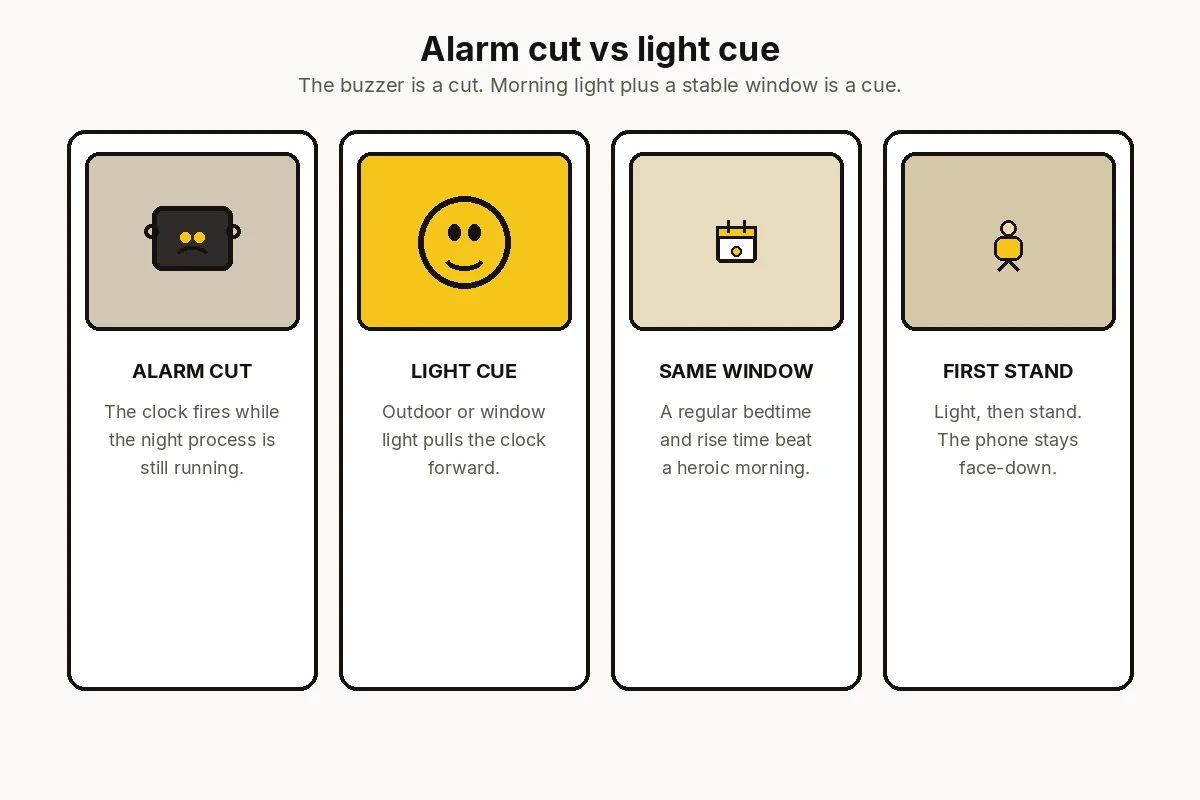
Waking without an alarm is a body clock that fires at the hour you already keep, because morning light and a stable sleep window trained it — not because you hid the clock and hoped. Search treats the phrase as a willpower stunt: throw the buzzer, become a morning person, never snooze again. The useful version is narrower. The alarm is a cut when it fires while the night process is still running. The morning is a cue when light and a regular window do the waking, and the clock on the nightstand is only a backup.
That is why this page sits under Morning, next to the cluster’s live parent how to build a morning routine. The parent owns the sequence after you are up. This URL owns the wake cue itself. The sister page is how to wake up early if you sleep late. Same cluster. Different file. That URL owns a schedule shift versus a sleep cut. This URL owns replacing the buzzer with light and regularity. If the stall is the first stand after the eyes are open, that is why is it so hard to get out of bed — a start-cue page, not this one.
This is a work-and-habits page on the productivity library. It is not a sleep-clinic protocol, not a diagnosis, and not a treatment list. It does not tell you that a hard Monday means a disorder. It does not tell you to throw the clock tonight if last night’s window was still late. Burnout vs laziness is motivation versus depletion at work. Do not paste an empty-tank story onto a missing light cue. Do not paste a laziness story onto a short night.
The named unused review on this row is Julia Cameron’s The Artist’s Way. Morning pages are three handwritten pages after you are already at the desk. Use the book as a first-task cue, not as a wake-up method and not as a second study. Live morning pages already owns the journaling habit. This URL does not rewrite that page. How to become a morning person owns identity and chronotype over weeks. How to fix your sleep schedule owns the wider routine repair. This URL owns one question: can the first wake be a light cue instead of a buzzer.
Alarm cut vs light cue
An alarm cut fires while sleep pressure and the body clock are still in the night; a light cue is the morning signal those two processes can learn. Borbély (1982) split sleep into Process S — homeostatic pressure that builds while you are awake — and Process C — the circadian clock that opens and closes the wake gate. A buzzer that rings while C is still in the biological night is a cut. You can stand up. You will still pay sleep inertia. Tassi and Muzet (2000) reviewed that fog: performance is worse in the minutes after waking, and the bill is larger after deep sleep or a short night. That is not laziness. It is a cut.
Light is the strongest daily time-giver the clock has. Duffy and Czeisler (2009) reviewed the human evidence: timing, intensity, and spectrum of light move the pacemaker. Wright, McHill, Birks, Griffin, Rusterholz and Chinoy (2013) then took eight adults camping for one week, away from electric light. Melatonin onset advanced by 1.4 hours. Sleep lined up earlier with the natural dark. That is a field sample of eight, not a randomised city trial, and it is still the cleanest demonstration that the clock follows light when you stop drowning it. A louder snooze does not do that job.
Why the alarm becomes the only wake cue
The alarm becomes the only wake cue when evenings stay bright, weekends drift, and the phone is the first thing the hand finds — so the clock never gets a morning signal it can trust. Chang, Aeschbach, Duffy and Czeisler (2015) ran a twelve-person crossover: five nights of a light-emitting e-reader versus a printed book before bed. The e-reader delayed circadian timing by more than 1.5 hours and reduced next-morning alertness. That is a lab sample, not a proof that every screen ruins every night. It is enough to say the last hour in bed is not a free slot. If the last cue of the night is a bright page, the first cue of the morning has more work to do.
Stothard and colleagues (2017) then measured the weekend version. After days with more outdoor light, timing sat earlier. After a weekend of more electric light and less outdoor light, the clock delayed. Wittmann, Dinich, Merrow and Roenneberg (2006) named the social version of that gap: social jetlag, the difference between mid-sleep on free days and work days. In their questionnaire sample it tracked weekday sleep trouble and stimulant use. A Saturday that ends at 2 a.m. and a Monday alarm at 6:30 are two clocks. The buzzer is what papers over the gap. It does not close it.
Monk, Reynolds, Buysse, DeGrazia and Kupfer (2003) found a simpler correlational layer: people with more regular daily rhythms also reported better subjective sleep quality. That is not causal proof that a calendar app fixes waking. It is why “same window” sits on this page next to light. A heroic 5 a.m. once, then a 10 a.m. Saturday, trains nothing. The billionaire morning routine owns the costume version of that heroics. The low-dopamine morning routine owns stimulus order after you are up. This URL asks whether the clock even got a chance to fire before the buzzer.
The four cues
- Light — the morning signal. Duffy and Czeisler (2009) is why this is first. Outdoor light or an open curtain is a zeitgeber. A phone torch under the duvet is not. Wright’s camping week is the field picture: when electric night ends, the clock moves earlier. You do not need a forest. You need a window you actually open.
- Dark — the evening opposite. Chang’s e-reader nights delayed the clock. The last bright page is a time-giver too, just pointed the wrong way. Dim the last hour. Charge the phone out of the bed. The morning routine checklist owns the sequence after standing. This cue is the night before.
- Same — a window the clock can learn. Monk’s regularity finding and Wittmann’s social-jetlag gap are the same file from two sides. A weekday 11-to-7 and a weekend 2-to-10 is two clocks. Roenneberg, Wirz-Justice and Merrow (2003) mapped how widely chronotype already varies. Same does not mean 5 a.m. Same means the window you can keep most days, including the day after a late dinner.
- Rise — one stand after the light. Tassi and Muzet (2000) is why snooze is a second cut: you drop back toward sleep and pay inertia again. The first stand is not a character test. It is the moment the morning cue becomes a morning. If that stand is the whole problem, open why is it so hard to get out of bed. If the problem is still last night’s clock, stay here.
Why it costs more than it feels like
A daily alarm feels cheap because it “works”; the bill is a week of cut mornings, leftover fog, and a weekend that has to repay the debt. You can stand to a buzzer every weekday and still have no light cue. Chang’s group measured the leftover on the other end of the night: next-morning alertness was worse after the bright e-reader evenings. Tassi and Muzet described the first-hour fog after a cut. Wittmann’s social jetlag is the Monday version of the same bill. None of those papers give a minutes-lost score for “people who use alarms.” This page does not invent one.
The honest scrap: Wright’s camping week is eight people in summer light, not your flat in winter. Roenneberg’s chronotype map says some clocks run late even when the window is regular. If the social hour is 6:30 and the body hour is 9:00, an alarm is still a cut. The sister page — how to wake up early if you sleep late — owns shifting the window. This page owns what replaces the buzzer once the window is close enough that light can finish the job. Why am I more productive at night owns the late-peak version. Do not force a 5 a.m. identity onto a late clock and call the leftover “laziness.”
| Cue | What it actually is | What it costs when it is missing | What it is not |
|---|---|---|---|
| Light | Morning outdoor or window light as the first time-giver | The clock stays late (Wright et al., 2013; Duffy & Czeisler, 2009) | A phone torch; a 5 a.m. identity |
| Dark | A dim last hour so the night process can start | Evening screens delay timing and next-morning alertness (Chang et al., 2015) | A digital detox; a diagnosis |
| Same | A sleep window you can keep on work days and free days | Social jetlag: two clocks, one Monday buzzer (Wittmann et al., 2006) | A packed week; a personality upgrade |
| Rise | One stand after the light, with the phone still down | Snooze is a second cut and more inertia (Tassi & Muzet, 2000) | Getting out of bed as a character test |
Two honest caveats. Wright’s 1.4-hour shift is eight campers, not a city RCT. Chang’s e-reader delay is twelve adults in a lab. Monk’s regularity finding is correlational. This page does not invent a day-count for “when you can throw the clock,” and it does not treat a hard morning as a medical score.
Cameron’s book is the first-task version of the same cheap layer: once you are up, the next cue can be three pages, not a feed. That is not peer-reviewed. Pair it with the parent how to build a morning routine if the missing piece is the sequence after standing, and with how to wake up early if you sleep late if the missing piece is still last night’s bedtime. A light cue is not a personality transplant. It is a signal the clock can see.
Common mistakes
- Throwing the clock before the window is close. If bedtime is still 1:30 and the desk is at 7:00, you cut sleep. That is the sister page, not a louder identity.
- Calling the leftover laziness. Tassi and Muzet (2000) is why the first hour can be fog after a cut. A missing light cue is not a character test. This page does not diagnose.
- Calling the leftover burnout. Burnout vs laziness is motivation versus depletion at work — not a health page and not a treatment list. Do not paste an empty tank onto a late clock.
- Keeping the phone as the alarm. The first reach becomes a feed. Chang’s evenings are why a bright page is already a time-giver. Charge it out of the room. Use a cheap backup clock if you still need a cut.
- Copying a 5 a.m. stack. Billionaire morning routine is the costume. The mechanism here is light plus same window, not a celebrity kettle.
- Treating weekend drift as recovery. Wittmann’s social jetlag is why a late Saturday trains a later Monday. Same does not mean no rest. It means the window does not jump by four hours.
- Confusing this page with morning pages. Live morning pages owns the journal. Cameron is the down-link for a first task, not for the wake cue.
When the alarm is not the problem
A missing light cue is a routine question; a pattern that takes over sleep, safety, or mood across contexts is a different conversation, and this page is not that conversation. The no-alarm frame is for ordinary work mornings: the window is close enough that light can finish the job, and the buzzer is what you still use by habit. It is not insomnia treatment, not a sleep-medicine protocol, and not a stand-in for help when nights stay impossible after the window is regular and the curtains open.
If you can name a bedtime you can keep and a window you can open, this URL applies. If mornings stay impossible after light, same window, and a first stand are in place, stop asking this page for a laziness test, a burnout score, or a tighter 5 a.m. identity. The honest next step is a qualified person, not a louder clock and not a quieter one. This article does not diagnose, does not treat, and does not list clinical symptoms. Energy management vs time management owns the daytime energy file. What makes someone a morning person owns the chronotype label. Stay on this URL only for the wake cue.
The evidence behind this
The usable evidence is a two-process model, light as the main time-giver, a small camping field shift, an e-reader delay, social jetlag, and a sleep-inertia review — not a day-count for throwing the clock, and not a personality test.
| Study | Design and size | Finding | What we used it for |
|---|---|---|---|
| Borbély (1982) | Theoretical two-process model | Sleep as Process S (pressure) plus Process C (circadian gate) | An alarm that fires in the biological night is a cut, not a cue |
| Duffy & Czeisler (2009) | Review of human light studies | Light is the primary synchronizer; timing, intensity, and spectrum matter | Morning light is the first cue on this page |
| Wright, McHill, Birks, Griffin, Rusterholz & Chinoy (2013) | Field; 8 adults, 1 week camping | Melatonin onset advanced 1.4 hours; sleep aligned earlier with natural dark | The clock follows light when electric night is removed. Small sample, not a city RCT |
| Chang, Aeschbach, Duffy & Czeisler (2015) | Crossover; 12 adults, 5 nights e-reader vs print | E-reader delayed circadian timing by more than 1.5 hours and reduced next-morning alertness | The last bright page is a time-giver pointed the wrong way |
| Stothard et al. (2017) | Field; weekend vs work-week light across seasons | More electric / less outdoor light delayed timing relative to outdoor-heavy days | Weekend light is part of Monday’s clock |
| Wittmann, Dinich, Merrow & Roenneberg (2006) | Questionnaire; Munich ChronoType data | Social jetlag associated with weekday sleep trouble and stimulant use | A late weekend plus a Monday alarm is two clocks. Not a trial |
| Roenneberg, Wirz-Justice & Merrow (2003) | MCTQ description and chronotype distribution | Human phase varies widely; social time and biological time are not the same file | Same window is not 5 a.m. for every clock |
| Monk, Reynolds, Buysse, DeGrazia & Kupfer (2003) | Questionnaire; Social Rhythm Metric and sleep quality | More regular daily rhythms associated with better subjective sleep quality | Regularity sits next to light. Correlational, not causal |
| Tassi & Muzet (2000) | Narrative review of sleep inertia | Alertness and performance are worse after waking; worse after deep sleep or deprivation | Snooze is a second cut. Fog is not a character verdict |
| Van De Werken et al. (2010) | Lab; artificial dawn vs control | Dawn simulation reduced sleep inertia versus an abrupt wake | A gradual light cue can help. Not a requirement, not a treatment |
Frequently asked questions
How do you wake up without an alarm?
You do not hide the clock and hope. You keep a sleep window the body clock can learn, make morning light the first signal, and keep a backup buzzer only until the wake arrives first. Wright and colleagues (2013) showed a 1.4-hour advance after a week of natural light in eight campers — a field sample, not a city promise. Chang, Aeschbach, Duffy and Czeisler (2015) showed the other end: evening e-readers delayed the clock. This page does not ship a how-to ladder. Light, same window, one stand. If bedtime is still late, open how to wake up early if you sleep late.
Is waking without an alarm the same as waking up earlier?
No. Waking earlier while bedtime stays late is a sleep cut. That file lives at how to wake up early if you sleep late. Waking without an alarm is a cue swap: morning light and a regular window do the waking, so the buzzer is no longer the first signal. You can wake at 8:00 without an alarm and still be on this page. You can set a 5:30 alarm after a 1:30 night and be on the sister page. Benefits of waking up early owns the why-early argument. This URL owns the cue, not the hour.
Why do I still need an alarm on weekdays?
Because social time and biological time are often two clocks. Roenneberg, Wirz-Justice and Merrow (2003) mapped how widely chronotype already varies. Wittmann, Dinich, Merrow and Roenneberg (2006) then measured social jetlag — the gap between mid-sleep on free days and work days — and found it tracked weekday sleep trouble. A Monday buzzer papers over that gap. It does not close it. Keep the backup until the window is close enough that light finishes the job. Do not read a weekday alarm as a character fail.
Does throwing away my alarm clock work?
Not as a first move. If the window is still late, you cut sleep and pay inertia. Tassi and Muzet (2000) reviewed that fog. Wright’s camping week removed electric night for eight people; it did not tell a city reader to bin the clock on a Thursday. Use a cheap backup out of arm’s reach while light and same window do the training. The Artist’s Way is the down-link for a first task after you are up, not a licence to wake by vibes. This is not a sleep-clinic protocol.
Is this a sleep-clinic protocol?
No. This is a work-and-habits page about a wake cue: morning light, a regular window, and a first stand. It is not insomnia treatment, not a diagnosis, and not a treatment list. Van De Werken and colleagues (2010) found dawn simulation reduced sleep inertia in the lab — useful as a light-cue hint, not a prescription. If mornings stay impossible after the window is regular and the curtains open, stop asking this URL for a laziness test. Talk to a qualified person. This article does not diagnose and does not treat.
How is this different from being hard to get out of bed?
Hard to get out of bed, on this site, is the first stand after the eyes are open — a start cue versus a laziness label. This URL is earlier: did the body clock fire, or did a buzzer cut the night. You can wake on time and still stall on the mattress. You can also have no stall and still need a cut because last night ran late. Open why is it so hard to get out of bed for the stand. Stay here for the cue. Neither page is a health score. Neither page treats depletion as laziness.
Do I need a dawn simulator?
No. Van De Werken and colleagues (2010) found artificial dawn reduced sleep inertia versus an abrupt wake in the lab. That supports a gradual light cue. It does not make a device mandatory. An actual window, outdoor light, and a dim last hour are the cheap version of the same idea Duffy and Czeisler (2009) reviewed: light moves the clock. A gadget that you stare at while the curtains stay shut is still a costume. Open the window first.
What if I am not a morning person?
Then do not turn this page into a 5 a.m. identity. Roenneberg, Wirz-Justice and Merrow (2003) described how late and early clocks already differ. How to become a morning person owns that shift. What makes someone a morning person owns the label. Why am I more productive at night owns the late-peak file. This URL only asks whether the wake you already need can be a light cue instead of a cut. A late clock with a regular window can still drop the buzzer. A late clock with a 6:30 desk may still need the sister page.
Sources
- Borbély, A. A. (1982). A two process model of sleep regulation. Human Neurobiology, 1(3), 195–204.
- Duffy, J. F., & Czeisler, C. A. (2009). Effect of light on human circadian physiology. Sleep Medicine Clinics, 4(2), 165–177. doi:10.1016/j.jsmc.2009.01.004
- Wright, K. P., Jr., McHill, A. W., Birks, B. R., Griffin, B. R., Rusterholz, T., & Chinoy, E. D. (2013). Entrainment of the human circadian clock to the natural light–dark cycle. Current Biology, 23(16), 1554–1558. doi:10.1016/j.cub.2013.06.025
- Chang, A.-M., Aeschbach, D., Duffy, J. F., & Czeisler, C. A. (2015). Evening use of light-emitting eReaders negatively affects sleep, circadian timing, and next-morning alertness. Proceedings of the National Academy of Sciences, 112(4), 1232–1237. doi:10.1073/pnas.1418490112
- Stothard, E. R., McHill, A. W., Depner, C. M., Birks, B. R., Moehlman, T. M., Ritchie, H. K., Guzzetti, J. R., Chinoy, E. D., LeBourgeois, M. K., Axelsson, J., & Wright, K. P., Jr. (2017). Circadian entrainment to the natural light-dark cycle across seasons and the weekend. Current Biology, 27(4), 508–513. doi:10.1016/j.cub.2016.12.041
- Wittmann, M., Dinich, J., Merrow, M., & Roenneberg, T. (2006). Social jetlag: Misalignment of biological and social time. Chronobiology International, 23(1–2), 497–509. doi:10.1080/07420520500545979
- Roenneberg, T., Wirz-Justice, A., & Merrow, M. (2003). Life between clocks: Daily temporal patterns of human chronotypes. Journal of Biological Rhythms, 18(1), 80–90. doi:10.1177/0748730402239679
- Monk, T. H., Reynolds, C. F., III, Buysse, D. J., DeGrazia, J. M., & Kupfer, D. J. (2003). The relationship between lifestyle regularity and subjective sleep quality. Chronobiology International, 20(1), 97–107. doi:10.1081/CBI-120017812
- Tassi, P., & Muzet, A. (2000). Sleep inertia. Sleep Medicine Reviews, 4(4), 341–353. doi:10.1053/smrv.2000.0098
- Van De Werken, M., Giménez, M. C., de Vries, B., Beersma, D. G. M., Van Someren, E. J. W., & Gordijn, M. C. M. (2010). Effects of artificial dawn on sleep inertia, skin temperature, and the awakening cortisol response. Journal of Sleep Research, 19(3), 425–435. doi:10.1111/j.1365-2869.2010.00828.x
Related reading on The Growth Reads
The books this page draws on
- The Artist’s Way summary — morning pages as a first task after you are up, not the wake cue
Related articles
- How to build a morning routine — this cluster’s parent: the sequence after you are up
- How to wake up early if you sleep late — the sister: schedule shift versus sleep cut
- Why is it so hard to get out of bed — the first stand, not the wake cue
- How to become a morning person — identity and chronotype over weeks
- Morning pages — the journaling habit; do not collapse it into this URL
Go deeper
How this article was researched
The Growth Reads editorial team writes from primary sources: the books themselves and the peer-reviewed literature behind the claims. Every study cited above was read in the original publication or its published abstract, and every figure is quoted with its design, sample and effect so you can judge its weight rather than take ours. Where a finding is a review, a field sample of eight, a twelve-person crossover, or correlational, we say so in the body rather than in a footnote. This page does not invent a day-count for throwing an alarm clock, because none of the cited papers measured one.
This article contains no medical advice. It is a work-and-habits page about a wake cue. It does not diagnose, does not treat, and does not list clinical symptoms. Sleep that stays impossible after a regular window and morning light is a different conversation with a qualified person, not a tighter identity.
How we work: every article on The Growth Reads is built from the books in our library plus the research they rest on, and is reviewed and date-stamped when the evidence changes. Read our full methodology.