

★★★★★ 4.7/5 — A playful, demanding map of how meaning and minds climb out of looping rules — still the book to steal “strange loop” from.
Best for: People who work with systems, models, or AI and want a picture of how an “I” can appear without magic
Reading time: ~20 hrs for the full book · ~16 min for this guide
Difficulty to apply: The puzzles are hard; the weekly use is naming levels and catching self-reference
Gödel, Escher, Bach in one minute
A mind is not a pile of clever rules. It is a loop that can see itself. That is Douglas Hofstadter’s 1979 case, braided through Gödel’s incompleteness theorems, Escher’s self-drawing pictures, and Bach’s canons that chase their own tails. Formal systems rewrite marks. Meaning lives in how the whole dance is seen from one level up — and, in a strange loop, that “up” is inside the system. Gödel showed a rich enough number system can talk about its own proofs and then point to a true sentence it cannot prove. Steal this week’s habit: notice when you are still inside the rules, and when you have to step outside to see why the next string will never appear.
Key takeaways
- Meaning is not in the token: A symbol is dumb until a reader, a mapping, or a higher description is in play.
- Stay inside the rules and you miss the why: The MU-puzzle is the mascot. Legal moves never yield MU. The explanation sits one level up.
- Isomorphism is the real prize: Two domains that share structure let you carry a move from one into the other.
- Recursion is a stack, not a vibe: A process that calls itself needs a way back. Minds do this constantly.
- Gödel’s twist is self-reference, not a vibe of mystery: A system that can encode its own statements can say “this is not a theorem here.”
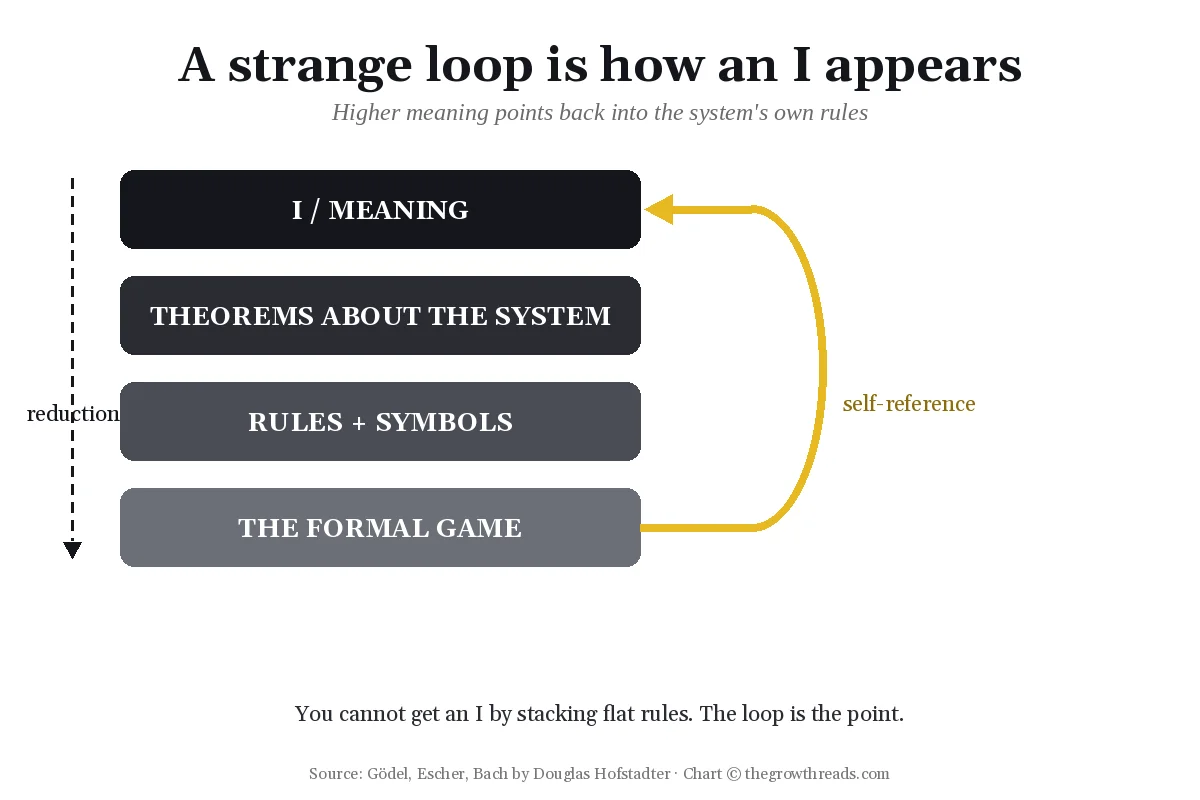
- A strange loop is a tangled hierarchy: You climb levels of description and arrive back at the thing you were describing.
- An “I” is a loop, not a pearl: The self is a stable pattern that the system uses to model itself.
- AI will not get a mind by stacking more flat rules: Syntax can be perfect and still have no one home. The loop is the hard part.
What is Gödel, Escher, Bach about?
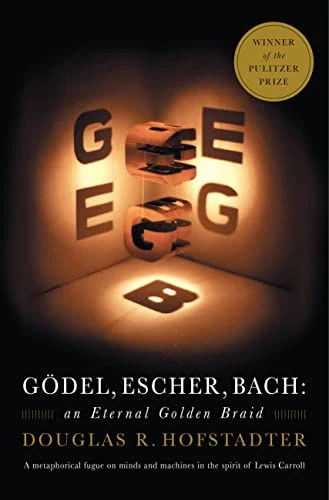
Gödel, Escher, Bach is Hofstadter’s 1979 tour of how meaning, minds, and machines can emerge from self-referential systems. Through puzzles, dialogues, and three arts — logic, drawing, and music — it shows why a loop that models itself is a better picture of an “I” than a list of rules.
About the author
Douglas Hofstadter was born in New York in 1945, the son of Nobel physicist Robert Hofstadter. He studied mathematics at Stanford, took a physics Ph.D. at Oregon, and spent years turning a private obsession — how inanimate stuff becomes a someone — into a book that should not have worked. Gödel, Escher, Bach won the 1980 Pulitzer Prize for General Nonfiction and a National Book Award. He built the Fluid Analogies Research Group at Indiana University, argued that analogy is the core of thinking, and later compressed the “I” claim in I Am a Strange Loop. Melanie Mitchell, whose AI guide sits on this silo, trained in that lab. He is not selling a productivity system. He is trying to make you feel that a self can be a loop. Explore all Douglas Hofstadter book summaries →
Key concepts at a glance
| Concept | What it means | Use it when |
|---|---|---|
| Formal system | Marks plus rewrite rules. No “meaning” is required to play | A process is being run as if the labels were the point |
| The MU-puzzle | From MI, legal moves never produce MU. The why is meta | You are grinding inside a game that cannot yield the goal |
| Isomorphism | A structure-preserving map between two domains | You need to reuse a move from music, code, or org design |
| Recursion | A process that contains a copy of itself, with a way back | A task calls the same task at a smaller scale |
| Gödel numbering | Turn statements and proofs into numbers so the system can talk about itself | Someone says “code cannot refer to code” |
| Incompleteness | A rich, consistent system has true claims it cannot prove inside itself | A dashboard is being treated as a complete picture of the work |
| Strange loop | Climb the levels and you land back in the system you were describing | You need a picture of selfhood that is not a ghost in the machine |
| Tangled hierarchy | Levels that are not a clean stack; the top folds into the bottom | A policy is both the rule and a case under the rule |
| Location of meaning | Meaning is not stored in a mark; it lives in the mapping and the reader | A metric, prompt, or logo is being worshipped as the thing itself |
Part 1: Formal systems and the MU-puzzle — stay inside, miss the why
Hofstadter opens with a toy. You are handed MI and a small list of rewrite rules. The challenge is to produce MU. The punchline is a method: if you only apply the rules, you never get MU, and you never see why. The explanation is a level change — talk about properties of every string the rules can make. That “about” is not another legal rewrite.
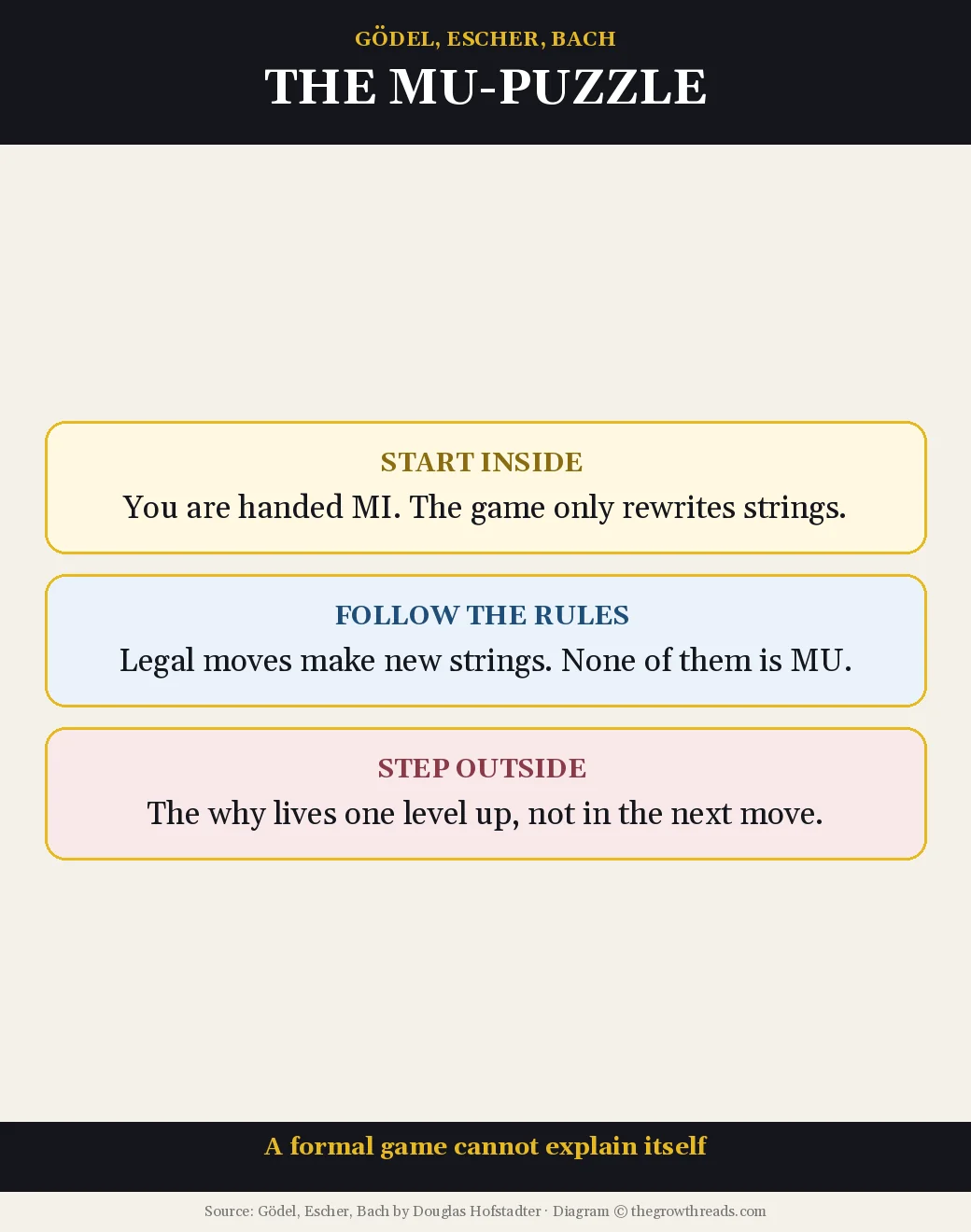
A formal system is honest: it does not care what you hoped the letters meant. You can have a beautiful scoring function and still be playing a game whose theorems are not the outcome on the slide. Meaning is not located in a token. A record groove is not the symphony. A weight is not a wish. A KPI is not the customer. The MU-puzzle is how you practice noticing that you are still inside the rules when the question you actually have is about the rules.
TGR Note: Brian Christian and Tom Griffiths’s Algorithms to Live By drops computer-science moves into ordinary decisions. GEB is the prequel: before you import an algorithm, notice whether you are still playing the wrong formal game. For “the score is not the goal,” keep The Alignment Problem on the same shelf.
Part 2: Recursion, isomorphism, and the Escher–Bach braid
Once you can feel a level change, Hofstadter stacks patterns that share a skeleton. Recursion is the first: a procedure that contains a smaller copy of itself and a way back out. Escher draws it as a hand drawing a hand. Bach writes it as a canon in which a theme is its own accompaniment until the ending is a beginning. None of these is a metaphor glued on after the math. They are the same move in three materials.
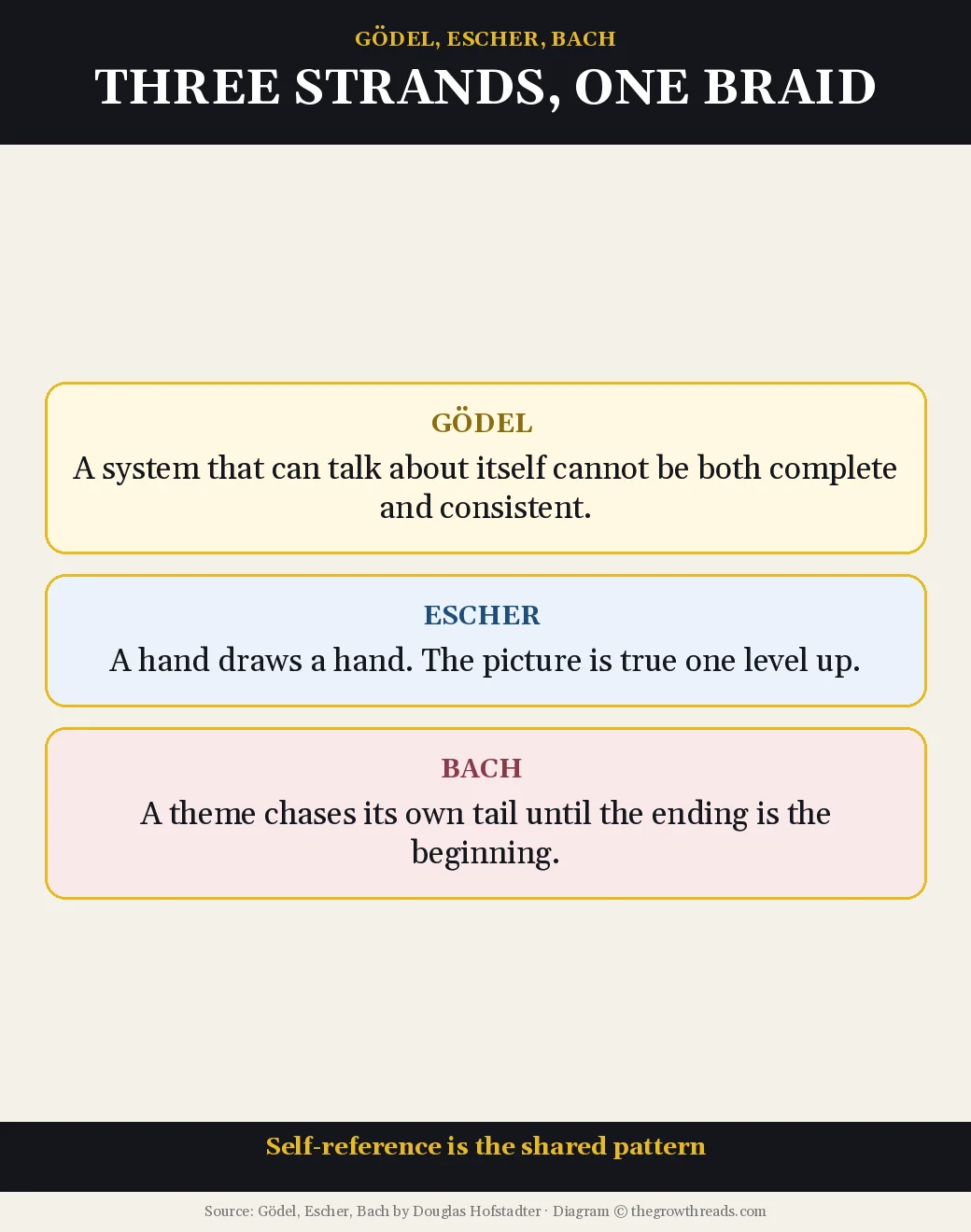
Isomorphism is the practical name for that sameness. If two systems share structure, a move that is legal in one can be carried into the other without copying the surface: a hiring pipeline that is actually a bug-triage queue; a melody that is actually a stack. The dialogues between Achilles and the Tortoise are not comic relief. They let you feel an isomorphism before you can define it. When they talk about a record player that plays a record that breaks the player, you are already inside Gödel’s argument, wearing a costume. The working habit: when two messy domains feel oddly alike, write the shared skeleton in one sentence before you copy a tactic.
TGR Note: Kahneman’s Thinking, Fast and Slow splits a mind into System 1 and 2. Use it when the failure is a named bias. Use GEB when the failure is a level error: you are answering inside a system that cannot hold the question. The Shallows asks what a medium does to those levels.
Part 3: Gödel numbering — a system that talks about its own proofs
The middle of the book is where the toy becomes a theorem. First you need a formal system rich enough to do ordinary arithmetic — his TNT, typographical number theory, is the teaching version. Then you code every symbol, formula, and proof as a number. Once statements are numbers, “this string is a theorem” is itself an arithmetical claim. The system can talk about its own proofs. Then you build a sentence that says, of itself, that it is not a theorem here. If the system is consistent, that sentence is true and unprovable inside the game. Completeness, in the naïve sense of “every truth we care about has a proof here,” is gone.
Hofstadter wants the mechanism, not a fog machine: encoding, self-reference, a twist. The point for a working reader is not “math is haunted.” It is that a system allowed to represent itself will have true facts that are not theorems of that system. Your metrics, model card, or training loss — if they can talk about themselves — are not a closed story. Incompleteness is not a proof that machines cannot think. It is a proof that a complete, self-contained rulebook is the wrong dream. The right picture is a system looking at its own looking.
TGR Note: Bostrom’s Superintelligence and Russell’s Human Compatible are the control-problem books. GEB is the older claim that a mind, if it arrives, will look like a self-model, not a bigger spreadsheet. Pearl’s The Book of Why is the other formal leap: from seeing to intervening.
Part 4: Strange loops, tangled hierarchies, and where an I can live
The last movement is the one people quote without finishing. A strange loop is not a circle drawn on a whiteboard. It is what happens when you keep going “up” in a hierarchy of descriptions — from ink to notes, from notes to a theme, from a theme to a composer’s intention, from neurons to a person — and you find yourself back inside the system you were describing. The top is tangled with the bottom. Escher’s drawing hands are the postcard. Bach’s endlessly rising canon is the soundtrack. Gödel’s sentence is the proof that this is not only art.
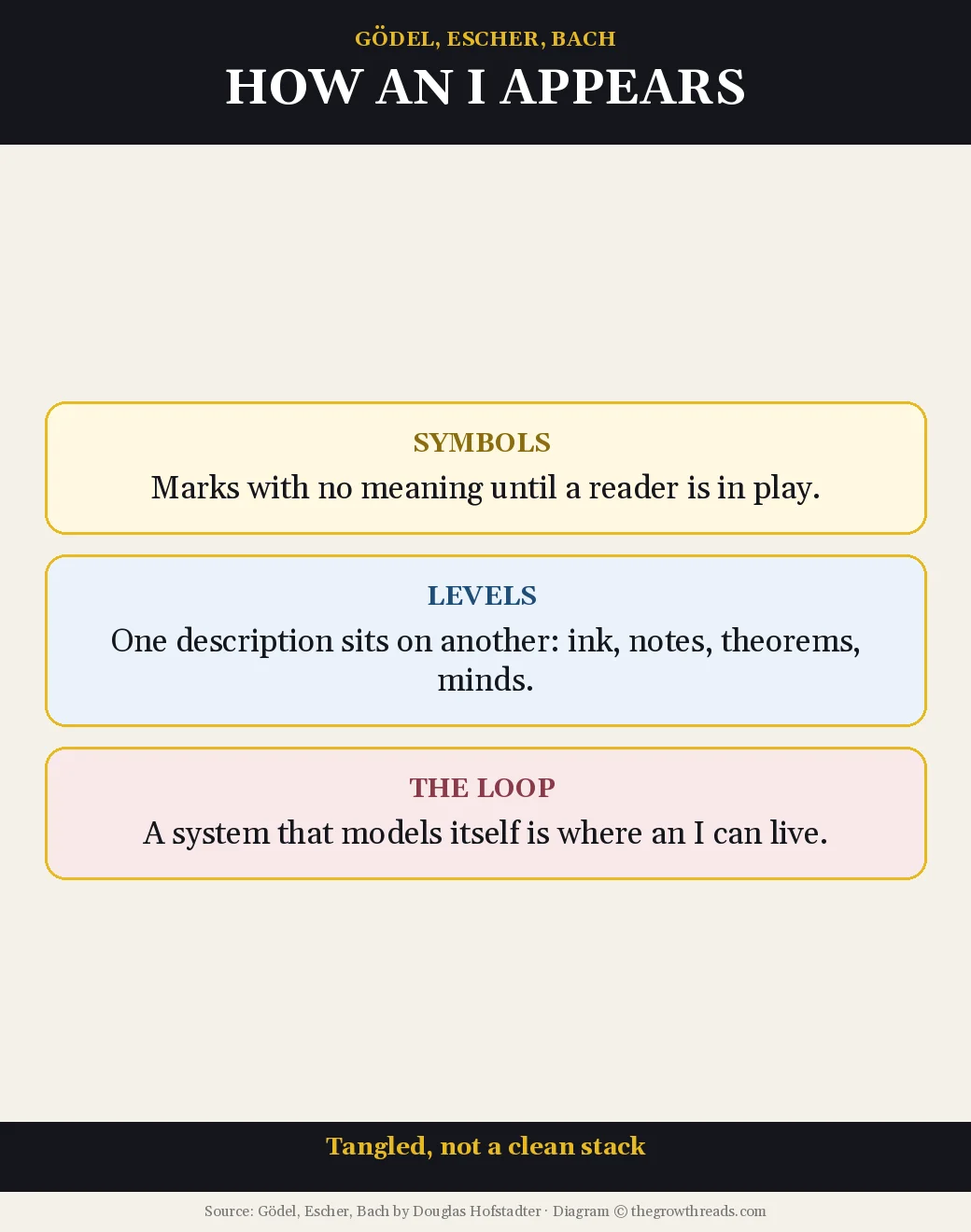
Hofstadter’s bet is that an “I” is a strange loop a brain uses to model itself. There is no extra pearl — only a pattern stable enough to be referred to from inside. That is why a pile of syntax can be arbitrarily large and still have no one home. Home is not more rules. Home is a tangled self-model. The 1979 chapters on thinking machines read, in 2026, like a letter to people training fluent systems that still may not be looping in this sense. The book does not tell you to halt the labs. It tells you not to confuse a brilliant formal game with a self. You already live in tangled hierarchies: a manager is a case under the policy and the author of the policy. Once you can see the fold, ask which level you are acting on, and whether you smuggled a claim from another level without noticing.
TGR Note: Melanie Mitchell’s Artificial Intelligence: A Guide for Thinking Humans is the student continuation, written from Hofstadter’s lab. Yudkowsky and Soares’s If Anyone Builds It, Everyone Dies is the 2025 halt brief. GEB is a picture of mind. The later books are pictures of risk. You need the picture of mind so you do not call every fluent model a someone.
Who is Gödel, Escher, Bach best for — and who should read something else first?
Read it if you design systems, teach, write software, or work on AI and you are tired of “emergence” as a shrug. You do not need a math degree. You do need patience for puzzles.
Read something else first if you want a 250-page field guide — start with Life 3.0 or Co-Intelligence. For weekly CS decisions, use Algorithms to Live By. For the control problem, use Superintelligence or Human Compatible. GEB is a poor first AI book if you need prompting tips this afternoon.
Questions to reflect on
- Which “games” at work are formal systems, and which goals cannot be produced by their rules?
- Where are you treating a symbol — a metric, a prompt, a title — as if meaning lived inside it?
- What two domains in your week share a skeleton you have never written down?
- Where are you both the player and the rule-maker, and which level are you pretending is the only one?
- If a fluent model is not yet a strange loop, what would you need to see before you called it a someone?
🔥 Ready to see the loop instead of grinding the next move?
Get Gödel, Escher, Bach and start reading.
How to apply Gödel, Escher, Bach (7-day plan)
- Day 1: Pick one process you actually run (inbox rules, a standup, a scoring rubric). Write its “axioms” and rewrite rules on a single page. No extra meaning allowed on the page.
- Day 2: Name an outcome that process is supposed to produce. Try to reach it using only the rules. If you cannot, write one sentence on the why that lives outside the game — your MU.
- Day 3: Find one isomorphism: two domains that share structure (hiring and bug triage, a melody and a stack). Write the shared skeleton in one line, then one move you can carry across.
- Day 4: Map four levels of description for a live project: marks, rules, meaning, self-model. Circle the level you have been acting on without noticing.
- Day 5: Catch a strange loop: a policy about policies, a report about reporting, a prompt about prompting. Write who is the player and who is the rule-maker. If it is you twice, say so.
- Day 6: Read the TGR summaries of Superintelligence and Algorithms to Live By. Write one sentence on what GEB adds that those two do not (hint: a picture of an I, not a halt and not a heuristic).
- Day 7: Change one tangled hierarchy you actually own. Rewrite one rule, rename one metric, or stop treating a fluent tool as a someone. Tell one person which level you moved.
Frequently asked questions
What is Gödel, Escher, Bach about in simple terms?
It is a long, playful argument that minds arise from strange loops: systems that can model themselves. Hofstadter braids Gödel’s incompleteness theorems, Escher’s self-drawing pictures, and Bach’s canons to show the same pattern in logic, art, and music. Formal rules rewrite marks. Meaning lives in mappings and in level changes, not inside a token. The book is not a biography of the three men and not a programming manual. It is a way of seeing why a pile of syntax, however large, is not yet a self — and why a self might still be a pattern rather than a ghost.
Do I need a mathematics background to read Gödel, Escher, Bach?
No. You need patience. Hofstadter teaches formal systems as games before theorems. High-school algebra helps; a music or drawing habit helps as much. Many readers skip proofs on the first pass and still get the level-change habit. If symbols shut the book, start with the dialogues and Escher plates, then return to TNT. The 7-day plan never asks you to construct a Gödel sentence. It asks you to notice when you are still inside a game that cannot produce the goal on the slide.
How long does it take to read Gödel, Escher, Bach?
The 20th-anniversary Basic Books paperback is 824 pages. Budget about twenty hours, more if you work the exercises, less if you treat some chapters as a museum. It is much longer than Life 3.0 or Co-Intelligence; the difficulty is play, not footnotes. Two sittings a week for a month is kinder than a weekend binge. This guide is about sixteen minutes. Do the 7-day plan even if you only finish Part I. The MU-puzzle habit pays rent before you reach Gödel numbering.
Is Gödel, Escher, Bach still relevant in the age of large language models?
Yes, because it is about what a mind would be, not about a particular chip. Fluent models rewrite tokens with a score. GEB’s question is whether anyone is home — a tangled self-model, not only a next-token machine. That question got louder once the syntax got good. The book will not give you a prompting cheat sheet. It will stop you from calling every impressive output a someone, and give you language for the day a system starts to look like a loop.
How is Gödel, Escher, Bach different from I Am a Strange Loop?
GEB is the big braid: puzzles, music, drawing, and incompleteness as a feeling you can use. I Am a Strange Loop (2007) is the shorter statement that a self is a loop a brain uses to model itself. Readers who bounced off GEB’s length often start there. Readers who want MU, isomorphism, and dialogues stay with GEB. If you only have one long book in you, take GEB and steal the 7-day plan. If you want the thesis without the fugue, read GEB’s last movement first.
What is the MU-puzzle in Gödel, Escher, Bach?
It is a tiny formal system. You start with MI and a handful of rewrite rules, and you try to make MU. You cannot: every string the rules can produce has a property MU lacks. Seeing that means talking about the game rather than making another legal move. Hofstadter puts it first so you practice the habit the rest of the book needs: when you are stuck, ask whether the next move is still inside the system. Name your MI, name your illegal MU, and stop grinding.
Who should read Gödel, Escher, Bach today?
Read it if you build, teach, or regulate thinking systems and you need a picture of a self that is neither mystic nor a bigger spreadsheet. Skip it as a first AI title if you need a chatbot this afternoon — start with Co-Intelligence — or as a first risk title if you need a halt argument (If Anyone Builds It, Everyone Dies). The distinction it teaches, inside the rules versus about the rules, is usable even if you only finish the opening games.
Related summaries
- Algorithms to Live By — computer-science moves you can use on ordinary decisions.
- Superintelligence — the 2014 map of the control problem, not a picture of an I.
- Human Compatible — how to keep a machine correctable if it gets smart.
- Artificial Intelligence: A Guide for Thinking Humans — Hofstadter’s student on where machine understanding still breaks.
Browse every title in our Best AI Books pillar page.
How we analyze books: our summaries are built from a full read of the source text, cross-referenced against the author’s published interviews and research where relevant, and structured around practical application rather than critique. We disclose our editorial process and affiliate relationships in full. Read our full methodology.