

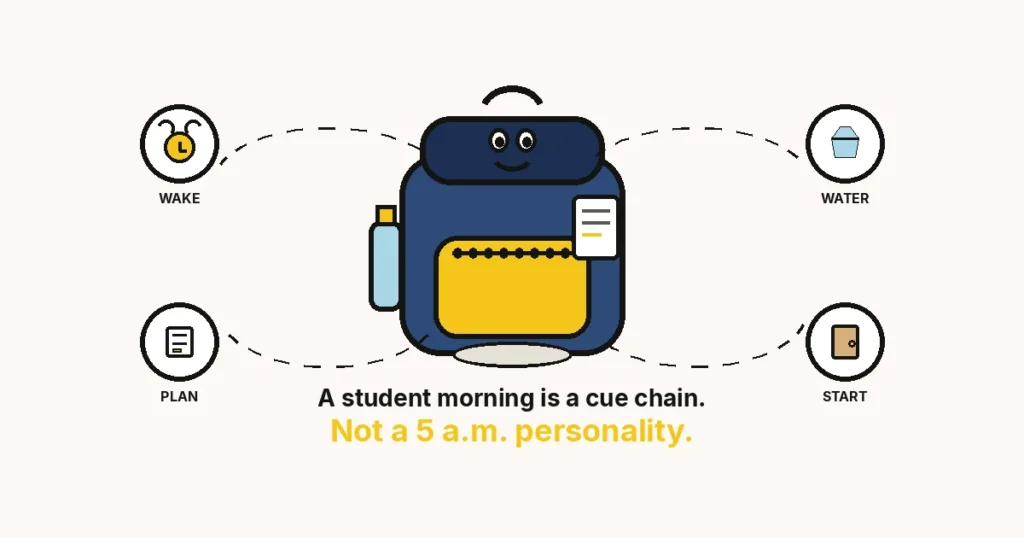
A morning routine for students is a short, same-order cue chain that starts the first class or first study block — not a 5 a.m. personality. Pack the bag the night before, move the body before the phone, and name one first-hour output. A later chronotype is a timetable problem, not a character flaw.
Key takeaways
- Wolfson and Carskadon (1998) surveyed 3,120 high-school students and found that those who described themselves as struggling or failing reported about 25 minutes less school-night sleep and bedtimes about 40 minutes later than A and B students — a self-report association, not a causal proof that earlier alarms raise grades.
- Roenneberg, Kuehnle, Pramstaller, Ricken, Havel, Guth and Merrow (2004) showed chronotype delays through the teen years and only begins to advance around age 20, which is why a student morning that copies a 5 a.m. adult stack is often fighting biology rather than building a cue.
- Gollwitzer (1999) showed that an if–then plan — a named cue, place and next action — raises follow-through compared with a vague intention to “be more organised in the morning.”
- Ward, Duke, Gneezy and Bos (2017) found that a smartphone merely sitting nearby reduced available working memory and fluid intelligence, even when people never touched it.
- Lally, van Jaarsveld, Potts and Wardle (2010) tracked 96 people forming a daily habit and found a median of 66 days to automaticity, with simpler behaviours automatising faster — which is why a four-move student morning beats a borrowed 90-minute stack.
What a morning routine for students actually is
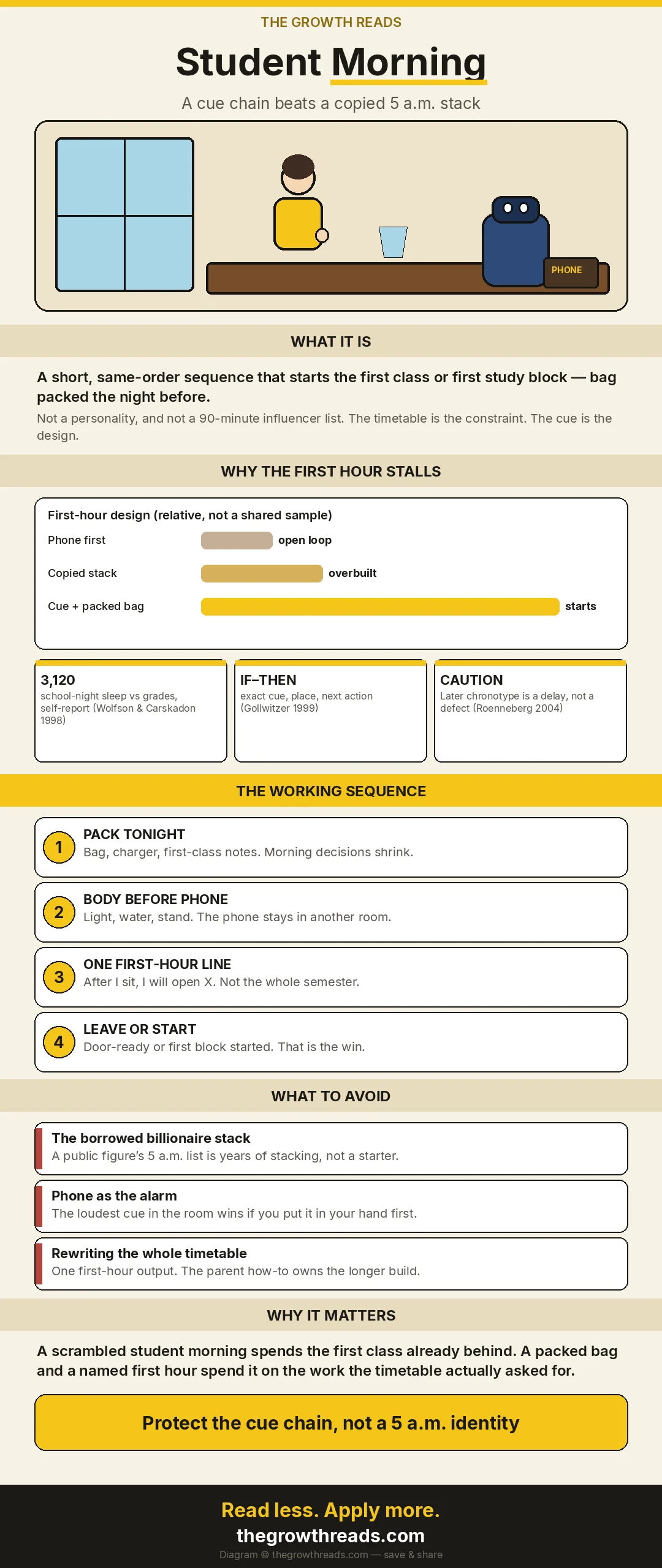
A morning routine for students is a short sequence, in the same order, that makes the first class or the first study block start on time. Four moves do the work: the bag is packed the night before, the body starts before the phone, one first-hour output is named, and the student is either door-ready or sitting down to that output. Drop the cue and you still have a list. Drop the first-hour output and you still have a vibe. This URL owns the student design constraint — a timetable you did not choose — not a new personality.
This is a Morning child. The parent how to build a morning routine already owns the general method: a fixed cue, a short stack, written the night before. Do not rewrite that page here. The live morning routine checklist already owns the list of items. Different phrase, different job. Sean Covey’s 7 Habits of Highly Effective Teens is the unused review this row was given, and it earns the slot because “Begin with the end in mind” and “Put first things first” are first-hour jobs: name the class or the block, then do that thing before the feed. The productivity library already holds the parent how-to, the checklist, and the morning-person page. This article names the student version so those pages have a timetable-shaped child.
The useful unit is adult-legible. It applies to a university student, a college student, or anyone whose morning is gated by a lecture, a lab, a shift, or a first study block they cannot move. It is not a parenting page and not a school-run logistics page. Packing a child’s lunch is a different job. So is copying a public figure’s cold plunge.
Student routine versus adult stack versus checklist
A student morning is shorter than an adult stack because the first obligation is not optional, and it is more than a checklist because the cue has to bind. Wendy Wood and David Neal (2007) described habits as context-cued responses: the same place and the same first action, repeated, until the context starts the move. A checklist without a cue is a reminder you can ignore while the phone is already in your hand. An adult stack that assumes a free 90 minutes before anyone else needs you is a different life than a 9 a.m. lecture. Keep the words apart.
Why student mornings fail
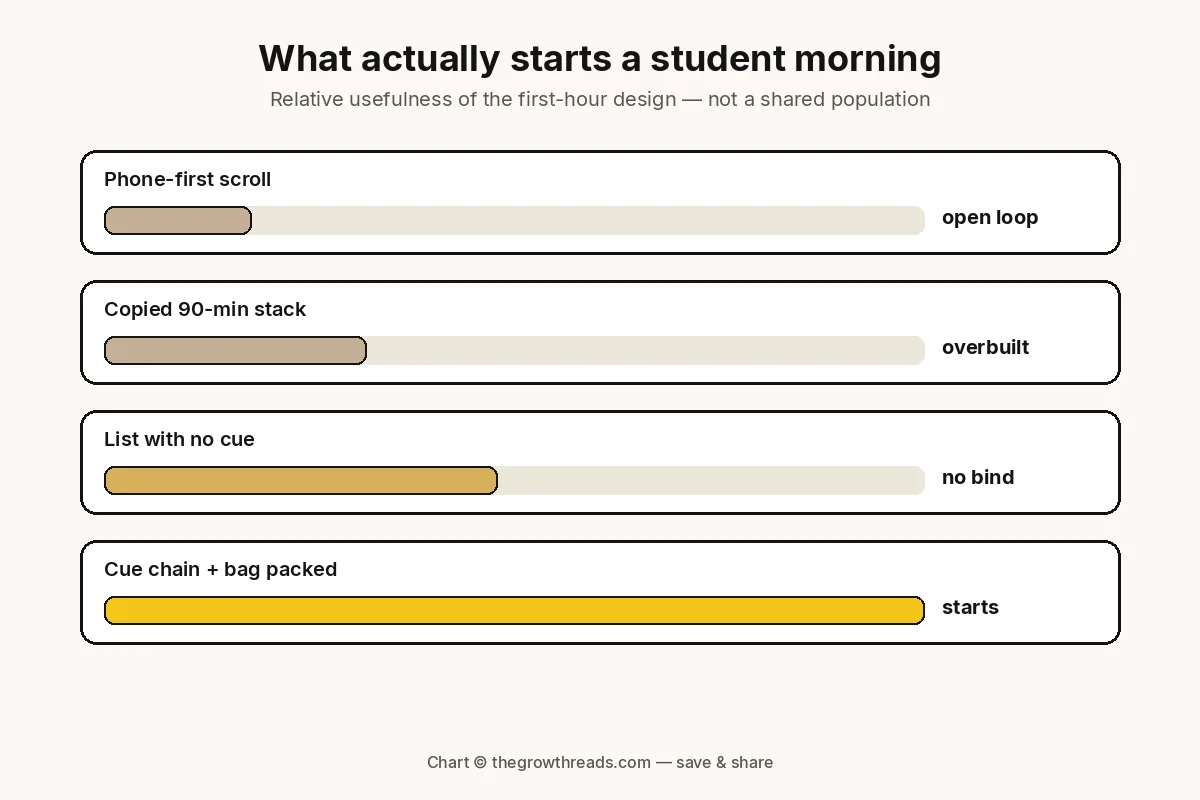
Student mornings fail when the first cue in the room is the phone, the bag is still empty, and the first hour is spent deciding instead of starting. That is a design failure, not a motivation diagnosis. The timetable still arrives. The sequence did not.
Till Roenneberg and colleagues (2004) mapped chronotype across age and found the sleep midpoint gets later through adolescence, then begins to advance around 20. Mary Carskadon, Cecilia Vieira and Christine Acebo (1993) had already linked pubertal status to a later phase preference in 12-year-olds. A student who is not a morning person is often running that delay against an early lecture. The live morning person page owns the chronotype question. This page will not restage it. It will say the routine has to fit the clock you actually have — light, water, bag, first output — rather than demand a 5 a.m. identity the parent how-to already refused.
Amy Wolfson and Mary Carskadon (1998) gave a Sleep Habits Survey to 3,120 students in four Rhode Island high schools. Self-reported school-night sleep shrank by 40–50 minutes from ages 13 to 19, mostly because bedtimes moved later while rise times stayed pinned by school. Students who called themselves struggling or failing reported about 25 minutes less school-night sleep and bedtimes about 40 minutes later than A and B students, and larger weekend delays. That is a cross-sectional, self-report association. It does not prove that an earlier alarm raises a grade. It does prove that many student mornings are already short, and that a routine which steals another 40 minutes for a copied stack is spending a scarce hour.
Lauren Hale and Stanford Guan (2015) reviewed screen-time and sleep studies in school-aged children and adolescents and found a consistent pattern: more screen time, later bedtimes, shorter sleep. Adrian Ward, Kristen Duke, Ayelet Gneezy and Maarten Bos (2017) then showed the daytime half of the same object: a phone on the desk, unused, still taxed working memory and fluid intelligence, with a larger effect in people who felt most dependent on the phone. A student morning that starts by unlocking the phone is running both findings at once — a later bedtime the night before, and a taxed first hour after.
Peter Gollwitzer’s 1999 review is the planning piece. Implementation intentions — “After I sit at the desk, I will open the problem set” — outperformed vague goals because the cue is specified in advance. A student who “will be more productive this term” has a goal. A student who wrote, last night, “After I fill the water bottle, I will put the bag on and leave at 8:10” has a cue. Play slots do not emit a HowTo ladder, and this page will not invent one. The four ingredients below are the design, not a numbered system.
The four ingredients a working student morning actually uses
- A bag packed tonight. Notes, charger, water bottle, whatever the first class actually needs. Morning decisions shrink. Wood and Neal’s context cue needs a stable first action; hunting for a cable is not one.
- Body before phone. Stand, light, water. Ward, Duke, Gneezy and Bos’s data is the reason the phone is not the alarm if you can help it. Charge it out of reach. The parent how-to already said this for any morning. The student version is the same rule with a lecture attached.
- One first-hour line. A verb and a noun: “open the problem set,” “review the two slides,” “leave by 8:10.” Gollwitzer’s if–then is that sentence. Rewriting the whole semester at 7:40 is not.
- Door-ready or started. The win is the first obligation begun, not a perfect stack. Sean Covey’s teen edition of the 7 Habits is not a trial. It is the library’s closest book-length name for putting the first important thing first on a school clock.
Lally, van Jaarsveld, Potts and Wardle (2010) asked 96 people to repeat a daily eating, drinking or exercise behaviour in the same context and found a median of 66 days to a plateau of automaticity, with a range from 18 to 254. Missing a day did not reset the curve. Simpler behaviours automatised faster. That is the honest habit finding underneath a student morning: four stable moves, repeated on class days, beat a new 12-step identity every Sunday night.
Why a scrambled first hour costs more than it feels like
A scrambled student morning costs more than a late bus because it spends the only unscheduled minutes on friction, then arrives at the first class already switching. The lecture still happens. The first-hour output did not. That is not free. It is a standing tax on the one block the timetable cannot move.
Wolfson and Carskadon’s short-sleep group — under 6 hours 45 minutes on school nights, or more than two hours of weekend bedtime delay — reported more daytime sleepiness and more sleep/wake behaviour problems than students sleeping longer than 8 hours 15 minutes with a smaller weekend shift. The National Sleep Foundation’s 2015 consensus (Hirshkowitz and colleagues) put the recommended window for 14-to-17-year-olds at 8 to 10 hours, and for 18-to-25-year-olds at 7 to 9. Those are consensus bands, not a prescription from this page, and they are not a diagnosis. They are the reason a student morning that starts at 5 a.m. after a 1 a.m. bedtime is not “discipline.” It is a sleep-debt stack wearing a routine’s name.
Two honest caveats. Wolfson and Carskadon (1998) is a survey, not a randomised trial of morning routines. Grades, sleep and mood were self-reported in the same questionnaire, so the association can run both ways. Roenneberg (2004) describes a population curve, not your Tuesday. Ward and colleagues (2017) tested undergraduates on cognitive tasks, not lecture attendance. Hale and Guan (2015) is a systematic review of observational screen-time studies. None of that blesses a 5 a.m. cold plunge. It still beats an unsourced “successful students just wake up earlier.”
The cost that does not need a dramatic percentage is the identity cost. Once “I have a morning routine” means a screenshot of someone else’s 5 a.m. list, students stop distinguishing a cue chain from theatre. The live billionaire morning routine page already owns that theatre. This page will not restage the celebrity list. It will say the student version is four moves that fit a lecture — or it is a mood board wearing their name.
Nearby pages that are not this routine
Several neighbouring pages share a morning word with this one and answer a different question. Keep them linked, not merged. This URL is the student-constraint page: a short cue chain under a timetable. Play slots do not emit a HowTo ladder, and this page will not invent one.
| Idea | What it actually is | What it is not |
|---|---|---|
| Morning routine for students | A short, same-order cue chain that starts the first class or first study block | A 5 a.m. personality, a parenting page, or a school-run checklist |
| How to build a morning routine | The Morning parent: a fixed cue, a short stack, written the night before | A second student recipe. Already live. Do not rewrite it here |
| Morning routine checklist | The list of items. Different phrase from the parent how-to | The student-constraint page |
| What makes someone a morning person | Chronotype. The delay Roenneberg mapped | A routine. A later type still needs a cue |
| How to wake up early if you sleep late | The sleep-schedule behaviour page | A first-class cue chain |
| The billionaire morning routine | The theatre this page refuses to copy | A student starter template |
| The low-dopamine morning routine | A low-stimulation first hour | A lecture-gated sequence |
The live morning-routine how-to and the live morning-routine checklist are different phrases and different jobs. This article does not restage either of them. A student can use the checklist as a list. The parent how-to remains the build. This URL is the timetable-shaped child.
Common mistakes
- Copying a 90-minute public-figure stack. Lally and colleagues (2010): simpler behaviours automatise faster. The billionaire morning routine page already named the theatre. A lecture at 9 does not care that someone else journals for 30 minutes.
- Using the phone as the alarm and the first input. Ward, Duke, Gneezy and Bos (2017) measured a tax from mere presence. Unlocking it first spends the cue on the feed. The how to focus better page already owns the phone-distance finding for the workday. Borrow the distance. Do not borrow a new focus HowTo.
- Leaving the bag empty until 8:05. Wood and Neal (2007): the context has to start a stable action. Hunting for a charger is a new decision every morning.
- Rewriting the whole semester in the first hour. Gollwitzer (1999) wants one if–then, not a new life plan. One first-hour line.
- Treating a later chronotype as a character flaw. Roenneberg (2004) and Carskadon, Vieira and Acebo (1993) describe a delay, not a defect. The morning person page owns that question.
- Rewriting the parent how-to or the live checklist. Different phrases, already published. This is the student-constraint page, not a second dawn stack.
- Spending the first hour on a new app. A new system delivers the same short-term relief as the scroll it was meant to replace. The cue is a kettle, a bottle, a bag — not a dashboard.
The evidence behind this
The claim on this page is modest: a student morning works when a short cue chain starts the first obligation, and fails when the first cue is the phone and the bag is still empty. The table is the working, not a highlight reel.
| Study | Design & size | What it found | Used here for |
|---|---|---|---|
| Wolfson & Carskadon (1998), Child Development | Sleep Habits Survey, 3,120 high-school students, four Rhode Island schools | School-night sleep fell 40–50 min from ages 13–19; struggling/failing students reported ~25 min less sleep and ~40 min later bedtimes than A/B students | Why student mornings are already short, and why this is association not causation |
| Roenneberg et al. (2004), Current Biology | Population chronotype by age | Sleep midpoint delays through adolescence and begins to advance around age 20 | Why a copied 5 a.m. stack often fights the clock |
| Carskadon, Vieira & Acebo (1993), Sleep | Sixth-graders, pubertal status and phase preference | More mature pubertal status associated with a later phase preference | The delay is developmental, not a motivation story |
| Gollwitzer (1999), American Psychologist | Review of implementation-intention experiments | If–then plans (cue + action) raise follow-through versus vague goals | Why one first-hour line beats “be more organised” |
| Lally, van Jaarsveld, Potts & Wardle (2010), European Journal of Social Psychology | 96 adults, daily behaviour in a stable context | Median 66 days to automaticity (range 18–254); simpler behaviours faster; a missed day did not reset the curve | Why four stable moves beat a 90-minute restart |
| Ward, Duke, Gneezy & Bos (2017), Journal of the Association for Consumer Research | Lab studies of phone location and cognitive capacity | A nearby unused phone reduced working memory and fluid intelligence | Why the phone is not the first cue |
| Hale & Guan (2015), Sleep Medicine Reviews | Systematic review of screen time and sleep in school-aged youth | More screen time associated with later bedtimes and shorter sleep | The night-before half of a phone-first morning |
| Hirshkowitz et al. (2015), Sleep Health | National Sleep Foundation expert consensus | Recommended 8–10 hours at 14–17; 7–9 hours at 18–25 | A consensus band, not a diagnosis, and not a 5 a.m. demand |
Frequently asked questions
What is a morning routine for students?
A morning routine for students is a short, same-order cue chain that starts the first class or first study block. The useful version packs the bag the night before, starts the body before the phone, and names one first-hour output. It is not a 5 a.m. personality and not a copied public-figure stack. The parent how-to already owns how to build any morning. The live checklist already owns the list. This page owns the timetable-shaped child. Play slots do not emit a HowTo ladder.
How is a student morning different from a normal morning routine?
The first obligation is usually not optional. A lecture, a lab or a first study block arrives whether the stack was pretty. Roenneberg (2004) also found later chronotypes through the teen years, so a student morning that copies a free 90-minute adult list is often fighting the clock. The parent how-to still holds: a fixed cue, a short sequence, written the night before. The student version just has to fit a door time. Keep the parent page for the build. Stay here for the constraint.
What should be in a morning routine for students?
Four moves: bag packed tonight, body before phone, one first-hour line, then door-ready or started. Gollwitzer (1999) is the planning piece — an if–then beats “be more organised.” Lally and colleagues (2010) found simpler daily behaviours automatised faster. A 12-step stack is how the sequence is gone by Thursday. The live checklist can hold the items. This page will not reprint that list as a second checklist, and it will not turn the four moves into a HowTo schema.
Why is it so hard for students to have a morning routine?
Because the rise time is often pinned by school while bedtime drifts later. Wolfson and Carskadon (1998) saw school-night sleep shrink 40–50 minutes from ages 13 to 19, mostly from later bedtimes. Hale and Guan (2015) tied more screen time to later bedtimes and shorter sleep. Ward and colleagues (2017) then showed a nearby phone still taxes the first hour. That is a design pile-up, not a character verdict. A later chronotype is a clock problem. The morning-person page owns that question.
Should students wake up at 5 a.m.?
Only if the bedtime already supports it. Hirshkowitz and colleagues (2015) put the recommended window at 8–10 hours for 14-to-17-year-olds and 7–9 for 18-to-25-year-olds. Those are consensus bands, not medical advice from this page. A 5 a.m. alarm after a 1 a.m. bedtime is a sleep-debt stack. The parent how-to already refused a 5 a.m. identity. This page refuses it for students too. Protect the cue chain. Do not collect an earlier number.
Is a morning routine for students the same as the morning-routine checklist?
No. The live morning-routine checklist is the list of items. This page is the student-constraint design: a short cue chain under a timetable. Different phrase, different job. You can use the checklist as a list and still need a cue that binds — Wood and Neal (2007) is the habit-context frame. Do not rewrite the checklist here, and do not rewrite the parent how-to. A play page is allowed one job.
What does the 7 Habits of Highly Effective Teens have to do with mornings?
Sean Covey’s teen edition is the unused review this row was given because “Begin with the end in mind” and “Put first things first” are first-hour jobs: name the class or the block, then do that thing before the feed. It is a book, not a trial, and this page will not dress it as one. Gollwitzer (1999) is the lab name for writing the if–then. The book is the library’s closest student-facing language for putting the important thing first on a school clock.
Does a student morning work if I am not a morning person?
Yes, if the sequence fits the clock you actually have. Roenneberg (2004) and Carskadon, Vieira and Acebo (1993) describe a later phase through adolescence. That is not a licence to skip the first class, and it is not a defect. Light, water, a packed bag and one named output still work at 8:40. The morning-person page owns the type. This page owns the cue. Play slots do not emit a become-a-morning-person ladder either way.
Sources
- Wolfson, A. R., & Carskadon, M. A. (1998). Sleep schedules and daytime functioning in adolescents. Child Development, 69(4), 875–887. doi:10.1111/j.1467-8624.1998.tb06149.x
- Roenneberg, T., Kuehnle, T., Pramstaller, P. P., Ricken, J., Havel, M., Guth, A., & Merrow, M. (2004). A marker for the end of adolescence. Current Biology, 14(24), R1038–R1039. doi:10.1016/j.cub.2004.11.039
- Carskadon, M. A., Vieira, C., & Acebo, C. (1993). Association between puberty and delayed phase preference. Sleep, 16(3), 258–262. doi:10.1093/sleep/16.3.258
- Gollwitzer, P. M. (1999). Implementation intentions: Strong effects of simple plans. American Psychologist, 54(7), 493–503. doi:10.1037/0003-066X.54.7.493
- Lally, P., van Jaarsveld, C. H. M., Potts, H. W. W., & Wardle, J. (2010). How are habits formed: Modelling habit formation in the real world. European Journal of Social Psychology, 40(6), 998–1009. doi:10.1002/ejsp.674
- Ward, A. F., Duke, K., Gneezy, A., & Bos, M. W. (2017). Brain drain: The mere presence of one’s own smartphone reduces available cognitive capacity. Journal of the Association for Consumer Research, 2(2), 140–154. doi:10.1086/691462
- Hale, L., & Guan, S. (2015). Screen time and sleep among school-aged children and adolescents: A systematic literature review. Sleep Medicine Reviews, 21, 50–58. doi:10.1016/j.smrv.2014.07.007
- Hirshkowitz, M., Whiton, K., Albert, S. M., Alessi, C., Bruni, O., DonCarlos, L., … Adams Hillard, P. J. (2015). National Sleep Foundation’s sleep time duration recommendations: Methodology and results summary. Sleep Health, 1(1), 40–43. doi:10.1016/j.sleh.2014.12.010
- Wood, W., & Neal, D. T. (2007). A new look at habits and the habit-goal interface. Psychological Review, 114(4), 843–863. doi:10.1037/0033-295X.114.4.843
Related reading on The Growth Reads
The book this page draws on
- The 7 Habits of Highly Effective Teens summary & review — put the first class or first block first, then stop collecting 5 a.m. stacks
Related articles
- How to build a morning routine — the Morning parent this student page sits under
- The morning routine checklist — the list sister; different phrase from the how-to
- What makes someone a morning person — chronotype, not a routine
- How to wake up early if you sleep late — the sleep-schedule behaviour page
- The billionaire morning routine — the theatre this page refuses to copy
Go deeper
How this article was researched
The Growth Reads editorial team writes from primary sources: the books themselves, the authors’ published essays and interviews, and the peer-reviewed literature behind the claims. Every study cited above was read in the original publication or its published abstract, and every figure is quoted with its design, sample and effect so you can judge its weight rather than take ours. Where a finding is a survey, a consensus band, a systematic review of observational studies, or a lab task rather than a randomised trial of Tuesday lectures, we say so directly in the text rather than in a footnote.
This article contains no medical advice and no diagnosis. Wolfson and Carskadon (1998) and Hirshkowitz and colleagues (2015) are cited as sleep-schedule and consensus-duration findings, not as guidance for a sleep disorder, depression, or a child’s school run. Persistent difficulty waking, staying awake in class, or sleeping across contexts is worth discussing with a qualified professional rather than treated as a missing routine.
How we work: every article on The Growth Reads is built from the books in our library plus the research they rest on, and is reviewed and date-stamped when the evidence changes. Read our full methodology.