

★★★★★ 4.5/5 — The book that still teaches you to see the system behind a meal you did not actually design.
Best for: Anyone who eats on autopilot, parents watching kids’ ads, and readers who want food-industry literacy before the next diet book
Reading time: ~7–8 hrs for the Mariner 384-page paperback · ~14 min for this guide
Difficulty to apply: Seeing is easy; changing a default meal takes a week of small swaps, not a personality transplant
Fast Food Nation in one minute
Eric Schlosser’s 2001 investigation argues that the All-American meal is not a snack you happened to want — it is a designed product, built from real estate, child marketing, teen labor, flavor chemistry, and industrial meat. The usable move is not shame. It is literacy. Once you can name the levers, you can stop treating the drive-through as weather and start treating it as a choice. Diagnostic: if your default lunch disappeared this week, could you say who designed it, or only that it was convenient?
Key takeaways
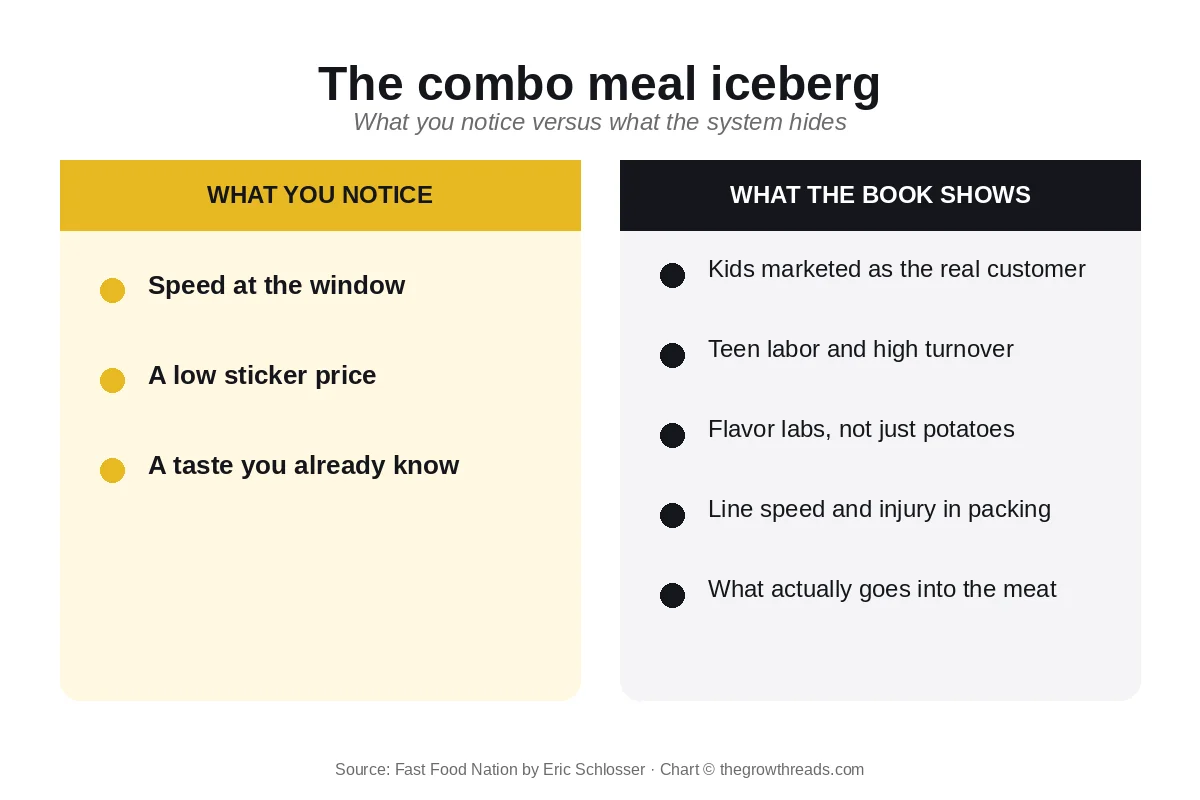
- The meal is a system: Price, speed, and familiar taste sit on top of labor, land, and livestock. Seeing only the bun is how the system stays invisible.
- Founders scaled a machine, not a recipe: Carl Karcher, the McDonald brothers, and Ray Kroc won by standardizing work and real estate, then exporting the template.
- Kids are the real customer: Toys, ads, and a clown teach preference before a child can read an ingredient list. Adult “willpower” is arriving late to a campaign.
- Cheap food is expensive labor: Teen counters and packing-plant line speed keep the sticker low. The cost shows up as turnover, injury, and a meal that cannot be slow.
- Fries taste like a lab: Frozen sticks plus oil plus aroma chemicals rebuild a memory of “fry.” The potato is the substrate, not the author.
- Cattle and packing set the burger: Captive supply, feedlots, and plants that treat bodies as throughput decide what is in the meat before you order.
- Flavor is an industry: A corridor of chemists can make strawberry without fruit. That is why two cities can serve the same bite.
- E. coli is a design problem: When cattle, feed, and speed collide, contamination is not a freak accident. It is a foreseeable output.
- Have it your way is the epilogue’s dare: The industry will not opt you out. You opt out one default at a time — a stop skipped, a potato cooked, a question asked.
What is Fast Food Nation about?
Fast Food Nation is Eric Schlosser’s investigation of how American fast food was built and what it does to land, labor, flavor, and meat. It follows the industry from founders and child marketing through fry chemistry and packing plants, then asks the reader to reclaim the next meal as a choice.
About the author
Eric Matthew Schlosser was born on 17 August 1959. He is an American journalist and food writer, a correspondent for The Atlantic whose reporting has also appeared in Rolling Stone, Vanity Fair, The Nation, and The New Yorker. Fast Food Nation grew out of a Rolling Stone assignment; Houghton Mifflin published it in 2001, and it became a New York Times bestseller, later a 2006 film, and a classroom staple. He received a National Magazine Award. Later books include Reefer Madness (2003) and Command and Control (2013). He is not a diet guru. He is a reporter who treats lunch as infrastructure. Explore all Eric Schlosser book summaries →
Key concepts at a glance
| Concept | What it means | Use it when |
|---|---|---|
| The designed meal | Speed, price, and taste are outputs of a machine, not a craving that appeared from nowhere | You are calling a drive-through “just this once” for the fourth time this week |
| Kids as customers | Toys and ads recruit preference years before an adult “choice” | A Happy Meal is the peace treaty after a long day |
| The labor discount | Teen counters and packing-line speed are how the sticker stays low | You assume cheap food has no human cost attached |
| Flavor industry | Chemists rebuild the smell of fry, strawberry, or grill without the farm | You think a potato is why the fries taste identical in two states |
| Captive cattle | Feedlots and packers set what a burger can be before you order | You are shopping only by bun and sauce |
| The most dangerous job | Meatpacking line speed turns bodies into throughput | You want the health of the meat without the health of the plant |
| What’s in the meat | Contamination and fillers are design risks, not bad-luck garnish | A recall feels like weather instead of a foreseeable output |
| Have it your way | The epilogue’s dare: reclaim one default; the industry will not do it for you | You finished the book angry and still hungry at 12:40 |
Part 1: The American Way — founders, clowns, and a template
Schlosser opens with origin stories that sound like entrepreneurship class. Carl N. Karcher selling hot dogs from a cart. The McDonald brothers stripping a barbecue menu down to a hamburger line that could run like a factory. Ray Kroc, a mixer salesman, seeing that the money was not in a better burger so much as in a replicable system of real estate, suppliers, and jobs a teenager could learn in an afternoon. The myth is rugged founders. The mechanism is standardization. Once the work is a script, it can be franchised onto a new exit ramp without a chef.
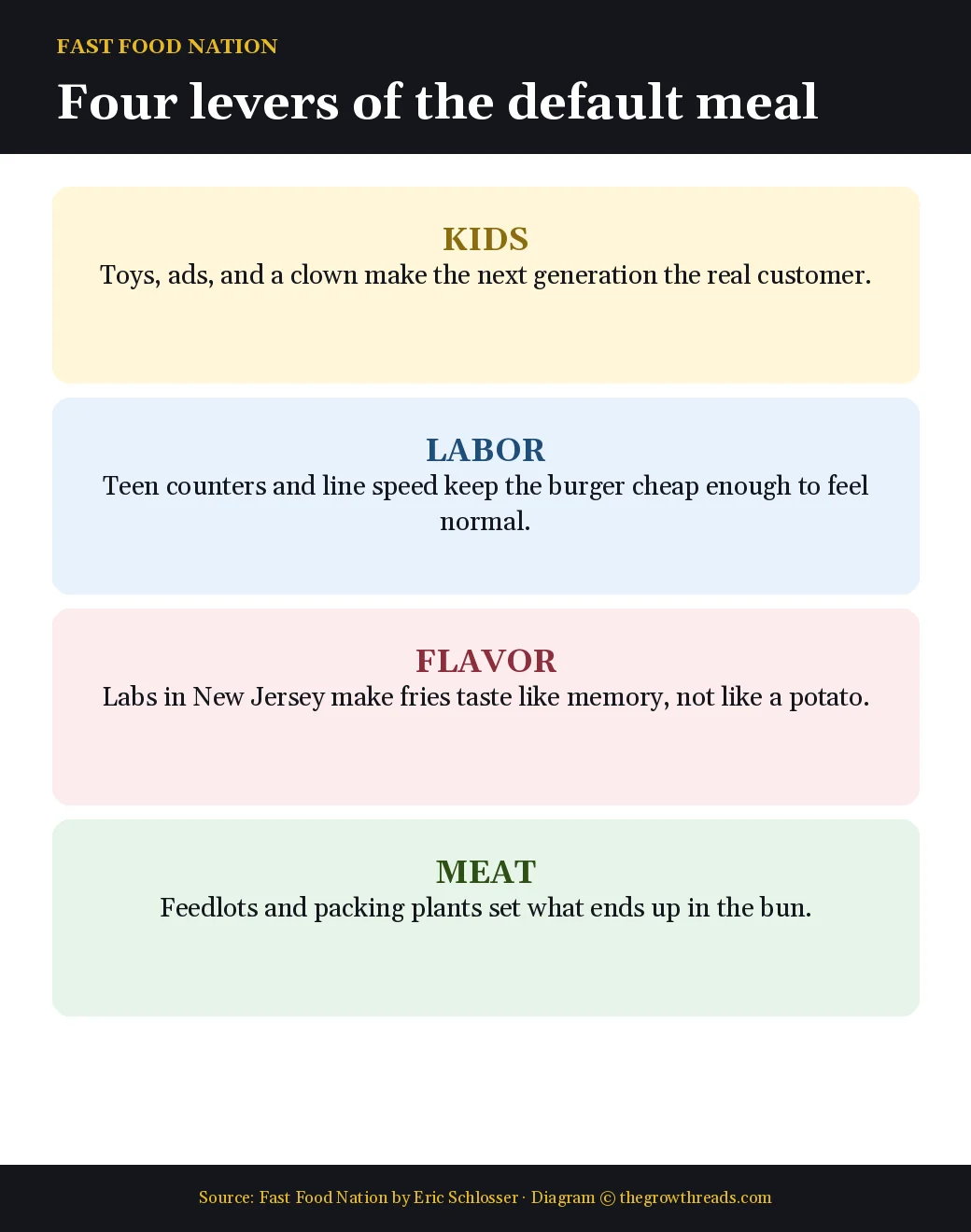
That script needs a next generation. A clown, a toy, a birthday, a Saturday cartoon — the brand arrives as a pal, not as a vendor. Schlosser’s point is not that children are foolish. It is that preference is trained before literacy. Adult willpower is a second-round draft pick. You are arguing with a campaign that started in a play area.
Franchisees and real estate close the American Way. The corporation sells a template, collects rent and royalties, and keeps the brand uniform while the local operator eats the variance. The same chain on the same kind of corner in every city is not coincidence. It is the product.
TGR Note: For the seven-word eating rule that follows this reporting, read In Defense of Food. Pollan assumes you already suspect the supermarket is designed. Schlosser shows who built the drive-through.
Part 2: Behind the counter — the labor that keeps the sticker low
The second movement is the job. Fast food did not become cheap because potatoes became generous. It became cheap because the work could be broken into tasks that do not require a trade or a long tenure. Schlosser spends time at the register and the fry station: students, recent immigrants, managers running a crew that turns over so fast training is a treadmill. The public story is first jobs. The private math is a wage that only works if the meal is assembled at speed and the crew is replaceable.
The same logic shows up later in the packing plant: throughput. A burger that takes four minutes at home has to take forty seconds if a family of four is promised they will not wait. Someone’s hands absorb that promise. Operators are squeezed between brand rules and local labor; they cannot slow the line or pay a craft wage without breaking the ad. “Just hire better people” is not a strategy when the template requires people to be interchangeable. The health of the meal and the health of the job are the same design. A $5 combo is not a law of nature.
TGR Note: If you want the later laboratory sequel — how salt, sugar, and fat were tuned inside snack companies — read Salt Sugar Fat. Moss is inside the conference room. Schlosser is still in the parking lot and the plant. Together they are the same map at two altitudes.
Part 3: Meat and potatoes — fries, flavor, and the cattle machine
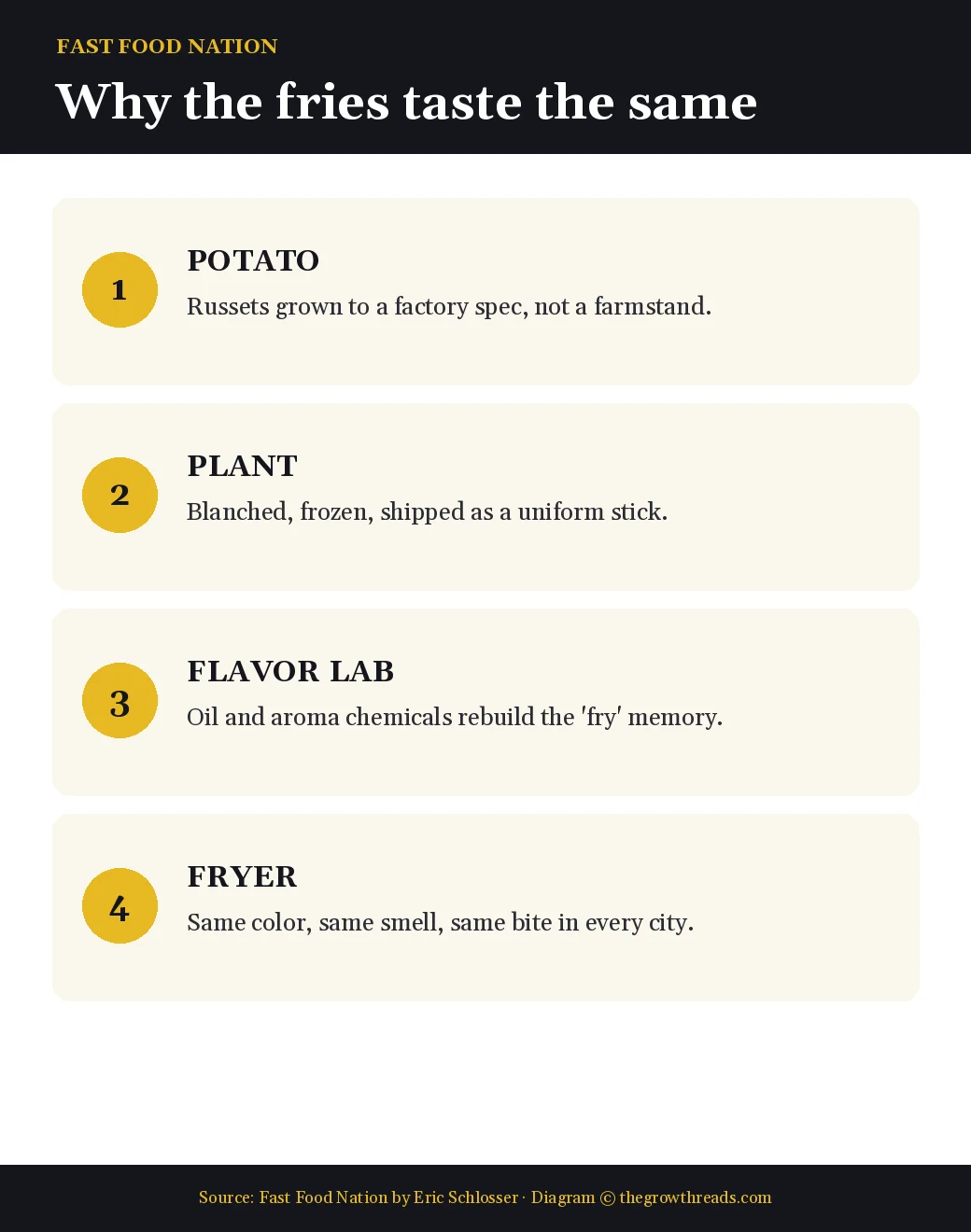
“Why the fries taste good” is the chapter people remember. A russet is grown to a factory spec, frozen, then dropped into oil whose flavor is as managed as the potato. Alongside that supply chain sit flavor companies where chemists reconstruct the smell of a fry or a strawberry. Taste is an industrial product. Two cities can serve the same bite because the bite was specified.
Then the book walks onto the range and into the plant. Independent ranchers get squeezed as packers consolidate. Feedlots concentrate animals the way the fry plant concentrates potatoes. Inside the packing house, Schlosser reports one of the most dangerous jobs in America: line speed, knives, a workforce easy to replace when a wrist gives out. This is not a vegetarian sermon. It is an accounting. If the burger is cheap, some of the cheapness is a body moving faster than a joint can tolerate. The same template then travels. Fast food, he notes, joined movies, jeans, and pop as a cultural export. Wherever the machine lands, the default meal lands with it.
TGR Note: For what “food that isn’t food” looks like a generation later, Ultra-Processed People is the clinical sibling. Van Tulleken names the product category. Schlosser named the factories and the ads that made the category feel like lunch. The Hungry Brain then explains why your brain, not a lecture, keeps saying yes.
Part 4: What’s in the meat — and having it your way
The last movement is the one that made the book infamous in classrooms: what goes into ground beef, how E. coli O157:H7 became a headline, and why a recall can travel through a supply chain built for speed. When cattle, feed, hide, and grind are a continuous flow, contamination is a design risk. You can improve testing. You cannot pretend the machine was built around a family kitchen’s caution.
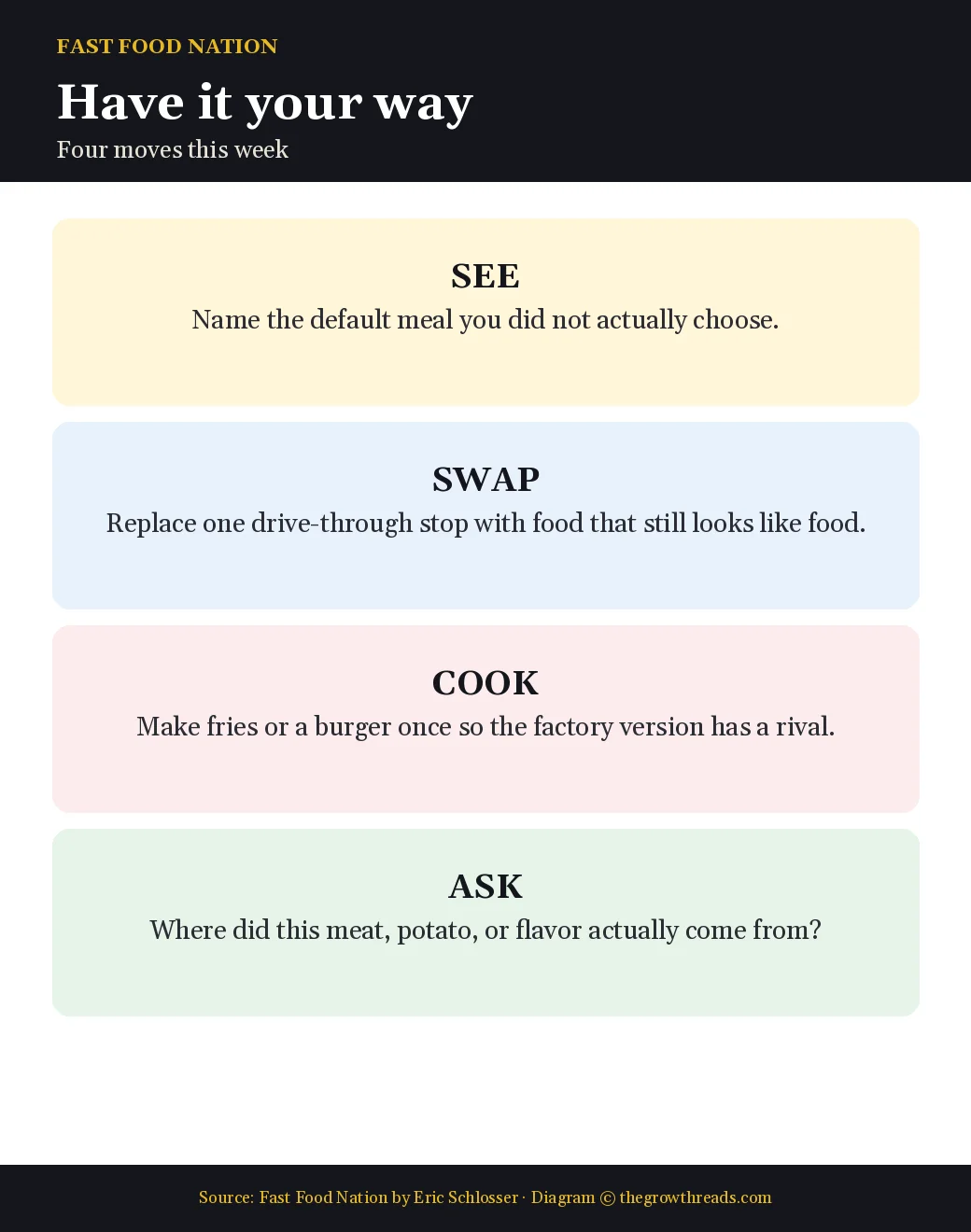
He does not sneer at the people eating the meal. The target is the invisibility. Hundreds of millions of people buy fast food without thinking much about it; that is the system working as designed. The epilogue’s slogan is the dare: have it your way — meaning notice you have been having it their way by default. Cook a potato. Skip one stop. Ask where the meat came from. That is not a monk’s vow. It is refusing to outsource the next ten meals to a template.
Later editions add an afterword. Logos changed; the levers did not retire. Diet books tell you what to plate. This one tells you why the default plate arrived before you thought to ask. If you can see the machine, what will you do at 12:40 tomorrow?
TGR Note: If you want a plant-forward protocol after the investigation, How Not to Die and The China Study are the how-to shelves. Schlosser will not write your grocery list.
Who is Fast Food Nation best for — and who should read something else first?
Read it if you eat a default meal you did not design, you parent through toy promotions, or you have finished three diet books and still cannot explain why the fries taste the same in two airports. It is reporting, not a 30-day plan.
Read something else first if you need a plate protocol this week — start with In Defense of Food, How Not to Die, or Glucose Revolution. If you want the snack-company conference room, Salt Sugar Fat. If you want the 2020s clinical name for industrial food, Ultra-Processed People. This is not medical advice and not a command to never eat a burger. It is a map of the machine that made the burger your default.
Questions to reflect on
- What is your actual default meal on a busy Tuesday, and who designed it if it was not you?
- Where does a child in your life meet a brand as a friend — a toy, a screen, a playground — before they meet an ingredient list?
- When you say a meal is “cheap,” whose time and whose joints are you leaving off the receipt?
- Can you tell the difference, in a blind bite, between a potato you cooked and a fry that was specified in a lab?
- What would “have it your way” be this week as one concrete swap, not as a new identity?
🔥 Ready to see the system behind the meal?
Start with the founding chapters, then read “Why the fries taste good” before you order the next carton.
How to apply Fast Food Nation (7-day plan)
- Day 1: Write down every meal this week you did not actually choose. Circle one. That is the designed meal you will work on.
- Day 2: Watch one ad or app promotion the way Schlosser watches a clown: who is the customer besides the person holding the tray?
- Day 3: Cook a potato or a simple burger at home so the factory version has a rival in your mouth.
- Day 4: Skip one stop you usually make “because it is on the way.” Replace it with food that still looks like food.
- Day 5: Read one package or chain sheet for an item you always order. Ask: flavor, or farm?
- Day 6: If you eat meat, pick one serving from a named farm or butcher you can ask — or skip the serving. The point is a question, not a purity test.
- Day 7: Write a four-word house rule and put it on the fridge. Example: “Cook before you queue.” Use it on the next busy Tuesday.
Frequently asked questions
What is Fast Food Nation about?
It is Eric Schlosser’s 2001 investigation of the American fast-food industry as a system, not a string of restaurants. He follows founders and franchises, child marketing, teen labor, the flavor industry that makes fries taste identical, and the cattle-and-packing complex behind the burger, then asks the reader to reclaim the next meal. It is reporting with an application: see the machine so a default lunch stops feeling like weather. It is not a calorie-counting manual and not a command to never eat a hamburger. It is literacy for people who already eat on autopilot.
Is Fast Food Nation still relevant in 2026?
Yes — the logos aged; the levers did not retire. Delivery apps and “better” chains changed the storefront. Child marketing, flavor specs, consolidated meat, and a cheap meal that depends on interchangeable labor are still the chassis. Later editions add an afterword; the Mariner paperback we link is the 384-page edition with that extra reporting. Read it as a map of design, then update the examples with whatever app is on your home screen. If you only want 2020s product chemistry, add Ultra-Processed People. If you want who built the driveway, this is still the book.
Fast Food Nation vs Salt Sugar Fat vs Ultra-Processed People — which should I read first?
Read Fast Food Nation first if you want the industry as land, labor, ads, and meat — the parking lot and the plant. Read Salt Sugar Fat first if you want the conference room where snack companies tuned bliss points. Read Ultra-Processed People first if you want a clinician’s name for industrial formulations and a self-experiment. They stack. Schlosser is the oldest and still the widest shot of the default meal. Moss is the snack sequel. Van Tulleken is the 2020s medical sequel. If you only have one weekend, start here, then pick the sequel that matches whether you care more about ads, snacks, or ingredients.
Did Fast Food Nation change the industry?
It changed the conversation more than it retired the machine. The book became a bestseller, a film, and assigned reading. Chains posted calorie counts, swapped frying fats, and advertised salads. Packing and marketing did not dissolve. Schlosser’s own later comments treat the work as an unfinished argument, not a victory lap. That is useful for a reader: do not wait for the industry to finish reforming before you change a Tuesday. Use the book as personal literacy. Policy is a longer fight. Your 12:40 meal is this week. Both matter; only one is on your calendar tonight.
Is the book anti-fast-food workers?
No. The reporting sits with the people at the counter and on the line. The argument is that the template requires them to be interchangeable so the sticker can stay low. That is a defense of the worker as a person, not a sneer at the job. If you have worked those shifts, you will recognize the speed, the turnover, and the gap between the ad and the crew. If you have not, read those chapters before you congratulate yourself for “not eating junk.” The meal is cheap because someone else’s time was priced that way. Seeing that is the opposite of punching down.
How long is Fast Food Nation and which edition should I buy?
The Mariner Books Classics paperback we link is 384 pages, ISBN-13 9780547750330, originally published in 2001 by Houghton Mifflin, with later afterword material. Most readers finish it in seven to eight hours, often in two sittings — the American Way chapters, then meat and potatoes. There is a 2006 film; it is not a substitute for the reporting. This guide is about fourteen minutes and is not a replacement for his plant-floor scenes. If a library has the Harper Perennial paperback, the argument is the same book. Buy the edition you will actually finish. The 7-day plan above is our application layer, not his workbook.
Is Fast Food Nation saying I can never eat a burger — and is this medical advice?
No, and no. Schlosser’s dare is to stop eating a designed meal on autopilot, not to join a purity contest. A burger you chose, from a place you can describe, is a different act from a default you did not notice. The book will not tell you how to treat cholesterol, a child’s growth, or a GI diagnosis. Those are clinical decisions. Use this as a map of industry design, then take personal health questions to clinicians who have your chart. Education, not a prescription.
Related summaries
- In Defense of Food — Pollan’s seven-word rule after you have seen the machine.
- Salt Sugar Fat — the snack-company sequel: how craving gets engineered in a conference room.
- Ultra-Processed People — the 2020s clinical name for food that is not food.
- How Not to Die — a plant-forward protocol once the investigation has made a grocery list feel possible.
Browse titles on our Best Health Books pillar page.
How we analyze books: our summaries are built from a full read of the source text, cross-referenced against the author’s published interviews and research where relevant, and structured around practical application rather than critique. We disclose our editorial process and affiliate relationships in full. Read our full methodology.