

★★★★½ 4.5/5 — a field manual for the call you keep postponing.
Best for: People with decent systems who still flinch before the hard conversation, the launch, or the truthful no
Reading time: ~6 hours (278 pages) if you binge · this guide ~12 min
Difficulty to apply: Easy to understand — one decision. Hard to keep — you have to take the rep while afraid
Courage Is Calling in one minute
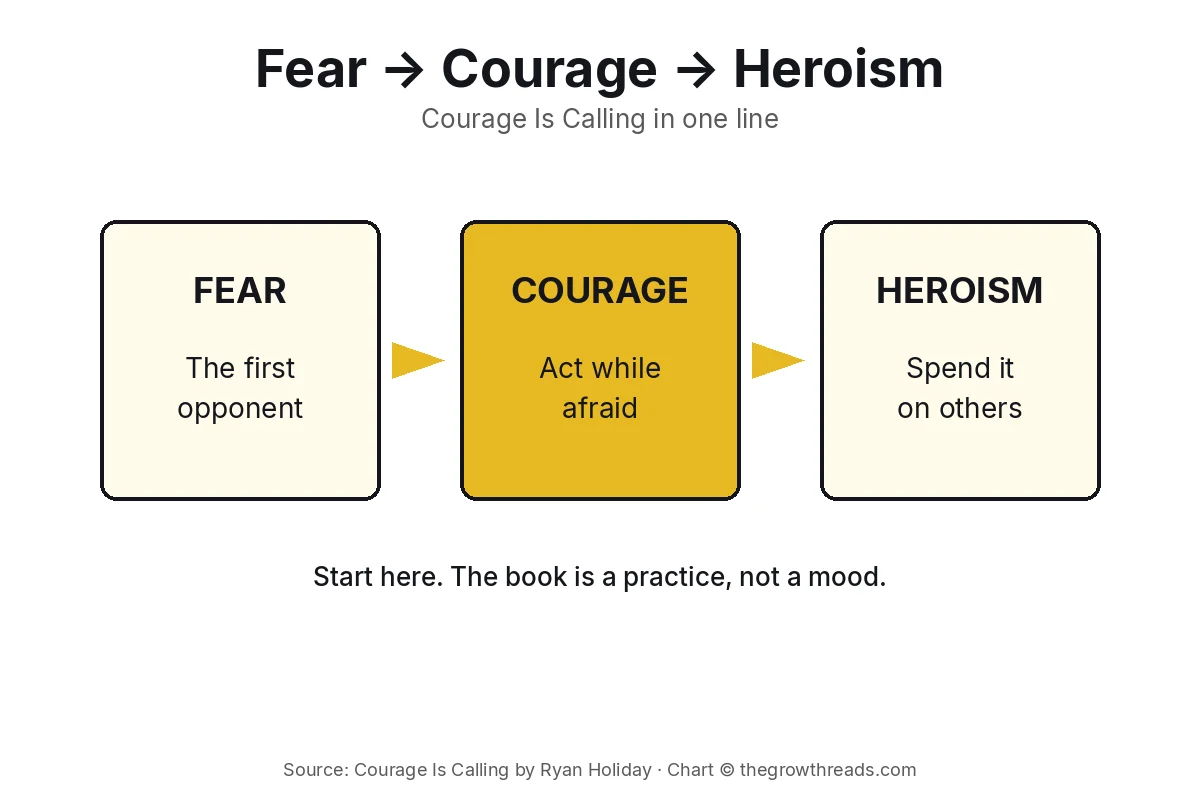
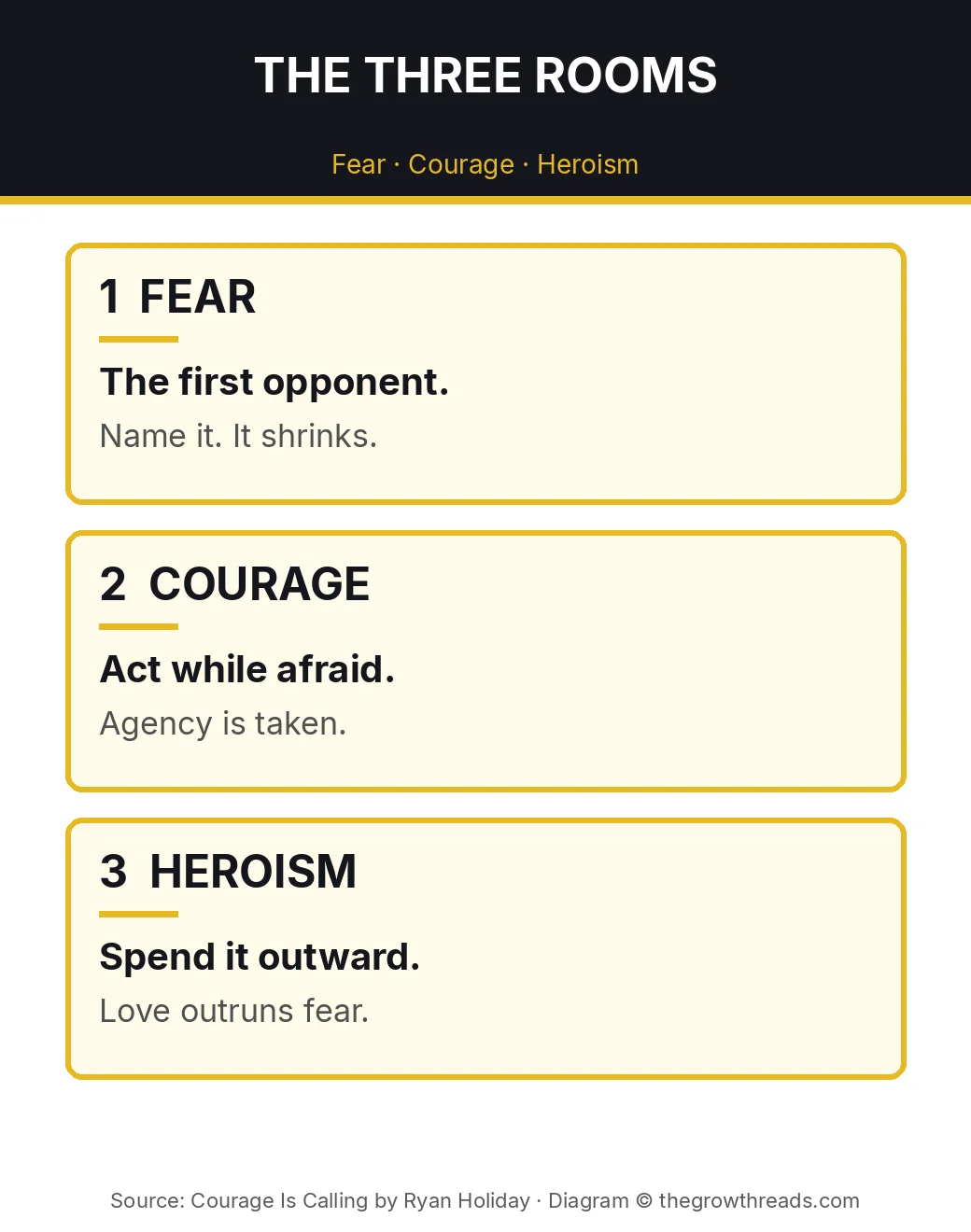
The bottleneck is not your system. It is the flinch. Ryan Holiday’s Courage Is Calling: Fortune Favors the Brave (Portfolio, 2021) opens his Stoic Virtues series where most productivity advice politely stops. You already know the important work. What you do not have is the two minutes in which you start it — because fear got there first and called itself timing or research. Courage is not the absence of fear. It is a decision you make while fear is still talking. Three rooms: name the fear, practice the decision, then spend that bravery on someone other than you. This summary is the application layer: a work-sized test for the call you keep dodging, the agency move (taken, not granted), and a 7-day plan of small brave acts — not a costume from a Spartan story.
Key takeaways
- Fear is the first opponent: It arrives before the obstacle. If you never engage, Obstacle-is-the-Way tactics have nothing to work on.
- Courage is a decision, not a feeling: Waiting to feel ready is how years disappear. Act while the pulse is up.
- We fear the wrong things: Embarrassment and a hard conversation outrank wasted seasons. Audit the cost of the delay.
- Name it and it shrinks: A vague dread runs the day. One sentence — “I am afraid of X” — puts it on the table.
- Prudence can be a costume: More research, a better moment, a cleaner draft. Sometimes that is wisdom. Often it is hiding.
- Agency is taken, not given: Permission and confidence rarely arrive first. Take a small act without being invited.
- Start smaller than the fantasy: The two-minute version of the brave move beats the movie version you will never cast.
- Reps beat a heroic Tuesday: Courage is a muscle. One spike does not install a practice.
- Heroism is courage spent outward: Truth, protection, credit given away — not self-help swagger.
- Fortune favors the brave: Boldness compounds. Hiding compounds too. The calendar shows which you chose.
What is Courage Is Calling about?
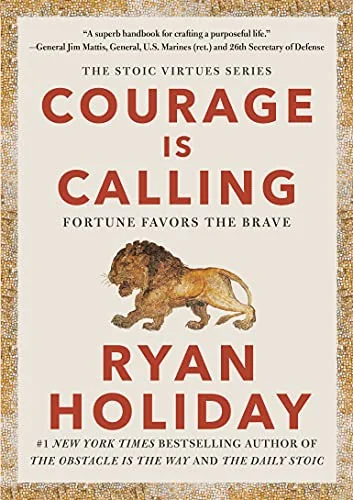
Courage Is Calling is Ryan Holiday’s 2021 Stoic field guide to acting while afraid. Fear is the first opponent; courage is a decision, not a mood; heroism is that decision spent on other people. The point is a practiced yes at work — not a quote about Spartans.
About the author
Ryan Holiday grew up in California, left college early, and apprenticed as a research assistant to Robert Greene before a run in marketing and media, including Trust Me, I’m Lying. The turn that made him a TGR regular was Stoic: The Obstacle Is the Way, Ego Is the Enemy, Stillness Is the Key, and The Daily Stoic — Marcus, Seneca, and Epictetus as an operating manual, not a museum visit. Courage Is Calling (2021) opens the four-virtue series. He writes in short historical cuts. The usable move is the same one his better readers already use from Obstacle: stop waiting for a feeling. Take the next right action while the feeling is still loud. Explore all Ryan Holiday book summaries →
Key concepts at a glance
| Concept | What it means | Use it when |
|---|---|---|
| The call | The work, talk, or stand you already know is yours | You keep “preparing” instead of starting |
| Fear as first opponent | The flinch arrives before the actual obstacle | The week’s important hour keeps losing |
| Wrong fears | We over-weight embarrassment and under-weight delay | You would rather look busy than look foolish |
| Naming | One honest sentence shrinks a vague dread | Anxiety is running the calendar with no label |
| Agency taken | You start without being certified ready | You are waiting for a nod that is not coming |
| Small brave act | A two-minute version of the hard move | The fantasy of the leap is blocking the step |
| Prudence costume | Delay dressed as wisdom | You have researched past the point of use |
| Heroism | Courage spent on someone else’s good | The brave act would only serve your image |
Part 1: Fear is the first opponent
Holiday opens the virtues series with fear because nothing else in the stack runs if you will not enter the room. The Obstacle Is the Way assumes you are already in the problem. This book assumes you might never go in. The first opponent is not the competitor or the difficult colleague. It is the flinch in the thirty seconds before you send, speak, or start — the clean story that says later, after one more pass, when the timing is professional. That story is often cowardice with better vocabulary. Nightingale leaving a comfortable path, Darwin sitting on a manuscript for years because of the fight it would start: same pattern at a larger scale. The work was clear. The delay had a respectable reason. The cost compounded in silence.
The test is last week, not a personality. Which hour was supposed to be the hard thing, and what did you do instead that still looked like work? Fear loves plausible activity. Holiday’s first move is naming. “I am afraid this draft will look amateur” is a problem you can walk toward. “I just need to get my head straight” is a fog that never clocks out. We also fear the wrong magnitudes. A red face in a meeting feels like death. A year of not shipping feels like nothing on Tuesday. Flip the weights. Write the cost of another month of hiding, in hours and in options closed. That is the fear audit — how you stop letting the wrong monster set the calendar.
TGR Note: If the flinch has a capital letter, our War of Art summary names it Resistance. Big Magic lets fear ride in the car; Holiday cares whether you still turn the key. After you enter, The Obstacle Is the Way is the next manual.
Part 2: Courage is a decision you practice
Holiday’s definition makes this a productivity book, not a pep talk. Courage is not a temperature you wait to reach. It is a decision under load. Treat bravery as a mood and you underline Spartans and freeze on Wednesday. Treat it as a practice and you take a slightly too-sharp rep while the ego complains. The fantasy leap is attractive: one cinematic act, then you are “a courageous person.” Holiday’s better claim is duller. Fortune favors the brave because boldness compounds. Hiding compounds too.
Start smaller than the movie. A career change’s first rep is a conversation or a two-minute skill, not a resignation on Monday. A conflict’s rep is the true sentence, not a manifesto in Slack. Complicated is allowed. Complication is not a waiver. The decision still has a size you can take today. You will not like the feeling. If it felt safe, it would not be the virtue. The job is not to enjoy it. The job is a next rep on the calendar before the story writes “I am just not that kind of person.” You become that kind of person by the calendar, the way you become a runner — not by reading about Sparta.
TGR Note: For the long-haul version of “keep taking reps,” Grit is perseverance; Holiday is the first yes those reps need. Can’t Hurt Me is the harder physical cousin. If the unit should be tiny before it is brave, Atomic Habits installs it.
Part 3: Agency is taken, not given
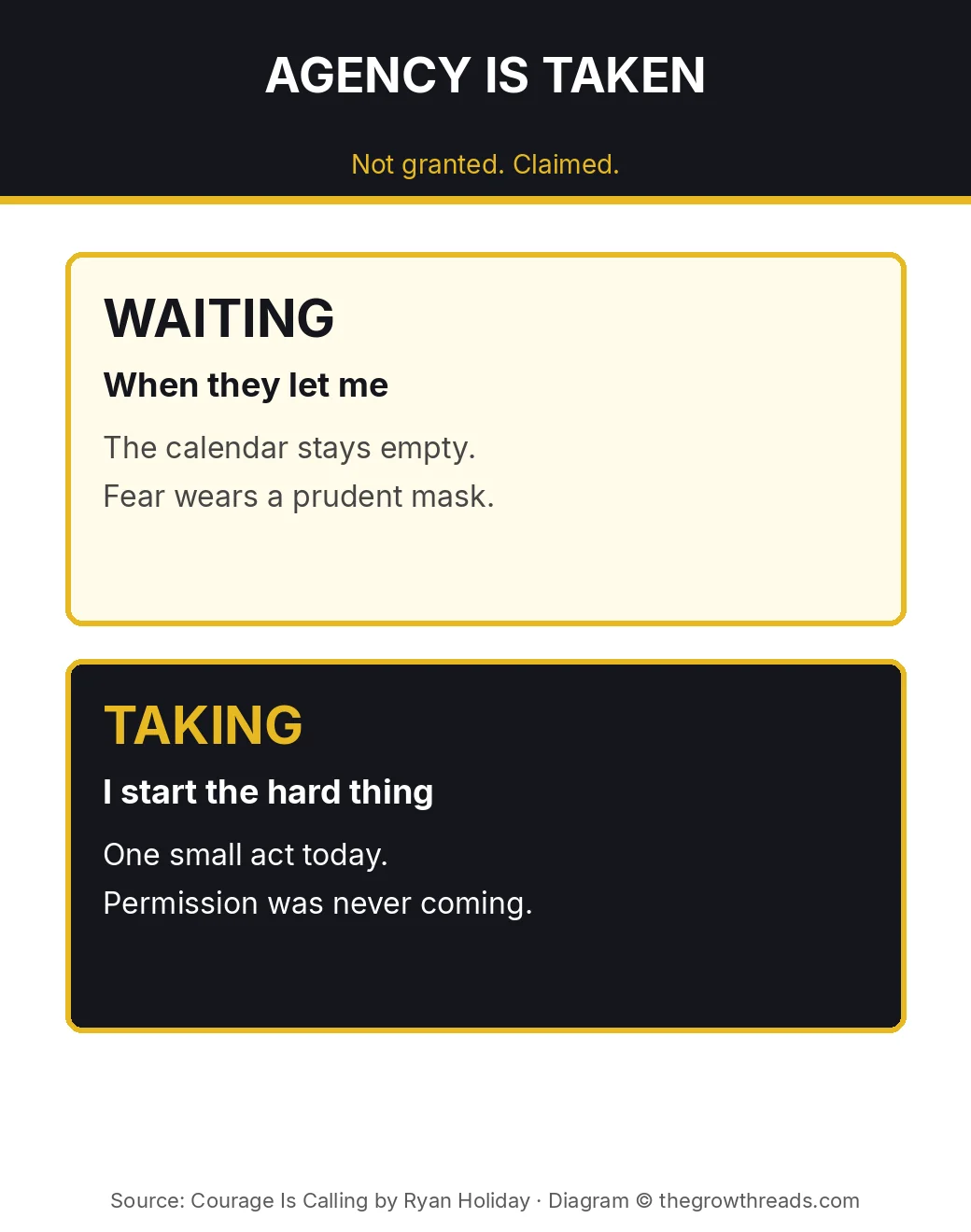
This is the sentence that earns the book its keep at work. Agency is taken, not given. Nobody will certify that you are ready to lead the meeting, ship the ugly version, or say the true number. Teams are full of people waiting to be invited into a role they already unofficially hold. Holiday’s “took it” histories are easy to misread as destiny porn. The usable core is smaller: a first act that does not need a title. Put the document in the folder. Book the slot. Ask the question everyone is dancing around. Readiness is often a story the ego tells so it can stay untested. The counter is a timestamp. No time on the calendar means you had a wish, not a strategy.
Two traps sit next to this. Recklessness: agency as blasting through other people. The virtue is the right thing under fear, not volume under adrenaline. And the perfect map: more information is catnip for smart people until you are not reducing uncertainty — you are feeding prudence as a costume. Would a slightly less informed version of you already have moved? If yes, you are researching as hiding. Take the smallest step that creates information you cannot get from another article. Agency is not a personality. It is a taken hour, recorded, that future-you cannot gaslight.
TGR Note: If the block is the need to look impressive while you wait, Ego Is the Enemy is the pairing. If you take the act and get flattened, The Obstacle Is the Way. If the stall is skill, not nerve, So Good They Can’t Ignore You.
Part 4: Heroism — courage spent on someone else
The last room refuses to stay a personal-branding manual. Courage for your career is necessary and still incomplete. Heroism, in Holiday’s frame, is courage directed outward: the truth that protects a team, the credit you give away, the stand that costs a little status. Love — of a craft, a person, a standard — is what gets people to take those hits, not fearlessness. You do not need the word “hero.” You need one outward spend so the virtue does not collapse into self-mythology. Nightingale belongs here because the work was for other people’s bodies. A launch that only inflates your legend is still a call. It is not the last room.
At work this is diagnostic. Who benefits if you speak? If the only beneficiary is your image, you are still in room two — finish that rep. If someone else is exposed because you stay polite, you are in room three and calling it professionalism. Holiday’s hard histories are not a demand that you immolate your job on a Tuesday. They warn against always choosing comfort when a smaller truth would have been enough. Ordinary heroism is a true number in a forecast, a colleague defended in the room they are not in, a no that keeps a customer from a bad fit. Then you go home. Courage, practiced, needs somewhere to go besides your own nervous system.
TGR Note: The next virtue is already on TGR: Discipline Is Destiny — how you keep showing up after the yes. Daily-page sister: The Daily Stoic. If the outward spend needs a volume knob first, Stillness Is the Key.
Who is Courage Is Calling best for — and who should read something else first?
Best for people who already have lists and tools, and still watch the important hour lose to a flinch. Run the 7-day plan on one real call — not on a quote graphic.
Read something else first if you are already in the fight: The Obstacle Is the Way. If you start and cannot stay: Discipline Is Destiny. If no small act sticks: Atomic Habits or Mini Habits. Resistance in artist language: The War of Art. Noise, not fear: Stillness Is the Key. Skill, not nerve: So Good They Can’t Ignore You.
Questions to reflect on
- What call did you postpone last week that still looked like work from the outside?
- What are you actually afraid of — in one sentence — and what has that fear cost in months?
- Where is “prudence” a costume, and what is the two-minute act it is blocking?
- Where are you waiting to be invited into a role you could take a first hour in without a title?
- If courage had to be spent on someone else this week, who would benefit from a true sentence you have not said?
🔥 Ready to answer the call before you feel ready?
Get Courage Is Calling, then run the 7-day plan on one real flinch — not on a binge of Spartan stories.
How to apply Courage Is Calling (7-day plan)
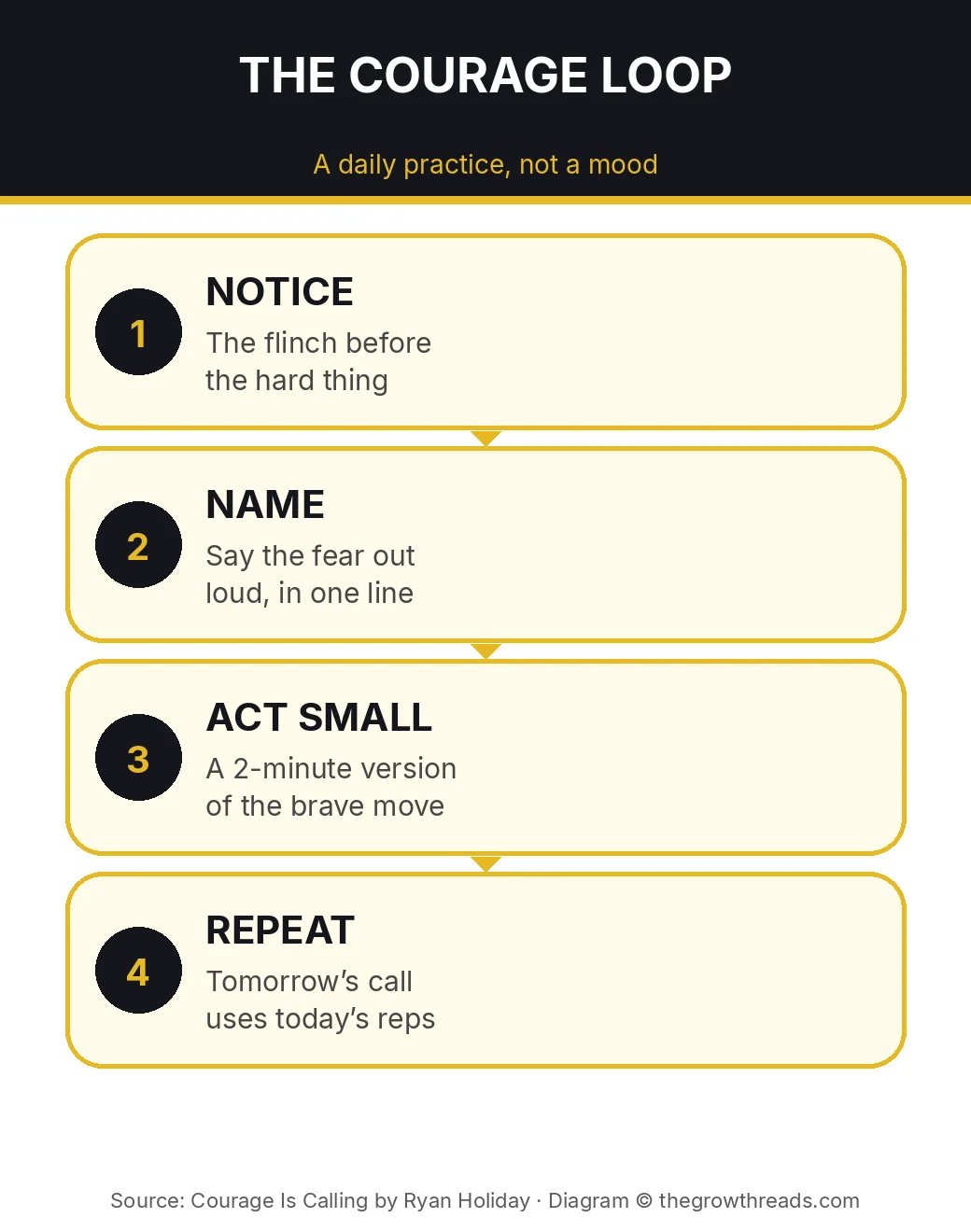
- Day 1 — Write the call. One sentence: the work, talk, or stand you keep dodging. Circle the fear in it. If you cannot name the fear, you are still in the story.
- Day 2 — Name it out loud. Say “I am afraid of X” to one person or a note. Then write the two-minute version of the brave move. If it still sounds like a movie, cut it in half.
- Day 3 — Take agency once. Send, book, or start the ugly first pass without waiting to be invited. Put a timestamp on it. Waiting does not count as a rep.
- Day 4 — Repeat the same call. Same fear, second rep. Courage is a muscle. A new quest every day is hiding in variety.
- Day 5 — Spend it outward. One unit of heroism: a true number, a defended colleague, credit given away, a no that protects someone.
- Day 6 — Catch the costume. When you delay, ask whether it is risk management or fear in a nice coat. If it is the coat, take the two-minute act anyway.
- Day 7 — Schedule next week’s first rep. Pick the next call. Put the small act on the calendar. The book only works if tomorrow still has a job to do.
Frequently asked questions
What is Courage Is Calling about in one paragraph?
Courage Is Calling is Ryan Holiday’s 2021 opener to the Stoic Virtues series. It argues that fear is the first opponent — before the obstacle, the competitor, or the inbox — and that courage is acting on the right thing while that fear is still loud. The book moves through three rooms: name fear, practice courage as a decision, then spend it on other people (heroism). This summary is the application layer: a work-sized test for the call you keep postponing, plus a 7-day plan of small brave acts, not a personality transplant.
How is Courage Is Calling different from The Obstacle Is the Way?
The Obstacle Is the Way is Holiday’s book on perception, action, and will once you are already in the problem. Courage Is Calling is about the step before that: whether you enter the problem at all. Obstacle assumes you will engage. Courage assumes you might hide, delay, or call the delay “prudence.” Read Obstacle if you are in the fight and need a stoic frame. Read Courage if the fight has not started because you will not pick up the call. They stack. This summary does not replace Obstacle’s three disciplines; it installs the yes that lets those disciplines run.
What does Holiday mean by “agency is taken, not given”?
He means permission, confidence, and a clear calendar rarely arrive first. The job, the conversation, the draft — someone else is not going to tap you on the shoulder and certify that you are ready. Agency is a small act you take without being invited: send the version, book the slot, tell the true number. Waiting for the feeling of authority is how years disappear. Day 3 of the plan is one taken act, not a manifesto. If you need the inner block named as ego rather than fear, Ego Is the Enemy is the pairing; the move is still a taken hour.
Is Courage Is Calling a productivity book?
Yes, in the TGR sense: the bottleneck is often not a system. It is the flinch before the hard thing — the meeting, the publish, the ask. Holiday writes in Stoic history, but the usable unit is a workday. Name the fear that stole this week’s important hour. Take a two-minute version of the brave move. Repeat. If your stall is a broken calendar rather than a flinch, start with Getting Things Done or Deep Work. If the stall is Resistance with a capital R, The War of Art names it; Holiday names the virtue that walks through it. This book is the walk, not the filing system.
Should I read Courage Is Calling before Discipline Is Destiny?
Holiday ordered the virtues series that way on purpose: courage first, then temperance. Courage Is Calling is the yes. Discipline Is Destiny is the how you keep showing up after the yes. If you already start things and cannot finish them, skip to Discipline. If you never start the thing that matters, start here. You do not need to finish the whole virtues shelf before Day 1. You need one feared action this week. Then Discipline is the sister summary for the days after the spike of bravery fades.
Who should read Courage Is Calling — and who should start elsewhere?
Read it if you keep postponing a conversation, a launch, a truthful no, or a piece of work that would actually move the week. It is for people who already own the systems and still flinch. Start with Atomic Habits or Mini Habits if you cannot get any small daily act to stick. Start with The War of Art if you need Resistance named before virtue. Start with The Obstacle Is the Way if you are already in the fight. Start with Stillness Is the Key if the problem is noise, not fear. This one waits until you will spend a brave two minutes, not just underline a Spartan story.
Is Courage Is Calling still useful in 2026?
The flinch aged well. Tools got better; the meeting you will not start did not. Feeds make other people’s bravery look like a personality you missed, which is another excuse to wait. Holiday’s claim is still the useful one: courage is a decision under fear, practiced in small reps, then spent on someone else. Ignore the quote-graphic version that makes bravery a mood. Keep the name-the-fear line, the two-minute act, and one outward spend in the 7-day plan. The history chapters are fuel, not a costume. Day 1 should still be a real call you have been dodging at work.
Related summaries
- Discipline Is Destiny Summary & Review
- The Obstacle Is the Way Summary & Review
- Ego Is the Enemy Summary & Review
- The War of Art Summary & Review
- Best Productivity Books
How we analyze books: every book on The Growth Reads is read cover to cover, summarized in thousands of words of original analysis, and rated against our five-criteria rubric (lasting impact, evidence quality, practical application, writing & originality, external consensus). Read our full methodology.