

★★★★★ 4.7/5 — Eat That Frog! hands you one filter for a chaotic to-do list: pick the task you’re most likely to avoid, then do it first.
Best for: Chronic procrastinators, anyone with more tasks than hours, first-time managers building a daily system.
Reading time: ~3 hrs to read the book · ~9 min to read this guide.
Difficulty to apply: Easy — one daily habit, no tools or apps required.
Eat That Frog in one minute
Your to-do list will never be empty — and that’s fine, as long as you do the right task first. Brian Tracy’s Eat That Frog! argues that procrastination isn’t a character flaw you fix with more willpower; it’s a prioritization problem you fix with a system. Your “frog” is the single task on your list that’s most important and most likely to get pushed to tomorrow — usually because it’s hard, ambiguous, or a little uncomfortable. Tracy’s instruction is blunt: eat that frog first, before email, before meetings, before anything else competes for your best hours. Everything else in the book — the ABCDE Method, the Law of Three, single handling, and blocking off large chunks of time — exists to help you correctly identify the frog and then protect the discipline to actually eat it. It’s less a time-management book than a decision-making one: which single task, right now, would matter most if it were the only thing you finished today?
Key takeaways
- Eat your frog first: Do your most important, most-avoided task before anything else each day — before checking email or messages.
- Use the ABCDE Method: Label every task A (serious consequences), B (mild consequences), C (no consequences), D (delegate), or E (eliminate) — then work strictly in that order.
- Apply the Law of Three: Identify the three tasks that account for up to 90% of your value, and protect time for them above everything else.
- Follow the 80/20 Rule: 20% of your tasks will generate 80% of your results — find that 20% before you touch anything else.
- Consider the consequences: The truest measure of a task’s priority is what happens if you don’t do it — not how urgent it feels.
- Practice single handling: Once you start your frog, stay with it until it’s 100% complete. Task-switching resets your focus and adds hours to real work.
- Plan every day in advance: Every minute spent planning saves multiple minutes in execution — build tomorrow’s list before you finish today.
- Slice big tasks into small pieces: The “salami slice” and “Swiss cheese” techniques turn intimidating projects into a five-minute starting move.
- Remove technological time sinks: Turn off notifications and close email during frog time — protect your best hours from other people’s priorities.
- Develop a sense of urgency: Act as though your deadline is today. Momentum, not motivation, is what actually gets frogs eaten.
What is Eat That Frog about?
Eat That Frog! is Brian Tracy’s system for beating procrastination by tackling your single most important, most-avoided task — your “frog” — first thing each day, before distractions take over. It combines prioritization tools like the ABCDE Method and the Law of Three with focus habits like single handling to help you consistently finish what matters most.
About the author
Brian Tracy is a Canadian-American author, speaker, and business consultant who has written more than 80 books on productivity, leadership, and sales, including Eat That Frog!, No Excuses!, and Million Dollar Habits. Before becoming a full-time author, Tracy worked in sales, construction, and manufacturing, and later ran international operations for a development company — experience that shaped his practical, no-nonsense approach to getting things done. He founded Brian Tracy International, which delivers management training and consulting to organizations worldwide. Eat That Frog!, first published in 2001 and now in its fourth edition, distilled decades of his time-management seminars into 21 short, actionable chapters, and became one of the best-selling productivity books of the last two decades, translated into more than 40 languages. Explore all Brian Tracy book summaries →
Key concepts at a glance
| Concept | What it means | Use it when |
|---|---|---|
| Eat the frog | Do your hardest, most important task first, before anything else | Every morning, before checking email |
| ABCDE Method | Rank tasks A–E by consequence, then work in strict order | Building today’s task list |
| Law of Three | Three tasks typically drive up to 90% of your value | Weekly planning and priority reviews |
| 80/20 Rule | 20% of your effort produces 80% of your results | Deciding what to cut from a long list |
| Single handling | Work on one task continuously until it’s 100% finished | Any time you feel the urge to task-switch |
| Salami slice technique | Break a big task into small, five-minute pieces | A project feels too big to start |
| Law of Forced Efficiency | There’s never enough time for everything, but always enough for the most important thing | When your list feels impossibly long |
Part 1: Decide What Your Frog Actually Is
Tracy opens with the anecdote the book is named for: a line often attributed to Mark Twain, that if you have to eat a live frog first thing in the morning, eating it early means nothing worse will happen to you the rest of the day — and if you have two frogs, eat the ugliest one first. The metaphor works because most people’s real problem isn’t a lack of time; it’s spending good hours on comfortable, low-value tasks while the one task that actually matters sits untouched, growing more intimidating by the hour.
Before you can eat the right frog, Tracy insists you clarify what you’re actually trying to accomplish. He calls this “setting the table”: writing your goals in specific, measurable terms, setting a deadline, listing every task the goal requires, organizing that list into a plan, and acting on it immediately. A written, dated goal changes how you filter your day in a way a vague intention never does — Tracy notes from his own surveys of seminar audiences that only a small fraction of adults have written goals at all, and that group consistently outperforms everyone else.
Once your goals are written, the next filter is the 80/20 Rule, first observed by economist Vilfredo Pareto: roughly 20% of your activities account for 80% of the value you create. Tracy’s practical version is blunt — look at your list, ask which few items would matter most if you could complete only those, and treat the rest as the noise it usually is. He pairs this with a second question: consider the consequences. A task is genuinely important, in Tracy’s framing, only in proportion to what happens if it doesn’t get done. Answering three quick emails has almost no consequence either way; delaying a client proposal for another week might cost you the account. That distinction — consequence, not urgency — is what should decide your first move each morning.
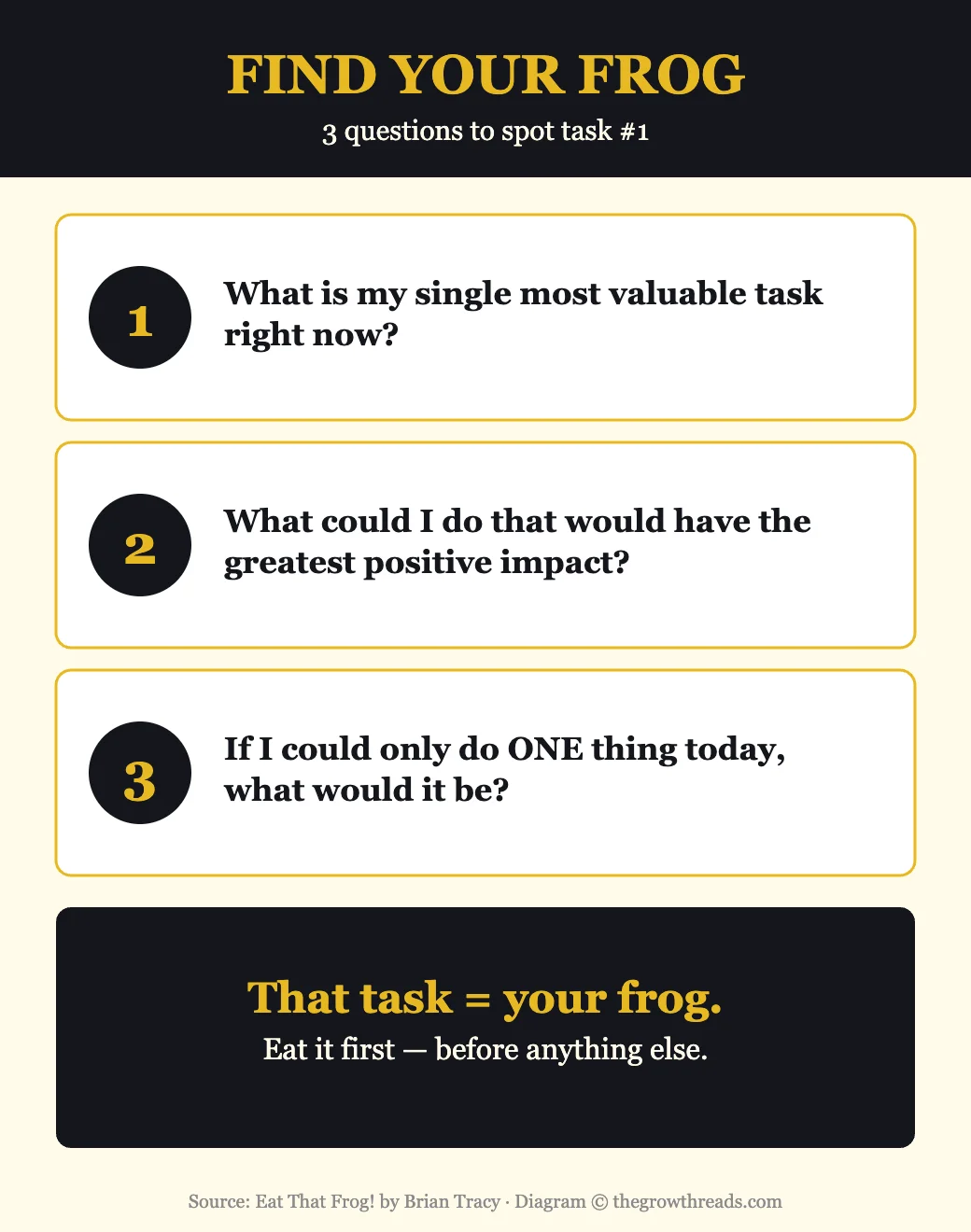
To find the actual frog on a crowded list, Tracy suggests a short series of questions: What is my single most valuable task right now? What could I do that would have the greatest positive impact on my goals? If I could only complete one task today, which one would I choose? Whichever task keeps surfacing — and whichever task you’re most tempted to keep pushing to tomorrow — is very likely your frog.
TGR Note: Tracy’s “write it down” instinct lines up with later habit research — if you want the frog-eating ritual to survive more than a week, stack it onto an existing morning routine rather than relying on willpower alone. See our Atomic Habits summary for the habit-stacking mechanics that make a new ritual stick.
Part 2: Prioritize With the ABCDE Method and the Law of Three
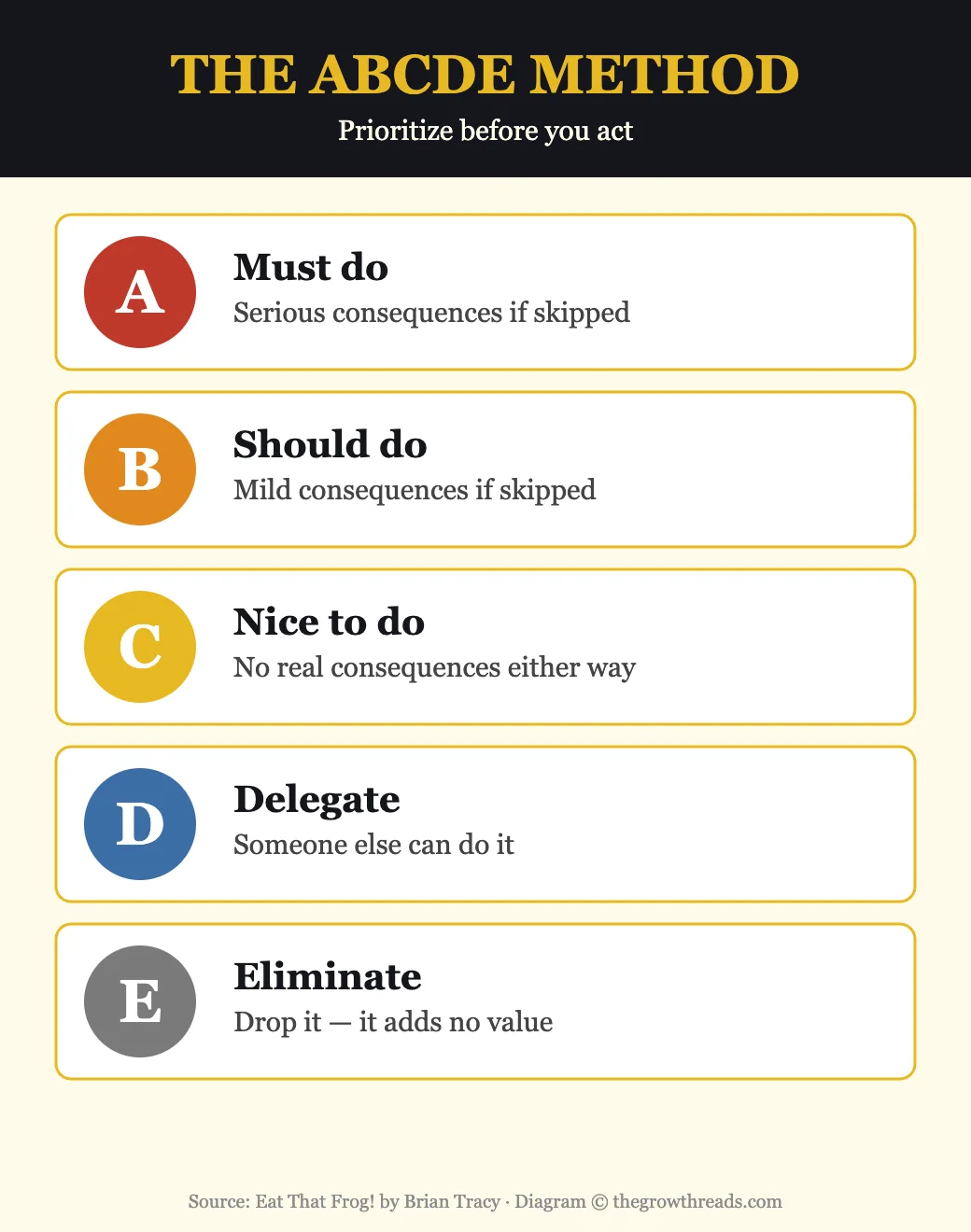
With your frog roughly identified, Tracy gives you a sharper tool for ranking everything else: the ABCDE Method. Before starting work, label every item on your list. An “A” task has serious consequences if left undone — missing a client deadline, for example. A “B” task has mild consequences — a colleague might be annoyed, but nothing breaks. A “C” task has no real consequences either way, like a long lunch with a friend. A “D” task should be delegated to someone else, and an “E” task should be eliminated outright. The rule Tracy is strict about: never touch a B task while an A task remains undone, no matter how much more appealing the B task feels. If you have more than one A task, add numbers — A-1, A-2, A-3 — and always start with A-1: your frog.
The ABCDE Method solves a subtler trap Tracy calls out repeatedly: activity is not the same as productivity. It’s possible to spend an entire day busy — answering messages, attending meetings, clearing a crowded inbox — and finish having moved none of your real goals forward. He calls this the difference between being “efficient” (doing things well) and being “effective” (doing the right things), and argues most professionals over-invest in the former.
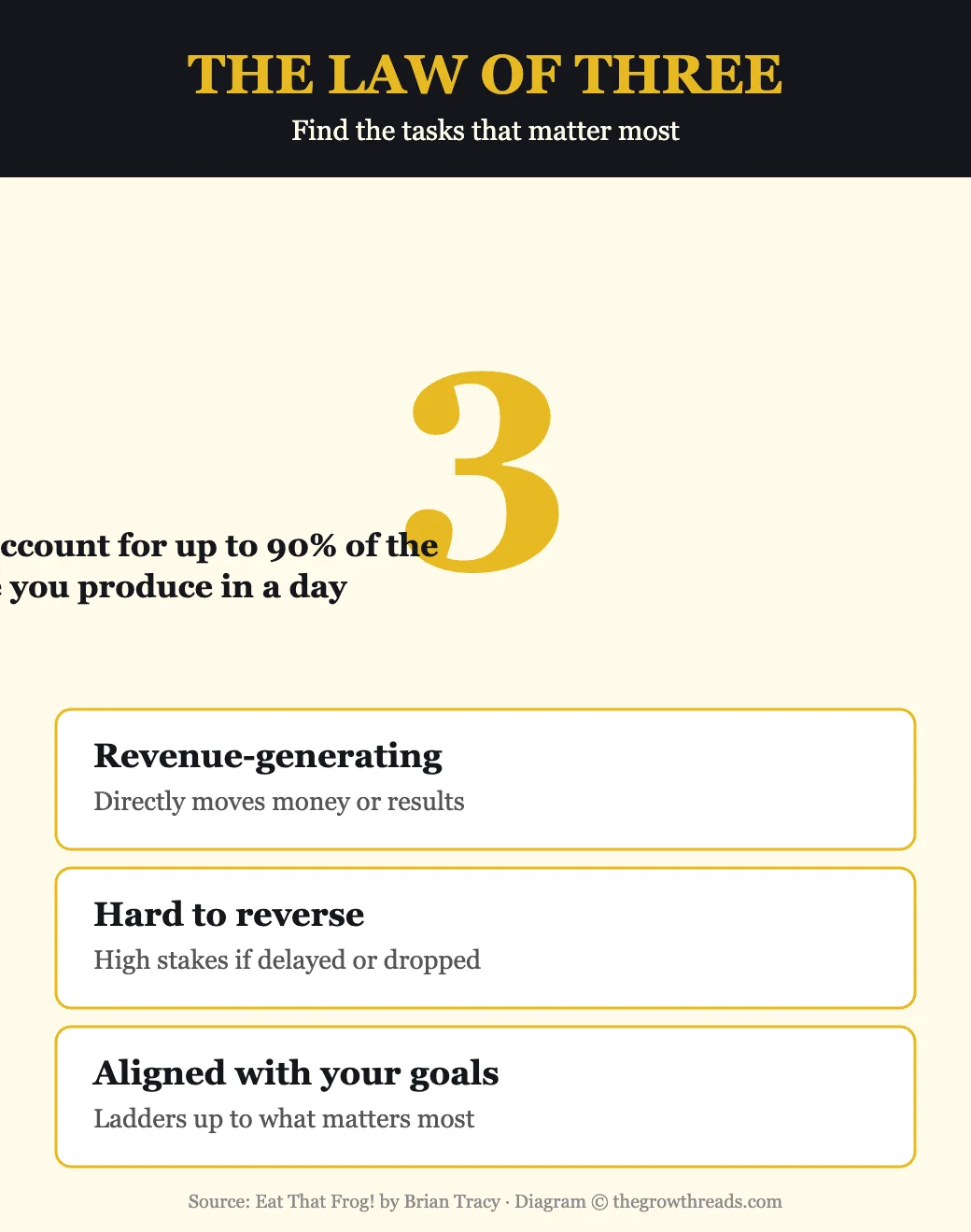
Tracy pushes the filter further with what he calls the Law of Three: when people track their work honestly, they usually find that just three tasks account for up to 90% of the value they contribute in a role. Everything else — status updates, routine admin, most meetings — is what Tracy calls “filler,” work that feels productive without moving anything meaningful forward. He recommends a simple recurring exercise: write down everything you do in a typical week, then ask which three items you’d protect if you could only keep three. Those three become your standing A tasks, revisited and re-ranked every week.
Underneath both tools sits a version of the Theory of Constraints, popularized by Eliyahu Goldratt: every goal has one limiting factor — a single bottleneck slowing everything else down. Tracy’s advice is to identify that constraint honestly, even when it’s uncomfortable (often, he notes, the limiting factor is a skill or habit in yourself, not an external circumstance), and put disproportionate effort into loosening it. Fixing the constraint moves the whole system forward; polishing an area that isn’t the bottleneck does not.
TGR Note: If the ABCDE Method feels like the missing piece in a GTD-style capture system, it usually is — GTD tells you where to put a task, ABCDE tells you which one to do first. See our Getting Things Done summary for the capture side, or Essentialism for a stricter version of the same 80/20 filter.
Part 3: Protect Your Focus Once You Start
Identifying the right frog is only half the battle — Tracy spends the back half of the book on staying with it once you’ve started. His central discipline here is what he calls single handling: pick your most important task, then work on it continuously, without stopping, until it’s 100% complete. Every time you stop a task and return to it later, Tracy argues, you pay a hidden re-entry cost — re-reading what you already wrote, remembering where your thinking left off, rebuilding momentum from zero. Do this enough times across a day and hours disappear into restarts rather than progress.
The biggest threat to single handling, in a modern inbox-driven job, is what Tracy calls technological time sinks — email, chat notifications, and phone alerts that interrupt a task in progress and invite you to switch. His instruction is simple and slightly old-fashioned for 2001 but more relevant now than ever: close email, silence notifications, and protect a defined block for your frog before you let anything else compete for attention. Only after the frog is eaten should the inbox reopen.
For tasks that feel too large to start — a report, a proposal, a big project — Tracy offers two related techniques. The “salami slice” method breaks an intimidating task into small, single-sitting pieces, the way you’d eat a large salami one slice at a time rather than swallow it whole. The “Swiss cheese” method works the other way: instead of a clean sequence of slices, you simply punch one small hole in the task — five or ten minutes of work on any piece of it — which is often enough to break the inertia that was keeping you from starting at all. Either technique gets you moving, and Tracy notes that starting is usually the hardest part; momentum tends to carry you further than planning ever will.
None of this works without preparation, so Tracy also asks you to prepare thoroughly before you begin: gather every document, tool, and piece of information your frog requires before you sit down, so the first ten minutes of your block aren’t lost to searching for a file. He calls this “clearing the runway” — a small step that removes the easiest excuse for delay.
TGR Note: Single handling is Brian Tracy’s plain-language version of what Cal Newport later formalized as deep work. See our Deep Work summary for the research-backed case for protecting distraction-free blocks.
Part 4: Build the Habit and Keep the Pressure On
The final third of Eat That Frog! is about sustaining the system once the mechanics are in place. Tracy argues that a sense of urgency — moving quickly and deliberately once you’ve decided what to do — is one of the most reliable markers separating high performers from everyone else. He suggests a simple exercise: act, for one day, as if every task on your A list were due by the end of the day. Most people discover they can compress hours of procrastinated work into a single focused sitting once the deadline feels real.
Closely related is what Tracy calls putting the pressure on yourself, rather than waiting for a boss, client, or deadline to supply it externally. Self-imposed deadlines and public commitments — telling a colleague when you’ll deliver something — borrow some of the urgency of an external deadline without needing one to actually exist.
Tracy also ties consistent frog-eating to energy management, which he calls maximizing your personal powers: identifying the hours in your day when your focus and willpower are naturally highest, and reserving that window specifically for your frog rather than for email or meetings. For most people, he notes, that window is earlier in the day, before the accumulated small decisions of the morning have worn down self-discipline — a pattern later researchers would describe as decision fatigue.
Because today’s frog eventually becomes routine, Tracy closes by tying the whole system to skill-building: your capacity to produce high-value work is limited by your weakest key skill, so continuously upgrading the skills tied to your most important goals raises the ceiling on what your frog-eating habit can actually produce. He calls this identifying your key result areas — the small number of things you must do well to succeed in your role — and treats skill growth in those areas as itself a recurring frog, not a one-time project.
Who is Eat That Frog best for — and who should read something else first?
Eat That Frog! is best for: people who feel busy all day but reach the evening without moving their real priorities forward; new managers building their first personal productivity system; chronic procrastinators who need one blunt rule rather than a complex app.
Read something else first if: you don’t yet have a reliable system for capturing everything on your plate — start with Getting Things Done to build the capture system first, then layer ABCDE on top. If your problem is really too many good options rather than procrastination on one clear task, Essentialism tackles the selection problem more directly. And if procrastination for you is rooted in habit formation rather than prioritization, Atomic Habits is the better starting point.
Questions to reflect on
- What’s the one task on your list right now that you keep moving to tomorrow — and what does that avoidance actually cost you?
- If you could only complete three tasks this week, which three would you protect, and what would you have to say no to?
- Where in your day do notifications or email interrupt your highest-value work, and what would it take to close that window for one hour?
- Which of your current skills, if you improved it, would raise the ceiling on everything else you’re capable of producing?
- What would change tomorrow morning if you ate your frog before opening email?
🔥 Ready to stop procrastinating?
Grab a copy of Eat That Frog! and start eating yours tomorrow morning.
How to apply Eat That Frog (7-day plan)
- Day 1 — Write your goals. Spend 15 minutes writing your top 3 goals for the month in specific, measurable terms.
- Day 2 — Build your first ABCDE list. List every task on your plate and label each A through E before you do anything else.
- Day 3 — Find your Law of Three. Review last week’s work honestly and identify the three tasks that produced most of your value.
- Day 4 — Eat your frog before email. Pick your A-1 task and complete a meaningful chunk of it before opening your inbox.
- Day 5 — Practice single handling. Choose one task and work on it without switching until it’s fully done, even if it takes longer than planned.
- Day 6 — Clear your runway. Before you start tomorrow’s frog, gather every file, link, and note it will require, tonight.
- Day 7 — Review and re-rank. Look back at the week, note which frogs you avoided, and rebuild next week’s ABCDE list.
Frequently asked questions
What is the main idea of Eat That Frog?
The main idea is that beating procrastination isn’t about willpower — it’s about correctly identifying your single most important task each day (your “frog”) and doing it first, before anything else competes for your attention. Brian Tracy argues that most people stay busy without being productive because they default to easy, low-consequence tasks and avoid the one task that actually matters. The book’s tools — the ABCDE Method, the Law of Three, and single handling — all exist to help you spot that task accurately and then protect the discipline to finish it before your energy and focus are spent elsewhere.
What does “eating the frog” mean?
“Eating the frog” is Tracy’s shorthand, borrowed from a line often attributed to Mark Twain, for doing your hardest and most important task first thing in the morning. The “frog” is whichever task on your list you’re most likely to procrastinate on — usually because it’s difficult, ambiguous, or a little uncomfortable — and is simultaneously the task with the greatest impact on your goals. Tracy’s rule is to eat it before checking email, before meetings, and before any easier task gets to compete for your best hours of focus and willpower.
What is the ABCDE Method?
The ABCDE Method is Tracy’s system for ranking tasks by consequence rather than urgency. “A” tasks have serious consequences if left undone, “B” tasks have mild consequences, “C” tasks have none either way, “D” tasks should be delegated, and “E” tasks should be eliminated. If you have multiple A tasks, you number them A-1, A-2, and so on, and always start with A-1 — your frog. The core rule is strict: never work on a B task while any A task remains unfinished, regardless of how appealing the lower-priority task feels in the moment.
Is Eat That Frog based on research?
Eat That Frog draws more on Brian Tracy’s decades of time-management seminars and consulting than on formal academic studies, and some figures he cites — like the share of people who set written goals — come from his own audience surveys rather than peer-reviewed research. That said, its central mechanisms overlap with well-supported ideas from psychology and economics, including the Pareto Principle, decision fatigue, and the cost of task-switching, which later researchers have studied more rigorously. Readers looking for a heavily cited, academic treatment should treat this as a practical field guide rather than a research text.
How long does it take to read Eat That Frog?
Eat That Frog is a short, practical book — around 130 to 150 pages depending on the edition — and most readers finish it in two to three hours. Each of its 21 chapters is designed to stand on its own as a short, actionable lesson, so it also works well read one chapter at a time over three weeks, applying each idea before moving to the next. This guide covers the book’s core frameworks in about nine minutes if you want the practical summary without reading cover to cover.
What is the difference between Eat That Frog and Getting Things Done?
Getting Things Done, by David Allen, is primarily a capture-and-organize system — it helps you get every task, idea, and commitment out of your head and into a trusted structure. Eat That Frog assumes you already have a list and instead focuses on which item to do first and how to stay with it. In practice, the two books complement each other well: use a GTD-style system to capture everything you owe, then use the ABCDE Method and the Law of Three to decide what actually deserves your first, best hour of the day.
Does Eat That Frog work for people who aren’t chronic procrastinators?
Yes — while the book is framed around procrastination, its real value is a prioritization system that works for anyone with more tasks than hours, procrastinator or not. Even highly disciplined people benefit from the ABCDE Method and the Law of Three, because the core problem the book solves isn’t laziness but the tendency to spend good focus on comfortable, low-value work when something harder and more important is available. Busy, productive people often eat several frogs a day; the book simply makes that instinct explicit and repeatable.
Related summaries
- Atomic Habits Summary & Review
- Essentialism Summary & Review
- Deep Work Summary & Review
- Getting Things Done Summary & Review
See more in our best productivity books guide.
How we analyze books: Every TGR summary is built from a full read of the source material, cross-checked against the author’s other published work and interviews, then structured around the book’s own frameworks rather than a generic template. We highlight the ideas practitioners actually use, note where claims are more anecdotal than empirical, and add original application tools — 7-day plans, reflection questions, and diagrams — that go beyond what’s in the book. Read our full methodology.
Related Productivity Summaries
Do Nothing Summary & Review: How to Break Away From Overworking
Smarter Faster Better Summary & Review: The 8 Drivers of Real Productivity
The Now Habit Summary & Review: A Strategic Program for Overcoming Procrastination
The Pomodoro Technique Summary & Review: 25 Minutes to Real Focus
The Power of Full Engagement Summary & Review: Manage Energy, Not Time