

★★★★½ 4.6/5 — the shortest useful book on the interpersonal habits that stall people who already know how to do the job.
Best for: Managers, senior ICs, and founders whose craft is not the problem, and whose “yes, but” is
Reading time: ~6 hours (256 pages) · this guide ~15 min
Difficulty to apply: Medium — the list is obvious; dropping one habit in public is the work
What Got You Here Won’t Get You There in one minute
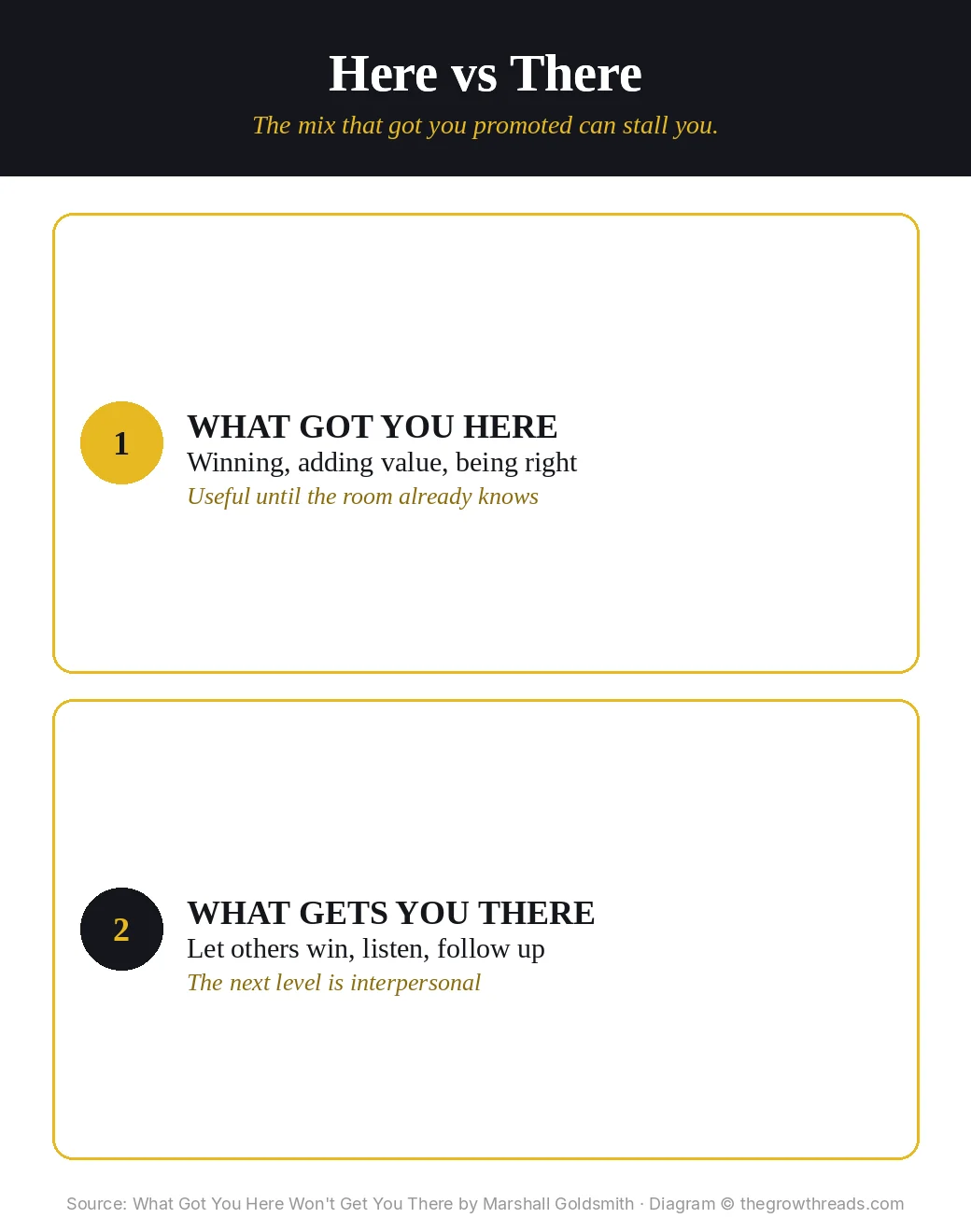
The habits that got you promoted are allowed to become the ones that stall you. Marshall Goldsmith’s What Got You Here Won’t Get You There (2007, with Mark Reiter) is a coaching book for people who already win on craft. Technical skill and the need to be right got you into the room. The same mix — winning too much, adding too much value, not listening, an excessive need to be “me” — now makes other people stop bringing you their best work. Goldsmith’s fix is not a new personality. It is a public sequence: pick one habit, ask for feedforward, apologize where you have to, advertise the change, and follow up until they can see it. This summary is that sequence plus a 7-day plan that starts with the leak other people already notice.
Key takeaways
- Success makes you deaf: The more you have been rewarded for a style, the less you can hear that the style now costs you.
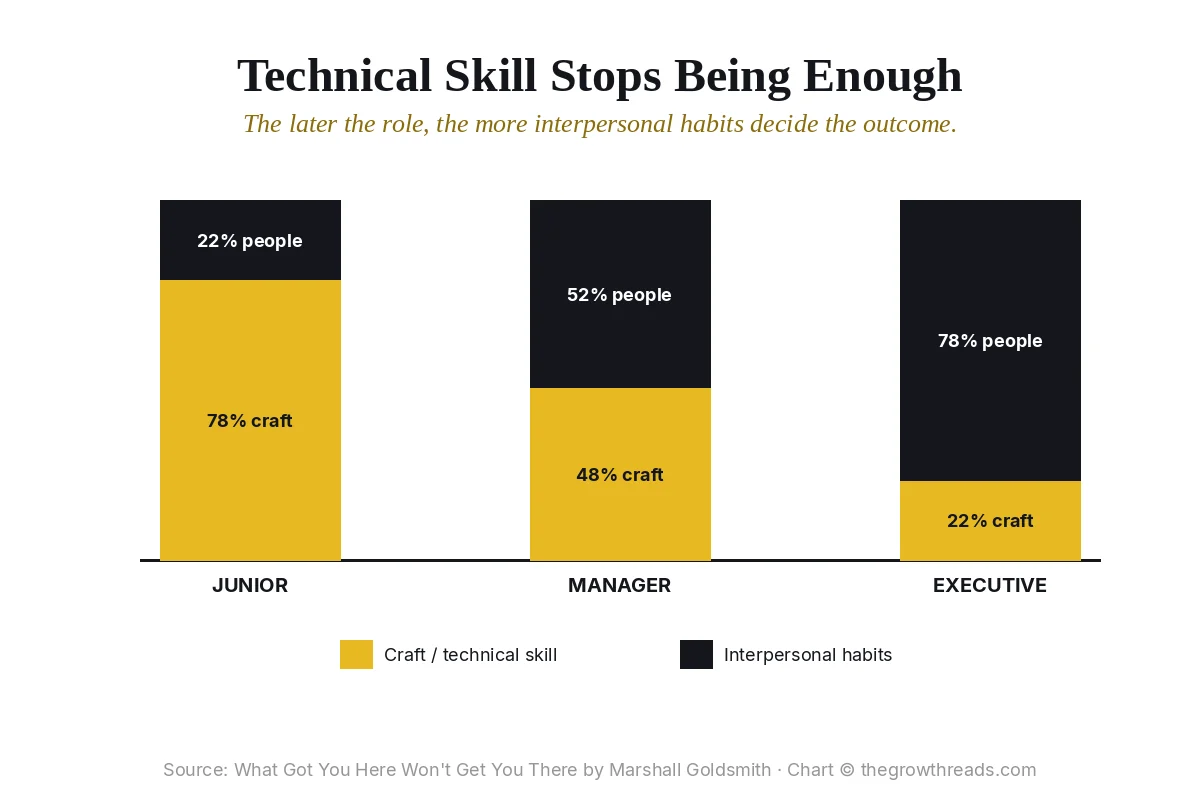
- The next level is interpersonal: Craft got you here. How you treat people decides whether you get there.
- Winning too much is the master habit: The need to win the restaurant, the route, and the meeting is the same habit wearing different clothes.
- Adding too much value kills commitment: A 5% improvement from the boss can erase 50% of the owner’s drive to ship it.
- You do not treat twenty habits: Other people already know the one. Pick that one and leave the rest.
- Feedforward beats most feedback: Two future suggestions, no debate, thank you. The past is not the assignment.
- Apology is a sentence, not a memoir: Name the habit, say you will stop, stop talking.
- Advertising is part of the change: If the people around you cannot see the new behavior, it did not happen yet.
- Follow-up is the intervention: Monthly “How am I doing on this?” is what makes coaching work, not the insight in week one.
- Personality is not a hall pass: “That’s just me” is allowed to be expensive. Change the behavior anyway.
What is What Got You Here Won’t Get You There about?
What Got You Here Won’t Get You There is a 2007 book that names twenty interpersonal habits successful people outgrow last, then gives a public process — feedforward, apology, advertising, follow-up — to drop one of them. The next promotion is rarely a skill gap. It is a people gap everyone else can see.
About the author
Marshall Goldsmith is an American executive coach and author who spent decades sitting with CEOs whose results were already excellent and whose interpersonal habits were not. He grew up in Kentucky, earned a PhD at UCLA, taught leadership at Dartmouth’s Tuck School, and became one of the first coaches whose fee was tied to whether colleagues actually saw the client get better. What Got You Here Won’t Get You There (Hyperion, 2007) distilled that stakeholder-centered method for people who will never hire a six-figure coach. Later books — Mojo, Triggers, How Women Rise with Sally Helgesen — extend the same behavioral bet: insight is cheap; other people’s scoreboard is the work. Goldsmith writes as a practitioner. The stories are from rooms, not labs, and the method is built so a busy operator can run it without a new personality. Explore all Marshall Goldsmith book summaries →
Key concepts at a glance
| Concept | What it means | Use it when |
|---|---|---|
| Success paradox | The style that was rewarded becomes the style you cannot hear criticism of | You keep winning arguments and losing people |
| Winning too much | The need to be right when the stakes are tiny | You “win” the restaurant, the route, the wording |
| Adding too much value | Improving someone else’s idea until they no longer own it | Your team stops bringing drafts |
| Feedforward | Two future suggestions, no debate, thank you | Feedback turns into a trial |
| Apology | A short sentence that names the habit and stops | You want to explain the history |
| Advertising | Telling stakeholders what you are changing so they can see it | You changed in private and nobody noticed |
| Follow-up | Asking “How am I doing on this?” on a schedule | The insight from last month already faded |
| Need to be “me” | Using personality as a hall pass for expensive behavior | You defend a habit as authenticity |
Part 1: The success paradox
Goldsmith opens with a pattern he saw in rooms that already had the results. The client is smart, driven, and used to being the person who finds the better answer. That mix got them the job. It also trained everyone around them to flinch. When you have been rewarded for winning, you start to win things that do not matter: the restaurant, the flight path, the wording of an email that was already good enough. The other people in the car stop offering ideas, not because they agree, but because the cost of being slightly right is too high.
The book’s first claim is not that successful people are unpleasant. It is that success makes you a worse listener. Every promotion is evidence that the old style works, so disconfirming data looks like noise. Goldsmith calls this the success paradox: the more you have been right, the less you can hear that a specific habit now costs you. The coaching job is not to invent a new identity. It is to make one interpersonal leak visible enough that a proud person will drop it.
Early in a career, craft is the scarce resource. Later, the scarce resource is whether other people still want to help you. If you keep competing on being the smartest person in the meeting, you will keep winning meetings and losing the people who could have made the work better.
TGR Note: Peter Drucker makes the same cut in Managing Oneself: know what you are good at, and stop spending the week on the rest. Goldsmith is the interpersonal version. Drucker tells you where to put the hours. Goldsmith tells you which habits are burning the people those hours need. Use both if you are already excellent at the craft and still leaving a trail.
Part 2: Twenty habits, one target
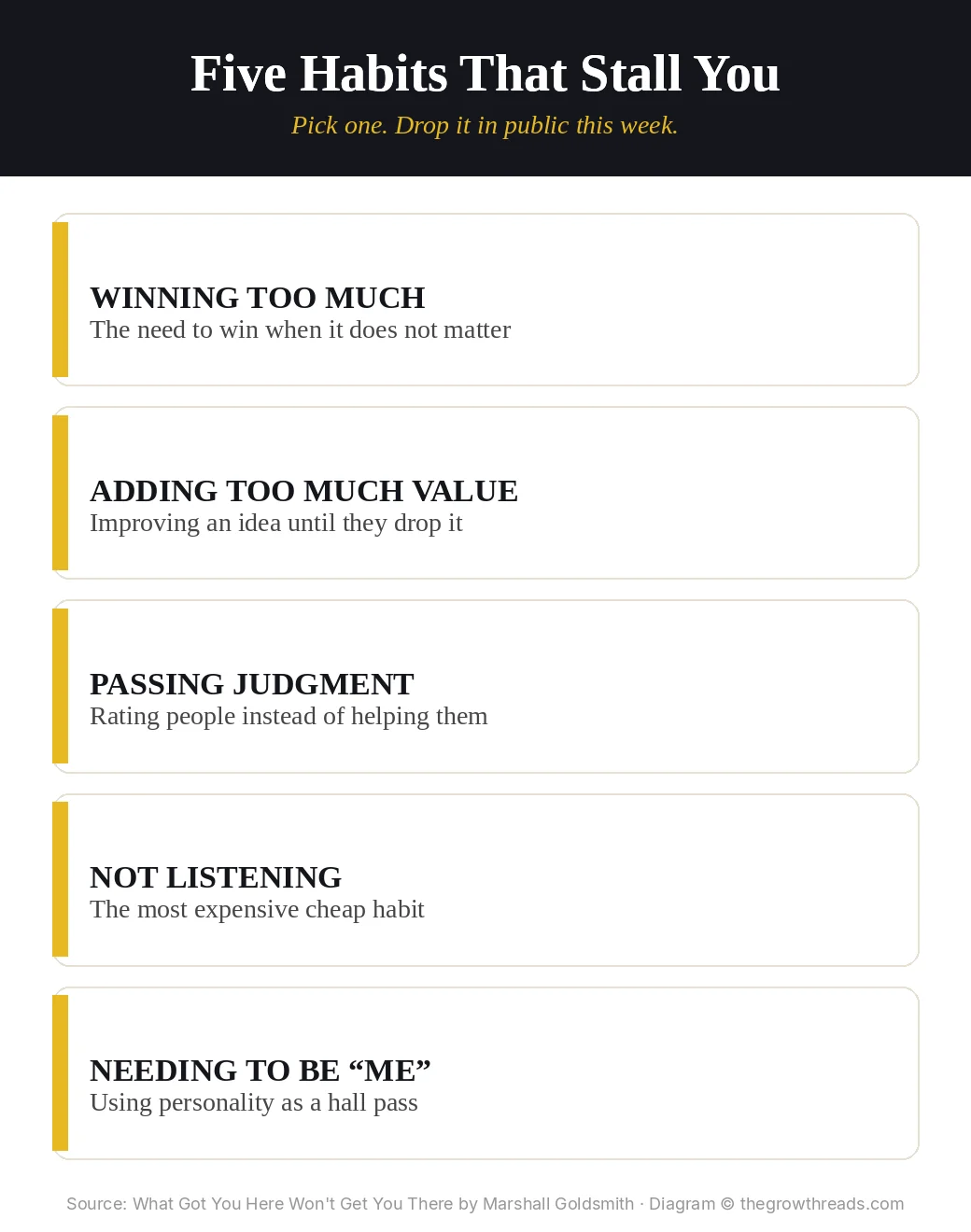
The famous list is twenty interpersonal behaviors, not twenty productivity hacks. Winning too much sits at the top because it disguises itself as high standards. Adding too much value is the manager’s version: you cannot let a decent idea leave the room without your fingerprint, so the owner of the idea quietly checks out. Passing judgment and “let me explain why that won’t work” train people to stop testing thoughts in front of you. Starting with “no,” “but,” or “however” does the same job in a single syllable.
The information habits are quieter and just as expensive. Withholding information, failing to give recognition, claiming credit, and passing the buck all tell the room that the scoreboard is yours. Not listening is the most expensive cheap habit: it costs you nothing to do and everything in trust. The identity cluster — clinging to the past, playing favorites, speaking when angry, an excessive need to be “me” — uses personality as a hall pass. Goldsmith’s line is practical: keep the personality; drop the expensive move. Goal obsession, sometimes listed as a twenty-first habit, is hitting the number while wrecking the team.
You do not work the twenty. Other people already know the one. Ask them. Pick that one. Leave the rest until the first one is boringly gone.
TGR Note: If the leak is how you give and take credit, read Give and Take next. Adam Grant’s otherish giver is the research version of Goldsmith’s “stop claiming credit and start recognizing people.” Goldsmith gives you the behavioral drop. Grant tells you why the scoreboard still works when you help without becoming unpaid staff.
Part 3: Feedforward, apology, and advertising
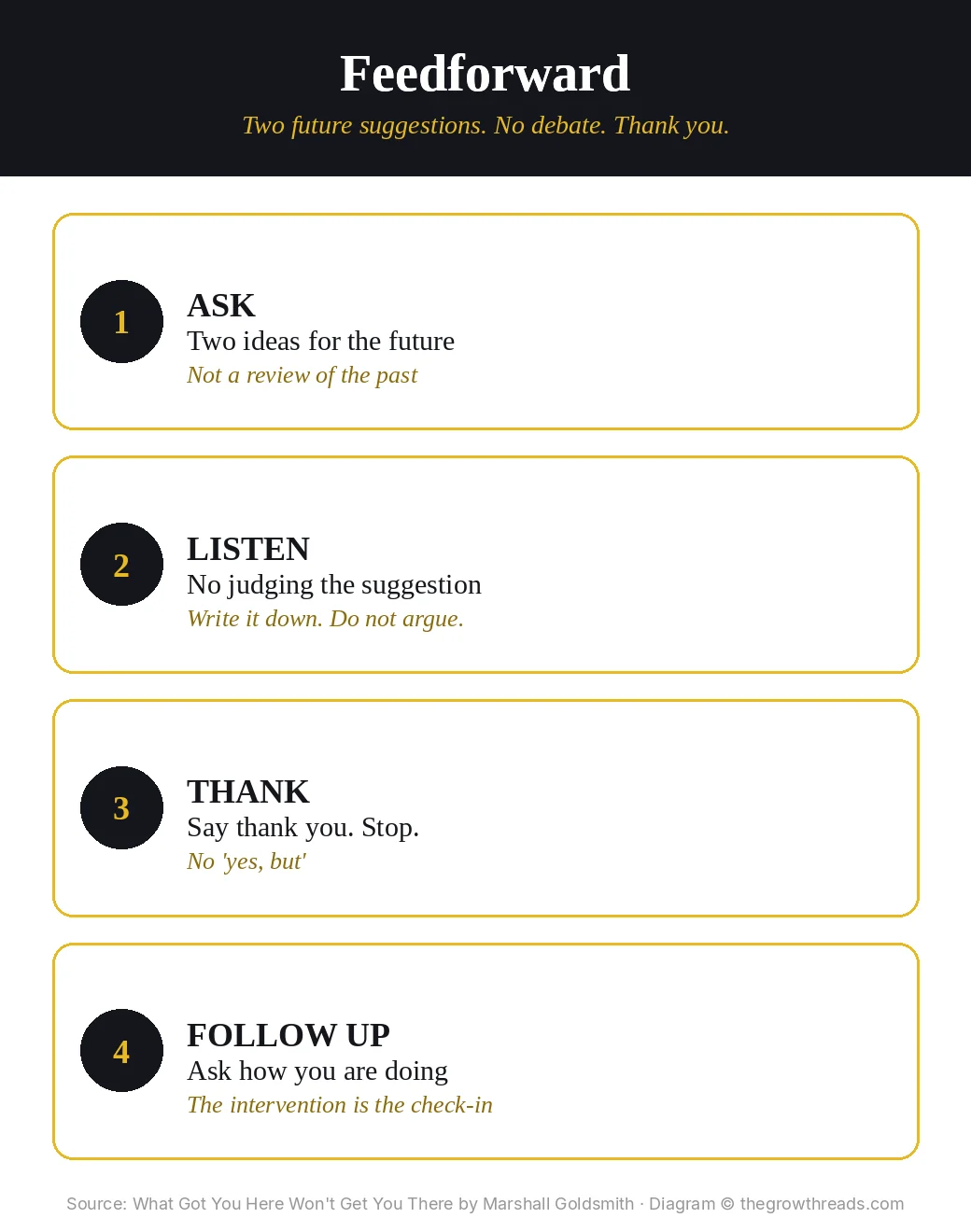
Goldsmith’s process is built for people who will argue with feedback. Feedback about the past triggers the need to win. Feedforward does not. You ask for two suggestions you could use in the future. You write them down. You say thank you. You do not judge the idea or review the history. The assignment is to collect help you can use, not to hold a trial.
Apology is a sentence, not a memoir. Name the habit. Say you are sorry it landed that way. Say you are working on it. Stop. Adding context until the apology is a defense is winning too much in a softer shirt.
Advertising is logistics. If you change in private, the people who already wrote your story will not update it. Tell them what you are dropping and when you will check in. Uncomfortable, and the only way a change becomes real in a team that already has a file on you.
TGR Note: The tiny replacement habit — no “yes, but” for a day — is easier if you steal the floor from Mini Habits and the two-minute start in Atomic Habits. Goldsmith tells you which interpersonal leak to drop. Guise and Clear tell you how to make the replacement small enough to survive a bad meeting. Do not “graduate” the floor. The whole point is that the replacement stays stupidly small.
Part 4: Follow-up is the intervention
The part of Goldsmith’s coaching that most summaries skip is the least glamorous and the one he would not drop. After the client picks a habit, apologizes, and advertises, they follow up. Every month they ask the same stakeholders: how am I doing on this? The insight from week one is cheap. The check-in is what changes the scoreboard, because other people keep you honest and because you cannot hide a relapse when you have asked them to watch.
This is stakeholder-centered coaching in one line. The people who live with the habit keep the score, not the client’s self-report. You can run a cheap version without a coach: four names, one habit, a calendar invite once a month. Skip the follow-up and you had a moving conversation and kept the habit.
The last warning is about identity. An excessive need to be “me” dresses up as authenticity and stalls the sequence. Keep the humor and the standards. Drop the expensive move the people around you have already named. Goldsmith’s bet is that you want the next level more than the hall pass. If that is true, the 7-day plan below is enough to start.
Who is What Got You Here Won’t Get You There best for — and who should read something else first?
Read this now if you already deliver and still hear — or should hear — that you are hard to work with. It is the right book for a manager who improves every idea, an IC who cannot let a small argument go, and a founder whose force of personality is the culture.
Read something else first if you still cannot start the work. Use Mini Habits or Atomic Habits for the floor. If you need a language for talent rather than a list of leaks, start with StrengthsFinder 2.0 or Managing Oneself. If the job is a new seat, The First 90 Days is the transition map. If the job is how to receive criticism, Thanks for the Feedback is the other half of Goldsmith’s 360. Do not use Goldsmith as a first productivity book. He assumes the craft is already there.
Questions to reflect on
- Which one habit would the four people who work closest to you name if they could not get in trouble for answering?
- Where did you win an argument this week that did not need a winner?
- Whose idea did you improve in the room — and did they still want to own it afterward?
- When did you last ask for two future suggestions and stop at thank you?
- If personality were not a hall pass, which expensive move would you drop this month?
🔥 Ready to drop the habit that is stalling you?
Get Goldsmith’s 20 habits and the feedforward process in the original book, then run the 7-day plan below.
How to apply What Got You Here Won’t Get You There (7-day plan)
- Day 1 — Name the one habit everyone already sees Write the one interpersonal habit you will drop. Ask one person who works with you if they agree.
- Day 2 — Collect feedforward Ask four people for two future suggestions on that habit. Write them down. Say thank you. Do not debate.
- Day 3 — Apologize once, in a short sentence If the habit hurt a specific person, say so without a history lesson. Then stop talking.
- Day 4 — Advertise the change Tell the same four people the habit you are dropping and when you will check in.
- Day 5 — Practice the smallest replacement For one day: no ‘yes, but’; no adding value to someone else’s idea; or no winning a small argument.
- Day 6 — Follow up in public Ask each stakeholder how you are doing on the habit. Write the score. Do not defend.
- Day 7 — Keep the score, do not add a second habit Review the week. Leave the first habit in place for a month before you pick another.
Frequently asked questions
What is What Got You Here Won’t Get You There about in one paragraph?
What Got You Here Won’t Get You There is Marshall Goldsmith’s field manual for successful people whose interpersonal habits are now the ceiling. The book names twenty workplace behaviors — winning too much, adding too much value, not listening, an excessive need to be “me” — that helped you get promoted and now make other people stop bringing you their best work. Goldsmith’s fix is not a new personality. It is a public process: pick one habit, ask stakeholders for feedforward, apologize where you have to, advertise the change, and follow up until they can see it. The coaching is expensive in real life; the sequence is not.
How long does it take to read What Got You Here Won’t Get You There?
The Hyperion / Hachette hardcover is about 256 pages and reads in five to seven hours. The first third is the success paradox and the twenty habits; the rest is the change process — feedback, apology, advertising, listening, gratitude, follow-up, and feedforward. You can finish a first pass in a weekend. The useful work is slower: pick one habit, tell four people, and check in for a month. This summary is a fifteen-minute map of that sequence so you can start the interpersonal part before you reread the habit list.
Who should read What Got You Here Won’t Get You There?
Read it if you already win on craft and still leave a trail of “yes, but” in meetings. It is built for managers, ICs who have become the smartest person in the room, and founders whose force of personality is now the bottleneck. Skip it as a first productivity book if you still cannot start the work; use Mini Habits or Atomic Habits first. If you need a language for talent rather than a list of interpersonal leaks, start with StrengthsFinder 2.0 or Managing Oneself. Goldsmith assumes you already know how to do the job.
What are the 20 habits in What Got You Here Won’t Get You There?
Goldsmith’s twenty are interpersonal, not technical: winning too much; adding too much value; passing judgment; making destructive comments; starting with “no,” “but,” or “however”; telling the world how smart we are; speaking when angry; negativity; withholding information; failing to give recognition; claiming credit; making excuses; clinging to the past; playing favorites; refusing to express regret; not listening; failing to express gratitude; punishing the messenger; passing the buck; and an excessive need to be “me.” A twenty-first, goal obsession, is the habit of hitting the number while wrecking the team. You do not treat all twenty. You pick the one other people already see.
What is feedforward in What Got You Here Won’t Get You There?
Feedforward is Goldsmith’s replacement for most performance feedback. You ask someone for two suggestions you could use in the future, you write them down, and you say thank you. You do not judge the idea, explain why it will not work, or review the past. The point is to get help you can actually use without triggering the successful person’s need to win the conversation. Combined with monthly follow-up — “How am I doing on this?” — it is the mechanism that makes the rest of the book more than a personality quiz.
How is What Got You Here Won’t Get You There different from Atomic Habits or The 7 Habits?
Atomic Habits and Mini Habits shrink a behavior so a bad day cannot beat it. The 7 Habits builds a character operating system from the inside out. Goldsmith starts later in the career. He assumes the craft is already there and the leak is how you treat people while you do it. You do not need a new morning routine; you need to stop winning arguments that do not matter. Use Clear or Covey if the problem is starting. Use Goldsmith if the problem is that people flinch when you enter the room, even though your work is excellent.
Is What Got You Here Won’t Get You There still relevant in 2026?
The twenty habits have not aged. Remote stand-ups and Slack threads made “starting with no, but, however,” withholding information, and failing to give recognition cheaper to do and harder to see. Feedforward still works in a video call: two suggestions, thank you, stop. Some of Goldsmith’s CEO stories come from a more hierarchical office, and the book is lighter on systems than on personal behavior. The practical advice is uncontroversial: pick one interpersonal leak, make the change public, and let other people keep the score. That sequence still fits a Tuesday.
Related summaries
- Managing Oneself Summary & Review
- StrengthsFinder 2.0 Summary & Review
- Give and Take Summary & Review
- Mini Habits Summary & Review
- Best Productivity Books
How we analyze books: every book on The Growth Reads is read cover to cover, summarized in thousands of words of original analysis, and rated against our five-criteria rubric (lasting impact, evidence quality, practical application, writing & originality, external consensus). Read our full methodology.