

★★★★½ 4.5/5 — a working process for the choice you keep re-arguing in your head.
Best for: Managers, operators, and anyone stuck in a whether-or-not loop at work or at home
Reading time: ~8 hours (336 pages) · this guide ~16 min
Difficulty to apply: Medium — the steps are simple; using them while you are still attached to option A is the work
Decisive in one minute
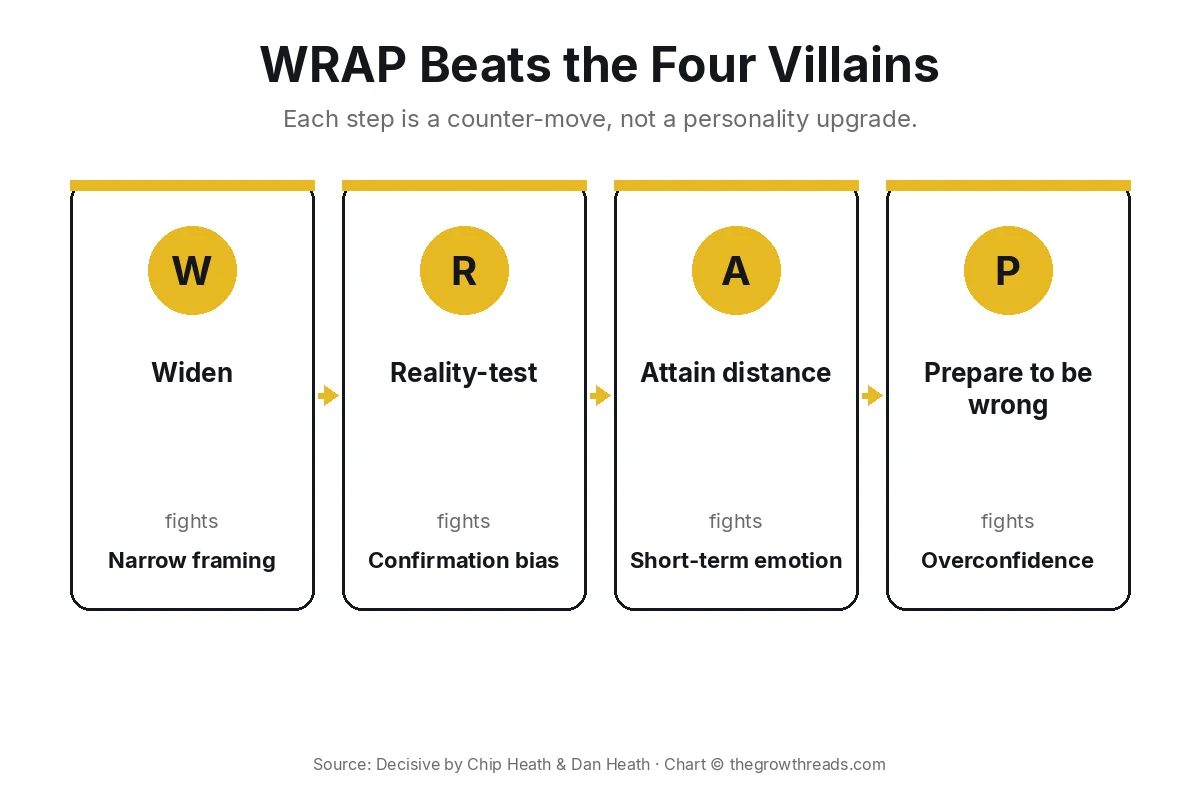
Your first frame is usually too small, and your confidence is not evidence that it is right. Chip Heath and Dan Heath’s Decisive (2013) names four villains of choice: narrow framing, confirmation bias, short-term emotion, and overconfidence. The counter is WRAP — widen your options, reality-test your assumptions, attain distance before deciding, and prepare to be wrong. This summary is the application layer: whether-or-not as a trap, multitracking, ooching, 10/10/10, the premortem, tripwires, and a 7-day plan for one real decision this week.
Key takeaways
- Whether-or-not is a trap: “Should I take this job or not?” hides the rest of the field. Add at least one real second option.
- Four villains, not one personality flaw: Narrow frame, confirmation, short-term emotion, overconfidence. Each has a move.
- WRAP is a process, not a vibe: Widen, reality-test, attain distance, prepare to be wrong. Intuition stays. It just stops running the meeting.
- Multitrack: Consider two or three options in parallel. One option is a hostage situation.
- Consider the opposite: Assign someone to kill your favorite story. If you cannot, you are still collecting fan mail.
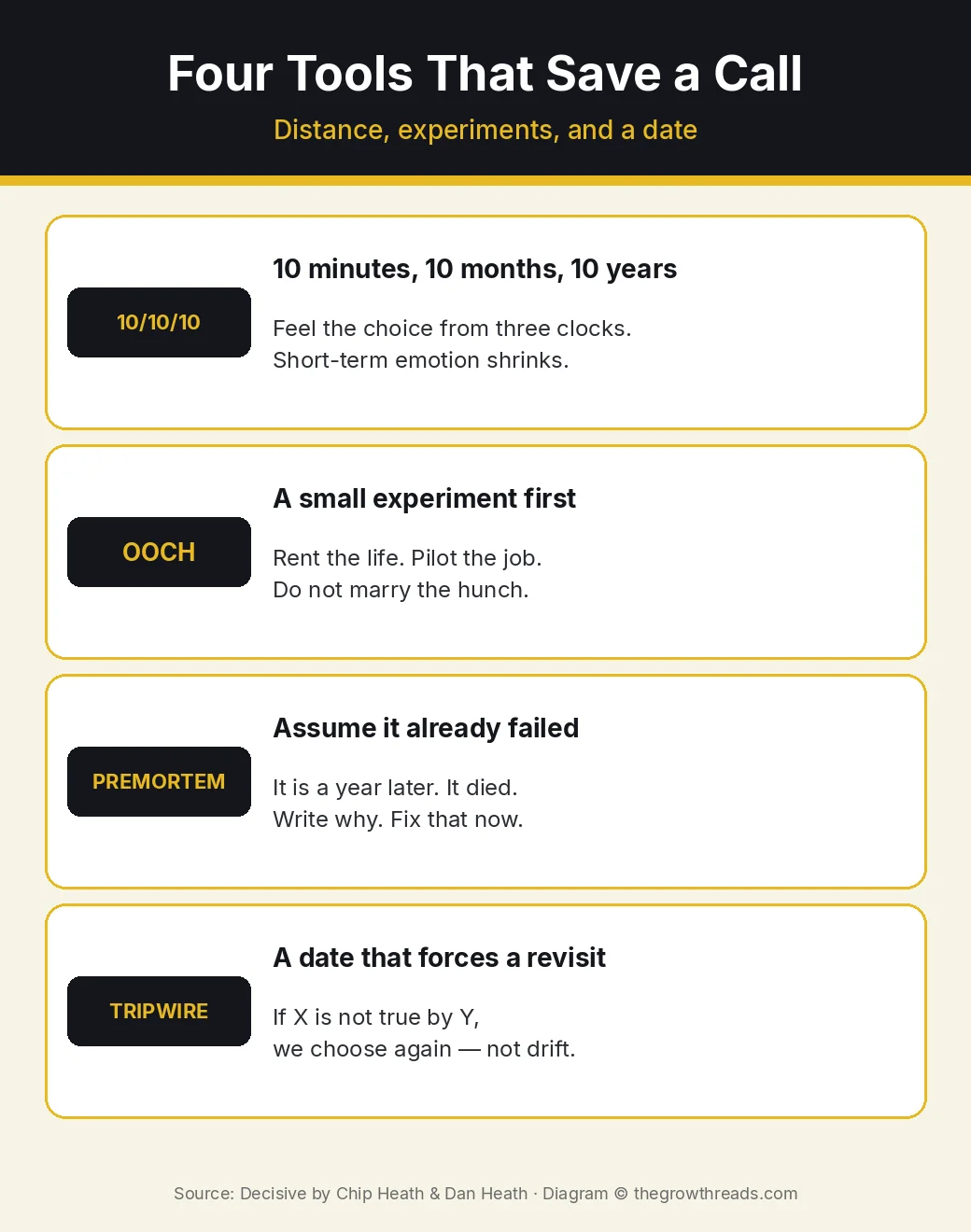
- Ooch before you leap: A small experiment beats a theatrical yes. Rent the life. Pilot the offer.
- 10/10/10: How will you feel in 10 minutes, 10 months, 10 years? Short-term emotion shrinks when the other two clocks speak.
- Ask what you would tell a friend: Distance is often one sentence away. You already know the advice. You will not give it to yourself.
- Premortem: It is a year later. The decision failed. Write why. Fix that cause now.
- Tripwires beat drift: A date or a metric that forces a revisit. Without one, “we will see” becomes a year of the same meeting.
What is Decisive about?
Decisive is Chip and Dan Heath’s process for making better choices at work and at home. Four villains — a narrow frame, confirmation bias, short-term emotion, and overconfidence — keep smart people sure and wrong. WRAP is the counter: widen options, reality-test, get distance, and prepare to be wrong.
About the author
Chip Heath teaches at Stanford Graduate School of Business. Dan Heath is a senior fellow at Duke’s CASE center and a writer who turns research into tools you can use on a Tuesday. Together they wrote Made to Stick (why ideas travel), Switch (why change stalls), Decisive (why choices go wrong), and The Power of Moments (how to design the ones that last). The voice is two brothers who like a story, a study, and a lever. They do not ask you to become a colder person. They ask you to stop treating the first option that walked in as the whole menu. Decisive is the book you open when you can already argue both sides and still cannot leave the chair. Explore all Chip Heath & Dan Heath book summaries →
Key concepts at a glance
| Concept | What it means | Use it when |
|---|---|---|
| WRAP | Widen, reality-test, attain distance, prepare to be wrong | A choice feels binary and “obvious” |
| Whether-or-not | A frame with one option plus a no | You keep asking “should I do this?” |
| Multitracking | Run two or three real options side by side | The room has fallen in love with plan A |
| Vanishing options test | Imagine your favorite option disappears | You cannot name a second path |
| Ooching | A small experiment before the leap | The yes would be expensive to undo |
| 10/10/10 | Feel it in 10 minutes, 10 months, 10 years | Tonight’s mood is writing the contract |
| Premortem | Assume the decision already failed, write why | The plan has no enemies in the room |
| Tripwire | A date or metric that forces a revisit | “We’ll see how it goes” has no calendar |
Part 1: Four villains that make you sure — and wrong
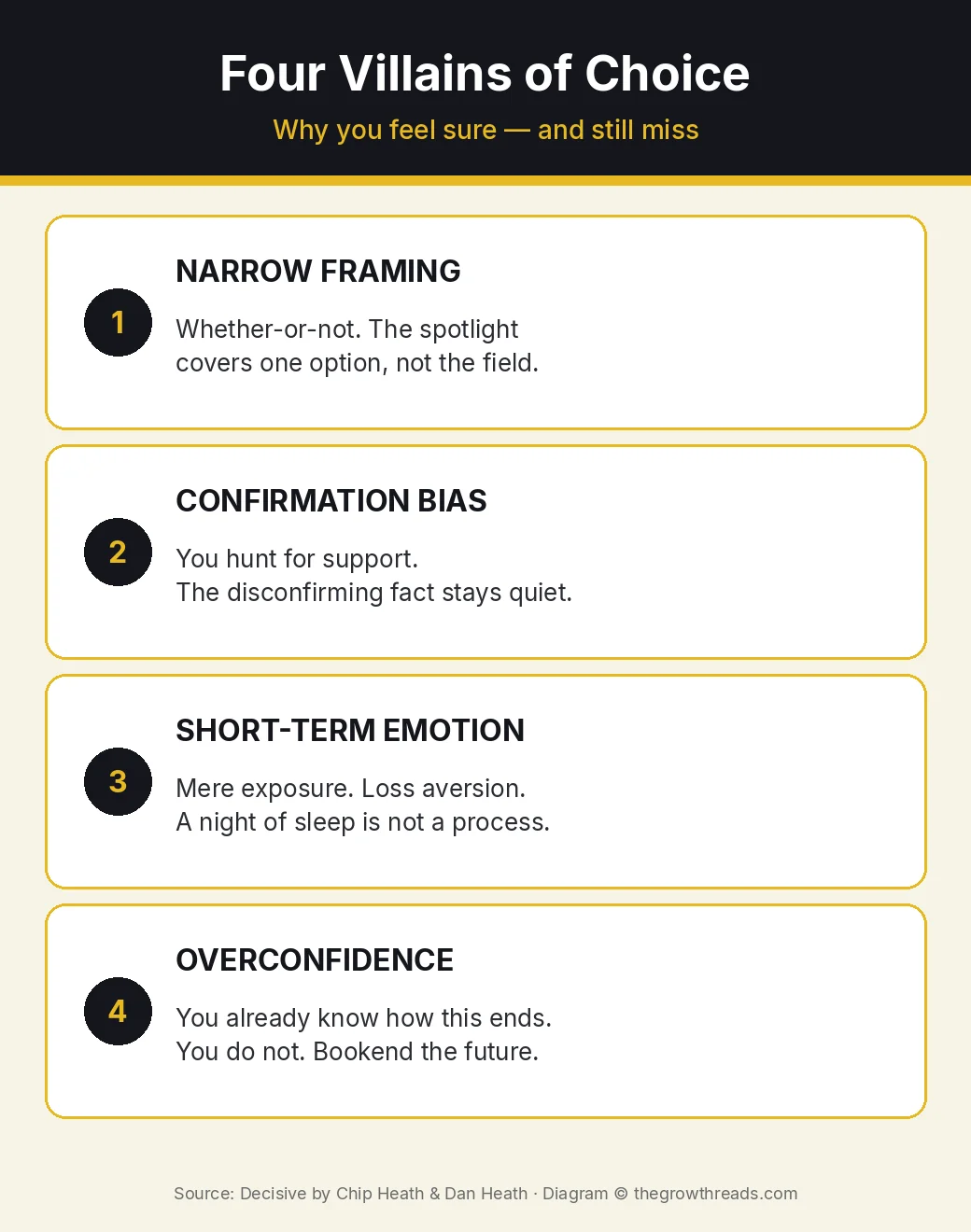
The Heaths start with a diagnosis, not a pep talk. Smart people do not fail at decisions because they are lazy. They fail because the mind runs a spotlight. Whatever sits in the beam looks like the whole stage. That is narrow framing. “Should I take this job or not?” is not a strategy question. It is a spotlight with one actor and an off switch. Paul Nutt’s research on organizational decisions is the cold number: most organizations consider only one option, and failure is much more common when the choice is whether-or-not. A second real option is how you find out whether the first one was a habit.
Confirmation bias is the second villain. Once you like an option, you collect evidence that it is wise and skip the person who left after six months. Short-term emotion is the third: mere exposure makes the familiar feel safer, and loss aversion makes the status quo look like a friend. “Sleep on it” is not WRAP. It is a nap. Overconfidence is the fourth. You can see the next two years in high definition. The answer is not to become timid. It is a checklist that fires while you are still attached to option A — and a tripwire if the movie is wrong.
TGR Note: If the problem is System 1’s hidden shortcuts, pair this with Thinking, Fast and Slow. Kahneman names the bias; the Heaths give you a Tuesday process. If you are drowning in options rather than trapped in one, The Paradox of Choice is the other door.
Part 2: Widen the options, then reality-test them
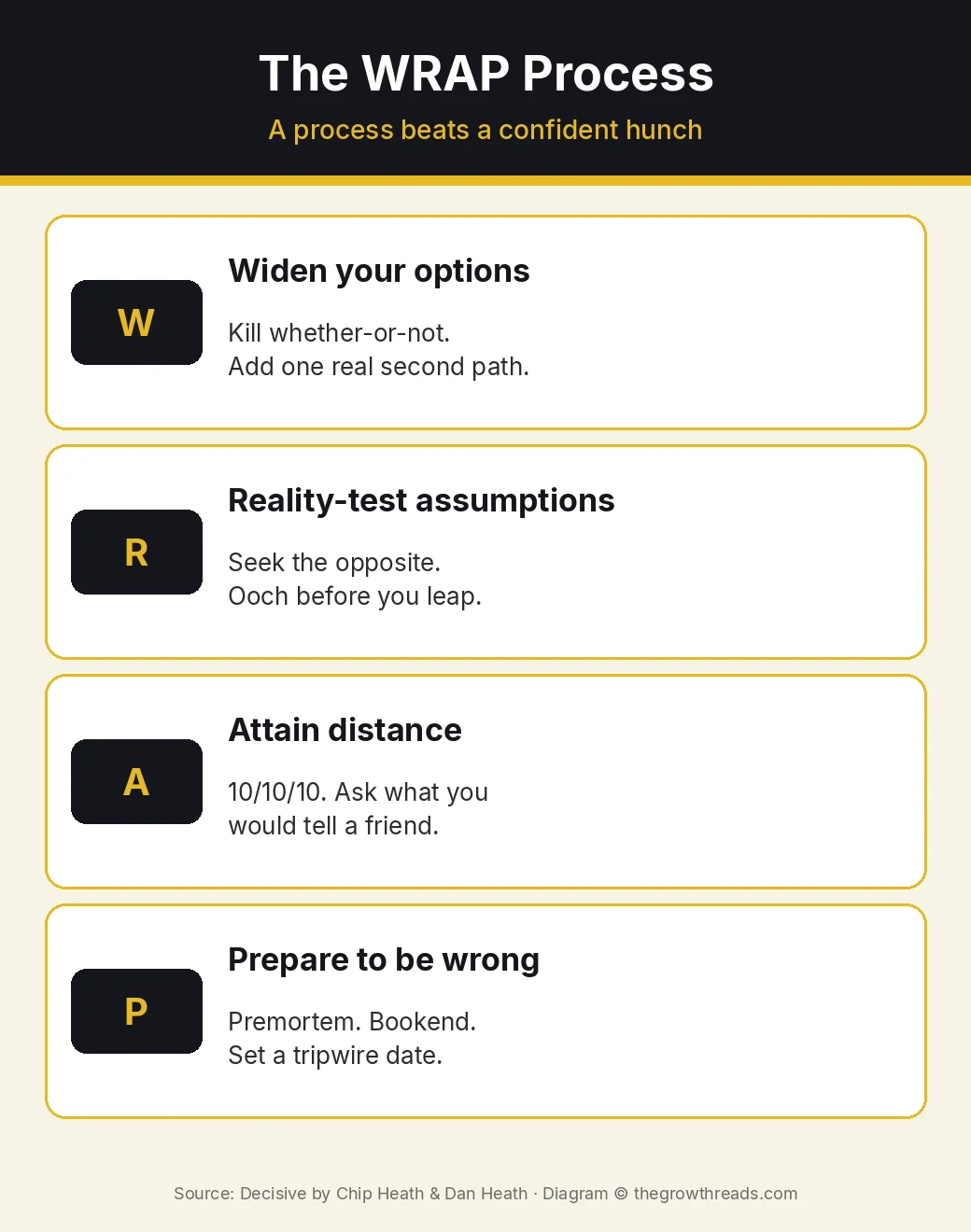
Widen is the first letter because nothing else works if the menu has one item. The vanishing-options test is the fastest drill: imagine your current favorite is illegal. What would you do this afternoon? That question usually produces a second path you were pretending not to see. Multitracking means you develop two or three options in parallel instead of falling in love, then shopping for a backup when it is too late. A career or a hire is the same shape as a product bet. One option is not focus. It is a hostage.
Opportunity cost is the quiet tax of a narrow frame. Saying yes to this job is saying no to the search you never ran. The Heaths like the AND question: is there a way to do this and that, not this or that. Finding someone who already solved your version of the problem is another widen move. Borrow their option set before you invent from zero.
Reality-test is the second letter. Ask: what would convince me this is wrong? Then go get that. Zoom out for base rates: how often do people who make this jump still like it in two years? Zoom in for the close-up: one week in the seat, one customer call. Ooching is a small experiment. Zappos paid new hires to quit if the job was a bad fit — an ooch with a price tag. You can ooch a move or a partnership. You cannot ooch a story you have already told at dinner. Tell the story after the experiment.
TGR Note: If the decision is actually a change problem — people know and still will not move — Switch is the Heath book for the elephant and the path. If you need the idea to travel after you choose, Made to Stick is the message layer.
Part 3: Attain distance before you decide
Short-term emotion is loud. Distance is a set of clocks. 10/10/10, from Suzy Welch and borrowed here, is the simplest: how will you feel about this in 10 minutes, 10 months, and 10 years? The first clock is the mood. The third is the life. If they disagree, the middle clock is often the adult in the room. Let the other two clocks speak before you send the email.
The friend test is cheaper. What would you tell your best friend to do? People give cleaner advice sideways. Look at others who already sit in the future you are buying — the Tuesday, not the highlight reel. Write the handful of priorities that actually get a vote, then notice which option spends them. A promotion that eats the only nights you see your kids is not a mystery. It is a trade you refused to put on paper.
Distance is not delay. Waiting a week while you refresh the same two arguments is not WRAP. Distance is another clock, another person, a written priority. Then you still choose. The Heaths are not anti-feeling. They are anti-letting tonight’s chemistry sign a three-year lease.
TGR Note: If ordinary moments hijack you before a choice appears, Clear Thinking is the prequel. If you need odds on the table, Thinking in Bets is prepare-to-be-wrong as poker. Decisive still wants a process you can run tonight.
Part 4: Prepare to be wrong — then set a tripwire
Overconfidence is the villain that survives a good meeting. You leave aligned and still have no plan for being wrong. A premortem, from Gary Klein, flips the script: it is a year later, the project is dead, everyone writes the cause. You will hear the risks people were too polite to say while the plan was still pretty. Bookend the future: a realistic worst, a realistic best, and what you will do at each rail. You are not predicting. You are refusing to live in one movie.
Tripwires are how WRAP stays alive after the signature. A date, a metric, a customer number: if we are not at X by Y, we revisit. Without one, the status quo becomes the decision you never made. “See how it goes” is not a tripwire. “If this is still flat at the June review, we stop the hire” is.
A process will feel slower than a hunch the first time. That is the point. The hunch already had a head start. WRAP gives the rest of the field a chance to speak, then keeps you correctable after you pick. You will still be wrong sometimes. You will be wrong in a way you can notice.
TGR Note: If the real job is cutting until one thing remains, Essentialism is the cut — WRAP widens first. If you need a tiny habit so the process happens, Atomic Habits is the installer. Put WRAP on a Tuesday.
Who is Decisive best for — and who should read something else first?
Best for people who can argue both sides of a choice and still cannot leave the chair. Best for managers whose team keeps bringing a whether-or-not. Best for operators about to make an expensive yes because the alternative was never named. Run WRAP on paper this week, not in the shower.
Read something else first if you need a habit installer: Atomic Habits. If the problem is change that people will not make even when the choice is clear, Switch. If you are drowning in options rather than trapped in one, The Paradox of Choice. If you already live in the Heaths’ message book, Made to Stick is how the decision travels after you pick. This one waits until you have a real call — and a first frame you no longer trust.
Questions to reflect on
- What decision this month did you treat as whether-or-not, and what second option did that frame hide?
- Whose evidence did you collect because it agreed with you, and who did you not call?
- If you asked 10/10/10 on the choice you are circling, which clock is writing the email?
- What would you tell a friend to do in your seat — and why is that advice not on your calendar?
- What tripwire (date or metric) would force a revisit, and what happens if you never set one?
🔥 Ready to stop whether-or-not decisions?
Get the WRAP process, then run the 7-day plan on one real choice this week.
How to apply Decisive (7-day plan)
- Day 1 — Catch whether-or-not. Write the decision as you currently ask it. If it contains “or not,” rewrite it as a menu with at least two real yeses. Circle the frame, not your mood.
- Day 2 — Add one option. Run the vanishing-options test: your favorite is illegal. Name what you would do by Friday. Put that option on the same page as plan A. If you cannot, you are still in the spotlight.
- Day 3 — Consider the opposite. Write three facts that would make your favorite option a bad call. Then try to find one of them. A conversation counts. A dashboard counts. A fan-mail interview does not.
- Day 4 — 10/10/10. For the live choice, write a sentence for 10 minutes, 10 months, and 10 years. If clock one and clock three disagree, do not send the email until you can say why the middle clock lost.
- Day 5 — Ooch. Design a test that fits in a week: a shadow day, a paid trial, a customer call, a sublet. If the leap cannot be ooched at all, write why — that is a different kind of yes, and it still needs a tripwire.
- Day 6 — Premortem. It is a year later. The decision failed. Write five causes. Pick the one you can still prevent this month. Put that prevention on the calendar, not in the appendix.
- Day 7 — Set a tripwire. Pick a date or a metric. Write the sentence: if X is not true by Y, we revisit. Share it with one person who will actually ask. Without a witness, tripwires go quiet.
Frequently asked questions
What is Decisive about in one paragraph?
Chip and Dan Heath’s 2013 book argues that bad choices are usually a process failure, not a lack of brains. Four villains — narrow framing, confirmation bias, short-term emotion, and overconfidence — keep smart people sure and wrong. WRAP is the counter: widen your options, reality-test your assumptions, attain distance before you decide, and prepare to be wrong. The book is a field guide of drills: whether-or-not as a trap, multitracking, ooching, 10/10/10, the premortem, and tripwires. You do not become a colder person. You stop letting the first option that walked in run the whole meeting.
What is the WRAP process in Decisive?
WRAP is four steps you run on a real decision, in order. Widen your options so the menu has more than whether-or-not. Reality-test your assumptions by hunting disconfirming data, zooming out to base rates, zooming in to a close-up, and ooching with a small experiment. Attain distance with 10/10/10, the friend test, and written priorities so tonight’s mood does not sign the lease. Prepare to be wrong with a premortem, bookends on the future, and a tripwire that forces a revisit. Intuition still votes. It just does not chair the meeting. Day 1 through Day 7 of the plan is WRAP stretched across a week.
What are the four villains of decision making?
Narrow framing is the spotlight: you see one option plus a no. Confirmation bias is collecting evidence that your favorite is wise and skipping the people who left. Short-term emotion is mere exposure and loss aversion — the familiar feels safer. Overconfidence is seeing the next two years in high definition when you do not. These are default settings, not insults. WRAP is one counter per villain: a wider menu, a hunt for the opposite, another clock or a friend, and a plan for being wrong. If you only remember “think harder,” you will still run the same four bugs with more slides.
What is 10/10/10 in Decisive?
10/10/10 asks how you will feel about the choice in 10 minutes, 10 months, and 10 years. The first clock is chemistry. The third is the life you are actually buying. When they disagree, the middle clock is often the adult. The Heaths borrow the tool from Suzy Welch and park it under attain distance: it pulls you out of tonight’s mood without asking you to become a robot. It is not a formula that spits out a yes. It is a way to notice which clock is writing the email. If you cannot fill in the 10-year sentence, you still have a feeling with a deadline.
What does ooching mean in Decisive?
Ooching is a small experiment before an expensive leap. You rent the life instead of marrying the hunch: a shadow day, a pilot customer, a trial project. The Heaths want you to learn from a cheap sample when the full yes would be hard to undo. Ooching is not stalling. Stalling is running the same two arguments for a month. An ooch has a next action and a date. Some choices cannot be sampled. Then you still widen, reality-test, and set a tripwire. The test of a real ooch is whether it could change your mind.
Who should read Decisive — and who should skip it for now?
Read it if you keep asking whether-or-not, if your team brings one option into the room, or if you can argue both sides and still cannot leave the chair. You get the most if you pick one live decision and run WRAP on paper this week. Skip it for a few days if you need a habit installer (Atomic Habits), a change system for people who already know (Switch), or a cut because the pile is already too big (Essentialism). Made to Stick is how the choice travels after you pick. This one is for a frame you no longer trust.
Is Decisive still useful in 2026?
The office tools aged. The villains did not. Slack made whether-or-not faster: a thread with one proposal and a thumbs-up. Confirmation bias now has an infinite feed of people who already agree. Short-term emotion still writes late-night messages. Overconfidence still ships a roadmap with no tripwire. AI can draft a pros-and-cons list that sounds complete while the menu still has one item. Keep WRAP, the vanishing-options test, ooching, 10/10/10, the premortem, and a date that forces a revisit. Ignore any example that assumes a 2013 conference room. Day 2 should still produce a second real option, not a prettier no.
Related summaries
- Made to Stick Summary & Review
- Switch Summary & Review
- Clear Thinking Summary & Review
- Thinking, Fast and Slow Summary & Review
- Best Productivity Books
How we analyze books: every book on The Growth Reads is read cover to cover, summarized in thousands of words of original analysis, and rated against our five-criteria rubric (lasting impact, evidence quality, practical application, writing & originality, external consensus). Read our full methodology.