

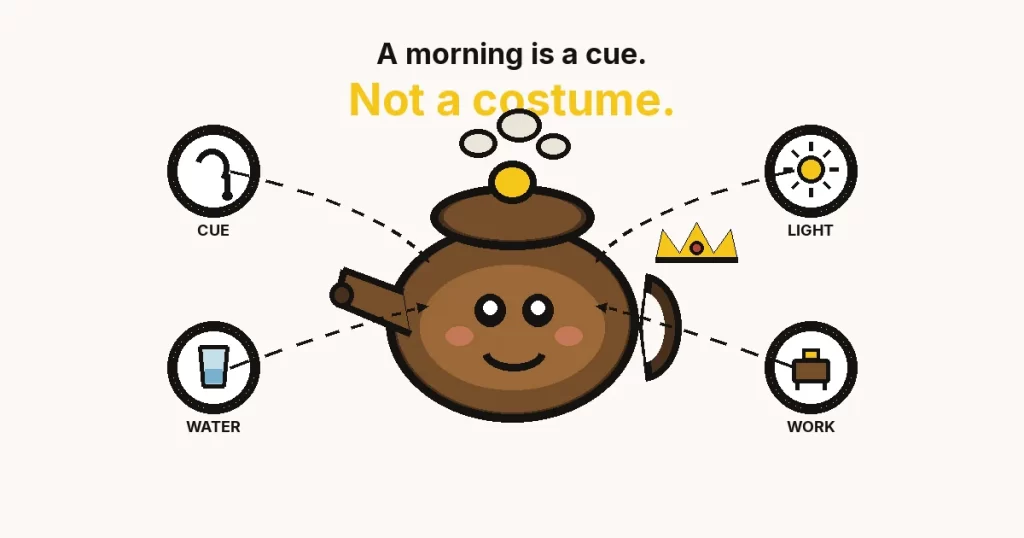
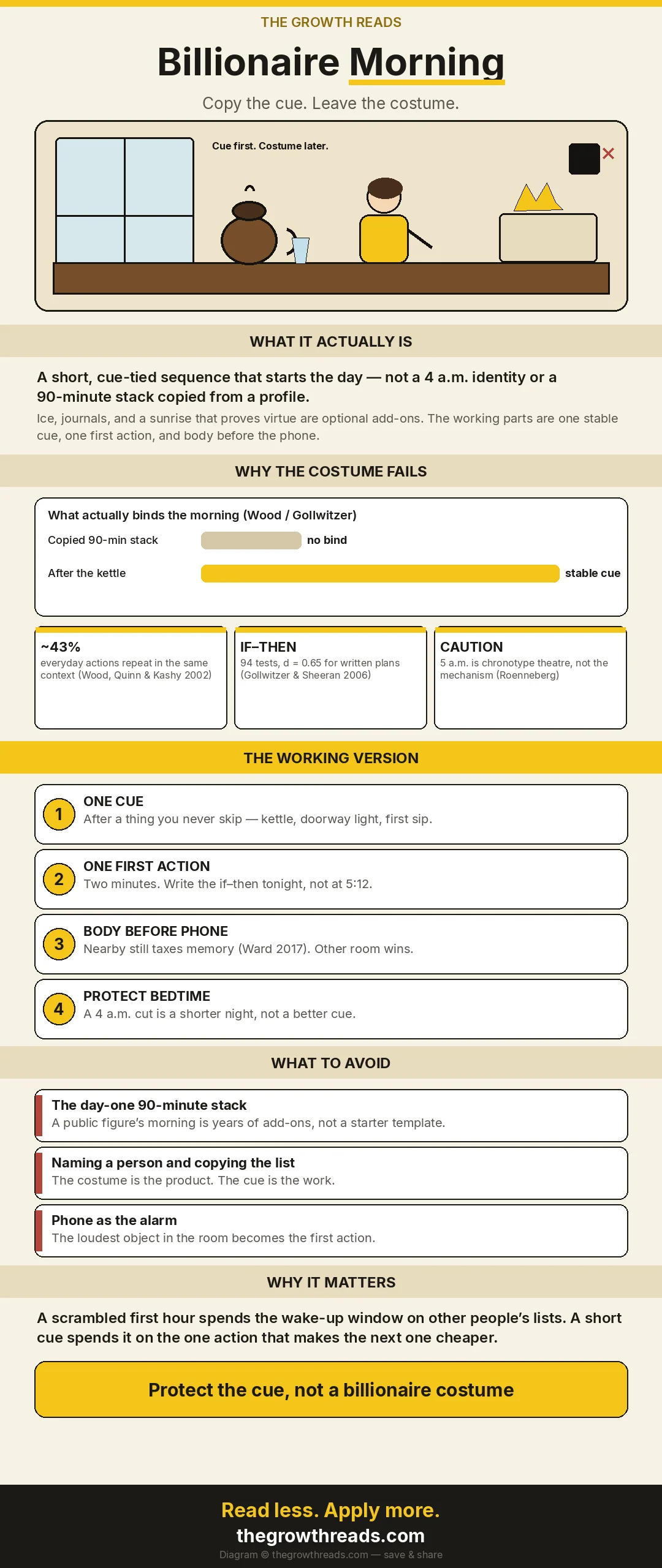
A billionaire morning routine is a short, cue-tied sequence — not a 4 a.m. identity or a 90-minute stack copied from a profile. The costume is ice, journals, and a sunrise that proves virtue. The working version is one stable cue, one first action, and body before the phone. Copy the cue. Leave the costume.
Key takeaways
- About 43 percent of everyday actions in a diary study were repeated in the same context while people were already thinking of something else — a morning that works is a context, not a personality (Wood, Quinn & Kashy, 2002).
- Written if–then plans — “After I [cue], I will [first action]” — produced a medium-to-large follow-through effect across 94 independent tests (Gollwitzer & Sheeran, 2006).
- The median time for a new simple action to feel automatic was 66 days, with a range of 18 to 254 — a 21-day “billionaire week” is not that curve (Lally, van Jaarsveld, Potts & Wardle, 2010).
- A phone that is merely nearby still reduces available working memory; face-down on the same desk is not “away” (Ward, Duke, Gneezy & Bos, 2017).
- Chronotype is partly biological. Treating 5 a.m. as a moral test fights the clock you actually have, which is the same warning under how to build a morning routine (Roenneberg, Wirz-Justice & Merrow, 2003).
What the billionaire morning routine actually is
A billionaire morning routine, minus the theatre, is a short sequence attached to a cue you already keep — not a 4 a.m. identity and not a 90-minute stack copied from a profile interview. The search phrase promises a secret used by people with unusual leverage. What it usually delivers is a costume: an ice bath, a gratitude notebook, a supplement tray, a sunrise photograph, and a start time early enough to count as proof. Those props can sit on top of a working morning. They are not the morning.
Wendy Wood, Jeffrey Quinn and David Kashy’s 2002 diary study is the unglamorous version of the same idea. Participants logged everyday actions and, in about 43 percent of cases, the action was one they already repeated in the same place while their mind had already moved on. The morning that survives Tuesday is that kind of action. It is a context that fires, then a first move that has been paired with it often enough to feel cheap. It is not a personality you put on with a silk robe.
That is why this page does not name a founder and reprint their Tuesday. Naming the person is the product. The mechanism does not care who owns the kettle. If you want the parent version of the same mechanism — a fixed cue, a short sequence, body before information — it already lives on how to build a morning routine. This page is the trend-shaped keyword sitting next to it: what the “billionaire” costume is doing, and what to keep when you take the costume off.
Josh Kaufman’s Personal MBA is the honest down-link for the same reason. The book’s job is a small set of working models, not the costume of a degree. A morning that works is the same move at 7:10. You do not need the syllabus of someone else’s finished life. You need the two or three parts that actually bind the first hour.
What is the difference between a morning routine and a morning performance?
A morning routine is a cue plus a first action you can still run on a bad Tuesday; a morning performance is a list long enough to impress a stranger. The tell is what happens when one piece drops. If the sequence dies because the ice, the journal, and the 4 a.m. alarm were a single identity, you were staging a show. If the kettle still happens and the first two minutes still happen, you have a routine. The sister page for the working list — not the costume — is the morning routine checklist.
Mason Currey’s Daily Rituals is useful here as a record, not a template. The historical mornings in that book do not agree with each other. Some people started late. Some people were messy. Some people needed quiet; some people needed a walk. The modern “billionaire morning” flattens that spread into one shareable stack and then sells the stack as the cause of the outcome. The outcome came from years of work, leverage, and help. The stack is what photographed well.
Why the theatre version happens
The theatre version happens because a long, photogenic stack is easier to sell than a kettle, and because 4 a.m. looks like discipline from the outside. A two-minute first action does not fill a thumbnail. A sunrise, a tub of ice, and a notebook fanned open do. Once the thumbnail becomes the definition, people copy the props and skip the cue. Then they call the leftover feeling “I am not a morning person,” when the actual failure was a list that never had a first hook.
Peter Gollwitzer’s implementation-intention work is the opposite of that thumbnail. The useful unit is a sentence with a slot: after a specified cue, a specified action. Gollwitzer and Paschal Sheeran’s 2006 meta-analysis pulled 94 independent tests and found a medium-to-large effect (d = 0.65) on getting the planned action to happen. The sentence is dull on purpose. Dull is what survives when the photographer leaves.
The 4 a.m. piece is a different product. Till Roenneberg, Anna Wirz-Justice and Martha Merrow’s 2003 paper on chronotype described a biological spread in when people naturally sleep and wake. That spread is not a moral ranking. A 4 a.m. alarm forced onto a later clock is often just a shorter night wearing a founder story. If your actual question is “can I shift the whole schedule without cutting sleep,” that is how to wake up early if you sleep late — a shift, not a costume.
Light still matters. Morning light is one of the stronger time-givers for the body clock; that is why a short walk or an open curtain keeps showing up in stacks that otherwise look like theatre. Keep the light. Drop the claim that the light only counts if it happens at 4:12 in a particular postcode. The same is true of water, standing up, and a first action that is already written down. Those are cheap. The 90-minute identity is expensive.
The four parts that actually do the work
The working morning has four parts: a cue you already keep, a first action that fits in two minutes, a phone that is not in your hand, and a bedtime that makes the wake time honest. Everything else is optional stacking. Optional stacking is allowed later. It is a poor day-one.
The cue is the load-bearing wall. Wood and David Neal’s 2007 review treated habit as a learned link between a context and a response. When the context returns, the response tries to run, even if today’s goal has changed. That is why “after the kettle” beats “when I feel ready to be the kind of person who journals.” Feeling ready is not a context. A kettle is.
The first action has to be small enough to run when the cue fires on a bad day. Phillippa Lally, Cornelia van Jaarsveld, Henry Potts and Jane Wardle’s 2010 study of 96 adults found a median of 66 days to reach 95 percent of a person’s automaticity plateau for a new everyday action, with a range from 18 to 254 days. One missed day did not reset the curve. Complexity slowed it. A 90-minute stack is complexity wearing a silk robe. A two-minute action in the same slot is the size that study actually measured.
The phone is the hidden first action in most failed copies. Adrian Ward, Kristen Duke, Ayelet Gneezy and Maarten Bos’s 2017 experiments found that the mere presence of a person’s own smartphone reduced available working memory and fluid intelligence, even when the phone was off and face-down. “I will just check the weather” is how the costume’s first hour becomes someone else’s agenda. Other room beats face-down on the same desk.
Bedtime is the part the thumbnail never shows. A 4 a.m. start with an unchanged midnight is not a routine. It is a cut. The morning page should not pretend it can repair a scrambled night. That is a different lever, and it is why this cluster already has energy management versus time management sitting next to the clock.
Why copying the 90-minute stack costs more than it feels like
Copying the 90-minute stack costs a fresh first hour, then a story that you lack discipline, when the actual miss was a list with no first hook. The hour feels busy. You stood in cold water. You wrote three pages. You watched the sun. Then the one task that would have made the day cheaper never started, because the stack used the window that a short cue would have spent on that task.
Cortisol rises after waking — the cortisol awakening response — and typically peaks around half an hour later (Clow, Hucklebridge, Stalder, Evans & Thorn, 2010). That is a physiological description, not a productivity hack and not a reason to collect ice. What it does mean, in ordinary language, is that the first stretch of the day is a poor place to spend thirty minutes deciding who to be. Spend it on the action you already named. The hormone paper does not say the action has to be photogenic.
There is also a social cost. A stack copied from a profile trains you to score the morning by resemblance: did it look like theirs? Resemblance is a terrible score. Wood, Tam and Witt (2005) watched habits travel — or fail to travel — when students changed campus context. The behaviour that survived was the one whose supporting context survived. Your kitchen is not their gym. Your first meeting is not their founder calendar. Copying the list imports a context you do not have, then blames your character when the list will not run.
The quieter alternative is the same move Kaufman makes with business models in The Personal MBA: keep the few parts that transfer, drop the costume of the institution. Transfer, here, means a cue you already own, a first action you can name in one sentence, and a phone that is not the alarm. The rest of the productivity library is there when you want the next add-on. Add-ons come after the cue holds, not instead of it.
If you already know you do your best work later, do not use a billionaire morning as a personality transplant. Why am I more productive at night and what makes someone a morning person are the sister pages for that question. A later peak is not a moral failure. It is a clock. Fight the clock and the costume will look like evidence you were right to feel behind.
Theatre versus the working morning
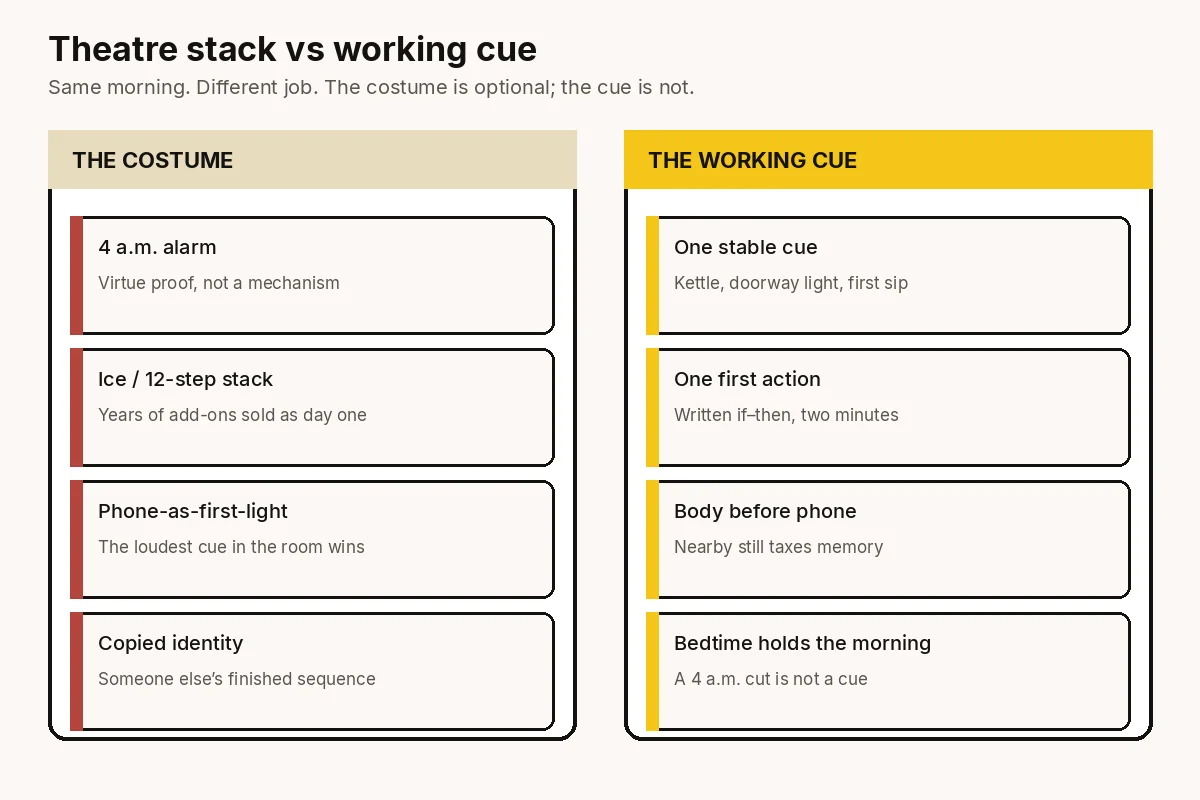
The useful split is costume versus cue, not “ambitious people” versus “lazy people.” The table is a comparison of jobs, not a ranking of character. A long morning can be a working morning after years of stacking. The failure mode this page is for is day one of someone else’s finished sequence.
| Move | Theatre version | Working version |
|---|---|---|
| Start time | 4 a.m. as virtue proof | A wake time your bedtime can actually hold |
| First object | Phone as alarm, then feed | Kettle, doorway light, or first sip — phone in another room |
| Length | 90 minutes of add-ons on day one | Two minutes attached to a cue you never skip |
| Score | Did it look like the profile? | Did the first action run when the cue fired? |
| Identity | “I am a 5 a.m. person now” | “After the kettle, I stand up and start X” |
| Add-ons | Ice, supplements, a journal stack, a sunrise photo | Optional later, one at a time, after the cue holds |
Common mistakes
Most failed “billionaire mornings” fail as copies, not as people. The mistakes below are the usual import errors.
- Copying a finished stack on day one. Use the morning routine checklist as a short working list, not as a second costume.
- Treating 4 a.m. as the mechanism. If you need a shift, use how to wake up early if you sleep late — move bedtime, do not just cut the night.
- Using the phone as the alarm. The object you touch first becomes the first action. Put the cue in the kitchen; leave the phone in another room (Ward et al., 2017).
- Skipping the written if–then. “Be more intentional” is not a plan. Implementation intentions are the sentence with a slot.
- Stacking before the first hook holds. Habit stacking is for the next action after a cue you already keep, not for eight new actions at once.
- Scoring the morning by resemblance. Score it by whether the first action ran. Consistency is that repeat, not a matching costume.
- Ignoring the night. A heroic morning on a scrambled evening is work-life balance theatre. Close the day on purpose or the cue has nothing to attach to.
When the morning is not the problem
If the night is a scramble, a costume will not repair the morning — and this page is not a sleep-clinic or a mood page. A later chronotype, a late last meeting, or a house that does not go quiet at 10 p.m. will beat a 4 a.m. alarm without anyone being lazy. The useful move is to stop adding morning props and look at the schedule that feeds the alarm. How to wake up early if you sleep late is the schedule-shift page. Off the Clock is the book-length version of using the hours you actually have, including the ones that are not photogenic.
If the first hour is fine and the rest of the day still will not start, the morning was never the bottleneck. That is a priority or a delay problem, not a missing ice bath. Leave this page. Do not collect another morning identity.
The evidence behind this
The usable evidence is a context-habit diary, an if–then meta-analysis, a formation curve with a wide range, a phone-presence experiment, and a chronotype paper — not a founder survey.
| Study | Design and size | Finding | What we used it for |
|---|---|---|---|
| Wood, Quinn & Kashy (2002) | Diary study of everyday actions; participants logged behaviour and whether attention was already elsewhere | About 43% of actions were repeated in the same context while people were thinking of something else | A working morning is a context, not a 5 a.m. personality |
| Wood & Neal (2007) | Theoretical review of habit as a context–response association | Habits keep running when the context returns, even if the current goal has changed | The cue is the load-bearing wall; the costume is not |
| Gollwitzer & Sheeran (2006) | Meta-analysis of 94 independent tests of implementation intentions | Medium-to-large effect on goal achievement (d = 0.65) | Write “After I [cue], I will [first action]” tonight |
| Lally, van Jaarsveld, Potts & Wardle (2010) | 96 adults; daily self-report automaticity on a self-chosen new behaviour; up to 84 days | Median 66 days to 95% of plateau; range 18–254; one missed day did not reset the curve | A 21-day billionaire week is not a formation deadline |
| Ward, Duke, Gneezy & Bos (2017) | Lab experiments; own smartphone present vs in another room; phone off / face-down conditions included | Mere presence reduced available working memory and fluid intelligence | Phone as alarm is a hidden first action |
| Roenneberg, Wirz-Justice & Merrow (2003) | Review / framework paper on chronotype and social clocks | Preferred sleep–wake timing varies biologically; social schedules create “social jetlag” | 4 a.m. as virtue is a clock fight, not a mechanism |
| Clow, Hucklebridge, Stalder, Evans & Thorn (2010) | Review of the cortisol awakening response | Cortisol typically rises after waking and peaks around 30 minutes later | The first stretch is a poor place to spend on identity; not a hack, not a diagnosis |
| Wood, Tam & Witt (2005) | Students transferring campus; habits vs intentions in stable vs changed contexts | Habits persisted when supporting context travelled; loosened when the context broke | Someone else’s gym-and-driver morning will not import cleanly |
| Gollwitzer (1999) | Review of implementation intentions as a self-regulation tool | If–then plans delegate control to a specified cue | The written sentence is the cheap version of the stack |
Frequently asked questions
What is a billionaire morning routine?
A billionaire morning routine, stripped of the theatre, is a short sequence tied to a cue you already keep: kettle, doorway light, first sip of water. The viral version is a costume — 4 a.m., ice, a long journal, a sunrise that proves virtue — copied from a profile. Those props can sit on top of a working morning. They are not the morning. Copy the cue and the first action. Leave the identity. The parent version of the same mechanism is how to build a morning routine; this page is only the trend-shaped keyword next to it.
Do I need to wake up at 4 a.m. for a billionaire morning routine?
No. Four a.m. is a start time, not a mechanism. Chronotype — the biological spread in when people naturally sleep and wake — is partly built in (Roenneberg, Wirz-Justice and Merrow, 2003). Forcing an early alarm onto a later clock is often just a shorter night. If you want an earlier schedule, move bedtime with it. That is a shift, covered on how to wake up early if you sleep late, not a personality test. A kettle at 7:10 with a written first action still counts. A 4 a.m. alarm with an unchanged midnight does not.
Is the ice bath and journal stack required?
No. Ice, a long journal, and a supplement tray are optional add-ons. The parts that show up in the habit evidence are a stable context (Wood, Quinn and Kashy, 2002; Wood and Neal, 2007) and a specified first action (Gollwitzer and Sheeran, 2006). Add the extras later, one at a time, after the cue holds on a bad Tuesday. A 90-minute stack on day one is how the sequence is gone by day four. Keep light and water if they help. Do not treat them as proof you have joined a club.
How do I start a morning routine without copying a profile?
Write one sentence tonight: after a cue you never skip, you will do one first action that fits in two minutes. That is an implementation intention, the format that raised follow-through across 94 tests (Gollwitzer and Sheeran, 2006). Put the phone in another room. Protect the bedtime that makes the wake time honest. Use the morning routine checklist if you want a short working list. Do not name a person and reprint their Tuesday. Their context is not in your kitchen, and the costume is the part that photographed well.
Why does the first hour collapse when I copy a long list?
Because the list has no first hook, and because the phone is usually still the first object. A long stack spends the wake-up window on deciding who to be. A nearby phone still taxes working memory even when it is face-down (Ward, Duke, Gneezy and Bos, 2017). Complexity also slows the path to automaticity; Lally and colleagues (2010) measured simple everyday actions, not a 90-minute identity. Collapse is what a costume does when the photographer leaves. Shorten the list to the cue and the first action, then stop scoring the morning by resemblance.
What if I am not a morning person?
Then do not use a billionaire morning as a personality transplant. Chronotype varies (Roenneberg, Wirz-Justice and Merrow, 2003). A later peak is a clock, not a character flaw. You can still attach a short cue to whatever hour you actually start — the mechanism does not require 5 a.m. What makes someone a morning person and why some people work better at night are the sister pages for that question. Fight the clock and the costume will look like evidence you were right to feel behind. Use the hours you have.
Should I use my phone as the morning alarm?
Prefer not to. The object you touch first becomes the first action, and the mere presence of your own smartphone reduced available working memory in Ward, Duke, Gneezy and Bos’s 2017 experiments, including when the phone was off and face-down. A cheap bedside alarm plus a phone in another room is the boring version that protects the cue. “I will just check the weather” is how a working morning becomes someone else’s agenda. Face-down on the same desk is not away. Other room is away.
Is a billionaire morning routine the same as a morning routine?
The working parts are the same: a cue, a first action, body before the phone, a bedtime that holds. The phrase “billionaire morning routine” adds a costume and a class story. This page keeps the parts and drops the story. How to build a morning routine is the parent. The morning routine checklist is the sister list. The Personal MBA is the same move in another domain — a few transferable models, not the costume of an institution. If you already have a short cue that runs, you do not need a new identity. You need to stop adding props.
Sources
- Wood, W., Quinn, J. M., & Kashy, D. A. (2002). Habits in everyday life: Thought, emotion, and action. Journal of Personality and Social Psychology, 83(6), 1281–1297. https://doi.org/10.1037/0022-3514.83.6.1281
- Wood, W., & Neal, D. T. (2007). A new look at habits and the habit–goal interface. Psychological Review, 114(4), 843–863. https://doi.org/10.1037/0033-295X.114.4.843
- Gollwitzer, P. M. (1999). Implementation intentions: Strong effects of simple plans. American Psychologist, 54(7), 493–503. https://doi.org/10.1037/0003-066X.54.7.493
- Gollwitzer, P. M., & Sheeran, P. (2006). Implementation intentions and goal achievement: A meta-analysis of effects and processes. Advances in Experimental Social Psychology, 38, 69–119. https://doi.org/10.1016/S0065-2601(06)38002-1
- Lally, P., van Jaarsveld, C. H. M., Potts, H. W. W., & Wardle, J. (2010). How are habits formed: Modelling habit formation in the real world. European Journal of Social Psychology, 40(6), 998–1009. https://doi.org/10.1002/ejsp.674
- Ward, A. F., Duke, K., Gneezy, A., & Bos, M. W. (2017). Brain drain: The mere presence of one’s own smartphone reduces available cognitive capacity. Journal of the Association for Consumer Research, 2(2), 140–154. https://doi.org/10.1086/691462
- Roenneberg, T., Wirz-Justice, A., & Merrow, M. (2003). Life between clocks: Daily temporal patterns of human chronotypes. Journal of Biological Rhythms, 18(1), 80–90. https://doi.org/10.1177/0748730402239679
- Clow, A., Hucklebridge, F., Stalder, T., Evans, P., & Thorn, L. (2010). The cortisol awakening response: More than a measure of HPA axis function. Neuroscience & Biobehavioral Reviews, 35(1), 97–103. https://doi.org/10.1016/j.neubiorev.2009.12.011
- Wood, W., Tam, L., & Witt, M. G. (2005). Changing circumstances, disrupting habits. Journal of Personality and Social Psychology, 88(6), 918–933. https://doi.org/10.1037/0022-3514.88.6.918
Related reading on The Growth Reads
The books this page draws on
- The Personal MBA summary — a few transferable models, not the costume of a degree; the same move as a cue versus a 90-minute stack
- Daily Rituals summary — the historical record that famous mornings do not agree with each other
- Off the Clock summary — using the hours you actually have, including the ones that will not photograph
Related articles
- How to build a morning routine — the parent: a fixed cue, not a 5 a.m. identity
- The morning routine checklist — the sister: a short working list instead of a costume
- What makes someone a morning person — chronotype, not a moral ranking
- Why am I more productive at night — a later peak is a clock
- How to wake up early if you sleep late — schedule shift, not a shorter night
- Implementation intentions — the written if–then for the first action
Go deeper
How this article was researched
This page is a productivity mechanism piece on the “billionaire morning routine” search phrase. It uses peer-reviewed work on habit as context, implementation intentions, habit formation time, smartphone presence, chronotype, and the cortisol awakening response. It does not name living public figures, does not reprint a celebrity stack, and does not treat 4 a.m. as medicine. It is not a sleep-clinic page, not a mood page, and not a diagnosis of anyone’s mornings. Books are used as models (Kaufman; Currey; Vanderkam), not as proof that a costume works.
Limits. There is no randomised trial of “billionaire morning routines.” The diary, lab, and meta-analytic papers above measure everyday action, plans, phones, and clocks. They do not measure net worth. A long morning that already runs for you is outside this page’s failure mode. Observational and theoretical papers are marked as such in the evidence table and are not treated as causal proof that a kettle creates leverage.
Method: nine peer-reviewed sources plus three book-length models already reviewed on The Growth Reads. Focus keyword in the opening answer. Play slot: no step ladder, no diagnostic “types” table, no “already behind” section. Last checked 12 September 2026.