

★★★★★ 4.7/5 — the clearest map of why “nice” teams still underperform.
Best for: managers and executives leading a team of 4–15 people where meetings feel polite but nothing quite gets resolved.
Reading time: ~3.5 hrs to read the book · ~12 min to read this guide.
Difficulty to apply: Moderate — needs the whole team’s buy-in, not just a personal habit change.
The Five Dysfunctions of a Team in one minute
Most team problems aren’t strategy problems — they’re trust problems. In The Five Dysfunctions of a Team, Patrick Lencioni tells the story of DecisionTech, a well-funded Silicon Valley startup with a talented executive team that is quietly failing. The new CEO, Kathryn Petersen, doesn’t fix the product or the market — she fixes the team, using a simple pyramid model: teams fail because they lack trust, which produces fear of conflict, which produces lack of commitment, which produces avoidance of accountability, which produces inattention to results. The fable makes the diagnosis vivid; the model at the back of the book makes it usable. This guide pulls out both.
Key takeaways
- Trust is the foundation: without it, every dysfunction above it is guaranteed.
- Fear of conflict looks like harmony — but it’s usually people withholding their real opinions.
- Commitment doesn’t require consensus: it requires clarity and closure, even amid disagreement.
- Accountability should be peer-to-peer, not something only the boss enforces.
- Results dysfunction is an ego problem: individual or departmental wins beating the team’s shared goal.
- The five dysfunctions stack: you can’t fix conflict avoidance without first building trust.
- Vulnerability-based trust starts with the leader going first, in public, without spin.
- Productive conflict is a trainable skill, not a personality trait some people just don’t have.
- One clear “thematic goal” does more for alignment than a long list of priorities.
- Teams drift back into old habits — a short recurring self-assessment catches the slide early.
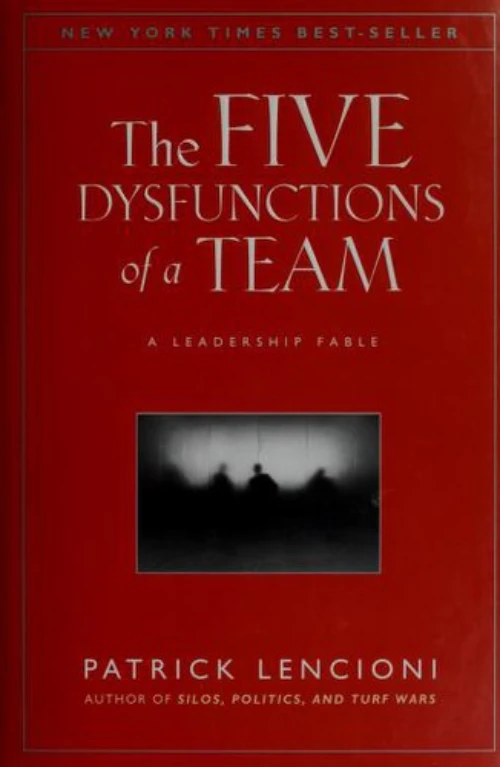
What is The Five Dysfunctions of a Team about?
The Five Dysfunctions of a Team is a leadership fable by Patrick Lencioni that explains why capable teams underperform: absence of trust, fear of conflict, lack of commitment, avoidance of accountability, and inattention to results. It offers a pyramid model plus practical exercises leaders can run to build a genuinely cohesive, high-performing team.
About the author
Patrick Lencioni is the founder and president of The Table Group, a management consulting firm he started in 1997 to help leaders build healthier organizations. Before that, he worked at Bain & Company, Oracle, and served on the executive team at Sybase — giving him a front-row seat to both functional and dysfunctional leadership teams. He’s written more than ten business books, including The Advantage, Death by Meeting, and The Ideal Team Player, together selling over three million copies. His signature format — a short business fable followed by a practical model — has made complex organizational ideas accessible to non-academic readers for over two decades. He lives in the San Francisco Bay Area. Explore all Patrick Lencioni book summaries →
Key concepts at a glance
| Concept | What it means | Use it when |
|---|---|---|
| Absence of Trust | Team members hide weaknesses and mistakes from each other | Starting a new team, or after a reorg |
| Fear of Conflict | Meetings stay polite but real disagreements never surface | The same decisions keep getting quietly revisited |
| Lack of Commitment | Ambiguity and false agreement replace real buy-in | Projects stall right after everyone “agreed” |
| Avoidance of Accountability | Low standards go unchallenged by peers | Performance is inconsistent across the team |
| Inattention to Results | Individual or department goals beat the team’s shared goal | People hit personal targets while the team misses its own |
| Personal Histories Exercise | A quick round of background-sharing questions to build empathy | Kicking off a new team or offsite |
| Thematic Goal | One overarching, qualitative priority for a defined period | The team has too many competing priorities |
| Team Effectiveness Exercise | Peers name each other’s biggest contribution and one thing to improve | The team has some trust but still avoids direct feedback |
Part 1: The Fable — A Team That Looks Fine and Isn’t
The book opens on DecisionTech, a Silicon Valley startup with strong funding, a recognizable brand, and an executive team full of talented, experienced people. On paper, it should be winning. In practice, it’s slipping — and nobody can point to a single reason why. The board’s answer is Kathryn Petersen, an outsider who has never worked in tech. She ran manufacturing plants and led a division of a car company. Her résumé makes the executive team skeptical before she says a word.
Kathryn doesn’t start with strategy decks or market analysis. She sits in on the executive team’s meetings and watches. What she sees is a team that is unfailingly polite: no raised voices, no visible tension, no obvious conflict — and almost nothing gets decided. People nod along in the room, then quietly do their own thing afterward. She recognizes the pattern immediately, because it’s the same pattern she’s seen sink teams before: a group of smart people who have never learned to trust each other enough to disagree honestly.
Over a series of offsites, Kathryn forces the team through exercises that feel uncomfortable at first — sharing personal history, naming what they actually think of each other’s work, sitting inside real disagreement instead of routing around it. The fable format matters here: it’s easier to recognize your own team’s avoidance in a story about someone else’s than in a bullet-point list about your own.
TGR Note: If Kathryn’s insistence on vulnerability-first leadership resonates, pair this with our Dare to Lead summary — Brené Brown makes the research case for why admitting uncertainty is a leadership strength, not a weakness. Simon Sinek’s ideas in our Leaders Eat Last summary cover the same trust-first territory from a different angle: psychological safety as the thing that lets teams take risks together.
Part 2: The Model — Why the Five Dysfunctions Stack
Strip away the fable and you’re left with a pyramid, read from the bottom up. Each dysfunction creates the conditions for the one above it, which is why Lencioni insists you can’t skip levels — a team that hasn’t built trust cannot simply decide to have better conflict.
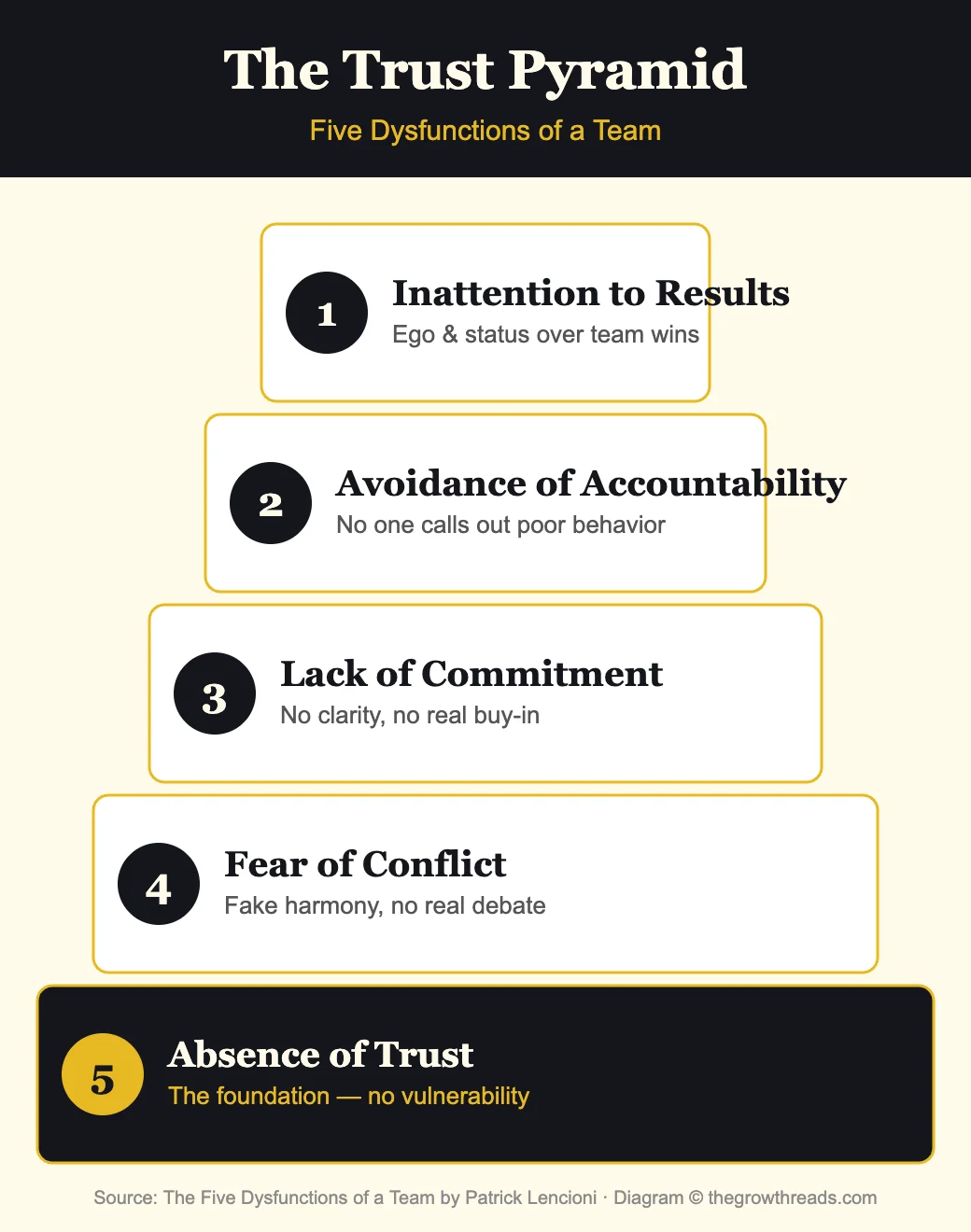
1. Absence of Trust. Lencioni means something specific by trust here: not “I trust you’ll hit your deadline,” but vulnerability-based trust — the confidence that you can admit a mistake, ask a dumb question, or say “I need help” without it being used against you later. Teams without this spend energy managing how they’re perceived instead of doing the work.
2. Fear of Conflict. Without trust, disagreement feels dangerous, so teams substitute artificial harmony: guarded comments, veiled meanings, meetings where the real conversation happens in the hallway afterward. Lencioni’s point is counterintuitive but sharp — a team with no visible conflict is not a healthy team, it’s a team avoiding the truth.
3. Lack of Commitment. If people never said what they really thought in the room, they never truly bought into what got decided. They comply, but they don’t commit — and compliance evaporates the moment things get hard.
4. Avoidance of Accountability. Without genuine commitment to a shared standard, nobody feels entitled to call out a peer who’s falling short. Accountability quietly becomes the manager’s job alone, which doesn’t scale.
5. Inattention to Results. At the top, individual ego and department-level wins start beating the team’s collective goal — because nothing lower in the pyramid was ever solid enough to hold a shared definition of “winning” in place.
TGR Note: The accountability layer overlaps closely with Jocko Willink’s central argument in our Extreme Ownership review — that leaders who own outcomes without blaming others set the standard their whole team then follows. Read them back to back if accountability is your team’s specific gap.
Part 3: Overcoming Trust and Conflict
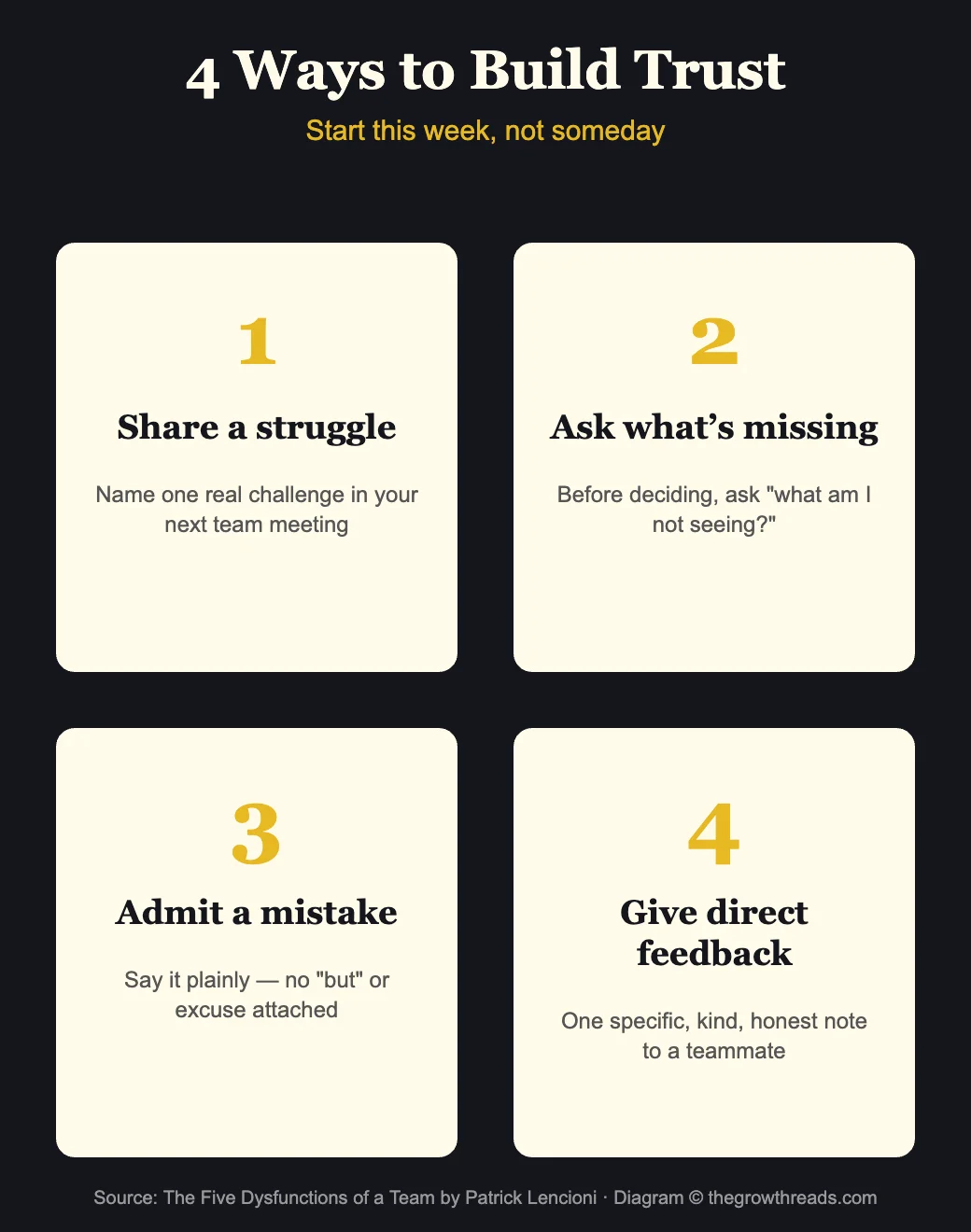
Lencioni doesn’t leave trust-building as an abstract instruction — he gives two specific exercises.
The Personal Histories Exercise takes about 30 minutes. Each team member answers a handful of low-stakes questions in front of the group: where they grew up, how many siblings they have, one unique challenge from childhood, and a favorite hobby. It sounds too simple to matter, but it consistently does — hearing a colleague’s actual background replaces the flat, professional version of them with a fuller, more human one, and empathy is hard to fake once it’s there.
The Team Effectiveness Exercise goes further and stings a little more: each person identifies the single most important contribution every teammate makes to the group, and one thing that person needs to improve or stop doing for the team’s sake. Said out loud, in the room, to each other. Lencioni is explicit that personality assessments (Myers-Briggs and similar tools) are useful supplements here, but they’re not a substitute — they describe style, not the willingness to be direct.
Once trust exists, the leader’s job shifts to mining for conflict — actively surfacing disagreements the team is dancing around rather than letting meetings stay comfortable. Teams that get good at this often adopt a simple real-time permission: anyone can name the avoidance out loud (“I think we’re being too polite about this right now”) without it being read as an attack.
TGR Note: If your team’s specific issue is that hard conversations go sideways rather than never happening, our Crucial Conversations summary is the natural next read — it’s a toolkit for the “how” of a difficult conversation once you’ve already decided, per Lencioni, to stop avoiding it.
Part 4: Overcoming Commitment, Accountability, and Results
Trust and conflict get the most attention, but Lencioni is just as specific about the top three layers.
Commitment comes from clarity, not consensus. Lencioni’s rule of thumb: people need to know their opinion was genuinely heard, and they need a clear, final decision to rally behind — even one they disagreed with. He recommends “cascading messaging”: within 24 hours of a leadership decision, the same explanation is repeated consistently down through the organization, so ambiguity doesn’t fill the gap.
Accountability becomes peer-to-peer once commitment is real, because people who helped shape a decision feel entitled to hold each other to it. The best teams don’t wait for a manager to enforce standards — teammates do it for each other, in the moment.
Results stay front-and-center when the team defines success with a single thematic goal: one qualitative priority for the current period (a quarter, a launch, a turnaround), supported by four or five concrete defining objectives. Pairing that with a simple, visible scoreboard — the handful of numbers that actually matter — keeps results a team conversation instead of a private, individual one.
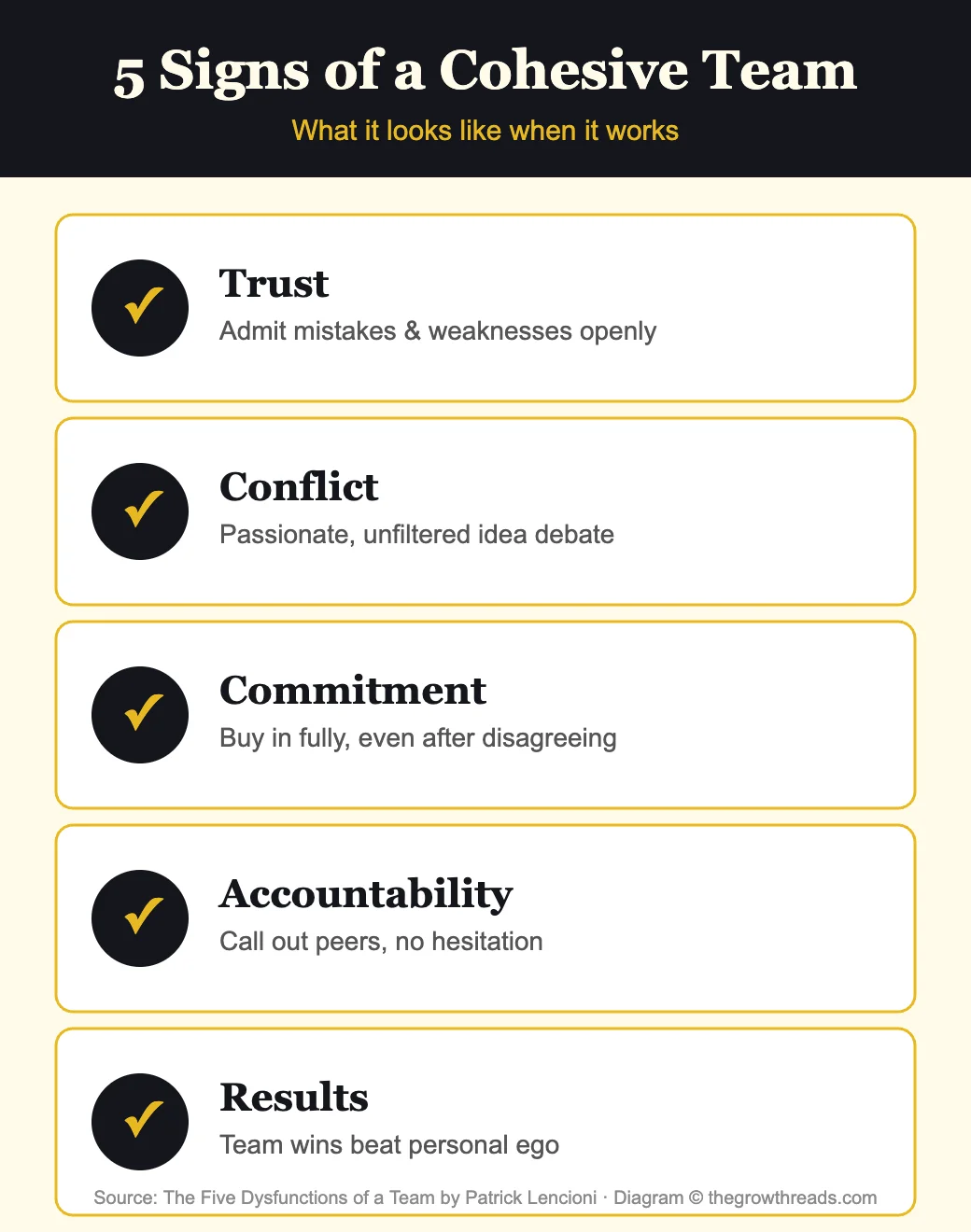
Lencioni closes the model with a short recurring self-assessment — a handful of questions the team revisits periodically to catch the slide back into old habits before it hardens again. Teams don’t fix these five dysfunctions once; they keep checking.
TGR Note: A thematic goal is close cousin to the “one thing” focus in our The ONE Thing summary — both books argue that too many priorities function as no priority at all. And if getting the right people into the right seats is your bigger constraint than alignment, our Good to Great summary covers Jim Collins’s “who before what” research.
Who is The Five Dysfunctions of a Team best for — and who should read something else first?
This book is best for managers and executives leading an intact team of roughly 4 to 15 people, especially ones where meetings feel unusually smooth but decisions don’t stick. It’s also useful for HR and People teams designing offsites or team-health programs. If you lead a team where the honest problem is misaligned individual incentives more than group trust, our Leaders Eat Last summary tackles that from the safety-and-belonging angle. If you’re an individual contributor or solo founder without direct reports yet, start with Start with Why or Extreme Ownership to build your own leadership foundation first — this book pays off most once you actually have a team to apply it to.
Questions to reflect on
- Which of the five dysfunctions shows up most often on your team right now?
- When did you last admit a mistake to your team without qualifying or softening it?
- What disagreement has your team been quietly avoiding for weeks?
- Do your teammates know they have real permission to call you out?
- If you asked each teammate to name your team’s #1 priority in one sentence, would the answers match?
🔥 Ready to fix the trust gap on your team?
Get the full fable plus Lencioni’s assessment tools and exercises in one short read.
How to apply The Five Dysfunctions of a Team (7-day plan)
- Day 1 — Self-assess. Rate your team 1–5 on each of the five dysfunctions, honestly, on paper.
- Day 2 — Run the Personal Histories Exercise. Fifteen minutes, low-stakes questions, in your next team meeting.
- Day 3 — Name one buried disagreement. Say it out loud in a 1:1 or team setting instead of routing around it.
- Day 4 — Write your thematic goal. One sentence describing your team’s single top priority this quarter.
- Day 5 — Ask for direct feedback. “What’s one thing I should stop, start, or keep doing?” — ask every teammate.
- Day 6 — Build a scoreboard. Pick the 3–5 numbers that actually matter and make them visible to the whole team.
- Day 7 — Schedule a recurring checkup. Put a 20-minute team-health review on the calendar, monthly or quarterly.
Frequently asked questions
What are the five dysfunctions of a team, in order?
From the foundation up: absence of trust, fear of conflict, lack of commitment, avoidance of accountability, and inattention to results. Lencioni presents them as a pyramid because each one creates the conditions for the dysfunction above it — a team can’t fix conflict avoidance, for example, until it has built real trust first. That’s also why quick fixes rarely stick: skipping straight to “let’s hold each other accountable” without trust and honest conflict underneath it tends to feel forced and doesn’t last.
Is The Five Dysfunctions of a Team based on a true story?
No — DecisionTech and its executive team are fictional. Lencioni uses the fable format deliberately, a technique he’s repeated across most of his books, because a story makes dysfunctional team patterns easier to recognize than a straight list of principles does. The characters and company are invented, but Lencioni has said the patterns are drawn from decades of consulting work with real executive teams, which is why so many readers find the scenes uncomfortably familiar.
How long does it take to read The Five Dysfunctions of a Team?
Most readers finish it in three to four hours. It’s a short book — under 230 pages — and the fable half reads quickly like fiction. The nonfiction model section at the end, which explains the pyramid and the exercises in plain terms, is much shorter and can be reread on its own as a quick reference once you’ve read the story once. Many teams keep just that section as a shared handout after the first read-through.
What is the Personal Histories Exercise?
It’s a roughly 30-minute team exercise where each person answers a handful of simple background questions in front of the group — hometown, number of siblings, a unique childhood challenge, a hobby. It’s intentionally low-stakes. The goal isn’t the answers themselves; it’s replacing a flat, purely professional impression of a colleague with a fuller human one, which is often the fastest available way to start building vulnerability-based trust on a new or reset team.
Does the book say consensus decision-making is bad?
Yes, largely — Lencioni argues real commitment doesn’t require unanimous agreement, and chasing consensus often produces weaker, slower decisions and false buy-in. What he says teams actually need is clarity (everyone understands what was decided and why) and closure (everyone knows the debate is over and it’s time to execute), even when some people would have decided differently. He calls this “disagree and commit,” and treats the ability to do it well as a hallmark of a mature team.
Is this book only useful for executives, or can any team use it?
While the fable is set at the executive level, Lencioni designed the model to apply to any intact team with a shared goal — a sales pod, an engineering squad, a nonprofit board, even a sports team. The exercises scale down easily; the core requirement is simply that the group works together toward common outcomes and meets regularly enough for trust and accountability to matter. Teams as small as three or four people use the framework as often as large leadership groups do.
What’s the difference between this book and Lencioni’s The Ideal Team Player?
The Five Dysfunctions of a Team diagnoses how a team, as a group, tends to fail — it’s a team-level diagnostic and process. The Ideal Team Player is about individuals: what specific traits (Lencioni names humble, hungry, and smart) make someone a good fit for a healthy team in the first place. They’re complementary rather than overlapping — one book helps you fix the team you have, the other helps you decide who to add to it or promote within it.
Related summaries
- Dare to Lead summary — the research case for vulnerability as a leadership skill.
- Leaders Eat Last summary — trust and psychological safety, from a biology-of-belonging angle.
- Extreme Ownership review — accountability that starts with the leader, not the team.
- Start with Why summary — building individual leadership clarity before leading a team.
- See all our picks on the best leadership books pillar page.
How we analyze books: every TGR summary is built from a full read of the source material, cross-checked against the author’s other published work and interviews, then structured into a practical application plan — not just a recap. We flag where research is contested and where advice is purely anecdotal. Read our full methodology.
Related Leadership Summaries
Team of Teams Summary & Review: Leading in Complexity
The Dichotomy of Leadership Summary & Review: Balance Every Principle or Fail
The Lean Startup Summary & Review: Build, Measure, Learn
Think Again Summary & Review: Master the Art of Rethinking
Who Moved My Cheese? Summary & Review: Navigate Change Before It Breaks You