

★★★★★ 4.7/5 — A field guide to how desire is created: nine types, a four-phase process, and the habits that kill magnetism on contact.
Best for: People who confuse niceness with attraction, over-explain on dates, or want a map of how attention actually works
Reading time: ~10 hrs for the full book · ~16 min for this guide
Difficulty to apply: Easy to understand; the hard part is dropping the need to be immediately liked
The Art of Seduction in one minute
Force makes people comply. Seduction makes them want to stay. That is Robert Greene’s 2001 companion to The 48 Laws of Power: attraction is a craft of attention, not a mood you wait for. He sorts seducers into nine types, names the anti-seducer who kills the room, and walks a four-phase process: stir interest, lead the other person off their script, deepen the feeling, then stop pushing so they feel they chose the next step. Read it as a diagnostic of why over-availability, bragging, and filling every silence make you forgettable. The usable moves are blunt: have a world, listen longer than you pitch, mix warmth with a little distance, and let the other person discover you instead of receiving a brochure.
Key takeaways
- Desire is manufactured: Greene’s claim is that people do not “find” chemistry so much as they are led into a state where curiosity has somewhere to go.
- Nine types, one job: Siren, Rake, Ideal Lover, Dandy, Natural, Coquette, Charmer, Charismatic, Star — each awakens a different hunger. You already lean toward one.
- The anti-seducer is usually you on a nervous day: Bragging, cheap jokes, over-explaining, and a need to be liked in the first five minutes.
- Choose who can want what you offer: The first move is selection, not performance. Chasing someone whose values cannot meet yours is unpaid labour.
- Mixed signals are not cruelty: They are proof you have a life. Total availability is a kind of flattening.
- Enter their spirit: Talk in their language, at their pace, about what already matters to them — then add a little of your world.
- Confusion plus pleasure holds better than pressure: A spike of force (a hard sell, a confession, a demand) often collapses. A slow rise of attention lasts.
- Absence is a tool, not a game: Leave before the room is empty of air. The other person should feel they are choosing to follow.
- Long-term desire needs the same craft: Once the chase ends, do not become furniture. Pair that with Mating in Captivity.
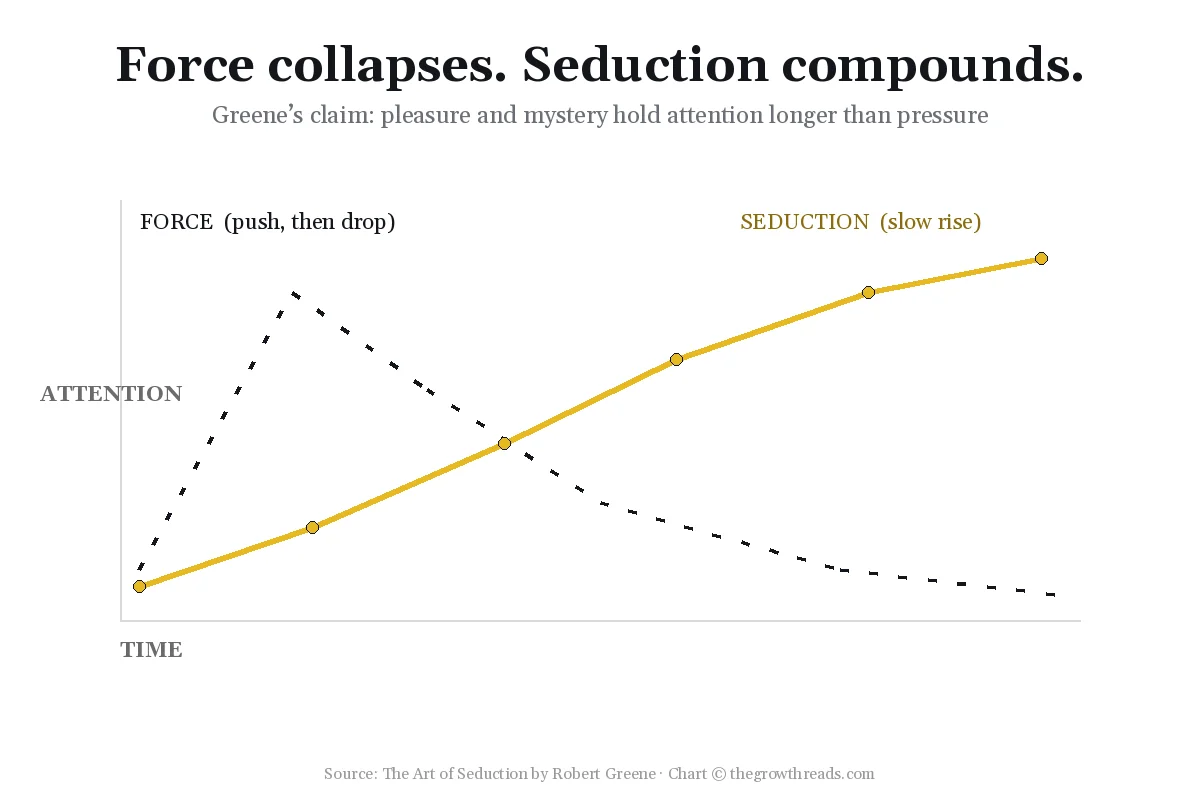

What is The Art of Seduction about?
The Art of Seduction is Robert Greene’s 2001 handbook on how attraction is created. It maps nine archetypes, the anti-seducer who repels, and a four-phase process — stir interest, lead astray, deepen, then pause — arguing that pleasure and mystery outlast force.
About the author
Robert Greene (born 1959) is the Los Angeles writer who made court-and-history self-help a genre. A Berkeley classicist who worked in journalism and Hollywood, he published The 48 Laws of Power in 1998 with packager Joost Elffers. The Art of Seduction (2001) is the companion that treats desire the way the first book treated power: as a pattern you can study without pretending you are above it. Mastery and The Laws of Human Nature followed the same method — a type, a historical case, a modern translation. The difference here is the material (Cleopatra, Casanova, Josephine Baker) and the claim that the most durable hold is the one the other person feels they chose. Explore all Robert Greene book summaries →
Key concepts at a glance
| Concept | What it means | Use it when |
|---|---|---|
| Seduction vs force | Pleasure and mystery that the other person feels they chose, versus a push that creates resistance | You are explaining harder and they are pulling away |
| Nine types | Nine ways of awakening hunger: pull, puzzle, or spell | You keep copying someone else’s dating persona |
| Anti-seducer | The habits that flatten desire: bragging, neediness, over-availability | Dates go well for twenty minutes and then die |
| Choose the right person | Pick someone whose unmet want matches what you actually offer | You are performing for a person who cannot want you |
| Mixed signals | Warmth plus a life that is not cancelled for them | You have become a calendar with no edges |
| Insinuation | Let them discover the idea; do not hand them a brochure | You are pitching yourself in complete sentences |
| Enter their spirit | Match their language, pace, and topic before adding yours | You keep steering every talk back to your résumé |
| The whirlpool | Pleasure plus a little confusion, then a pause so they step closer | You fill every silence and call it honesty |
| Object of desire | Look wanted — triangles of social proof that are real, not invented rivals | You are the only one investing and calling it patience |
Part 1: The seductive character — nine types
Greene opens with character, not tactics, because tactics copied from a stranger look like costume. The nine types keep reappearing: the Siren who is dangerous and musical; the Rake absorbed in the other person; the Ideal Lover who seems to complete a private fantasy; the Dandy who will not be categorised; the Natural who has not sanded off their oddness; the Coquette who advances and retreats; the Charmer who makes you feel chosen; the Charismatic lit from a cause; the Star who is slightly unreachable. You need the one already in your body when you are not performing.
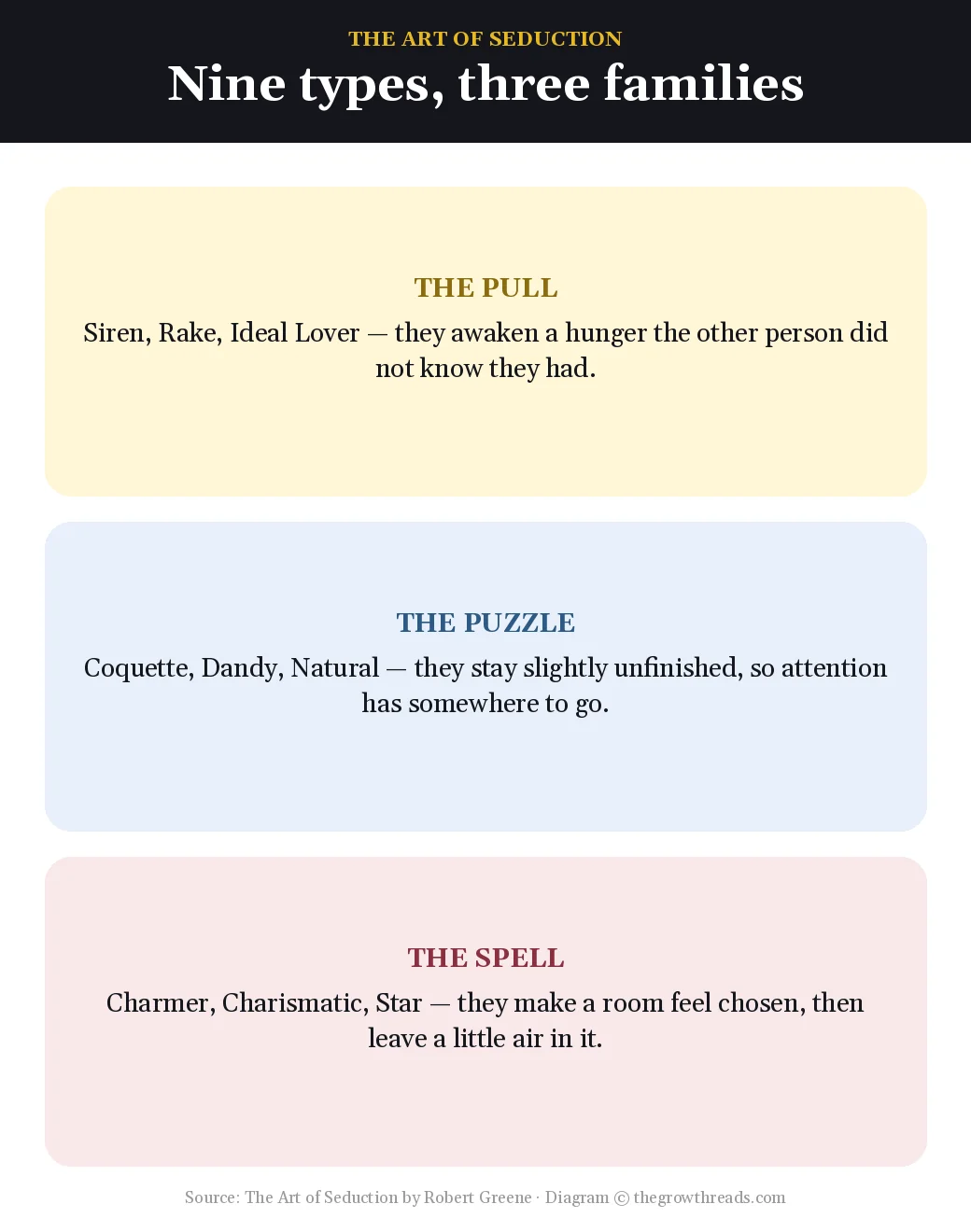
The practical test is ugly and useful. When you try to be the Rake and you are actually a Natural, the room smells the effort. Greene’s cases — Cleopatra as Siren, Casanova as Rake — show the pattern; they are not a script for a bar. Steal the type that matches evidence other people would recognise, not the one that looked good in a film. If you make people feel seen in a noisy room, you are already in the Charmer chapter.
TGR Note: Fromm’s The Art of Loving is the ethical twin: love as a skill of care, responsibility, respect, and knowledge. Greene is the psychology of attention. Read both if you want magnetism that you would still defend in the morning. How to Win Friends and Influence People is the gentler social version of “enter their spirit.”
Part 2: Stirring interest — choose, insinuate, create a need
The process section is where the book becomes a sequence. Phase one is not “be hotter.” It is selection. Greene’s first move is to choose the person whose unmet want you can actually meet — the disappointed dreamer, the lonely leader, the person starving for play. If you skip this, every later tactic is a sales call to the wrong account. Create a false sense of security: be easy to be around before you are interesting. Send mixed signals so you are not a solved puzzle. Appear as an object of desire without inventing fake rivals — have friends, work, a table that is not empty. Create a need by being useful, funny, or calm, then slightly scarce. Master insinuation: hint, do not lecture. Enter their spirit. Create a temptation that is specific to them, not a generic weekend.
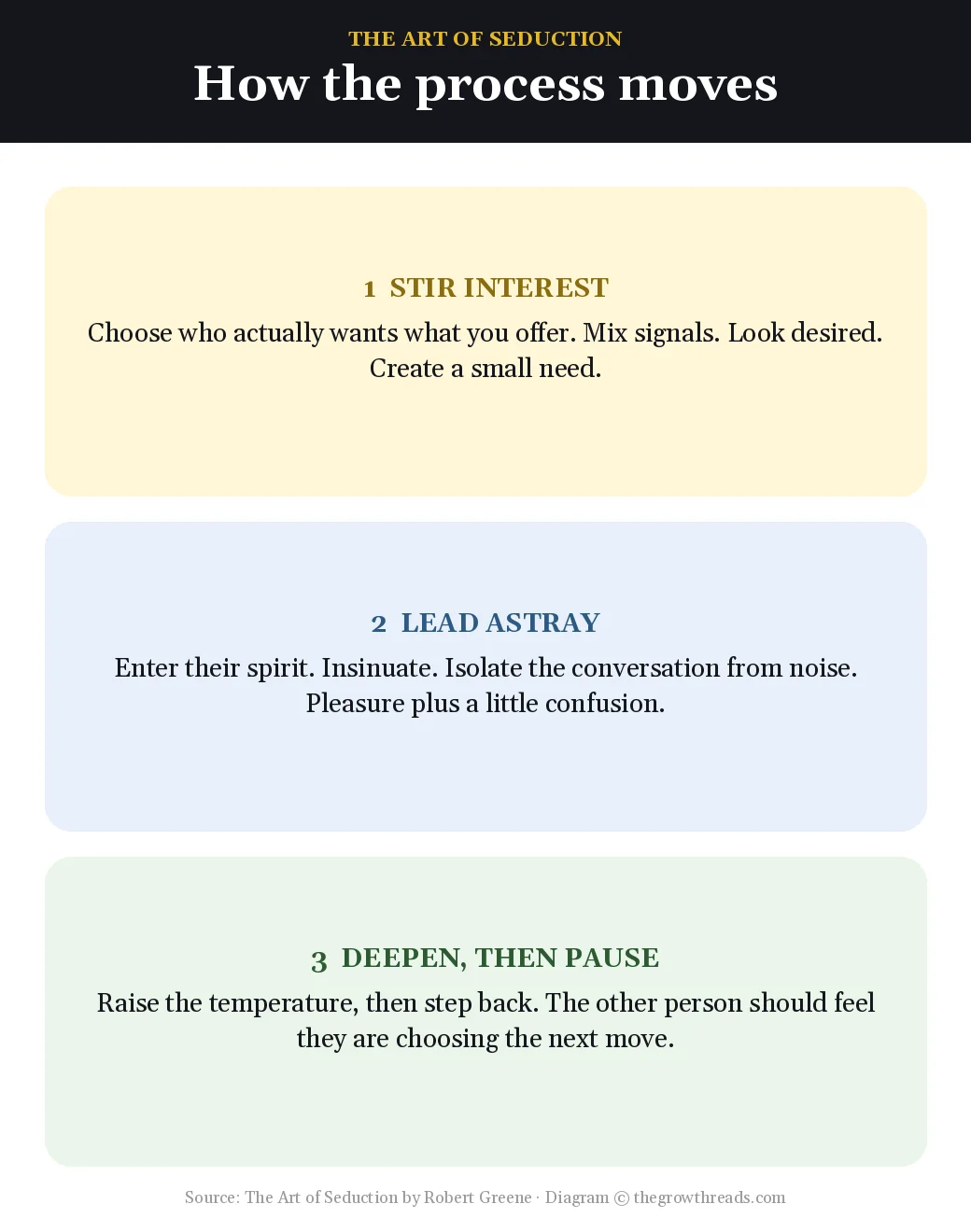
Applied without contempt, this looks like good adult dating. You do not cancel your Tuesday. You do not send a five-paragraph autobiography. You notice what they light up about and stay there long enough to be a person, not a pitch. Translate the court histories down: a founder who only talks about the round is an anti-seducer. The “need” you create should be real — calm, humour, competence — not a manufactured crisis.
TGR Note: If the problem is that you keep choosing people who cannot meet you, start with Attached before you practise mixed signals. If the problem is that you have no edges, No More Mr Nice Guy is the plainer diagnosis of people-pleasing. Greene is the aesthetic layer on top of those two.
Part 3: The whirlpool — pleasure, confusion, and timed absence
Phase two and three are where Greene wants the other person slightly off-balance — not frightened, not gaslit, but no longer running their usual script. Lead them into experiences they did not schedule. Isolate the conversation from noise (a walk, a kitchen, a room without phones). Use a “demonic” side only in the sense of not being only nice: a sharp opinion, a laugh at the wrong moment, a refusal to flatter. Keep the seduction going by varying the temperature. Then — this is the move most nice people skip — step back. Absence is how the other person feels they are choosing. Greene’s whirlpool image is the opposite of a hard close: the current should feel like their idea.
In a long relationship the same physics show up as routine. Once someone is “won,” many readers drop the craft and become furniture. Keep a private world and a little unfinishedness; do not narrate every feeling the minute it occurs. Safety is not the enemy; total transparency-as-performance is. The ethical line is non-negotiable: timed absence is not punishment, and mixed signals are not a cover for a secret life. If you need a lie for the tactic to work, you are hiding, not practising the craft.
TGR Note: Mating in Captivity is the research-clinic version of this chapter: desire needs a gap. The Mastery of Love is the fear-and-domestication version. Greene supplies the historical colour; those two tell you how to stay kind while keeping the gap.
Part 4: The anti-seducer, and staying magnetic after the spark
The anti-seducer chapter is the one to photocopy. Greene’s list is a museum of modern dates: the person who brags, who cannot bear a silence, who teases to wound, who is always available, who moralises, who is sour, who makes everything a joke so nothing can land. The fix is having a world — work, friends, a walk you will not cancel — and listening longer than you perform. The 18 “victim” types are unmet needs. Read them as a warning about projection. If someone needs you to complete a fantasy you cannot live in, decline.
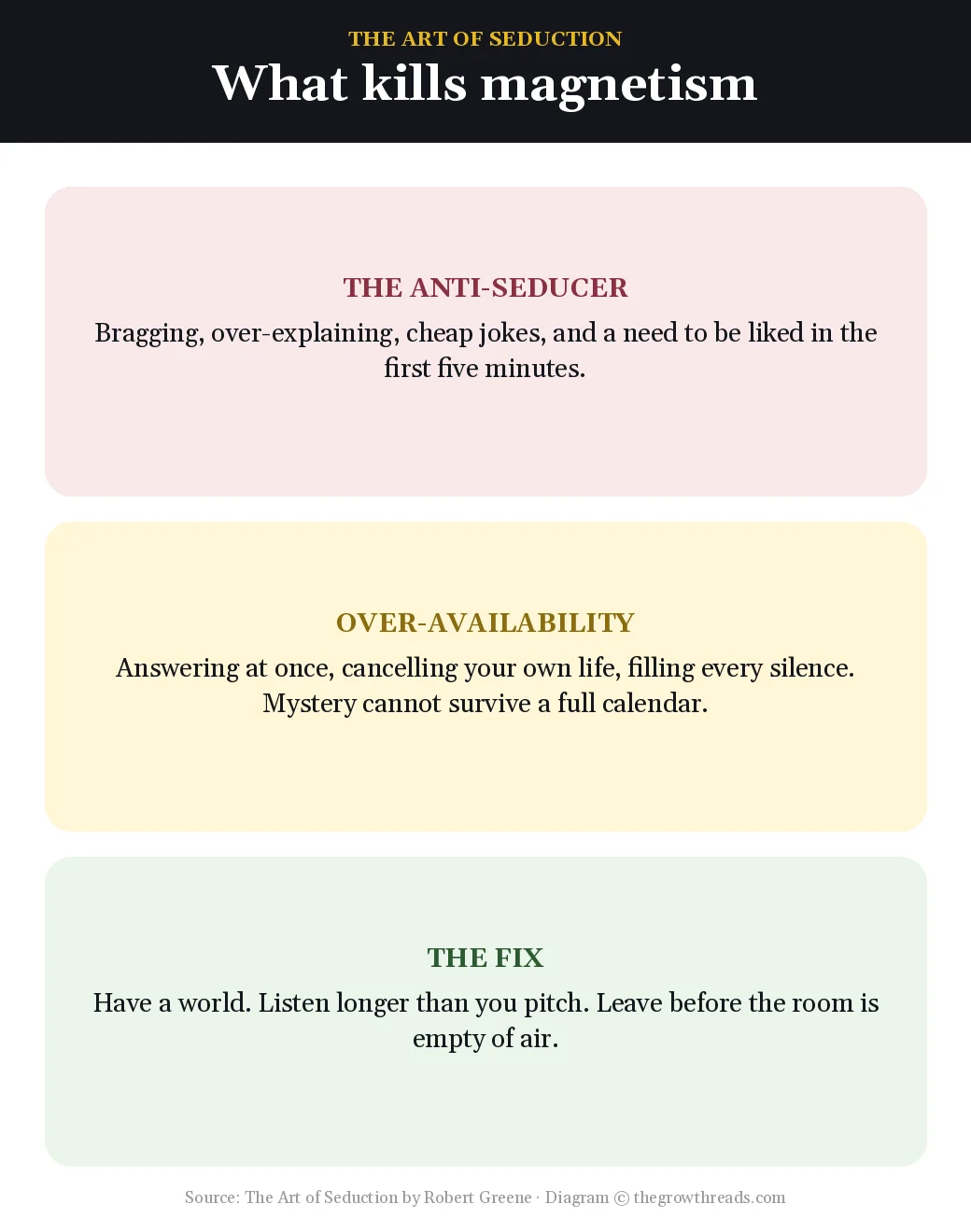
Staying magnetic after the spark is the adult test. Translate the court theatre: keep one part of your week that is yours, one conversation that is not the calendar, one way of looking at them that is not a status update. The relationship reader should hear “do not become a utility.” If you need vulnerability without the intrigue, that is Daring Greatly. Greene will not teach you how to repair after you have been cruel. He will teach you why a room went cold when you tried too hard.
TGR Note: For the power-map underneath this book, use The 48 Laws of Power. For the inner drivers, The Laws of Human Nature. For skill over a lifetime, Mastery.
Who is The Art of Seduction best for — and who should read something else first?
Read it if you have been using niceness as a strategy and you can feel the room go flat. It is also the right book if you already have a life and you want language for why attention dies when you over-explain. Founders, artists, and people returning to dating after a long relationship often recognise themselves in the anti-seducer list more than in the Siren chapter.
Read something else first if you are in an anxious-avoidant spiral — start with Attached. For a moral philosophy of love, use The Art of Loving. For long-term erotic deadness, use Mating in Captivity. If you cannot say no, use No More Mr Nice Guy. Greene is a poor first book if you want a repair manual after harm; it is a strong second book once you will not use mystery as a weapon.
Questions to reflect on
- Which of the nine types do you actually inhabit when you are not performing — and which one have you been copying?
- Where are you the anti-seducer: bragging, over-texting, filling silence, or cancelling your own plans?
- Who are you trying to win whose values cannot meet what you offer?
- What would “enter their spirit” look like in the next conversation you already have on the calendar?
- If you left twenty minutes earlier than feels polite, what would the other person have to do next?
🔥 Ready to treat attraction as a craft, not a mood?
Get The Art of Seduction and start reading.
How to apply The Art of Seduction (7-day plan)
- Day 1: Write your anti-seducer list from the last two dates or meetings: where you bragged, explained, or asked for liking. Circle one habit to drop this week.
- Day 2: Name your actual type in one sentence (Natural, Charmer, Coquette…). Do not upgrade it to a film character. Use only evidence other people would recognise.
- Day 3: Keep one plan that is yours. Do not cancel it for someone who has not earned that slot. Notice the urge to be available as a personality.
- Day 4: In one conversation, ask three questions before you tell a story. Enter their spirit for ten minutes. Then add one specific piece of your world, not a résumé.
- Day 5: Practise insinuation: hint at an idea or an invitation and stop. Let them complete it. If you fill the silence, you are back in the brochure.
- Day 6: Leave first once — a call, a drink, a meeting. Not as punishment. As air. Write down what they did with the space.
- Day 7: Audit selection. Who cannot want what you offer? Stop performing for that person this month. Put the energy into the one conversation that already has a current.
Frequently asked questions
What is the main message of The Art of Seduction?
Greene’s claim is that desire is a craft of attention, not a prize you wait to feel. Force (a hard sell, a confession, a demand) can spike interest and then collapse. Seduction, in his scoring, is slower: you stir curiosity, enter the other person’s world, mix pleasure with a little unfinishedness, and stop pushing so they feel they chose the next step. The usable message is narrower than the court histories. Have a life. Listen longer than you pitch. Leave before the room is empty. Apply that in dating, friendship, and any room where you have been trying to be liked in the first five minutes.
What are the nine seducer types in The Art of Seduction?
The nine types are Siren, Rake, Ideal Lover, Dandy, Natural, Coquette, Charmer, Charismatic, and Star. They cluster into a pull (Siren, Rake, Ideal Lover), a puzzle (Dandy, Natural, Coquette), and a spell (Charmer, Charismatic, Star). You do not collect all nine. You identify the one that already shows up when you are not performing, then you stop borrowing a type that does not fit. The anti-seducer sits outside the list: it is the nervous version of any type — bragging, over-explaining, sourness, cheap jokes — and it is the first thing to cut.
Is The Art of Seduction a book about manipulation?
It is a book about the psychology of wanting, in the same unsentimental voice as the 48 Laws. Greene uses “victim” as a technical term for the person whose attention is being led, which is easy to abuse. The ethical line is whether they would still recognise themselves in the story tomorrow. Timed absence and mixed signals can be adult boundaries — or a cover for lying. TGR’s reading: become harder to flatten, not harder to trust. If a move requires a lie, put the book down.
How long does it take to read The Art of Seduction?
The Penguin paperback is about 466 pages of types, maneuvers, and case studies. A careful reader should budget eight to twelve hours, longer if you follow every historical footnote. It is denser than a typical dating title and lighter than The Laws of Human Nature. This guide is about sixteen minutes and maps the book into four movements: the nine types, stirring interest, the whirlpool of pleasure and pause, and the anti-seducer. Two sittings work well: character first, then the process and the anti-seducer list on a second evening with a notebook.
How is The Art of Seduction different from the 48 Laws of Power?
The 48 Laws is a field guide to power in rooms that keep score. The Art of Seduction is the same method — type, history, translation — applied to how people come toward you. Power can be held with fear; seduction, in Greene’s scoring, has to feel voluntary or it dies. If you only read the 48 Laws you will under-index on pleasure. Start with the 48 Laws if your problem is a workplace. Start here if your problem is a flat date.
Can you use The Art of Seduction in a long-term relationship?
Yes, if you translate “chase” into “do not become furniture.” The later maneuvers keep a private world and shared experiences that are not logistics — the same gap Esther Perel describes in Mating in Captivity. Timed absence is not a punishment cycle. If the relationship is already scared, start with Hold Me Tight or Attached. Used as a repair-after-harm manual, this book is the wrong tool. Used as a reminder to stay interesting to someone you already love, it is surprisingly domestic.
Who should read The Art of Seduction today?
Read it if you lead with niceness and you can feel attention die when you over-explain. It is also the right book if you are returning to dating and you have been sending brochures instead of having a life. Skip it as a first relationship book if you need attachment language (Attached), a philosophy of love (The Art of Loving), or a couples-therapy sequence (Hold Me Tight). Come back when you can tell the difference between mystery and a disappearing act, and when you will not use Greene’s “victim” vocabulary on a person sitting across from you.
Related summaries
- Mating in Captivity — desire needs a gap, without the court histories.
- The Art of Loving — love as a skill of care, not a hunt.
- How to Win Friends and Influence People — enter their spirit, in a kinder key.
- The 48 Laws of Power — the colder map this book was written beside.
Browse every title in our Best Relationship Books pillar page.
How we analyze books: our summaries are built from a full read of the source text, cross-referenced against the author’s published interviews and research where relevant, and structured around practical application rather than critique. We disclose our editorial process and affiliate relationships in full. Read our full methodology.