

★★★★☆ 4.3 / 5 — A research-backed field guide to leading with vulnerability, building trust, and having the hard conversations that transform teams.
Best for: Managers, executives, entrepreneurs, HR leaders, and anyone who wants to lead with more courage and less armor.
Reading time: ~6 hours (320 pages) · This summary: 18 min
Difficulty to apply: High — vulnerability-based leadership requires rewiring deeply held habits around self-protection.
Dare to Lead in one minute
Brave leaders are not born fearless — they are people who have learned to lead with vulnerability instead of armor. Brené Brown distills twenty years of research on courage, vulnerability, shame, and empathy into four learnable skill sets that any leader can develop. The book demolishes the myth that vulnerability is weakness, showing instead that it is the birthplace of innovation, trust, and genuine human connection at work. Brown provides concrete tools — from the BRAVING trust inventory to the “rumble” framework for hard conversations — that turn abstract leadership ideals into daily practices.
Key takeaways
- Vulnerability is not weakness: It is the courage to show up when you cannot control the outcome, and it is the single most accurate measure of bravery in leadership.
- Armor kills innovation: When leaders protect themselves from discomfort, they also shut down creativity, feedback, and the willingness to take risks.
- Trust is built in small moments: The BRAVING framework breaks trust into seven measurable behaviors — boundaries, reliability, accountability, vault, integrity, non-judgment, and generosity.
- Clear is kind, unclear is unkind: Avoiding tough conversations is not compassion — it is self-protection dressed up as niceness.
- Values must be operationalized: Naming your top two values is only the beginning; you need specific behaviors that prove you are living them.
- Shame resilience is a leadership skill: Leaders who understand shame can recognize it in themselves and their teams, preventing it from hijacking decision-making.
- The rumble is the process: A “rumble” is a structured conversation where all parties commit to staying curious, generous, and engaged even when it gets uncomfortable.
- Learning to rise follows a pattern: When you fail, the process is: recognize emotion (the reckoning), get curious about the story you are telling yourself (the rumble), then write a braver ending (the revolution).
- Empathy is a skill, not a gift: Brown identifies five elements of empathy that can be taught and practiced in any workplace.
- Daring leadership is contagious: When one leader removes their armor, it gives permission for everyone around them to do the same.
What is Dare to Lead about?
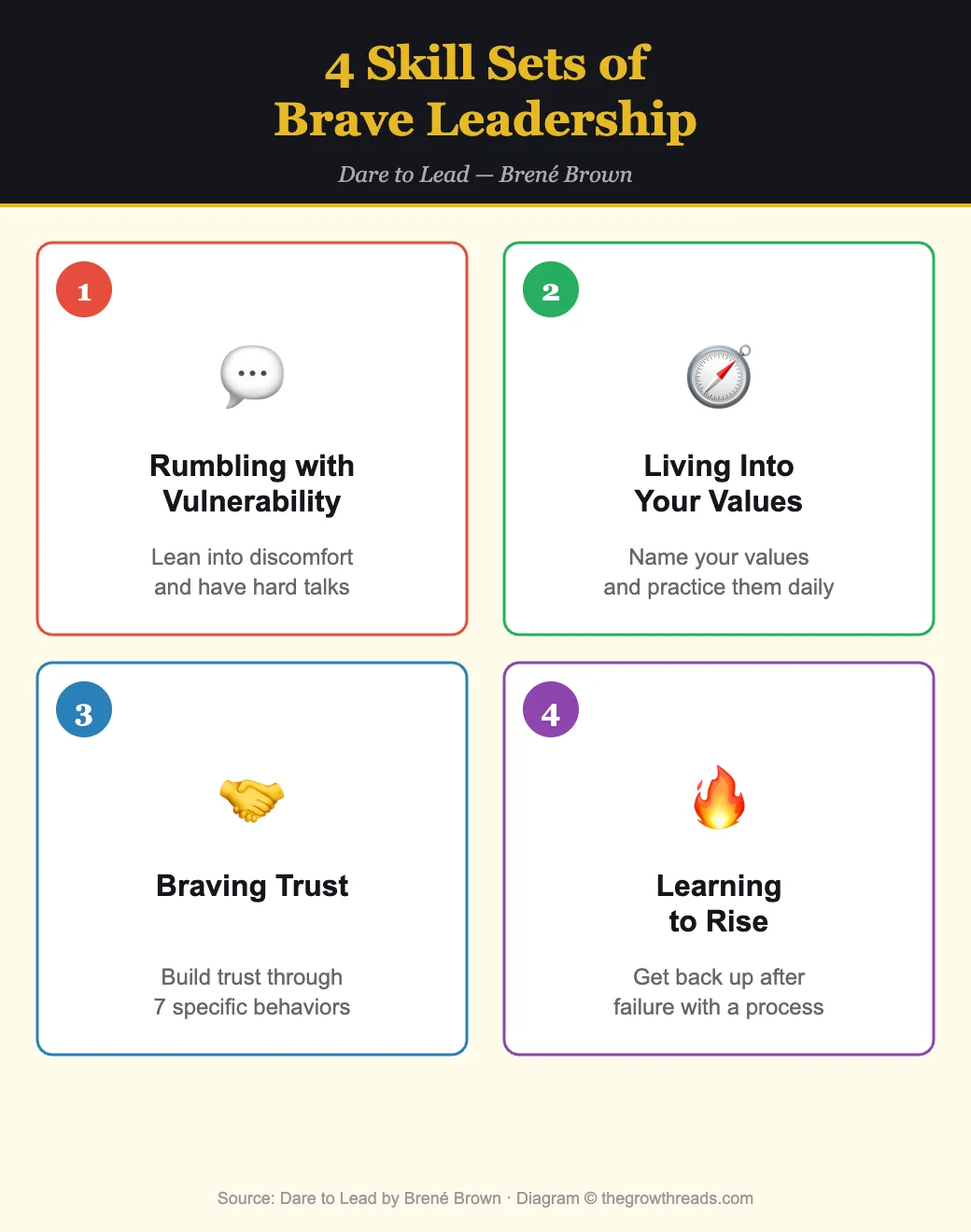
Dare to Lead is a practical guide to leading with courage and vulnerability based on Brené Brown’s two decades of research. It identifies four skill sets — rumbling with vulnerability, living into your values, braving trust, and learning to rise — that transform how leaders connect with their teams, navigate uncertainty, and build cultures of belonging and innovation.
About the author
Brené Brown is a research professor at the University of Houston, where she holds the Huffington Foundation Endowed Chair at the Graduate College of Social Work. Her 2010 TEDx Houston talk, “The Power of Vulnerability,” is one of the most viewed TED talks in history with over 60 million views. Brown has spent more than two decades studying courage, vulnerability, shame, and empathy, publishing six bestselling books including Daring Greatly, Rising Strong, and Atlas of the Heart. She hosts two podcasts and created a leadership development program used by organizations worldwide. Explore all Brené Brown book summaries →
Key concepts at a glance
| Concept | What it means | Use it when |
|---|---|---|
| Vulnerability | The willingness to show up when you cannot predict or control the outcome | You catch yourself avoiding a difficult conversation or decision |
| BRAVING | Seven elements of trust: Boundaries, Reliability, Accountability, Vault, Integrity, Non-judgment, Generosity | You want to diagnose exactly where trust has broken down on a team |
| Rumbling | A commitment to staying curious and engaged during hard conversations | You need to give feedback, address conflict, or challenge the status quo |
| Armored Leadership | Self-protective behaviors like perfectionism, cynicism, and power-over tactics | You notice yourself or others shutting down, withdrawing, or controlling |
| Living Into Values | Naming two core values and defining the specific behaviors that demonstrate them | You face a decision that tests your principles under pressure |
| Shame Resilience | Recognizing shame triggers and moving through them without shutting down | A failure or criticism sends you spiraling into self-doubt or blame |
| Learning to Rise | A three-step process (reckoning, rumble, revolution) for getting back up after failure | You or a team member has experienced a significant setback |
| The Story I’m Telling Myself | A phrase that names the narrative your brain creates during emotional events | You notice a strong emotional reaction and want to check the facts before acting |
Part 1: Rumbling with vulnerability
Brown opens with a provocative finding from her research: when she asked leaders what they most needed from their people, the overwhelming answer was “more courage.” But when she asked the same leaders whether they were willing to create the conditions for courage — which requires tolerating vulnerability, discomfort, and hard conversations — the room got very quiet.
Vulnerability, Brown argues, is not about disclosure or oversharing. It is the willingness to show up when you cannot control the outcome. It is the manager who says “I made a mistake and here is what I learned” instead of pretending to be infallible. It is the founder who admits “I do not have all the answers” and asks the team for help. The research is clear: vulnerability is positively correlated with trust, creativity, and belonging, and negatively correlated with disengagement, cynicism, and attrition.
A “rumble” is Brown’s term for a conversation where all parties commit to leaning into vulnerability. The rules are: stay curious, be generous in your assumptions about others’ intentions, and keep returning to the data even when emotions run high. Brown provides a practical sentence stem — “the story I’m telling myself is…” — that allows people to name their emotional narrative without accusing others. This small linguistic tool has transformed how organizations handle conflict, because it separates the story from the facts.
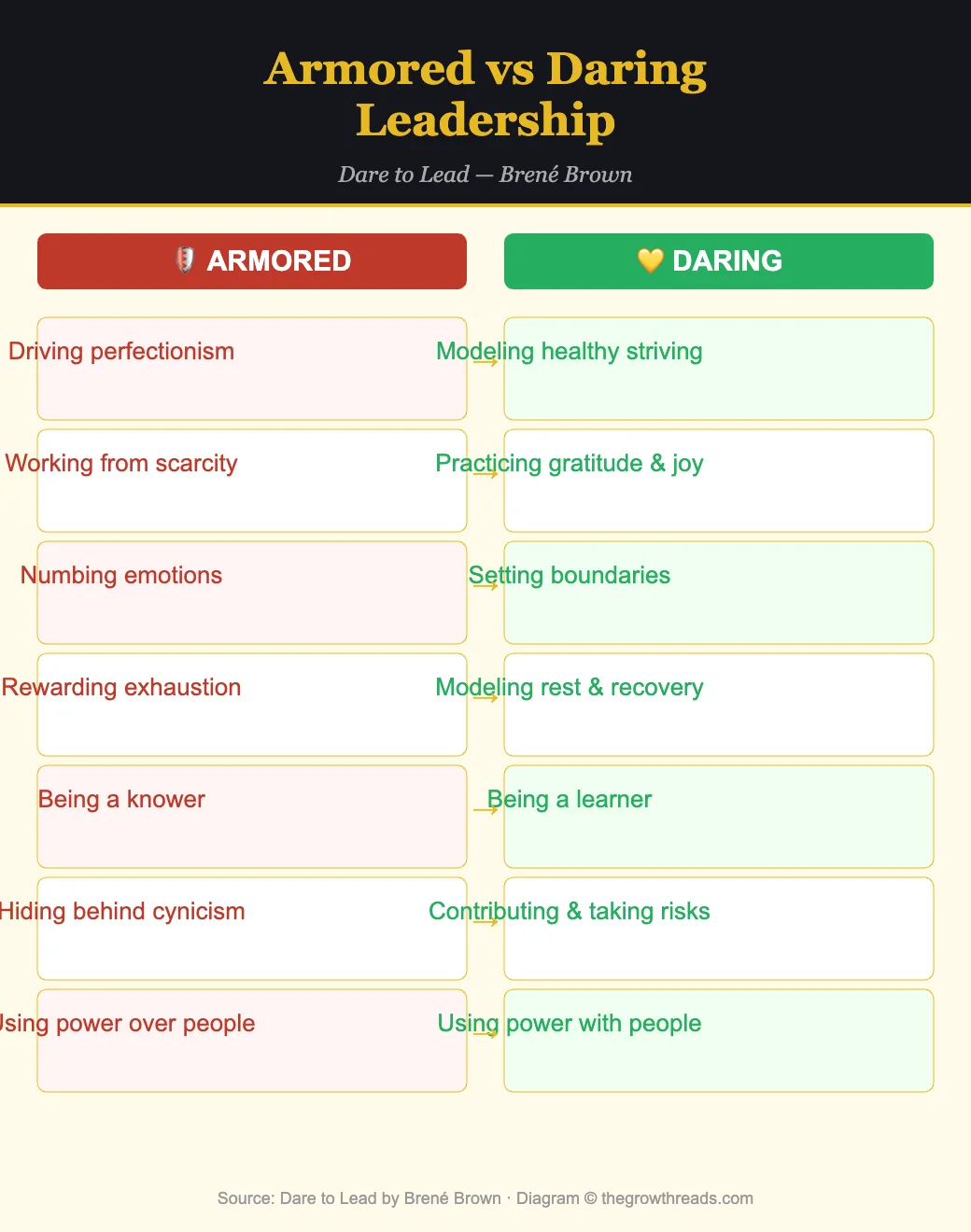
Brown also maps 16 specific behaviors that distinguish “armored leadership” from “daring leadership.” For example, armored leaders drive perfectionism and reward exhaustion; daring leaders model healthy striving and rest. Armored leaders use power over people; daring leaders use power with people. The list is actionable because each armor has a corresponding dare — leaders can assess where they default to protection and practice the alternative.
Part 2: Living into your values
Brown makes a distinction that sounds simple but proves transformative: there is a gap between “professed values” and “practiced values.” Most leaders can name their values easily. Very few can describe the specific behaviors that prove they are living those values under pressure.
The exercise she prescribes is deceptively rigorous. First, narrow your list to two core values — not five, not ten, just two. Brown’s research shows that more than two creates values confusion, where every decision can be justified by referencing a different value. Then, for each value, identify three to four behaviors that represent that value in action, and three to four “slippery behaviors” — things you do when you are not living the value.
For example, if one of your values is integrity, a supporting behavior might be “I choose discomfort over resentment by having the hard conversation within 48 hours.” A slippery behavior might be “I avoid conflict by saying everything is fine when it is not.” This specificity turns values from motivational posters into accountability tools.
Brown emphasizes that living into your values is particularly difficult during what she calls “the arena” moments — times of high stress, uncertainty, or criticism. These are precisely the moments when leaders are most tempted to abandon their values for self-protection. The practice of naming slippery behaviors in advance creates an early warning system: you recognize the pattern before you slide.
Part 3: Braving trust
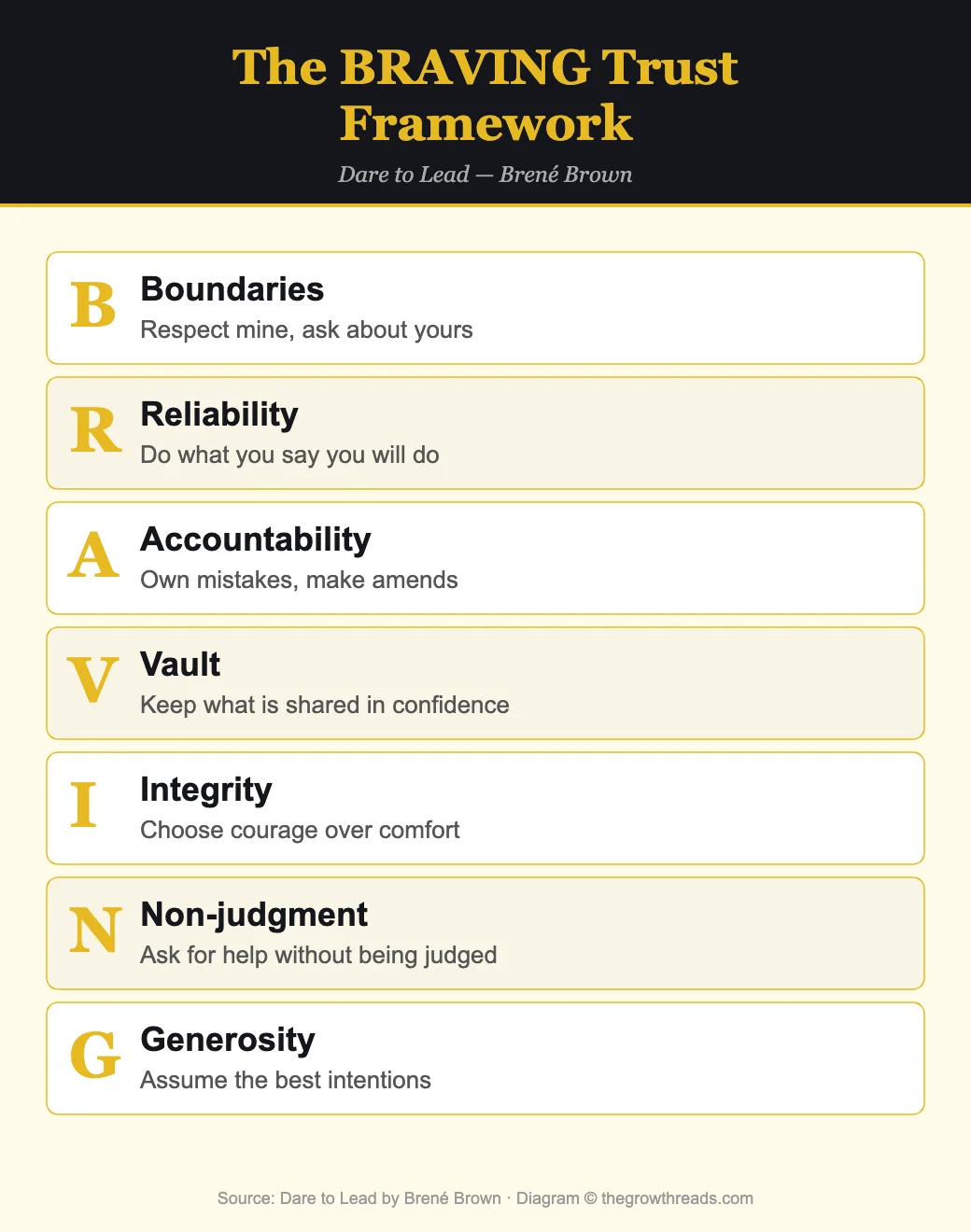
Trust is the most common word in Brown’s qualitative data on leadership, yet most people struggle to define it concretely. The BRAVING inventory solves this by breaking trust into seven elements, each of which can be independently assessed and strengthened.
Boundaries means respecting other people’s limits and being willing to state your own. Reliability means doing what you say you will do — and only committing to what you can actually deliver. Accountability means owning mistakes, apologizing, and making amends. Vault means keeping confidences — and also not sharing information about others that is not yours to share. Integrity means choosing courage over comfort, choosing what is right over what is fast or fun or easy. Non-judgment means people can ask for help without feeling judged. Generosity means extending the most generous interpretation possible to the intentions and actions of others.
Brown makes a crucial observation about how trust actually builds: it is not through grand gestures or dramatic moments, but through an accumulation of small actions over time. She uses the metaphor of a marble jar — every time someone keeps a confidence, follows through on a commitment, or extends generosity, a marble goes in the jar. Trust fills up slowly and empties quickly.
The framework is designed to work in both directions — assessing your own trustworthiness and evaluating where trust has broken down with someone else. Brown recommends using the BRAVING inventory as a self-assessment first, because it is easier to extend trust to others when you trust yourself.
Part 4: Learning to rise
The final skill set addresses what happens when courage does not produce the result you hoped for — because vulnerability guarantees discomfort, not success. Brown’s “learning to rise” process has three phases.
The reckoning is the moment you notice you have been emotionally hijacked. Your face flushes, your stomach tightens, your inner narrative starts spinning. The skill here is simply recognizing that you are in an emotional episode and resisting the urge to act on the first story your brain generates. Brown calls these first stories “shitty first drafts” (borrowing from Anne Lamott) — they are almost always inaccurate, because the brain prioritizes speed over truth when threatened.
The rumble is where you interrogate your story. “What are the facts? What am I making up? What do I actually need to learn?” Brown uses the “the story I’m telling myself” technique here too: writing down the unfiltered narrative, identifying the assumptions, and then reality-testing them against evidence. This is not about being stoic or suppressing emotion — it is about adding information to emotion so you can respond rather than react.
The revolution is the rewrite. Once you have a more accurate story, you can act from a place of clarity rather than fear. Over time, the rising process gets faster and more automatic. Leaders who practice it develop what Brown calls “grounded confidence” — not certainty, but the knowledge that they can handle whatever comes next because they have a process for it.
Brown closes the book with a reminder that courage is contagious. When one leader takes off their armor, it creates space for everyone around them to do the same. The result is not just better leadership — it is a fundamentally more human workplace.
Who is Dare to Lead best for — and who should read something else first?
This book is ideal for leaders who know they are technically competent but sense they are emotionally guarded. It is particularly powerful for high-achievers who have been rewarded for having all the answers and now need to learn a different kind of strength. HR professionals and organizational development leaders will find the BRAVING framework immediately deployable.
If you find Brown’s writing style too personal or emotionally oriented, Extreme Ownership covers similar leadership accountability principles in a more tactical, military-oriented framework. If you want the neuroscience behind why vulnerability is hard, Thinking, Fast and Slow explores the cognitive patterns that drive self-protective behavior.
Questions to reflect on
- Which of the 16 armor-vs-dare pairs describes your most common default under pressure?
- Can you name your two core values — and the specific behaviors that prove you are living them this week?
- When you assess yourself against the BRAVING inventory, which element is your weakest? What would it take to improve it by one step?
- Think of the last time you avoided a hard conversation. What was the cost of that avoidance — to you, to the other person, and to the team?
- What is the “story you are telling yourself” right now about a relationship or situation at work? How would you reality-test it?
🔥 Ready to lead with more courage and less armor?
Dare to Lead will transform how you have hard conversations, build trust, and show up as a leader.
How to apply Dare to Lead (7-day plan)
- Day 1 — Name your two core values. Narrow your list to exactly two. For each, write three behaviors that prove you are living them and three slippery behaviors that signal you are not.
- Day 2 — Run a self-BRAVING inventory. Score yourself 1–5 on each of the seven trust elements. Circle the one you want to improve first.
- Day 3 — Identify your armor. Review the armored-vs-daring list. Pick the one armor you default to most often and practice its daring counterpart once today.
- Day 4 — Have one rumble. Choose a conversation you have been avoiding. Open with “I want to have a productive conversation about X” and use “the story I’m telling myself is…” at least once.
- Day 5 — Practice the reckoning. The next time you feel emotionally triggered, pause and name the emotion. Write your shitty first draft in a notebook — do not send it to anyone.
- Day 6 — Check your vault. Pay attention all day to moments when you are tempted to share information that is not yours to share. Notice the urge and choose differently.
- Day 7 — Share your learnings. Tell a trusted colleague about one insight from this week and one behavior you plan to continue. Ask them to hold you accountable.
Frequently asked questions
What is the main message of Dare to Lead?
The core argument is that courage is a collection of four learnable skill sets, not an innate personality trait. Brave leaders are people who have practiced rumbling with vulnerability, living into their values, building BRAVING trust, and learning to rise after failure. The book provides specific, research-backed tools for developing each skill set in a professional context.
Is Dare to Lead worth reading in 2026?
Yes. As workplaces navigate remote-hybrid complexity, AI-driven restructuring, and widespread burnout, the demand for leaders who can build trust and have honest conversations has only intensified. Brown’s frameworks — particularly BRAVING and the armored-vs-daring inventory — remain among the most practical tools available for diagnosing and improving team culture.
How is Dare to Lead different from Daring Greatly?
Daring Greatly introduced Brown’s vulnerability research to a general audience and focused on personal life as much as professional. Dare to Lead takes the same research and applies it specifically to organizational leadership, providing concrete tools, exercises, and frameworks designed for the workplace. If you have already read Daring Greatly, Dare to Lead extends those ideas into actionable leadership practices.
What is the BRAVING trust framework?
BRAVING is an acronym for seven elements that make up trust: Boundaries (respecting limits), Reliability (doing what you say), Accountability (owning mistakes), Vault (keeping confidences), Integrity (choosing courage over comfort), Non-judgment (asking for help safely), and Generosity (assuming good intentions). Each element can be independently assessed and improved.
What does “clear is kind, unclear is unkind” mean?
This is one of Brown’s most quoted principles. It means that avoiding difficult feedback or sugarcoating the truth is not an act of kindness — it is self-protection that ultimately harms both parties. True kindness is being direct, specific, and honest, even when it is uncomfortable. When leaders are unclear about expectations, performance, or concerns, they create anxiety, confusion, and eroded trust.
Can introverts practice vulnerability-based leadership?
Absolutely. Brown emphasizes that vulnerability is not about being extroverted, emotionally effusive, or sharing everything with everyone. It is about the willingness to be honest and present in moments of uncertainty. An introverted leader might practice vulnerability by admitting they need more time to think before making a decision, or by privately sharing a lesson learned from a mistake with a direct report. The expression differs; the courage is the same.
How long does it take to read Dare to Lead?
The paperback is approximately 320 pages. Most readers complete it in 5 to 7 hours. The audiobook, narrated by Brown herself, runs about 8 hours and 10 minutes (Brown includes additional commentary and personal stories in the audio version). The writing style is conversational and story-driven, so many readers find the pace quicker than the page count suggests.
Related summaries
- Leaders Eat Last Summary & Review — Simon Sinek on the biology of trust and the Circle of Safety
- Start with Why Summary & Review — Sinek’s foundational book on purpose-driven leadership
- Extreme Ownership Summary & Review — Jocko Willink on radical accountability in leadership
- Ego Is the Enemy Summary & Review — Ryan Holiday on staying humble through success and failure
- Best Leadership Books — Our complete ranked guide
Related Leadership Summaries
Leaders Eat Last Summary & Review: Build a Team That Has Your Back
Measure What Matters Summary & Review: The Goal-Setting System Behind Google’s Explosive Growth
Never Split the Difference Summary & Review: The FBI Negotiator’s Playbook for Getting What You Want
Start With Why Summary & Review: How Great Leaders Inspire Action
The Advantage Summary and Review