

★★★★☆ 4.2 / 5 — A compelling exploration of why some teams thrive while others fracture, told through biology and real-world leadership stories.
Best for: Team leaders, managers, founders, military-to-civilian professionals, and anyone who suspects their workplace culture is broken.
Reading time: ~7 hours (350 pages) · This summary: 18 min
Difficulty to apply: Medium — the principles are intuitive but require patience and consistency to embed in a team culture.
Leaders Eat Last in one minute
The best leaders sacrifice their own comfort so their people feel safe enough to do remarkable work. Simon Sinek argues that leadership is not about being in charge — it is about taking care of those in your charge. Drawing on evolutionary biology, neuroscience, and case studies from the U.S. Marines to corporate boardrooms, Sinek shows that when leaders create a “Circle of Safety,” teams naturally cooperate, innovate, and outperform. When that circle breaks — through layoffs, distrust, or selfish leadership — cortisol floods the organization and people turn inward to protect themselves. The book is part biology lesson, part leadership manifesto, and entirely about the humans behind the org chart.
Key takeaways
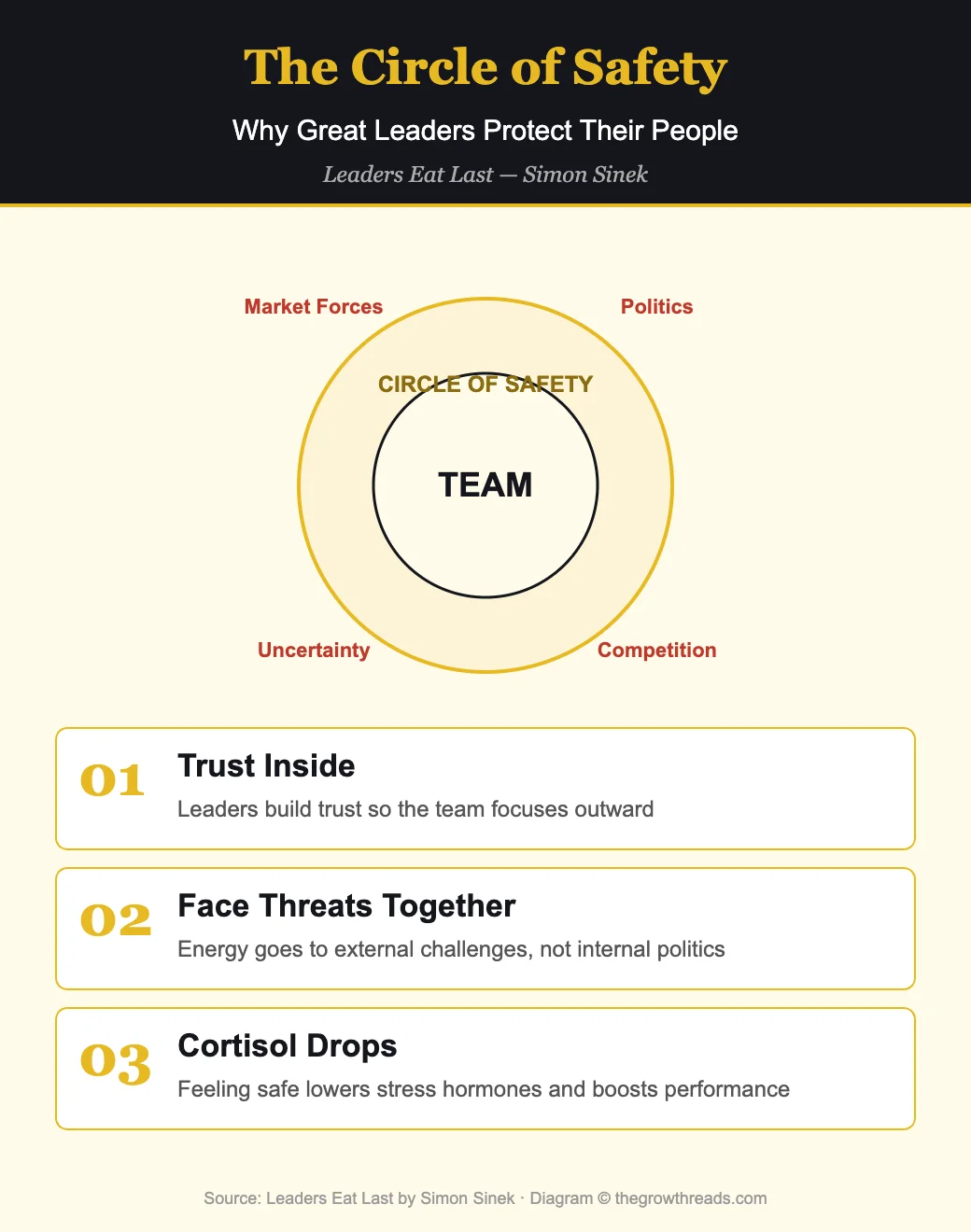
- The Circle of Safety determines everything: When people feel protected from internal threats, they direct all their energy toward external challenges and opportunities.
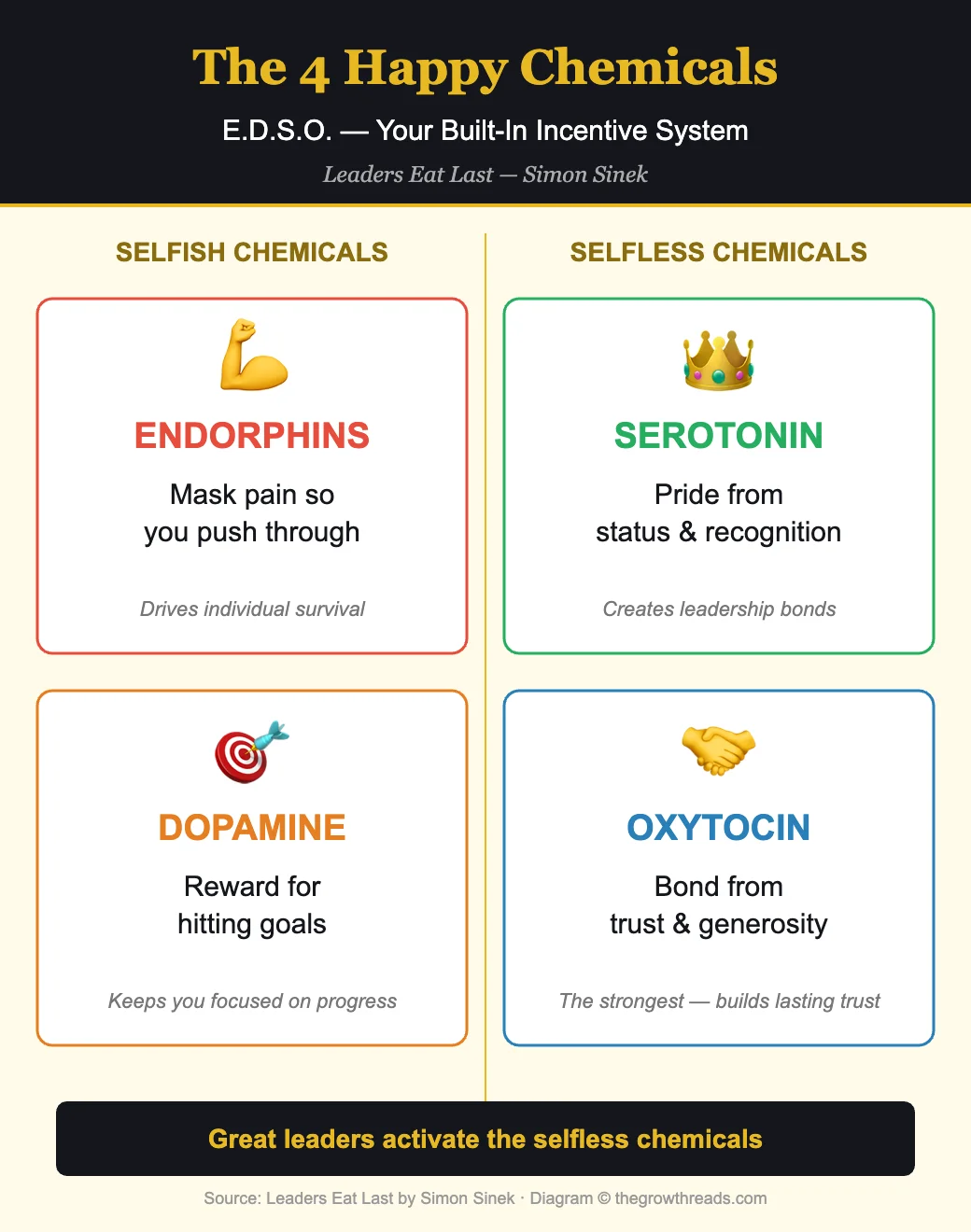
- Biology drives workplace behavior: Four chemicals — endorphins, dopamine, serotonin, and oxytocin — shape how we lead, follow, and cooperate at work.
- Oxytocin is the leadership chemical: It builds trust and loyalty through acts of generosity, time, and physical presence — things that cannot be faked or shortcut.
- Dopamine can become destructive: When organizations over-index on targets and bonuses, they can create cultures of addiction rather than cultures of service.
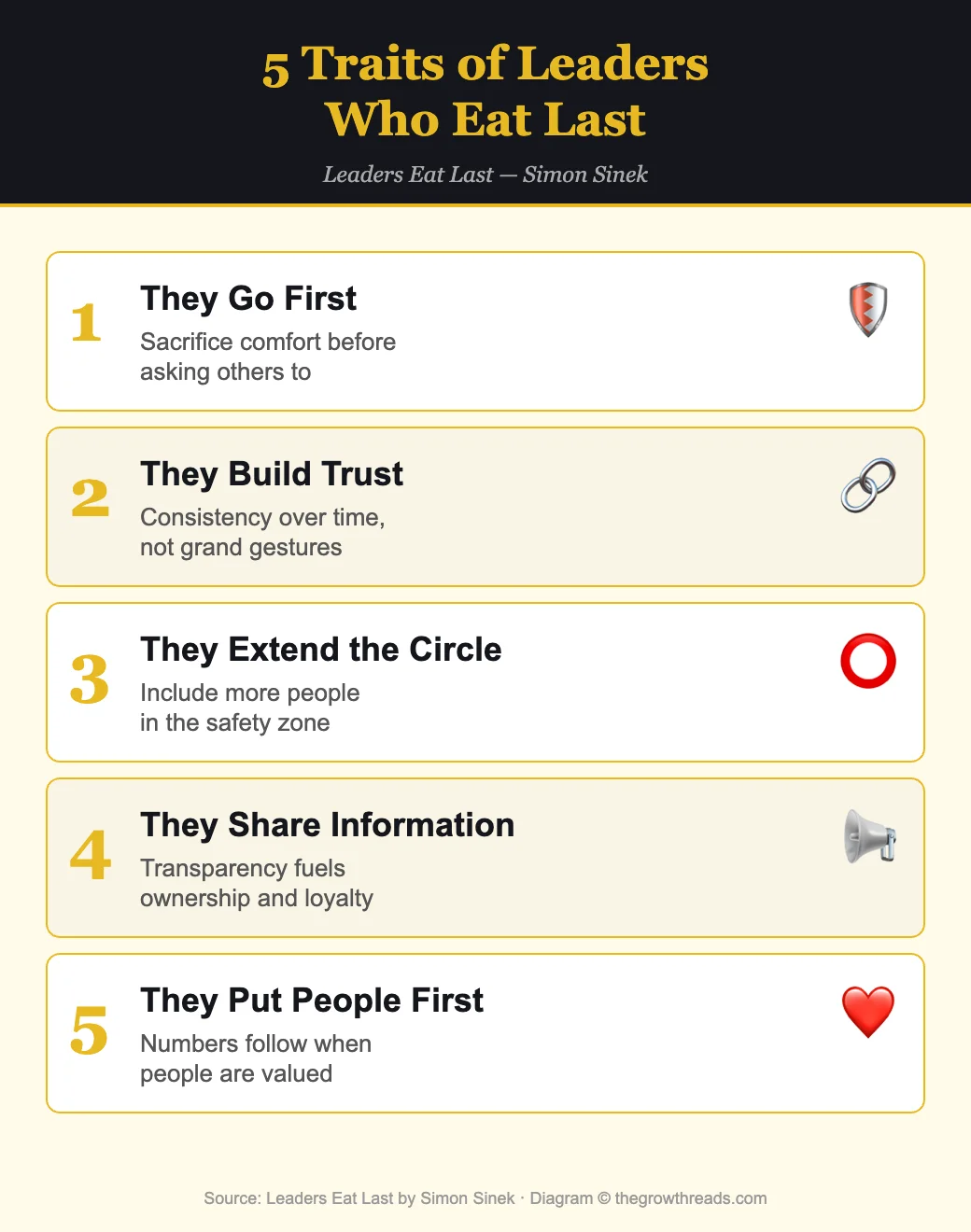
- Leaders eat last — literally: In the Marines, the most senior person eats last in the chow line. This small ritual demonstrates that leadership is about service, not status.
- Empathy is a practice, not a trait: Leaders build empathy by spending real time with their people, not by reading dashboards from the executive floor.
- Layoffs break the social contract: When companies treat people as disposable resources, they destroy the very trust that makes performance possible.
- Small gestures compound: Trust is not built through grand transformations but through consistent, small acts of putting others first.
- The abstraction problem: The bigger the organization, the easier it is to see people as numbers — great leaders fight this by staying close to the front lines.
- Authority is given, but leadership is earned: You can be a boss without being a leader, and a leader without being a boss.
What is Leaders Eat Last about?
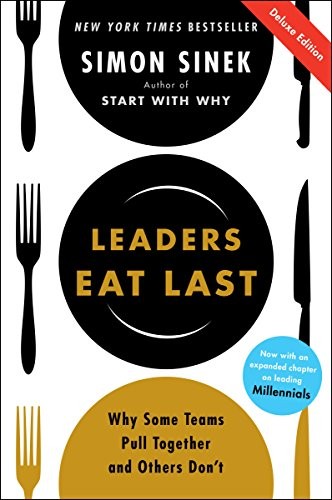
Leaders Eat Last explores why some teams pull together while others fall apart. Simon Sinek uses evolutionary biology and real leadership stories — from the U.S. Marines to Fortune 500 companies — to show that great leadership is about creating environments where people feel safe, valued, and inspired to contribute their best work.
About the author
Simon Sinek is a British-American author and motivational speaker best known for his TED Talk “How Great Leaders Inspire Action,” which has been viewed over 65 million times. Trained as an ethnographer, Sinek began his career in advertising before discovering his passion for studying why some leaders and organizations inspire while others do not. His first book, Start with Why, became an international bestseller and introduced the concept of the Golden Circle. Sinek is also the author of The Infinite Game and Find Your Why, and teaches graduate-level strategic communications at Columbia University. Explore all Simon Sinek book summaries →
Key concepts at a glance
| Concept | What it means | Use it when |
|---|---|---|
| Circle of Safety | A protective boundary leaders create so the team feels safe from internal threats | You notice your team spending more energy on office politics than on customers |
| E.D.S.O. chemicals | Endorphins, dopamine, serotonin, and oxytocin — the four incentives nature gives us | You want to understand why bonuses alone don’t motivate long-term performance |
| The Abstraction Challenge | Distance makes it easier to dehumanize — size and hierarchy create moral blind spots | You lead a remote or large team and feel disconnected from the front lines |
| Destructive Abundance | When dopamine-driven success creates addiction to results over relationships | Your culture celebrates numbers but your best people keep leaving |
| Cortisol Culture | Chronic stress from broken trust, forced rankings, or mass layoffs | Turnover is high and engagement surveys show declining trust |
| Integrity in Leadership | Doing what is right even when it costs, because trust is non-negotiable | You face a decision where short-term profit conflicts with your team’s welfare |
| The Marine Corps Model | Officers eat last, take care of people first — leadership is sacrifice, not privilege | You want a practical metaphor for reorienting your leadership style |
Part 1: Our need to feel safe
Sinek opens with a powerful military story: a pilot named Johnny Bravo who risked his life flying dangerously low in a sandstorm to protect ground troops he had never met. Why? Because the culture of the Marines trained him to value the lives of others above his own comfort. This is the Circle of Safety in action — when people feel that others have their back, they will go to extraordinary lengths to protect the group.
Sinek then pivots to the corporate world and asks a pointed question: why do so few workplaces inspire this kind of loyalty? The answer lies in how leaders define the boundaries of trust. In organizations where leaders prioritize shareholder returns over employee wellbeing, people instinctively shift into self-preservation mode. They hoard information, cover their tracks, and avoid risk. The Circle of Safety shrinks, and so does performance.
The key insight is that safety is not a perk — it is a prerequisite. Just as our ancient ancestors could only hunt and explore when they knew the tribe was watching for predators, modern workers can only innovate and collaborate when they feel protected from internal threats like blame, backstabbing, and arbitrary layoffs.
Part 2: The chemistry of why we do what we do
This is where Sinek introduces his most memorable framework: the four chemicals that incentivize human behavior. Endorphins and dopamine are “selfish” chemicals — they reward individual achievement and help us push through pain. Serotonin and oxytocin are “selfless” chemicals — they reward social bonds, status earned through service, and acts of generosity.
Endorphins mask physical pain, which is why runners experience a “high.” In the workplace, endorphins help people push through grueling deadlines. Dopamine is the reward chemical — it fires when we accomplish a goal, check something off a list, or hit a sales target. It feels wonderful, but it is also the chemical behind addiction. Organizations that rely exclusively on bonuses, targets, and performance metrics are essentially building dopamine-driven cultures, which can become just as destructive as any other addiction.
Serotonin is the chemical of pride and status. It flows when we feel respected by the group. Crucially, it also flows in the people who witness our recognition — this is why public awards ceremonies work. Oxytocin, which Sinek calls the most important leadership chemical, builds through physical proximity, generosity, and time. You cannot hack oxytocin. There is no shortcut to trust. Leaders who try to buy loyalty with money are using dopamine when they need oxytocin.
Cortisol, the stress chemical, is the villain of the story. In healthy doses it keeps us alert, but chronic cortisol — from toxic bosses, constant layoffs, or cutthroat competition — literally inhibits the release of oxytocin. You cannot build trust in a cortisol-soaked environment.
Part 3: The abstraction problem and destructive abundance
Sinek argues that one of the biggest threats to modern leadership is abstraction. The larger an organization becomes, the easier it is to see people as statistics rather than humans. A CEO who lays off 10,000 workers does not have to look any of them in the eye — the decision happens in a boardroom, mediated by spreadsheets. This distance makes morally questionable decisions feel acceptable.
He illustrates this with the Milgram experiment, where ordinary people administered what they believed were lethal electric shocks simply because an authority figure told them to. The experiment shows that when we are separated from the consequences of our actions, our empathy circuits disengage. Sinek connects this directly to corporate culture: when leaders are physically and emotionally distant from their teams, they make decisions that harm people without feeling the weight of those decisions.
Destructive Abundance is Sinek’s term for what happens when an organization becomes so successful that it forgets why it succeeded in the first place. Growth becomes an end in itself. Shareholder value replaces customer and employee value. The very dopamine that fueled early success becomes an addiction that corrodes the culture. Sinek points to companies like GE under Jack Welch — celebrated for ruthless performance management that ultimately hollowed out the company’s long-term health.
The antidote, Sinek argues, is to keep leaders close to the action. Walk the floor. Know names. Make decisions where you can see their human impact. This is not sentimental — it is a structural safeguard against the abstraction that enables moral drift.
Part 4: Building a culture where leaders eat last
The final section of the book moves from diagnosis to prescription. Sinek profiles organizations and leaders who embody the “eat last” philosophy. He returns to the Marine Corps, where the most senior officers literally eat after every junior member has been served. This is not about food — it is a daily ritual that reinforces the fundamental contract of leadership: the leader’s job is to serve, not to be served.
Sinek profiles Bob Chapman, CEO of Barry-Wehmiller, who refused to lay off workers during the 2008 recession. Instead, he implemented a furlough program where every employee — including executives — took unpaid time off so that no one had to lose their job. The result was not just preserved employment but deepened loyalty: employees who had never considered going above and beyond suddenly did, because they felt the company had gone above and beyond for them.
The chapter also addresses the generational challenge. Sinek argues that Millennials and younger workers have been shaped by environments of instant gratification (dopamine) and often lack the patience-building experiences that develop serotonin and oxytocin pathways. Leaders need to create environments that teach delayed gratification, genuine connection, and earned status — not through criticism but through mentorship, structure, and belonging.
The book closes with a clear message: leadership is a choice, not a rank. Anyone at any level can decide to look after the person to their left and the person to their right. That choice, made consistently over time, is what transforms a group of individuals into a team.
Who is Leaders Eat Last best for — and who should read something else first?
This book is ideal for new managers stepping into their first leadership role, founders building company culture from scratch, and experienced leaders who sense that something is off in their teams but cannot articulate what. Military veterans transitioning to corporate leadership will find the Marine Corps parallels especially grounding.
If you have never read Sinek before, you might want to start with Start with Why, which lays the foundation for purpose-driven leadership. If you are looking for a more actionable, systems-oriented leadership book, Extreme Ownership by Jocko Willink is a strong complement. And if you want the psychology of trust and vulnerability in leadership specifically, Brené Brown’s Dare to Lead goes deeper on that dimension.
Questions to reflect on
- When was the last time you sacrificed your own comfort or credit so that someone on your team could succeed?
- Does your organization reward dopamine-driven results (targets, bonuses) more than oxytocin-driven behaviors (mentorship, generosity)?
- If your team were asked to describe the “Circle of Safety” in your workplace, what would they say? Would their answer surprise you?
- Think of a leader who made you feel safe. What specific actions did they take — and are you replicating those for the people who now look to you?
- How do you fight the abstraction problem in your own role? Do you know the names, struggles, and aspirations of the people you lead?
🔥 Ready to build a team that has each other’s backs?
Leaders Eat Last will change how you think about trust, safety, and what it really means to lead.
How to apply Leaders Eat Last (7-day plan)
- Day 1 — Map your Circle of Safety. Draw your team’s current boundary: who feels inside it, and who might feel excluded? Write down one name that surprises you.
- Day 2 — Eat last (literally or figuratively). Let your team go first in a meeting, lunch line, or resource allocation. Notice how it feels and how people respond.
- Day 3 — Replace one dopamine reward with an oxytocin one. Instead of sending a congratulatory email, walk over and thank someone face-to-face for a specific contribution.
- Day 4 — Audit your cortisol sources. Identify one practice in your team that creates unnecessary stress — forced rankings, unclear expectations, or public blame — and commit to changing it this week.
- Day 5 — Fight abstraction. Spend 30 minutes with someone two or more levels below you in the org chart. Ask about their work, their challenges, and what would make their day better.
- Day 6 — Share something vulnerable. In your next team meeting, admit a mistake you made recently and what you learned from it. Model the behavior you want to see.
- Day 7 — Write your leadership credo. In one paragraph, define what “eating last” means for you personally. Share it with one trusted colleague and ask for honest feedback.
Frequently asked questions
What is the main message of Leaders Eat Last?
The central argument is that great leaders prioritize the safety and wellbeing of their people above their own comfort and status. When leaders create a “Circle of Safety” — an environment where team members feel protected from internal threats — people naturally cooperate, innovate, and perform at their highest level. Leadership is not about rank or authority; it is about the willingness to sacrifice for others consistently.
Is Leaders Eat Last worth reading in 2026?
Absolutely. While the book was originally published in 2014, its core ideas about trust, safety, and biological drivers of cooperation have only become more relevant as remote work, AI disruption, and economic uncertainty reshape the workplace. The neurochemistry framework (E.D.S.O.) remains a uniquely accessible way to understand team dynamics, and the case studies — particularly around layoffs and corporate culture — feel prescient given recent tech-industry turbulence.
How is Leaders Eat Last different from Start with Why?
Start with Why focuses on how great leaders inspire action by communicating purpose (the “why” before the “what” or “how”). Leaders Eat Last shifts the lens from inspiration to protection — it asks how leaders create environments where people feel safe enough to be their best. Start with Why is about vision and communication; Leaders Eat Last is about culture and trust. They are complementary books, and reading both gives a complete picture of Sinek’s leadership philosophy.
What are the four chemicals in Leaders Eat Last?
Sinek identifies endorphins (which mask pain and enable endurance), dopamine (which rewards goal achievement), serotonin (which creates feelings of pride and status), and oxytocin (which builds trust through generosity and connection). He groups endorphins and dopamine as “selfish” chemicals that drive individual performance, and serotonin and oxytocin as “selfless” chemicals that strengthen social bonds and team cohesion.
What is the Circle of Safety?
The Circle of Safety is Sinek’s central metaphor for the protective environment that great leaders create. Inside the circle, team members feel shielded from internal dangers like blame, politics, and job insecurity. This safety allows them to focus all their attention and energy on external challenges — competition, innovation, and customer needs. When leaders shrink the circle (through layoffs, favoritism, or distrust), people turn inward to protect themselves, and organizational performance declines.
Can you apply Leaders Eat Last if you are not a manager?
Yes — and Sinek explicitly makes this point. Leadership is a choice, not a title. Anyone can decide to look after the person to their left and the person to their right. You can extend the Circle of Safety by being the colleague who shares credit, covers for a teammate under pressure, or speaks up when something feels wrong. Sinek argues that these small, consistent acts of service are what leadership actually is, regardless of your position in the hierarchy.
How long does it take to read Leaders Eat Last?
The paperback edition is approximately 350 pages. At an average reading speed, most readers finish it in 6 to 8 hours. The audiobook, narrated by Sinek himself, runs about 7 hours and 15 minutes. Because the book is story-driven rather than framework-heavy, many readers find it faster than expected — the narrative style keeps the pace moving even through the biology chapters.
Related summaries
- Start with Why Summary & Review — Sinek’s foundational book on purpose-driven leadership
- Extreme Ownership Summary & Review — Jocko Willink’s combat-tested leadership principles
- Good to Great Summary & Review — Jim Collins on Level 5 Leadership and enduring company greatness
- Ego Is the Enemy Summary & Review — Ryan Holiday on the dangers of ego in leadership
- Best Leadership Books — Our complete ranked guide
Related Leadership Summaries
The First 90 Days Summary & Review: Master Every Leadership Transition
The Making of a Manager Summary & Review: Your First Leadership Playbook
Tribal Leadership Summary & Review: Upgrade Your Team from Stage 3 to Stage 4
Tribes Summary & Review: How to Lead a Movement Without Permission
Who Moved My Cheese? Summary & Review: Navigate Change Before It Breaks You