

★★★★ 4.2/5 — a profane, funny, and surprisingly Stoic argument that the key to a good life is caring about less, but caring about the right things.
Best for: anyone exhausted by relentless positivity and the pressure to be extraordinary · Reading time: ~5 hours (this guide: 15 min) · Difficulty to apply: Easy to grasp — the discipline is in choosing your values honestly
The Subtle Art of Not Giving a F*ck in one minute
Not caring about everything is not apathy — it is the discipline of caring about what actually matters. Mark Manson’s counterintuitive self-help book argues that we each have a limited supply of “f*cks” to give, and that a good life comes from spending them deliberately rather than scattering them across every minor irritation and other people’s opinions. Underneath the jokes and swearing is a genuinely Stoic and Buddhist message: life involves unavoidable problems and pain, so the goal is not to escape suffering but to choose problems worth having. Manson attacks the “feel-good” self-help industry, arguing that the constant pressure to be positive, special, and happy is itself a source of misery. The path to a better life runs through accepting your limitations, taking radical responsibility, and picking better values.
Key takeaways
- The backwards law: the more you chase happiness, success, or love, the more you feel their absence. Accepting negative experience is itself a positive experience.
- You have limited f*cks: your attention and care are finite, so spending them on trivial things leaves nothing for what matters.
- Happiness comes from solving problems: not from avoiding them. The goal is to choose problems you enjoy solving.
- Suffering is useful: pain is a messenger pointing to what needs to change; numbing it removes the signal.
- You are always choosing: even not choosing is a choice. You are responsible for your responses even when you are not at fault.
- Good values beat bad values: choose values that are reality-based, within your control, and constructive — honesty over being right, curiosity over certainty.
- You are not special: the belief that you are exceptional and entitled to great things is a recipe for constant disappointment.
- Failure is the way forward: action produces failure, failure produces feedback, feedback produces growth. Doing something beats waiting to feel ready.
- Saying no gives your yes meaning: commitment and boundaries — rejecting alternatives — are what make relationships, work, and identity solid.
- Remembering death clarifies life: confronting your mortality strips away the trivial and reveals what is worth your limited f*cks.
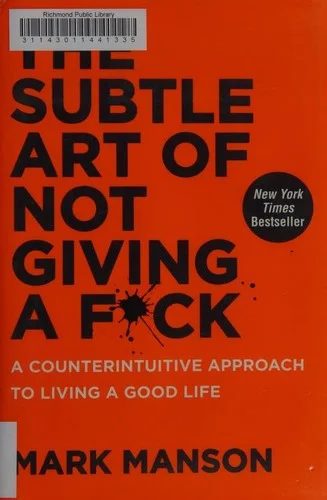
What is The Subtle Art of Not Giving a F*ck about?
The Subtle Art of Not Giving a F*ck is a counterintuitive self-help book by Mark Manson. It argues that a good life comes not from relentless positivity but from caring about less — reserving your limited attention for values that are true, controllable, and meaningful, while accepting the pain and problems that any worthwhile life involves.
About the author
Mark Manson is an American writer who built a large online following with blunt, profane, research-informed essays about relationships, values, and the messiness of being human. After years as a dating coach and blogger, he distilled his philosophy into The Subtle Art of Not Giving a F*ck in 2016, which became a global phenomenon, selling more than fifteen million copies and topping bestseller lists for years. His voice — irreverent, self-deprecating, and allergic to feel-good clichés — disguises a serious intellectual lineage that runs through Stoicism, Buddhism, and the philosopher Alan Watts. Manson followed it with Everything Is F*cked: A Book About Hope. His appeal is that he says the quiet, uncomfortable parts out loud, then turns them into something oddly liberating. Explore all Mark Manson book summaries →
Key concepts at a glance
| Concept | What it means | Use it when |
|---|---|---|
| The backwards law | Chasing the positive amplifies the negative | You feel you never have enough |
| Limited f*cks | Your care is finite; spend it wisely | You’re upset over trivial things |
| Good values | Reality-based, controllable, constructive | Deciding what to prioritize |
| Responsibility | Owning your response, not the blame | Something unfair happens to you |
| The value of suffering | Pain signals what to change | You want to numb a problem |
| Saying no | Commitment through rejection | You’re spread too thin |
Part 1: The backwards law — chasing the positive backfires
Manson opens with a story about the writer Charles Bukowski, a lifelong drunk and failure who kept writing anyway, and whose gravestone reads “Don’t Try.” The point is not to give up but that Bukowski never pretended to be something he was not; his honesty about his own mess was the source of his work. From there Manson introduces the book’s philosophical spine, borrowed from Alan Watts: the backwards law. The desire for more positive experience is itself a negative experience, and, paradoxically, the acceptance of negative experience is a positive one. Want to be happy and you fixate on how unhappy you are. Want to be confident and you dwell on your insecurity. The pursuit itself reinforces the lack.
This produces what Manson calls “the feedback loop from hell”: you feel anxious, then you feel anxious about being anxious, then guilty about that. Modern culture, with its endless images of other people’s exceptional lives, pours fuel on the loop by making ordinary feelings seem like failures. His counterintuitive fix is to stop trying to feel good all the time and instead accept that struggle, boredom, and disappointment are normal parts of a full life. The freedom comes from no longer needing every experience to be positive.
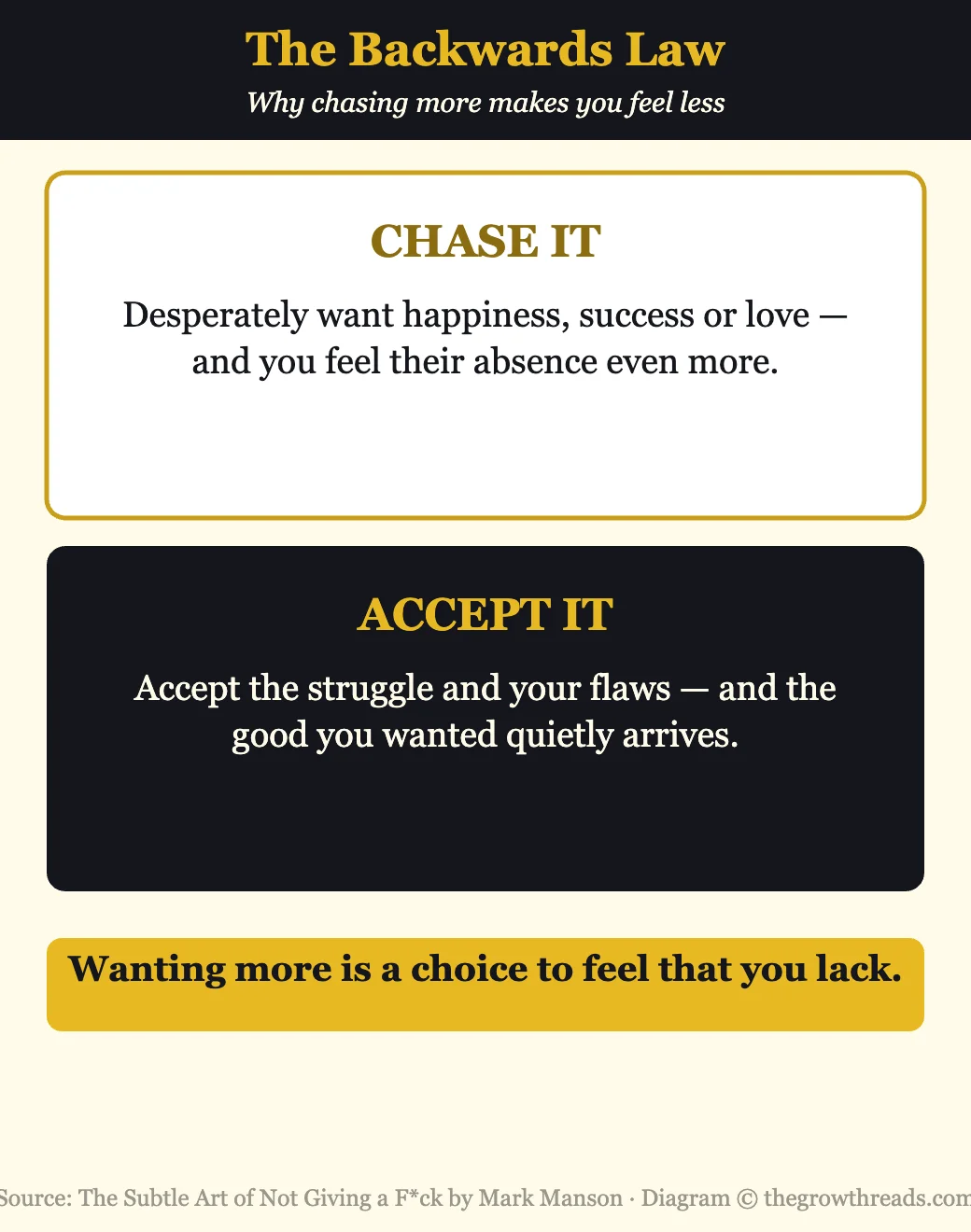
The practical reframe is that not giving a f*ck does not mean being indifferent; it means being comfortable being different, and being at peace with the fact that some things will go wrong. When you stop demanding that everything be great, you free up enormous energy that was being wasted on resenting reality.
Part 2: You have limited f*cks — so choose better problems
The book’s central metaphor is that each of us has a limited number of f*cks to give, and maturity is the process of spending them more selectively. Children give a f*ck about everything — every slight, every want, every stranger’s opinion. As we grow, Manson argues, wisdom is learning to reserve our care for the few things that are genuinely important: our health, our closest relationships, work that means something. Giving a f*ck about less is not laziness; it is the refusal to let trivia and other people’s judgments colonize your finite attention.
Underlying this is a bracing claim: happiness is a problem, and that is good news. Life is an endless series of problems, and the solution to one is merely the ticket to the next. So the aim is not a problem-free life — which does not exist — but choosing problems you actually enjoy solving. The person who loves the gym has different problems than the person who hates it, but both have problems; the difference is which struggle they have chosen. Manson extends this to suffering itself: pain has a purpose, functioning as a signal that something needs attention. Numbing it with distraction or substances only silences the messenger while the problem grows.
TGR Note: Manson’s “choose your struggle” is the same insight that powers The Courage to Be Disliked, which argues from Adlerian psychology that freedom begins when you stop seeking others’ approval. Both books relocate the source of a good life from feeling good to living by chosen values — and both insist that the discomfort you avoid is often exactly where growth is waiting.
Part 3: You are always choosing — values, fault, and responsibility
If we are going to have problems no matter what, the question becomes which problems, and that comes down to values. Manson argues that most unhappiness is really the result of bad values — metrics for life that are unreliable or destructive. He contrasts good values, which are reality-based, socially constructive, and within your control, with bad values, which are superstitious, socially destructive, or outside your control.
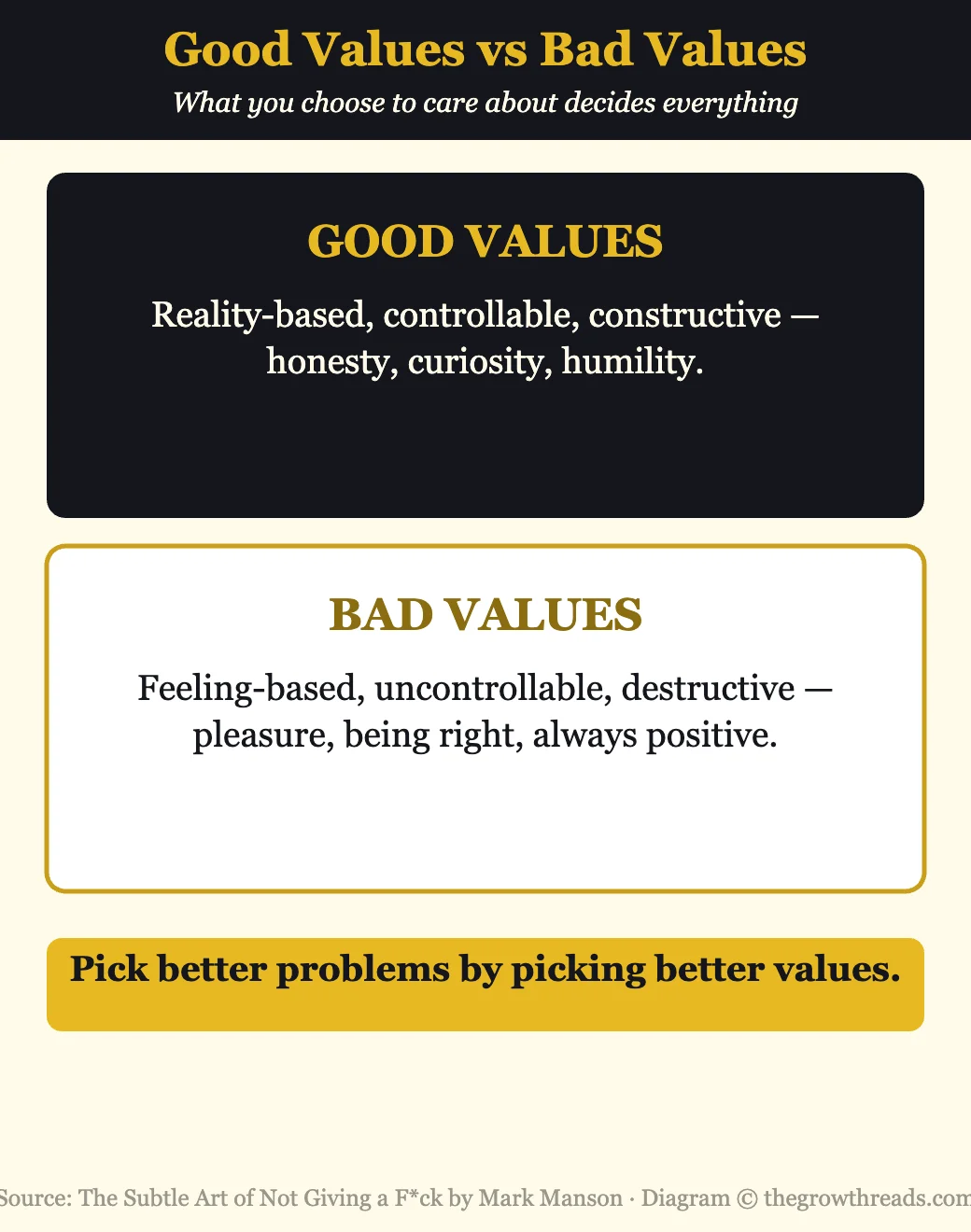
Pleasure, material success, always being right, and staying positive are, in Manson’s telling, bad measuring sticks — either fleeting, uncontrollable, or self-deceiving. Better values are things like honesty, curiosity, humility, and taking responsibility, because you can actually control your relationship to them regardless of circumstance. Choosing better values means choosing better problems, and therefore a better life.
The engine that makes this possible is the distinction between fault and responsibility, which Manson calls the most important idea in the book.
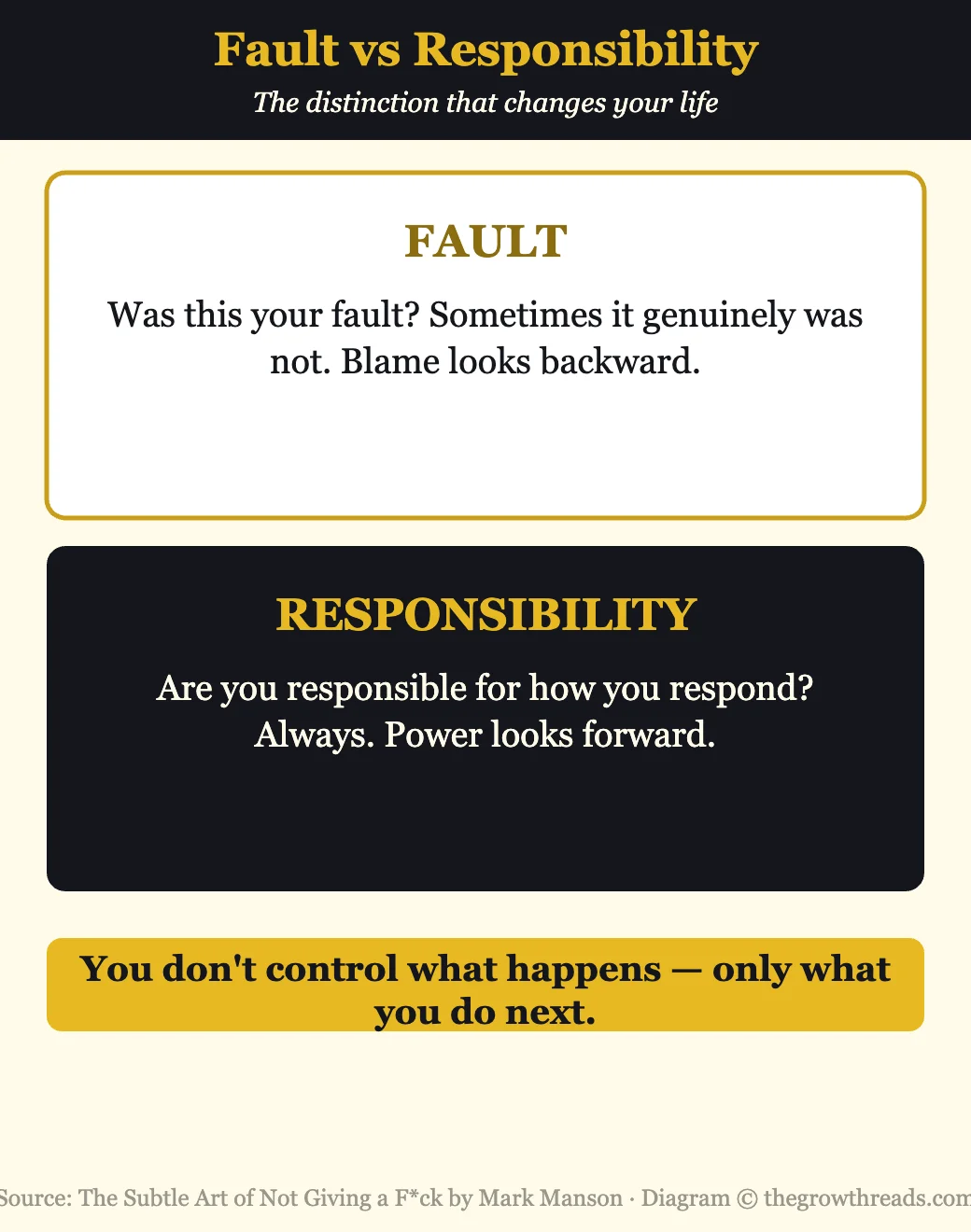
Many painful things in life are not our fault — we did not choose our childhood, an illness, or another person’s cruelty. But we are always responsible for how we respond to them. Fault is past tense; responsibility is present tense. Blaming keeps you stuck arguing about whose fault a situation is, while taking responsibility, even for a problem you did not create, is the only thing that lets you change it. This is not about guilt; it is about power. The moment you accept responsibility for your response, you regain agency.
Part 4: Certainty, failure, boundaries, and death
The final movement turns these ideas into a way of living. Manson argues that certainty is the enemy of growth: the more you insist you are right about who you are and how the world works, the less you can learn. He recommends holding your beliefs loosely and being willing to be wrong, since the goal is not to be certain but to be a little less wrong over time. This connects directly to failure. Success comes through action, action produces failure, and failure produces the feedback that makes you better — so the person who is willing to fail repeatedly outpaces the one waiting to feel ready. Do something, Manson says, and the doing itself generates the motivation and clarity you were waiting for.
Two final disciplines round out the philosophy. Saying no — setting boundaries, rejecting alternatives, committing to fewer things — is what gives your commitments meaning; a life that says yes to everything stands for nothing. And, most soberingly, confronting death. Manson closes by recounting the death of a close friend, which taught him that awareness of our mortality is the one thing that reliably clarifies what deserves our limited f*cks. Remembering that you will die is not morbid; it is the ultimate tool for stripping away the trivial and living for what actually matters.
TGR Note: Manson’s radical responsibility echoes the first half of 12 Rules for Life — take ownership, tell the truth, aim at meaning rather than happiness. And his “let go of needing to be right” is the same humility Ego Is the Enemy argues protects you from self-sabotage. Read together, they form a coherent case that a good life is built on chosen values and ownership, not on chasing good feelings.
Who is The Subtle Art of Not Giving a F*ck best for — and who should read something else first?
This book is ideal for anyone worn out by hustle culture and toxic positivity, or stuck comparing their ordinary life to everyone else’s highlight reel. Its blunt tone is a feature, cutting through self-help clichés to something honest. It is not for readers who dislike profanity, or who want a step-by-step system rather than a shift in perspective — this is a philosophy book in disguise, not a workbook. If you want the same liberation with a gentler, more structured argument, start with The Courage to Be Disliked. And if you want the deeper responsibility theme expanded, read 12 Rules for Life.
Questions to reflect on
- What are you currently giving a f*ck about that, honestly, does not deserve it?
- Which problems in your life have you actually chosen — and which are worth choosing?
- Where are you confusing fault with responsibility, staying stuck in blame?
- What value are you measuring yourself against that is outside your control?
- If you remembered you were going to die, what would you stop caring about tomorrow?
🔥 Ready to care about less — and better?
This guide is the map — Manson’s humor and stories are what make the philosophy land.
How to apply The Subtle Art of Not Giving a F*ck (7-day plan)
- Day 1 — Audit your f*cks. List what upset you this week. Circle the ones that actually matter to your life; consciously release the rest.
- Day 2 — Name your values. Write the three values you want to measure your life by, and check each is reality-based and within your control.
- Day 3 — Separate fault from responsibility. Take one frustrating situation and, regardless of fault, decide the one response you are responsible for.
- Day 4 — Choose a better problem. Pick a goal and get honest about the struggle it requires. Decide if it is a struggle you actually want.
- Day 5 — Be willing to be wrong. Identify one belief about yourself you hold too tightly and ask what if the opposite were partly true.
- Day 6 — Say one real no. Decline something that does not fit your values, so your commitments mean more.
- Day 7 — Do the death exercise. Spend five minutes on what you would regret. Let it reorder what gets your attention tomorrow.
Frequently asked questions
Is The Subtle Art of Not Giving a F*ck worth reading?
Yes, for most readers. Beneath the profanity and jokes is a genuinely useful, Stoic-flavored argument: care about less, but care about the right things, and accept that a good life includes problems and pain. It is a fast, entertaining read that reframes how you think about happiness, values, and responsibility. Readers who dislike swearing or who want a concrete step-by-step system may prefer a gentler book, but for cutting through toxic positivity, few books do it better.
What is the main message of The Subtle Art of Not Giving a F*ck?
That the key to a good life is not caring about more things but caring about fewer, better things. Manson argues we have limited attention and energy, so we should reserve them for values that are true, controllable, and meaningful, while accepting the struggle any worthwhile life involves. Happiness comes from solving problems you have chosen, not from avoiding problems altogether.
What does “not giving a f*ck” actually mean in the book?
It does not mean apathy or indifference. Manson defines it as being comfortable being different and being at peace with adversity — reserving your care for a few important things rather than being rattled by every trivial slight or opinion. In fact, to not give a f*ck about adversity, he argues, you must first give a f*ck about something more important than that adversity. It is selective caring, not no caring.
How long does it take to read The Subtle Art of Not Giving a F*ck?
The book is around 220 pages and most readers finish it in about five hours, often faster because the conversational, joke-filled style pulls you along. It is organized into nine self-contained chapters, so it is easy to read in short sittings. Our summary above captures the core philosophy in roughly 15 minutes.
Is The Subtle Art of Not Giving a F*ck just about being negative?
No — it is often misread that way. The book is not an argument for pessimism or not caring; it is an argument for caring more deliberately. Its philosophy is rooted in Stoicism and Buddhism, which teach acceptance of what you cannot control and focus on what you can. The “negativity” is really honesty about life’s difficulties, offered as a path to a more grounded, less anxious kind of contentment.
Is The Subtle Art of Not Giving a F*ck good for beginners?
Yes, it is very accessible and requires no prior reading. Its humor and directness make heavy philosophical ideas easy to absorb, which is a large part of its appeal. Beginners to self-improvement often find it a refreshing antidote to more earnest, formulaic books. Just be aware it offers a change in mindset rather than a set of exercises, so pairing it with a more practical book can help you turn the ideas into habits.
What is the fault versus responsibility idea?
It is Manson’s most important distinction. Fault is about the past — who caused a problem — while responsibility is about the present, meaning who chooses how to respond to it. Many hard things in life are not your fault, but you are always responsible for your reaction. Blaming keeps you stuck; taking responsibility, even for problems you did not create, is the only thing that gives you the power to change your situation.
Related summaries
- The Courage to Be Disliked Summary — freedom from needing approval, gently argued.
- 12 Rules for Life Summary — responsibility and meaning over happiness.
- Ego Is the Enemy Summary — the humility that protects you from yourself.
- Atomic Habits Summary — the systems that turn new values into daily action.
- Browse all our best psychology books.
How we analyze books: We work from the full book — reconstructing its core arguments in our own words, adding commentary that connects it to related research and other books in our library, and pressure-testing the advice against how it plays out in real life. We never reproduce the text; we synthesize it. Read our full methodology.
Disclosure: The Growth Reads is reader-supported. When you buy through links on our site we may earn an affiliate commission at no extra cost to you. We only recommend books we believe are worth your time, and our summaries and opinions are written independently.
Related Psychology Summaries
The Chimp Paradox Summary & Review: How to Manage the Brain That Reacts Before You Think
The Gift of Fear Summary & Review: Why Your Instincts Are Your Best Protection
The Righteous Mind Summary & Review: Why Good People Disagree
The Scout Mindset Summary & Review: See Reality Clearly
Thinking in Bets Summary & Review: Make Smarter Decisions Under Uncertainty