

★★★★★ 4.7/5 — The most rigorously researched case for why some companies (and teams, and careers) tip from good into great, and most never do.
Best for: founders, executives, and team leads who want a research-backed filter for people, focus, and discipline decisions.
Reading time: ~7 hrs to read the book · 13 min to read this guide
Difficulty to apply: Moderate — the ideas are simple to state and hard to live by, since most of them require saying no.
Good to Great in one minute
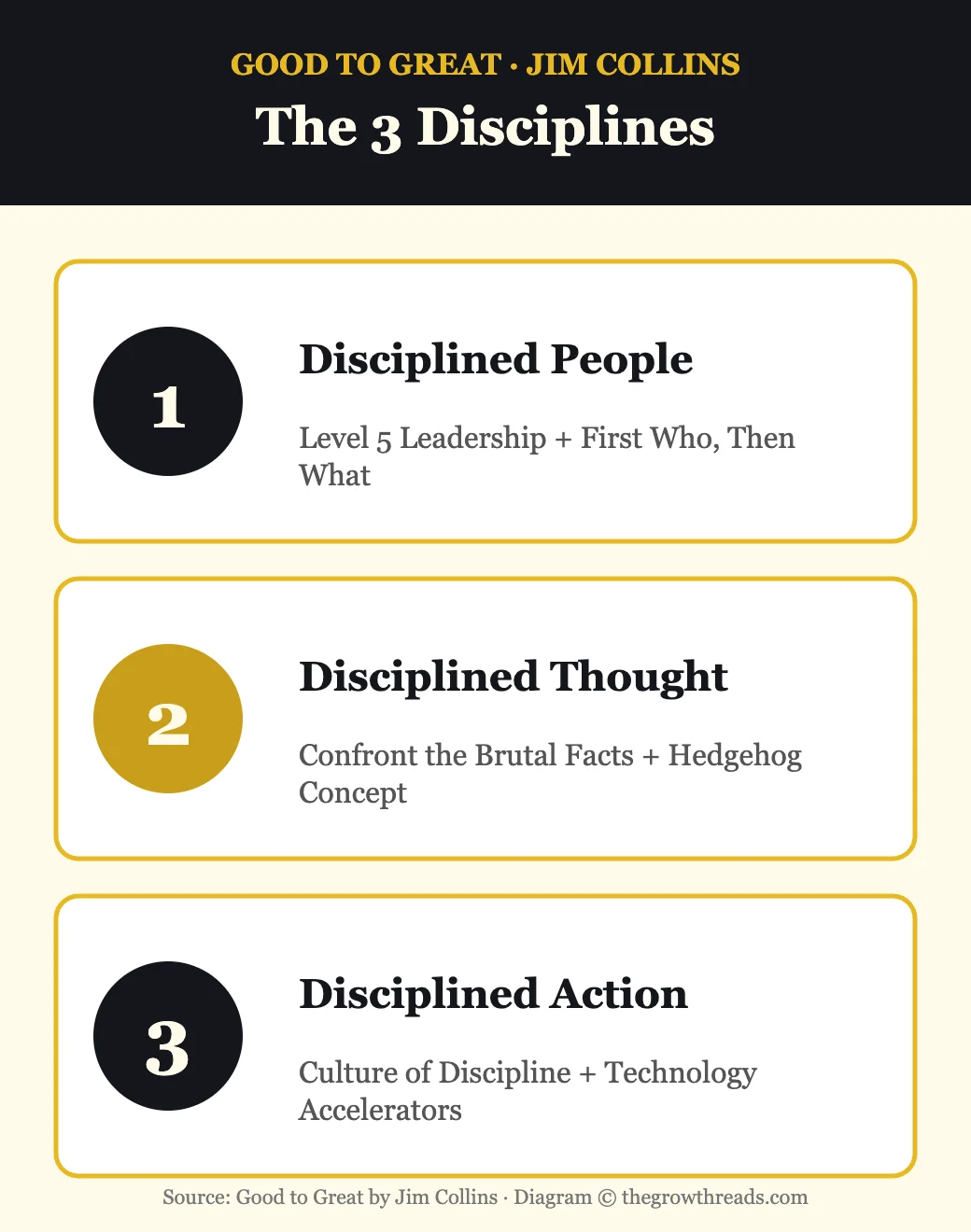
Greatness is not mostly a function of circumstance — it’s a matter of conscious choice and discipline. Jim Collins and a team of researchers spent five years studying Fortune 500 companies that went from an average stock performance to returns at least three times the market for fifteen straight years, and stayed there. They matched each of the 11 “good-to-great” companies against a similar company in the same industry that never made the leap, then dug through decades of data to find what actually separated them. The answer wasn’t strategy, technology, or a charismatic CEO. It was a consistent pattern: disciplined people, disciplined thought, and disciplined action, compounding quietly like a flywheel until the results looked sudden from the outside. This summary breaks down each layer of that pattern — Level 5 Leadership, First Who Then What, the Hedgehog Concept, a Culture of Discipline, and the Flywheel — and turns them into decisions you can actually make this month.
Key takeaways
- Greatness is a choice, not a circumstance: the good-to-great companies didn’t have better luck, industries, or starting conditions than their comparisons — they made different decisions, consistently, for years.
- Level 5 Leaders are humble and willful: the leaders behind every transformation combined personal modesty with fierce professional resolve — they built enduring companies rather than personal brands.
- Get the right people on the bus first: before deciding strategy, direction, or vision, good-to-great leaders got the right people in, the wrong people out, and the right people in the right seats.
- Confront the brutal facts, but never lose faith: the Stockdale Paradox — absolute honesty about current reality, paired with unwavering belief you’ll prevail in the end — is what separates realism from denial.
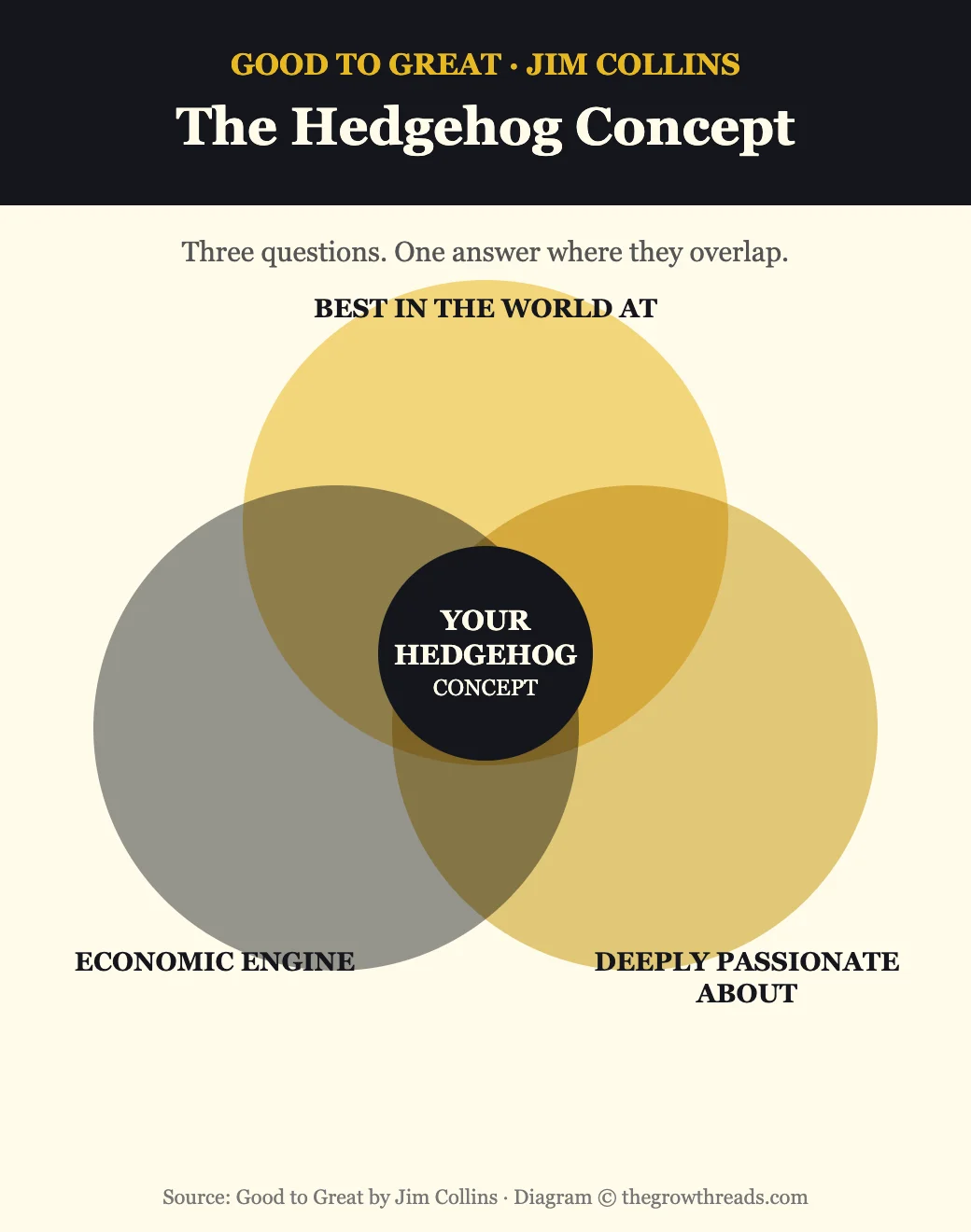
- Find your Hedgehog Concept: the intersection of what you can be best in the world at, what drives your economic engine, and what you’re deeply passionate about is the only reliable compass for where to focus.
- A culture of discipline beats a culture of bureaucracy: when disciplined people engage in disciplined thought and take disciplined action, you don’t need hierarchy, rules, or controls to keep everyone in line.
- Technology is an accelerator, never a creator, of momentum: good-to-great companies never used technology as the primary cause of transformation — they used it to accelerate a flywheel already turning.
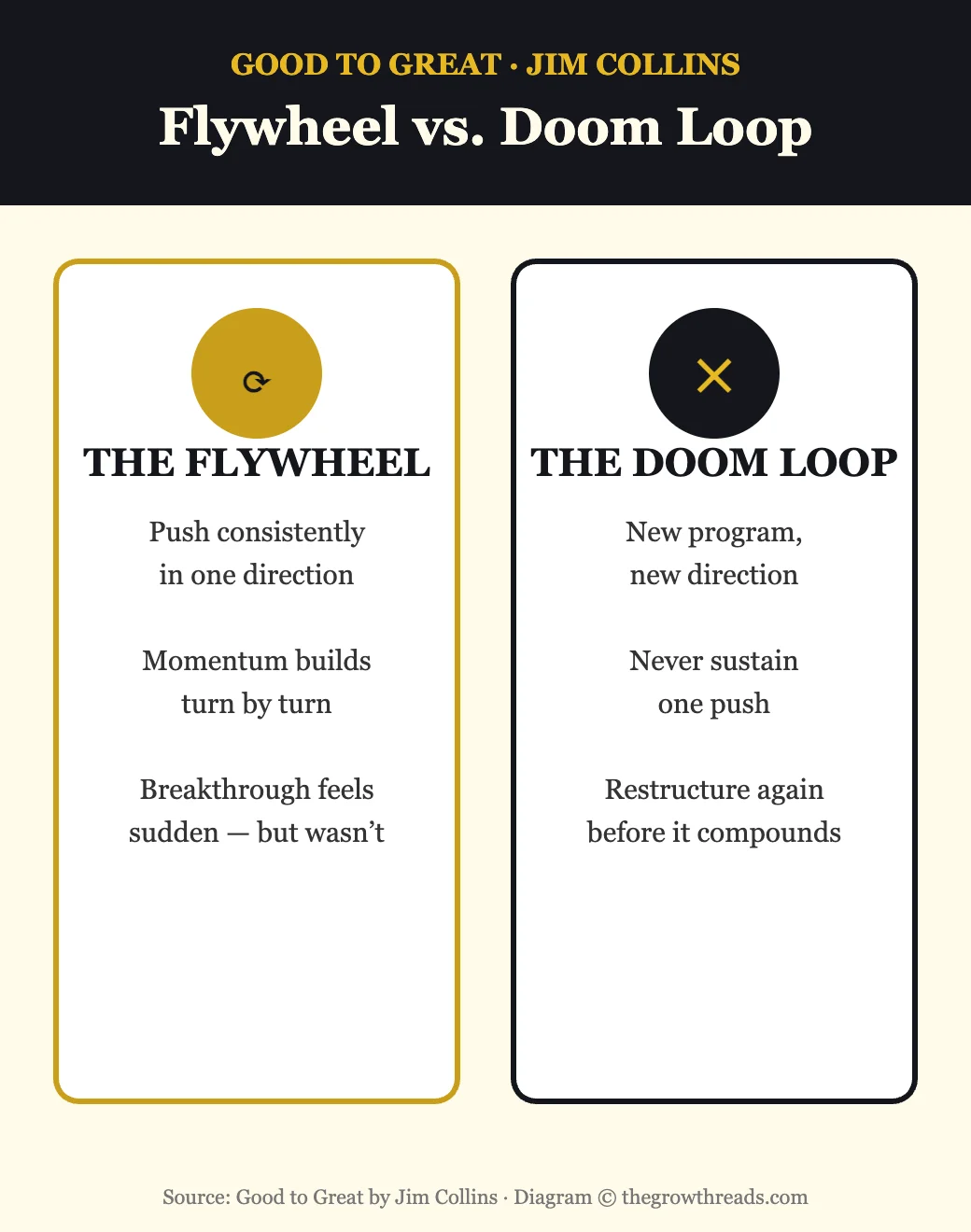
- Momentum builds through the Flywheel, not a single big push: there was no single defining action, program, or announcement — just thousands of small, consistent pushes in the same direction that eventually built unstoppable momentum.
- Avoid the Doom Loop: companies that failed to transform often lurched between new programs, new leaders, and new “big moves” without ever staying the course long enough for momentum to compound.
- Preserve the core, stimulate progress: enduring greatness comes from holding core values and purpose fixed while constantly changing operating practices, strategies, and tactics in response to a changing world.
What is Good to Great about?
Good to Great is Jim Collins’s five-year research study of why 11 once-average public companies transformed into sustained market outperformers while comparable companies in the same industries never did. Collins’s team identifies a repeatable pattern — Level 5 Leadership, disciplined people, a clear Hedgehog Concept, and a culture of discipline — that explains the leap, and shows how the same pattern applies to teams, nonprofits, and individual careers.
About the author
Jim Collins is a researcher, teacher, and author who has spent more than three decades studying what makes organizations and people go from good to enduringly great. Before Good to Great, he co-authored Built to Last with Jerry Porras, a landmark study of visionary companies that has sold millions of copies worldwide. Collins began his research and teaching career on the faculty of the Stanford Graduate School of Business, where he won the Distinguished Teaching Award, before founding an independent management research laboratory in Boulder, Colorado in 1995. He later served a two-year appointment as the Class of 1951 Chair for the Study of Leadership at the United States Military Academy at West Point. His later books — Great by Choice, How the Mighty Fall, and Turning the Flywheel — extend the good-to-great research into questions of resilience, decline, and momentum. In 2017, Forbes named him one of the 100 Greatest Living Business Minds. Explore all Jim Collins book summaries →
Key concepts at a glance
| Concept | What it means | Use it when |
|---|---|---|
| Level 5 Leadership | A blend of deep personal humility and fierce professional will, focused on building the institution rather than the leader’s own image. | You’re evaluating who should lead a team, company, or major initiative. |
| First Who, Then What | Get the right people on the bus, the wrong people off, and the right people in the right seats — before you decide where the bus is going. | You’re hiring, restructuring, or setting strategy from scratch. |
| Confront the Brutal Facts | Face reality without flinching, while never losing faith that you’ll ultimately prevail (the Stockdale Paradox). | Performance is slipping and the instinct is to spin or ignore it. |
| The Hedgehog Concept | The simple, clear idea at the intersection of what you can be best at, what drives your economics, and what you’re passionate about. | You’re deciding what to focus on — or what to stop doing. |
| Culture of Discipline | Disciplined people + disciplined thought + disciplined action, so you need less hierarchy and fewer controls. | You’re scaling a team and tempted to add layers of process. |
| Technology Accelerators | Technology speeds up momentum that already exists — it doesn’t create momentum on its own. | You’re evaluating whether a new tool or platform is a strategy or a shortcut. |
| The Flywheel | Consistent pushes in one direction build cumulative, compounding momentum that eventually looks like a sudden breakthrough. | You’re several months into a change and it doesn’t feel like it’s “working” yet. |
| The Doom Loop | Lurching from program to program, restructuring to restructuring, without ever letting the flywheel gain speed. | You notice your team keeps announcing new initiatives instead of sticking with one. |
Part 1: Level 5 Leadership and First Who, Then What
Collins’s team expected to find larger-than-life, celebrity CEOs behind the good-to-great transformations. Instead, they found something almost invisible: leaders who were, in Collins’s words, “a study in duality — modest and willful, humble and fearless.” He calls this Level 5 Leadership, the top of a five-level hierarchy of executive capabilities, and it was present in every single good-to-great company and absent, or replaced by a comparison-company celebrity CEO, in nearly every company that failed to transform.
Colman Mockler, CEO of Gillette from 1975 to 1991, is Collins’s signature example. Mockler fought off three hostile takeover attempts that would have delivered short-term shareholder gains at the expense of Gillette’s long-term research investments — decisions that looked unglamorous at the time and vindicated the company for decades afterward. Level 5 leaders like Mockler tend to credit good results to other people, luck, or good fortune, while taking personal responsibility for poor results — the mirror image of how comparison-company leaders in the study behaved.
Before Level 5 leaders decide where to take an organization, Collins found they do something counterintuitive: they get the right people on the bus, the wrong people off the bus, and the right people in the right seats — and only then figure out where to drive. “First Who, Then What” inverts the usual sequence of vision-then-recruitment. The logic is straightforward once you sit with it: if you have the right people, they’ll figure out the best direction with you; if you start with a compelling vision and the wrong people, you’ll have to spend all your energy managing and motivating them instead of building anything.
TGR Note: If Level 5 Leadership sounds like an argument against ego-driven leadership, it pairs naturally with our summary of Ego Is the Enemy, which makes the same case from a very different angle — that ambition untethered from humility eventually sabotages itself. And “First Who, Then What” is essentially the hiring-first version of the “start with why” clarity Simon Sinek argues for in Start With Why: get your people and your purpose straight before you get tactical.
Part 2: Confront the Brutal Facts and the Hedgehog Concept
Every good-to-great company went through a period of confronting uncomfortable truths about its business — declining markets, uncompetitive costs, product lines that would never be great — without spinning the story or waiting for someone else to fix it. Collins illustrates this with the story of Admiral Jim Stockdale, a prisoner of war in Vietnam for eight years, who survived by holding two seemingly contradictory beliefs at once: an unwavering faith that he would eventually prevail, combined with a clear-eyed acceptance of the brutal facts of his present reality. Collins calls this the Stockdale Paradox, and found that the officers who died in captivity were often the optimists — the ones who kept predicting an end date that never arrived, and were crushed each time it passed.
Confronting the brutal facts creates the conditions for the second major idea in this section: the Hedgehog Concept. Borrowed from Isaiah Berlin’s essay on foxes (who know many things) and hedgehogs (who know one big thing), Collins argues that good-to-great companies behaved like hedgehogs — they found a single, simple, crystalline concept and built everything around it. That concept sits at the intersection of three circles: what you can be the best in the world at, what drives your economic engine most powerfully, and what you’re genuinely, deeply passionate about. Walgreens found its Hedgehog Concept in being the best, most convenient drugstore per customer visit — and shut down its hundreds of restaurants to focus on it. The concept is never a goal, strategy, or intention; it’s an understanding.
TGR Note: Confronting the brutal facts without losing hope is close in spirit to the radical honesty Jocko Willink and Leif Babin describe in Extreme Ownership — taking full ownership of a bad situation rather than explaining it away. If you want a more individual, day-to-day version of finding your “one big thing,” it rhymes with the focus-first argument in Deep Work and the ruthless prioritization in Essentialism.
Part 3: A Culture of Discipline and Technology Accelerators
Once you have disciplined people who confront the brutal facts and share a clear Hedgehog Concept, Collins argues you don’t need more bureaucracy — you need a culture of discipline instead. Most organizations build rules and hierarchy to manage the small percentage of people who lack self-discipline, and in doing so, they punish and frustrate the disciplined majority. Good-to-great companies did the opposite: they hired self-disciplined people who didn’t need to be managed, then gave them freedom and responsibility within a clear framework — the Hedgehog Concept acting as the boundary, not a supervisor standing over their shoulder.
This is also where “disciplined action” separates hedgehogs from foxes in practice. A culture of discipline means saying no to opportunities that fall outside the Hedgehog Concept, even good, profitable-looking opportunities — because chasing every opportunity is precisely what keeps a good company from ever becoming great. Collins found that good-to-great companies maintained a “stop doing” list that was at least as important as their to-do list.
On technology specifically, Collins found a pattern that ran against the hype of the dot-com era he was writing in: good-to-great companies were thoughtful, sometimes even conservative, about technology adoption. They never used a new technology as the reason for their transformation. Instead, they asked whether a given technology fit directly into their Hedgehog Concept, and if it did, they became pioneers in applying it — Walgreens’ investment in prescription-tracking technology being a case in point. Technology was a powerful accelerator of momentum that already existed, never a substitute for it.
TGR Note: This “freedom within a framework” idea shows up again in James Clear’s identity-based habits in Atomic Habits — small, consistent systems that don’t require willpower once they’re built into your environment. If technology-as-accelerator resonates, it’s worth reading alongside the money-behavior research in The Psychology of Money, which makes a similar case that tools amplify existing behavior rather than replacing the need for discipline.
Part 4: The Flywheel, the Doom Loop, and Building to Last
Collins’s most memorable metaphor closes the book: transformation doesn’t happen through one dramatic announcement, reorganization, or acquisition. It happens the way a giant, heavy flywheel starts turning — you push, and push, and push, and for a long time almost nothing seems to happen. Then, one day, the flywheel breaks through and starts generating its own momentum, and from the outside it looks like a sudden, dramatic breakthrough. From the inside, everyone involved knows it was the cumulative effect of thousands of consistent pushes in the same direction, none of them individually decisive.
The mirror image is the Doom Loop: companies that lurch from one big new program to the next — a new CEO, a new acquisition, a new reorganization, a new culture initiative — without ever pushing the same flywheel long enough for it to gain speed. Every restart resets the momentum to zero. Collins found that comparison companies were far more likely to be characterized by dramatic change programs, restructurings, and revolving-door leadership than the quiet, consistent good-to-great companies.
Finally, Collins connects Good to Great back to his earlier research in Built to Last: making the leap to great results is necessary but not sufficient for enduring greatness. Companies that sustain greatness across generations also learn to preserve their core purpose and values while relentlessly changing their operating practices, strategies, and tactics to fit a changing world — a discipline he later expanded on in Great by Choice and Turning the Flywheel.
TGR Note: The flywheel idea is the corporate-scale version of the compounding-habits argument in The Power of Habit — small, consistent loops that eventually produce outsized results. If you want the individual-career version of “preserve the core, change the tactics,” The ONE Thing makes a similar case for narrowing focus while staying adaptable in execution.
Who is Good to Great best for — and who should read something else first?
Good to Great is best for founders, executives, managers, and team leads who make decisions about people, focus, and priorities — and for anyone who wants a research-backed language for why some efforts compound and others don’t. It’s especially useful if you’re currently deciding who to hire or let go, what to stop doing, or whether a plateau in results means you need a bigger push or a different direction entirely.
If you’re earlier in your career and want the individual-level version of “narrow, disciplined focus” before tackling a company-wide study, start with Essentialism or Atomic Habits. If you’re specifically wrestling with purpose and motivation rather than operating discipline, Start With Why is a faster, more personal entry point.
Questions to reflect on
- Where in your work or life are you still relying on a talented individual instead of a disciplined, repeatable system?
- If you had to name the single intersection of what you’re best at, what sustains you financially, and what you’re genuinely passionate about — what would it be?
- What’s one brutal fact about your current situation you’ve been softening, delaying, or avoiding?
- What’s on your “stop doing” list — and what’s stopping you from actually stopping?
- Where have you mistaken a big, dramatic announcement for real progress, instead of trusting a slower, more consistent push?
🔥 Ready to build your own flywheel?
Get Good to Great in the format that fits how you read — the underlined copy on your shelf, the audiobook for your commute, or support an independent bookstore with every purchase.
How to apply Good to Great (7-day plan)
- Day 1: Write down one brutal fact about your team, business, or career that you’ve been avoiding or softening. Say it in one blunt sentence.
- Day 2: List the people on your “bus” today. Mark each as right seat, wrong seat, or shouldn’t be on the bus — be honest, not comfortable.
- Day 3: Draft your three circles: what you (or your team) can be best in the world at, what drives the economics, and what you’re genuinely passionate about.
- Day 4: Find the overlap from Day 3 and write your Hedgehog Concept in one sentence. If you can’t make it one sentence, keep cutting.
- Day 5: Build your “stop doing” list — three things you’ll deliberately stop chasing because they sit outside that one sentence.
- Day 6: Identify one small, consistent action tied to your Hedgehog Concept that you can repeat weekly — your first flywheel push.
- Day 7: Review the week. Note where you slipped into Doom Loop thinking — chasing a new idea instead of pushing the same flywheel — and recommit for next week.
Frequently asked questions
What is the main message of Good to Great?
The main message is that sustained organizational greatness comes from a repeatable, disciplined pattern — Level 5 Leadership, getting the right people in place first, confronting brutal facts honestly, finding a clear Hedgehog Concept, and building a culture of discipline — rather than from charismatic leadership, breakthrough strategy, or new technology. Greatness is a matter of consistent choices compounding over time, not a single decisive event.
What is Level 5 Leadership in simple terms?
Level 5 Leadership describes executives who combine deep personal humility with intense professional will. They’re driven to build an enduring, successful organization rather than their own reputation, often deflecting credit to others or to circumstance while taking personal responsibility when results fall short. Collins found this style of leadership present in every good-to-great transformation he studied.
What is the Hedgehog Concept?
The Hedgehog Concept is the single, simple idea that sits at the intersection of three questions: what you can be the best in the world at, what best drives your economic engine, and what you’re deeply passionate about. Good-to-great companies used it as a filter for every major decision, turning down opportunities that fell outside it even when those opportunities looked profitable.
What is the Stockdale Paradox?
The Stockdale Paradox, named after Vietnam POW Admiral Jim Stockdale, is the combination of unwavering faith that you will ultimately prevail with a clear-eyed, undistorted confrontation of the brutal facts of your current reality. Collins argues this balance — realism without despair, hope without denial — is what separates disciplined leaders from both blind optimists and cynics.
Is Good to Great still relevant today, given some of the featured companies later struggled?
Several companies in the original study — including Fannie Mae and Circuit City — ran into serious trouble in the years after publication, and critics have noted this. However, the underlying research methodology and behavioral patterns (Level 5 Leadership, disciplined people, the Hedgehog Concept, the Flywheel) are widely considered durable and are the reason the book remains a management staple more than two decades later; Collins addressed sustaining greatness directly in his later book How the Mighty Fall.
How is Good to Great different from Built to Last?
Built to Last, Collins’s earlier book with Jerry Porras, studied visionary companies that were great from their founding and asked how they sustained that greatness over time. Good to Great asks the opposite question: how does an average or mediocre company become great in the first place? The two books are frequently read as a pair — the leap, and then the endurance.
What are practical first steps for applying Good to Great as an individual, not just a company?
Start small: write a one-sentence personal Hedgehog Concept at the intersection of what you’re good at, what supports you financially, and what you care about. Then build a short “stop doing” list of distractions or opportunities that fall outside it. Finally, pick one small, repeatable action tied to that focus and commit to pushing it consistently — the individual version of the flywheel.
Related summaries
- Start With Why Summary & Review
- Extreme Ownership Summary & Review
- Ego Is the Enemy Summary & Review
- See all Best Leadership Books
How we analyze books: We read the full text, cross-reference the author’s research and interviews, and structure every summary around what you can practically apply — not just what the book says. Read our full methodology.
Related Leadership Summaries
Leadership and Self-Deception Summary & Review: Get Out of the Box
Never Split the Difference Summary & Review: The FBI Negotiator’s Playbook for Getting What You Want
Team of Teams Summary & Review: Leading in Complexity
The Coaching Habit Summary & Review: Say Less, Ask More, Lead Better
The Leadership Challenge Summary and Review