

4.6/5 — A calm, research-backed antidote to hustle culture that still takes ambition seriously.
Best for: High achievers who are successful but running on fumes, and want to sustain excellence without burning out.
Reading time: ~6 hrs full book (Guide: 20 min)
Difficulty to apply: Moderate — the principles are simple to understand, but unwinding hustle habits takes sustained practice.
The Practice of Groundedness in one minute
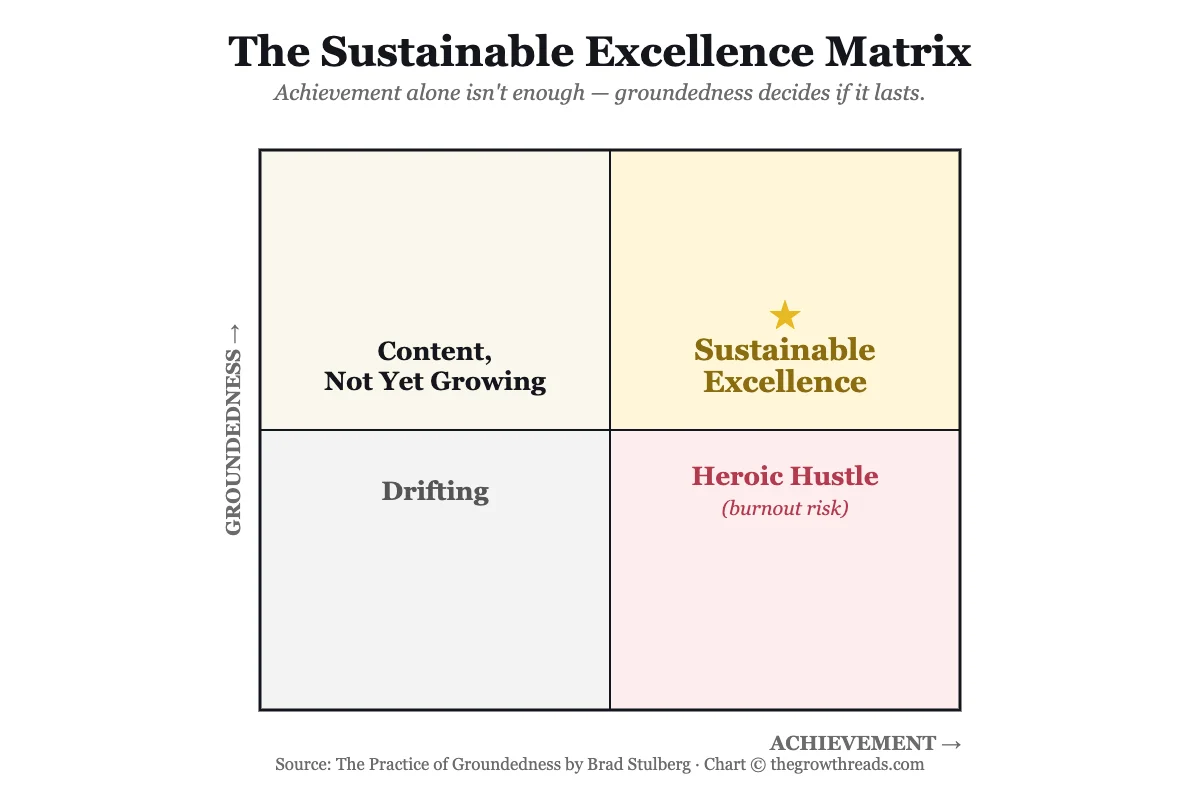
Success that costs you your health, relationships, and peace of mind isn’t really success — it’s a loan against your future self. Brad Stulberg, a performance researcher and coach, spent years studying elite athletes, executives, and creatives who achieved extraordinary things, then watched many of them flame out. The common thread wasn’t ambition — it was a cultural script he calls “heroic individualism”: the belief that constant hustle, self-reliance, and never being satisfied are the only path to a meaningful life. The Practice of Groundedness (2021) offers an alternative. Instead of chasing achievement to prove your worth, Stulberg argues, build a stable internal foundation first — and let genuinely sustainable excellence follow from that, rather than from fear.
Key takeaways
- Heroic individualism is the default script, and it’s unsustainable: nonstop hustle and self-reliance eventually produce burnout, not lasting achievement.
- Groundedness is a stable sense of self-worth that isn’t contingent on your latest win, deadline, or metric.
- Acceptance comes first: you can’t productively change a situation you refuse to see clearly.
- Presence beats multitasking: full attention on the task in front of you produces both better work and more satisfaction.
- Patience protects against shortcuts: the biggest gains come from processes measured in years, not days.
- Vulnerability is a strength, not a weakness: naming struggle honestly is what allows real support and growth.
- Movement is a foundational practice for groundedness, not just a fitness side-quest — the body and mind are trained together.
- Deep community outperforms networking: a small number of real relationships provide more stability than a large shallow network.
- Groundedness enables performance, it doesn’t compete with it: the calmest people in Stulberg’s research were often also the most accomplished.
- Rest is part of the practice, not a reward for finishing it — recovery is where the gains from effort actually consolidate.

What is The Practice of Groundedness about?
The Practice of Groundedness (2021) by performance coach Brad Stulberg argues that lasting success depends on a stable, internal sense of self-worth — “groundedness” — rather than on constant achievement. Drawing on research and stories from elite performers, Stulberg lays out five principles, acceptance, presence, patience, vulnerability, and deep community, that build this foundation and make high performance sustainable instead of self-destructive.
About the author
Brad Stulberg is a writer and executive coach who studies sustainable excellence — how people perform at a high level over the long run without burning out. He co-founded The Growth Equation, a coaching and media company, and writes a widely read newsletter on the same theme. His journalism has appeared in the New York Times, Outside, and other major outlets, and he has coached executives, physicians, and elite athletes on building resilience under pressure. With exercise scientist Steve Magness, he co-authored Peak Performance and The Passion Paradox. In The Practice of Groundedness, he turns that research inward, arguing that lasting success depends less on relentless hustle than on a stable inner foundation. Explore all Brad Stulberg book summaries →
Key concepts at a glance
| Concept | What it means | Use it when |
|---|---|---|
| Heroic Individualism | The cultural myth that nonstop hustle and self-reliance are the only path to success | Recognizing why constant striving feels exhausting instead of energizing |
| Groundedness | A stable sense of self-worth that doesn’t depend on your latest achievement | Building a foundation that holds up under pressure or setbacks |
| Acceptance | Seeing your situation clearly before trying to change it | Breaking out of denial or wishful thinking that’s stalling progress |
| Presence | Full attention on the current task instead of past or future | Improving focus and the quality of both work and relationships |
| Patience | Trusting slow, compounding progress over shortcuts | Sticking with a long-term goal through a boring middle stretch |
| Vulnerability | Being honest about struggle instead of performing invincibility | Asking for help or admitting a plan isn’t working |
| Deep Community | A small number of genuine, unhurried relationships | Replacing shallow networking with real support |
Part 1: The Case Against Heroic Individualism
Stulberg opens with a pattern he kept seeing in his coaching practice: brilliant, driven people who had achieved real success — promotions, medals, book deals — and were quietly falling apart. Anxious, exhausted, unable to enjoy what they’d built, and terrified to stop in case stopping meant losing their edge. He traces this to a cultural script he calls “heroic individualism”: the idea, inherited from decades of self-help and productivity culture, that constant hustle and radical self-reliance are not just useful but morally superior — that resting, asking for help, or feeling satisfied are all forms of weakness.
The problem, Stulberg argues, isn’t ambition itself. It’s that heroic individualism ties your sense of worth entirely to your latest output. When self-worth is contingent — “I’m valuable because I just shipped, won, or finished” — every pause becomes threatening, because a pause means the evidence of your worth stops accumulating. That’s a psychologically brutal way to live, and it’s also, counterintuitively, bad for performance: people operating from fear and contingent self-worth make worse decisions, take fewer healthy risks, and burn out faster than people operating from a stable base.
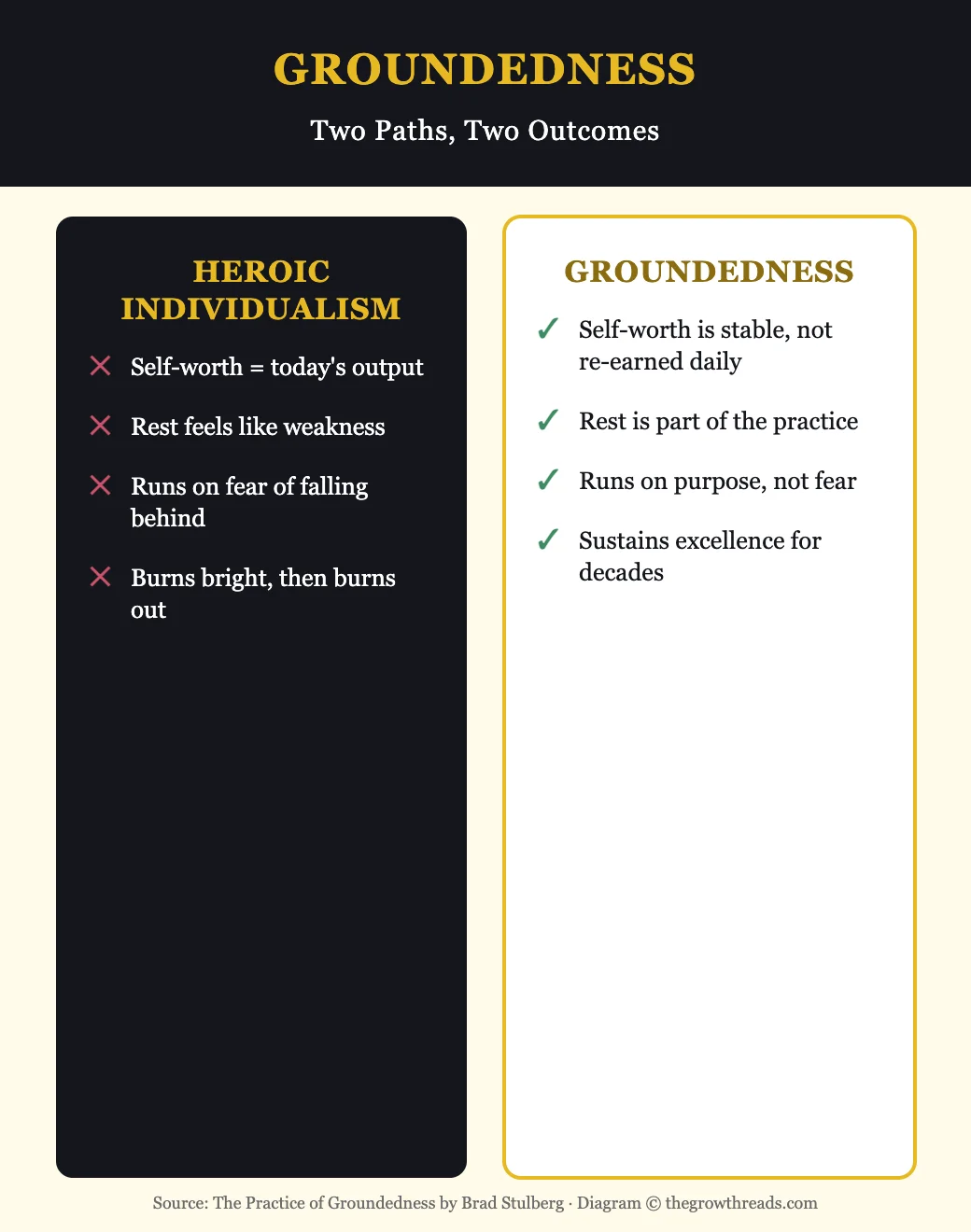
His alternative is groundedness: a stable, internal sense of self-worth that exists independent of whatever you accomplished today. Crucially, Stulberg isn’t arguing for lowering your ambitions — he’s arguing that ambition built on a grounded foundation is more sustainable, and often more successful over a long horizon, than ambition built on fear of not being enough.
TGR Note: This critique of hustle culture runs parallel to Cal Newport’s argument in Digital Minimalism — both books treat constant activity as a symptom to diagnose, not a virtue to maximize.
Part 2: The Four Inner Principles of Groundedness
Stulberg breaks groundedness down into four practices you build from the inside: acceptance, presence, patience, and vulnerability.
Acceptance comes first because you can’t skillfully respond to a situation you’re not willing to see clearly. This isn’t resignation — Stulberg is careful to separate accepting reality from approving of it. It’s simply refusing to waste energy fighting facts, so that energy is available for actually changing what’s changeable.
Presence is full engagement with what’s directly in front of you, rather than a mind split between the current task, yesterday’s mistake, and tomorrow’s deadline. Stulberg cites research showing that a wandering mind is reliably a less happy mind, regardless of what it’s wandering toward — and that presence, trainable through simple practices like single-tasking, improves both the quality of work and the experience of doing it.
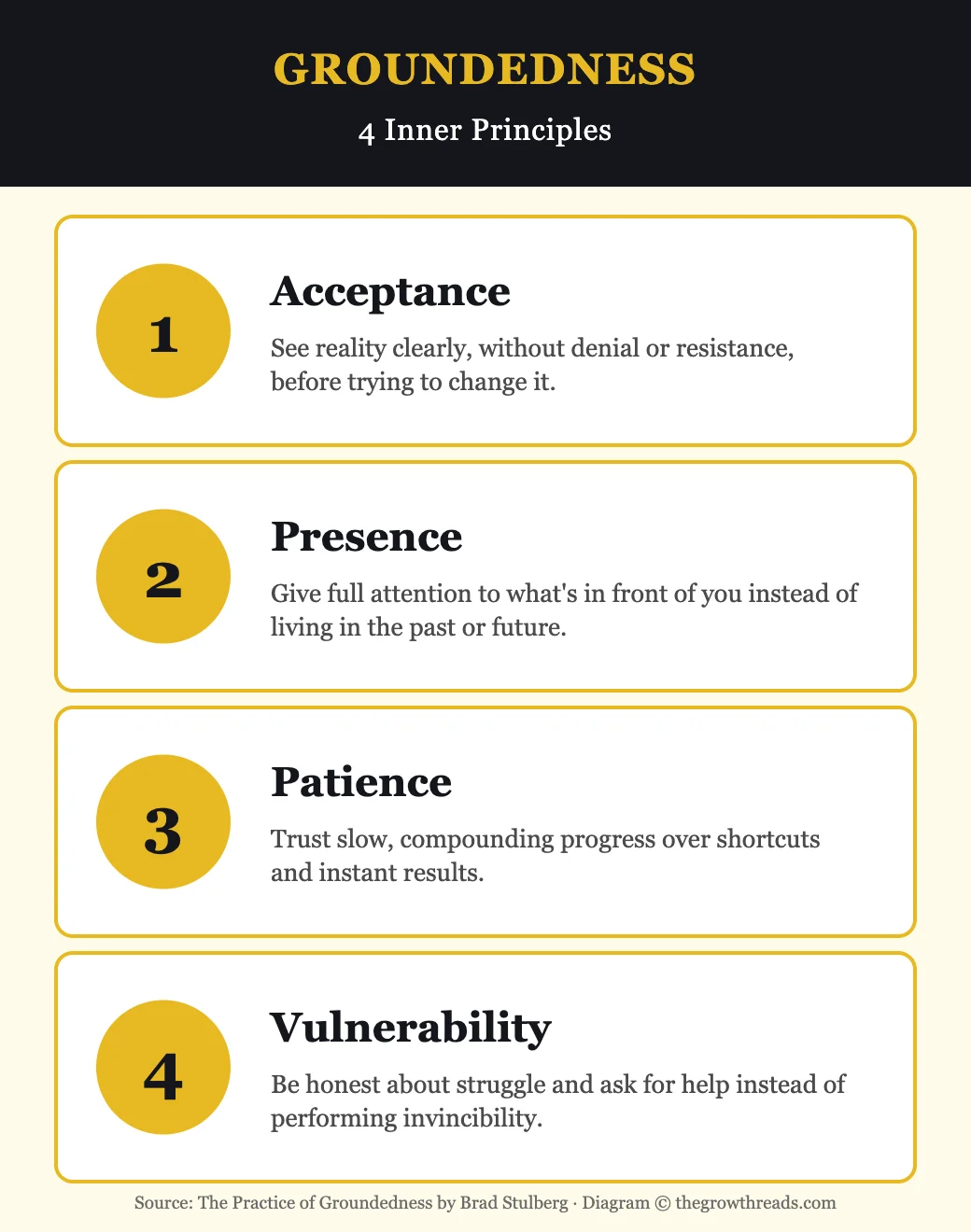
Patience is trust in slow, compounding processes over shortcuts. Stulberg points out that almost everything genuinely valuable — mastery, deep relationships, physical health — is built on a timescale of years, and that heroic individualism’s obsession with speed actively works against the patience these things require.
Vulnerability closes the loop: being honest about struggle, asking for help, and admitting when a plan isn’t working. Stulberg argues this is the principle heroic individualism attacks hardest, because performed invincibility is exactly what the “hustle” identity depends on — and it’s also the principle that unlocks real support from other people.
TGR Note: Stulberg’s “patience” principle pairs naturally with Essentialism — both argue that doing fewer things, more slowly and deliberately, outperforms doing everything at once.
Part 3: Movement and Deep Community — the Practices That Reinforce Groundedness
Alongside the four inner principles, Stulberg identifies two outward practices that make groundedness durable rather than theoretical: movement and deep community.
Movement isn’t framed as a fitness add-on — Stulberg treats regular physical activity as core infrastructure for a grounded mind. The research he cites links consistent movement to improved mood regulation, stress resilience, and cognitive function, and he argues that an embodied sense of capability — knowing your body can handle discomfort — transfers directly into psychological steadiness elsewhere in life.
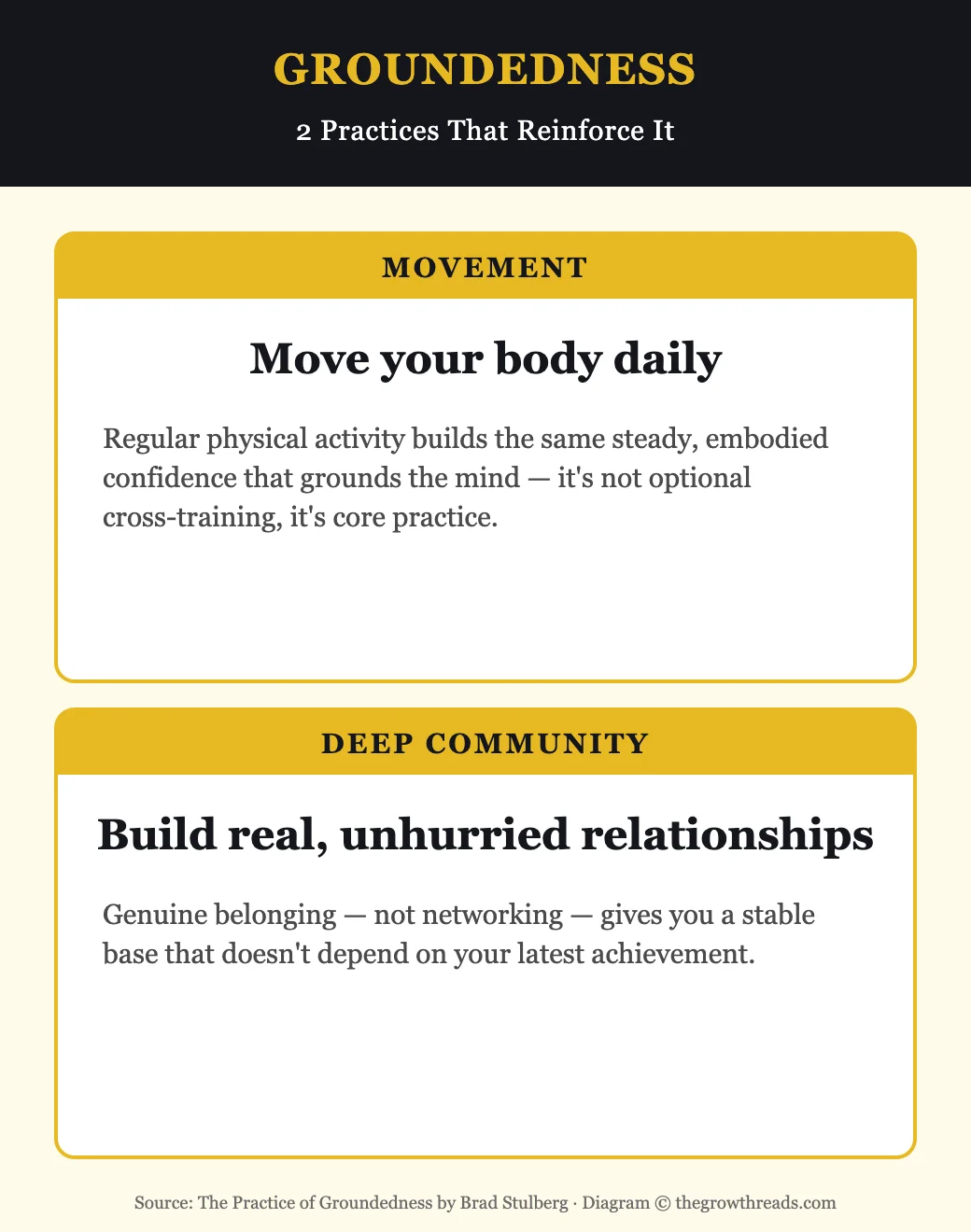
Deep community is the second reinforcing practice — a small number of genuine, unhurried relationships rather than a large network of shallow connections. Heroic individualism treats needing other people as a weakness; Stulberg’s research points the opposite direction, showing that people with a handful of close, reliable relationships handle stress and setbacks far better than people who are professionally well-connected but personally isolated. Belonging, in his framing, is a stabilizer that achievement alone can’t provide.
TGR Note: The movement research here echoes findings we cover in our health silo, and the community argument connects to the attention economics in Stolen Focus — both point to constant connectivity crowding out the slower, deeper relationships that actually sustain us.
Part 4: Sustainable Excellence in Practice
The back half of the book is a practical case that groundedness and high achievement aren’t in tension — they’re complementary, and in Stulberg’s research, the most consistently excellent performers were also among the most grounded.
He’s explicit that this isn’t a call to lower your standards. Sustainable excellence still requires real effort, real skill-building, and real ambition. What changes is the engine: instead of running on fear of not being enough, you run on a stable sense of worth that lets you take healthy risks, recover from setbacks without spiraling, and sustain effort over years instead of burning out in months.
Practically, Stulberg suggests starting small: pick one principle — often acceptance or presence — and build a five-minute daily practice around it before trying to overhaul your entire relationship with achievement. Groundedness, like fitness, is built through repeated small reps, not a single insight. The goal isn’t to eliminate ambition, but to build a foundation stable enough that ambition stops requiring you to be anxious all the time.
Who is The Practice of Groundedness best for — and who should read something else first?
This book is best for people who are already successful by external measures but feel like they’re running on empty — high achievers, founders, and professionals who suspect their current pace isn’t sustainable but don’t want to simply “do less.” It’s also useful for coaches, managers, and parents who want a healthier vocabulary for ambition than pure hustle.
If your challenge is more about focus and less about burnout specifically, start with Deep Work instead. If you’re drawn to the idea of doing less but want a sharper filter for what to cut, Essentialism covers that more directly. And if your core issue is that you’ve never questioned whether busyness itself is the problem, Four Thousand Weeks is the deeper philosophical starting point.
Questions to reflect on
- Does your sense of self-worth rise and fall with your most recent win or deadline?
- Where in your life are you accepting reality clearly, and where are you avoiding it?
- How much of your day is spent fully present in one task versus split across several?
- Who are the two or three people you could be genuinely vulnerable with — and when did you last talk to them?
- What would change if you treated rest as part of your training, not a reward for finishing it?
🔥 Ready to build success that doesn’t burn you out?
Grab a copy of The Practice of Groundedness and start training the foundation that makes achievement sustainable.
How to apply The Practice of Groundedness (7-day plan)
- Day 1: Write down one situation you’ve been avoiding facing clearly, and name it honestly — that’s acceptance in practice.
- Day 2: Single-task for one full hour with your phone in another room, and notice how presence changes the work.
- Day 3: Identify one goal where you’ve been looking for a shortcut, and commit to the slow version instead.
- Day 4: Tell one person about a struggle you’d normally hide — practice vulnerability in a low-stakes way.
- Day 5: Move your body for at least 20 minutes, treating it as core practice rather than an optional extra.
- Day 6: Reach out to one person for deep community — not a networking message, a genuine check-in.
- Day 7: Take a real rest block with no productivity goal, and notice whether you can enjoy it without guilt.
Frequently asked questions
Is groundedness the same thing as being complacent or unambitious?
No — Stulberg is explicit that groundedness is meant to sustain ambition, not replace it. The distinction is about the source of your drive: heroic individualism runs on fear of not being enough, while groundedness runs on a stable sense of worth that lets you pursue big goals without your identity collapsing if you fall short. In his research, the most consistently high-performing people were often also the most grounded — calm under pressure precisely because their self-worth didn’t hinge on the outcome of any single effort. Groundedness is a foundation for ambition, not an alternative to it.
What is “heroic individualism” exactly?
It’s Stulberg’s term for a cultural script that treats constant hustle, radical self-reliance, and never being satisfied as not just useful but morally superior — the idea that resting, asking for help, or feeling content are signs of weakness. He traces its roots partly to productivity and self-help culture, and argues it quietly ties your self-worth to your most recent output. That makes every pause feel threatening, since a pause means the evidence of your worth stops accumulating. The book positions groundedness as a direct alternative to this script, not a rejection of achievement itself.
How is this different from other burnout or self-care books?
Many burnout books focus on symptom management — better sleep, fewer meetings, more vacation days. Stulberg’s approach goes further upstream, targeting the belief system that makes people burn out in the first place: the idea that your worth depends on constant output. Rather than treating rest as a reward you earn after enough hustle, groundedness reframes acceptance, presence, patience, vulnerability, movement, and community as core practices that make sustained high performance possible, not just occasional relief from it.
Do I need to slow down my career to apply this book?
Not necessarily. Stulberg isn’t arguing for lower ambition — several of the high performers in his research maintained demanding careers while becoming more grounded. What typically changes is the internal experience of pursuing those goals: less anxiety, less need to prove yourself with every task, and more resilience after setbacks. Some readers do choose to change pace after reading it, but the book’s central claim is that groundedness and ambition reinforce each other rather than compete, so a career slowdown isn’t a requirement.
What’s the single easiest principle to start with?
Stulberg suggests starting small rather than trying to overhaul everything at once, and presence is often the most immediately practical entry point — a simple single-tasking practice, like giving one task your full attention for a set block of time, produces a noticeable shift within days. Acceptance is a close second: naming a situation honestly, without judgment, tends to reduce the background anxiety of avoiding it. Either principle can be practiced in five minutes a day before expanding to the rest of the framework.
Is there research behind the book, or is it mostly anecdotal?
Both. Stulberg draws on peer-reviewed research in psychology, exercise science, and performance studies, and combines it with case studies and interviews from elite athletes, executives, and other high performers he has coached or studied. The result reads more like an applied research synthesis than a memoir, though personal stories are used throughout to illustrate each principle. Readers who want citations can find them in the book’s endnotes, which point to the underlying studies for each major claim.
How does movement actually build psychological groundedness?
Stulberg cites research linking regular physical activity to improved mood regulation, stress resilience, and cognitive function, but his more distinctive claim is about embodiment: consistently proving to yourself, physically, that you can handle discomfort builds a transferable sense of capability. That “I can handle hard things” experience, repeated through movement, carries over into how you face difficulty elsewhere — a work setback, a hard conversation — which is why he treats movement as core infrastructure for groundedness rather than a separate wellness habit.
Related summaries
- Essentialism — a sharper filter for cutting the nonessential, the natural companion to patience.
- Deep Work — the focus-and-presence companion for getting more done in less time.
- Four Thousand Weeks — the philosophical case against busyness as a virtue.
- Stolen Focus — why constant connectivity crowds out the deep attention groundedness requires.
- See all best productivity books →
How we analyze books: every TGR summary is built from a full read of the source material, cross-checked against the author’s own talks, interviews, and follow-up research where available, then structured around practical application rather than just recap. Read our full methodology.