

⭐⭐⭐⭐½ 4.5/5 — Culture isn’t a soft add-on to a business plan; it’s the plan.
Best for: Founders and managers building or repairing team culture
Reading time: ~7 hrs to read · 14 min to skim this guide
Difficulty to apply: Moderate — needs organizational buy-in, not just a personal habit change
Delivering Happiness in one minute
Tony Hsieh sold a company for $265 million at 24, felt hollow about it, and spent the next decade proving that culture — not cash — is what makes a business (and its people) actually thrive. Delivering Happiness tracks his path from childhood side-hustles through LinkExchange’s sale to Microsoft, into Zappos, the online shoe retailer he helped build into a $1.2 billion Amazon acquisition. The throughline is that profits, passion, and purpose aren’t three competing priorities to balance — they’re what naturally show up once you get culture and service right. The back third of the book turns from memoir to framework, mapping happiness research onto business strategy and arguing that durable success is designed, not stumbled into.
Key takeaways
- Profits, Passion, Purpose: treat culture as strategy, not an afterthought — it’s what makes the other two possible, not a tax on them.
- Core values must be specific and enforced: Zappos’ 10 values were written down, hired for, and fired against — not printed on a poster and ignored.
- Deliver WOW through service: exceed expectations exactly where competitors cut corners, especially in unglamorous places like the call center.
- Hire for culture fit first, skills second: skills are teachable; genuine alignment with how a team works usually isn’t.
- The Offer: Zappos paid new hires to quit after training if they weren’t fully committed — a cheap filter for real buy-in.
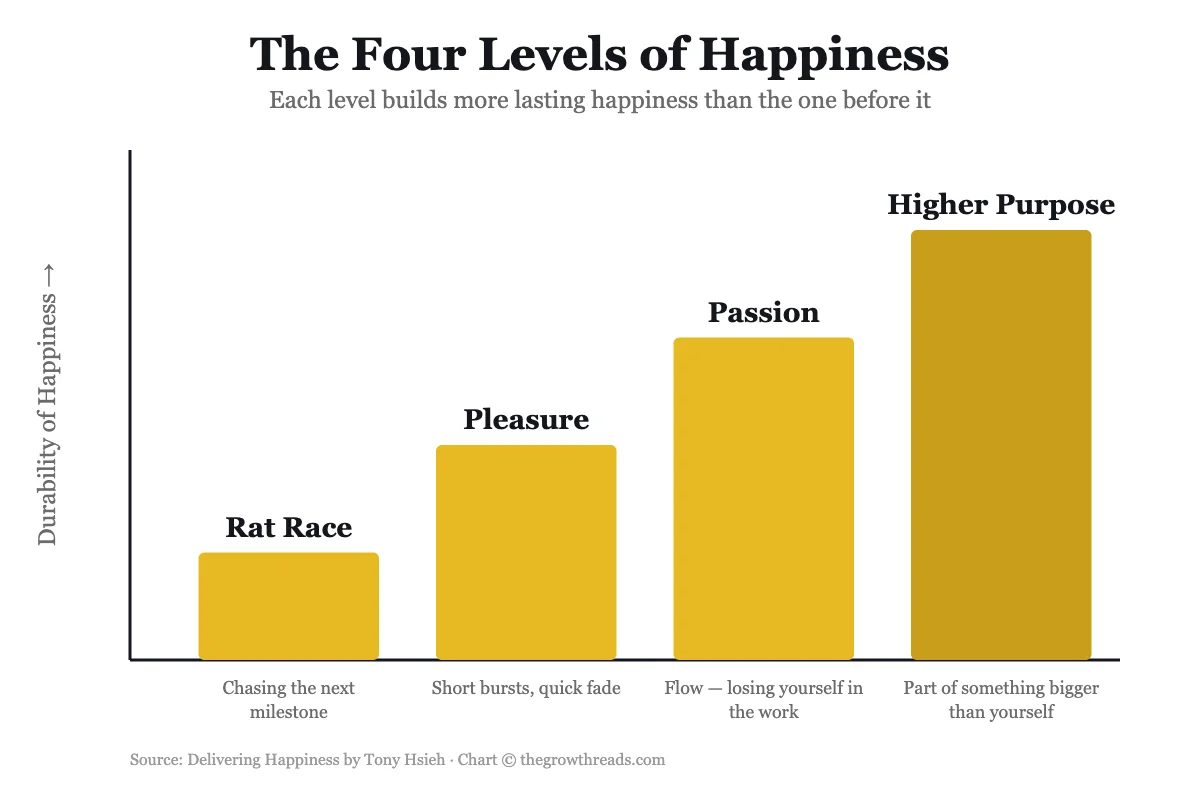
- Happiness has four levels, and only two of them last: Rat Race and Pleasure happiness fade fast; Passion and Higher Purpose compound.
- Employees are customers too: how you treat your team shows up directly in how they treat everyone else.
- Radical transparency builds trust: Zappos published an unedited, all-staff “Culture Book” every year — good and bad included.
- Word of mouth beats ad spend: delighted customers are a cheaper, stickier growth channel than most marketing budgets.
- A leader’s real job is protecting the culture as the company scales — not just hitting the quarterly numbers.
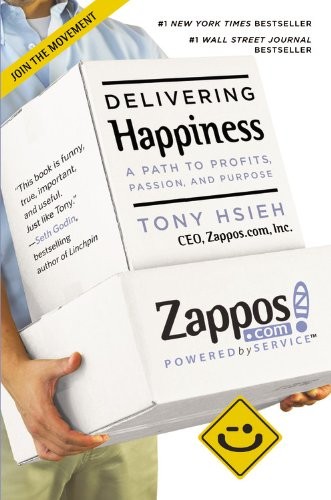
What is Delivering Happiness about?
Delivering Happiness is Tony Hsieh’s memoir and business philosophy, tracing his path from childhood ventures through selling LinkExchange to Microsoft and building Zappos into a $1.2 billion, service-obsessed company — arguing that profits, passion, and purpose aren’t competing goals, but the natural output of getting culture right.
About the author
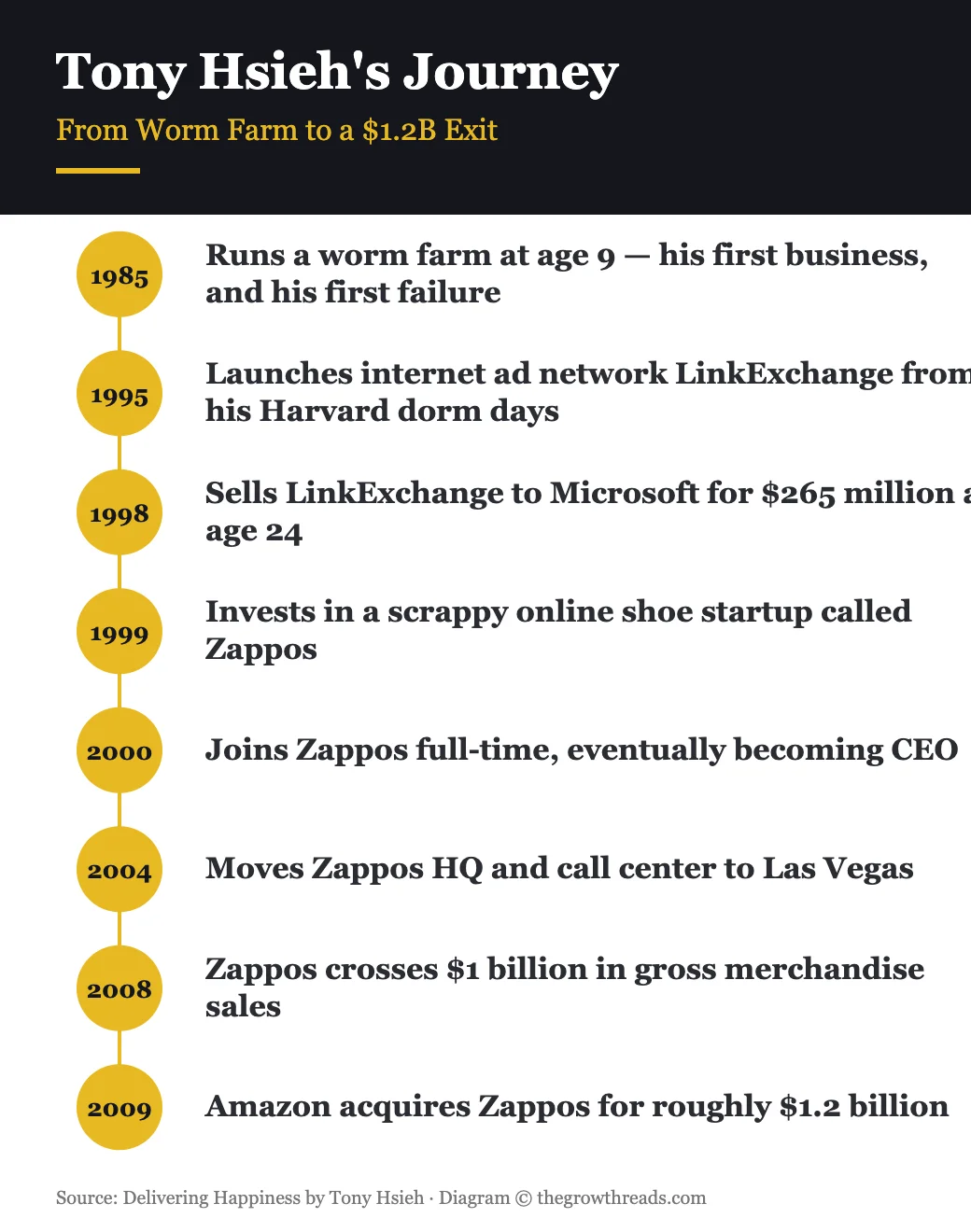
Tony Hsieh (1973–2020) was an American entrepreneur best known as the CEO who turned Zappos into a billion-dollar company built almost entirely on customer service. As a kid in the San Francisco Bay Area he ran a string of small ventures — a worm farm, a button-making business, a mail-order magazine — before studying computer science at Harvard, where a dorm-room pizza business taught him an early lesson in incentives. In 1996 he co-founded internet ad network LinkExchange, selling it to Microsoft for $265 million in 1998 at age 24. Explore all Tony Hsieh book summaries →
He then became an early investor and, in 2000, CEO of a scrappy online shoe startup called Zappos, relocating its headquarters and call center to Las Vegas and steering the company toward a $1.2 billion acquisition by Amazon in 2009. He later championed self-management (“holacracy”) and downtown Las Vegas revitalization projects until his death in 2020.
Key concepts at a glance
| Concept | What it means | Use it when |
|---|---|---|
| Profits, Passion, Purpose | Hsieh’s 3-part framework: build a business that makes money, energizes its people, and serves something bigger | Setting long-term company or career strategy |
| Core Values | A short, specific list of behaviors the company hires, fires, and promotes against | Scaling a team past the founder’s direct oversight |
| Deliver WOW Through Service | Exceed expectations at the exact moments competitors cut corners | Designing any customer-facing process |
| The Four Levels of Happiness | Rat Race → Pleasure → Passion → Higher Purpose, each more durable than the last | Evaluating whether a goal or job will actually satisfy you |
| The Offer | Paying new hires to quit if they’re not fully committed | Filtering for genuine buy-in during onboarding |
| Culture Book | An unedited, all-employee collection of reflections on the company culture | Auditing whether stated values match lived reality |
| Do More With Less | Treating constraints as a forcing function for creativity, not an excuse | Scaling operations without bloating headcount |
Part 1: The Making of an Entrepreneur
Hsieh opens with childhood ventures that read like a checklist of future obsessions: a worm farm that collapsed because he underpriced the labor of feeding thousands of worms, a button-making business, a mail-order magazine — each one a small, real lesson in unit economics learned years before business school. At Harvard, he and his roommates ran a pizza delivery side-business out of their dorm, buying whole pizzas for a few dollars and reselling slices at a markup late at night. The lesson he draws isn’t about pizza margins — it’s about noticing where value is being left on the table.
After graduating, Hsieh co-founded LinkExchange, an early internet advertising network, with college friend Sanjay Madan. It grew fast, got funded, and by 1998 Microsoft acquired it for $265 million. Hsieh was 24. He also describes the part most founder memoirs skip: as LinkExchange scaled, the culture he’d loved in its scrappy early days curdled into something closer to a typical corporate office, and by the time of the sale he was actively looking forward to leaving the company he’d built. The payout didn’t fix that feeling — which is the seed the rest of the book grows from.
TGR Note: Phil Knight’s Shoe Dog tells almost the same shape of story — a founder who nearly loses the company in a forgettable middle stretch before an unlikely breakout. Read them back to back and the pattern becomes obvious: the “boring” years are usually where the real company gets built.
Part 2: Building Zappos and the Ten Core Values
Zappos wasn’t Hsieh’s idea — he came in as an investor and advisor to founder Nick Swinmurn, then joined full-time as the company burned through cash faster than it could prove that people would really buy shoes sight-unseen online. Hsieh describes near-bankruptcy more than once, including personally lending the company money and selling off a real-estate portfolio to keep it afloat. The turning point wasn’t a product breakthrough; it was a decision to relocate the headquarters and call center to Las Vegas, where Hsieh believed he could build a tighter, more values-aligned team than Silicon Valley’s revolving-door talent market allowed.
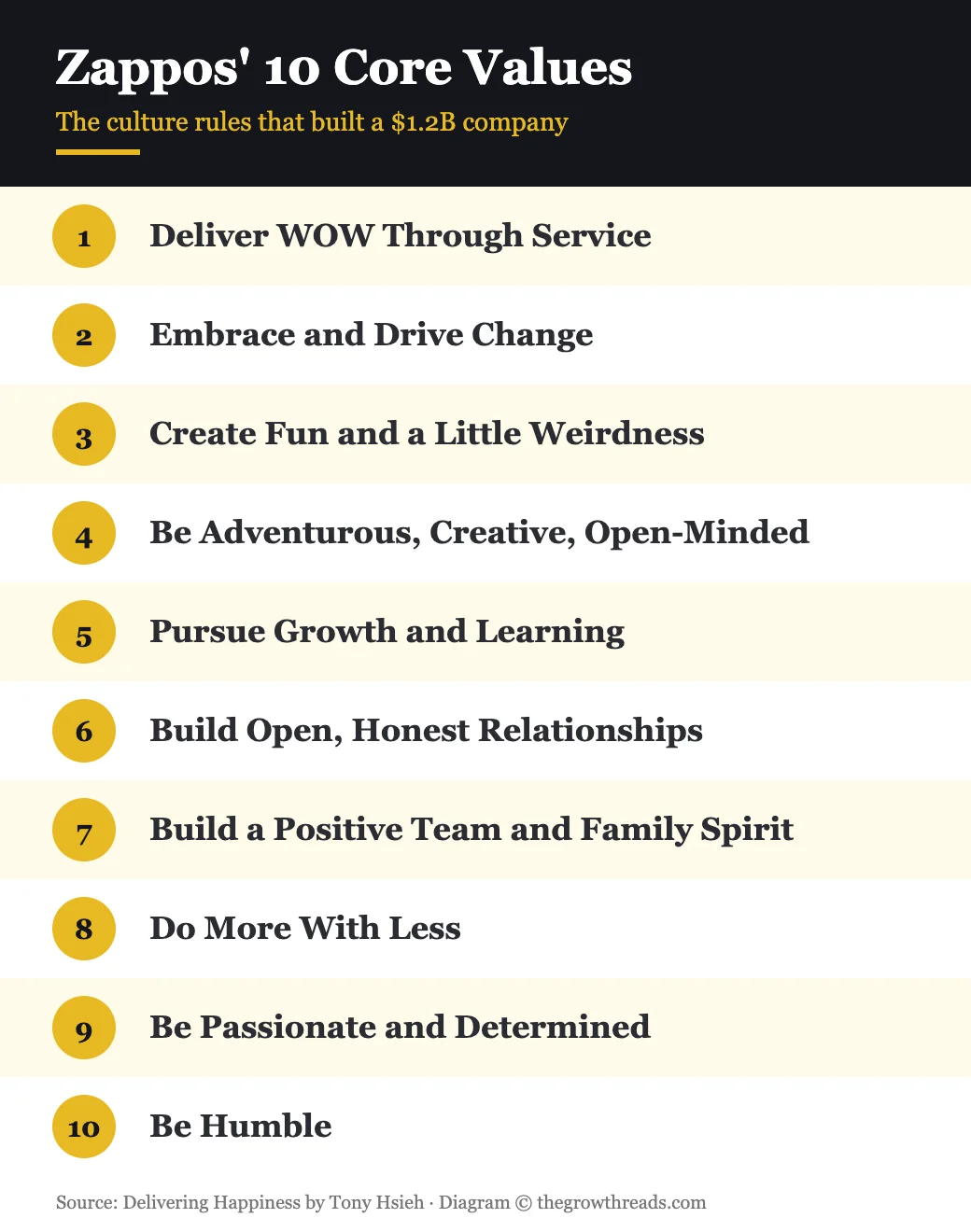
That’s where the ten core values come from — not a branding exercise, but a document built from asking every employee what they thought the company already stood for, then codifying the answers into something specific enough to hire and fire against: Deliver WOW Through Service, Embrace and Drive Change, Create Fun and a Little Weirdness, and seven more. Zappos backed the values with “The Offer” — paying new hires up to $2,000 to quit after a few weeks of training if they didn’t feel it was genuinely a fit. Most people never took it, which was the point: the offer filtered for real commitment rather than just weeding people out.
One hiring detail Hsieh returns to is what became known as the “cab driver test”: imagine sharing a cab ride with a candidate for an hour after the interview ends. If you wouldn’t enjoy that hour, Zappos passed on the hire, regardless of how strong the résumé looked. It’s a deliberately fuzzy filter, and Hsieh is upfront that it cost the company some technically talented people — but he argues the trade-off was worth it, because one culture mismatch on a small team does more damage than one missed skill gap.
TGR Note: If Delivering Happiness convinces you that culture is strategy, pair it with Start With Why for the “why” behind the values, and No Rules Rules for a very different, freedom-and-responsibility approach to the same problem at Netflix.
Part 3: Delivering WOW Through Service
This is the section people quote most: Zappos call center reps had no scripts and no time limits, and the company still cites a customer service call that ran over ten hours — not because the customer needed ten hours of help, but because the rep was empowered to just talk, and did. Free shipping in both directions and a 365-day return window turned an online shoe purchase (a category everyone “knew” required trying shoes on in person) into something customers trusted enough to buy in bulk and return what didn’t fit.
Hsieh’s argument is that this wasn’t generosity for its own sake — it was marketing with a better return on spend than advertising, because a customer who gets WOW’d tells other people, unprompted, for free. He’s explicit that most companies could afford to do at least some of this and choose not to, because service is treated as a cost center to be minimized rather than a growth channel to be invested in.
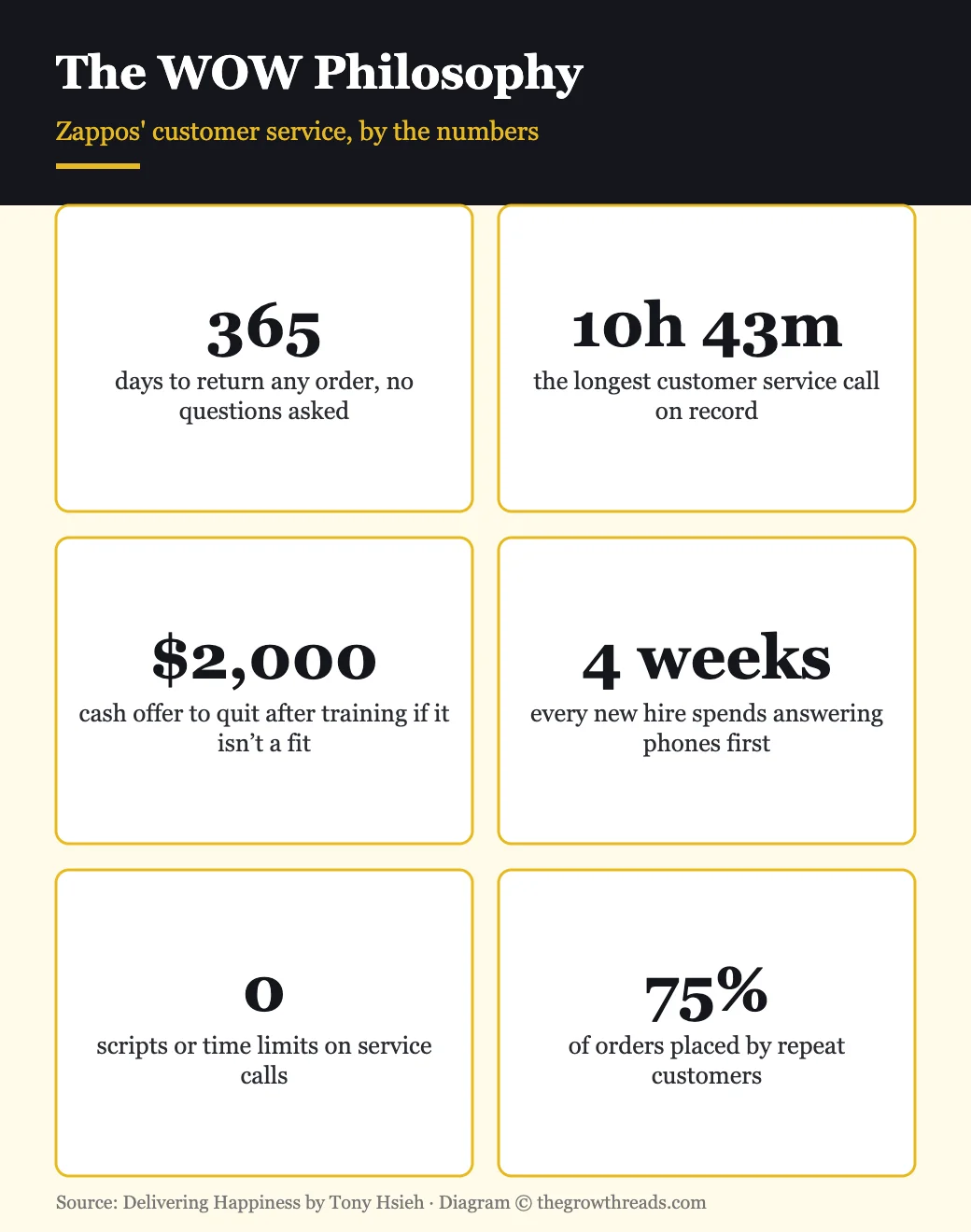
The most-cited proof point in this section is a call where a Zappos rep, unable to find the customer’s requested item in stock, spent time researching local pizza delivery options and called the customer back with a recommendation — not because it was in any manual, but because nothing stopped her from helping. Hsieh uses stories like this to make a structural point: you can’t script genuine helpfulness, so the job of leadership is to hire people who default to it and then get out of their way.
TGR Note: For the research-backed case that this kind of service consistency comes from team psychology rather than individual heroics, see The Culture Code — it explains the belonging cues that make “deliver WOW” repeatable instead of a one-off.
Part 4: The Science of Lasting Happiness
The final section pulls back from Zappos entirely and lays out the framework the whole book has been building toward: happiness comes in four levels, each more durable than the last. Rat Race happiness comes from hitting external milestones — a promotion, a bigger house — and fades almost as soon as it arrives, because the goalpost immediately moves. Pleasure happiness is even shorter-lived: a good meal, a purchase, a compliment. Passion happiness is what psychologists call flow — full absorption in a challenging, well-matched task, which Hsieh says he felt more building Zappos’ early culture than he ever did at the moment LinkExchange sold. Higher Purpose happiness is the most durable of all: feeling part of something bigger than yourself, whether that’s a company mission, a community, or a cause.
Hsieh credits psychologist Mihaly Csikszentmihalyi’s research on flow as the intellectual backbone of the Passion level, and cites broader positive-psychology findings on adaptation — the well-documented tendency for people to return to a baseline mood after both windfalls and setbacks — as the reason Rat Race happiness keeps disappointing high achievers who assume the next milestone will finally feel different. The practical takeaway he draws for founders: don’t just ask whether a decision will make the company more money next quarter, ask whether it moves people toward flow and shared purpose, because that’s the part that compounds.
Hsieh’s point for business readers is blunt: if you design a company (or a career) that only offers Rat Race and Pleasure rewards — bonuses, perks, promotions — you’ll always be running to stand still. Design for Passion and Higher Purpose instead, and retention, service quality, and word-of-mouth growth become side effects rather than problems to solve separately.
Who is Delivering Happiness best for — and who should read something else first?
Delivering Happiness is best for founders, managers, and hospitality or service leaders who are building — or repairing — a team culture, and for anyone weighing a “good job” against work that actually feels meaningful. It’s a memoir first and a framework second, so readers wanting dense, prescriptive tactics may find the storytelling sections slower going.
If you want blunt, operational leadership frameworks rather than a founder’s story, start with Extreme Ownership. If you want the research behind why teams gel, read The Culture Code. And if you’re earlier-stage and need product-market-fit thinking before culture becomes the bottleneck, Zero to One is the better starting point.
Questions to reflect on
- Which of your team’s stated values would survive being tested against a real hiring or firing decision this month?
- Where in your business could you “deliver WOW” at near-zero marginal cost, the way Zappos did with free shipping and returns?
- Are you currently operating from Rat Race or Pleasure happiness, or from Passion and Higher Purpose — in your work and outside it?
- If you offered your newest hire $2,000 to quit today, would they take it?
- What would an unedited, all-staff “culture book” reveal about your organization right now?
🔥 Ready to build a culture people actually believe in?
Get Delivering Happiness and see exactly how Zappos turned service into its biggest growth channel.
How to apply Delivering Happiness (7-day plan)
- Day 1: Write down your own 3-5 core values in one sentence each, tested against a real decision you made this year.
- Day 2: Audit one customer-facing process for a “WOW” opportunity that costs little but is rarely done.
- Day 3: Ask three team members what they think the company’s real (not stated) values are, and compare the answers.
- Day 4: Map your current goals onto the Four Levels of Happiness; identify one task stuck at “Rat Race.”
- Day 5: Draft one “Do More With Less” constraint you could impose deliberately to force creativity.
- Day 6: Have one honest conversation with a team member about whether their role is a genuine values fit.
- Day 7: Write a single-page “why we exist” statement and share it with your team for reaction.
Frequently asked questions
What is the main message of Delivering Happiness?
That profits, passion, and purpose aren’t separate goals to trade off against each other — they’re what naturally follow when a company builds its culture and customer service around genuine values instead of treating both as afterthoughts. Tony Hsieh uses Zappos’ growth from near-bankruptcy to a $1.2 billion Amazon acquisition as proof that culture is a business strategy, not a soft perk.
Is Delivering Happiness still relevant given what happened to Zappos after Hsieh left?
The core lessons — specific core values, hiring for fit, investing in service as marketing — remain widely cited and taught in business schools regardless of Zappos’ later corporate changes under Amazon. Treat the book as a case study in how one company built a service-first culture at a specific moment, not as a guarantee of what happens to any culture indefinitely; every framework needs re-application to your own context.
What are Zappos’ 10 core values?
Deliver WOW Through Service, Embrace and Drive Change, Create Fun and a Little Weirdness, Be Adventurous/Creative/Open-Minded, Pursue Growth and Learning, Build Open and Honest Relationships, Build a Positive Team and Family Spirit, Do More With Less, Be Passionate and Determined, and Be Humble. Hsieh describes them as built from employee input, not handed down from leadership.
What is “The Offer” in Delivering Happiness?
The Offer was Zappos’ practice of paying new hires up to $2,000 to quit after a few weeks of training if they didn’t feel genuinely committed to the job. Very few people took it, but Hsieh argues the offer itself filtered for real buy-in and made everyone who stayed more confident the team was there by choice.
How long does it take to read Delivering Happiness?
At roughly 300 pages, most readers finish Delivering Happiness in about 7 hours of continuous reading, or a few sessions spread across a week. The audiobook, narrated by Tony Hsieh himself in the original edition, runs a similar length.
Is Delivering Happiness suitable for someone without a business background?
Yes — it’s written as a memoir first, with the business framework woven through personal stories rather than delivered as dense theory. Readers without an MBA or startup background generally find it more accessible than typical management books, though some prior interest in entrepreneurship helps.
What happened to Tony Hsieh?
Tony Hsieh stepped down as Zappos CEO in August 2020 after more than two decades leading the company. He died in November 2020 at age 46 following a house fire in Connecticut. His death was widely covered by business media, and tributes noted his lasting influence on how companies think about culture and customer service.
Related summaries
- The Culture Code — the psychology behind why some teams gel and others don’t
- No Rules Rules — Netflix’s freedom-and-responsibility alternative to Zappos’ core-values approach
- Start With Why — the purpose-first framework behind Hsieh’s “Higher Purpose” happiness level
- Shoe Dog — Phil Knight’s founder memoir, a close cousin to Part 1 of this book
- Best Leadership Books — the full ranked pillar list
How we analyze books: We read the full text, cross-check key claims and figures against primary sources and later reporting where relevant, and test every framework against a real 7-day application plan before publishing. Read our full methodology.