

⭐⭐⭐⭐ 4.6/5 — A blunt, decades-tested toolkit for shutting worry off before it takes over.
Best for: Chronic worriers, professionals under constant pressure, and anyone stuck replaying the same decision
Reading time: ~20 min summary · ~7 hrs full book
Difficulty to apply: Easy — most techniques take one sitting to learn
How to Stop Worrying and Start Living in one minute
Worry doesn’t drain the body of energy so much as poison it — and Dale Carnegie’s 1948 field manual is still one of the most practical toolkits for shutting worry off. Carnegie, already famous for How to Win Friends and Influence People, spent years collecting real case studies from people who had beaten chronic anxiety, then reverse-engineered their strategies into repeatable techniques. The result is less a philosophy than a maintenance manual: live in “day-tight compartments,” use a three-step formula to defuse any specific worry, keep busy, count what’s going right, and stop keeping score of what you’re owed. None of it requires special equipment or years of therapy — it requires deciding, once, to stop rehearsing disaster and start acting on the facts in front of you.
Key takeaways
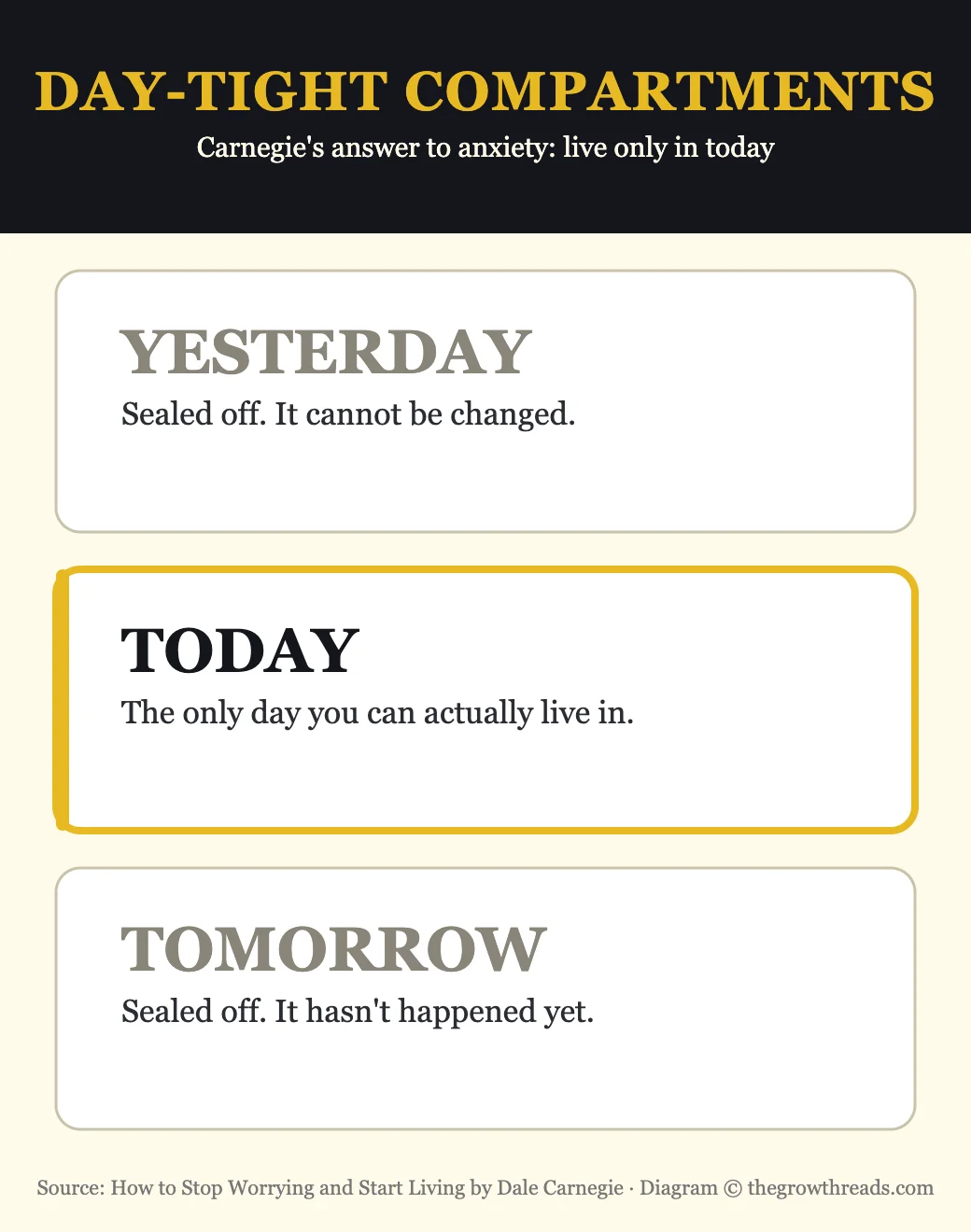
- Live in day-tight compartments: Worry can’t get traction if you refuse to think past today — seal off yesterday and tomorrow the way a ship seals watertight doors.
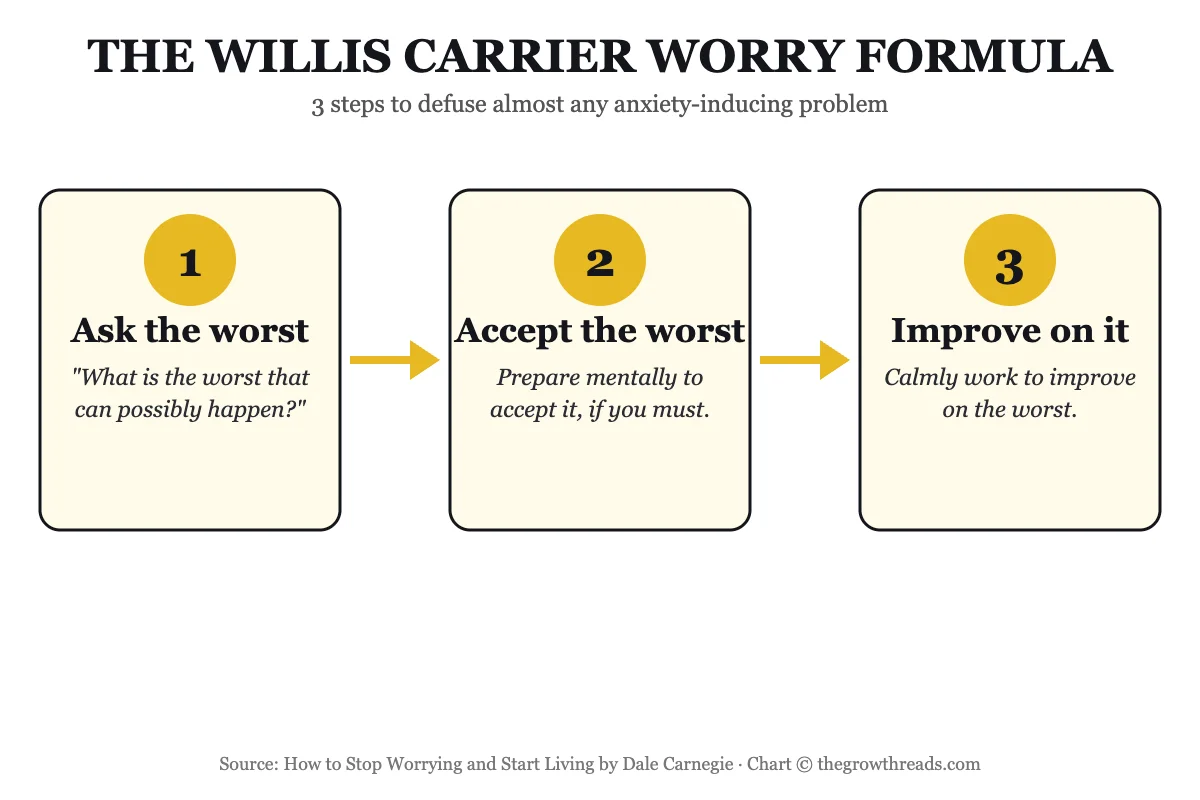
- Use the Willis Carrier formula: Ask the worst that can happen, accept it if you must, then calmly work to improve on it.
- Get the facts, then decide: Indecision, not the decision itself, is usually the bigger source of anxiety.
- Name the worst case out loud: Vague dread shrinks the moment it’s spoken or written down in specific terms.
- Keep busy: An occupied mind has no vacancy left for worry to move into.
- Apply the law of averages: Ask how often the thing you’re dreading actually happens — usually, almost never.
- Cooperate with the inevitable: Energy spent fighting what cannot be changed is energy you don’t get back.
- Set a stop-loss order on worry: Decide in advance how much emotional energy a problem is actually worth.
- Count blessings, not troubles: Gratitude is a practiced habit, not a mood that arrives on its own.
- Give real appreciation to others: Turning attention outward starves the self-focused loop that worry runs on.
What is How to Stop Worrying and Start Living about?
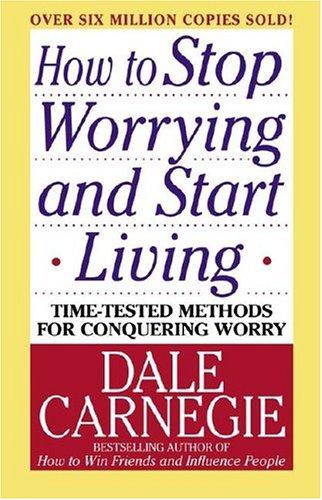
How to Stop Worrying and Start Living is Dale Carnegie’s 1948 self-help classic that distills interviews with hundreds of formerly anxious people into concrete, repeatable techniques for reducing chronic worry — including the Willis Carrier formula, “day-tight compartments,” and the law of averages — aimed at replacing rumination with calm, decisive action.
About the author
Dale Carnegie (1888–1955) was an American writer and lecturer who pioneered the modern self-improvement industry. Raised on a poor Missouri farm, he worked as a traveling salesman before turning to public speaking instruction in New York, where he discovered that most people’s biggest obstacle wasn’t ability but confidence and anxiety. His 1936 book How to Win Friends and Influence People became one of the best-selling books in history, and its success gave him the resources to study worry itself as a distinct, solvable problem. Explore all Dale Carnegie book summaries →
For How to Stop Worrying and Start Living, published in 1948, Carnegie and his research team gathered real case studies — businesspeople, homemakers, soldiers returning from war — who had overcome chronic anxiety, then reverse-engineered their strategies into teachable habits. His work predates modern cognitive-behavioral therapy by decades but anticipates several of its core mechanisms, from cognitive reframing to structured problem-solving.
Key concepts at a glance
| Concept | What it means | Use it when |
|---|---|---|
| Day-tight compartments | Living fully in today, mentally sealing off past and future | You’re anxious about the future or replaying the past |
| Willis Carrier formula | Face the worst case, accept it, then calmly improve on it | You’re facing one specific, high-stakes worry |
| Law of averages | Most feared outcomes are statistically unlikely to occur | You’re worrying about a rare or improbable event |
| Stop-loss order on worry | A pre-set limit on how much emotional energy a problem deserves | A problem keeps resurfacing without new information |
| Cooperating with the inevitable | Accepting circumstances that cannot be changed | After a loss, setback, or irreversible decision |
| Fatigue-worry cycle | Physical exhaustion amplifies emotional distress | Decisions feel overwhelming late in the day |
| Counting blessings | A deliberate, repeatable gratitude practice | You’re comparing your situation unfavorably to others’ |
Part 1: Fundamental Facts About Worry
Carnegie opens with a blunt observation: most of the people he interviewed weren’t undone by real crises. They were undone by the mental habit of rehearsing disasters that never arrived. He cites physicians of his era who linked chronic worry to ulcers, heart strain, and exhaustion — the specific diagnoses have since been refined, but the underlying claim, that unmanaged anxiety has a measurable physical cost, has held up well under later research.
His first and most durable prescription comes from a speech by physician Sir William Osler, who described sailing on a ship built with watertight compartments — bulkheads that could seal off a flooded section so it didn’t sink the whole vessel. Osler’s advice, which Carnegie adopted as the book’s organizing idea, was to build the same kind of bulkhead around today: seal off yesterday, which cannot be changed, and tomorrow, which hasn’t happened, and live only in the compartment marked “today.”
This isn’t positive thinking or denial. Carnegie is explicit that real problems still need to be solved — the point is that almost none of them need to be solved twice, once in anxious anticipation and again when they actually arrive. He tells the story of a man who spent months dreading a stomach diagnosis, only to realize afterward that the dread itself had cost him more functioning days than the illness did.
The chapter closes with a simple test Carnegie recommends running on any worry: ask whether thinking about it right now changes anything about the outcome. If the answer is no, the worry is pure rehearsal, and the day-tight compartment is the fix.
TGR Note: Carnegie’s “day-tight compartments” is essentially a folk-psychology version of what later authors formalized as presence-based practice. If this idea resonates, our The Power of Now summary goes deeper on the mechanics of staying anchored in the present, minus the anecdotal framing.
Part 2: Basic Techniques for Analyzing and Solving Worry Problems
Carnegie’s second section makes a claim that sounds almost too simple: most worry isn’t caused by problems, it’s caused by unmade decisions. He illustrates it with the story of Willis Carrier, the engineer who later founded the air-conditioning company that bears his name. Early in his career, Carrier was installing a gas-cleaning system at a plant in Crossett, Arkansas, when the machine failed to meet specification. Facing professional embarrassment and a costly redo, he developed a three-step method on the spot: work out, in an honest and detailed way, what the worst possible outcome would actually be; mentally accept that outcome as survivable; then calmly direct all his energy toward improving on it. The plant kept the equipment, refined it, and the crisis passed — but the formula outlived the specific problem.
Carnegie generalizes this into a repeatable process: gather every fact relevant to the decision, weigh them without letting emotion inflate the stakes, come to a decision, and then act on it without revisiting the choice. He’s particularly insistent on that last step — endlessly re-litigating a decision you’ve already made, he argues, causes more suffering than either the original problem or a wrong choice would have. The goal isn’t certainty; it’s closing the open loop that anxiety feeds on.
He also addresses a specific failure mode: worrying about problems that are still hypothetical, where no facts exist yet to analyze. His advice here is less a technique than a boundary — hypothetical worry gets tabled until it becomes a real, fact-based problem, at which point the Carrier formula applies.
TGR Note: Carnegie’s insistence that indecision — not the decision — is the real source of anxiety pairs well with The Paradox of Choice summary, which explains why more options tend to make decisions harder, not easier, and offers rules for cutting the analysis short.
Part 3: Breaking the Worry Habit Before It Breaks You
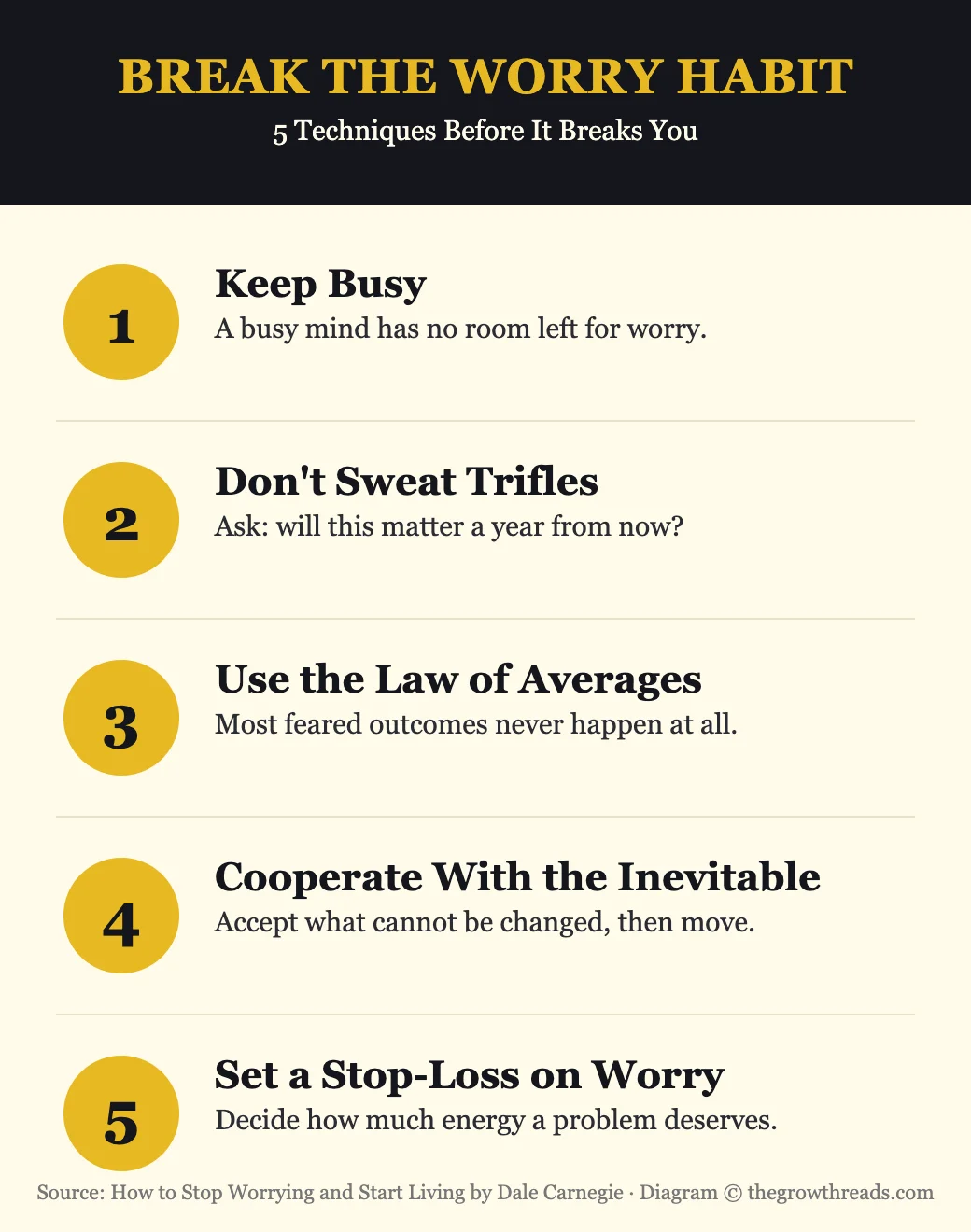
The third section reframes worry as a habit rather than a personality trait, which means it can be broken the same way any habit is broken — by replacing the behavior it runs on. Carnegie lists several concrete substitutions.
Keep busy is the first and most repeated: idle time is when rumination fills the vacuum, so purposeful activity — even unrelated to the worry itself — starves it of attention. Don’t fuss over trifles asks the reader to apply a simple filter: will this specific thing matter in a year, a month, even a week? Most irritations fail the test immediately. The law of averages pushes further, asking how often the catastrophe being imagined has actually happened to anyone, ever — usually the honest answer is close to never, which deflates a surprising amount of anticipatory dread.
Cooperating with the inevitable addresses worries about things that have already happened or cannot be undone — a lost opportunity, an irreversible decision, someone else’s choice. Carnegie’s position is unsentimental: resistance to an unchangeable fact doesn’t change the fact, it just adds a second layer of suffering on top of the first. And putting a stop-loss order on worry, borrowed explicitly from stock market terminology, means deciding in advance the maximum amount of energy a given problem is allowed to cost you — a boundary that prevents minor setbacks from metastasizing into major ones.
Carnegie closes the section with a warning about fatigue: worry and exhaustion feed each other in a loop, so protecting basic rest is itself a worry-reduction strategy, not a separate concern.
TGR Note: The “law of averages” technique is a plain-language ancestor of what behavioral scientists now call probability neglect. For a more clinical look at how the brain miscalibrates threat under stress, The Chimp Paradox summary is a useful next read.
Part 4: Cultivating a Peaceful, Happy Mental Attitude
The final section moves from crisis-management techniques to standing mental habits meant to keep worry from accumulating in the first place. Carnegie’s list reads almost like a maintenance checklist: fill your mind with thoughts of peace, courage, health, and hope, since a mind can only hold one dominant emotional tone at a time. Never try to get even with people who’ve wronged you — retaliation, he argues from multiple case studies, costs the retaliator more than it costs the target. Expect ingratitude rather than resenting it, so that giving doesn’t come with an invisible invoice attached.
Count your blessings instead of your troubles — not as a vague platitude, but as a specific, repeatable exercise: naming concrete things that are currently going right, on a regular schedule, rather than waiting for gratitude to arrive unprompted. Don’t imitate other people, since comparison manufactures a kind of worry that has nothing to do with your actual circumstances. And when a real loss happens, look for a way to convert it into something useful rather than sitting inside it indefinitely — Carnegie’s version of “turn lemons into lemonade.”
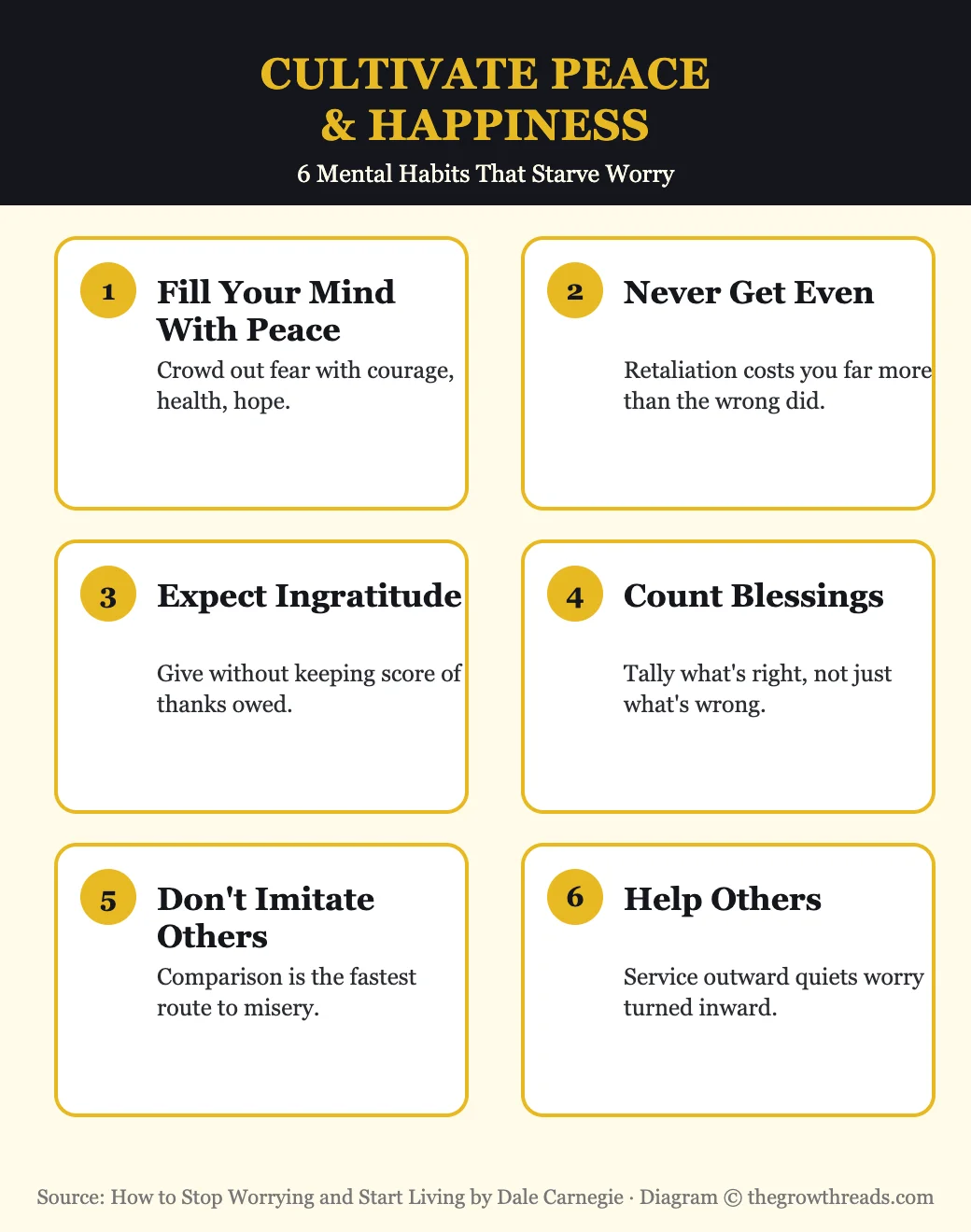
The thread running through all of it is that peace of mind is built the same way any other skill is built: through small, repeated actions, not a single insight or realization.
TGR Note: Carnegie’s “count your blessings” is functionally a proto-gratitude practice, decades before positive psychology formalized it. Self-Compassion summary extends the same instinct into a more structured, research-backed practice for people whose inner critic is the main source of their worry.
Who is How to Stop Worrying and Start Living best for — and who should read something else first?
Best for: chronic worriers, professionals navigating constant pressure or decision fatigue, and anyone stuck in a specific, situational anxiety loop who wants concrete, low-effort techniques rather than a new philosophy.
Read something else first if: you’re dealing with a diagnosed anxiety disorder — this book is a practical supplement, not a substitute for professional care, and pairing it with treatment works better than either alone. If you want research-backed, modern techniques for a harsh inner critic specifically, start with Self-Compassion. If your anxiety centers more on relationships and social situations than internal rumination, Carnegie’s own How to Win Friends and Influence People is the more direct fit.
Questions to reflect on
- What specific worry has been consuming your mental energy this week — and what’s the worst realistic outcome if it happened?
- Where in your day could you build a “day-tight compartment” instead of replaying yesterday or rehearsing tomorrow?
- Is there a decision you’ve been avoiding that, once made, would end the anxiety loop around it?
- What’s something outside your control that you’re still spending energy trying to change?
- Who could you give sincere, specific appreciation to today, redirecting attention away from self-focused worry?
🔥 Ready to stop rehearsing disasters that never happen?
Grab a copy and start applying the Carrier formula this week.
How to apply How to Stop Worrying and Start Living (7-day plan)
- Day 1: Write down your single biggest current worry, then run the Carrier formula on it: name the worst realistic outcome, accept that you could survive it, then list one concrete step to improve on it.
- Day 2: Practice a day-tight compartment — journal only about today, and mentally note “sealed” for anything about yesterday or tomorrow that intrudes.
- Day 3: List every worry currently on your mind, then sort each into “within my control” and “outside my control.” Cross the second list out entirely.
- Day 4: Identify one decision you’ve been putting off. Gather the facts you actually need, make the call, and don’t revisit it today.
- Day 5: Catch yourself overreacting to something small. Apply the “will this matter in a year” filter before responding.
- Day 6: Write three specific things you’re grateful for each morning and evening — not vague categories, concrete details.
- Day 7: Reach out to one person and give sincere, specific appreciation, with no ask attached.
Frequently asked questions
What is How to Stop Worrying and Start Living about?
Published in 1948, the book is Dale Carnegie’s practical guide to reducing chronic anxiety, built from real case studies of people who overcame it. Rather than offering abstract theory, Carnegie organizes dozens of interviews into repeatable techniques — living in “day-tight compartments,” applying the Willis Carrier formula to specific worries, keeping busy, and deliberately counting blessings instead of troubles. The book treats worry as a habit that can be replaced with better habits, not a fixed personality trait, and most chapters end with a short, actionable rule rather than a broad philosophical claim.
Is this book still relevant given modern psychology and CBT?
Largely yes. Carnegie wrote decades before cognitive-behavioral therapy was formalized, but several of his techniques — reframing a feared outcome, testing catastrophic predictions against reality, structured problem-solving instead of rumination — anticipate CBT’s core mechanisms in plain, anecdotal language. The book isn’t a clinical text and shouldn’t replace therapy for diagnosed anxiety disorders, but as a practical supplement for everyday, situational worry, its techniques hold up well and are echoed in more recent, research-backed books on the same subject.
What is the Willis Carrier formula?
It’s a three-step method Carnegie borrowed from engineer Willis Carrier for defusing a specific, high-stakes worry: first, honestly work out the worst realistic outcome; second, mentally accept that you could survive that outcome; third, calmly direct your energy toward improving on it rather than avoiding or denying it. The formula works because most anxiety comes from vague, unexamined dread — naming the actual worst case in concrete terms is usually far less frightening than the imagined version, and it converts rumination into a plan.
How is this different from How to Win Friends and Influence People?
How to Win Friends and Influence People, Carnegie’s earlier book, focuses outward — building relationships, handling people, and influencing others through genuine interest and encouragement. How to Stop Worrying and Start Living turns the same practical, case-study-driven approach inward, toward managing your own anxiety and mental state. They share a method — reverse-engineering real success stories into teachable rules — but almost no content overlap, and many readers benefit from both, since chronic worry and strained relationships often reinforce each other.
Can this book help with clinical anxiety disorders?
It can be a useful supplement, but it isn’t a substitute for professional treatment. Carnegie’s techniques were built from case studies of everyday, situational worry — job stress, decision fatigue, interpersonal conflict — not diagnosed anxiety or panic disorders, which typically need clinical support such as therapy or medication. If you’re dealing with a diagnosed condition, use this book’s techniques alongside professional care rather than in place of it, and treat chapters on day-tight compartments and the Carrier formula as complementary tools, not a treatment plan.
What are “day-tight compartments”?
The phrase comes from a speech by physician Sir William Osler, who compared living well to a ship built with watertight bulkheads — sections that can be sealed off individually so a flood in one doesn’t sink the whole vessel. Carnegie adapted the metaphor into a daily practice: mentally seal off yesterday, which can’t be changed, and tomorrow, which hasn’t happened, and direct all your attention to the “compartment” marked today. It’s less about ignoring real problems and more about refusing to solve them twice — once in anxious rehearsal, and again when they arrive.
How long does it take to read and apply?
The full book runs a little over 250 pages, roughly a 7-hour read at an average pace, though Carnegie’s short chapters and frequent case studies make it easy to read in scattered sessions. Applying the core ideas takes far less time than reading the whole thing — the Willis Carrier formula and the day-tight compartments practice can both be learned and tried in a single sitting. Most readers see the earliest results within a week of consistent use, which is why we’ve built a 7-day plan into this summary.
Related summaries
- How to Win Friends and Influence People Summary & Review
- The Power of Now Summary & Review
- The Chimp Paradox Summary & Review
- Self-Compassion Summary & Review
- Best Psychology Books
How we analyze books: we read the full text, cross-reference the author’s other work and public interviews, and test every framework against independent research before writing a summary. We never review a book we haven’t read cover to cover. Read our full methodology.