

★★★★★ 4.6/5 — The relationship pattern you can’t shake usually traces back to a wound you haven’t named yet.
Best for: Anyone who keeps repeating the same relationship pattern and wants to know why
Reading time: ~6 hrs to read the book · ~20-min guide
Difficulty to apply: Moderate — asks for honest self-reflection and sometimes hard conversations
The Origins of You in one minute
The patterns you can’t seem to break in your relationships were mostly written before you turned ten — and you can finally read the manuscript. Therapist Vienna Pharaon argues that almost every recurring relationship complaint traces back to one of five “origin wounds” formed in childhood: worthiness, belonging, priority, trust, or safety. As kids, we adapt to protect our bond with caregivers — by pleasing, performing, adapting, or disappearing — and those same adaptive strategies quietly run our adult relationships, work lives, and parenting long after they stopped being useful. The Origins of You is part explanation, part workbook: it walks readers through naming their specific wound, tracing it to its origin, and practicing a new response until it becomes believable.
Key takeaways
- Origin wounds form early: the patterns you’re stuck in as an adult were usually learned in your family of origin, not chosen consciously by you.
- Five wounds cover most complaints: worthiness, belonging, priority, trust, and safety explain the vast majority of recurring relationship friction.
- You traded authenticity for attachment: as a child, you learned to please, perform, adapt, or disappear to stay connected to caregivers who couldn’t fully meet your needs.
- The wound isn’t only the parent’s fault: even loving, attentive parents pass on wounds simply by being imperfect humans repeating their own upbringing.
- Triggers are data, not overreactions: a disproportionate reaction to a small moment is usually the original wound firing, not the present situation alone.
- Naming interrupts the pattern: awareness alone doesn’t fix it, but you can’t change what you refuse to name specifically.
- Healing happens in relationship: most exercises are built to practice with a partner, friend, or family member, not just journal about alone.
- The four-part path is sequential: roots, wounds, behavior change, and reclamation build on each other — skipping ahead rarely sticks.
- Reclamation is a new belief, not just insight: real change means replacing the old wounded story with a new, tested one.
- Small repeated practice beats one big breakthrough: Pharaon favors gradual, repeatable practice over a single cathartic realization.
What is The Origins of You about?
The Origins of You is a guide by therapist Vienna Pharaon to the five childhood wounds — worthiness, belonging, priority, trust, and safety — that quietly shape adult relationships. Using family-systems therapy and real client stories, it helps readers trace recurring conflicts back to their root and build new, healthier patterns.
About the author
Vienna Pharaon is a licensed Marriage and Family Therapist and the founder of Mindful Marriage and Family Therapy in New York City. She trained at The Family Institute affiliated with Northwestern University, and has spent more than two decades — over 20,000 clinical hours — helping individuals and couples trace present-day conflict back to unresolved family-of-origin patterns. Explore all Vienna Pharaon book summaries →
Pharaon built a following of more than 680,000 on Instagram by translating therapy-room concepts into accessible, shareable language, and she hosts a popular podcast exploring relationships and family dynamics. The Origins of You, published in 2023, is her first book. It became a national bestseller and an Amazon Best Book of the Month, distilling the framework she uses daily with clients into a structured, do-it-yourself healing process.
Key concepts at a glance
| Concept | What it means | Use it when |
|---|---|---|
| Origin wound | Unresolved pain from a childhood family pattern that still runs your adult behavior | You keep reacting the same way despite consciously wanting something different |
| Worthiness wound | The belief that love or approval must be earned through performance | You over-function at work or overextend yourself to feel valued |
| Belonging wound | Trading authenticity to fit in and avoid rejection | You notice yourself agreeing with everyone or hiding your real opinions |
| The “please” strategy | Saying yes and avoiding conflict to keep the peace | You feel resentful after agreeing to things you didn’t actually want |
| Family of origin | The family system and unspoken rules you grew up inside | You’re trying to understand why a specific dynamic feels so familiar |
| The lens | Pharaon’s tool for viewing a present conflict through the family pattern that created it | You’re in a recurring argument that doesn’t match its surface-level trigger |
| Reclamation | Replacing an old wounded belief with a new, tested, more accurate one | You’ve named the wound and are ready to practice a different response |
| Origin work | The active practice of interrupting an old pattern in real time, not just insight | You notice a trigger firing and want to respond differently in the moment |
Part 1: Where the Pattern Begins
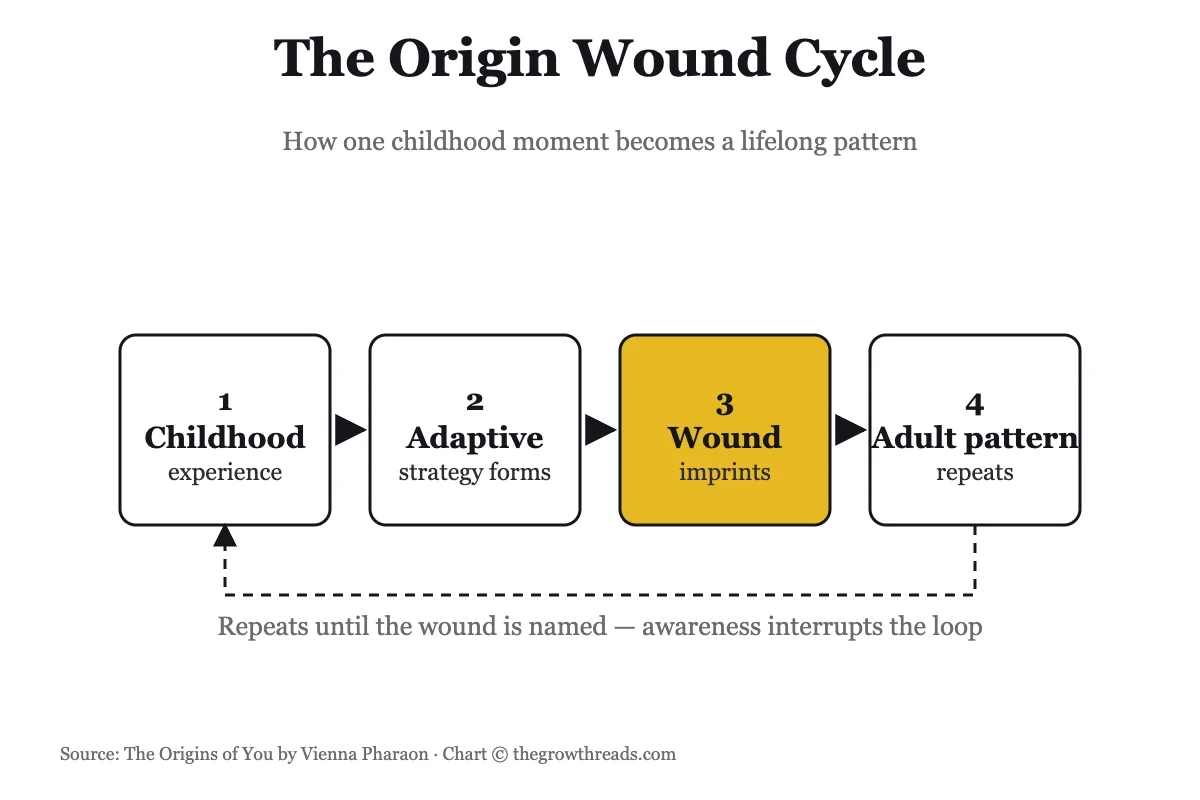
Pharaon opens with a claim that sounds obvious once stated but rarely gets applied: almost every recurring struggle in your adult relationships has a first draft, and it was written before you were old enough to consent to the plot. She calls this your family of origin — not just the people who raised you, but the whole system of spoken and unspoken rules you absorbed about love, conflict, and belonging. You didn’t choose those rules. You learned them the way you learned to walk, through repetition, long before you had language for what was happening.
The mechanism is deceptively simple. Children depend on caregivers for survival, so when a caregiver is inconsistent, distracted, or simply human and imperfect, a child doesn’t conclude “my parent is having a hard year.” A child concludes something about themselves — too much, not enough, unsafe, unseen — because that keeps the world coherent. Pharaon walks through client after client who built an adult identity around a conclusion drawn at age six.
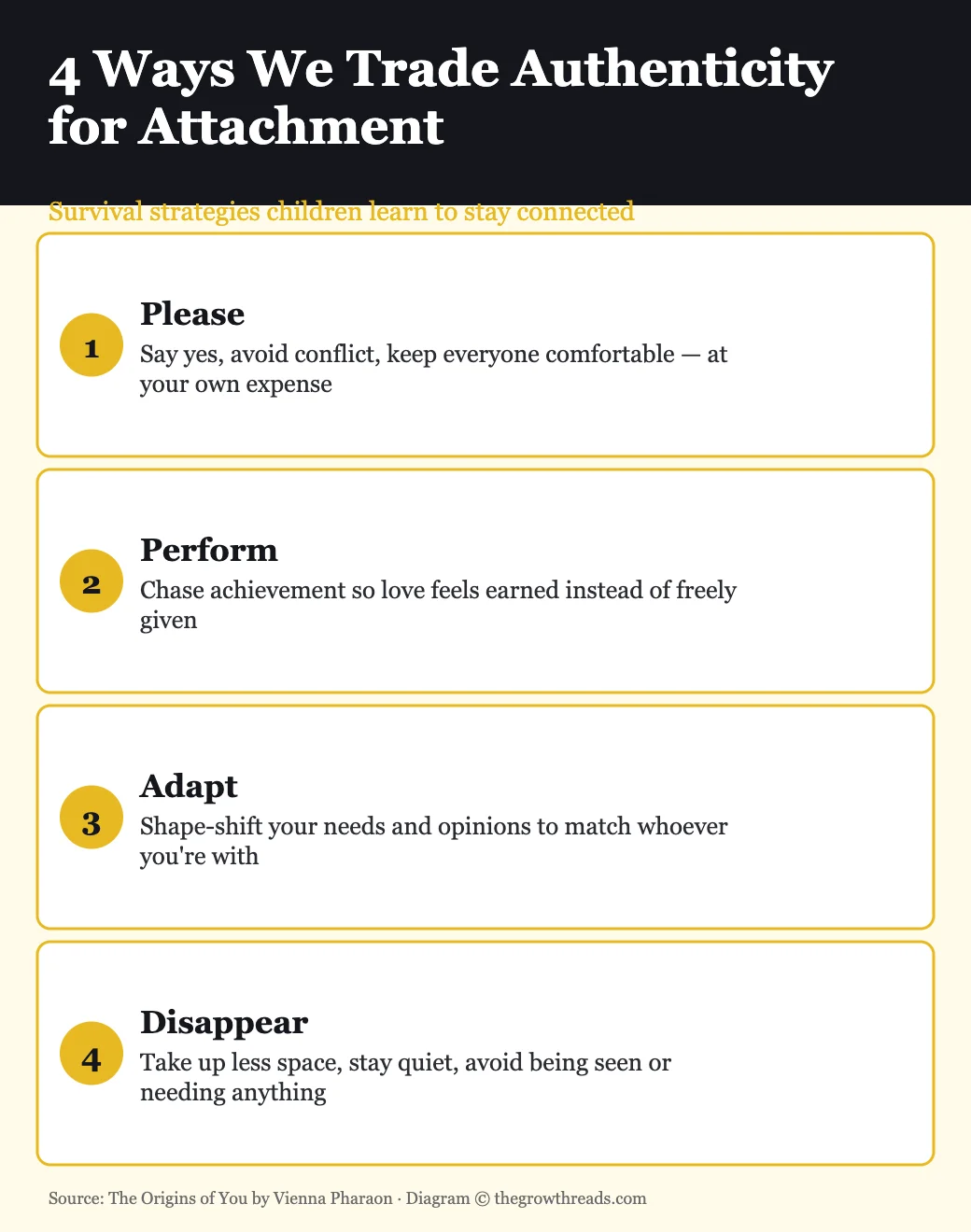
To survive that early bind, children develop what Pharaon frames as adaptive strategies: ways of showing up that protect the relationship with a caregiver, even at the cost of the child’s own authenticity. She names four of the most common — pleasing, performing, adapting, and disappearing — shown below. These strategies aren’t character flaws; they were smart, protective moves for a small person with no other options. The problem is that most adults are still running the same strategy at forty that they built at seven, in relationships where it’s no longer necessary and often working against them.
What makes this section more than a diagnosis is Pharaon’s insistence on specificity. She doesn’t ask readers to accept a vague label like “I had a hard childhood.” She asks for the scene: the exact moment, the exact sentence, the exact expression that taught you the lesson you’re still applying today. That specificity is what makes the rest of the book workable — you can’t interrupt a pattern you can only describe in general terms.
Part 2: Naming the Five Wounds
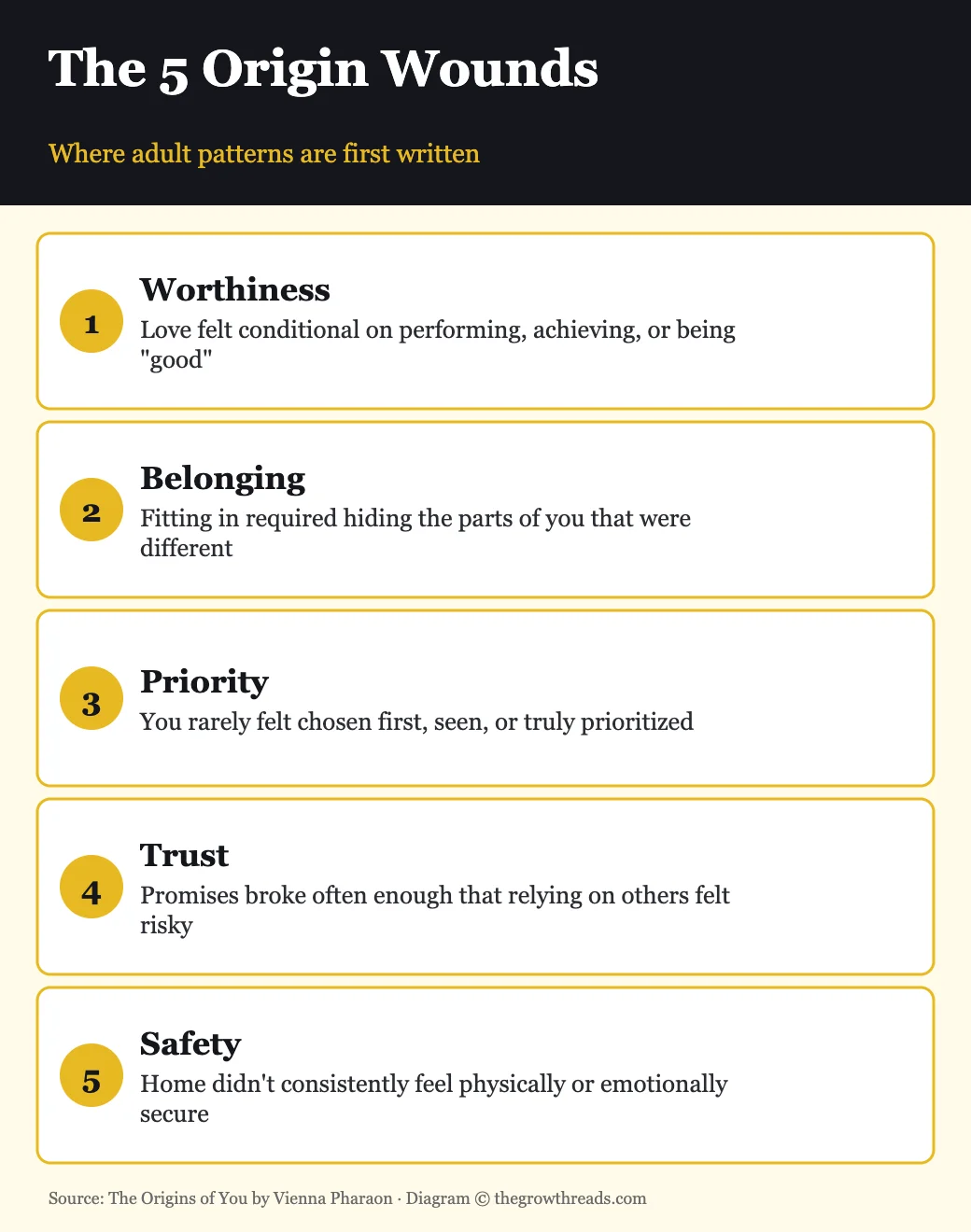
This is the section readers tend to underline the most, because it turns a fuzzy sense of “something’s off” into five specific, nameable categories. Worthiness shows up as a belief that love has to be earned through achievement or self-sacrifice. Belonging shows up as trading your real opinions and preferences for acceptance. Priority shows up as a persistent, low-grade feeling of never quite being chosen first. Trust shows up as difficulty relying on people, even ones who’ve never actually let you down. Safety shows up as a nervous system that never fully relaxes, even in objectively calm rooms.
Pharaon is careful to note that most people don’t carry just one wound — two or three overlapping wounds is typical, and they often reinforce each other. Someone with both a worthiness and a priority wound, for example, might over-give in relationships (worthiness: earning love through usefulness) while quietly resenting never being asked what they need (priority: not feeling chosen). Untangling which wound is driving a specific reaction, rather than treating every conflict as one big undifferentiated hurt, is what lets someone respond to a partner’s forgotten birthday differently than they respond to being interrupted in a meeting.
She also covers where wounds come from beyond an obvious “bad parent” narrative: birth order, a parent’s own unresolved wound passed down a generation, a sibling’s illness that pulled attention away for a season. The point isn’t to rank whose childhood was worse, but to get specific enough about your own that the pattern becomes visible and changeable.
Part 3: Changing How You Show Up
Naming a wound is necessary but not sufficient — this is where Pharaon shifts from explanation to practice. She introduces what she calls “the lens”: a way of pausing during a triggering moment to ask which wound is actually firing, before reacting to the present-day situation as if it were the whole story. A partner running fifteen minutes late isn’t inherently a crisis; it becomes one when it lands on an old priority wound that says “I don’t matter enough to be planned around.” The lens doesn’t erase the feeling, but it separates the size of the reaction from the size of the actual event.
From there, the book gets concrete about interruption: asking directly for what you need instead of hinting, testing whether a relationship can hold your real preferences, setting a boundary and staying in the discomfort of holding it. She’s honest this gets uncomfortable — the strategies that protected you as a child were often rewarded, and changing them can briefly unsettle relationships built on the old pattern before it settles into something healthier.
A recurring theme in this section is that healing an origin wound rarely happens in isolation. Pharaon builds many exercises to be practiced with the person the pattern shows up with most — a partner, a parent, a close friend — rather than only in a journal. That design choice is deliberate: a wound formed in relationship, so a new belief is most durable when it’s also tested in relationship, with real feedback instead of imagined outcomes.
Part 4: The Reclamation
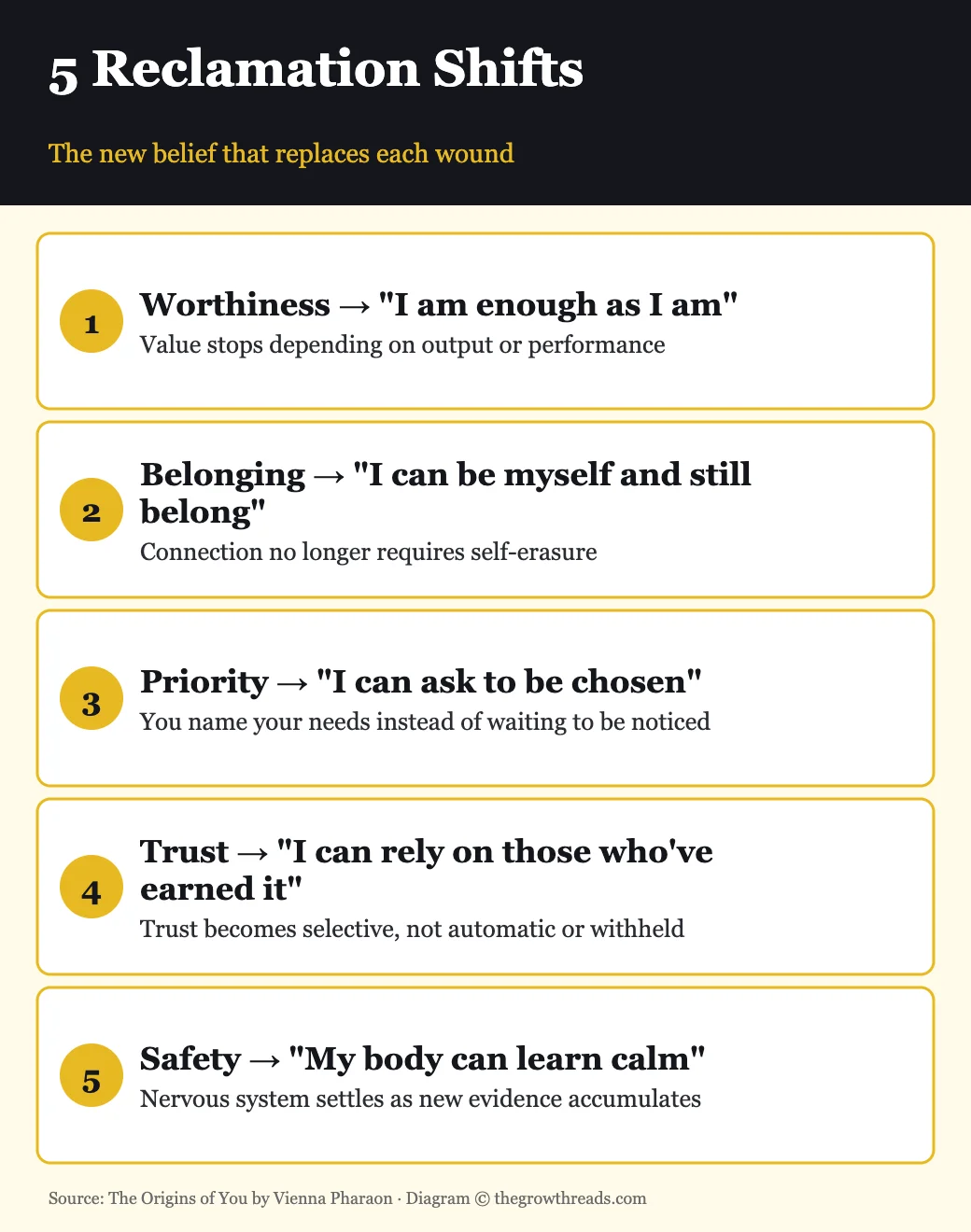
The book’s final section is about consolidating change into identity, not just behavior. Pharaon’s framework for this is the reclamation statement: a short, specific belief that replaces the old wounded conclusion, tested repeatedly until it feels as true as the original wound once did. “I am enough as I am” replaces “love must be earned.” “I can be fully myself and still belong” replaces “fitting in requires hiding.” These aren’t affirmations recited passively — Pharaon frames them as hypotheses to test against real evidence, gathered through the practices from Part 3.
She’s realistic about the timeline. A belief built over decades of repetition doesn’t dissolve after one honest conversation or one good week. Reclamation, in her framework, is closer to strength training than a light switch: small, repeated reps that gradually make the new belief feel more true than the old one, with occasional relapses into the familiar pattern that don’t erase the progress made. The chapter includes guidance for what to do when an old wound reasserts itself under stress, which she treats as expected rather than as failure.
The closing chapters widen the lens beyond the individual reader, touching on how unresolved wounds pass to the next generation through parenting, and how naming your own wound is a concrete gift to a child you’re raising. It’s a fitting bookend: the book that traces your patterns back to your parents ends by asking what you’ll choose to pass forward.
Who is The Origins of You best for — and who should read something else first?
The Origins of You is best for readers who keep repeating the same relationship pattern — the same argument, the same kind of partner, the same way of shutting down — and want to understand the why behind it, not just tips for what to say differently in the moment. It rewards people willing to look at their family history honestly, including at parents they love and don’t want to blame.
It’s less suited to readers in an acute crisis, especially anyone in a relationship involving abuse or ongoing safety concerns; that situation calls for immediate professional support, not a self-guided framework. Readers who want attachment-style language first might prefer starting with Attached, and those specifically untangling a difficult parent relationship may want Adult Children of Emotionally Immature Parents before circling back here.
Questions to reflect on
- Which of the five origin wounds — worthiness, belonging, priority, trust, safety — do you recognize most in yourself?
- What is one coping strategy (pleasing, performing, adapting, or disappearing) you still lean on today?
- Think of your most recent overreaction. What older, smaller moment might it actually be about?
- Whose voice do you hear when you doubt your own worth in a relationship?
- What would it look like to ask directly for what you need, instead of waiting to be noticed?
🔥 Ready to trace your own pattern back to its root?
Get The Origins of You and start naming the wound that’s been running the show.
How to apply The Origins of You (7-day plan)
- Day 1: Read Part 1 and write down your earliest memory of feeling unseen, unworthy, unsafe, or excluded.
- Day 2: Identify which of the five origin wounds shows up most in your closest relationship right now.
- Day 3: Track every time today you notice yourself pleasing, performing, adapting, or disappearing — just notice, don’t judge.
- Day 4: Pick one recent overreaction and trace it back to an earlier, smaller version of the same feeling.
- Day 5: Have one honest, low-stakes conversation where you name a need instead of hinting at it.
- Day 6: Write the “old belief” tied to your primary wound, then write the “new belief” you want to practice.
- Day 7: Choose one small, repeatable action that reinforces the new belief this week, and schedule when you’ll do it.
Frequently asked questions
What are the five origin wounds in The Origins of You?
Pharaon identifies five recurring wounds that form in childhood and resurface in adult relationships: worthiness (love felt conditional on performance), belonging (authenticity traded for acceptance), priority (rarely feeling chosen first), trust (promises broken often enough that reliance felt risky), and safety (home didn’t consistently feel secure). Most people recognize themselves in two or three, not just one. Naming them precisely turns vague dissatisfaction into something specific enough to actually work with.
Do I need a difficult childhood to have an origin wound?
No. Pharaon is explicit that origin wounds don’t require abuse, neglect, or an obviously “bad” family. Even loving, attentive parents are imperfect humans who occasionally misattune, and children are exquisitely sensitive to small, repeated moments. A wound can form from something as ordinary as a parent who was distracted during a stressful year, or a sibling who got more attention during a hard season. The size of the original event matters far less than how consistently it repeated and how a child made sense of it at the time.
Is this book only about romantic relationships?
No, the framework applies to any close relationship, including friendships, work dynamics, and parenting. Pharaon draws examples from client stories across all of these contexts, and several chapters specifically address how origin wounds shape parenting choices and workplace patterns like over-functioning or conflict avoidance. Romantic relationships get the most attention because they tend to activate wounds most intensely, but readers looking to understand a difficult friendship or a pattern at work will find the same five-wound framework directly useful there too.
How is this different from attachment theory books like Attached?
Attachment theory categorizes people into styles such as secure, anxious, or avoidant, based on early caregiving. The Origins of You works alongside that lens but digs one layer deeper, asking which specific wound produced the pattern you now call your attachment style. The two frameworks pair well together: Attached helps you quickly recognize your pattern, while this book helps you trace where it came from and what to do about it.
What if my parents did their best — does this book blame them?
Pharaon is careful to separate blame from cause. The book’s stance is that naming a wound honestly doesn’t require condemning the parent who was part of creating it; most parents are simply repeating patterns from their own upbringing, doing the best they could with what they had. The goal of origin work isn’t to assign fault but to stop an unconscious pattern from running your adult life on autopilot, so you can hold compassion for a parent’s limitations and still do the work of healing what those limitations left behind.
Does the book include exercises, or is it just explanation?
It’s built to be practiced, not just read. Nearly every chapter includes guided prompts and exercises, some for solo reflection and others meant to be practiced with a partner, friend, or family member. Pharaon frames origin work as something you do repeatedly in real moments, not a single insight you check off. Readers who skip the exercises will still get value from the ideas, but the book’s real design is closer to a workbook than a memoir.
Is The Origins of You backed by research, or is it mainly anecdotal?
The book blends family-systems therapy and psychodynamic theory with two decades of Pharaon’s own clinical case material, rather than presenting itself as a data-heavy academic text. Some readers have noted the framework leans more on client anecdotes than citations to formal studies, a fair distinction if you prefer research-first books. That said, the underlying idea that early attachment ruptures shape adult relational patterns is well established across attachment and family-systems research; Pharaon’s contribution is a practical, five-wound framework for applying that research to your own life.
Related summaries
- Attached — the attachment styles this book’s wounds trace back to
- Adult Children of Emotionally Immature Parents — a deeper look at one specific family pattern
- Getting the Love You Want — the same family-of-origin lens applied to marriage
- Boundaries — practical language for the direct-ask practice in Part 3
- See all best relationship books on The Growth Reads