

★★★★☆ (4.5/5) — a genuinely paradigm-shifting read for anyone let down by siloed explanations of mental illness.
Best for: Anyone managing depression, anxiety, or treatment-resistant mental illness who wants a science-grounded, hopeful new lens — and clinicians curious about metabolic psychiatry.
Reading time: ~7 hrs for the full book · 12 min for this guide
Difficulty to apply: Moderate — the theory is simple, but some interventions (especially therapeutic ketogenic diets) need clinical supervision.
This summary is educational and isn’t a substitute for professional medical or psychiatric advice. If you’re managing a mental health condition, work with a qualified clinician before changing treatment or diet.
Brain Energy in one minute
What if depression, anxiety, bipolar disorder, and even schizophrenia aren’t separate diseases — but different expressions of the same underlying problem: a brain that can’t produce or regulate energy properly? That’s the claim at the center of Brain Energy. Harvard psychiatrist Christopher Palmer spent 25+ years treating patients whom standard psychiatry couldn’t fully help, and grew convinced that genetic, chemical-imbalance, trauma, and social theories of mental illness were each capturing a piece of a bigger picture. His unifying answer is metabolism: specifically, the health of mitochondria, the cell structures that generate and regulate a neuron’s energy supply. When mitochondrial function breaks down, Palmer argues, the downstream effects show up as psychiatric symptoms — and metabolic interventions, from diet to sleep to exercise, become legitimate tools for treatment, not just “healthy lifestyle” advice on the side.
Key takeaways
- One theory, not eight: genetics, inflammation, stress, hormones, sleep, and other risk factors don’t compete to explain mental illness — Palmer argues they converge on a single mechanism: mitochondrial dysfunction.
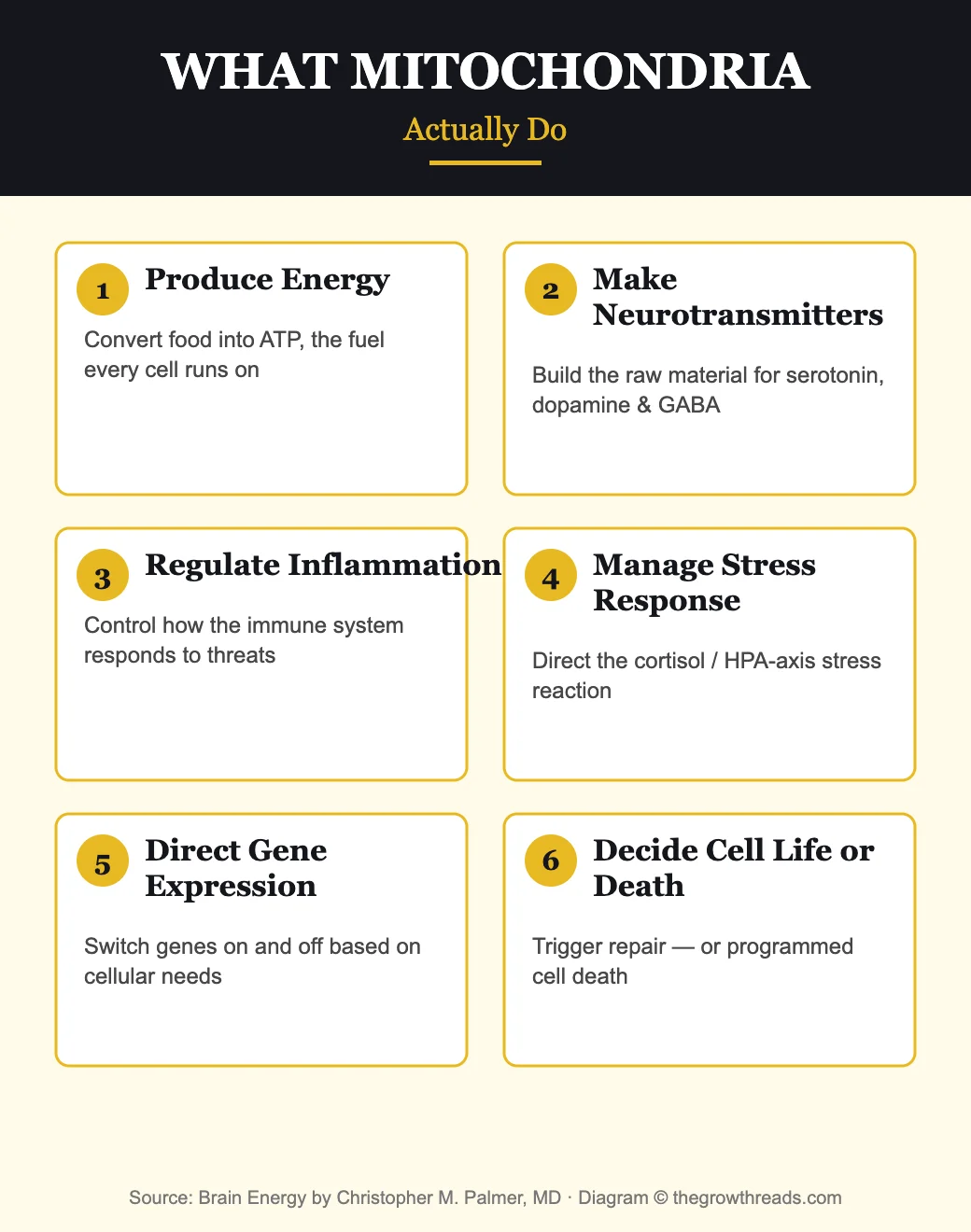
- Mitochondria do more than make energy: they build neurotransmitters, regulate inflammation, manage the stress response, direct gene expression, and decide whether a damaged cell repairs itself or dies.
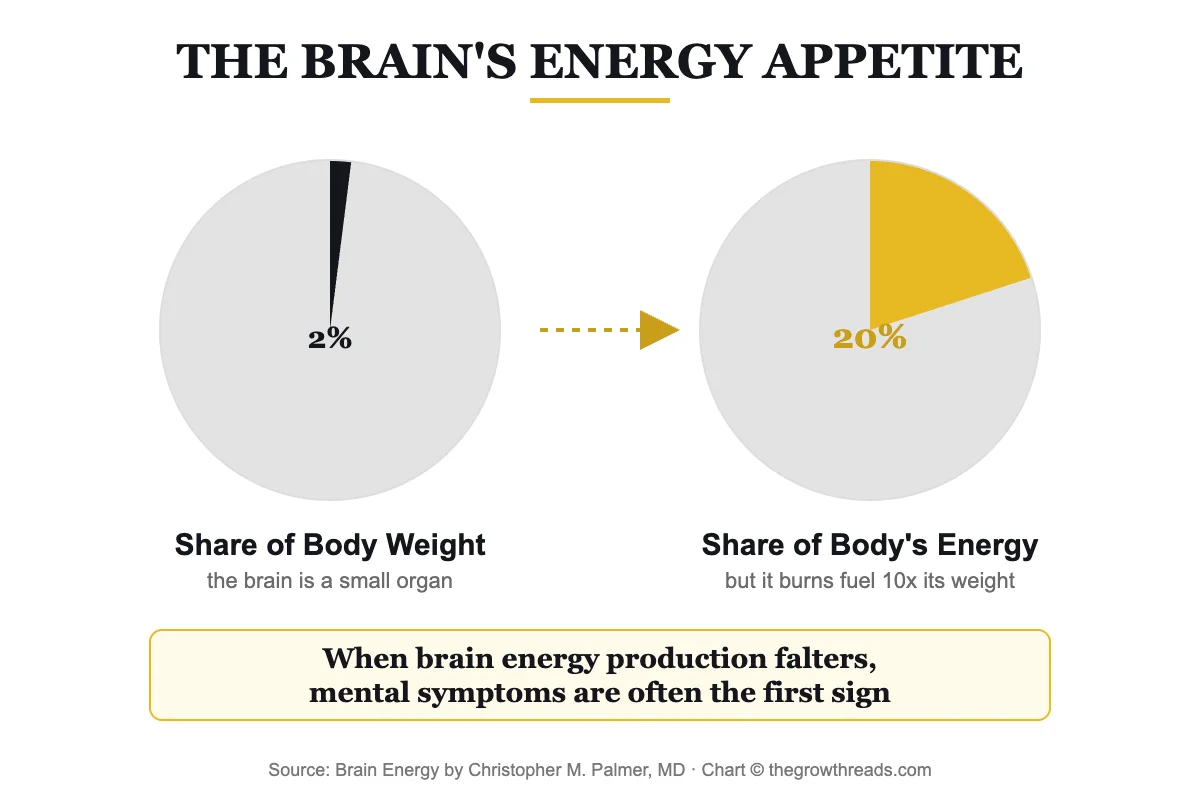
- The brain is metabolically expensive: at roughly 2% of body weight it consumes about 20% of the body’s total energy, making it unusually sensitive to any disruption in fuel supply.
- Metabolic and mental illness travel together: people with schizophrenia, bipolar disorder, and depression have far higher rates of obesity, diabetes, and metabolic syndrome — and the relationship runs in both directions.
- Existing treatments may already work this way: lithium, antipsychotics, antidepressants, and even ECT have measurable effects on mitochondrial function, which may explain part of why they help.
- The ketogenic diet has decades of psychiatric precedent: it has treated drug-resistant epilepsy since the 1920s by directly changing how brain cells generate energy.
- Kim’s case is the book’s turning point: a patient with 20 years of treatment-resistant schizoaffective disorder and severe obesity stabilized dramatically after starting a medically supervised ketogenic diet.
- Sleep, exercise, and stress aren’t “soft” advice: they’re direct levers on mitochondrial health, with mechanisms as real as any medication.
- This isn’t a replacement for treatment: Palmer frames metabolic strategies as additions to, not substitutes for, standard psychiatric care.
What is Brain Energy about?
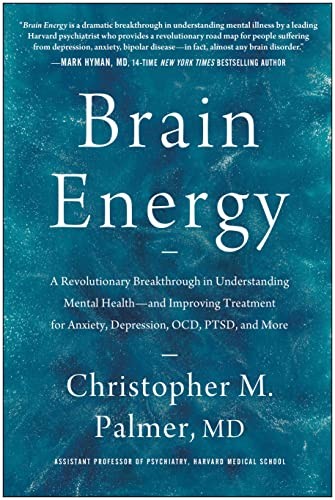
Brain Energy is Harvard psychiatrist Christopher Palmer’s argument that depression, anxiety, bipolar disorder, and other mental illnesses share a common root: impaired energy metabolism in brain cells. Drawing on mitochondrial biology, Palmer proposes a unifying framework for mental illness and outlines metabolic interventions — from diet to sleep — that support recovery alongside standard treatment.
About the author
Christopher M. Palmer, MD is a Harvard psychiatrist who has spent more than 25 years treating patients with severe, often treatment-resistant mental illness. He is Director of the Department of Postgraduate and Continuing Education at McLean Hospital and an Assistant Professor of Psychiatry at Harvard Medical School, where he has also spent over a decade researching the biology of psychiatric disorders. Explore all Christopher M. Palmer, MD book summaries →
Palmer’s interest in metabolism began after a patient with treatment-resistant schizoaffective disorder improved dramatically on a ketogenic diet prescribed for weight loss — not her psychiatric symptoms. That case, combined with his own history of mental illness and a personal metabolic diagnosis, sent him deep into the neuroscience of mitochondria. In 2022 he published Brain Energy, distilling years of research into a single unifying theory of mental illness.
Key concepts at a glance
| Concept | What it means | Use it when |
|---|---|---|
| Metabolic theory of mental illness | Most mental disorders share a root cause: impaired brain energy metabolism | Framing your symptoms within a bigger, more hopeful picture |
| Mitochondria | Cell structures that produce energy and regulate inflammation, neurotransmitters, and stress response | Understanding why “chemical imbalance” was never the whole story |
| Metabolic flexibility | The body’s ability to switch efficiently between burning glucose and fat for fuel | Explaining why diet and fasting can affect mood and cognition |
| Medical ketogenic diet | A high-fat, very-low-carb diet that shifts brain fuel from glucose to ketones | Considering diet-based options for treatment-resistant symptoms, under medical supervision |
| HPA axis | The hypothalamus-pituitary-adrenal system that governs the body’s stress response | Understanding how chronic stress drains metabolic resources |
| Neuroinflammation | Low-grade inflammation in brain tissue linked to depression, psychosis, and cognitive decline | Connecting physical health markers to mental health symptoms |
| Insulin resistance | Reduced cellular sensitivity to insulin, common in both diabetes and several mental illnesses | Recognizing the overlap between metabolic and psychiatric risk |
| Circadian rhythm | The body’s internal 24-hour clock that regulates sleep, hormones, and metabolism | Prioritizing consistent sleep and light exposure as treatment |
Part 1: The Trouble With How We Explain Mental Illness
Palmer opens by walking through the major schools of thought in psychiatry: the chemical-imbalance theory that dominated pop culture for decades, genetic explanations, psychological and trauma-based models, and social or environmental accounts. Each has real evidence behind it. Each also falls short on its own — genetics alone can’t explain why identical twins are sometimes discordant for schizophrenia, and “low serotonin” never accounted for why antidepressants take weeks to work or fail in a third of patients.
As a clinician, Palmer found this fragmentation practically frustrating: patients wanted to know why, and the honest answer was usually “some combination of factors we don’t fully understand.” That gap is where Brain Energy starts — not by discarding existing research, but by asking whether there’s a deeper mechanism that could explain why so many different risk factors all lead to the same handful of psychiatric syndromes.
TGR Note: This is the same fragmentation problem Bessel van der Kolk tackles from the trauma side in The Body Keeps the Score — both books argue that talk therapy and medication alone often miss something the body is holding onto. Palmer’s metabolic lens and van der Kolk’s trauma lens aren’t competitors; read together, they cover more of the picture than either does alone.
Part 2: The Metabolic Theory — Mitochondria as the Missing Link
The core of the book reframes mitochondria. Most people learn them as “the powerhouse of the cell” and stop there. Palmer builds the case that mitochondria are actually cellular command centers: they synthesize the building blocks for neurotransmitters like serotonin and dopamine, help regulate inflammation, manage the stress response via the HPA axis, direct which genes get switched on or off, and ultimately decide whether a damaged cell repairs itself or self-destructs.
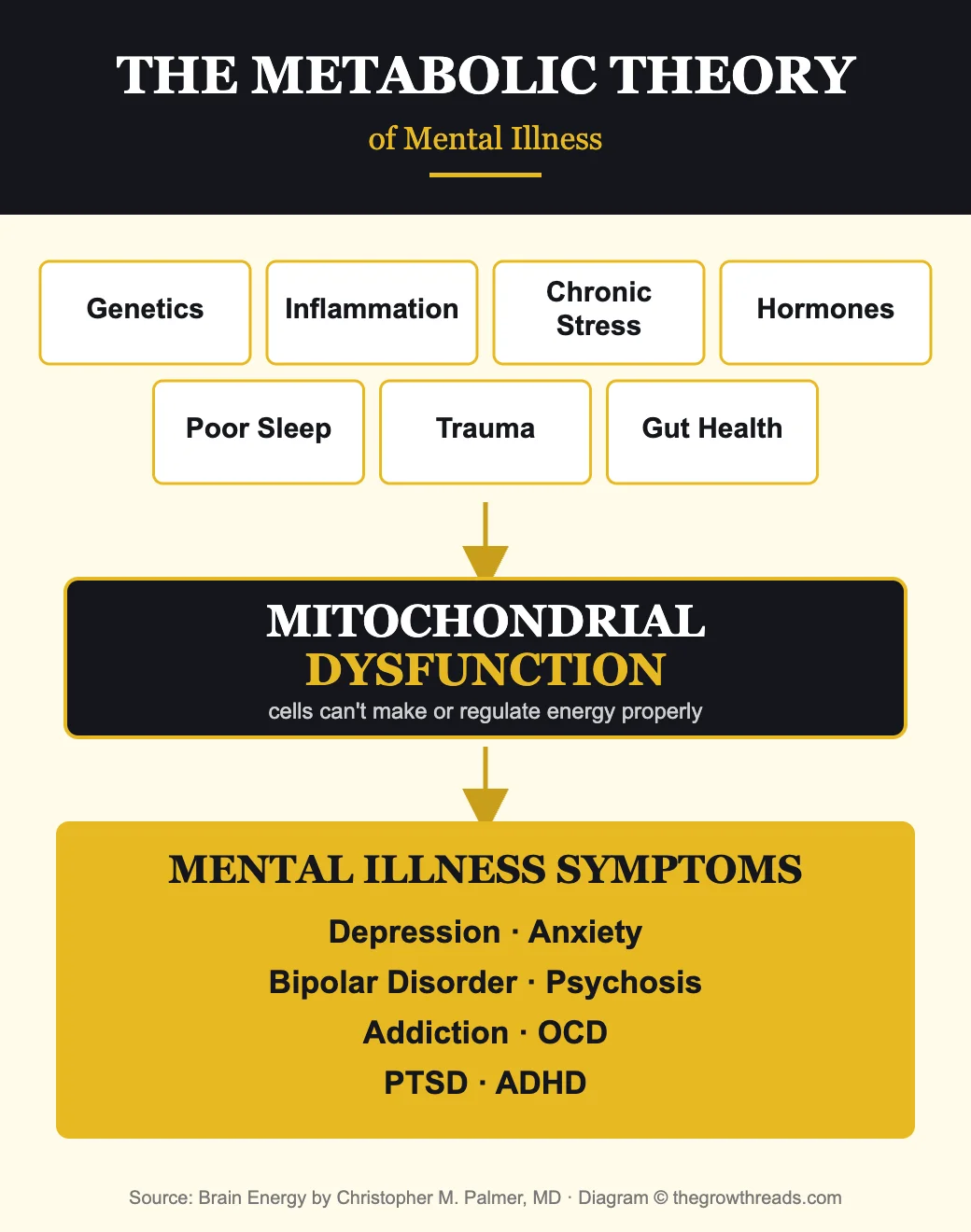
That expanded job description is what lets one framework absorb so many existing risk factors. Genetics can predispose someone to weaker mitochondria. Chronic stress burns through metabolic reserves. Poor sleep disrupts the brain’s overnight energy-clearing process. Inflammation and gut health interact with mitochondrial function directly. None of these factors is “wrong” — they’re just different roads that can lead to the same destination: a brain that can’t reliably produce or regulate the energy it needs.
TGR Note: This also reframes reward and motivation. In Dopamine Nation, Anna Lembke explains compulsive behavior through the brain’s pleasure-pain balance — a system that, per Palmer’s framework, is itself downstream of how much usable energy the brain has on hand to regulate itself.
Part 3: The Evidence — From Epilepsy Wards to Kim’s Recovery
Palmer builds his case on two pillars of evidence. The first is historical: the ketogenic diet has been a mainstream medical treatment for drug-resistant epilepsy since the 1920s, and its mechanism — shifting brain cells from burning glucose to burning ketones — is a direct, well-documented change to brain energy metabolism. If diet can control electrical activity in the brain that severely, Palmer asks, why wouldn’t it also influence the metabolic processes underlying psychiatric symptoms?
The second pillar is clinical: Palmer’s own patient, given the pseudonym “Kim,” had lived with treatment-resistant schizoaffective disorder and severe obesity for two decades, cycling through nearly every medication and therapy available with little lasting improvement. When Palmer put her on a medically supervised ketogenic diet — initially targeting her weight, not her psychiatric symptoms — her auditory hallucinations and mood stability improved dramatically within weeks, results that held up over years of follow-up. Palmer is careful to frame this as one compelling case rather than proof, and the book surveys a growing (if still early-stage) body of research applying metabolic interventions to bipolar disorder, depression, and schizophrenia.
TGR Note: Peter Attia covers the same metabolic territory from a longevity angle in Outlive, where insulin resistance and metabolic dysfunction show up as drivers of heart disease and cancer risk decades before diagnosis. Palmer’s book is essentially the psychiatric half of that same story.
Part 4: What To Do About It
The book’s final section turns practical. Palmer is explicit that metabolic strategies are meant to sit alongside standard psychiatric treatment, not replace it — and that some interventions, especially therapeutic ketogenic diets, should be undertaken with medical supervision, particularly for anyone on medication that affects blood sugar or electrolytes. With that caveat in place, he lays out eight everyday levers that support mitochondrial and metabolic health.
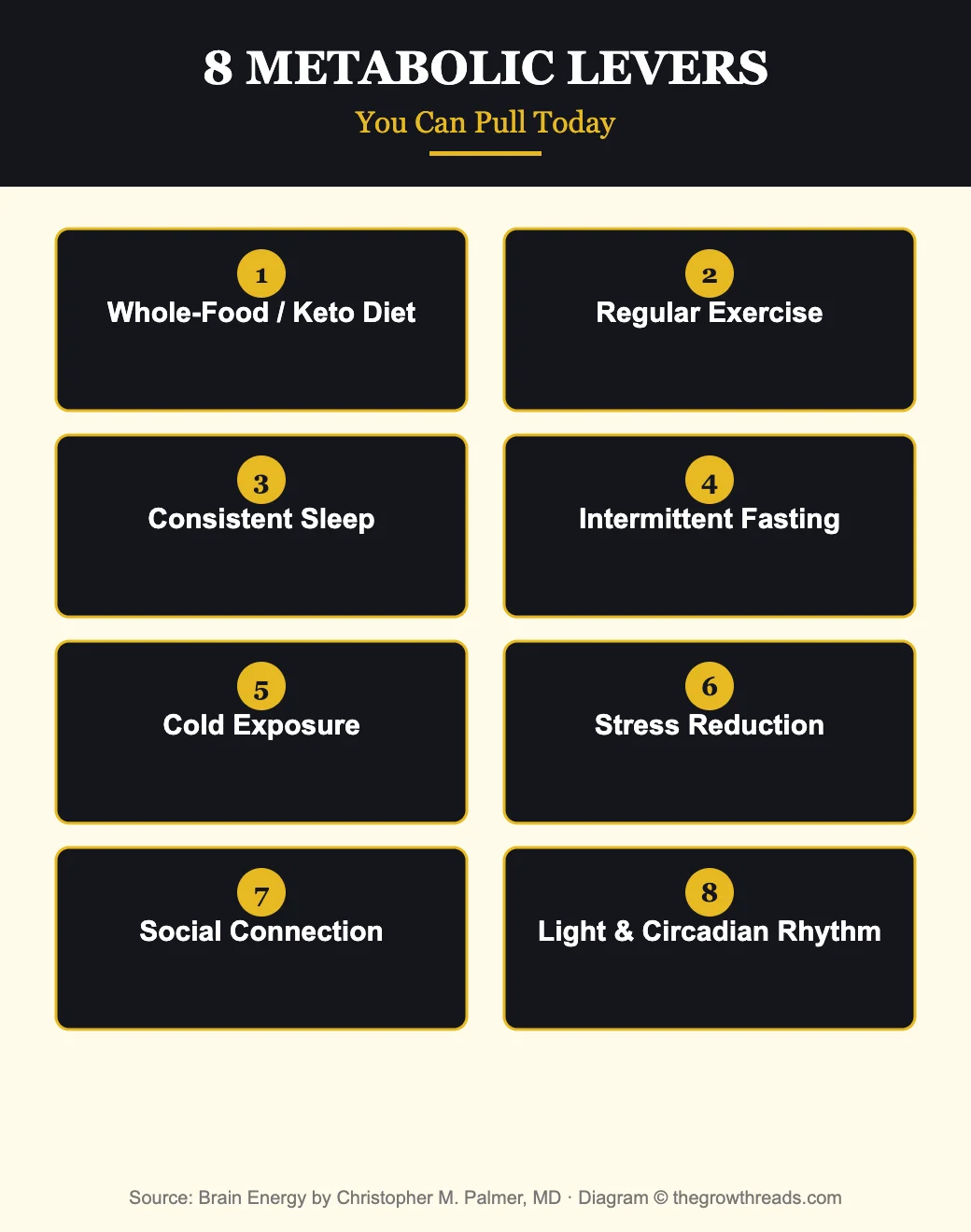
None of these are novel wellness advice on their own — what’s different is Palmer’s claim that they work through a specific, biologically plausible mechanism: they change how efficiently your cells produce and use energy. That reframing is arguably the book’s most useful contribution for a general reader, because it turns “eat better, sleep more, move your body” from vague self-help into a targeted set of interventions with a testable rationale.
TGR Note: John Ratey makes the exercise case in exhaustive detail in Spark, showing how movement directly builds new mitochondria in brain cells — one of the clearest mechanistic overlaps between the two books.
Who is Brain Energy best for — and who should read something else first?
Brain Energy is best for readers who have felt unsatisfied by a single explanation for their mental health struggles — “it’s genetic,” “it’s chemical,” “it’s just stress” — and want a framework that connects the dots. It’s also valuable for anyone supporting a family member through treatment-resistant mental illness, and for clinicians curious about metabolic psychiatry as an emerging field.
If your primary interest is trauma and its physical imprint on the body, start with The Body Keeps the Score instead. If you want the sleep-science deep dive that underpins one of Palmer’s eight levers, Why We Sleep is the better starting point. And if you’re earlier in a diagnosis and want practical day-to-day coping tools before tackling a theory-heavy book, a workbook-style resource may serve you better first.
Questions to reflect on
- Which of the eight metabolic factors (sleep, diet, exercise, stress, substance use, relationships, purpose, circadian rhythm) is currently the weakest link in your own life?
- Has a doctor ever looked at your metabolic health (blood sugar, inflammation markers, weight) alongside your mental health? What might that conversation surface?
- Where have you been given a single explanation for a mental health struggle that, in hindsight, was probably only part of the story?
- If small, consistent changes to sleep or movement really do change brain chemistry, what’s the smallest change you could sustain for 30 days?
- Who in your life — or which professional — would you want on your team before making any significant change to treatment or diet?
🔥 Ready to rethink mental health from the ground up?
Get the full case, the case studies, and Palmer’s complete treatment framework.
How to apply Brain Energy (7-day plan)
- Day 1 — Baseline check: Write down your current sleep schedule, typical meals, exercise frequency, and stress level. You can’t track change without a starting point.
- Day 2 — Fix your light exposure: Get 10 minutes of natural light within an hour of waking, and dim screens/bright lights for the hour before bed.
- Day 3 — Audit your blood sugar swings: Notice which meals leave you crashing an hour later. Swap one refined-carb meal for one built around protein, fat, and fiber.
- Day 4 — Add one movement session: A 20–30 minute walk or workout — Palmer’s research ties even moderate exercise to measurable mitochondrial benefits.
- Day 5 — Protect a full night’s sleep: Set a consistent bedtime and wake time, even on a day off. Consistency matters more than total hours.
- Day 6 — Do one stress-reduction practice: Ten minutes of breathwork, a walk outside, or time with a supportive person — anything that measurably lowers your stress in the moment.
- Day 7 — Review and decide on one professional step: Based on the week, identify one thing worth raising with a doctor or therapist — a lab test, a medication question, or a referral.
Frequently asked questions
What is the main idea of Brain Energy by Christopher Palmer?
The book argues that most mental illnesses — including depression, anxiety, bipolar disorder, and schizophrenia — share a common root cause: impaired energy metabolism in brain cells, particularly dysfunction in mitochondria. Palmer proposes this as a unifying framework that connects genetic, inflammatory, hormonal, and lifestyle risk factors, and argues it opens up new metabolic treatment options alongside standard psychiatric care.
Is the metabolic theory of mental illness scientifically accepted?
It’s an emerging framework, not yet mainstream consensus. The individual pieces — mitochondrial biology, the ketogenic diet’s effects on epilepsy, and the overlap between metabolic and psychiatric disorders — are well established in the research literature. Palmer’s contribution is synthesizing them into one theory, which is still being tested through ongoing clinical trials, particularly for the ketogenic diet in bipolar disorder and schizophrenia.
Does Brain Energy recommend the ketogenic diet for everyone?
No. Palmer presents the ketogenic diet as one option among several metabolic interventions, and stresses that it should be undertaken with medical supervision — especially for anyone on psychiatric medication that affects blood sugar, electrolytes, or weight. The book’s broader message is about supporting metabolic health generally, through sleep, exercise, and stress reduction as well as diet.
Who is Kim in Brain Energy?
Kim is a pseudonym for one of Palmer’s patients, who lived with treatment-resistant schizoaffective disorder and severe obesity for roughly two decades. After starting a medically supervised ketogenic diet aimed at her weight, she experienced a significant and lasting reduction in psychiatric symptoms. Her case is the clinical anecdote that first drove Palmer toward the metabolic theory.
How is Brain Energy different from the “chemical imbalance” theory of depression?
The chemical-imbalance theory focused narrowly on neurotransmitter levels, like serotonin, as the cause of depression — a framework that’s since been widely questioned for being incomplete. Palmer’s theory goes a level deeper: it argues that neurotransmitter production itself depends on mitochondrial energy, and that a wide range of other factors (inflammation, stress, sleep, hormones) all converge on that same energy system.
Does Brain Energy replace medication or therapy?
No — Palmer is explicit that metabolic strategies are meant to complement, not replace, standard psychiatric treatment. He also notes that many existing medications likely work partly through metabolic and mitochondrial mechanisms, so the theory reframes current treatments rather than dismissing them.
Is Brain Energy a good starting point if I’ve never read about mental health science before?
Yes, with one caveat. Palmer writes for a general audience and explains mitochondrial biology from the ground up, so no scientific background is required. The caveat is emotional: some sections cover severe, treatment-resistant cases in detail, which may feel heavy if you’re currently in crisis — in that case, pair the book with support from a clinician rather than reading it in isolation.
Related summaries
- The Body Keeps the Score Summary & Review
- Dopamine Nation Summary & Review
- Why We Sleep Summary & Review
- Outlive Summary & Review
- See all Best Health Books →
How we analyze books: every TGR summary is built from a full read of the source material, cross-referenced against the author’s published interviews and research where relevant, then structured around one goal — helping you actually apply the ideas, not just recall them. Read our full methodology.